Home Blog Page 1281

Paige Spiranac Joins SportsGrid for Exclusive Sports and Casino-Themed Shows

0

Barrett Media produces daily content on the music, news, and sports media industries. To stay updated, sign up for our newsletters and get the latest information delivered straight to your inbox.

SportsGrid has announced a multi-year partnership with former professional golfer and social media’s most followed golf personality Paige Spiranac. Under the agreement, Spiranac will lead exclusive original casino-themed programming.   

According to the network, Spiranac will team with EVP of Programming and Development, Scott Lasky, and “headline a series of shows featuring engaging sports and casino content, offering fans a mix of strategy, insight, and entertainment.”

“We are thrilled to welcome Paige Spiranac to the SportsGrid family,” said Jeremy Stein Co-Founder and CEO of SportsGrid in a release. “Her dynamic personality, love for gaming, and connection with sports fans perfectly align with our mission to deliver unique and captivating content. Paige’s presence in our casino programming is a game-changer, and we look forward to seeing her elevate our viewers’ experience as we pioneer this new category.”

“I’m thrilled to join SportsGrid and dive into the world of sports gaming with a network that’s truly pushing boundaries in sports and casino entertainment,” said Spiranac. “Creating unique, interactive content for fans who share my passion for gaming is something I’m incredibly excited about. Together with SportsGrid, I look forward to bringing a fresh perspective and delivering the fun, engaging experiences that fans expect and deserve.”

Joe Rogan: Elon Musk Reached Out to Spotify CEO Daniel Ek Personally to Get Conversation With Donald Trump Published on X

0

Barrett Media produces daily content on the music, news, and sports media industries. To stay updated, sign up for our newsletters and get the latest information delivered straight to your inbox.

After initially claiming there were no concerns about his interview with Donald Trump on YouTube, Joe Rogan reversed course and said there were problems. That led to Elon Musk and Spotify CEO Daniel Ek getting involved.

Rogan assured observers that there was no funny business after his own producers originally removed the episode with Trump last week to ensure it was published on both Spotify and YouTube at the same time.

However, users noticed that the episode was difficult to find on YouTube. The conversation between Joe Rogan and Donald Trump was ultimately published in its entirety on the X social media platform, which Elon Musk owns.

Joe Rogan revealed that Musk personally reached out to Spotify CEO Daniel Ek to get permission for the episode to be published on the social media app, ensuring it was seen by as many viewers as possible.

“If you Google’d ‘Rogan Trump’ you could only get clips, you couldn’t find the full episode,” said Rogan. “We reached out to them, and they fixed it. But in the meantime, Elon was furious and contacted Daniel Ek at Spotify and they put it on X as well.”

Rogan then shared his displeasure with the situation, saying it’s the latest in a long line of censorship concerns.

“You can’t suppress (expletive). It doesn’t work. This is the internet. This is 2024. People are going to realize what you’re doing,” said Rogan. “If (my video with Trump) isn’t trending, you tell me what the (expletive) is. If one show has 36 million downloads in two days, that’s not trending?”

Joe Rogan concluded by adding that it isn’t possible, in his opinion, that the episode failing to come up under certain search terms was a coincidence.

“There’s no way this was a mistake. That’s too convenient,” he shared. “It could have been a rogue engineer. There’s a lot of people working behind the scenes.”

The Big 550 KTRS Midday Host Wendy Wiese Announces Retirement

0

Barrett Media produces daily content on the music, news, and sports media industries. To stay updated, sign up for our newsletters and get the latest information delivered straight to your inbox.

After 40 years in the news/talk format, Wendy Wiese has announced she’s retiring from The Big 550 KTRS in St. Louis.

Wiese will depart The Wendy & Frank Show — which she co-hosts alongside Frank Cusumano — from 10 AM-Noon at the end of the week.

“I’ve been doing this for over 40 years and the timing just seemed right,” Wendy Wiese told The St. Louis Post-Dispatch.

Wiese spent a decade at KMOX in St. Louis before moving to The Big 550 KTRS in 1996 with co-host Bill Wilkerson. After 10 years, she departed to join a Catholic radio network before returning to KTRS in 2018.

Wendy Wiese and Frank Cusumano had only been paired together since August. Wiese had previously worked alongside Jennifer Blome in the daypart.

After her retirement, Cusumano will remain in the 10 AM-Noon window. He’ll now be joined by Jill Farmer on the St. Louis news/talk station.

For Wendy Wiese, the Missouri Broadcasters Association Hall of Famer said she is excited to embark on her after-radio life, but says there are certainly aspects she’ll miss.

“I’ll miss the listeners most,” Wiese said. “I was taught early on to respect someone who in the rush and crush of their lives, seeks out your company in real time. It’s special.”

Jemele Hill’s Talent and Guts Help truTV’s ‘Above The Fold’ Stand Out

0

Barrett Media produces daily content on the music, news, and sports media industries. To stay updated, sign up for our newsletters and get the latest information delivered straight to your inbox.

Jemele Hill is like no other sports personality, and it really comes down to one word: authenticity. She says what she feels regardless of whether it costs her money, popularity, jobs, or recognition. Hill is one of the few sports media personalities who has consistently chosen integrity over dollars. She stands up for what she believes and, if you check out her social media platforms, she does not do this meekly.

Hill uses whatever form or format to offer real talk. Agreement does not have to be given, but attention must be paid. We now live in a world where disagreement often becomes synonymous with disenfranchisement. Jemele Hill does not live in that world.

Her opinions are fraught with intelligence, thought, and conviction. Hill rubs a lot of people the wrong way. Good, that means she’s doing something right. Truthfully, it’s refreshing to hear a voice that is comfortable with standing alone – not in need of sycophantic followers, nodding their heads and kowtowing to every syllable uttered.

Hill’s latest program is Above the Fold with Jemele Hill on truTV. I checked out the premiere episode and was not disappointed. The show opened with Hill providing a tongue-in-cheek look at the Dodgers versus Yankees World Series. She sarcastically stated that these two teams with small payrolls, no history of success, and no superstar players should be admired for making it to the World Series.

Hill went off on the mercenary aspects of these rich franchises wondering how they somehow manage to get by with payrolls that exceed $300 million. She ended the vitriolic soliloquy saying, “And yes, this message has been brought to you by a hater.”

This is the essence of Hill. Most people on television are afraid of someone else calling them a hater, Hill playfully used the term on herself. Hill is spellbinding as an orator. She is a student of the written word and effectively translates her crisp writing into verbal prose. Her inflection and tone bring her words to life in an extremely descriptive manner.

Hill again ventured into controversial territory talking about the ruptured Achilles injury to Browns’ quarterback Deshaun Watson. She boldly stated that many of those Cleveland fans who cheered when Watson got hurt are the same people who ignored the multiple sexual assault charges against Watson and were thrilled when the Browns signed him to a fully guaranteed $230 million contract.

There has been a lot of talk about Watson’s poor play and injuries, but few commentators have had the stones to bring it back to the sexual assault charges, which have seemingly disappeared from the discourse. Hill boldly stated, “Watson is easily the worst acquisition any NFL team has ever made in NFL history.”

She also bemoaned the fact that many of Watson’s fellow players insulted fans for cheering his injury but have never called out their peers who harm women. These are vital words.

Above the Fold’s opening Headlines segment has Hill jumping from issue to issue, but it wasn’t mere fodder. Each one of her subjects and accompanying analysis had depth and gravitas.

After the Headlines segment, Hill Registered a great interview with hoops pioneer and current USC women’s basketball coach Lindsay Gottlieb. The pair talked about Trojan expectations and superstar JuJu Watkins. One of the great things about Hill, the interviewer, is that there is no time clock on quality. She lets her guest speak and finish a thought, and actually listens to the answers given.

Hill has no impulsive need to hear her own voice. Her questions are to the point and concise. She is a skilled conversationalist and leads her interview subjects down the road toward informative and provocative responses. Being straight up honest, I knew nothing about Lindsey Gottlieb before this relatively lengthy interview. I left the segment educated, informed, and impressed with her résumé and eloquence.

Later in the program, Hill was joined in a roundtable discussion by LA Times Lakers beat writer Dan Woike and Spectrum News 1 host/anchor Kelvin Washington. Let’s start with the fact that these are two guys I have not seen before on television. We call that refreshing – not the same old talking heads we see on show after show, network after network. New blood is good blood.

I will slightly lament the fact that Hill, Woike, and Washington spent far too much time discussing the Los Angeles Lakers, a team that warrants little attention outside of Anthony Davis, LeBron James, and his son Bronny. Interestingly enough, neither Woike nor Washington felt that the Boston Celtics would be able to repeat as NBA Champions, mainly because of the number of talented teams in the league right now.

Hill then moved the discussion to the 2024 World Series saying that it is a dream matchup, especially for television executives. Woike and Washington were not flashy on the program, but you can see that they follow sports on a regular basis and have been on the beat, inside locker rooms, and interviewing players.

They are working media in the truest sense of the phrase. They may not get their own show anytime soon, but they certainly offered an informative back-and-forth with Hill.

I absolutely loved the next topic covered, the fact that FOX game analyst Tom Brady is forbidden to watch an opposing team’s practice, enter a team facility, or critique officials and players now that he is a part owner of the Las Vegas Raiders.

Hill asked Woike and Washington if Brady’s media career is now a big “nothing burger.” Her guests chimed in, but not nearly powerfully enough. The truth is that Brady should quit the FOX gig immediately. His objectivity and depth of analysis have now been compromised. I applaud Hill for bringing this topic up on Above the Fold.

In the final few minutes of the show, Hill read and showed graphics of viewer social media questions and offered her retorts. She closed the program with One Last Thing, talking about the rise in popularity of the WNBA. In a twist, Hill actually assigned a homework list for media and fans to truly enjoy and respect the league beyond just last year’s rookies Caitlin Clark and Angel Reese.

I could easily say that Above the Fold with Jemele Hill is a mélange of some really good television shows. There is a dash of ESPN’s First Take with her unbridled commentary, a hint of HBO’s now defunct award-winning Real Sports with her in-depth, long form interviews, and even a sprinkle of NBC’s Late Night with Seth Meyers with her Headlines segment.

These comparisons, however, are somewhat of an injustice to the originality and individuality of Hill. Because of her talent and guts, Above the Fold stands alone. The program contains everything that is good about sports television while eschewing the hackneyed and trite aspects of the genre. I’m pleased that Hill has this new vehicle to drive. Her excellence as a reporter, commentator, and advocate merit the forum.

Meet The Leaders: Brian Phillips, Cumulus Media

Barrett Media produces daily content on the music, news, and sports media industries. To stay updated, sign up for our newsletters and get the latest information delivered straight to your inbox.

When it comes to influential programming minds, Cumulus is not lacking. If you’re a Barrett Sports Media lifer, you no doubt know about Bruce Gilbert’s accomplishments, but maybe you’re less familiar with Brian Phillips.

Phillips has programmed his share of legendary stations. He has also helped usher revolution into country music, during his time programming CMT. Now, he is the Chief Content Officer for Cumulus.

In today’s conversation for the Meet The Leaders series presented by Point-to-Point Marketing, Brian and I discuss what innovations in our industry have actually made things better. We also talk about why Phillips wants to have a direct line to his company’s top talent and much more.

Demetri Ravanos: In what ways is programing a music station, regardless of format, like programing a music television channel like you did with CMT?

Brian Phillips: Well, you have to remember the span of years over which I’ve programed music radio stations and then my interval with the MTV Networks (CMT’s parent company). When I came back to radio, it had changed dramatically.

I would say that I walked into television feeling reasonably confident that it might bear some resemblance to radio, but really it was kind of upside-down land. Thanks to MTV Networks and Viacom and everybody at CMT, I had terrific teachers who got me through it so I wouldn’t fail. That was 2001. My bigger mistake was to imagine that after the TV and film run, that I could walk back into a big radio group and pretty much find my way around. So much change transpired from 2001 to 2019.

I think at times I could be fixated on what hadn’t changed. There was some discomfort in that, frankly. Really though, it was a completely different business.

To answer the original question, there are things this culture and the MTV Networks culture have in common. I like to think that maybe, during my CMT run, I picked up a little flair and some cultural sensibilities that I can now impart on the people at Cumulus.

DR: One of those big changes in the radio that you came back to that didn’t exist in 2001 is all of the new types of competition and how our business has adapted to or answered them. Whether it is because you had time away or because of your overall experience in entertainment, can you look at some of those responses and see what has actually revolutionized our business and what is cost-cutting being passed off as innovation?

BP: We are in a state of perpetual reinvention of the things around radio to help keep it up to date, modernized and relevant, but there is a tipping point.

If you look at our core 400 radio stations, among those are some very big brands with gigantic morning shows that we love, and great talent, and notorious program directors. Then we start building on all of the essentials, and I would say they are essential in 2025. You’ve got to get good at short form video. You have to have extraordinary social media skills. Obviously, podcasting is a big part of our business. You don’t have the choice of not embracing each new trend that comes along.

I guess the trick is never letting the extensions of the original product get in the way of the source product. You can’t fall down the hole of spending a disproportionate amount of time trying to make sure that every stream on every station is perfect. That’s somebody’s gig within our company, but if I make it too much my focus, then what suffers? What doesn’t get the attention?

It cannot be the talent. Those are the people doing amazing local work on behalf of their communities, so much so that their communities are in love with them. Never forget that that’s the core business. That is still what gives you the best shot at success.

DR: I’m glad you said that, because one of the things I wanted to ask you about was the state of big personalities, usually morning shows, but it could be any day part on music radio. A lot of the shows that we associate as the big spoken word brands away from news and sports are mostly podcasts now, but that’s national, right? Locally, what is the state of the big personality radio business?

BP: It’s my favorite part of what I do. In a perfect world, I would spend the better part of each day just listening, both in real time and then to podcasts and going back in and paying attention to our biggest and our best local morning shows. We have them all over the map, in places like Atlanta and Dallas and Knoxville and Nashville. It is the defining proposition of a radio station on any platform.

My personal strength, I think is that I’m very collaborative. I bring a lot of people in, send out a lot of pings and get reaction back. “What do you think if we did this?” That’s probably my reputation. But with talent, I’m very impulsive.

I’m likely to have a five minute meeting with somebody and say, “Well, there it is. That’s the person for that job.” You know, obviously, you do a little bit of checking, but I’m very motivated and inspired by great talent.

There’s no reason to have this job if you can’t have all those people on speed dial and call them up. What a great luxury, to hear somebody do a great break in Chicago and call them and just have a laugh! It’s what makes the job rewarding and fun. From my perspective, it’s how the listener enjoys the station, so I’m just a stand in for the listener. 

DR: Plenty has been written and said about attracting young people to the talent side of radio, but I wonder what about young people that might be great programmers? How does the industry make it clear that it’s a path that still exists for the more analytical minds in the entertainment business?

BP: I think we’re breeding a good crop of analytical minds with this entertainment technology ecosystem that exists right now. I never fear that we will run out of people who are capable of adapting to the analytical side. I more fear that the people who possess some magic or some ability to discern greatness from average programing, that those people will become harder to find.

It worries me a little bit to see how process driven we’ve made these programing jobs. I worry that we bury people under process and boxes to be checked and information to be relayed. They may not have the luxury that I enjoyed of being the program director of a big radio station or the head of a TV network and be able to sit back and have a minute to think about the property, where it’s going and what magical new thing might be possible.

That person is probably doing an air shift, some production, maybe some voice tracking on other stations too. People are working so much harder now than they ever did in the field of radio. It really should be acknowledged now that the people who sign up for this are Navy SEALs, in relative terms, obviously. We’re trying to acknowledge the fact that all of this process work that goes into creating radio and audio is getting handled, but also give them the bandwidth to create. To me, those are opposing forces.

DR: So I hope you appreciate that I did my research on you before our chat. Something you said there reminded me of an interview that you did with The Tennessean in 2015, where you said that you would hope country radio specifically would let go of some of these rules that it has made up for itself. I think this was in response to the “you don’t play two women back to back” idea that was out there a few years ago.

BP: God, what a terrible time for radio that was.

DR: Every format has their own rules. Before I made the switch over to sports, I was in every iteration of rock radio you can imagine. Even though it was never said out loud, I’m pretty sure we had the same rule about no two women back to back, right?

Every format has their own version. So do you find yourself still fighting against those? As you said, you have to kind of be a Navy SEAL now to be a programmer. Is it hard to get people to break some of those rules? In some cases, I would think following them make this very complicated job a little bit easier.

BP: It’s a great question. One of the things that stifles the advancement and change in the way we deliver a station’s sound is the fact that we’re so busy cranking it out that nobody has time to rewrite the rules.

Mary Berner will challenge me. We had a conversation just last week. We were talking about formats and why there really are a limited number of format variants that we all practice slightly different twists of depending on the market.

She said, “What if we landed here from Mars, and somehow we had access to a medium that could reach millions of people? Would this be what we would choose to do with this?” 

Would we be able to be like the pioneers of AM and FM over the last century, who sort of made it up as they went along and found things that worked? I think what we’re doing now is we’ve fallen into a cycle. The lingo may change, and of course, the music changes. The way people talk to each other evolves in society, but the way it’s delivered on conventional over-the-air radio still owes a lot to eras gone by.

That’s a pattern we’re trying to discourage, obviously, at Cumulus. We want you to ask yourself why you said what you said there and what are the real implications for the listener in 2024.

You’re exactly right. Radio has some traditions that it clings to, and often we find that when we separate ourselves from those traditions and take a new path, we’ve invented a brand-new thing, and I can think of both music and personality-based formats where we’ve done that and have been the beneficiaries of a lot of acclaim for it.

DR: At some point, we are, as a business, going to have to get back to that pioneer mentality out of necessity, right? We can’t do the angry shouting white guy thing forever on news talk radio. Like at some point that model burns the audience out. Look, I’d say the same thing about country radio. I think I’ve heard enough about trucks and beer and cute girls’ butts for a lifetime.

BP: I’m with you, Demetri. I’m always the one saying enough of that. I’ve heard it my whole lifetime.

When I walked into CMT, this is around 2001, once in a while there would be producers at CMT or on another country show that was shot elsewhere in Nashville, that when they had a country artist play, they would have somebody come out and play surrounded by bales of hay. This would happen on The Tonight Show too.

I would always think “We have a bunch of big soundstages here. I never want to see things on any of them for a performance at CMT. We never want to see a picket fence. I never want to see a poorly painted set piece of an old front porch with a swing on it. I don’t want to see hay bales, and I don’t want to see cornfields.”

We go through eras when we think about why do we do the things we do, right? We went through a phase where we said, let’s make country more accessible to the masses. This is probably around 2010. I thought some people who might be country music fans are put off by some of the trappings that go with it. And I think you could say this about any format or any lifestyle.

I decided “Enough with this look, enough with these kind of go to lyrics, enough with the black cowboy hats and the videos with the sides of barns! Let’s get rid of some of these totemic things that suggest country to see if we can move the genre along on its timeline.”

I think there’s a lesson here for radio. The research came back that the audience looked for those things, or in the case of radio, they listened for certain subliminal cues that what they were listening to was what they’ve known and want.

So sometimes, Demetri, the part of me that says, “let’s just keep reinventing,” has to take a break, right? That’s for the sake of the audience. But I think the real genius is in striking the balance.

To learn more about Point-To-Point Marketing’s Podcast and Broadcast Audience Development Marketing strategies, contact Tim Bronsil at tim@ptpmarketing.com or 513-702-5072.

News Talk Radio Talent Always Need to be Working the Room

0

Barrett Media produces daily content on the music, news, and sports media industries. To stay updated, sign up for our newsletters and get the latest information delivered straight to your inbox.

I recently walked into a business that touts that they are locally owned and operated. I was the lone customer when I walked in and started to look at their products. My reason for going in was that I wanted to purchase an item that this locally owned and operated business sells. The owners and/or employees didn’t greet me. It was a silent place with no music or activity. I walked around the store for 5 minutes without being welcomed and decided to leave and go to a big box store to purchase what I was after.

I came to the realization that I have observed radio personalities and staffers do exactly the very same thing. Every business or radio station depends on people using their products. We must always be working the room. Smiles, handshakes, introducing yourself, and listening to people.

I get it, most of us got into news talk radio because we had a difficult time interacting with people. That microphone allows us to communicate with thousands of people. We share our innermost thoughts. We often say things that we have never told our spouses or partners. It’s like a confessional or seeing a psychiatrist.

Many of us are not naturally outgoing. In the beginning of my career, the sister FM station to the AM juggernaut that I worked for had a standard policy. No public appearances. It was to keep the mystery of radio. Well, that doesn’t wash anymore with social media, cameras in the studio, and websites. We are public personalities twenty-four hours a day, 365 days a year. So, here are my thoughts:

If a listener ever greets you, take time out for them. It won’t be long and listening to them makes you a hero. After the passing of Joan Rivers, David Bernstein (Joan’s PD at WOR Radio.) gave an interview to Mike Gallagher of Salem Media Group. David said that Joan would put down everything to spend time with a fan. Joan’s priority was the person who greeted her. This is such a lesson.

For the uninitiated, Joan Rivers was a major comic for decades. She sold out big rooms until her passing. Joan knew the score. Everyone is important. When you make your listeners your priority, you will be praised forever. We have all met celebrities at the radio clusters that we have worked at. I had two negative experiences that I have told repeatedly. I certainly have praised famous people that I have met, but, I have told more people about the negative experiences.

Now, as we are entering the 3rd decade of the Selfie in a few years, your interactions are more important than ever. You should request a selfie with your fan. Ask them if you can put it up on your station’s Instagram account and Facebook page. This is for a couple of purposes. You will not only display that you are in the community, but you will also create a post that automatically will be shared from your radio station’s social media accounts. There is so much goodwill in that small gesture.

If you meet a listener who disagrees with you, which is scary for many hosts, interact with them. Listen. Thank them for speaking with you. This is always a win.

Ok, this suggestion is next level stuff. You are having dinner with friends, and you notice someone looking at you. Wave to the individual. Yes, I said wave. If you are walking into a restaurant and you notice that you are recognized, go up to them and say, “Hi.” You don’t necessarily need to introduce yourself right away. But if the person is a fan… You can build a more powerful relationship with that listener and their immediate circle of friends and acquaintances. I get it. We all want to get away and not be a public personality all the time. If you want privacy, get food to go and eat with your friends at your home.

Do you speak with your neighbors? Do you greet them? At a prior hosting job, I lived in a subdivision. I do normal things. I mow my own lawn, walk my dog, and wave at everyone. If a neighbor is going to the mailbox, say hi. I guarantee you that every person in my neighborhood knew who I was.

It was essential that I be the nicest man on the block. I failed on one thing though. If I’m not working, I dress down. I heard this anecdote from Gene Simmons who says ‘you are a star whenever you leave your home’. I should have dressed the role more, and lived like a celebrity every moment. Be presentable. You are representing yourself, the station, and advertisers every day.

Invest in yourself. I get it that radio station budgets for promotional gear have almost evaporated. You need to toot your own horn. Get pens to hand out with your name and station logo to listeners. Pay for them yourself. Leave them places. To foster Listen-Focused Experiences… Be everywhere. I get it, we are naturally shy beasts. Make appearances, even if it is for a short time. Do your social media videos from the events. Post reels, go live on the station’s Facebook page. 45 minutes, every weekend will allow you to appear engaged with your community.

If you are an air personality, you want to be considered essential. This starts with making sure that advertisers and listeners have positive experiences with you.

How About a Halloween Spooky Format Flip

0

Barrett Media produces daily content on the music, news, and sports media industries. To stay updated, sign up for our newsletters and get the latest information delivered straight to your inbox.

It’s the most frightening day of the year; no Election Day is next week; it’s Halloween, of course!

It’s only the past 20 years or so that the all Christmas format has swept markets across America massively bolstering ratings for the lucky station first to do it and earn the critical mass awareness for it, usually AC or sometimes Classic Hits or Christian Contemporary.

A magazine survey last month showed that, based on popularity and money spent annually by consumers, St Nick is number one. Thanksgiving is second and Halloween is a close third. Most interesting? The demographic most likely to rank Halloween as their favorite and to spend the most money on, whether it be decorations, a costume, or supplies, is millennials, particularly female (that’s consumers aged roughly 25-45). Much like Christmas in pop culture, the traditions of celebrating Halloween, spooky hit songs, television, and film are endless and date back to the 50s mostly.

The legendary AC consultant Gary Berkowitz recently shared in his newsletter the wise idea to sprinkle in some Halloween theme imaging and songs in the days leading up to and certainly on this day. Observing the absolute explosion of Halloween in culture, I’d suggest radio is missing a major opportunity, especially for older-skewing stations or flailing ones, to reach younger audiences potentially. (Sidebar: The House of Mouse completely transforms the Disney parks and rethemes many of their attractions for two full months annually).

Certainly, radio could be harnessing Halloween more forcefully to generate NTR with added sponsorships, events, concerts, website/studio overhauls, special station vehicles, broadcast booths out at a haunted house, the possibilities are numerous. As far as music, there are some bonafide Halloween classics that test plenty of secondary and oh-wow tunes as well.

It’s easy to say there is not an equivalence with Christmas music, but there are about 20 that test as superpowers and then lots of alternate versions and filler; Halloween is no different. Now I am not sure an all-Halloween format is sustainable for 6-8 weeks as most holiday stations will venture but I do think two weeks, maybe October 1-31 is worth the gamble.

The fun of all spooky imaging using clips from the vast swath of horror movies, specials and TV, the music beds and sound effects, true theater of the mind that harkens back to the earliest days of radio.

At a time when radio is struggling to grab the attention, particularly of listeners under 50, an innovative attempt like an all-Halloween radio station would be a calculated risk that would generate press and buzz, create lots of otherwise nonexistent revenue and marketing opportunities + likely lead to a ratings boost particularly the week of Halloween itself. A transition straight to Christmas following on November 1 could be a strong one-two punch. Truck or treat!

Here’s a sample hour example:

Ghostbusters-Ray Parker Jr

Spooky-Classics IV

Bad Moon Rising-CCR

Vampire-Olivia Rodrigo

Devil Woman-Cliff Richard

Evil Ways-Santana

Monster Mash-Bobby Boris Pickett

Somebody’s Watching Me-Rockwell

Werewolves of London-Warren Zevon

Disturbia-Rihanna

Strange Magic-ELO

The Purple People Eater-Sheb Wooley

Multitasking Jay Towers Makes It Work in Detroit

0

Barrett Media produces daily content on the music, news, and sports media industries. To stay updated, sign up for our newsletters and get the latest information delivered straight to your inbox.

Jay Towers hosts a top-rated weekday morning radio show in Detroit on 100.3 WNIC, “Detroit’s Variety 80s 90s and Today.” Impressive enough. But the tireless multi-tasker hosts the top-rated Fox 2 TV morning news show at the same time. Simultaneously. Five days a week.

Drinking seven cups of coffee a day helps. He says a good partnership between iHeartRadio and Fox 2 is also critical. Also key is the radio studio with his co-hosts Allyson Martinek and Chelsea Kivell, who are just steps away from the TV studio. If you don’t spot Jay on the TV set, he’s not on a smoke break or drinking a latte. He’s talking about music, pop culture, the community, and good causes to a devoted radio audience.

“I manage to juggle both by working on the radio show during traffic, weather, and commercial breaks on TV. It’s a lot of running back and forth, but it’s also exciting! People turn on their TV and see me anchoring the news and then hear me on WNIC during their drive to work.”

He got the Fox News gig after a TV crew came to cover a radio promotion Jay was also covering, and the TV reporter was a no-show.

“Since so many FOX 2 reporters had been on my radio show, the station was comfortable handing me an earpiece and asking me to report live. I did it for an hour, then another hour. They asked if I could fill in as they searched for a new feature reporter. Twenty years later, I’m still here! I moved from weekend features to anchoring the morning news full-time in 2014.”

Early Years

Jay knew as a kindergartener that he wanted to be a radio jock. He was on the mic in high school at age 14 at WJRZ in Toms River, New Jersey, while a student at Central Regional High School in nearby Bayville.

When he was just 18, he got a full-time radio show in Atlantic City at WAYV, a Top 40 Station, and then at classic rock “The Boss” 97 WBHX 99.7 FM.

He left the Jersey Shore at age twenty for Grand Rapids, Michigan, to become one of the youngest Program Directors in the country at WMAX, a Hot AC station. The next year, he helped launch 93.1 WDRQ in Detroit while on air in Atlantic City and other markets, including Philadelphia.

Dream Job

He returned to the East Coast for a job at Q 102 in Philadelphia, where he was Music Director and afternoon host at the Top 40 station.

“In ’97, I got my dream job at Q102, a station I grew up listening to. I lived in a part of Jersey where you could hear both Philly and New York stations, so Z100, Q102, WPLJ, and Eagle 106 were all such big influences on me.

Motor City Mojo

“Then, in 1999, Alex Tear from WDRQ in Detroit said, ‘I don’t know what it is about you, but your name really resonates in Detroit research.’ So, I came back to do mornings and have been here ever since.

“After WDRQ, I did talk radio for five years and eventually found my way to the station I’ve always wanted to work for, thanks to Tom Poleman at iHeartMedia. 100.3 WNIC has always felt like the place I was supposed to be.”

Expresses His Inner Geek

Jay’s a space nerd and gets to express it in a TV segment called “Space Minute,” which caught the attention of scientist Neil DeGrasse Tyson when he was in Detroit. Like DeGrasse Tyson, Jay is also a Superman fanatic and the two bonded over that as well.

Superman is not just a passion for Jay. He has created content around the movie that garnered him attention, an Emmy award, and more.

“The 1978 Film ‘Superman the Movie’ was my earliest childhood memory and my favorite,” he says.

His super-fandom of the Man of Steel caught the attention of Director Zack Snyder, who cast him in “Batman v Superman” in 2016 as a Metropolis TV reporter.

In 2018, Jay hosted and produced a TV special on the 40th Anniversary of “Superman the Movie” that received an Emmy Nomination.

Emmy Win

On June 15, 2024, Jay earned an Emmy Award for Light Feature for his special, “Superman Filming Locations: 45 Years Later.”  The Fox 2 news piece featured the filming locations in Alberta, Canada, as seen in the movie. Jay has also learned that his likeness will be in a new Superman comic book.

Jay has a connection with the actor he calls “the greatest Superman of all time,” Christopher Reeve, who passed away in 2004 of heart failure after suffering from a spinal cord injury.  

“Working with iHeartRadio allows me to co-host the ‘Caped Wonder Superman’ podcast with my friend, historian Jim Bowers, and we’ve done over 50 episodes, talking to actors and crew from the Christopher Reeve ‘Superman films.’ A few years ago, we put together a Christopher Reeve Legacy Reunion in Detroit, which I made a fundraiser and awareness event for the Christopher & Dana Reeve Foundation. I became close to the foundation after that, and now I try to advocate for them however I can.”

The foundation searches for treatments and cures for paralysis caused by spinal cord injury and other neurological disorders.

“Having two major media platforms lets me give back in so many ways. Being invited to the red carpet for a ‘Superman’ documentary in New York City in September was an honor, especially since it gave me some social media responsibilities for the Reeve Foundation.”

But his advocacy doesn’t stop there.

“Throughout my career,” Jay says, “I’ve been deeply moved by letters and emails from families, especially during the holidays. Many parents of children with serious illnesses shared their stories, and I thought we needed to do something impactful. So, we take kids with life-threatening or life-altering illnesses to Disney World with their families at Christmas with all expenses paid.”

His cause is called Jay’s Juniors.

Jay’s Juniors Celebrates Ten Years

“It’s the most fulfilling part of my job, hands down. I have incredible partners. This year alone, we raised over $400,000 with Jersey Mike’s through a Day and Month of Giving. Jersey Mike’s has been close to my heart because I grew up eating there.

“Altogether, the entire program raised almost $600,000 this year. Kroger, Planet Fitness, and Emagine Theatres are also supporters. Emagine donates a portion of their popcorn sales during the holidays and gives me airtime on their ‘policy trailer’ before every film to promote Jay’s Juniors and our morning radio show on WNIC.”

This will be the tenth year Jay’s Juniors takes kids to Disney World. “I’ve been fortunate to take over 100 families on trips at Christmas time,” he says. The families say Jay’s all about the kids.  

Scary Stuff

Jay’s also a horror film fanatic, especially of “Terrifier” films, with villain Art the Clown. Last weekend there were three sold out “Terrifier 3” shows in Detroit and Jay spent the weekend with the moviemakers and fans who raised over $5,000 for Jay’s Juniors. Jay received a prosthetic from the movie as a memento.

On Halloween night, Jay’s hosting an event with Jude Courtney, the actor who plays the protagonist “Mike Myers” in two of the Halloween films. It’s the first time the actor has agreed to a Halloween night live in-person event. They will have autographed masks and a “q and a” session with proceeds to benefit Jay’s Juniors.

He has interviewed countless regular Joes as well as famous folks, and Jay found the tables turned as he was the subject of an interview himself with Martin Short in character as Jiminy Glick.

Radio Roots Run Deep

“I used to pretend to be a DJ in my bedroom, recording on cassette tapes from the time I was six. Today, people can do real shows from their bedrooms and share them with the world through social media and podcasts. My best advice is to master your craft – you have more outlets to do so now than ever before. Radio is one of the best ways to connect with people and create something magical every day.”

John Wordock Knows What the ‘Podcast Election’ Means for the Future of the Podcast Industry

0

Barrett Media produces daily content on the music, news, and sports media industries. To stay updated, sign up for our newsletters and get the latest information delivered straight to your inbox.

Both Donald Trump and Kamala Harris have appeared on a plethora of podcasts in the run-up to the 2024 presidential election. And John Wordock, former Cumulus Podcast Network Senior Vice President and founder of his own podcast consultancy firm, believes it’s a strong signal that podcasts are here to stay as a mainstream media vehicle.

Most notably in recent days, The Joe Rogan Experience welcomed the Republican nominee to the show for the first time. In turn, more than 40 million have viewed the nearly three-hour conversation. Podcast download figures from Spotify have yet to be made available.

The 2024 race for the White House has been dubbed the “Podcast Election” by some observers due to the high-profile interviews conducted by the candidates. And in Wordock’s eyes, that’s a good thing for the industry.

“I think podcasting is not only having its moment in the sun, but that moment is here to stay for a long time,” said Wordock. “Because what we have seen with this presidential election cycle is the two major candidates trying to reach unaffiliated, uncertain, undecided voters, and they are turning to podcasting to do just that.”

John Wordock also doesn’t believe that it’s an accident that the major shows that each campaign have interviewed with have major followings on YouTube, in addition to strong podcast metrics.

“It’s not a coincidence that a lot of these major shows are on YouTube,” he shared. “Kamala Harris goes on Club Shay Shay. She goes on All the Smoke. And when you throw in Call Her Daddy — which put clips on YouTube and then ran the interview on Spotify, which is ramping up its video game, none of this is a coincidence.

“And then when you look at Donald Trump going on Joe Rogan — which had about 40 million views on YouTube — that is absolutely staggering. You throw on top of that Shawn Ryan and Theo Von, it’s amazing what the two candidates are doing using podcasting and using YouTube in particular.”

Despite all of the success and high-profile conversations happening in the podcast space, the John Wordock Media founder did note that there is some apprehension from those in the industry that an overreliance on YouTube and a focus shifting away from audio into video could be a problem in the future.

“That is the underlying current of tension. There are some in the podcast industry who are concerned that YouTube is massively disrupting the traditional RSS feed syndication route,” he admitted. “YouTube is trying to incorporate RSS feeds into its platform, but at the end of the day, there are audio purists out there who are going to remain audio purists. And they will not want to do video. So, I don’t see how they get convinced to do video. I think this tension will remain for a while as long as YouTube is out there, ruffling a lot of feathers.”

While some in the podcast industry can view their feathers as ruffled due to an increased priority on video, Wordock posits that the television industry, not radio or other audio mediums, is the one most affected by the rise of podcasts and digital video.

“I think — with the rise of video podcasts and the rise of YouTube — this also further signals the decline of TV news,” he shared. “Once upon a time, Tom Brokaw or Dan Rather, would have secured these interviews. Now, we’re looking at this entire next generation of interviewers and information gatherers, and they have made their mark.

“Shannon Sharpe, Shawn Ryan, Joe Rogan, Theo Von, Alex Cooper. It’s amazing to see how we’ve had this shift of where people are getting their information about a major presidential election.”

It’s difficult to project what the ultimate outcome will be in whether or not advertisers will be attracted to podcasts after the election cycle due to the notoriety of the conversations. But John Wordock says it’s unlikely that constant conversation about the medium will be a bad thing.

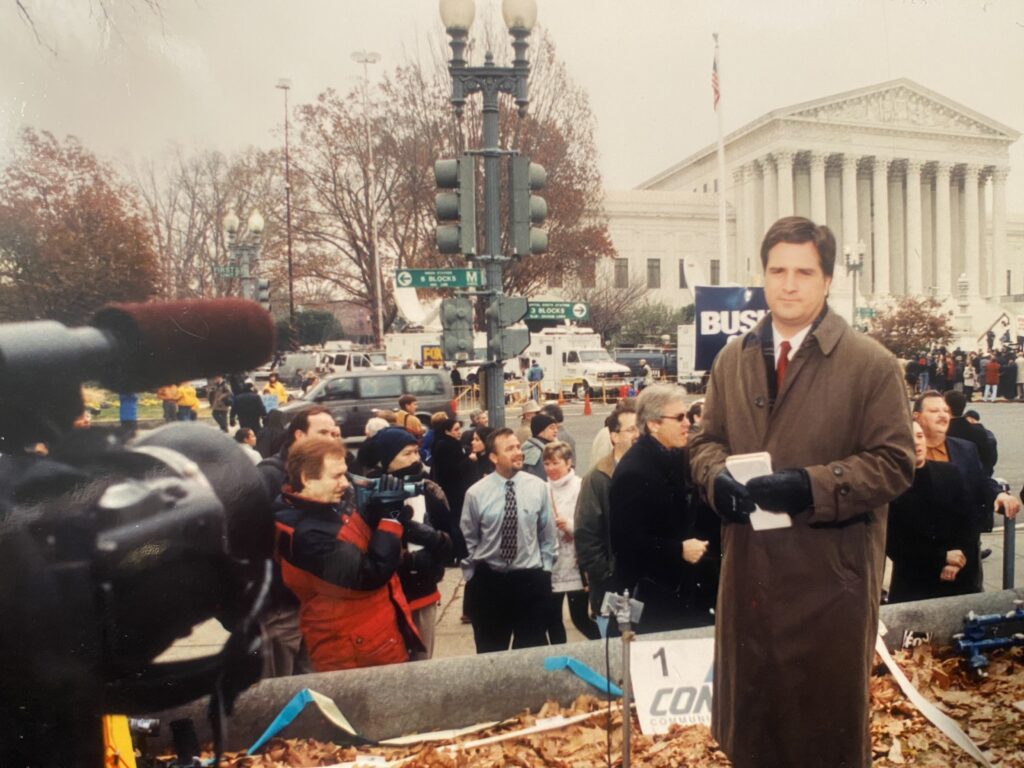
Podcast consultant John Wordock was a radio and television correspondent in a past life, covering presidential elections, including the 2000 Gore v. Bush case that went all the way to the Supreme Court. (Photo provided)

“I think potentially it will manifest itself with advertisers. Because what do advertisers want? They want to be associated with reach, they want to be associated with large audiences, and they want to get their messages out,” Wordock said. “So I think longer term, advertisers are going to be probably more inclined to want to have sponsorships for these shows.”

He added that while the candidates wanting to do interviews with major podcasts proves the legitimacy of the medium, it’s also likely the same thing for the advertising industry.

“Not only do all these interviews on these top shows offer a seal of approval for the industry, but they also offer a seal of approval for these big shows. So they had bragging rights now when they go to advertisers.”

At this stage in the race for the White House, most Americans are ready for Election Day to come and go, and to move on from the seemingly never-ending story. But John Wordock, a former Washington D.C. radio and TV correspondent who has met five U.S. Presidents, is likely in the extreme minority in that he can’t get enough.

“I must tell you that I am thoroughly enjoying this presidential election cycle,” he said with a smile. “I live here outside of Washington D.C., I’m a political junkie, and I’m a long-time podcaster. So this presidential election checks a lot of boxes for me.”

Amazon’s Prime Video to Pair NBA Game with NFL Game on Black Friday

0

Barrett Media produces daily content on the music, news, and sports media industries. To stay updated, sign up for our newsletters and get the latest information delivered straight to your inbox.

Court filings in the lawsuit between Warner Bros. Discovery and the NBA resulted in more information becoming public about Amazon Prime Video and their plans when they become media partners with the league after this season. One of those bits of information is that Amazon will pair the NFL and the NBA together on Black Friday.

Last season, the streaming company aired a Black Friday NFL game, and now they will air an NBA game or two following the NFL broadcast. This is part of their new 11-year 1.8 billion per year package. Prime Video will air 66 regular-season games including the Emirates NBA Cup and NBA playoff games.

With the NFL unable to play late Friday games, the language in Amazon’s agreement says it will air, “one or two games on Black Friday immediately after its National Football League (NFL) game.” Amazon will also have Thursday night basketball games at the conclusion of the NFL season in February and Friday games throughout the season.

Amazon will also have the rights to stream the conference finals through Prime video on alternating years, starting with the second year, and then consecutively in the 10th and 11th years. During those seasons, Prime Video will stream an equal number of Eastern Conference and Western Conference Final games.

Another part of the agreement says, “Amazon is required to ensure that the NBA games distributed through Prime Video or other platforms reach at least 80 million paid digital subscribers between October 2024 and April 2028.”