Home Blog Page 1313

Meet The Leaders: Kevin LeGrett, iHeartMedia

Barrett Media produces over 20 stories per day on the music, news, and sports media industries. Stay updated on the latest happenings by signing up to receive our newsletters straight to your inbox.

There aren’t many companies in this business as big as iHeartMedia. Not many companies can claim their success in multiple areas of what we now call the audio business. That is what keeps Kevin LeGrett so busy.

LeGrett is the President of iHeartMedia Sports. It means running more than just the strategy for the company’s local stations or FOX Sports Radio. LeGrett is an integral part of growing iHeart’s footprint in sports podcasting as well.

He shares his thoughts on politics on sports radio, what evolutions FOX Sports Radio could be open to in the future, and so much more. Today’s conversation in our Meet the Leaders series is presented by Point-to-Point Marketing.

Demetri Ravanos: iHeartMedia Sports is such a big, diverse endeavor. Do you have a strategy that you start each day with to make sure everything gets the amount of attention it needs?

Kevin LeGrett: I think the most important thing for us is we’re very focused on making sure a couple of things happen. Number one, we are putting together the best programming content possible. That includes our 85-plus owned and operated sports stations, and the Fox Sports Radio Network, which Don Martin and Scott Shapiro oversee. Then we have our play-by-play partnerships, which includes making sure our daily sports updates and all of our extensions, events, etc., are up to the standards that we expect from iHeartSports.

The second part of that is making sure that we’re delivering on our commitments to our clients. It’s really important that we’ve got the best programming content out there, but that we’re also delivering on the commitments we have for our clients and the communities that our stations and network serve. Then lastly, it’s making sure that we’re delivering for our partners and spending every day making sure that we get together and run everything through those three filters. At the end of the day, if we deliver on those three, we’re going to be consistently successful.

Our approach has always been to focus on winning the day. If we’re winning the day, then at the end of the day it allows us to win the week. That allows us to win the month, the quarter, and ultimately, the year. That’s the focus. Every single day matters.

I took that a little bit from when I ran radio stations. Whether they were in the Northeast or out here in Los Angeles and the West Coast for the last ten years. If you have the commitment to day-by-day excellence, and the commitment to distill it down into specific ways that define success, the process is going to lead you to success day in and day out.

DR: So let’s dive into success as it relates to some of the stations you guys have recently turned on as pure plays with Fox Sports Radio. They’ve been on smaller AM signals and HD signals. Do you have local goals for those stations or are they purely in service of the national network’s goals of being on in as many markets as possible?

KL: Our goal is to continue to extend the Fox brand. I’ll take a step back here. The fact of the matter is, when people think about iHeartMedia, they always think of us as the Taylor Swift Company. Taylor Swift comes out with a new album, we play three songs from her every hour. We’d play an interview at the top of the hour, and lo and behold, she’d play our iHeartRadio Music Festival or be on our Jingle Ball tour.

But during Covid, we spent a lot of time looking at our assets and areas that we believed we could grow. One of the glaring verticals that we had was sports. We were a dominant player in sports, and Bob Pittman and Greg Ashlock, as well as Rich Bressler, decided that they would stand up this vertical and really stick their chest out a little bit and show people that we are a dominant player in audio when it comes to sports.

That’s allowed us to look at stations, some performing, some underperforming, and make sure that we’re giving them the tools and the resources to succeed. Now, I’d be foolish if I didn’t say that in each market, our expectation is that if we have a sports station, it’s the number one sports station in that market, and quite frankly, that it complements the other stations that we have within the cluster. There’s a lot of ways to go about doing that. The one thing that we know is that fandom is enormous in each and every market. So, if you have the right associations, the right brand, and the right content, and you’re giving people the opportunity to sort of talk back, you’re ultimately going to be successful.

DR: The right associations you mentioned, I struggle to think off the top of my head of an iHeart-owned sports station that does not have a strong play-by-play presence. Am I wrong or is play-by-play central to what you view as the ingredients for making a successful local sports station?

KL: I’m not sure that you have to have that each and every time, but I would say it sure makes it a lot easier. It gives you the opportunity to have a forum where the fans can vent. It gives you an opportunity to have a forum where you can actually tell the stories behind the stories. 

I think that when you look at our biggest and most successful stations like KFAN in Minneapolis, we have associations with the Minnesota Vikings and Timberwolves, the University of Minnesota, and the Minnesota Wild. You look here in Los Angeles and the great job KLAC has done with our association with the Los Angeles Dodgers, the association with UCLA, and Angel City Football Club. There is a partnership with multiple stations here with the Los Angeles Chargers. It definitely helps both from a content and access opportunity.

But I do think that there are stations out there that, quite frankly, can be propped up because they’re so large and they have big personalities. We’re just blessed with in our most successful markets that we have really great personalities, like KFAN with Paul Allen or here in Los Angeles with Colin Cowherd, who’s based here, as well as having Petros & Money and Fred & Rodney. It really does make a difference.

DR: The juxtaposition is interesting. A few years ago, I talked to Don Martin and some other folks who have been integral in the growth and success of Fox Sports Radio. Don described launching Fox Sports Radio as wanting to be the “columnists network” to ESPN’s “reporters network.” He said that at the time, they viewed no play-by-play as a key part of that. It was always going to be opinion driven. It is just interesting that that has remained the case at the network, while local stations in the iHeart family are prioritizing play-by-play.

KL: Well, I think that there’s always room for evolution. If national play-by-play was an opportunity, we would probably stick our nose in there and at least explore it, and we have explored it. But I think Don hit it on the head. The baseline of how Fox Sports Radio was created was to have the best personalities, which we do. Having the best conversations and the best storytelling about the world of sports works for us.

The great news is sports has evolved so much. It’s not just the NFL and baseball anymore. There was a storyline 365, whether it’s around women’s sports, the evolution that college sports are going through, as well as all the other leagues, the NBA, NHL, etc. It leads to real tune-in daily, where you want to hear what Colin Cowherd has to say. You want to hear what Dan Patrick, Covino & Rich, and The Odd Couple have to say. Our up-and-coming show is doing spectacular, which is Two Pros and a Cup of Joe with LaVar Arrington, Brady Quinn and Jonas Knox. People who listen to those shows join the tribe and become part of it. They want to hear those daily takes, and who they’re interviewing and interacting with.

DR: In the age of sports podcasts and younger listeners gravitating towards digital audio, what is the state of network sports talk? Obviously, with iHeart, you are in a luxurious position of not only being strong with network radio but with podcasts as well. I wonder when you are talking, be it with partners or advertisers about Fox Sports Radio, what adaptations have you had to make in your presentations?

KL: We really haven’t had to make an adaptation. What we’ve had to do is we have to make sure people understand that we can enter through several doors where our competitors can’t.

One of the reasons why we’re the leader in sports audio is the fact that we own 85 sports stations – more than anyone else. We own the dominant sports network in Fox Sports Radio. We have over 140 play-by-play associations, the most in the NFL, 11 play-by-play partners. We’re strong in Major League Baseball, NBA, NHL, MLS, etc.. In addition to that, we have our iHeart Sports Daily updates that we run on over 500 radio stations. That’s something that Don Martin and his team created.           

So, our commitment to sports is outside of just our owned and operated sports stations. It actually updates on 500 of the 860 radio stations that we own. That’s a lot of commitment to sports. 

Then you forget the other piece, the secret sauce, and you alluded to it, which is podcasting and the fact that we’re the dominant player in podcasting. In fact, if you pulled iHeart Sports out of iHeart’s podcasts and made it its own standalone company, it would be the fifth largest podcast company out there, and that includes exclusive deals that we have with the NFL and with the NBA. We’re in talks with other leagues right now and bringing on really great personalities like we did this week with Rob Gronkowski and Julian Edelman.

We’re always looking at evolving. Just back in June, we launched the Women’s Audio Sports Network, which includes updates on women’s sports across not just sports stations, but all of our stations. In addition to that, launching a podcast slate, and looking at other strategic partnerships, whether it’s with the New York Gotham in New York City or Angel City Football Club here in Los Angeles. We’re looking and making a commitment to ensure that our coverage of sports is more balanced, because in many cases it had tilted almost 90% towards men, and that may be a conservative number.

DR: I want to wrap up by asking you a question that is probably 2024-specific. I wrote a column earlier this week looking at the rising importance of podcasts to political candidates this year. It used to be pretty common, and in fact, on Fox Sports Radio it was pretty common, for candidates to make time for the biggest national sports radio shows during an election year.

I wonder what your advice would be, though, if Kamala Harris or Donald Trump wanted to go on with say, Dan Patrick. Are we too polarized at this point for there to be an obvious win for the host if a campaign approaches them in that way, the way they might have in the past?

KL: That’s a really interesting question. Besides wearing the hat as President of Sports for iHeart, one that I absolutely love, I also wear the hat of president of political sales strategies here. So to your question, I think we would be open to at least having those discussions with the Vice President or with former President Trump. Depending on the show, if they felt like it could work, we would explore and exhaust all options to see if we could get something like that on the air.

I will point out, which I think is really important, we did that yesterday with The Breakfast Club and Charlamagne Tha God. Charlamagne had an intimate conversation, a town hall with Vice President Kamala Harris. It was hugely successful. In fact, on social we broke records based upon anything else she’s done up until this point, which is really powerful not only for us, but it shows the power of where audio and broadcast radio is.

I still think there’s that fallacy out there that, “Hey, no one’s listening to the radio. They’re all on podcasts. They’re all on streaming this and that.”

What I say to people all the time is, number one, streaming is awesome. There’s no question people use streaming for convenience. But the fact of the matter is companies like Spotify and Pandora, they put record stores out of business because when you want to escape the world, you listen to those. When you look at where Spotify and Pandora are with ad-supported, it’s much, much smaller than where iHeartRadio is.

Then when you think about podcasting, people will say, “well, podcasting listening has to come from broadcast radio.” Well, in fact, podcast listening is coming from social. It’s coming from the time that you spent on Instagram, the time that you spent scrolling on Facebook. There’s research after research that shows that. So, when you combine the fact that you’ve got a dominant position in broadcast radio, a dominant position when it comes to podcasting, and a dominant position in streaming, those three things combined add up to why we’ve been successful for so long and why our talent get those opportunities.

DR: So the follow-up or pushback, I’m not quite sure what the right way to frame this would be, is that Charlemagne and The Breakfast Club are a really good example of a show that has conditioned its listeners to know that nothing is off limits, right? It might be a little bit escapist, but they have a long history of having political figures from both sides of the aisle on their show.

I wonder if there is any sort of preciousness about the escapism of sports during a year where it seems like we’re always in contentious conversations about everything else.

KL: Well, I think your pushback is justified. Maybe I didn’t answer it clearly enough, but with any situation, we would sit down with the personalities and do our own research. That’s the one great thing about working for a large company is that we have research out in the field almost on a daily basis. We find out how our core listeners would react to something like that, and then we collectively come together and make a decision. We’re not going to make a decision in a vacuum.

Obviously, if we did something like that, we’d have to offer equal time, which means Dan Patrick or Colin or whichever show it is would have to not only offer it to former President Trump, but they’d have to offer it to Vice President Harris. That may put them in a pickle, so we would work with the talent on that and make those decisions.

I can’t say unequivocally that we would welcome political talk on to our stations. I think with anything, it’s kind of a let’s take a step back. Julie Talbott, myself, Don Martin, and Scott Shapiro, would all huddle up, and have a discussion. We would bring in Bob Pittman and Rich Bressler too, who are very hands-on within our organization. We want to make the most intelligent choice possible to make sure that we’re serving our listeners and not alienating them.

To learn more about Point-To-Point Marketing’s Podcast and Broadcast Audience Development Marketing strategies, contact Tim Bronsil at tim@ptpmarketing.com or 513-702-5072.

News Talk Radio Hosting Playbook Refresher

0

Barrett Media produces over 20 stories per day on the music, news, and sports media industries. Stay updated on the latest happenings by signing up to receive our newsletters straight to your inbox.

You are a host on a terrific News Talk station. You may receive occasional aircheck sessions. Your Program Director is very busy. The PD is likely running more than one radio station and has other jobs in the building. Some Program Directors are very good at coaching and others are not so gifted to get you over the rut that you feel that your show is in at the moment. I like to think that I have coached my hosts more than most Program Directors. There are 4 ingredients to setting up a topic for a great show:

Keep it brief. I hear many hosts still replicating the Rush Limbaugh template of a long and detailed monologue. Most of you can’t do that. Listeners were patient with Rush because they knew that the payoff would be there. Limbaugh’s insane show prep is more than you are likely doing. PPM is soon to debut the 3-minute quarter hour. So, three minutes will give your show credit. Your topic set up should be in 3 minutes.

Ask your PD to see the average time spent listening per listening occasion, if you are in a PPM Market. If you are in a diary market, the average PPM result shows approximately 5 times more tune-ins per week and the TSL is quite short. PPM and Diary methodologies have deep flaws in my opinion. Even though there are not enough people in the panel for PPM, it shows actual listening. I have used PPM programming data in diary markets. You don’t have much time. You have mere seconds to entrap people into your show. Tighten up the monologue.

Lead with your opinion. The opinion is the hook. The opinion is verbal clickbait. I hear too many hosts open with the news story. Your audience connects with your thoughts. Opening with a line such as, “The Mayor thinks that we are morons,” will create immediate interest. It is all about grabbing attention. There are so many distractions. There are so many choices that hosts need to maximize attention grabbing moments.

Personal connection is essential once you set the hook with your opinion. I was monitoring a terrific host recently. (I have managers and hosts who seek my opinion on improvement ideas for talk show hosts and news people.) So, this host was speaking about the political leadership twiddling their fingers on a bridge replacement. I know this host. He drives over said bridge twice a day. The host ignored the frustrations of a daily traffic jam. He didn’t relay his feelings or experiences.

Every listener that drives that bridge knows those feelings. It is essential storytelling. If I was going to give a blanket complaint for most hosts that I hear is that they don’t tell personal stories that relate to the topic. Radio is the theater of the mind. Have you created a picture for your listeners. This host could have talked about how this aging narrow bridge is a safety hazard. How he is fearful of the bridge failing. Tell a story of being stuck on the bridge on a windy day and feeling the bridge move. Lots of angles on this story. Find your personal passion point.

The least important part is the actual news story. It is the base of the discussion with callers but should be used at the end of the set-up. I often hear hosts reading an article on the story. That is not show prep. It is reading. I once had a host who would read for twenty minutes and wonder why he wasn’t getting any calls or feedback. People are not listening to your show to read someone else’s words. It is kind of like audio plagiarism. Even though this host acknowledged the writer of the article one time. Most of the station’s listeners will not hear that.

I hate referencing opinion pieces. When I was doing a show, I generally avoided opinion articles. You must draw your own conclusions. It is too easy to take an opinion from the article and make it your own. You are not being paid to just read others’ opinions, words, and feelings. You are being compensated for your thoughts, words, and opinions. Don’t steal the opinions of others. It is theft. It really is and most hosts don’t even realize that they are doing it. If you avoid opinion articles or podcasts, you can’t get tempted.

You have been given a microphone and a platform to be a host. I realize that this is art. Follow my ideas in this order: Strong opinion, story supporting your opinion, followed by the news story. This is what it takes to have a great show. The most successful hosts that I hear follow this basic set-up.

Technique is as important to a talk show host as it is for any NFL quarterback. It is essential. Do you aircheck yourself? How often? I think that you should listen to an hour of your own show each week. I understand that nearly every host hates listening to themselves. I also know that no growth can occur if you do not have self-reflection.

Hey Program Directors… You don’t need to break down every moment of an hour. Play a segment for the host and ask the talent to tell you what worked or what didn’t. Often, hosts hear the shortcomings. I have had hosts make the same mistakes and then I ask them to help me solve the problem. You and the talent already agree on the shortcoming. Asking the host how you can help him/her is a win. You are being an ally to their success.

Follow my advice and it will actually help you maximize your footprint ratings wise, and it will create greater connectivity with your listeners.

Radio’s Low Wages Cripple Ability To Attract New Blood

0

Barrett Media produces over 20 stories per day on the music, news, and sports media industries. Stay updated on the latest happenings by signing up to receive our newsletters straight to your inbox.

My friend, mentor, and former boss (he tries to block it out because I drove him nuts), Mike McVay, recently shared his thoughts on the dire need for content creators in radio and rightly discussed thinking outside the box in looking for and hiring talent.

Commenters on his social media post mentioned college radio hosts and the restrictions of media contracts, particularly regarding non-compete clauses, and one rightfully compared the lack of young renegades in radio akin to NBC’s resistance to Lorne Michaels and the “Not Ready For Prime Time Players” as depicted in the new “Saturday Night” film. But there’s a bigger elephant in the room, or perhaps better put a smellier 800-pound gorilla in the equation: money.

Historically, pay has been dirt low at the lower rungs of the radio ladder back to its earliest days. There have always been unhinged owners, bouncing checks, deplorable facilities, and dinner coupons, traded-out motels rather than salary and moving expenses, even in medium markets. What has really changed is severalfold:

There are fewer opportunities beyond entry-level and, therefore less opportunity to break in, learn, grow, move around, and move up.

Often, when a bright young person does break in, they get handed “too much too soon,” and by that, I mean they take high-level positions and accept far lower wages than seasoned veterans or union talent could or would.

Outside of the top 25 markets or so, not only are there far fewer jobs, the revenue hits, particularly in the loss of national ad money, has greatly decreased, bringing down local income.

Starting in the 90s and accelerating ever after, the value of the local personality (and AEs, too) has decreased and doesn’t much improve, even for those in large markets or with syndication deals, voice-over work, and the like.

A few examples of what I’m talking about: many dream of getting syndicated and or tracking multiple stations as a way to reach wider audience imprints and make extra income. Whether you’re a talent offered by a syndicator or tracking stations in an owner group the average pay is $500 a month or $6,000 a year often replacing what were easily $30,000 jobs a dozen years ago.

Many states now require employers to share salary information in job postings, and one that drew much discussion in several online radio groups is legendary LA rock outlet KLOS’s offering of “$70-90.” The average rent for a two-bedroom single-family in Los Angeles County is around $3,973 per month; do that math. Similarly, a recent top ten market posting listed PM Drive for $60 and $42 for an OM job in a top 50 Midwest market.

How can radio possibly expect to attract new blood, find and maintain the best and brightest and expect really anyone to survive on wages like that? Radio has always been a passion-driven business where most didn’t get rich, but to pay rock bottom wages with large workloads, zero job security, minimal job growth opportunities, and restrictive contracts, it’s another example of radio acting as its own worst enemy, creating an unnecessary hindrance in landing and keeping the best content creators to compete with new media.

Relationships Are Key To Danny Ocean’s Radio Longevity

0

Barrett Media produces over 20 stories per day on the music, news, and sports media industries. Stay updated on the latest happenings by signing up to receive our newsletters straight to your inbox.

Danny Ocean Had Something to Prove

He had been making a living away from the mic in the radio industry for more than twenty years. Once his kids were grown, Danny Ocean wondered whether he still had the chops to be on the radio full-time, as he had been for eighteen years all over the U.S. in his younger years.

Danny made some calls, including to his former colleague Jim Loftus at 7 Mountains Media (he’s now at Shamrock), and expressed his interest. 

When an opening for Program Director and afternoon drive personality became available at WSBG in Pennsylvania’s Pocono mountains many months later, Danny jumped at the chance.

“There’s a great staff at SBG in Stroudsburg. I’m really lucky to have live talent from 5 am to 7 o’clock at night.” Veterans like Chuck Seese in mornings and Karen Stone in middays. They’re all veterans who’ve hosted their shows for many years in the market.

“We’ve got a great staff and company support for promotions and sales. They go out and sell Main Street because that’s what it is. We are a heritage Hot AC station for the people in the Poconos.”

It all starts with our VP/Market Manager Pat Lincoln, who has worked in the area for decades and brings the winner culture to our building.  

Relationships, says Danny, are the key to radio success, and his previous work relationship with Loftus was “100 percent responsible” for getting a shot with 7 Mountains Media, where he’s been for almost a year.

Weekend Rock Jock

Even while working in writing, advertising, and affiliate relations for two decades, Danny kept his programming skills fresh and his foot in the door in radio with weekend on-air shifts at various Philly radio stations.

“In 2011, Chuck Knight, who was the Program Director at B101, the dominant Adult Contemporary station in Philly for decades, invited me to come do weekends and I was thrilled. I spent nearly ten years there. When the pandemic hit, Entercom had purchased the station and put all the part-time people on the shelf. I then reached out to Bill Weston at Beasley’s Classic Rock 102.9 MGK. Beasley has a gold mine in Philly largely due to their heritage station brands and their talent,” Danny explains.  

“The MGK On Air hosts are people who have been there for twenty years or more, and the talent is incredibly entrenched in the market. Listeners live for them; they are like rock stars, so to go on there was a real dream. I’m playing the music I love, and it’s a complete 180 from the other work I’m doing right now.”

He’s on every other weekend from 6 a.m. to 11 a.m. on Saturday and 8 to 10 p.m. on Sunday, with features like “Philly’s Top 500 Songs” and Arlo Guthrie’s “Alice’s Restaurant” around Thanksgiving.

Radio Roots

The classic rock format harkens back to his very first days in radio, which began for Danny at PA’s Haverford High School. WHHS is the oldest high school-run radio station in the country.   

“We were only 10 watts, but it was the experience of being in the room and picking the songs and playing the vinyl. You could play what you wanted. It really lit the flame for me. There was no way I was going to be doing anything else after having that experience.”

Naturally he joined his college radio station at American University in Washington, DC, and was something of a sensation as “Dr. Rock,” on WAMU’s AM free-form Friday evenings. He was also a fixture at frat parties and local clubs DJing three nights a week.

Anything and Everything

After “leaving college with his hair on fire,” he started his first radio job in DC in 1986 at EZ Communications Inc.’s WBMW-FM B106, where he “did anything and everything ever asked of me and loved it.”

Miami Overnights

A prior professional relationship would lead to Danny’s first full-time on-air job at Hot 105 in Miami.

“The Program Director had been the APD at B106 in Washington and I was hired for overnights. I slept all day. I was on my own trying to get good and it wasn’t easy.

“We were a hybrid CHR station before Miami Beach was built up, and the market exploded. Even though we had the right attitude, we were not successful in the ratings, and the company flipped the format to Urban in late 1988, and that’s where it’s remained as a dominant station for the past 34 years.”

He would then do weekends in Philly and work at NY’s Z100 as assistant promotions director and weekend host and crisscross the country with stints as APD/MD at JAM’N 94.5 in Boston, Z95.7 in San Francisco, and Hot 97 (WBHT) in Wilkes-Barre, PA, where he would work with Jim Loftus and his lifelong friend and radio host Kid Kelly.

Ramped Up the Ratings

One of Danny’s career highlights was his time as Program Director and afternoon host on New Haven’s KC101 from 2000-2003, where he increased ratings at the Clear Channel station by a full share (5.9 – 6.9) in the first year.

“I spent a lot of time listening to the market and assessing the music, air talent, and promotions. We didn’t have a ton of turnover there, but being a heritage CHR station between Boston, Hartford, and New York, it needed attention. I focused the music and developed larger than life style promotions and helped generate revenue non-traditional revenue at the same time,” he recalls.

 9/11 Hits Home

Danny says being on air after the terrorist attacks of September 11, 2001, is one of his proudest moments.

“When we came back to regular programming, we were a different-sounding radio station. New Haven is only ninety minutes from NY, and people commute. We had families that were affected immediately. We needed to reflect exactly how people were feeling, so we came back with uplifting music that sounded like America. I got calls from people, including a guy who was so moved that he had to pull over and weep on the side of the road.

“It made me feel like we stepped up and were doing what we were supposed to be doing. The job is to protect the license and serve the community.”

Danny and KC101 would go on to win the 2001 Gavin Magazine Small Market CHR Radio Station of the Year and Small Market CHR Operations Manager/Program Director of the Year awards, as well as 2002 FMQB Promising Manager/Program Director of the Year and more.

Budget cuts led to a layoff in 2003. Danny would move on to Memphis for a job at CBS Radio’s FM 100/WMC-FM.

He had a young family in PA, so he flew home every weekend and lived in Memphis’ Peabody Hotel. “It was a difficult time. The ground beneath my feet was unstable, and after three months on the job, CBS Radio sold the station to Entercom and I felt it was time for a change, and that’s when I stepped away.”

He continued to work off the air and was more financially secure in his positions in writing, advertising, promotions, and direct mail at companies including Friday Morning Quarterback and Radio Direct Response/RDR Promotions.

Affiliate Relations/Doc Rock Media

An ad on All Access in 2012 would change the course of Danny’s career.

He had no sales experience but knew radio inside and out and was hired as an affiliate relations director at Sheet Happens Prep Service. He worked as an independent contractor under the company name Doc Rock Media (an homage to his college radio handle) and grew the company’s client base from approximately 160 stations to nearly 400 in just over four years.

“In 2017, I got a call from United Stations in NY, who said, ‘We’re going to be very blunt with you. You have been killing our company by putting Sheet Happens Prep all over America. Would you consider coming to work for us?’”

Astounded and flattered, he took the job, which, he says, was completely different because he went from selling one product on his own to selling 50 products along with a staff. He stayed for four years.

“It was a lot of fun. I probably would have been there longer,” he says, but he was offered a gig he couldn’t refuse.

Kid Kelly Called

“(Radio host) Kid Kelly hired me twice,” says Danny. The two first worked together in 1994 with Jim Loftus at WBHT in Wilkes-Barre, PA.

“We made so much noise and caused so much havoc for the competition back then. We succeeded in becoming a viable player in the market for a station with a limited signal.”

“Then, in 2021, Kid called me and asked me to do affiliate relations for a new syndicated show he was launching. It was a tremendous opportunity. We launched the show, and within three months, we landed our flagship on WLS-FM in Chicago every weeknight. From there, it grew, and fifteen months into the job, the syndication company said they couldn’t sell it, and they pulled the plug, and I was out of work, and it started a two-year struggle.  

Kid Kelly Cancelled

“So, I took some jobs that were not ideal and worked myself back to a better place, and last year 93 5 SBG Stroudsburg happened,” he says.

WOWY Radio

Danny also hosts middays on WOWY radio in State College, PA. It’s heard all over the state. “It’s on so many stations they don’t even say the frequency; they just call it WOW WEE Radio!

“We play songs from the late ‘60s through the ‘90s, and it’s really unique and fun for a kid who grew up on Top 40 radio. It takes me an hour and a half to prep it every day and about an hour to voice, so my days are long. I’m in at 7:30 in the morning, and I usually don’t leave until 7:30 at night.”

Larger Than Life Promotions

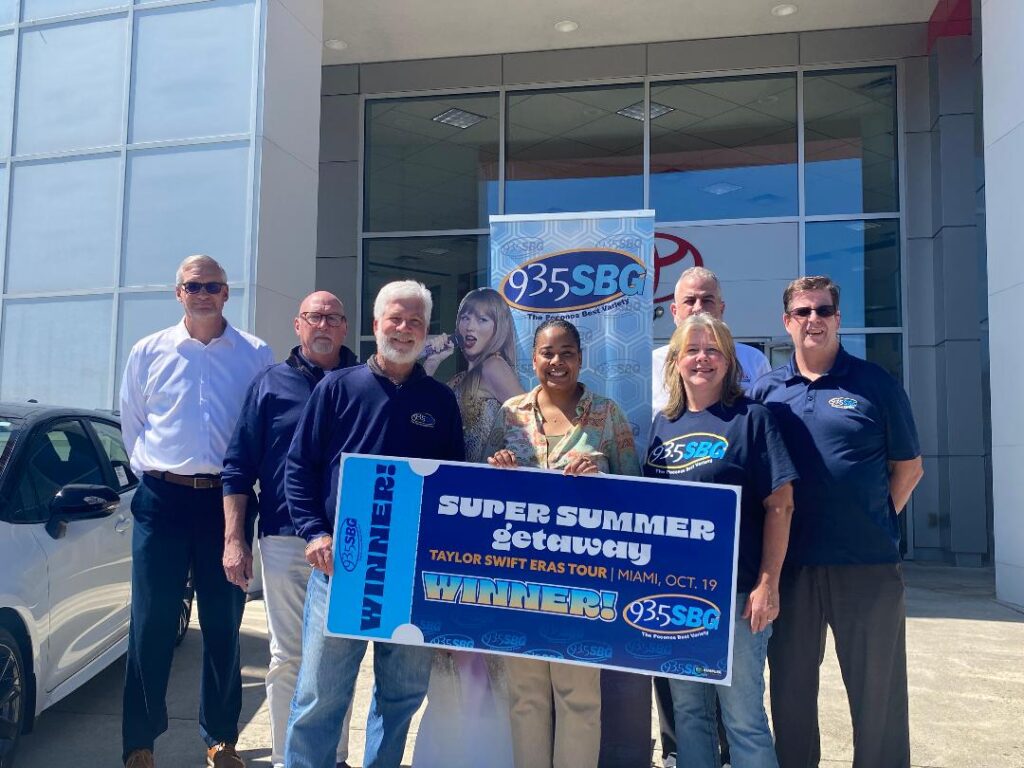
“We just put the wraps on a Taylor Swift promotion that we did for fifteen weeks this summer. We gave away her catalog and merchandise three times a day and we gave away tickets to a show in Miami to a 43-year-old woman who is surprising her 14-year-old niece with her first concert ever.  There is nothing bigger for our Hot AC format right now than Taylor Swift.

“I’m so happy that we were able to award a prize like that to somebody who’s going to have the experience of their life. We had over 200 on-air winners, plus we took the promotion on the street. We let people come by remotes and register to win, so we had well over 1000 people who participated.”

Big promotions and generating revenue are a hallmark of his career.  

“My experience at Z100 taught me to do larger-than-life promotions. I don’t care what size market it is. It’s what you do, not where you are. I took the long-standing relationships that I have with artists and management companies, and I made the promotion work.”

He strives to “give the listener a once-in-a-lifetime experience that they can’t buy or get anywhere else” while generating money for the company.

In addition to elevating promotions, Danny created benchmark features like “93 Minutes Commercial Free at 3” and the station now features the 90s at 9, an hour of ‘90’s music at 9 a.m. every weekday, and they’re both sponsored segments.

“When you don’t have the benefit of looking at the ratings, you have to look at other areas. How’s our advertising, our requests, do people come out to our appearances and it was a yes in all areas, so I believe we’re doing good work,” he says of his first year on the job. “We are all very proud of our success.

At 60, Danny says, “I’m probably working harder now than I’ve ever worked,” but he’s content.

KDKA Brand Manager PJ Kumanchik Still Pinching Himself After Winning Marconi Award in 1st Year Leading Brand

0

Barrett Media produces over 20 stories per day on the music, news, and sports media industries. Stay updated on the latest happenings by signing up to receive our newsletters straight to your inbox.

At the 2024 Marconi Radio Awards during NAB Show New York, the finalists for the News Talk Station of the Year Award were some of radio’s strongest and most recognizable brands. Stations like 95.5 WSB in Atlanta, 102.3 KRMG in Tulsa, 700 WLW in Cincinnati, and 93.1 WIBC in Indianapolis were up for the award. But KDKA in Pittsburgh, one of news/talk radio’s most storied stations, took home the top honors. And as first-year Brand Manager PJ Kumanchik looked on, he couldn’t help but smile.

A lifelong Pittsburgh resident and career-lifer at the Audacy Pittsburgh station, PJ Kumanchik took over the station from programmer Dave LaBrozzi in April after the longtime leader stepped away from the station.

For most first-year brand leaders, the idea of winning a Marconi Award is nothing more than a pipe dream. But KDKA is a different animal, with a long, illustrious history. And PJ Kumanchik didn’t take that history for granted when the station was nominated.

“I look back at the history of the Marconi with KDKA Radio and the previous awards that we’ve won outside of a Marconi, and it’s a lot of pride when you’re when you’re nominated,” said Kumanchik. “It’s kind of like disbelief. You don’t believe it has happened, and you kind of pinch yourself. Our radio station, and to also have our sister station that’s right next door to us, 100.7 nominated in the same cluster — different format — it’s a tremendous honor. And it’s kind of surreal. It really is, being the first-year Brand Manager coming into this and to be nominated, it’s really a dream come true.”

When asked what emotions entered his mind as the presenter revealed that his station was honored with the prestigious award, Kumanchik didn’t hesitate.

“You just gave me chills,” he said. “It’s very humbling, because if you look across the country at the rest of the news/talk stations, and who we were nominated with to be honored, it’s overwhelming. At times, you want to scream to the mountain tops or what have you. You want to tell everybody. But it’s very humbling. I hate to be that guy that says we expect things, but we expect to lead at what we do. And to have this happen from a staff perspective — because they work very hard day in, day out — it’s truly humbling for us, and so gratifying. So it’s a dream come true. It’s a great feeling.”

Kumanchik got the opportunity to lead the brand after working for the station for 35 years. And he believes that — along with a deep knowledge of the personnel, the area, and what listeners expect from the station — helped him hit the ground running once he took over.

“I’ve been with the radio station for such a long time, and so I knew all the players involved. So I would like to think that if you have the respect of the team and what have you, the transition from where I was as the news brand manager to brand manager wouldn’t be as difficult as some might expect, and it hasn’t been,” Kumanchik said. “So it’s been a joy. It’s been a delight. I think we’re making great progress, and it’s been nothing but enjoyment, I can tell you that.”

“I grew up in the city of Pittsburgh, lifelong resident of the city itself, city proper, in knowing the audience, knowing what the audience, audience expects from you, knowing your place in the market, knowing the history of this radio station and what we have done in the past, I think it was a tremendous help for that to be on my side,” he added.

And while the prevailing story about KDKA’s latest win for News Talk Station of the Year at the Marconi Awards, PJ Kumanchik was quick to note it was a team effort that led to another victory in the sought-after category.

“There is no doubt it’s a team effort, and it’s just not me,” he said. “If you take a look at our entire, not just KDKA Radio, but the cluster here in Pittsburgh, I mean, you’re talking about promotions, what we’re doing outside in the community. You talk about our newsroom that have won multiple (Pennsylvania Association of Broadcasters) Awards for the best cast in the state. Talk about our digital platform. You talk about our high school platform. So it’s not just an on air, not just a news, not just in promotion, but it’s everything together.

“And that’s what’s so gratifying. Because you win as a team and everybody can enjoy it.”

RJ Choppy to Dan Patrick: We’ve Done Interview with Jerry Jones for 14 Years, ‘Never Had Anything Like That’

0

Barrett Media produces over 20 stories per day on the music, news, and sports media industries. Stay updated on the latest happenings by signing up to receive our newsletters straight to your inbox.

105.3 The Fan in Dallas host RJ Choppy was a guest on The Dan Patrick Show talking about the now infamous interview he and partner Shan Shariff had earlier this week with Dallas Cowboys owner Jerry Jones. The Fan is the Cowboys flagship station and Jones has done the weekly interview on the show for almost a decade and a half.

“How did that interview end, R.J.?” asked Patrick after playing a clip of the question that led up to Jones going on a tirade about how he could replace the hosts with others who would ask questions he wanted to answer.

“We went into a couple of other topics, and we ended it as normal,” Choppy said. “Now, it went longer than normal. Usually, they’re about 15 minutes. This one went closer to a half hour, but yeah, it ended less contentious than it was in that moment, but when it ended, we did know that that was not a normal Tuesday appearance from Jerry. We’ve had almost 300 of them with him. It’s been 14 years that we’ve done that interview with Jerry. Basically, the same time on Tuesdays, and we’ve never had anything like that.”

Patrick then asked, “Any follow-up from Jerry Jones after the interview, given the fallout from it?”

Choppy replied, “No, not to us, and we haven’t heard anything, and I’m sure that it would have been relayed to us had there been, but no. We actually talked yesterday, we were wondering if he would call in today. He has an appearance Tuesday on the station and then Friday on the station. So, we haven’t heard from him. It may change as the week goes on, but as of now, no.”

“Did you take the threat seriously that you guys are interchangeable parts there on the flagship station?” asked Patrick.

As Choppy said, “…Everybody’s interchangeable, I suppose…” Patrick added, “He seems serious, RJ.”

“It did seem serious, but you know, we were sitting there wondering, was he talking about removing us physically? Or just he’s gonna do his interview on another show on our station at a different time of day, which if he wants to do that, I suppose that’s his prerogative, but no, our company, our bosses have been behind us. They’ve not said a word about that.”

Patrick asked if Jones or the Cowboys had ever asked for certain topics to be off limits or submitted questions they wanted asked. Choppy said there was one time several years ago when they asked to not discuss the Colin Kaepernick situation, however Choppy explained they had already talked to Jones about the subject a few different times.

Choppy later added about Jones, “He’s been great. That’s why this was so surprising. He’s never been sensitive. Of all the owners that we’ve dealt with in town, and even owners that we’ve had on from other markets, we’ve never had one that is more accepting of difficult questions. We don’t get personal with him…He’s never had a problem with answering tough questions. When you’re the owner and the GM, and you put yourself out on radio twice a week, every week, it’s hard to avoid those questions. To his credit, he’s never had a problem with them, and that’s what made this so surprising and disappointing, to be frank.”

Patrick and Choppy would go on to talk about why they thought this happened and whether Jones is more interested in winning championships or getting himself and the Cowboys brand promoted on radio and television.

As they wrapped up, Patrick said, “Good to talk to you, RJ. Glad you’re still employed.” Choppy replied, “For now.”

Q101 Chicago Sets Lineup For 30th Annual ‘Twisted XMAS’

0

Barrett Media produces over 20 stories per day on the music, news, and sports media industries. Stay updated on the latest happenings by signing up to receive our newsletters straight to your inbox.

“Twisted XMAS” is coming back to Chicago. Alternative Q101 has announced the lineup for the four nights.

Set for December 10-13 at Chicago’s Byline Bank Aragon Ballroom.

The four nights for the 30th anniversary “Twisted XMAS” 2024 include:

12/10- Cage The Elephant, Franz Ferdinand, and almost monday

12/11 – The All-American Rejects, The Maine, Andrew McMahon, and Dexter & The Moonrocks

12/12 – The Smashing Pumpkins, AWOLNATION, and Badflower

12/13 – Bush, Bishop Briggs, and Palaye Royale

The station is offering BYLINE as a presale code before tickets go on sale on Friday. (10/18)

Chris Fowler Talks Differences of Working College Football with Kirk Herbstreit, NFL with Dan Orlovsky and Louis Riddick

0

Barrett Media produces over 20 stories per day on the music, news, and sports media industries. Stay updated on the latest happenings by signing up to receive our newsletters straight to your inbox.

ESPN and Arizona Cardinals broadcaster Dave Pasch had his ESPN teammate Chris Fowler on his podcast, The Dave Pasch Podcast, which airs through the team’s channels. Fowler has the Arizona Cardinals game against the San Diego Chargers coming up which will be one of two games on Monday Night Football. Fowler and his partners Dan Orlovsky and Louis Riddick will call the streaming-only game on ESPN+.

Fowler will also be on the call with Kirk Herbstreit the day before when the SEC on ABC game Saturday night features Georgia at Texas. Pasch knows what it is like trying to prepare for multiple games at a time but asked Fowler about how he handles the preparation.

“What’s a week in the life of Chris Fowler like?” Pasch asked as he laid out what Fowler has coming up. “Not much extra time for stuff,” Fowler said. “I try to keep my mental health intact by getting a workout in or a nice walk in, but as you know, there’s not much time for the fringes.”

Fowler said he doesn’t mind the schedule though, given the games and atmospheres he gets to be a part of. Whether that is at a college game working with Herbstreit or doing an NFL game as part of the three-man booth.

“I love being able to straddle both the biggest college games and NFL games,” Fowler said. “I’m glad it’s not every week. I don’t know how I’d do it every week, but I’ve learned over a couple of years how to manage the time better. [What] works better for me is to do the second game first. I’m looking at the Cardinals and the Chargers early in the week…kind of get a foothold, put it away, focus on the college, and then the minute the game is over on Saturday night, there’s a plane ride to Phoenix. There’s that time, there’s all day Sunday and all day on Monday to focus exclusively on the NFL game. That’s how it works for me, second game first, first game second.”

Pasch talked about his upcoming schedule and then asked Fowler about the differences between working in a solo booth with Herbstreit and working in a three-man booth with Orlovsky and Reddick as well as what is different about working a college game and an NFL game.

“It almost feels like a different job,” he said. “I love Lewis and Dan. And those guys are so plugged into the NFL. The part of the fun for me, Dave, is I learn a lot about the league through them. I know football, but I don’t know the inner workings of the NFL and how teams are assembled. And I don’t know teams like the Cardinals and the Chargers that well, living on the East Coast, in Miami, in New York…So, a week like this, I’ll lean on them a lot. I’ll spend extra time on that.”

As for his college assignment this week, Georgia at Texas, Fowler and Herbstreit have already seen both teams this season, so he said it will be more about fine-tuning. He said when they arrive in Austin, “we’ll lock in and talk to those teams, and I’ll be ready for that game.”

As for the three-man booth along with Laura Rutledge on the sidelines, Fowler said, “It feels really different working with those guys. I think that a three-man booth is something different for me. I haven’t done it that much. I think that the rhythm is different because Lewis and Dan, when you have a three-man booth, I don’t know if you’ve experienced this in the same way, but those guys, one being an offensive guy, one being a defensive guy, see the game through a very different lens.”

Fowler explained how the calls are different when he does NFL games as he will give it just a little more time while the analysts decide who is going to talk first based on what happened on the play.

As for college play-by-play he said, “I give a very economical call with Kirk. I try to be very generous. I’ll make a call…stop, let him get in, let him get in quickly. I like to do a replay or two because I want it back before the snap.”

As for what he enjoys about getting to do the NFL games when the schedule calls for two games and the crew he works with, he said, “Those guys are so easy to work with. I have a blast, and I’ll tell you what’s different about the NFL games and college is that we actually have a lot of time to hang together as a crew. And that means, if possible, watch a practice. It’s not always easy with the college schedule, but be on the zoom calls, have a dinner…and be able to hang together on the field pregame. And I love the experience of an NFL pregame. It’s so different than college.”

ESPN Signs NFL Analyst Andrew Hawkins to Extension

0

Barrett Media produces over 20 stories per day on the music, news, and sports media industries. Stay updated on the latest happenings by signing up to receive our newsletters straight to your inbox.

ESPN has announced it has agreed to a contract extension with NFL analyst Andrew Hawkins for the former wide receiver to remain with the Worldwide Leader.

Hawkins joined ESPN in 2018 before joining the NFL Network. He returned to ESPN and has now inked an extension to continue appearing on shows like NFL Live, Get Up, First Take, SportsCenter, and various network digital properties.

With his new contract, Hawkins will be a mainstay on NFL Live on both Tuesdays and Wednesdays at 4 PM ET, and will also work on Get Up, hosted by Mike Greenberg, on Wednesdays.

During his NFL playing career, Andrew Hawkins suited up for the Cincinnati Bengals, Cleveland Browns, and New England Patriots. He served as a team captain for both the Browns and Bengals, and also spent two seasons with the Montreal Alouettes of the Canadian Football League.

In addition to his work with ESPN and NFL Network, he has also served as an on-air talent at Roku, Discovery, Amazon, and DraftKings network.

CNN Adds Ben Hunte as New Anchor and Correspodent Based in Atlanta

0

Barrett Media produces over 20 stories per day on the music, news, and sports media industries. Stay updated on the latest happenings by signing up to receive our newsletters straight to your inbox.

CNN has announced the addition of anchor and correspondent Ben Hunte to serve in its Atlanta headquarters.

Hunte joins the network after previously working for VICE News in London as a global correspondent. During his time at the network, he earned Emmy nominations for his work on programming for BBC News Africa as well as BBC World Service.

“This is an exciting time to be joining CNN, especially at its original home in Atlanta,” said Hunte. “The studios, facilities, technology and talent here are all exceptional, but I’m also looking forward to the stories I’ll be able to tell from here and elsewhere for audiences around the world.”

During his tenure working on London for VICE, Hunte won several awards for his work surrounding LGBTQ issues, which said was a primary focus for him.

“I am extremely passionate about LGBTQ issues, and I’m also looking forward to picking those important stories up again with the backing of an organization like CNN.”

“Ben embodies so much of what we want to do at CNN,” added CNN International Senior Vice President of Programming Meara Erdozain. “He’s a dynamic, exciting talent with proven multi-platform skills and a hard-earned reputation for delivering impactful reporting. Whether in the field or in the studio, he will bring a new dimension to our content and our journalism.”

As part of his new role, he’ll be anchoring CNN Newsroom for Europe, the Middle East, and Asia, and for late-night audiences in the United States.