Home Blog Page 1787

Report: YouTube TV Adding ‘Build a Multiview’ Feature

0

While no official announcements have been made, it appears YouTube TV will be enhancing its “multiview” feature. 9to5google.com has reported users have seen a “build a multiview” option recently which allows you to build your own multiview versus having to choose one of YouTube TV’s premade options.

The report also notes CordCuttersNews received clarification from Google the “build a multiview” feature would not allow you to pick from any channels, just sports games which were already eligible for multiview.

Multiview was introduced by YouTube TV during March Madness, allowing users to stream up to four games at once, however the options were preset. The feature was expanded to include NFL Sunday Ticket, NBA League Pass as well as some non-sports content.

Neuhoff Media Plans Exit From Radio Business After Sale of 2 Clusters

0

Neuhoff Media is planning to completely exit the radio business and has begun by announcing the sale of its Danville and Decatur, Illinois clusters.

After striking a deal with Champaign Multimedia Group, Neuhoff Media plans to sell its other radio entities in Bloomington and Springfield, Illinois, and its Lafayette, Indiana properties in the coming months.

Included in the sale to Champaign Multimedia Group is news/talk station 104.7/1480 WDAN in Danville and 103.3/1340 WSOY in Decatur. The new owner also owns 93.9/1400 WDWS in the Champaign-Urbana market.

“We are proud of what broadcast ownership has meant to our family, our employees, and the markets we serve,” said Julian Hickman, trustee of the Neuhoff family. “Our grandfather, Roger Neuhoff, began his ownership in the business during the mid-1950s. He loved the broadcast industry and was proud of the way our radio and television stations served their local communities.”

“We would like to thank the incredible teams of local broadcasters in Decatur and Danville. We are proud of their daily dedication to their listeners, clients, and communities,” said Makena Neuhoff, another trustee of the estate.

Nuehoff Media began operations in 1955 after its founding by Roger Neuhoff. The sale of the stations comes after Mike Hulvey, the company’s CEO, announced his intention to depart on April 1st to become the CEO of the Radio Advertising Bureau.

“We are pleased to see the iconic local media brands of Neuhoff Media’s Danville and Decatur markets all brought together through this historic transaction with the Champaign Multimedia Group,” said Neuhoff Media President Mike Hulvey. “The next chapter for the Danville and Decatur radio stations and digital platforms will create something very special for each community.”

Sports Podcasting Company Blue Wire Adds to Executive Team

0

Blue Wire, a leading sports podcasting company, announced three promotions to its executive team on Wednesday. Andrew Rotondi was named Chief Operating Officer, Luke Pagano was named Chief Revenue Officer and Brittany Machado was named Senior Vice President of Business Affairs.

“Andrew, Luke and Brittany have demonstrated the characteristics we want in Blue Wire leaders,” said Founder and CEO Kevin Jones. “They craft solutions to problems, build strong relationships, and have been selfless time and time again to benefit the organization. Blue Wire prides ourselves on promoting from within, and we look forward to continuing the journey of growing our company with Andrew, Luke, and Brittany at the helm.”

Rotondi joined Blue Wire in 2021 and most recently served as SVP of Network Operations. He also hosts one of Blue Wire’s most popular podcasts, Bronx Pinstripes, covering the Yankees. Rotondi will be leading company operations, content, podcast network recruitment, ad operations and Blue Wire’s new technology dashboard build.

“I’m extremely confident where Blue Wire is positioned right now,” said the new COO Rotondi. “Our flexibility when it comes to working with creators, sponsors, and partners allowed us to adapt throughout 2023 and yielded a profitable Q4. I’m not only excited about the future of podcasting, but about the advancements Blue Wire is planning in 2024.” 

Pagano joined Blue Wire in 2021 after over 10 years with Warner Bros. Discovery (formerly Turner Broadcasting) and Bleacher Report and most recently served as VP of Sales. Pagano will lead Blue Wire’s revenue, marketing, third-party sales relationships, talent recruitment and hiring, as Blue Wire continues to invest in its direct sales team.

“With podcasting holding strong as one of the hottest emerging channels, Blue Wire continues to innovate ways to immerse brands across our creators’ sports content ecosystems spanning audio, video, social, and more,” said the new CRO Pagano. “We thrive on helping partners capitalize on the unprecedented fan engagement that exists with our shows and creator channels, and look forward to building even bigger and more impactful partnerships in 2024 and beyond. I couldn’t be more excited to take on this new role as CRO and progress Blue Wire’s revenue operation even further alongside our incredibly creative and talented team.”

Machado originally joined Blue Wire as one of its first hires in 2020 after stints with Sundance Institute and Warner Brothers. Machado will lead all legal operations, talent negotiations and renewals, investor diligence and will assist Jones in business development efforts.

“Blue Wire is in an exciting phase right now with our ability to serve an evolving marketplace,” said new SVP of Business Affairs Machado. “As a startup we’ve been thoughtful about our business operations and client services, both of which are stronger than ever and well-positioned for growth. This year we’re looking forward to expanding our core business and taking some smart, innovative swings.”

Blue Wire was founded by Jones in 2018. The company has primarily received its funding from former athletes, including former NBA guard Baron Davis, along with venture capitalists and Wynn Resorts.

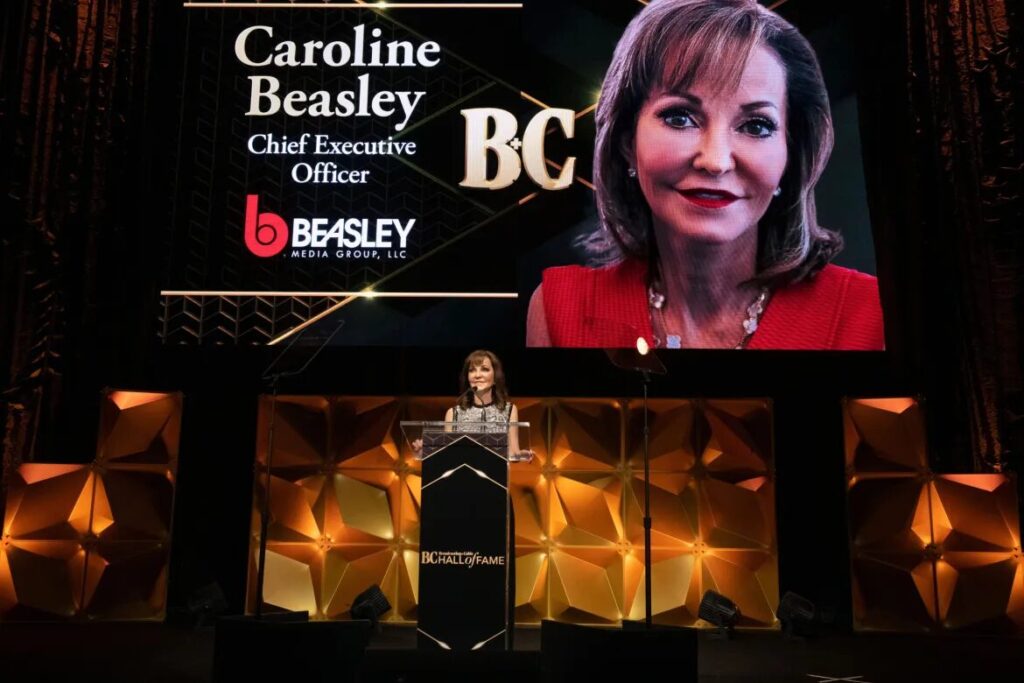
Beasley Media Group CEO Caroline Beasley Joins the 2024 BSM Summit for the Day 1 Keynote Conversation

0

If you read my recap of last year’s Summit, you’ll recall that I expressed an interest in talking with a radio CEO at our 2024 show. Having spent my career in the radio business including covering, consulting and championing the industry for the past 8 years, I thought that’d be easier to arrange than lining up conversations with television and digital executives. Yet over the past five events, it just didn’t work out. We received support from Jimmy Pitaro, Eric Shanks, Erika Ayers, and John Skipper but no luck with radio’s top leaders.

Well, good news. That’s changing this year.

I am excited to share that Beasley Media Group Chief Executive Officer Caroline Beasley is helping us end that streak. Caroline will join me for our Day 1 Keynote Conversation on Wednesday March 13th. Meadowlark Media CEO John Skipper is our Day 2 Keynote Conversation, which means our executive sessions this year will be outstanding.

Caroline Beasley’s credentials as an industry leader are very impressive. She serves as Chair of Beasley’s Board of Directors, and recently served as Chair of the BMI Board of Directors. She is also a member of the Federal Communications Committee (FCC) Diversity and Inclusion Committee, a former Joint Board Chair of the National Association of Broadcasters (NAB) Board of Directors and a former Chairman of the NAB Radio Board.

Her responsibilities don’t end there either. She serves as a member of the Broadcasters Foundation of America (BFOA) Board of Directors and the National Association of Broadcasters Leadership Foundation (NABLF). Caroline has been consistently ranked annually in the top five of Radio Ink magazine’s “40 Most Powerful People in Radio” list, and has been recognized among the “Most Influential Women in Radio” every year since 2003.

Among her many industry accolades, Caroline was inducted into the Broadcasting and Cable Hall of Fame in May 2023. She has also received numerous awards and recognition from the Library of American Broadcasting, the NAB, the North Carolina Association of Broadcasters, and the Mentoring and Inspiring Women in Radio Group (MIW).

Under Caroline’s leadership, Beasley Media Group has operated more than sixty radio brands. Among them are sports radio’s top performer, 98.5 The Sports Hub in Boston. The station consistently delivers double digit shares thanks to an elite air staff, strong leadership and important play-by-play partnerships. For the past four years, The Hub has generated more revenue than any station in the sports format. In addition, Beasley also runs 97.5 The Fanatic, Fox Sports Charlotte, ESPN Southwest Florida, and Fox Sports New Jersey. The company is also invested in the Esports business.

I’m eager to chat with Caroline about the growth of The Hub, the value of play-by-play rights, radio’s opportunities for future growth, and a number of other pertinent issues. Sports broadcasting professionals don’t get to hear everyday how leaders view the present and future of the industry. This will be a conversation attendees want to be in the room for. I appreciate Caroline making time to offer her insights and can’t wait to hear what she has to say.

Tickets for the 2024 BSM Summit are available through BSMSummit.com and the BSM Store. Full details of this year’s final agenda will be posted online at the end of February.

Dave Portnoy: Being ‘Nimble’ Has Been Key to Success of Barstool Sports

0

The digital media world evolves and shifts so quickly, Barstool Sports founder Dave Portnoy has never seen himself as a big vision entrepreneur.

Portnoy joined The Will Cain Show this week and was asked if he had a grand vision for Barstool or if he was the kind of businessperson that keeps perpetual motion going until success is struck.

Dave said he was very much the perpetual motion type. With so much happening so quickly online and in the world of social media, it was hard to develop a grand vision for what to expect.

“In my world, we started as a newspaper, and then the internet wasn’t really humming so there was no way to predict it,” Portnoy said.

Not tethering the company to one thing or a small handful of things has allowed Barstool to succeed, grow, and sustain in Portnoy’s eyes.

“The biggest advantage, there’s a bunch of things. Right place, right time, right guy. But we’ve been nimble. Just nimble,” he said. “We’re not stuck in our ways. And a lot of networks that we competed against are the opposite. They’re stuck in their ways, old school, older.”

“I like to say we’re one of the first true digital media companies, and we’ve just reacted quickly and been able to maneuver,” he added. “I think people ask me, what is the best compliment you can give to Barstool Sports. We’ve managed to stay cutting-edge cool, if you want to say it, for 20 years. Very hard to do for a media company. Eventually, you get stale, get old and the next new guy comes. Maybe thanks to Roger Goodell, thanks to whoever, we’ve managed to stay cool.”

While being able to ride the social media and internet media wave, Dave Portnoy did admit he hasn’t always had the exact formula for success. But it’s all about trusting in the people around him to come up with something or find something, make it work and then milk it for what it’s worth.

“I never thought podcasting would be big,” Portnoy said. “I made fun of our guys doing it early. Good for us they kept doing it, and it exploded. So I’m not the end all be all with knowing what works. We also give our talent a ton of freedom.”

“It’s just finding talent and letting them go nuts,” he added.

Adam Copeland is Thinking About The Modern Audience at KNBR

1

The Bay Area has watched Adam Copeland grow up. That means more than just spending his entire life in Northern California. Sports fans in the area have literally heard Copeland start and stop phases of his life on air at KNBR.

He started at the station as an intern way back in 2009. Now, 15 years later, he is the boss. He took over as the station’s program director in November.

Kevin Graham left the station two months earlier. Copeland did not immediately view it as an opportunity. He just wanted to make sure the people who would be hiring the next programmer knew what KNBR really needed, so he made it a point to keep Larry Blumhagen, Cumulus’s San Francisco market manager, and Bruce Gilbert, the company’s head of sports programming, informed.

“So after about eight weeks, I pitched an idea about bringing a Warriors show to KNBR. We didn’t have the Warriors. It was just an idea I had and there was no leader,” Copeland said. “So my market manager says, ‘Stop this idea.’ And he takes his glasses off and he goes, ‘Do you want to be the PD?’ It stopped me dead in my tracks. I said, ‘Do I want to be? I don’t know that I want to be,’ I said, I think I’m a good guy for the job. I don’t know that the job is right for me. I don’t know that that’s what I want to do.’”

After a round of formal interviews, which included meeting with another candidate to see if that person may be a better fit, Copeland got the job. It would be a new phase of his career in the one place that has always been his professional home.

From the outside, it’s easy to look at what has gone on with KNBR and Adam Copeland in the last 18 months and think it has been a rocket ride. He moved from the early mornings to afternoon drive in 2022 and by the end of 2023, he was everyone’s boss.

It doesn’t quite feel that way to Copeland. He’s the one that was living every day of that 15-year grind. He learned from his father that there is truth in the old saying “you fake it till you make it.” Maybe that is what he was doing on his way to his current job.

“When I was sitting in this chair a couple weeks ago in my office, I thought, ‘Well, I faked it too hard.’ Like, now I’m here,” he says.

Sure, it feels like an accomplishment, but now Copeland has to watch the teams he grew up rooting for with half of his brain focused on the action and the other working out strategy. Case in point, he is happy to see his 49ers capture another NFC title, but it also means that he is responsible for securing the details of the station’s visit to Radio Row in Las Vegas. And, by the way, he didn’t give up his on-air role. He has to find time to prep for the afternoon show in there too.

“It’s a long day every day,” he says. “It’s a stressful day, but it’s a toy factory. We’re talking sports and we’re hanging with buddies, and it’s a blast, dude, I don’t know, that I want to be PD forever, but it’s definitely something that has already been a really cool and fulfilling part of my life.”

The KNBR staff is filled with names and voices Copeland grew up idolizing and rooting for. They became co-workers and now, they are supportive of him as their boss. Copeland wants people like Greg Papa and Tom Tolbert to be themselves. It’s what made KNBR the legendary station that it is. 

That doesn’t mean change is off-limits though. The station is locked in a ratings battle with 95.7 The Game after all. 

After years of going without phone calls, Copeland says the station is giving a voice to listeners again and the listeners are ready any time the phone number or text line is given out on the air. It’s been a real difference-maker.

Some of the changes have not been as fun. Late last year, cuts across Cumulus hit KNBR particularly hard. Copeland was forced to deliver bad news to FP Santangelo, who was hosting at night, and Paul McCaffrey, who had co-hosted the morning show since 2005. They were out. So was morning producer Eric Engle.

Copeland says breaking the news to those guys was one of the hardest moments of his career. He doesn’t like admitting that though, because at the end of the day, he is still at KNBR. No matter how hard it was for him, he knows it was so much worse for Santangelo, McCaffrey and Engel. It was something he realized before he even had to do the job.

“It was terrible. It was awful,” he says. “The angst around it, the nerves around it, the lack of sleep, the appetite stuff. It was really frustrating and upsetting because I was an intern here. I’ve known a lot of these guys for a long time.”

There were no phone calls to his mentors seeking advice, no long conversations about how to handle the worst part of being a boss. Instead, Copeland talked to each person who was losing a job man-to-man and let them know the situation. He says he is still in touch with all three. 

It wasn’t just the people that would be leaving. The staff still at KNBR needed answers too. Copeland knew that they would want to see that there was a plan going forward, that these weren’t just budget cuts for the sake of saving money.

Several producers got promotions. Copeland made it clear that there was a new vision for the station. KNBR had to evolve from a radio station to a media company that included a radio station.

There was external criticism. He didn’t stop his staff from airing their own feelings publicly. But in the end, he knew there was enough buy-in for his vision to be executed successfully. It’s why he can focus on the future now.

He’s thinking about how to reach the modern audience. Copeland makes it a point to say that he doesn’t talk about reaching a “young” audience, because even his mom is streaming audio from her phone now when she is in the car. It’s something he wants his bosses and his air staff to understand.

“Nobody’s flipping on the radio and saying, “Dude, I like this guy. I’m going to listen every day!’ What happens is they’ve got to see a YouTube clip or something on social and they go, ‘That’s interesting. I’ll follow it.’ Then they check in regularly.”

His other focus is authenticity. He points to Rod Brooks, who he listened to on KNBR at night when he was younger. It mattered to Copeland that Brooks looked like him and lived where he lived. It meant that doing this was possible for Copeland when he got older.

It’s not just trying to find other minority sports talk talent. Copeland wants to find people who are not afraid to be themselves. He knows part of what stood out about him on air is that there aren’t a lot of Black people in the Bay Area who will drop everything to talk about the minutiae of baseball. He will.

It’s not just sports opinions and tastes either. He wants talent that listeners hear their own experiences in. 

“When I’m talking about a pizza place that I went to in my hometown in the East Bay of San Leandro, I mention that pizza place, because then a kid from San Leandro texts you and says, ‘Dude, I’ve been to that place!’ That’s how you gather that community,” he says. “It’s about representing the market you’re in and you’ve got to know where you are in order to do that.”

Maybe Copeland won’t be a program director forever. That’s the job right now though, and he isn’t going to half-ass it. He has given his full focus to every position he has held at KNBR and this one is no different. Was he faking it before? That’s hard to say, but he has made it now, and Adam Copeland is set on doing this his way.


Mike Florio: NFL Gives ‘Word Salad’ Answers to Media When Pestered About Gambling

0

NBC’s Mike Florio has grown frustrated with the NFL and its response to questions about gambling and the integrity of the game.

On Pro Football Talk on Wednesday, Florio told co-host Chris Simms that he asked NFL executive vice president of communications, public affairs and policy Jeff Miller if the league office had been hearing all the talk in the media and by fans about games being rigged. But his question was shot down.

Florio prefaced the question using a quote from Commissioner Roger Goodell in 2012, where he said, “If gambling is permitted freely on sporting events, normal incidents of the game, such as bad snaps, dropped passes, turnovers, penalties and play calling, inevitably will fuel speculation, distrust and accusations of point shaving or game fixing.”

“My question for Jeff was, have you seen that kind of speculation and distrust, and what are you doing about it?” Florio said.

“The answer I got, and I don’t want to say word salad in a pejorative way, but it was a word salad of all the things we’re doing, and thank you for asking a difficult question, and yada, yada, yada,” he added. “But he never addressed the threshold question – are you witnessing it? Because Chris, we sure are.”

Florio felt like the legalization of sports betting at the state level has driven calls from fans that games are rigged. The league didn’t seem interested in having a conversation about it.

“It’s more than ever before because the legalized gambling gives people another layer to believe that people are fixing things,” he said. “And he never addressed it, and I’ve sent two emails since then. Because I tried to ask a follow-up and they shut me down before I could.”

“Regardless of what you’re doing to address it, is your fear coming to fruition?” Florio later asked.

Mike Florio was frustrated that the league won’t even entertain a simple question.

“Are they at least willing to address that what the commissioner said 12 years ago is happening?” he said. “You have to acknowledge that, because what you’re doing may not be working. That’s really the bottom line. Whatever they’re doing, it’s not working because the speculation and distrust is rampant right now, and we’re headed to Las Vegas, baby.”

Greg Olsen: I Won’t Demand a Trade From FOX Sports

0

Don’t expect to see Greg Olsen pushing to get a role calling NFL games on another network next season. The NFL on FOX analyst will be moving from the number one broadcast crew to the number two as Tom Brady moves in to call games alongside Kevin Burkhardt.

Olsen told Dan Patrick on Wednesday that even knowing that his time on the A-team was limited, his goals for broadcasting haven’t changed.

“I aspired to be a top broadcaster. I really thought I could do it,” Olsen said. “I thought that given the opportunity and the chance I could show people that I could do it. And I got the opportunity, and FOX was kind enough to give me that. I think over the last two years we’ve really changed the narrative.”

Olsen said exceeding expectations and gaining that confidence that he is capable of calling a Super Bowl only reinforced his drive to get back to being on an A-team crew.

“My goals and aspirations, if anything, have even gotten more committed to, I want to call top games,” he said. “I want to call games in front of 57 million people and dive into the biggest moments and why it’s happening.”

The host asked if Olsen was considering demanding a trade from FOX to one of the other networks, but he didn’t feel like that was his place.

“I’m not really in the business of making demands,” he said. “I’m not sitting here holding anyone’s feet to the fire. FOX understands the position I’m in, they understand what my aspirations are.”

“We understand what we signed up for,” Olsen added. “They understand where I am and being at this stage of my career of where I want to go.”

Greg Olsen joked that it was a delicate situation Tom Brady was coming into. But all he’s focused on is continuing to work on being the best announcer he can. Where that is doesn’t matter.

“I understand the uniqueness of what’s going on, and I feel like we’ve handled it as well as we could for the last two years,” Olsen said. “If I could get another opportunity to call top games at FOX or somewhere else, we’ll cross that bridge when we get there.”

Anatomy of an Analyst: Kurt Warner

Kurt Warner was the engineer of the “Greatest Show on Turf” in their glory days in St. Louis. He became a Superbowl MVP and two-time NFL Most Valuable Player. He took the Walter Payton “Man of the Year” honors as well. Oh, and he was elected into the Pro Football Hall of Fame in 2017. Not bad for a guy that was stocking shelves at a local Hy-Vee grocery store in Iowa while waiting for an NFL opportunity. Warner is the living embodiment of the rags to riches cliché.

Warner was born in Burlington, Iowa. He played football at Regis High School in Cedar Rapids, graduating in 1989. From there, Warner attended the University of Northern Iowa, where he was third on the Panthers’ depth chart until his senior year. When Warner was finally given the chance to start, he was named the Gateway Conference’s Offensive Player of the Year and first-team all-conference.

But Warner’s story almost never happened. After Northern Iowa, he was cut by two teams in the mid-’90’s. He then left the grocery store business in 1995, when the Iowa Barnstormers of the Arena Football league, signed him to a contract. Warner led the Barnstormers to two Arena Bowl berths and was named to the first team All-Arena in 1996 and 1997.

The story of perseverance was going to be tested again after he was given another shot at the NFL in 1998 with the Rams. But the rest, as they say, is history.

NFL CAREER

In 1994, Warner went undrafted and was invited to try out for the Green Bay Packers in training camp. He was released before the regular season began. Warner returned to UNI as a graduate assistant, still hoping to get another tryout in the NFL.

In 1998 the Rams signed Warner as a free agent. They allocated him to the European Football League where he played for the Amsterdam Admirals. Warner led the EFL in passing yards and touchdowns in 1998.

Still nothing was guaranteed for him. In 1999 the Rams left him unprotected for the Expansion Draft to stock the Cleveland Browns. He went unclaimed. So, he stayed with the Rams and began the ’99 season as the team’s second-string quarterback. Following an injury to veteran quarterback Trent Green, who would miss the rest of the season with a torn ACL, Warner was named the starter. Then Rams coach Dick Vermeil said in a press conference following the injury, “We will rally around Kurt Warner, and we’ll play good football.” Truer words may have never been spoken.

Warner made the most of the opportunity and became THE story in the NFL. With Warner at QB, the Rams explosive offense scored 526 points. Warner passed for a league-leading 41 TDs and was named the NFL’s Most Valuable Player that year as the Rams posted a 13-3 record. The team capped the improbable season with a 23-16 victory over the Tennessee Titans in Super Bowl XXXIV. Warner set a Super Bowl record with 414 passing yards and threw a pair of touchdowns to lead the Rams to their first Super Bowl title and was named the game’s MVP.

He recorded another MVP season two years later when he brought the Rams back to the Super Bowl. This time they came up short 20-17 to the Patriots.

In the offseason of 2004, the Rams released Warner. 2 days later he signed a deal to play for the Giants. He started that season as the number one quarterback, but following a two-game losing streak, he lost the job to rookie Eli Manning.

Warner would then sign a one-year deal with the Cardinals and became the starter. After an up and down couple of years, Warner once again was the starting quarterback and made a third trip to the Super Bowl, the first ever appearance in Cardinals history. Warner threw for 377 yards and 3 TDs in a tough loss to the Pittsburgh Steelers in Super Bowl XLIII.

A couple of years later, in January of 2010, Warner announced his retirement from the NFL.

BROADCASTING CAREER

Immediately after his retirement, Warner already had two offers from television networks. Warner said he’d basically had conversations with every network before making his choices. He joined both the NFL Network and Fox Sports in 2010. He worked as an analyst for the NFL Network and was in a booth for Fox as a game analyst with either Chris Rose or Chris Myers to call regional games.

In 2011 Warner signed an exclusive deal with NFLN, leaving his other part-time gig with Fox.

During the football season, Warner joins Rich Eisen, Steve Mariucci, and Michael Irvin on NFL GameDay Morning, the network’s Sunday Morning pregame show. He can also be seen as a regular contributor throughout the week on NFL Total Access.

Warner is also given the opportunity to work from the booth multiple times a year. He’s mainly paired with Eisen on these telecasts.

He added another gig a few years ago. After many attempts to lure Warner to Westwood One’s broadcast booth full-time, the network landed him and made him the new lead color analyst for Monday Night Football and the Super Bowl, starting with the 2018-19 NFL season.

While Warner loves his studio work immensely, there’s something about being at the game that excites the former player.

“I love being on the field before the game, talking to the players, taking in the atmosphere and the energy of the fans,” Warner told NFL.com in 2018. “I love the story of the Xs and Os. On radio, I’m sharing what I’m seeing and how I view the game.”

He’ll continue in his dual role and will be on the call for Super Bowl LVIII in Las Vegas.

AS AN ANALYST

I really enjoy Kurt Warner’s work. He presents a no nonsense, authoritative ,yet friendly demeanor on air. Warner has the credentials in the league to be a guy that could be someone that talks down to the audience, but he’s quite the opposite. He has the ability to talk. By that I mean he’s smooth when it comes to making a point, or analyzing a play. Warner’s thoughts come across energetically in a manner that is extremely clear and on point. He’s smart, comfortable on camera and has that ability to break down the game in a way that’s understandable for die-hard and casual football fans.

You can tell that there’s a chemistry on NFL GameDay Morning. These guys, Rich Eisen, Steve Mariucci, Michael Irvin and Warner present themselves as guys that actually like each other.

“When you watch us, you feel like you’re hanging with a bunch of guys in a living room who are talking football and having a good time,” Warner told NFL.com in 2018.

Warner has shown the ability to be versatile as well. He’s been in the studio, in the booth on television and also on radio. That’s not an easy trifecta to pull off by anyone. The constant reps he gets on the Monday Night radio broadcasts certainly go a long way in building confidence in his other roles along the way.

He doesn’t take himself too seriously at times either. Warner isn’t afraid to poke a little fun at himself.  Warner recently went viral for a response to a Steelers fan proclaiming the James Harrison interception return for a touchdown of Warner in Super Bowl XLIII as the best play in Super Bowl history. Warner saw that post on social media and politely disagreed with that fan’s opinion. With a repost, simply saying “Kind of depends on who you ask!!!!”

DID YOU KNOW?

Kurt Warner had a movie made about his life called “American Underdog”.

On August 30, 2010, it was announced on live television that Warner would be appearing as a contestant on Dancing with the Stars. His professional dance partner was Anna Trebunskaya; the couple was eliminated in week 8.

Does Your Social Media Plan Have Goals?

0

You’ve been told that you have to be on every platform these days, that the audience is all over the place and you need to create social media content and put it where they are.

So you post on Facebook and Instagram and X and Threads and TikTok and Snapchat and BlueSky. Maybe you have a corporate department doing it for you, or you have to do it yourself, or some intern is making sure there’s content on all your social media pages. You’re making videos, you’re posting memes, you’re engaging with people in the comments. You’re doing everything you’re supposed to do.

One question few media managers seem to ask when they create social media plans for their operations: Why?

I’m not questioning that to reach your audience and to grow it, you have to go where they are. What I’m wondering is whether most companies, stations, and shows that embark on ambitious plans to gain clicks and likes and attention on Facebook and TikTok have an end result in mind. Are the posts meant to generate revenue in and of themselves? Are they meant to get people to click through to a website, and how is that being monetized? Are they meant to just promote, and if so, how are you measuring the effectiveness of the promotion? Do videos of a stunt in the studio or clips of interviews get people to listen to a radio show or podcast? Do news headlines redirect users to the full story, or do people just read the headlines and move on?

How, in other words, do you measure a social media plan’s success?

I never got a clear answer for that question when I asked it at more than one company in my career. In fact, all I got was “you just don’t understand” and intimations that I was an “old media” guy in a new media world, ignoring that I was involved in both podcasting and streaming audio before most people even knew what those were, and that those concerns were as valid then as they are today. The question, however, still stands: If you’re putting in all this effort to create stuff for various platforms, what’s the end game? Okay, you’re having spirited exchanges with people in the Facebook comments; is that being directly monetized, is it directing people to check out your primary (radio, TV, website) product, or are you diverting them from time they could be spending with that product?

I wonder how many media executives are asking themselves those questions. I see major radio companies getting “likes” and followers on X with posts that are just gushing over pop stars, no links or other content included. What’s that for? I see news organizations posting headlines and links, but I wonder what the click-through rates are, especially when a station in a smaller market is just posting national and international headlines – is anyone going to click to News-Talk 950 in Podunk when they can go to CNN or The New York Times instead? If your target audience is older, is TikTok really necessary? And – here’s the big question – are you spending time, money, and effort creating content that is making Facebook a lot of money that isn’t being sent along to you? Do you work for Facebook or are you making Facebook work for you? And is X working for anybody these days?

The bottom line should be obvious: Stop doing things just because someone says you’re “supposed to be doing them.” Take a moment to create a game plan for social media that is designed to have a concrete, measurable result, not just a nebulous “it’s good exposure” or “it’s where the kids are these days.” Decide on an end result and design a plan that is likely to get there.

Otherwise, you’re wasting time, just like the rest of us who spend most days doomscrolling on our phones. That’s not good for anybody.