The 2024 BNM Summit is in the rear view mirror but the sessions from the show are now available on demand. One thing different this year, we’re making them available to watch for FREE.
Whether you were on stage, in the room and missed something, want to use an example to help your staff or didn’t attend and want to see what you missed, all you have to do is click this link and watch what you’re interested in. We’ve even made the 2023 BNM Summit sessions available too. Scroll down the page and you’ll find them as well. It should inspire some to take the plunge and join us next time.
We host this conference to unite the industry, share ideas and information, and to improve the media business. Celebrating the industry’s best is also a part of the show. Recognizing those who create impact on a consistent basis is the least we can do.
Forty six accomplished professionals graced the stage this year from different organizations. The wealth of knowledge in the room benefits anyone and everyone who pays attention. We use examples to highlight successes, failures, opportunities, and challenges. Being sensitive doesn’t help your brand, staff or businesses grow. Educating the room and offering a stronger understanding of what you’re up against is the motivation behind the two-day agenda.
We will host our third news media conference in the fall of 2025. New York, Philadelphia, Dallas, and Los Angeles are the four cities under consideration to host the event. Cast your vote on where we should go at BNMSummit.com.
CBS News has launched a free, ad-supported television (FAST) channel dedicated to 60 Minutes, beginning today.
The new channel made its debut on Paramount+, Pluto TV, and the CBS News streaming platform this morning. CBS News added that additional partners for the new channel will be announced at a later date.
The 60 Minutes streaming channel joins a growing lost of FAST channels created by Paramount Global. Previous channels include a dedicated stream for 48 Hours, CBS News 24/7, and channels dedicated to Inside Edition and Entertainment Tonight, among others.
Viewers of the channel will see classic segments from previous correspondents like Mike Wallace, essays from Andy Rooney, and former high-profile interviews with newsmakers, political leaders, celebrities, athletes, and innovators.
Additionally, extended versions of interviews will be available, as will updates to previous stories and extra content not seen during the usual one-hour broadcast will be available on the streaming outlet.
60 Minutes producer Nicole Young has been elevated to Senior Producer of the broadcast and will lead special projects for the brand, including the new FAST channel.
The news of the FAST channel coincides with the return of the venerable news magazine for its 57th season this Sunday.
Deebo Samuel, wide receiver for the San Francisco 49ers, is working with Bleacher Report to launch a new video podcast through which he will interview top-tier NFL wide receivers and elite athletes in the league to talk about their lives on and off the gridiron. The show, which is titled Cleats and Convos, will be co-hosted by Liv Moods and air every Tuesday for 16 weeks during the 2024-25 NFL season within the Bleacher Report app. Samuel joins a roster of athletes who are creating content through the Warner Bros. Discovery digital subsidiary, discovering new ways to connect with fans and divulge their opinions on action around the league.
Through the new show, Samuel is expected to take viewers behind the scenes into his mindset of being a No. 1 option on the San Francisco 49ers. The team has made the playoffs in the last three seasons but has not won a Super Bowl championship since 1994. Nonetheless, the 49ers have a deep roster of talented players that includes Samuel, along with Brock Purdy, Christian McCaffrey, Nick Bosa and George Kittle, and are projected by many league experts to make the playoffs and/or win the Super Bowl championship. Samuel will balance his responsibilities on the field with his new media venture, granting consumers a new avenue to learn more about the league.
“I can’t wait to give fans a true glimpse into the lives of their favorite playmaking wideouts, premiere athletes and artists who share the same mentality and the real conversations we share with each other about football and life,” Samuel said in a statement. “B/R is the perfect platform to host the show, and I’m excited to join their team of athletes doing new things in the social space.”
The announcement is the first new football show since Dallas Cowboys linebacker Micah Parsons became the president of the B/R Gridiron division of the company. The slate of shows now includes superstars on both sides of the ball, with Parsons premiering a new season of The Edge in late August on the B/R app. In addition to the football offerings, Bleacher Report also continues to air new episodes of On Base featuring Los Angeles Dodgers superstar infielder/outfielder Mookie Betts.
“The addition of Deebo and Cleats and Convos to our roster of athlete-led shows is a huge win for the B/R Gridiron team, and, most importantly, the fans who look to B/R for real sports content,” Parsons said in a statement. “Deebo and I are ultimate competitors on the field, but I couldn’t be happier about welcoming him to the B/R Gridiron team.”
The first episode of Samuel’s new Bleacher Report show will premiere on Tuesday, Sept. 17 ahead of the team’s Week 3 matchup against the Los Angeles Rams. Samuel will record the program from his personalized podcast studio throughout its duration. Content within the first episode, including potential guest appearances, is currently unknown.
Earlier this year, the Dallas Stars revealed the launch of its Victory+ streaming service. Now, Dallas sports radio station The Ticket is joining the new platform.
Beginning on Wednesday, September 25th, The Ticket — which has served as the radio flagship of the Dallas Stars since 2009 — will be available on the digital streaming platform.
“Joining the Victory+ family will allow for expanded digital distribution of The Ticket that makes it easily available to Dallas Stars and Dallas/Fort Worth sports fans no matter where they are outside of their cars,” Cumulus Dallas Vice President and Market Manager Dan Bennett said. “We are thrilled to have the opportunity to expand upon our lengthy relationship with the Stars and benefit from the industry-leading technology that APMC brings to the table.”
“The synergy that The Ticket on Victory+ provides our fans is unmatched in the sports industry,” added Stars President and CEO Brad Alberts said. “Our fans are now able to consume even more Dallas Stars content however and whenever is convenient for them. The Ticket has become synonymous with our hockey team, and this is just another chapter in our strong relationship.”
Victory+ was launched to serve as a free, direct-to-consumer streaming service that will allow Dallas Stars fans in Texas, Oklahoma, Louisiana, and Arkansas the ability to watch the NHL franchise’s games.
“The Ticket is known for keeping listeners up to date on all Dallas Stars happenings and now being able to listen on Victory+ will give fans an all-in-one experience across devices,” said A Parent Media Comapny Inc. President and CEO Neil Gruninger.
Kim Zandy is returning to mornings at Cumulus Media’s Top 40 WPRO (92 PRO-FM)/Providence.
Zandy co-hosted “Giovanni in the Morning” on 92 PRO-FM for 24 years until her exit in 2023. She will join hosts Bekah Berger and Jay Buff, who both debuted on the show in May following the retirement of legendary morning host Giovanni.
Zandy said, “I am so lucky and excited to join Bekah and Jay in Mornings. They did all the hard work to get the show to #1 and I get to come in and have a great time! It is amazing to be back home on 92 PRO-FM Mornings!”
Holly Paras Cumulus, Providence/New London Regional VP/Market Manager, added, “It is a phenomenal moment to welcome Kim back to 92 PRO-FM and to bring our listeners more of what they love in Mornings. We are very pleased to add additional live talent to an already successful show.”
In a joint statement, Buff and Berger commented, “We are thrilled to warmly welcome back Kim Zandy to the 92 PRO-FM family. Her vibrant personality and deep connection to the community make her the perfect addition to Mornings, and we look forward to creating amazing moments together with our listeners in Southern New England and beyond.”
Just over one year after launching a conservative news/talk format on 910AM Superstation, owner Kevin Adell is putting the Detroit news/talk outlet up for sale and hoping to walk away from the broadcasting industry.
Adell told The Desk that he is selling his Detroit television station, his 50,000-watt AM radio station, and his religious broadcasting network The Word.
“If I don’t live with you, and it’s not nailed down, it’s for sale,” he told the outlet.
Earlier this year, a deal between Adell and Mission Broadcasting to purchase his Detroit TV station fell through after the FCC received objections to the deal. Mission Broadcasting was going to purchase the station for $75 million, but its backing came from Nexstar Media Group, which other broadcast owners argued would benefit the TV giant.
Kevin Adell said that he hopes the sale of his media assets — along with a 22-acre parcel of land in the Detroit suburb of Novi — would give him enough money to repay his minority business partners and purchase a sailboat.
“I think I will do a much better job fighting with sailfish than the FCC,” he concluded.
Launched in September of last year, 910AM Superstation featured a conservative lineup built with many of the nationally syndicated shows from Premiere Networks like The Glenn Beck Program, The Clay Travis & Buck Sexton Show, The Sean Hannity Show, and The Jesse Kelly Show, among others. The station does have a local morning show, hosted by Justin Barclay.
Inside the NFL is now in its 47th season, but this year’s incarnation which airs on The CW, comes down to the talent and growth of its new host: Ryan Clark. This dude has staked his claim as one of the most insightful, biting, intelligent, probing, and knowledgeable NFL commentators in the business.
Clark pulls no punches and gives his opinions, but a lot of people do that. What separates Clark is the content of his commentary. He likes to throw in a unique turn of phrase, whether it’s a Bayou reference from his days at LSU, or a piercingly humorous take on a player or issue.
Clark is much more than an ex-jock turned gabber. In a relatively short amount of time, the former Pittsburgh, Washington, and New York Giant defensive back has become a premier part of several ESPN programs. He’s also lighting it up on multiple platforms. Clark is Willie Beamen in the film Any Given Sunday, a warrior football poet. Want another big screen reference? To paraphrase Eddie Murphy’s Reggie Hammond character in 48 Hours, there’s a new sheriff in town, and his name is Ryan Clark.
The latest installment of Inside the NFL gives Clark a chance to take control of a mainstream NFL television program. On the August 30 premiere episode, Clark took the wheel of the ship with first mates Bill Belichick, Chris Long, and Chad Johnson. Talk about an eclectic crew. This foursome has little in common with each other, other than the fact that Long and Johnson had brief stints with Belichick in New England.
They say opposites attract, and that is definitely the case with Inside the NFL. The premiere show featured a unique cold open with the panel talking about Ryan Clark’s jewelry. It was just off the cuff banter, but it was different, and I like that.
The quartet sat in studio around a conference table and opened with both Johnson and Long talking about their time with the Patriots and what they learned from Belichick. As they were speaking, B-roll showed Belichick in action coaching both players.
Clark has truly taken the reins of the show and has made the often-difficult transition from analyst to moderator look easy. He clearly explained to viewers how Inside the NFL was going to be different this season.
The panel discussed the Kansas City Chiefs’ chances of winning their third straight Super Bowl with Belichick stressing continuity in the coaching staff. Kudos go out to the Inside the NFL production team. Clark made mention of rookie KC wide receiver Xavier Worthy and without even an introduction to the clip, viewers got sound up video of Worthy scoring a preseason touchdown.
On Inside the NFL, It’s not the usual talking head to video repetition. You never know when video will become part of the conversation. Johnson, the erstwhile Bengals receiving legend, provided some nice commentary on how speed will propel Kansas City this year. Johnson knows the game, but I would like to see more of his emotional and personality-laced commentary, and less interjection of stats. It slows him down and lessens his impact.
When Chris Long speaks, you cannot help but think of his dad, the Hall of Fame Raider defensive end and equally great FOX broadcaster Howie Long. He sounds like his dad and has that same relaxed pacing and vocal inflection. Don’t get me wrong, Long is his own man on TV. The former Ram, Patriot, and Eagle is a two-time Super Bowl champion and a fine commentator in his own right, but that Long pedigree is wonderfully visible.
Right out of the first break, the show came back with video of the Inside the NFL pre-show meeting, then clips of several NFL teams at practice. Again, the video variety and innovative edits on the program stand out to me. The on-air team has great chemistry, but they are not afraid to challenge each other. Johnson lauded the preseason of Bears’ #1 pick Caleb Williams while Clark pinpointed the Falcons as a team that caught his eye.
Belichick countered by saying that you really can’t take anything away from preseason games because starters are not getting a lot of playing time. He backed up his point saying that Williams wasn’t even accurate during the preseason as he was 10 of 20 on pass attempts.
This show is all about diverse perspectives. Each of the four panelists bring a unique skill set and résumé to the proceedings, and that makes for fascinating exchanges. Clark has a slick way of tying up every conversation and topic in a neat bow as they move to a break or another subject.
Perhaps the most interesting segment on the premiere show featured Clark and Belichick analyzing the performance of Walter Payton in the 1975 College All-Star Game. Belichick revealed that this was the first game where he had to break down film as a young coach for the Baltimore Colts who were opening with the Bears that season.
In this now defunct game, top college players would play against the previous year’s Super Bowl champion. Can you imagine that happening today? Listening to Belichick reminisce and analyze provided a cool little nugget of NFL history, something that is lacking on most NFL programming.
The show also features the Ocho Predicto segment where Johnson, alongside Long, makes prognostications. This segment lagged and was a bit boring to be honest. Both Johnson and Long have electric personalities. The show’s producers need to tap into this more. They can really have some fun with these two if they get creative.
Clark showed his interviewing chops in a nice back and forth with Chicago RB D’Andre Swift while Belichick looked back on his former player Rodney Harrison in the Football Guy segment. In this segment, the panelists try to pitch Belichick on their picks for this week’s tough-minded Football Guy. In the end, Belichick selected Johnson’s pick of Niners’ WR Jauan Jennings.
Of course, if you have Bill Belichick on your show, you have to have a Game Plan segment where he breaks down NFL plays, but in a twist, the first part of the segment on this episode looked at how to manage the distractions of the NFL Kickoff game for the previous year’s Super Bowl champion.
Belichick’s old school surliness surfaced here as he reflected on his arguments with the Patriots’ marketing staff to eliminate the hype and get on with the game. Good stuff. Eventually, Belichick did offer a straight up breakdown of this year’s NFL Kickoff game between Kansas City and Baltimore.
I give high praise to the show’s director here for the back-and-forth cuts from Belichick to the three former players at the desk. Long, Clark, and Johnson were totally rapt in what Belichick was saying as if they were his players sitting in the locker room. They were so transfixed, I thought they were ready to don helmets and pads and hit the field.
Inside the NFL version 2024 is not perfect, but with a few tweaks, it could be something special. Pick up the tempo in spots, keep Belichick in his coaching mode, delve further into the personalities of Johnson and Long, and maintain Clark’s dynamic flow and presence, and it might just become a can’t miss show for NFL fans this season.
It’s no secret that most radio stations have seen a drop in revenue over the past couple of years. Market Managers, Program Directors and news talk radio hosts may be in a precarious position. Depending on your corporate structure, a show is judged on billing over ratings. That being said, ratings help drive revenue. In News/Talk, sometimes a host with subpar ratings drives huge amounts of money for the station.
Market Managers are under a constant barrage of pressure. The sales goals are a huge challenge. If your station group is missing the goal with 6 weeks left in the quarter, your Market Manager will be driving the salespeople to get all the money possible on the books. Ultimately, the Market Manager will be blamed if the cluster is not hitting their revenue numbers.
The other challenge involved expenses. As a Program Director, I have always attempted to pad the staff budget for the coming year. Your Market Manager may really drill into the numbers at budgeting time and will not allow this. More on my budget methodology later in this column.
If your cluster has an unexpected expense, your Cluster’s bottom-line expenses may exceed the budget. Your Market Manager is under enormous pressure to hit those numbers. Very likely, if you are the star host on a station, your salary may be one of the biggest expenses on the station. So, if your cluster or better yet your station is seeing a drop in revenue, you should believe that your expense is being discussed. Have you asked about the billing attributed to your show alone? Is that billing down? Are you asking for a raise with lower revenue?
Program Directors, you must evaluate and manage your expenses. With corporate debt, your department’s expense line may not be allowed to grow without considerable rationalization. If your station has expenses to do sports, special broadcasts and/or anything else, you must account for it ahead of time.
My second programming job, I started in March and due to sports and other special broadcasts we hit our yearly budget with 3 months left in the fiscal year. Even though I had nothing to do with the budgeting for the previous Program Director, I was required to submit reports on why the station had exceeded the staffing expense in the programming budget. I learned that it is much easier to come under budget than over.
You know the initiatives for your company and cluster. You also know that increasing pay for board operators is a real issue. If those people are not being paid more than a fast-food worker, you could lose them. You know your company; how far can you push your budget? You need to have your budget realistic and be prepared with rationalizations. If you are able to reasonably build in a padding, coming in under budget makes you a hero. Coming under budget also shows that you are an expert in managing your department.
You have been the premiere host on your station and in the market for years. You’ve received steady pay increases over the years. You have a history of driving revenue for the station. There is a yin and yang you must consider. Let’s say that your station’s year-to-year billing is down 3%. That is a very likely number from the reports that I am seeing across the industry. It may also be affecting your show’s revenue. Do you know how much your show is billing? Is it up? If down, how far has it fallen?
Do you like your job? Here is my advice, if billing is down on your station and show… Take a pay cut. Not only take a pay cut, request a reworking of your contract to lower your pay. Your company expects a certain return from your show’s revenue. In the last five years, if your salary has increased by 15% but the billing has fallen by 10%, your expense will seriously be examined.
I have a friend of mine who was a longtime host on an adult contemporary station. His show’s ratings had begun to soften, but the revenue had mostly held up. He kept asking for raises and getting them. At one point, his salary growth was seriously outpacing revenue. He was downsized. If you ask him now, he will tell you that he should have asked for salary decreases. He would have kept that morning show revenue going for several more years.
I hate being the bearer of bad news. You should seriously evaluate your show’s revenue track. If your show’s revenue falls by 3%, ask for a contract renegotiation. Ask for a salary decrease of 4%. This will extend your career. If you can’t fathom doing this, here is a real-life example. Big time host was downsized and couldn’t find another job. So, he was pushed into a new career.
This locally well-known radio personality is now selling life insurance. His office is adorned with radio memorabilia. He has pictures of his previous job as a local celebrity and influencer. Perhaps, you can be a blackjack dealer. What about joining the car salesman crew? I want you to work in this field as long as you wish. I know that asking for a pay decrease seems like a bad idea. But it might be reality.
My favorite conversation at the Barrett News Media Summit in Washington, D.C., last week began with, “Wow, what are you doing here?” It’s always great to run into a colleague you haven’t seen in two decades!
For all the news headlines, social media posts, blogs, and message board posts that are often negative, bearish on radio, or indeed heralding bad news like corporate RIFs or cutbacks, despite all of this, the spirit and mood of the summit was very positive, upbeat and focused on the future. There was talk of the importance of personalities, local newsrooms, and investing in marketing and contesting. There was less worry about intrusive AI and more talk about harnessing digital revenue with the over the air brand the center of radio station strategy.
A few highlights:
NAB President/CEO Curtis LeGeyt noted the organization’s work to attempt to funnel federal dollars to local newsrooms in smaller markets and more isolated communities, plus the continued importance of protecting the terrestrial band’s availability in new car models, particularly AM
Radio One CEO David Kantor gave a master class in leadership strategies, noting the importance of team buy-in on consistent plans to get the most out of them.
High-profile talent, including Premiere’s Clay Travis and Cumulus’ Chris Plante, both talked about the importance of preparation, of listening whether it’s a guest or a caller and on staying connected to the audience on multiple platforms (Clay had copies of his latest book to hand out)
There was an inside look into Radio Cloud partnering with McVay Media and Gemini to launch ‘The TJ Show’ on “pop-up” station TJ 98.7 in the Big Apple.
Most importantly, it was great to connect with a few great contacts and friends I’d not yet met in person. Others were great to see again, as well as a few who’d made a real difference in my career. Radio needs more of that more often. A feeling of optimism about what is possible as an industry might just lead us to work a little harder and smarter at our next great chapter.
We also did our “Robby and Rochelle in the morning” show for WWZY/WBHX from the Arc Hotel and snuck over to the mall to capture this gem!
We have been doing our “Meet the…” series in conjunction with Point-to-Point Marketing for a few years now. The latest iteration is called ‘Meet the Leaders,’ focusing on executives of audio companies across the spectrum. Given both his history and his current role, there may be no one better to start the series with than Saga Communications’ Senior VP of Content Pat Paxton.
Paxton took the role last year. He oversees stations in 28 markets across the country. The size of the markets makes his job very different than the one he held at Audacy until 2021.
Saga is a company focused on delivering relevant local content in smaller markets than the ones some of the bigger conglomerates in the radio business lust after. Paxton is adamant that doesn’t mean his team at Saga is any less talented or knowledgeable.
In our conversation, we touch on the future of the programming role, how digital buys are changing, and what he would say to potential advertisers questioning radio’s relevance in 2024. All of that is just the tip of the iceberg though.
Demetri Ravanos: How has your role changed since you first started overseeing programing at a corporate or national level? Now that the position is called VP of Content, that seems to encompass a whole lot more than it used to.
Pat Paxton: It’s a lot more than it used to be, but in many ways, it’s the same as it used to be at the end of the day. Our job is to create premium content that attracts consumers. That part hasn’t changed.
The difference, the changes obviously, have been the advent of digital, the advent of social, the advent of mobile, the advent of all the different distribution channels, and the advent of all the new competition. I mean Amazon, Spotify, Apple, etc. We have to be better than we used to be. We’ve also dealt with the technological changes that give us the opportunity to broadcast anywhere, anytime from any device. Which is a huge advantage for us and one that we’re still working to take full advantage of.
DR: So, with those new digital competitors, especially things like Spotify and Amazon offering people whatever it is they may want the second they want it, how does that change the way that radio is pitched – be it potential advertisers or even to listeners? What are you emphasizing that is available on radio that isn’t on those digital products?
PP: Well, radio can be a number of things. It could be a music concierge. Radio goes through all the music out there and chooses the best songs, so the consumer doesn’t have to. There used to be a thing called owned playlists. They’re way down on the list of listening because people get tired of listening to their own playlist. They want something fresh and something different, and the way that they learn about new music is by listening to the radio. So that part of radio, the music discovery side of things, hasn’t changed.
Another thing is that at Saga we serve our local communities. We talk about what’s going on in our communities. We are the number one source for local information in our communities. That’s something that none of the pure plays could ever do, and that’s one of the things that makes us so different, so unique and so attractive to the people in the areas that we serve.
DR: I wanted to hit on that very thing. I would like to know a little bit about how you operate at a national level, because all of the company’s web presence really gives the impression that the local markets have a lot of autonomy. So how do you go about working with the leaders in those markets to make sure everything is fitting into the ideals and strategies that corporate has in mind?
PP: Communication. It’s just talking. It’s the local markets understanding what the corporate initiatives are and corporate understanding what local needs to do to be successful and then helping them. It’s a servant type of leadership. Our radio markets make the money and we’re there to help them do well. We’re there to help them build audiences, build revenue and take full advantage of the marketplace that they’re in.
There are certainly corporate initiatives too that the markets take part in, and there’s certainly expertise in the local markets that corporate needs to listen to. It’s a mixture of both, and it’s communication that keeps it all meshing together.
DR: You have worked a lot in the type of role you’re in now. When you’re coming from somewhere like an Audacy or Entercom you’re used to working with large and major markets. Was there anything you needed to learn or rethink in order to be an effective leader for a company like Saga that has a lot of smaller market stations?
PP: One thing that really surprised me is how good the smaller markets are. Obviously, I was working in the larger markets and so I didn’t have a lot of time to pay attention to some of the smaller markets. Getting to know the people, the programmers, the talent, getting to sit and talk strategy with the market managers and the program directors really was an eye-opening experience for me. These are really, really smart people.
These radio stations are programed extremely well. They’re hitting at the center of the marketplace that they serve way more so than what I had been involved with before. That makes them really special and unique.
Where we compete against other radio broadcasters and certainly against pure plays, there are very few that can out-local us. That’s our unique calling card and that’s what will continue to be our specialty.
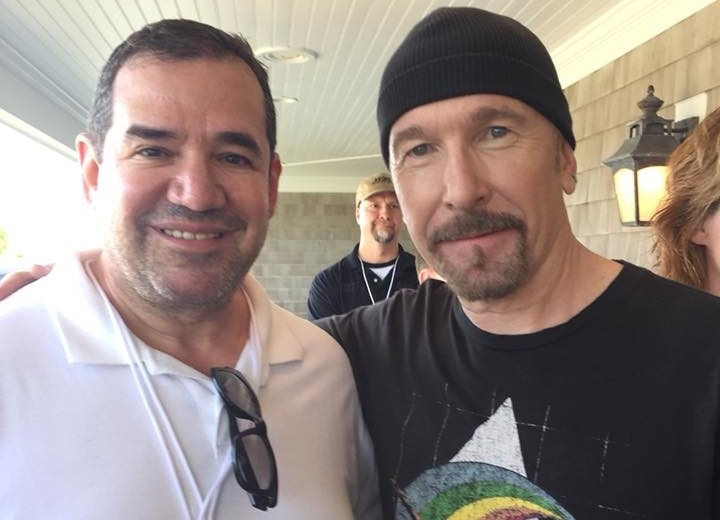
Pat Paxton with U2’s Edge
DR: We’re in this time where everyone in the media business, regardless of what your platform is, they’ve seen ad dollars shrink. And I wonder if, because you are working in markets where that local buy is so important, are there strategies beyond cost cutting that seem worthwhile to you? There are fewer ad dollars out there so what are you talking about with your stations to make sure their product is the most appealing to advertisers?
PP: There are fewer dollars going to terrestrial radio, but huge dollars are available to us. The digital market is a massive opportunity for the radio industry.
I think every company out there is making a big play into digital to help supplement some of the dollars that aren’t spent in radio anymore. We’re no different with our digital platforms and multiple digital initiatives.
DR: When you say mixed digital assets, are you talking about offerings beyond just putting ads on the web stream or in front of podcasts?
PP: Yeah, I mean our mobile assets, our apps, our social media assets, taking advantage of search and all of the different tools out there that clients need to be successful in today’s marketplace.
DR: So I want to wrap by asking you a question that we kind of touched on a little bit earlier, but in your role, like for years, people have viewed the idea of a VP of Programing or VP of Content, whatever the title may be, as almost a threat or a sign that the local programing positions may be someday eliminated.
You did a really good job of outlining why local bodies are important, but you look at some of these music formats where the hits are the hits, and I don’t think it’s crazy to wonder if programming at the local level may disappear. Tell me why I’m wrong.
PP: The hits are the hits, but the music is just one aspect of programming and executing a great local radio station. Relating to our local audiences isn’t going to happen by just playing music. We need people to do that. Local people. There is so much that goes into programming great local radio. We couldn’t do it without great local talent at every level.
DR: So what about when it comes to talk formats? In those formats, sports in particular, and news as well, the programing role on the local level becomes much more about coaching talent than it does about picking the content.
PP: I think for spoken word, you look at syndicated and local talent, and you’re going to see local talent outperform syndicated almost every time. That doesn’t mean there aren’t some great syndicated talent out there. There certainly are. But I know with all of our talk stations, which are a mix of syndicated and local talent, our local talent outperforms syndicated.
To learn more about Point-To-Point Marketing’s Podcast and Broadcast Audience Development Marketing strategies, contact Tim Bronsil at tim@ptpmarketing.com or 513-702-5072.