Home Blog Page 1659

Newsradio WFLA Gets Lift From ‘The Ryan Gorman Show’ in Tampa Winter Ratings Book

0

The Tampa news/talk radio scene is one served by several different brands. However, Newsradio WFLA has cemented a leadership position thanks to the combination of a strong local morning show, and the biggest names in national syndication courtesy of Premiere Networks. In the winter ratings book, the Florida talk station relied on both to produce success.

Mornings feature The Ryan Gorman Show from 5a-9a. In the traditional 6a-10a timeslot, which includes three hours of Gorman, and the first hour of the nationally syndicated Glenn Beck Program, WFLA earned a 4.2 share to finish 8th with Persons 6+. That was up from a 3.0 during the same time last year. Gorman officially took the reins in morning drive in March 2023. The show was lower though with Persons 25-54 (2.0 share), and Persons 35-64 (1.4 share).

Middays on the iHeartMedia-owned station featured the final two hours of Beck’s show along with the entirety of The Clay Travis & Buck Sexton Show. Those two programs collectively delivered a 2.9 share (Persons 25-54) and a 1.6 share (Persons 35-64) from 10a-3p EST.

The afternoon daypart, which features The Sean Hannity Show from 3p-6p, and the first hour of The Jesse Kelly Show recorded a 1.5 with Persons 25-54. That was slightly higher than the 1.4 pulled in with Persons 35-64.

In weekday prime (M-F, 6a-7p), WFLA reeled in a 2.2 share with Persons 25-54. That was seven tenths (1.5 share) higher than its performance with Persons 35-64. For the full week (M-Su, 6a-12a), WFLA scored a 1.8 share with Persons 25-54, and a 1.4 with Persons 35-64.

A few additional positives for the quarter saw WFLA produce a 5.3 share with Persons 35+, good for sixth place. That represented a jump from a 3.2 year-over-year. Among Persons 6+, the station also finished 6th with a 4.5 share, up from a 2.9 share/13th-place showing in the winter 2023 book.

Ratings information for AM 860 The Answer and Impact Radio 1250 were not available.

Ratings reports and analysis are written by BNM and sponsored by Crowd React Media, a division of Harker Bos Group. Learn more about the different ways media research can benefit your station and cut through the noise by clicking here.

101 ESPN Delivers Double-Digit Shares Across All Shows in St. Louis Winter Ratings Book

101 ESPN turned in one of its strongest books to date during the winter ratings period. The brand received double-digit share performances from each of its weekday shows.

Starting with mornings, The Opening Drive registered an impressive 11.3 share with Men 25-54 to finish second. The program, which features Randy Karraker, Brooke Grimsley, and special contributor and former St. Louis Cardinals play-by-play announcer Dan McLaughlin recorded the quarterly gain at the station, gaining 4.4 shares from its fall book. Among Persons 25-54, the show posted a 9.6 share, third-place outcome. That was up from a 10th-place tie, 3.9 share finish during the fall. Additionally, the morning show obtained a 16.2 share, second-place result with Men 18-49.

Immediately following the morning show, Balloon Party with Tim McKernan, delivered a 14.8 share to finish first between 10a-11a CST. Compared to the fall book, McKernan added 3.4 shares while moving up two rankings. Brandon Kiley and Alex Ferrario retained the trajectory in the latter stage of middays from 11a-2p CST with an improvement from third to first place. For the winter book, BK & Ferrario produced a 14.9 share, which was up 3.6 shares from the prior book.

Both midday shows finished third with Persons 25-54 with a 9.6 and 9.5 share, respectively. Within the Men 18-49 demographic, Balloon Party finished second with a 16.2 share, while BK & Ferrario took first with a 15.9 share.

Carey Davis officially joined The Fast Lane in late-December, making this his first full book with co-hosts Anthony Stalter and Jamie Rivers. The trio didn’t disappoint. The four-hour afternoon drive program popped an impressive 15.2 share with Men 25-54. The show built on the 11.7 share, second-place outcome it fulfilled during the fall ratings book. Among Persons 25-54, the show snagged an 8.3 share to rank third, up from a 6.1, sixth-place finish in the fall. The Fast Lane collected a 14.6-share, first-place outcome among Men 18-49 within the winter ratings period as well.

In weekday prime (M-F, 6a-7p), 101 ESPN ranked second with a 13.5 share among Men 25-54. The brand picked up 3.7 shares and one ranking position from the fall ratings book. With Persons 25-54, the station delivered a 7.9-share, third-place outcome, up 2.4 shares and three ranking positions for the quarter. Additionally, among Men 18-49 demographic, the Hubbard Broadcasting-owned station secured a second-place, 13.9 share.

For the full week (M-SU, 6a-12a), 101 ESPN grabbed a 12.1 share to rank second. That marked a 3.1-share improvement from the fall and a move from third to second. With Persons 25-54, the station’s fourth-place, 7.3 share was up from a 5.2 share, ninth-place outcome in the fall. Moreover, the station procured a 12.1 share, second-place result among Men 18-49.

Ratings information for 590 The Fan was not available this quarter since it did not appear within the Nielsen quarterly ratings report.

Ratings reports and analysis are written by BSM and sponsored by Crowd React Media, a division of Harker Bos Group. Learn more about the different ways sports media research can benefit your station and cut through the noise by clicking here.

106.7 The Fan Finishes Top-3 in Morning Drive, Middays in Washington, D.C. Winter Ratings Book

Audacy-owned 106.7 The Fan continued its winning ways in the Nielsen winter ratings book. Beginning with weekday prime (M-F, 6a-7p), the station garnered a 7.3 share among Men 25-54, good for fifth in Washington, D.C.. That was down year-over-year from the 9.4 share, first-place outcome it realized last winter.

In mornings, The Sports Junkies drew an 8.0 share to secure a third-place finish. John Auville, Eric Bickel, Jason Bishop and John-Paul Flaim were up seven tenths of a share from the 2023 winter book.

Shifting to middays, Brian Mitchell and JP Finlay recorded an 8.2 share in the winter book, placing the show third among Men 25-54. The program amassed the largest share at 106.7 The Fan for the quarter, but lost 2.4 shares year-over-year. BMitch & Finlay ranked first last winter with a 10.6 share.

Grant Paulsen and Danny Rouheir delivered a top 5 ranking for the quarter, registering a fifth place finish with Men 25-54. The afternoon show reeled in a 6.5 share, which was down from a 10.9 during the same period last year.

For the full week (M-SU, 6a-12a), 106.7 The Fan drew a 6.0 share, placing it sixth with Men 25-54. Ratings information for the market’s other sports radio stations – Team 980 and ESPN 630 DC – was not available.

Ratings reports and analysis are written by BSM and sponsored by Crowd React Media, a division of Harker Bos Group. Learn more about the different ways sports media research can benefit your station and cut through the noise by clicking here.

Barrett Sports Media Presents ‘The 2024 NFL Analyst Draft’

0

Draft fever has returned! As the eyes of the nation turn to the NFL Draft on Thursday, Friday and Saturday, BSM is once again tapping into the week by doing things in a less conventional way. We’ve had PD’s draft talent, talent draft talent, talent draft guests, and reporters draft all-time sports TV shows. We’ve even done a lazy sports radio draft among the BSM staff. While we recognize this is a big week for football fans, we see it as an opportunity to use our creativity to produce content that is interesting, entertaining, and connected to a topical event.

Having said that, this year we decided to do our first NFL Analyst Draft. The rules for this were simple, whether an individual talks football in a TV booth, radio booth, TV studio, or digital platform, if they’re exceptional at explaining the game and sharpening the minds of football fans, they’re eligible to be drafted.

As you review the results, you’ll notice that the draft order is based on the actual NFL Draft. We involved hosts in each NFL city or called upon a talent who has an affinity for the franchise picking in that spot. Some selections you’ll agree with, others you won’t, and it’ll likely lead to texts and social media interactions among industry folks. It may even become on-air content. I thank all 32 participants for making time to be a part of the process, and now present you with the results of BSM’s 2024 NFL Analyst Draft.

Enjoy!

______________________________________________________________________________________________________

  • 1. Danny Parkins, 670 The Score: GREG OLSEN, FOX SPORTS
  • 2. Grant Paulsen, 106.7 The Fan: CHARLES DAVIS, CBS SPORTS
  • 3. Andy Gresh, WEEI: TOM BRADY, FOX SPORTS
  • 4. Dave Burns, Arizona Sports: LOUIS RIDDICK, ESPN
  • 5. Rob Parker, Fox Sports Radio: RYAN CLARK, ESPN
  • 6. Shaun Morash, WFAN: TIKI BARBER, CBS SPORTS
  • 7. Dawn Davenport, 104.5 The Zone: JASON MCCOURTY, CBS SPORTS
  • 8. Chris Dimino, 680 The Fan: PHIL SIMMS, CBS SPORTS
  • 9. Marc Silverman, ESPN Chicago: KYLE BRANDT, NFL NETWORK
  • 10. Brandon Tierney, WFAN: ROSS TUCKER, CBS SPORTS/Westwood One
  • 11. Phil Mackey, SKOR North: BRETT KOLLMANN, UNDERDOG
  • 12. Zack Bye, Denver Sports 104.3 The Fan: MARK SCHLERETH, FOX SPORTS
  • 13. Q Myers, ESPN Las Vegas/ESPN Radio: AMBER THEOHARIS, WESTWOOD ONE
  • 14. Matt Moscona, 104.5 ESPN: MARCUS SPEARS, ESPN
  • 15. Andy Sweeney, 107.5/93.5 The Fan: DAN ORLOVSKY, ESPN
  • 16. Bob Stelton, Seattle Sports 710: PEYTON MANNING, OMAHA PRODUCTIONS
  • 17. Mia O’Brien, 1010XL: DANIEL JEREMIAH, NFL NETWORK
  • 18. Mo Egger, ESPN 1530: MINA KIMES, ESPN
  • 19. Allen Sliwa, ESPN Los Angeles: TROY AIKMAN, ESPN
  • 20. Andrew Fillipponi, 93.7 The Fan: BEN ROETHLISBERGER, CHANNEL SEVEN PRODUCTIONS
  • 21. Marc Hochman, WQAM: MICHAEL IRVIN, NFL NETWORK
  • 22. Tyrone Johnson, 97.5 The Fanatic: KIRK HERBSTREIT, PRIME VIDEO
  • 23. Judd Zulgad, SKOR North: NATE BURLESON, CBS SPORTS
  • 24. Gavin Dawson, 105.3 The Fan: TONY ROMO, CBS SPORTS
  • 25. Steve ‘Sparky’ Fifer, 1250AM The Fan: CHAD REUTER, NFL NETWORK
  • 26. Jay Recher, WDAE: BOOGER MCFARLAND, ESPN
  • 27. Jody Oehler, FOX Sports 910: CHRIS SIMMS, NBC SPORTS
  • 28. Maggie Gray, Infinity Sports Network: BOOMER ESIASON, CBS SPORTS
  • 29. Jim Costa, 97.1 The Ticket: MEL KIPER JR., ESPN
  • 30. Ken Weinman, 105.7 The Fan: BRIAN BALDINGER, NFL NETWORK
  • 31. Daryle ‘Guru’ Johnson, 95.7 The Game: CRIS COLLINSWORTH, NBC SPORTS
  • 32. Carrington Harrison, 610 Sports: MICHAEL STRAHAN, FOX SPORTS

Industry Guest Column: Howard Balzer Recalls the First NFL Draft on ESPN

Howard Balzer is beginning his 49th year covering pro football and currently covers the Arizona Cardinals for cardswire.usatoday.com. He has been a Hall of Fame selector for 20 years and is co-host of the weekly Pro Football Hall of Fame show on Sirius/XM NFL Radio. You can follow Howard on X @HBalzer721. Howard was an analyst on the first nine NFL Draft shows on ESPN and shares some memories for today’s guest column:

The call came to my desk at The Sporting News in St. Louis several weeks before the 1980 NFL Draft.

I had been with the publication for two years and had started writing a weekly NFL notebook (even in the offseason) the year before. That was a leap for the venerable Baseball Bible at the time, but I convinced then-managing editor Lowell Reidenbaugh that we should expand our coverage of the NFL.

But a bigger leap was what ESPN wanted to do.

The decision to televise the draft had been made in February of that year amid a certain level of skepticism. In fact, when ESPN president Chet Simmons first approached Pete Rozelle with the idea, the commissioner wondered, “Why would you want to do that? Who the heck would want to watch the NFL Draft?”

Eventually, the league’s vice president of broadcasting, Val Pinchbeck, convinced Rozelle it would be a good idea.

So it was that about six months after ESPN had launched in September 1979, the call from a producer at the network came.

ESPN was quickly figuring out all the nuts and bolts of the broadcast, and the question to me from the producer was whether they could use our mock draft on the show.

I assured him that was fine, but then explained the pitfalls. Not only was the mock draft finalized 11 days before the Tuesday draft, but once it invariably blew up in the early part of the first round, it might not be very useful.

Having some experience on St. Louis radio, my bold suggestion was that we coordinate a phone hookup, and they could bring me on at different times to discuss what had happened and what could be coming next.

Not a bad idea, I was told, and they said they’d get back to me. Which they did with the shocking (to me) question, “How would you like to come to Bristol, and be on the broadcast?”

We didn’t even have a production meeting before the telecast and I’m not sure I even knew who else would be on with me until my arrival in Connecticut. That turned out to be host Bob Ley, former Philadelphia Eagles wide receiver Vince Papale and Upton Bell, a former Patriots general manager and son of former NFL commissioner Bert Bell.

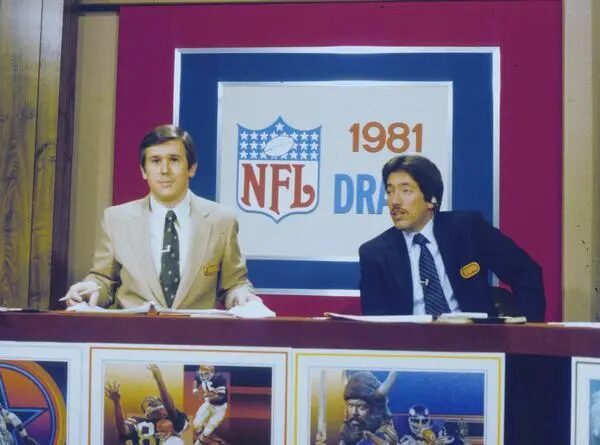
As can be seen from the featured image, the four of us were seated around a coffee table with papers strewn about and newspapers visible on the floor.

We just talked when they came to us from New York where host George Grande was with former NFL general manager Joe Thomas.

Ley told The Athletic on the draft’s 40th anniversary, “When we got off the air I think everybody realized not only did we survive, but that was pretty damn good. While you’d never want to be a prisoner of your reviews, they were positive and I think even the most hardened and objective of us would say we hit a nerve and seemed to have done OK.”

Most significant was the decision to run it back in 1981.

Who knew that now, 44 years later, the draft would be must-see TV, telecast on three networks and would have cities bidding to host it every year.

As executive producer Bill Fitts told The Athletic, “There’s no possible way I could have imagined it would turn into this. I wasn’t even sure we would make Year Two.”

There certainly were seminal moments along the way as more highlights of players from their college career were available and talent was sent to different venues to report.

In 1981, Paul Zimmerman of Sports Illustrated joined the show and famously said after quarterback Rich Campbell was selected sixth overall by the Packers, “They lied to me. I’ll never talk to them again.

Dr. Z was accustomed to being told the truth during his pre-draft discussions with teams, but all bets were off with it now being televised.

The next year, I was “promoted” to New York and while sitting at our small table, I heard a distinctive voice with a New York accent, say, “Hey Paul, keep your eye on Jeff Bryant. He’s moving up on everybody’s list.”

That voice was the reclusive Joel Buchsbaum of Pro Football Weekly, who had been rarely seen in public. Late in the broadcast, with his scraggly hair and Notre Dame sweatshirt, he was interviewed on the broadcast. Had Joel been a tad more telegenic, there might never have been a Mel Kiper, who was on for the first time in 1984 from Bristol. Oh, by the way, the relatively unknown Bryant was selected sixth overall by the Seahawks.

My nine years on the broadcast included two years in Bristol, four in New York, one at 49ers headquarters when there was a power outage in the facility that kept us off the air for a while, one at NFL Films and one in Anaheim at Rams headquarters for what was my final appearance in 1988.

My final year (1986) in New York was memorable. I was at a large draft board that had player rankings with Chris Berman, but no one knew who had put the board together. One of Berman’s funny lines came when he commented on mine and Kiper’s hair!

Following the draft, I suggested to Fitts that if they planned to continue with the board, Kiper should be identified as the architect because that was the essence of his expertise.

Sure enough, he was moved from Bristol to New York the next year and Mel’s Big Board was born.

The actual board might not be as big now as it was then, but the draft itself only gets bigger and bigger over three days with two in prime time.

It’s humbling and gratifying to have been there at its birth.

Meet The Bettors: Nick Kostos, BetQL Network

If you read this site with any regularity, you’re familiar with the term “wagertainment.” It’s how everyone that works at BetQL describes the network’s content philosophy. While the idea of making betting content welcoming to all listeners was the plan all along, the term came from Nick Kostos.

He approaches the network’s afternoon show You Better You Bet, with simple goals. He wants to give people information, he wants to make them laugh, and he wants them to come back tomorrow.

Kostos got his first taste of radio at WFAN as an intern. Between then and now, he has called a lot of brands home. He contributed to Bleacher Report, Sports Illustrated and SiriusXM. He moved to Florida to be a part of CBS Sports’ digital properties. 

In 2018, he noticed the tide shifting and attitudes on his betting content changing. It’s also around the time he met with Mike Dee, Audacy’s President of Sports Programming. He and Nick thought similarly about what gambling content on sports radio and podcasts could be, and he also happened to be starting a new network that would focus on the topic.

The latest conversation in our Meet the Bettors series, presented by Point to Point Marketing, focuses on Kostos. We talk about who brings the best out of him, the surprises that have come along with legalized sports betting, and why regulations are not as helpful as alignment for gamblers.

Demetri Ravanos: The BetQL Network is built around your term, that idea of wagertainment. So how did that come to be the case? 

Nick Kostos:  I think for me and Mike Dee, it was really like a meshing of our ideas. Now, he loved the wagertainment concept immediately, I think he would say that. So, I don’t think I’m betraying anything to say they really liked the idea.           

Now I will be careful to say that I think there is a lot of really good sports betting content out there, my show among that. I think there are a lot of people who do really good work. The idea of wagertainment is there can be really entertaining betting content, and that’s great. And there can be really smart betting content, and that’s great too. But ideally, obviously, you want a combination of the two. You want to be able to educate people and have high-level conversation, and this does not mean that your pick has to win. You can have a great handicap of the game and then the game starts, and someone gets hurt, or the ball bounces a certain way, or the referee makes a bad call.           

Smart betting content does not mean that you give out a winner all the time. We’re trying to win, right? We just give you a smart conversation about betting markets and handicapping games combined with a segment that will entertain people. So, you kind of get the best of both worlds to make people laugh and also try to make them smarter about sports, about handicapping the games, etc.           

That is wagertainment in a nutshell. I think that You Better You Bet, obviously I think this I’m a little biased, but I think that we pull this concept off on a daily basis and do it very well. 

DR: So that audience that is looking for wagertainment. Let’s talk about that group of people that maybe, if it were not for the entertainment factor, is not necessarily coming to your show. We have seen the NCAA president say he wants to limit or eliminate prop bets on college games. Various commissioners in the wake of these scandals have said they might revisit the idea of prop bets on their games. How much would that hurt that particular audience when it comes to their interest in betting?

NK: It’s more content for us to talk about, right? I just I feel like the tide is so strong at this point now that I kind of don’t think there’s any stopping it. So yeah, sure, Charlie Baker can say that, and the NCAA can kind of do what they want. Ultimately there’s still going to be a billion things to bet on. So, it’s not something that I really concern myself with.           

I think they’re nuts to say they don’t want people betting college props. Look at all the interest in all of Caitlin Clark’s point totals and other women in the women’s college basketball tournament. Let’s say that goes away. There are still a million things you can bet on. There’s still the game itself between Iowa and LSU or Iowa and South Carolina. I mean, I guess it’s something that you don’t want to see happen, but I also don’t think it’s anything close to the end of the world if it does. 

DR: Since PAPSA, which state has surprised you the most with how it has taken to sports betting – whether that means anecdotal evidence or in raw numbers? 

NK: I think kind of like all of them have done really well. I do radio in a lot of different cities where Audacy has stations and I see where it’s a really big deal.           

I know like Ohio was pretty recent to legalize sports betting and it was a really big deal there. Whenever I’ve gone on The Fan in Cleveland, it’s always been “We get asked so many questions about this stuff. People are so interested in it.”           

I think that everyone’s kind of going to be really into it. I think it’s going to do really well everywhere.           

I live in New York, so when you bring up kind of like the legalization, candidly where my mind goes to is what I can’t bet on. I can’t bet on awards in New York, the way that New York has it is you can’t bet on something that’s a predetermined outcome. Sports writers decide on season awards. So, it’s just a pain for me. Like, if I want to bet Joe Flacco to win NFL Comeback Player of the year. My buddy in Connecticut has to put the bet in for me. It’s ludicrous because I live in a state where sports betting is legalized.            

I think it’s going to be everywhere. I think there’s going to be interest for it everywhere. I wish that there was more uniformity in terms of what can I bet on in New York versus anywhere else.

DR: We’ll circle back on some of those radio hits in just a moment, because I do want to ask you about that, but you mentioned that you can’t bet on awards in New York because it is a predetermined outcome. I know you’re a wrestling fan. What did you make of the WWE’s efforts to make betting on their events legal? 

NK: Yeah, I think it’s awesome. I love it. As someone that’s been a wrestling fan for his entire life, I just think it adds more excitement to the event.           

Now, look there are there are some matches like the main event for Night One of WrestleMania that doesn’t make sense to bet. So you know, it was a tag team match with the Rock and Roman Reigns against Cody Rhodes and Seth Rollins. The result was going to determine how the main event for Night Two worked.

DR: Right. Night Two doesn’t work if Roman Reigns doesn’t win Night One. 

NK: Correct, so you can have a betting market for it, but there is no price big enough where I would bet Cody Rhodes and Seth Rollins because it makes no sense. It’s not real life. If Vince McMahon or Triple H ran the NCAA Tournament, like you would never have Cinderellas happen. It’s not how things go, right? You would never have the number one seed get knocked out early because you would want the number one seed there at the end for drama. But now with pro wrestling, you can control these sorts of things.            

I love wrestling, but it is predetermined and that’s okay. So you know, like of course the Rock and Roman Reigns were gonna win. Once you get into matches where there is some doubt though, and look, I felt that Cody was going to win on Sunday night but it wasn’t a guarantee that that was the case. Like if Roman Reigns had won that match, I don’t think anyone would have been super duper shocked and they would have figured out a way for Cody to win eventually. You put a couple bucks on Cody Rhodes.           

I mean, think about how much fun that match is to watch when you have no money on it and you’re just enjoying the drama of it. It’s like a regular sporting event, right?      

I am a lifelong diehard sports fan. I’ve been watching sports my entire life. If sports betting went away, I would watch sports and still love it. I’m a sports fan first and foremost, and I think most bettors are sports fans first and foremost. You were able to watch games for a long time without betting, but now you bet. It makes it even more fun and it’s a new added wrinkle to it. I think it’s the same thing with professional wrestling. I really like the idea of doing that. 

DR: So when you do those local radio hits, who are some of the hosts that you think bring the best out of you? 

NK: Well, first and foremost, I would bring up WFAN in New York with Sal {Licata] and Brandon Tierney. Sal is someone that I’ve known for a really long time, about 20 years. We came up at WFAN together. I interned there when Sal was there, and Brandon’s been really welcoming. I love the conversations that the three of us have on the air about New York sports and betting on football. So, I would say that they definitely stand out.           

I love my hit on The Score in Chicago with Mully and Haugh. I think they do a tremendous job. 

The Greg Hill Show in Boston, I am on with them Friday mornings during football season. That was really fun because it is a lot of sports betting talk and we’re also able to have a lot of fun with it. It’s more like a variety show, so I’m able to kind of show off a little bit more of my personality as opposed to just like a straight 15 minutes of “here’s the line of the game” and “what’s your analysis of the betting market.” I kind of like to flex some different muscles sometimes and they give me the opportunity to do it. I like all the hits that I do, but those are some that stand out. 

DR: So, what is the key in those hits to preventing your time on air from turning into the old school fantasy expert just taking calls over and over again about one dude’s team?

NK: From my perspective, I kind of look at it from what I can control. So, I can give my analysis on what I think someone should do with their show, but ultimately that’s their piece of real estate. I have my real estate four hours every day.           

What I can control is no matter what questions are asked, whether they’re good or bad, and just to be clear, like for the vast majority, I think it’s really good, but let’s say I do a radio interview and the questions are not great and really milquetoast where we just kind of go one by one down the games with no personality involved. “Up next the Eagles, a three-point favorite against the Giants, total in the game is 48. What do you think?” Even if that’s the line of questioning, it’s my job to make that palatable for the person listening, to make it entertaining, to make it knowledgeable.          

I don’t go into an interview thinking, “Wow, I hope the people ask me…” This is my job. No matter what happens, I have to make sure that my performance is good no matter what I’m given to work with. That’s what I can control. That’s why I get paid when the red light goes on. I have to perform no matter what. 

DR: Obviously, there are BetQL affiliates all over the country and most of them carry your show uninterrupted every day. But let’s be real. It’s not ESPN, it’s not CBS Sports Radio, it’s not Fox. So, I would guess there were a lot of people hearing you every day for the first time on the podcast. How much effort do you make to make sure the content works both for people listening live and people listening on that podcast replay? 

NK: It’s a really terrific question and something that we have given a lot of thought and consideration to because as the show evolves, obviously and I think I mentioned this, when I did an interview with Peter Schwartz for you guys, I kind of see the show becoming like a television show that also exists on the radio and exists in podcast form. One where we can please all masters, right? We can please the audience that’s looking for analysis of games that night and we can bring on really great guests.           

The guests we’ve been able to pull on the show recently have been nothing short of outstanding: 80 plus guests, not only from the world of media, but having like the head coach of Oakland, Greg Kampe, on the day after they beat Kentucky and he comes on the show and says that he hears the Bet MGM sponsored sports betting minutes that I do every day and is like why haven’t I mentioned Oakland? It just kind of just goes to show the reach of the show and candidly, like the power of radio. Radio is still extremely powerful.           

So to get back to the original question, we’re always going to have evergreen content because it is a sports betting show, right? We can talk about current matchups and future playoff matchups in a variety of different ways. So, because sports betting is what it is and it’s always kind of looking forward. There’s always something right now, but it will always dovetail and lead into something moving forward.           

We never have to really try that hard to make sure that we please the audience. We’ve got their picks that night and also kind of like more of a longer form conversation, so the content doesn’t die right when we go off the air. There’s going to be something there that’s going to matter for the next day, for a week down the road, for three months down the road. 

To learn more about Point-To-Point Marketing’s Podcast and Broadcast Audience Development Marketing strategies, contact Tim Bronsil at tim@ptpmarketing.com or 513-702-5072.

It’s Time for Radio to Throw Out the Rule Book

You know the rules. Every medium and every format in radio has its rules. There are specific formatic rules – keep calls short, frequently repeat call letters, keep things moving forward – and general rules, like shut up and play the music, or stick to the party line and give ‘em “more of what they came for.”

The rules are drilled into baby radio personalities from day one, passed down from generation to generation, from consultant to Program Director, from Program Director to host. There are ways to do every format, especially talk radio, and the rules are immutable.

Maybe it’s time to trash the rules. All of them. Okay, maybe not “don’t do anything to jeopardize the license,” but the rest.

I’m not arguing that the rules don’t work. I personally have used and enforced those rules and a) they helped the station and hosts sound better and b) got ratings. If your station is solidly performing and revenue is increasing, hey, stick with what works. The rest of you, however….

Everybody following the same rules has resulted in every station sounding the same. A talk station in one market sounds just like one in another, down to the same syndicated hosts, same topics, same imaging, same clock, same aging demographics. You know the exceptions but can count them on… let’s be generous and say two hands. Stale and stagnant doesn’t even begin to describe the stasis in radio.

Cable television news isn’t much better – the formula has fossilized, news during the day and opinion at night, and changing the talking heads doesn’t make the format fresher. Local TV news is so standardized that at least one major group broadcaster is getting into pre-recorded newscasts, and some have the staff in one market do the news for another market; same format, same script, same features. 2024 is 1994 throughout the media. The rules haven’t changed.

So, let’s try getting rid of them. Take talk radio: Why are shows three hours long? Why do they start and end at the top of the hour? Is there a reason female hosts still get middays or completely shut out? Why are we doing things according to the same playbook we used decades ago?  Can creative people be encouraged to color outside the lines, or wherever they want to color?

Of course, this is likely a purely academic argument. You and I know that taking chances is not what media people do. Taking chances could lead to failure, and failure is not an option. But when I turn on local radio, not only does it sound exactly like it did 20 years ago, it’s worse than it was 30 years ago, when rulebreakers like Phil Hendrie, Neil Rogers, and Randi Rhodes were able to do what they did on an actual AM talk radio station in these parts.

And I hate to say it, but a lot of podcasts follow formulas, too. Maybe because the influx of new talent can only look to other, existing, podcasts for instructions on “how to do it.” What radio, podcasts, and every other medium need are people who haven’t been raised on the rules, and who bring fresh ideas that sound and look and read like nothing else.

I mean, you’ve got nothing to lose. Maybe you’ll hit on something great. And then what you do will become the new rules, because if imitation, as Oscar Wilde said, is the sincerest form of flattery that mediocrity can pay to greatness, anything that succeeds will spawn a lot of flattery. It’s what the media does best.

6 Things News/Talk Radio Hosts Should Never Say

0

I have heard radio hosts say a few things that drive me nuts. Seemingly, I am writing another one of my columns in the Angry Little Man series.

Why? Because I have heard things that drive me insane.

“I only talked about things that I care about.”

Your listeners don’t care about that. Your listeners can change the channel, hit a podcast up, or check out satellite radio. Half of my radio career has been behind the microphone. If I were to speak about my “passions,” I would shed the audience. You are there for one reason: to focus like a laser beam on your station’s target listener.

A couple of things that you need to understand. Being a talk show host comes with a certain amount of freedom and responsibility. The news/talk format is somewhat different from music stations in this respect, other than playing the hits of course. If a music station is having a ratings slump, the music can be changed. The rotation can be loosened or tightened depending on the circumstances. If a talk show host’s ratings slip, it’s on the host. If your ratings and perhaps revenue are slipping, reassess.

“I can’t change.”

This is the dumbest thing that any host can utter. Rush Limbaugh’s show evolved. Howard Stern’s broadcast updated over the years. If you are unable to adjust, you will shorten your career. I don’t care how smart you are or how loyal a following you had five years ago. It is always about today and moving forward.

The power is in your brain. The Rolling Stones put out their first album of new material in 18 years. These dudes are in their 70’s and 80’s. I am not a big fan of The Rolling Stones, but this album sounded fresh and different. The Stones brought in a 33-year-old producer. The Hackney Diamonds album sounds as fresh as a band playing together for 60 years could sound. They adjusted. You must change with the times.

I will say this: talk show hosts have been replicating the same format for 35 years since Rush Limbaugh changed radio. This album sounds modern. Sure, The Rolling Stones have some of the basic sounds that have made them great. But they have updated their sound and approach. You need to do this as well.

“40-year-olds as young people.”

I heard this recently. A talk show host speaking about the rising rate of cancer among young people referenced 41-year-old Kate Middleton. An 18-year-old who has joined the military to protect this nation is a man. This dude is not a kid. He is doing manly things.

Referring to your audience as children will not allow our format or your show to grow. These people are adults.

“It’s 35 degrees, 6:41 or Sunny out there.”

Where is “out there?” You are metaphysically with your listener. These people are likely solitary in the car, home, office, or walking the streets. You are with them. You are the individual speaking to them, and, quite frankly, with them. Using the term, “out there” steals the intimacy that you need to build with every audience member.

Your connection to the listener should never be compromised. This connection cannot be replicated. Movies, TV, music, or YouTube can never replace the one-on-one connection that a great radio host builds with their listener.

Bragging about your money.

There is a radio host in New York City who frequently bragged about his “homes.” There are many hard-working stiffs who work much harder than any radio host. They come home physically and mentally spent. These people are sometimes just trying to scrape together enough money for food.

Bragging about your state in life is tone-deaf and stupid.

‘I had lunch with the Governor.’

Who are you representing? The powerful or the people? This is an awful flex by many talk show hosts. It can be intoxicating to have a member of Congress or a Senator as a “friend.” I can guarantee you that the elected official could give a rat’s behind about you. Your good friend will throw you off the bridge once you don’t benefit them.

You are there for the people, you are their voice, and you are not there to defend the politicians.

______________________________________________________________________________________________________

I once worked with a staffer for the legendary WNBC. This was with the classic line-up of Imus, Soupy, Stern, etc. This guy was in the lobby as Imus was waiting for his limo. Don was making small talk with the receptionist. During the conversation, Imus reached into his trousers and pulled out a Guido Roll.  For the uninitiated, a “Guido Roll” is an almost toilet paper-sized roll of cash held together with a rubber band. Don unfurled the wad of dough, which was probably more money than the receptionist made in a year, as some sort of odd flex to show her who held the power in the conversation.

Treat everyone well. If you are very successful, make sure that the receptionist, server, or whoever, are treated very well.

I can’t speak for you. It’s time for you to reflect. Did I strike a nerve? I hope so. We have probably all committed these errors. We must keep our mission in mind. We are there for a listener-focused experience.

How YouTube and Video Simulcasts Have Shaped News/Talk Radio

0

In the early 2000s, a trend emerged in cable TV: simply take a radio show and put it on TV. Cameras were installed in both news/talk and sports radio studios, and the programs were aired on linear TV. Now, with the advent of digital video platforms like YouTube, Rumble, and others, anyone can become a content creator. And news/talk radio has begun to truly embrace the enhanced distribution.

For decades, the term “face for radio” was used to describe the less-than-pleasant look of AM/FM hosts. But many prominent hosts — like Glenn Beck, Dan Bongino, Mike Gallagher, Erick Erickson, Howie Carr, Dave Ramsey, Joe Pags, and a plethora of others — broadcast their shows daily, not just on terrestrial radio, but on YouTube, Rumble, Twitch, and others.

For instance, the Salem News Channel carries a video simulcast of the nationally syndicated Mike Gallagher Show. And Gallagher told Barrett News Media it’s undeniably been a change for the longtime radio broadcaster.

“We’ve had to make huge adjustments to that space,” Gallagher said. “I think Salem has done a great job in keeping up with it … The TV component — the over-the-top streaming — is a whole different ballgame. Gone are the days where we could be in our boxer shorts and a sweatshirt with a Comrex box. Now it’s lights, and camera angles, and backdrops, and everything else. But it’s still the old trite cliche, content is content. Doesn’t really matter what the platform is.”

Gallagher added that despite his reluctance to initially embrace the new medium — quipping that he was always “protective of radio” in the past — the reality is that a video simulcast of the program is just as much about the business and revenue opportunities as it is meeting listeners where they are.

“I got to be a businessman about this. And, frankly, I kind of roll my eyes are people who are sort of ‘artists’ and they just worry about, ‘I’m a talk show host and I don’t want to be bothered. I don’t want to get my hands dirty working with advertisers.’ They’re the lifeblood of what we do. They’re the fuel of the engine, and I pay a great deal of attention to my relationships with advertisers.”

Many in the industry were hesitant to embrace digital video at first, worrying about the effect increased access would have on the radio stations that have partnered with syndicated hosts for decades.

However, Blake Thompson, the Executive Producer of The Ramsey Show and The Ramsey Network, says their analytics show YouTube is actually bringing more listeners to their terrestrial radio offerings.

“The best way to describe it is that they’re going to a Short because they happen to be on YouTube and they see a clip of Dave — even an old clip in the studio — and he hits a felt need with them that we’re doing a good job leading them further down and then they realize ‘Oh, this guy’s on the radio. I just happen to be on YouTube looking on how to fix my car hood. And I see this guy and then I recognize him from a billboard in my market or I’ve heard that name.’

“So in our last survey, we’ve really seen a crazy amount of people who have even come from those digital shorts, or Instagram, or TikTok over into listening to radio,” Thompson shared. “It was neat to see people discovering us in those really short formats on video in other places, and then realize that we’re in their market on radio and tune it in when they’re in their car heading to work.”

Joe Pags was an early adopter of featuring a video simulcast of his show. Between YouTube and Rumble, he boasts more than 350,000 subscribers. And he believes the offering has now become imperative to his program and brand.

“I think that people don’t look at a talk show host as radio talk shows anymore. I think they look at us as broadcasters, or even that term podcaster that we’re hearing a lot now,” The Joe Pags Show host said. “People like it because they can go into it anytime. They can watch it live on the fly as we’re doing it or watch it later on because it’s still up there. And because of social media and video components in it, I think that you’re gonna get an audience that you otherwise wouldn’t get. People don’t generally say “I listened to a talk show.” They say ‘I listened to or I watch Joe Pags’ or fill in the blank.”

For Pags, the digital video component doesn’t change the content of his show as much as it changes the demographics of his audience, and similarly to Gallagher, admits it provides a potentially lucrative business opportunity, too.

“How important is it monetarily? Not very, yet. I mean — I make a little bit of money on it. But I think as far as expanding the audience and possibly making the audience more youthful, I think that it’s a big deal,” Pags said. “Because people who are my age, I’m 57 now, we still can use theater of the mind like we grew up on.

“But people who were younger than, maybe my kids age, they’re not used to that — listening to an AM radio, generally speaking, and hearing guys talk for three hours. But to watch it and see it and watch the reaction and react along with or see the video of whatever that gas station sign was or of my interview with Trump, I think that’s a different thing. It’s very important to me for the future. As far as my income or the revenue stream, it’s not where it could be.”

Mike Kadlick Out at WEEI Boston as Audacy Begins Layoffs

0

Reports indicate that Audacy is having another round of layoffs, this one expected to affect around 100 employees. Mike Kadlick, who had served as the Patriots reporter for WEEI in Boston took to X to announce he had been let go.

“My time with WEEI has come to an end due to company-wide reductions,” he wrote. “Very tough to swallow right before the NFL Draft, but I’m looking forward to continuing covering the Patriots in some way. I’ll still be plugged in this weekend. Onward.”

One Audacy employee based in New York posted on LinkedIn, “A tough day at Audacy as we had to say goodbye to a handful of really talented, hard-working colleagues, three of whom I’ve become particularly close to.” The employee goes on to mention a sports content producer in the New York City area in addition to a few other positions which were eliminated.

This is an ongoing story and BSM will update it as we learn of anyone else in sports media who may have been affected by today’s layoffs.