A recent dissertation from Audacy Senior Vice President, Head of Research and Insights, Idil Cakim, conveys that sports radio stations strive to reach a segment of the audience known as “forever fans.” Within the insight, Cakim trifurcates these groups into different parcels to accentuate the indispensable aspect of the latter. Casual fans will generally watch prime-time matchups and become more invested when a team contends for the playoffs, while core sports fans will follow their teams over the duration of the season and have a vested interest in the games.
Although these groups are valuable to advertisers, it is within the “forever fans” where the most return on investment is often realized. These diehard fans do not waver in their engagement during stretches of wins or losses and will consume the game in any way possible. Whether it is watching on television, traditional radio or streaming through their phone, they will always make sure to know the latest information about the franchise.
Moreover, they will generally spend more money on game tickets and allocate more funds for discretionary costs and provide strong ancillary revenue streams, including for concessions and parking. This group is also the most likely to bet on live games and consume sports media content, such as radio programs or television highlight shows. Ultimately, fandom is entrenched within their lives, causing one in every five of those rooted in baseball to lose sleep over games.
These fans tend to have more purchasing power, garnering an average median household income of $123,000. According to the Audacy study, 75% of decision-makers in the business world consider themselves sports fans and are 56% more likely to listen to sports on the radio.
Ninety-six percent of “affluent decision-makers” emanate from this realm and listen to at least one form of sports audio. The median age of these sports fans is 42 years, while sports fans in general are, on average, 50 years old.
Courtesy: Audacy
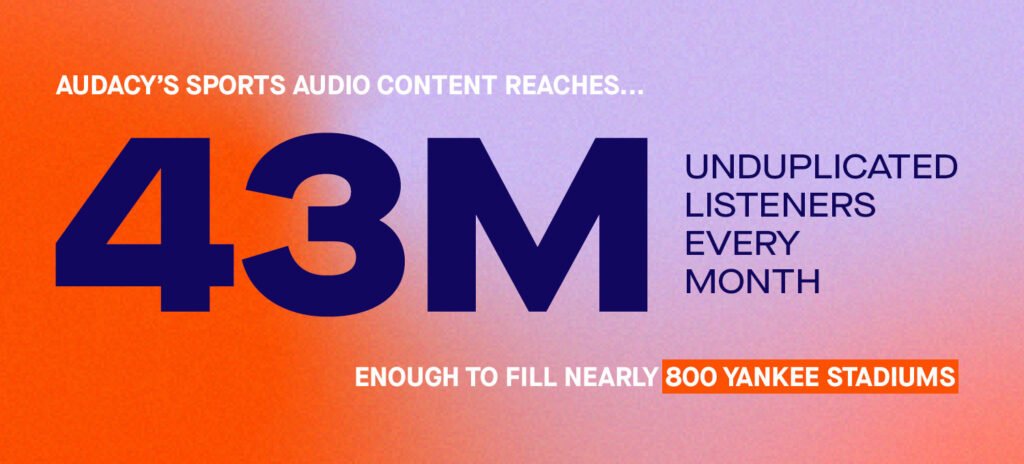
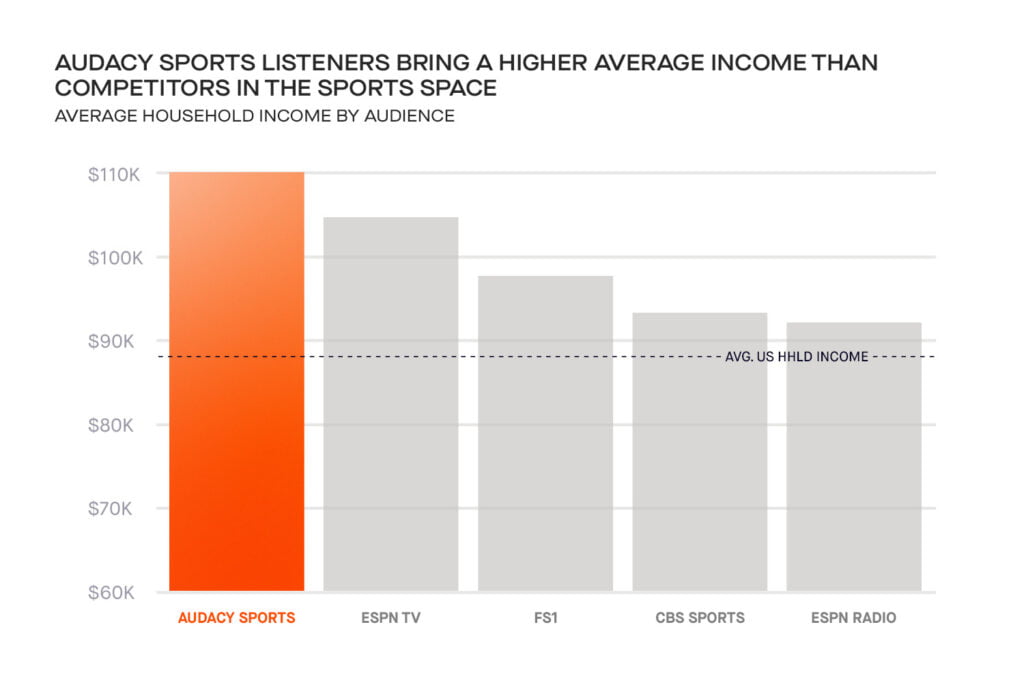
Audacy sports content engenders the largest household income by audience, according to the company, and reaches 43 million listeners per month. Coming in second is ESPN’s television network at about $105,000 and FOX Sports 1 in third at just under $100,000.
Audacy also conveyed that small business owners are 49% more likely to consume sports through their company rather than others, and also finishes at the top of the category when it comes to auto intenders, home sellers and business decision makers.
The first day of the 2023 BNM Summit is underway in Nashville at Vanderbilt University’s Student Life Center. We’re keeping you updated on news, key information, and interesting perspectives shared on stage by our speakers. BNM editor Garrett Searight will be updating this column throughout the day as each session wraps up, so be sure to check back multiple times to avoid missing anything important.
Also, make sure you’re following us on Twitter/X at @BNMStaff. We’ll be sharing photos, video clips from the stage, and backstage conversations inside the Core Image Studio green room courtesy of our friends at Steve Stone Voiceovers so be sure to follow along.
—
Barrett Media President Jason Barrett kicked things off, welcoming attendees to Nashville for BNM’s inaugural news/talk media conference. After setting the scene for what to expect over the two-day event, Barrett moved into his opening remarks. He showed some statistics of news/talk radio’s highs and lows over the past decade including some recent signs from a few top markets which highlighted the format’s decline and audience ages rising. With additional battles ongoing with auto companies for dashboard supremacy, he emphasized how vital it is for brands to be much more active and exceptional at digital content creation and distribution.
9:10-9:45 = The Programmer’s Playbook Presented By:
Tim Wenger – WBEN
Craig Schwalb – WBBM
Drew Anderssen – KRLD
The first question from Barrett to the panel asked about attracting a new audience to their stations. Schwalb said it’s no secret that it isn’t easy to find marketing dollars. “We need to be really savvy on the digital side,” Schwalb added. “My approach has been to be more aggressive and that’s been really effective. We’re getting a new narrative out in the marketplace.”
Schwalb added that focusing on more than crime and showcasing new narratives and great storytelling has been a big addition to WBBM. Social media and video enhancements have been added, as well.
Anderssen admitted that AM radio’s challenges are evident, so embracing podcasting has been a major factor for the station. “As the format has aged, we as programmers haven’t thought about what is our target. The really good programmers understand that. It’s one thing to know your audience is 25-54, but it’s another thing to develop content for 25-54,” Anderssen said.
Wenger, who recently was named the Market Manager of Audacy Buffalo and will be tasked with finding his replacement, shared that his thoughts on programming hasn’t changed. He believes focusing on news more than talk is important. “The format has been more focused on Rush Limbaugh and Sean Hannity, and that’s a limited audience,” Wenger said.
“No one wakes up in the morning and talks about Trump and Biden. They just don’t do it,” he continued. “Focus on other things will provide value. We should start the conversation on a talk station where the talk is.”
That led Barrett to ask about what the focus should be, instead of strictly politics.
Wenger said cameras on school bus stop signs is a hot topic of conversation in Buffalo, not the latest Trump indictment.
Anderssen added that what a 40-year-old focuses is on is what KRLD needs to be covering. “Things to do, what to do in your area, and events matter as much as hard news. It’s a reflection on the lifestyle of the user. We get so caught up on what we think news is, and this hamster wheel of ‘we’ve always done things this way’. That is the target demo now.”
The KRLD Brand Manager continued by saying that, obviously, weather and traffic have the ability to be the top news stories.
Schwalb said “10 years ago, we wouldn’t have treated a Taylor Swift concert as a news event. But that fits right into a 25-54. We treated it the same as a political convention. That’s something news stations might not have thought about before. Taylor Swift is a great example, to me, of something we really got behind and switched up cover on, and it also was a great breakup on the crime we often talk about…in a city like Chicago, you can spend all day talking about crime. You have a responsibility to the community to not simply focus on crime all day, but telling stories.”
Misinformation has become a buzzword in the last decade. A clip of former President Barack Obama saying that a splintering of media has created “different realities” for different people. Barrett asked the panel how they would combat that.
Schwalb said having a lot of filters and layers before a story hits the air is important. “If make a mistake, we share it. If we update a story, we’re transparent. It lends credibility.”
“The most dangerous word in media is ‘reports’. That just says we didn’t do our job, and we’re relying on someone else to do it. Being first is great, but being right is better,” Wenger said. “If we’re first with something, that’s great. But if we’re first with something that’s wrong, we look like idiots. I do think everything needs to be fact-checked, and if you make a mistake, own up to it.”
“News is a process, not a destination,” added Anderssen. “What you know now is probably going to be different in 10 minutes. Everybody in the world is media now. They all have their platform and their audience. Doing the vetting process and understanding the filters Craig (Schwalb) was talking about. I want to be first, but I don’t want to be first in getting a lawsuit, either.”
Artificial Intelligence is a rapidly changing landscape, especially in media. Barrett asked how brands can use the technology to their advantage.
“To me, it’s in the fun stage, which can also be the scary stage,” Wenger said. “What scares me is it can be taken to — you could bring Rush Limbaugh back with current content. On the sales side, it can be used for many things. Right now, it’s ‘go slow’. As far as investing in it to replace content, I don’t know.”
“I’m super bullish on AI, but I think there’s a responsibility fact that we need to rectify with,” Anderssen admitted. He added that he let Gmail let his nightly note to his staff last night and said it was a disaster. “I think we’re in the trial and experimentation phase. I think there’s applications in our format that have different applications. From imaging, to writing, I think AI is a tool that can make us smart and better deliverers of content rather than just going at it on our own. There are checks and balances AI can present that will make us better.”
“I can use it to help me write a better promo or write a better lede, so I think there are some places we dip our toes in,” said Schwalb. “But nothing will beat a well-staffed newsroom and having someone at city hall asking the questions that’s going to get the story and comeback and put together a story for our audience.”
The final question asked the panel to share one win and one loss in their career.
“I made a list,” Anderssen joked. “If you step back and think about ‘What I want to be known for’, I want to be known as a great people leader. Brands win from the inside out but also lose from the inside out.” He said he’s made interesting hires in his career that people would question, but he taught them a skill. On the flip side, he said he has held on to people he was comfortable with that he held onto for too long.
Wenger said being there for the community when it’s both celebrating and in mourning, “being there” matters to the listeners. “I don’t manage shows while they’re on the air. A lot of program directors do that. I manage in the office, at lunch, or somewhere else, but not while they’re on the air.”
“I experienced weather coverage in at WPRO (Providence). When everything was down, it was our station talking to the Governor and snowplow drivers,” concluded Schwalb. “I really enjoyed that working with WTOP and WBBM, and making sure we’re really invested in the community. When stations haven’t been invested in the community, you can tell.
“If you’re doing local really effectively, you can find ways of getting in touch with the community. Local radio is still really a competitive advantage.”
9:45-10:20 = News/Talk Radio in an Audio World
Larry Rosin – Edison Research
Rosin began his presentation with the two main takeaways he wanted attendees to depart with.
He noted there are two “mega trends” that have been seen in the last decade.
“The phone is eating all the listening time”
Rosin argued that listening is moving away from radios and to phones.
2) “Linear media consumption is losing to on-demand.”
50.3% of time spent listening is now with on-demand audio. That number has risen from 31% in 2015.
He then showcased reasons for why that’s the case. 91% of citizens own a smartphone. 70% of Americans have a smart TV. 36% now own a smart speaker. In 2008, 96% of people owned an in-home radio. In 2022, that number is now 61%. From 1950 to 2008, the figure remained steady from 1950 to 2008. But it has shrunk dramatically in the past 15 years.
“People aren’t adding radios to their households. Of all the things they have less of, it’s radios,” said Rosin.
Online audio consumption was 2% in 2000. 70% of the U.S. population listens to some kind of online audio.
In 2014, 53% of all audio was spent with AM/FM radio. That number is now 36%. In that same timeframe, podcasting grew from 2% to 10% of all audio listening.
Since the pandemic began, radio has experienced a drop of listenership of 13%.
However, there is good news, especially for the news/talk audience. Spoken word listening continues to rise.
In 2014, 105 million people said they listened to some spoken word content. There are now 139 million people who say they listen to the content. Spoken word audio percentages have risen from 20% the same time period to 31% of all audio content.
Similarly to every other genre or format, though, spoken word content is growing rapidly on mobile devices, too. 73% of all spoken word content was listened to on AM/FM radio and 9% on a mobile device. 38% is now listened to on a mobile device, while 35% happens on AM/FM radio.
“Podcasting is a massive factor for spoken word,” Rosin added.
In 2015, 7% said they had listened to a podcast in the last week. That figure has grown to 31% in 2023. Radio previously had a 71 point margin over podcasting in the spoken word genre. Its advantage is now just 8% compared to podcasting (44% radio to 36% podcasting).
AM/FM radio and podcasting still dwarfs SiriusXM in the news genre. 64% of respondents said they listen to AM/FM, with 23% to podcasts, and 9% to SiriusXM.
Respondents that said finding personalities and talk shows is important to them, 67% said they go to podcasts as their first route of content. In 2015, radio had a massive advantage. It has dropped 23% in those eight years.
The research from Edison shows that 87% of radio listening happens over-the-air, compared to 13% of streamers. In news, that number is 84% for terrestrial radio and 16% for streaming.
10:20-10:55 = Talking With Talent Presented By:
Erick Erickson – Cox Media Group/Compass Media Networks
Chad Benson – Radio America
Tony Katz – WIBC/Radio-One
Andy Bloom – Bloom Communications/Barrett News Media
Bloom asked the panel why they do or do not video stream their shows. Erickson said he does not, but does clips. Benson shared that he does stream and loves the availability.
“To me, it’s a must. YouTube is the second largest search engine. They don’t go to the radio, they go to video,” Benson said.
Katz said he does stream his show and will replay the audio on his show. “I actually hate radio on video, but I’m the minority. People love radio on video,” Katz said. He added that he will eventually completely stream Tony Katz Today.
Bloom then asked how the hosts got their radio starts.
Erickson said he backed into radio by chance, and never told anyone he was not a radio guy until he signed his first contract.
Chad Benson said he worked with Robert W. Morgan, who is in the Rock and Roll Hall of Fame. He shared he learned a lot from the host, despite his status as a “horrible person”.
Katz shared in 2008-2010 he nearly went bankrupt. After starting the California Tea Party, he began filling in for Dana Loesch. He later auditioned at 93.1 WIBC, but did not get the job originally. However, he later got the position and went from there.
Bloom asked what the panel what they want programmers to know about managing talent.
Erickson said his previous programmer supported him as he didn’t support Donald Trump in the 2016 election. He shared he was one of the only local radio hosts who didn’t support the candidate and kept his job. “Don’t do an impression of the conservative radio host. Call the balls and strikes,” Erickson said he was told. “Listeners might not agree with me on this, but they’ve hung around.”
“Know your talent,” Benson said. “Let the talent shine. You gotta let them do their thing. That’s why you hired them. More often than not, they just but a body somewhere. You can’t do that. If you trust somebody, put them in the position to succeed and go.”
“I’ve only had one program director, so as far as I know, David Wood could be terrible,” Katz joked. “Is the relationship adversarial? Is the relationship one of force or recognition? There’s a reason you have people on your station.”
All three panelists host syndicated shows, and Bloom asked how PDs can help foster a relationship.
“Call me. Text me. Anytime,” Benson. “I’m quick to respond. Bring me out. Let’s hang out. I’ll do the show live from there.”
“I started national syndication in March, and I’m stunned at the program directors who are stunned that I’m reaching out. I’ll come do local endorsements for you. I’ll do local events,” said Erickson. “It’s still somewhat funny to me that a lot of local program directors are stunned that it’s done this way.”
“I wonder if it’s generational,” Katz added. “We’re used to being multi-platform and reaching out and all the ways. A decade ago, it was a very siloed thing. There was never a crossing of the streams. I think that is it. I’m surprised that Erick is talking about that. I don’t disagree. Just call me. There are stations that I’ve been talking to for awhile. Just send me a text.”
The topic of live reads was broached to the panel.
“I only do them if I like the product,” Erickson said. “I live transparently with my listeners. They know I’m not a sports betting guy, so I’ve turned down sports gambling dollars. I like cooking, so my listeners know if I’m talking about Omaha Steaks, they know I’m using it.”
“It’s a real relationship and using the products, but it’s different on the national side.”
“The ability to say no and your PD and sales team accepting that. I will not endorse financial advisors. If I endorse a carpet cleaner, and they screw it up, I get new carpet. If I endorse a financial planner and they screw it up, I don’t sleep at night,” Katz said. “You have to be comfortable in where you’re at.”
When asked if they court controversy, the panel shared similar sentiments.
“I’ve had many aggressive conversations on the Never Trump movement, but if honesty is controversial to your audience, so be it,” said Katz. “Honesty creating controversy? That should be par for the course.”
“What is controversy? It’s not what’s said, it’s how it’s taken,” Benson said. “Everything can become a controversy in two seconds. Court controversy? I’m sure I said something today that offended somebody. Right, left, center, everybody is going to have controversy.”
“Controversy is going to find you. I’m sure we know people who are trying to be controversial just to get attention,” Erickson said.
Benson argued that if you’re not getting angry phone calls, you’re milquetoast. And no one wants to be milquetoast.
“I’ve seen program directors that get any angry email and think ‘I’ve gotta let the host know’,” Erickson said, which he disagreed with.
Bloom questioned if callers still play a strong role in today’s news/talk landscape.
“In an average week, I take a total of zero callers. Twitter is my caller,” Katz said. “I’m not anti-callers, but in the end, I often discuss on the air if I should take more callers, the vast majority say no.”
“I haven’t taken a phone call in seven years? Eight years? My local show, we talk callers. The reality is it’s just easier. People don’t wanna call, they wanna text,” Benson said. “That’s what they want. That’s the world we live in.”
“I take some,” Erickson said. “It sounds more local to them. I don’t take a lot of callers, and I’ll go some days without calls at all. I’ve got a great screener. When I filled in for Rush Limbaugh, he had three lines. I’ve got eight and wish I had three. I don’t mind them, but it’s not a caller-driven show. I lost a station because I didn’t take more calls.”
“The host should not be adversarial. I’m convinced of this,” Katz said of callers. “I don’t understand confrontation with callers. You sound like a confrontational jerk.”
Benson disagreed, saying the Real Housewives series works because viewers want to watch confrontation, not just women at dinner.
The final question pertained to whether they viewed themselves as an entertainer or an informer.
Katz said he better be entertaining for as often as he is on the air. “Just because the subject matter is culture or political or sports, it better be entertaining. If these are my options, I’m an entertainer.”
“I’m an entertainer,” Benson said. “Colin Cowherd told me ‘Nobody cares if you’re right or you’re wrong, they care if you’re entertaining.’ And he’s right. If you’re right and you’re boring, they’ll never come back. You better entertain, because there’s more eyes and more ears.”
Erickson said a conversation with Rush Limbaugh tasked him with answering “Are you gonna save the world or are you going to be an entertainer?” which shaped his view as a host.
11:05-11:40 = Keynote Conversation Presented By:
Dave Ramsey – Ramsey Solutions
Barrett began the conversation by asking Ramsey about his 1992 start on SuperTalk 99.7 WTN.
“These billboard gurus decided if you did an extension outside of the square, it drew more eyeballs. But the extension was my bald head. So we went to go see one of the billboard, and there were birds sitting — and pooping — on my bald head,” Ramsey joked.
He shared the station was in a bind after a financial host quit, so he and Roy Matlock worked for free with the hope of selling mutual funds and Ramsey’s book. He shared the host after their midday show saw a woman who would read palms over the phone.
Barrett then asked about the growth of financial media, noting numerous TV networks and radio programs.
“We approach the space differently than most others do. We approach it with a life lens, instead of just discussing your mother’s 401K, which is boring as crud,” Ramsey said. “People are always going to be drawn to have some more (money), whether they go through a lens of Fox Business, the highbrow stuff, or the stuff we’re in with people trying to avoid foreclosure. It doesn’t matter what part of the demographic you’re touching, everyone touches money.”
When asked about distribution, Ramsey said having the right approach is paramount to success.
“One of our core values is that if we help enough people, we don’t have to worry about money. You can monetize stuff if you just do the right thing and help people. This is the 31st year. It isn’t like we gotta break even by summer,” Ramsey joked.
He then added that his podcast audience is completely different from his radio audience, so he did not cannibalize his audience at all. He added that hour of of the radio show in podcast form garnered $1 million in ad revenue last year.
“We’re agnostic to the delivery method, as long as it gets the message out there,” Ramsey said.
Prioritization of the radio show, podcast, YouTube, and satellite radio program could be viewed as an issue. However, he said the company has managed it well.
“What we’ve found is we just put everything on everything,” said Ramsey. “We rarely ‘sawdust’ something that can’t be used on another platform.”
“The good news about YouTube and podcasting is a lot of what is on there, the production values suck. You don’t have to have the Fox Business production values. This is not rocket science,” Ramsey said of how he’d suggest stations get started in creating additional content.
“The YouTube user’s expectation of production value isn’t high, they just care if the information is right. You can take somebody that’s got another job inside of the radio station, hand them an iPhone, put it on a tripod, and create a YouTube show. Same way with podcasts. The hardware necessary to do a podcast is already in your radio station.”
AM Radio has been an important driver of Ramsey’s success.
“AM Radio was dead before Rush Limbaugh,” Ramsey said. “If (my show) had sucked — when you well-distribute crap, you’re just well-distributing crap.”
Ramsey said AM Radio is ripe for a “renaissance” period, noting that “If you put content the people demand and is compelling, it will flourish. If AM Radio is giving them something they can’t get anywhere else, people will demand it.”
The host said reviewing your content is important.
“What we do with all of our brands is consume them all ourselves. The leadership team is required to consume it. We know if something makes us cringe because we actually view it,” Ramsey said. “I’ve listened to my own things and thought ‘Who is this in-bred hillbilly? My god, you sound like you live in trailer!’” Ramsey joked of his past performances.
“You’re insulting your audience with your traffic and what comes out on the air, what you’re allowing to advertiser, and what comes out on the air from your hosts. I’m the hardest on me and I’m the hardest on my own tapes. I still watch and think ‘That guy’s awful. Wear something else’. If you consume it, everybody does something that’s cringeworthy, but if you catch it before your audience does, they’ll listen if you don’t run them off.”
Not only is Ramsey a radio host, but he’s also operating a financial company with 1,100 employees. When asked about what the financial outlook looks like in 2024, Ramsey said he’s always seen some sort of financial consternation.
“We’re in an environment with doldrums, but economics at its core is psychology,” remarked Ramsey. “It’s ‘Do people believe that the sun is going to come up tomorrow?’. That’s what we do in business. We want to take advantage of prosperous times. That’s what we’re in right this second…We wanna be honest with ourselves of the moment that we’re in, but also know that that’s just the moment that we’re in. The moment we’re in right now is not like post-9/11, 2008, or the quarantine.”
Ramsey knows he won’t host his popular radio show forever. He has a succession plan in place.
“The brand’s gotta be better after I’m gone than it is when I’m here, and it already is,” the 63-year-old said. “We started studying family business and succession planning of all kinds. We just started the whole process. You gotta have organizational leadership. That was the first thing, was quality leadership.
“The second thing is you gotta transfer ownership to the second generation. So my kids sat in the room in their 20s and they weren’t allowed to talk. That’s been well over a decade. The three Ramsey children — they’re not children anymore. They’re competent adults. How do you do a brand transfer in a personality thing? That model has been born and polished since then.”
He noted that branding with his company — from DaveRamsey.com and The Dave RamseyShow to The Ramsey Show and ramseysolutions.com — happened and only one radio show and three listeners noted, so it is a slightly easier feat to accomplish than originally expected.
11:40-12:15 = 10 Takeaways For Radio and Digital Imaging Presented By:
Jim Cutler – Voiceover Artist
Cutler opened up by explaining why “social proof” matters.
“My pet peeve is in-studio shots. It doesn’t make me want to learn anything,” Cutler said.
“Social proof is really fun. You can’t say ‘Hey, I’m popular’, but you can with social proof.”
What is social proof?
“Social proof is a phenomenon where people follow and copy the actions of others in order to display accepted or correct behavior, based on the idea of normative social influence,” said Cutler.
Cutler advocated for using real voices in imaging rather than your station voice. The easy way to utilize sound is the station app or the set up a voicemail box.
Cutler shared that attention spans have shrunk due to phone usage. YouTube analytics show that if you veer from the topic for as little as 15 seconds, views go down. With videos with millions of views, 32% of viewers have departed the video in the first 30 seconds.
He then shared that good copy is a great key to driving listenership. Saying “You never know what you’ll hear” or a lineup promo isn’t going to excite listeners. Topical promos are the biggest drivers.
1:15-1:50 = Content Planning For An Election Year Presented By:
Phil Boyce – Salem Media Group
Boyce explained that talk radio is uniquely American, sharing an anecdote that he consulted a station in Paris that wasn’t allowed to offer political opinions on the radio.
He continued by noting he thought Hillary Clinton would have brought the Fairness Doctrine back had she won the 2016 Presidential election. He continued by informing attendees that they should be prepared for the situation should it ever return.
“I don’t think they want the Fairness Doctrine to come back. They don’t want both sides presented,” Boyce alleged of Democratic politicians. “If they can get drag queen story hour for small children, what makes you think they won’t come after talk radio?”
The Salem Radio Network executive said that there is a civil war without bullets being fought against the talk radio industry.
He then shared statistics of Salem Media Group listeners and what their opinions are of former President Donald Trump. 63% of listeners would vote for Trump over any other Republican candidate. 37% strongly approve of Trump’s personality and public persona. 44% strongly approve Trump’s political policies.
1:50-2:25 = DH7 Brand Building For News/Talk Radio Presented By:
Rick Caballo – Dead Horse Branding
Melissa Caballo – Dead Horse Branding
The Dead Horse Branding team shared their seven ingredients for branding anything or anyone.
Artist/Strategy Build
Ask yourself “Who you are and what’s your super power?”
Logo/Identity
There are three things to your branding identity. “Consistency, consistency, and consistency”, Rick Caballo joked.
“When your listeners drive past your logo and see it, are you consistent and are they loyal?” Melissa Caballo asked. “That brand loyalty message: what does it mean, what does it mean to your listeners, and do you stray from it? You shouldn’t.”
Photography
A picture is worth a thousand words, but does your photography showcase a visual identity to your listeners? What messages are you bringing to your marketing concepts?
Website
The branding experts told attendees that your website is your “home and hub” of your brand. If all the third party platforms — social media, podcasts, etc — crashed tomorrow, where would your listeners find you? On your website. Your website is your home, so you should utilize it in the same visual identity as your other branding areas.
Public Relations
How do you do PR for your radio station? It comes through your messaging from your hosts. It is your brand’s credibility and social proof. Ultimately, it is the perception of your brand.
Marketing/Social Media
You have the whole world in your hands. Use it. Dead Horse Branding research shows that 46% of listeners want a visual component to their content. So complete utilization of all social media apps, including YouTube, is key. Essentially, your station should be on every platform that you use.
Licensing/Distribution
Put your money where your mouth is. Sit back and let others make money for you.
2:25-3:00 = Tomi Lahren Is Everywhere Presented By:
Tomi Lahren – OutKick
BNM President Jason Barrett led the discussion with Lahren. He asked how much she enjoyed the grind of getting to the top of her field.
“It used to be you could be on a TV or radio show and that was enough. Not anymore. If you wanna still be in the conversation, you have to be active on everything,” Lahren said. “It is a constant grind. There’s not a time where you can check out and not do social media or things that are asked of you, because you have to use every other medium to promote what you’re doing.”
While she’s constantly active, she still finds time to prepare for all of her platforms.
“Part of the luxury of being in it all the time is you’re updated on everything all the time. For me, it’s looking at things that fire me up. It doesn’t take me long to form an opinion, so it doesn’t take me long to find my content.”
The perception is that Lahren began her career in social media, but that’s not the case.
“I started at OAN and then moved onto TheBlaze. I did conservative influencing before people knew what it was. People saw me on social media because they didn’t know what One America News or TheBlaze was…people can see me and my opinion on social media in two or three minutes rather than three hours on a TV or radio show.
“When people feel like they know you, you’ve got a fan for life. When they feel attached to me and my career on a personal level, they’re fans. If you can do that, I would highly encourage it.”
Lahren was an early adopter of Twitter subscriptions, and she said she hasn’t really delved into the world completely yet.
“I haven’t leaned into it as much because I lean into it on Instagram and Cameo, which has been a huge side hustle for me over the years,” Lahren admitted. “The thing that I worry about on Twitter subscriptions is — there were a lot of people that were posting large sums of money they were getting — and I’m worried about people getting more sensationalized content just to make more money.”
“I will never self censor to appease an alogrithm or an advertiser,” Lahren continued. “The reason that Fox News is the number one cable company in the world and they got there because they found who their audience was. We realize the value of our viewers. We’re the same at OutKick. We’re the anti-woke on sports, culture, and pop culture. When you try to play the middle, you could just be going after the people who love you and the advertisers who want 100% of that audience. Find those people.”
Barrett asked Lahren how often she monitored what topics were driving traffic for her digitally.
“I’m selecting things people are already talking about,” Lahren remarked before listing conservative topics she usually talks about. “That hits well for us because people are sick of narratives and talking points.”
“Pop culture is a big thing for me. It always has been,” Lahren continued. “Talking about wokeness in culture is always a good one for me. That’s always been my sweet spot. When I started doing this, there weren’t many talking about culture. Now there are a lot of them, but that’s always going to be a home run for me.”
She was asked about endorsements and companies she’s willing to work with. She said she turns down 90% of the offers she’s presented.
“I don’t want to be someone chasing the grift. A lot of these social media followings are fake and manipulated,” Lahren admitted. “A lot of things you see are contrived because they’ve been able to mess the algorithm that makes them appear something they’re not.”
3:10-3:45 = Fixing a Broken Media Presented By:
Jason Whitlock – Blaze Media
Whitlock shared that the last time he spoke with BNM President Jason Barrett on a stage, he was hosting a show on FS1 as a sports host, but felt the need to branch out.
“I needed to be in a place — and obviously there were personal reasons as well — where I could be myself and have my thoughts. I needed to be in place where I could talk about my faith more authentically and it’s more difficult to do that in a corporate media environment,” said Whitlock.
“I completely enjoy what I’m doing, and I feel completely liberated to say what I think at a time when there’s a lot of resistance to truth and what people really think,” Whitlock continued. “That’s the liberation that I feel. That’s the biggest win.”
Whitlock said he has a struggle more than most digital creators.
“I face headwinds in a society and an internet that is opposed to my world view. The internet controls distribution and you don’t know who is tipping the scales one way or the other. Things are more manipulated on the internet and I’m at the forefront of some pretty strong headwinds against a traditional Christian worldview,” TheBlaze host said.
“I think a lot of people love to label me as a conservative, and I work at TheBlaze and they’re conservative, but I’ve never really voted conservative. But I am traditional. I lean on values I learned in the church, so if that makes me conservative, label me a conservative.”
“I’m just expressing what I genuinely believe. I’m trying to invoke thought,” he continued. “If I was just sitting around thinking ‘How can I make the most money today?’, I’d say much different things. If that were the case, I’d still be working in corporate media.”
Whitlock maintains he’s fiercely independent in his thoughts.
“For the whole industry, it seems that the results don’t matter. The rewards are staying with the narrative and staying on point. I just don’t do that. I don’t care about politics and I really don’t care about narrative. I used to get rewarded for the objectivity and the unpredictability of my opinions. Objectivity is no longer rewarded, but narrative is.”
Barrett asked Whitlock if he had a future in the news/talk radio world.
After a lengthy pause, Whitlock said “There’s a level of transparency and authenticity to me that spooks news/talk radio, or I’d have a national show.”
He continued by noting that news/talk hosts don’t attack the discussion on race the way he does.
“I’m just not sure if the corporate media space is comfortable with the way I would discuss it,” Whitlock concluded.
3:45-4:20 = New Solutions For Old Problems Presented By:
Lee Harris – NewsNation
Steve Moore – KMOX
David Wood – WIBC
Dan Mandis – SuperTalk 99.7 WTN
Harris asked what the problems were that news/talk stations were facing. Audience retention, revenue, and technology were several of the problems suggested.
“We’re staying on AM. Everybody wants to move, but we’re sticking it out, and think it will be just fine,” said Moore.
“I think it’s getting the news out where people are,” Wood said. “We’re hiring people that in theory are triple threats — being good on-air, online, and social media.”
“What we do is have fun,” Mandis said. “There are times where it’s time to do the politics and those things, but we try to have fun. It’s all about doing good radio. For me, luckily, we’re on FM. We try to make the news interesting and fun. Let’s face it, the news — especially if you’re a conservative — is not fun these days.”
Harris asked the program directors their opinions on social media.
“Social media is a brand extension tool for us,” Moore said. “At KMOX, we’re trying to grow our personalities and use this technology to grow their brands and their personalities and bring them back to our radio station.”
“Being able to look at streaming numbers, so when Nielsen doesn’t favor us, we still are strong. YouTube is nice to see the interactivity. You can see views go up when something is really hot and views go down when the topics are going down.”
“It’s a gut thing for me,” added Mandis said. “We do video streaming 5A-7P. We’ve had the same experience where you can see it wasn’t a great day topic-wise. One of the things we’ve noticed is you can watch the views and keep track of the views as almost a precursor to the ratings. We noted in June the numbers of the views were up, and conversely, our ratings were really up. If our video is down, my phone is blowing up at 5:02 AM. There’s a passion for people of embracing the video aspect of it.”
AI has grown to be a hot-button topic.
“There’s going to come a point where we can predict where it will go,” said Wood. “I’ll use it to brainstorm with myself, but it can be an idea starter.”
The topic of streaming was broached, and Mandis said his audience is migrating to the digital side.
“At least 20%,” Mandis said. “Depends on what you mean. Facebook, YouTube, the video, or audio on the website. What we’ve found is there is more reliability with Facebook or YouTube than there is on streaming or if we’re off the air. There’s lot of avenues for people to find us.”
Moore was asked about the potential for AM Radio to be removed from cars after his strong remarks about the station staying on the band.
“I think the KMOX brand is strong and the company will do what it can to protect the band and the revenue,” Moore remarked. “Radio needs to be radio. Revenue needs to be locally driven, and we need to focus on that.”
Wood argued finding talent in the format has been difficult.
“I’ve had good luck looking outside of radio. I had an afternoon show, later a midday show, called The Chicks on the Right and I thought ‘God, I hope they don’t find out they don’t need us anymore’. They eventually did, and are making more money podcasting. My afternoon show — Hammer & Nigel — hadn’t done talk radio. They were rock jocks in the market. But they’re real creative in different ways.”
Mandis agreed, saying he looks everywhere.
“What I focus on is looking at the balance of the station. You may have someone that’s a little more moderate but still conservative…everyone needs a little different lane than everyone else. For me, I look everywhere. There are a lot of conservative organizations that are really opinionated and speaking in front of crowds.”
4:20-4:55 = OutKick The Industry Presented By:
Clay Travis – OutKick/Premiere Radio Networks
Travis was born and raised in Nashville, and he knew he wanted to base his media company in the city.
“It’s funny, when I founded OutKick in 2011, everyone told me I needed to be in New York or LA, and it can’t be based in Nashville,” Travis said. “I actually think staying in Nashville was incredibly important for OutKick. I feel like (certain topics) get ignored in New York or LA…I am the consumer of the OutKick product, and so I know if we’re missing something or should be on top of something.”
“I’m excited about where we are and way more excited about where we’re headed,” Travis concluded of the company’s future.
Travis then mentioned that he doesn’t have many qualifications when it comes to potential hires.
“I am attracted to fearlessness. In many ways, it isn’t about what your opinion is, but can you share it and can you defend it?…I knew (Tomi Lahren) was a strong an unique voice. There will be more and more people that we add, but part of it is just who is available and when they’re available.”
Travis had humble expectations when he founded the digital outlet.
“When I started OutKick, I wanted to be able to make $100,000 a year from it. When I started in 2011, I wrote every article, I sold every ad, I edited every article. OutKick was profitable from the jump because I worked all the time…with each level of success, you’re able to have more levels of success. Your adjacent possibilities become greater. What we did with OutKick was we made the ‘adjacent possible’ possible.
“Part of that was sports gambling. I saw real clearly about 10-12 years ago, there was going to be a massive trend in sports media. If you look at the industry as a whole, cable transformed sports media. Fantasy sports transformed sports. And to me, the biggest paradigm shift and the one I’ve been able to take advantage of was sports gambling.”
Travis then opined on the power and focus of the media.
“The number one power of media is deciding what stories to cover. The number one power. So deciding what you cover is more important than what you say about what you cover. So that’s number one. Number two, there is a huge lack of differentiation between opinion and news. And a lot of people don’t understand that distinction… Every opinion should be rooted in substance of facts. And I always say on my shows — if I get a fact wrong, it pains me. want to come back to you and say, hey, I’ll give you an example. I was on my radio show live.
So, I think we live in a post-fact America where it’s a post-fact world and somebody decides, ‘I agree with this person at whatever their conclusion is to be anything under the sun’. And they don’t care about the way that we got to that. And I think the media in particular, is is guilty of that.”
Travis famously replaced Rush Limbaugh on his nationally syndicated radio show alongside Buck Sexton. He knows the importance of the show and the role of host.
“I think there’s a public trust to the audience that Rush (Limbaugh) built… I feel like there’s a public trust job to this radio show where Rush’s legacy and the show that he built is so important that I would imagine that when Jay Leno took over for Johnny Carson on The Tonight Show, for instance…The legacy of that show is so important, that really you are just someone who is there to further that legacy. And so that’s probably the thing that I’ve learned the most about it.
“In terms of radio, I really don’t think the topic matters that much. I think what we do is weird. And what we do is strange. I am a home studio, and I would gesticulate, move my hands, and things like that. And there’s nobody in the room and I’m talking into a microphone, and there are millions of people who listen to us every day, but it’s still a public job that is done privately, if that makes sense. And so I think what works in radio is honestly.”
The President of the NAB wants some action from Congress. Curtis LeGeyt is set to present written testimony today that will advocate for more actions that benefit broadcasters.
“For broadcasters to continue our unique service to your constituents, television and radio stations must remain economically viable in a highly competitive marketplace,” he writes.
His testimony includes requests for action on the AM for Every Vehicle Act and reforms to the FCC that would update ownership rules.
He also lobbies congress to reinstate the diversity tax certificate program. The program existed for 17 years between 1978 and 1995. Through tax credits, minority ownership of stations increased by more than 450% during that time.
“Modernizing ownership regulations also makes broadcasting more desirable for potential investors and new entrants, ensuring continued investment and encouraging greater diversity in local broadcasting and content,” he writes.
As the Chicago Cubs vie for their first postseason appearance since 2020 sitting four games back from the Milwaukee Brewers for the National League Central division lead, every matchup down the stretch counts. The Cubs are playing meaningful September baseball and attracting large crowds at Wrigley Field on the north side of Chicago to watch all of the action. Cubs manager David Ross helped the team snap a 108-year championship drought when they won the World Series in 2016, defeating Cleveland in seven games, and is now working to help the club capture another chance to compete for the game’s ultimate glory.
Every Tuesday throughout the regular season, Ross has joined Dan Bernstein and Laurence Holmes on 670 The Score in Chicago to discuss the state of the team and provide his insight and expertise towards baseball manners. Additionally, Cubs infielder Nico Hoerner joins the afternoon program, Parkins & Spiegel, on the same day and gives compendious answers in an easygoing manner. Ross, however, can be a much more difficult interview, and it is something their colleagues from afar have observed in listening to the program.
“It’s fiery and he challenges Dan and Dan challenges him and Laurence and him have a great relationship,” co-host Danny Parkins said on Tuesday. “It’s a fun dynamic. Today as Ross is talking about all of the options in his bullpen, things got a little silent.”
Indeed, when Ross began noting various relief pitchers in the team’s bullpen, Bernstein decided to interject. After the manager said that Luke Little and Jose Cuas had proven to be effective options for the club, he continued to say that hard-throwing Daniel Palencia had also stood out in his appearances.
“Oh, that was rough, man,” Bernstein said. “Palencia was rough – I can’t live like that. I know he can throw 100 [mph], but I can’t.”
Several seconds of silence then occurred on the air, leaving listeners on the edge of their seats as to what would happen next. Once Bernstein realized that the Cubs manager was not responding, he continued his reasoning on why he does not feel Palenica is an effective option for the team.
“When you start seeing the wild pitches and all of that; is the trust still there?,” Bernstein followed up.
The silence then continued before Ross finally ended the protracted quietude by asking whether it was Bernstein or Holmes who had posed the question. Once Bernstein replied that it was him, Ross stated that the coaching staff has to trust everyone on the team to do their jobs.
“David Ross would have sat in that silence for the rest of the interview,” Parkins reacted. “Is there a question here? Did you forget who I am?”
Chris Tannehill, the senior audio producer at the station, contributed his opinion by saying that Ross did not particularly want to hear what Bernstein had to think. Parkins then proceeded to do an impression of the Cubs skipper, saying, “I need a new reliever from the reliever tree because of Bernsy!”
“Dan Bernstein has read every Bill James baseball abstract ever published,” added co-host Matt Spiegel. “He has thoughts!”
Even as they poked fun towards the conjecture, Parkins was glad to see Bernstein handle the situation in the way that he did. After all, the interviews with team personnel are meant to benefit the fans, and he felt that Ross was serving himself by discussing many of the relievers in the bullpen in response to a question.
“I love, ‘Hey, you are not just going to come on my show and list every reliever in your bullpen as an option for you,’” Parkins said of Bernstein. “‘I know that you’ve listed a guy that I don’t think you should trust; why do you trust him?’ I don’t even mind the interruption. Jump in; challenge him. He’s coming on a talk show; this is not a press conference. He’s coming to your territory, [and] there’s an agreement that’s [been] reached.”
You never have to guess what Keith Olbermann thinks about his colleagues in the media. He is always more than happy to tell you.
On a recent episode of Countdown with Keith Olbermann, the host was discussing changes made to the an excerpt from Walter Issacson’s book about Elon Musk when it was reprinted in the Washington Post. Isaccson was Olbermann’s boss at CNN.
He listed a number of decisions and assignments that Isaacson oversaw. Those included a new 8 pm newscast, 9/11 coverage, and a hire that would define the network.
“He had to make a crucial decision that the future of CNN was Anderson Cooper,” Olbermann recounted, “who has done as much as anybody to make sure that CNN has, in that time, sunk from first place in the field to last.”
Cooper joined CNN in 2001. He came over from ABC, where he had recently switched from doing news to hosting a reality TV show.
Olbermann did not elaborate on exactly what Anderson Cooper had done to tank CNN’s ratings. He has been the anchor of the network’s primetime lineup since 2003 when Anderson Cooper 360 debuted. Since 2002, he has also been the host of the network’s New Year’s Eve specials, which are routinely panned by others in the industry as being “beneath” the news network’s standards.
This isn’t the first time Keith Olbermann has gone after Cooper this month. On an earlier episode of Countdown, he called Cooper “world’s longest-running unsuccessful marketing experiment” and accused him of “denigrating his audience” and showing “how little he understands what he does for a living.”
When New York Jets star quarterback Aaron Rodgers suffered a complete tear of his left Achilles tendon four plays into his season debut, the football world was overwhelmed with distress and frustration. Rodgers had been the story of the offseason and one of the reasons why the Jets were scheduled for six games in prime-time television, the maximum number under the National Football League’s new media rights deals.
Many sports commentators are declaring that the calamitous occurrence has ended any hopes of the Jets competing for a Super Bowl championship, something that head coach Robert Saleh is surprised to hear. As it stands, the team still has a burgeoning young core of dynamic offensive players combined with one of the league’s top defenses and an experienced, shrewd coaching staff.
WFAN midday host Brandon Tierney, who is an ardent fan of the Jets, was surely disappointed in what had transpired with the team’s quarterback, who many people referred to as the team’s missing piece. Yet he is not in a melancholic state, ready to surrender and effectively punt on the season. Despite Rodgers enduring a season-ending injury on the first offensive drive of the game, Tierney is holding out hope that Zach Wilson can prove himself as an effective starter and overcome adversity to help the team snap a 12-year playoff drought.
“Get up!,” Tierney shouted into the microphone, standing up donning a Jets sweatshirt on WFAN. “Stop walking around work like a loser! Get your act together – we’re playing until January!”
The Jets were able to come together as a team and defeat the Buffalo Bills in overtime on the strength of a touchdown off a punt return by rookie Xavier Gipson. When the team won the game, MetLife Stadium erupted in jubilation, acknowledging the breathtaking feat Gipson had achieved in his NFL debut after being signed as an undrafted free agent. Simultaneously, the victory was pyrrhic to a degree, accentuated when the team made it official after an MRI the next morning that Rodgers’ season was indeed over.
“There is no way that I’m tapping out now!,” Tierney continued. “No chance! If you didn’t kill us last night, we are unkillable!”
“I think the season in fact might be over BT,” co-host Sal Licta interjected. “I hate to break it to you.”
With the Dominion Voting Systems lawsuit resolved and put behind them, the Fox Corporation has a new legal battle in their crosshairs.
Pension funds in Oregon and in New York City are suing Fox News. The suit claims the Fox neglected its fiduciary duties to shareholders by continuing to push “conspiracy thoeries that made Fox the target of several defamation lawsuits.”
Oregon’s DOJ cited segments about U.S. Dominion, Inc. and Smartmatic USA Corp. rigging the 2020 election and the murder of DNC staffer Seth Rich as examples of putting shareholders’ money at risk.
“We aim to hold Fox’s board of directors, including Rupert and Lachlan Murdoch, accountable for their decisions,” Oregon State Treasurer Tobias Read told the New York Times. “We believe that this action is necessary in fulfilling our obligation to our beneficiaries.”
NFL games have seen numerous alternate broadcast ideas in recent years. Whether it be the Manningcast, Amazon’s barbershop idea with LeBron James, or the Dude Perfect stream, alternate broadcasts are nothing new. And then came Toy Story.
As an avowed Manningcast lover, I’m hesitant to say the upcoming Toy Story broadcast is the best thing since sliced bread, but it’s pretty close.
When it was announced that Disney+ and ESPN+ would feature a simulcast of the Jacksonville Jaguars and Atlanta Falcons next month with the characters from Toy Story, I nearly jumped for joy.
First of all, the technology is there for Disney+ to utilize. Earlier this year, the company produced an alternate broadcast of an NHL game that featured its Big City Greens brand. Had I heard of the show? No. I don’t have kids. Did I watch the entire game that way? Absolutely. Did I end up on a group chat with four of my 30-something-year-old friends talking about the game? 100%. Because it’s fun. Especially when you don’t have a dog in the fight. To just sit back and watch cartoons play a game when you know it’s live and it’s actually Mika Zibanejad and not whoever the hell is in Big City Greens, it’s a grand old time.
The Toy Story brand is massive. You can’t argue otherwise. It’s the perfect pairing for an alternate broadcast because it will attract eyeballs of both young and old. Or maybe old enough. I don’t think the average person realizes that the first movie in the franchise came out nearly 30 years ago…and it’s still culturally relevant.
Pair the strong brand with the strongest brand in television — the NFL — and you have a match made in heaven. Have you ever wanted to see Buzz Lightyear stiff arm his way to a TD? Or Woody the Cowboy say “There’s a snake in my boots!” after a big third down sack? Neither have I, but sometimes The Walt Disney Company knows what I want more than I do. And now I desperately want to see it.
I’m not naive enough to pretend that this play is anything other than what it is: turning a beloved movie franchise into a Joe the Camel-type marketing ploy to hook young people into loving the NFL. But I don’t have time to be cynical about this. I’m filled with too much joy, damn it.
It isn’t the first time the NFL has done this. The Nickelodeon simulcast has been a mainstay in recent years, and even served as a proving ground for up-and-coming play-by-play announcer Noah Eagle.
The NFL needed to find a way to attract young fans other than just watching grown men hurl their bodies into one another. You can decry the TikTok-ification of today’s youth, or you can appreciate the business acumen of the league and its network partners. I’m choosing to do the second. I hope you’ll join me in the fun.
PS: I’ve never actually seen the playoff simulcast on Nickelodeon, but I’d probably love it.
Dave LaBrozzi brings a wealth of experience to Audacy’s KDKA Newsradio. His career spans nearly four decades, taking him to places like Nashville, Austin, San Antonio, Baltimore, New York City, and Pittsburgh. LaBrozzi is the Brand Manager at the iconic KDKA, the first-ever radio station in the U.S. The station just celebrated 102 years on the air.
KDKA is committed to Western Pennsylvania, where local stories take center stage. With a laser-like focus on its community, KDKA remains deeply rooted in its mission to deliver relevant, impactful, and engaging content that resonates with its local audience.
One of LaBrozzi’s recent triumphs at KDKA was the pairing of seasoned veterans Marty Griffin and Larry Richert on the morning show. Their chemistry and complementary strengths have strengthened the station’s connection with the Pittsburgh community.
Dave LaBrozzi acknowledges the importance of attracting a younger audience to a news/talk format in an era where the media landscape constantly evolves. Social media platforms play a pivotal role in this endeavor, offering the means to engage a demographic that might not traditionally turn to radio. For KDKA, it’s about evolving without losing sight of its core mission – delivering meaningful local news and talk that affects the lives of its community.
In an interview with Barrett News Media, Dave LaBrozzi discusses the growth of The Big K Morning Show, the role ratings play at KDKA, how he directs his talent to engage the critical money age demographic, and the importance that his star-studded newsroom plays in keeping KDKA winning in the eyes of Pittsburghers.
Ryan Hedrick: Is there a similarity in the programming of radio stations in New York and Pittsburgh that you’ve been involved with?
Dave Labrozzi: KDKA is much more locally driven, and we don’t dwell on national politics as much as WABC. WABC spends much more time on national politics than KDKA. We’ve learned that, in Pittsburgh, local news, local content, and local issues dominate our content recipe. KDKA is all about Western Pennsylvania and always has been. [At KDKA], there’s more of a laser beam focus on local stories.
RH: Since the pairing of two seasoned veterans, Marty Griffin and Larry Richert, how has the morning show evolved?
DL: That was fun to watch. The two market vets hadn’t really worked together in the past. But that show gelled right away. Marty brings a different perspective and has so much history in the market. At heart, he is an investigative reporter; that’s what he did for TV in other markets like Dallas. The marriage of the two really worked well right away. Larry embraced his new partner, and they enjoy working with one another.
RH: Do you have coaching sessions when you manage great talent like Larry and Marty? What is the extent of your interaction with them?
Dave LaBrozzi: We meet every day just to go over show content and kick around benchmark ideas. They are good at diving into what matters in Pittsburgh and ensuring that the show has a real, local focus. We still meet and talk, go over segments, and kick around ideas.
RH: Ratings play a significant role in determining the success of a product or service. How important are they to you?
DL: They are still very important. It’s a barometer of what we must live by on what we’re doing in the market. With that being said, a station like KDKA has a history, heritage, and reputation that is also an asset in selling the property.
RH: Do you think the news/talk format can reach a younger audience beyond the typical “money demographic”?
DL: I do, and I think that’s where our social media platforms have to play a pivotal role in that. Our social platforms have grown, and it’s become an integral part of what we do. That’s how I believe you can target the younger demos and attract them to the radio station.
It’s also the content you choose as well. I tell our staff that our target audience is 40-50. That’s the target demo that we are going after to try and stay younger.
RH: Would you hire an influencer with a big social media following to work at KDKA?
DL: I would entertain the idea and make sure that we look at as many influencers as we can and possibly try to book them as guests on our shows and make them a part of the fabric of what we do. We look at all those attributes and what they can bring to the radio station.
As you know, many qualities go into making a great talk show host. We would entertain the concept of trying to make them a talk show host and give them an opportunity to grow into that role and then take it from there.
RH: Can you discuss why a local newsroom is important to KDKA’s long-term health and stability?
DL: That’s really what we’re all about. When you look at what KDKA stands for. We are about to complete our 102nd year, and people come to us for news that affects their lives.
(Recently, KDKA moved a Pirates game over to another one of its stations when a man, whom deputies were trying to serve an eviction notice on, started shooting at police).
That decision goes back to what we stand for. We are Pittsburgh’s news and talk station, and we have to deliver on that.
Our number one attribute is that we are a news station and must deliver that product. We have a professional and seasoned news team led by Paul [Rasmussen], including all the others that we have in that room; I don’t want to leave anybody out. We count on their expertise and their background. It is really the fact that KDKA is a news and a talk station, and we have to make sure that we deliver on that, and that’s what our expectations are.
RH: How do you honor the 102-year history of the station while also appealing to a younger, broader audience?
DL: Show content choices; social media plays a big part, and daily looking for content that can attract that demographic and those people without chasing away the P1s that we’ve had for a long time.
RH: What is your opinion on car manufacturer’s attempts to remove the AM band from vehicles after 2024?
DL: We have an FM station here too, but AM radio is vital. If you look at all the important stations in the markets, New York is a prime example. There’s 770 WABC, 1010 WINS, and 710 WOR. You could go market-to-market and look at the pivotal role AM stations play. They all have important roles in serving the communities that they are in. With app usage climbing, it’s another avenue for people to have access to what we’re doing.
RH: What makes a great talk talent?
Dave LaBrozzi: It’s really two simple things: Authenticity and storytelling.
The much-anticipated New York Jets debut of Aaron Rodgers on Monday Night Football this week drew a record-setting audience for ESPN.
Average viewership of the game was 22.644 million across ESPN, ABC, ESPN2, ESPN+, NFL+ and ESPN Deportes. That figure surpassed the 2009 Monday night game featuring Brett Favre’s first game against the Green Bay Packers as the network’s most-watched. That broadcast averaged 21.8 million.
Viewership was up 14% year over year. Last year’s MNF debut for announcers Joe Buck and Troy Aikman averaged 19.8 million, setting a new Week 1 record.
For the ManningCast on ESPN2, it averaged 1.52 million, which was an increase from Week 1 last year.
ESPN will have its first of four MNF doubleheaders in Week 2. Saints/Panthers will air on ESPN at 7:15 p.m., with Browns/Steelers kicking off at 8:15 on ABC.