Home Blog Page 2784

Swimming In Digital Waters

0

In most buildings, talent are conditioned to think about the here and now. They’re consumed with creating content, watching and reading about sports and other topical events, and forming emotional connections with their listening audience. Few are spending their time studying industry trends and changes or creating Plan B strategies to assure their brand remains relevant across multiple media platforms in the event of a catastrophic shift in audio consumption.

The same can be said of many programmers, sales managers, and account executives. Today’s tasks are what matter most and winning the next month or quarter helps determine if the boss remains satisfied and a future raise awaits.

But while we’re all caught up in our day to day responsibilities, it’s too important to stay informed on the way our business is changing. You may think that radio is bulletproof but one piercing of the skin could require much more than a band aid. I’m not talking about a competitor’s decision to adjust their lineup or the station’s largest client switching its ad agency and reevaluating how much business they want to do with your brand. I’m talking about change that can affect every single person and brand and the way our entire industry thinks and operates.

Now before you sound the alarm and start emailing copies of your resume to the real world, relax. Radio isn’t going anywhere tomorrow nor the day after. But if we’re not smart and strategic in the future, we could be in deep trouble because technology is moving at the speed of sound and it’s not going to wait around for anyone.

If you weren’t aware, last week the country of Norway announced that it was eliminating FM radio. The Norwegian government said the country’s high mountains and scattered population make it expensive to operate the Norwegian FM networks compared with other countries, and a growing confidence in digital audio was behind their reason to change course.

As a result of the change, the government estimates that radio stations will save 23.5 million dollars per year. They also feel that broadcasters will have access to more channels and better audio quality by operating in the digital space.

“Radio digitization will open the door to a far greater range of radio channels, benefiting listeners across the country,” former Minister of Culture Thorhild Widvey said in a statement in 2015. “Listeners will have access to more diverse and pluralistic radio content, and enjoy better sound quality and new functionality.”

Although Norway is the first to execute this strategy, other countries such as Denmark and the United Kingdom are said to be considering following suit. Switzerland has also pledged to shut down FM broadcasting by 2020.

There will certainly be some bumps in the road when making such a drastic change, but the digital audio space is seen as an open road full of possibilities. The surplus of content is enormous, listening and downloading of programming is available on each individual’s time, and broadcasters are treated to more reliable measurement. It also happens to be where the majority of advertising dollars are moving.

When Napster and other file sharing software became available in the 1990’s, the record industry didn’t take the threat seriously. That lack of concern resulted in the music industry experiencing years of agony and a whole lot of financial pain. Fast forward to today and the majority of music is downloaded and purchased online, and companies like Spotify, Pandora, YouTube and Apple have become very lucrative.

Here’s something to ponder that you may not have ever considered before, what would your brand identity be if your product was removed from the AM and/or FM dial? Many stations tie the name of their brand to their dial position and the frequency they broadcast on, but if those two things were eliminated tomorrow, how would you be identified?

The answer is many of you would be pushing the panic button because your entire brand history would be permanently altered.

Why does that matter? Because technology is changing the game. Many of us may accept the status quo with the dashboards inside of our vehicles, but the auto industry believes it can make the experience inside of your car better and more attractive. In doing so, they believe it will result in more sales and higher customer satisfaction.

If you didn’t notice, two of the hottest selling products on the market this holiday season were Alexa by Amazon and Google Home. Each have been a big hit with consumers and the auto industry has taken notice.

Case in point, Ford has formed a partnership with Amazon to make Alexa available inside of its cars, and voice activation is an attractive feature to automakers. Once the inside of your vehicle begins to offer this service, and the dashboard is no longer controlled by an FM and AM tuner, the only way you’ll stand out is through audience recall.

In order to do that, you must create a powerful brand. There are hundreds of thousands of digital audio options to enjoy, but if the consumer can’t remember you or isn’t familiar with what you offer, then you’re as useful as a white crayon.

Are these products good for radio’s future? I believe they can be. Except radio may have to rethink and expand its content and distribution strategy and pursue other areas of the entertainment business. iHeart and Townsquare have already done this by becoming event creators and marketers, and Hubbard and E.W Scripps have too through significant investments in podcasting.

In recent years, many in the industry have been skeptical of the growth potential of digital audio. Inventory counts are drastically lower, and consumers have been unwilling to foot the bill to enjoy consuming content, which means it’s financially unattractive when compared to radio’s current business model. But, if it’s where the audience is shifting, and distributors begin to introduce newer technology at the expense of the previous models which had been reliable and successful for previous decades, then the industry has two choices – adapt or risk permanent damage.

Our industry has done a great job building and sustaining its local awareness, community connection, and visibility. That approach has enabled stations to build bonds with the audience, making it easier for them to be remembered. Those type of relationships help a brand remain important to a consumer who has access to voice recognition software or a digital dashboard.

It’s true that innovation is happening lighting quick and what seems groundbreaking today could be old news tomorrow, but one thing we can’t take for granted is radio’s position in the car through FM and AM distribution. All it takes is one monumental change in the way audio is distributed, and the business as we know it would not exist.

I can’t see the United States of America abandoning FM and AM radio the way other countries have, but to think that in the next ten years there won’t be massive changes and a heavier focus on digital distribution is simply naive.

Throughout my career I’ve tried to prepare myself for the “what if” scenarios. What if my best talent retired tomorrow? What if my legendary play by play announcer had to step aside as the voice of the local team which my brand held the rights for? What if a new social media platform launched and the audience shifted away from Facebook and Twitter? What if the identity of my brand was changed?

Fortunately, I was able to avoid these situations, but I’m a believer that when chaos ensues, it’s the ones who are prepared beforehand who navigate the rough roads best.

I’ll share one small example with you about preparing for change.

When we were building what is now known to sports radio folks as 101 ESPN in St. Louis, we launched with the rights to the St. Louis Rams, St. Louis Billikens, and a partnership with ESPN. The ESPN relationship in particular provided us with an opportunity to align our on-air and online branding.

During our first two years, we gained strong traction in the marketplace using the name 101 ESPN and 101ESPN.com. But as many great brands and leaders do when they’re having success, we held open dialogue about some of the potential dangers that could face us down the road.

We heard whispers about the Rams potentially relocating. We realized there was a chance that a key personality or two could elect to leave in the future to pursue a different opportunity when their contracts expired. And there was this one longshot possibility that we didn’t give much thought to but could never be discounted, what if we lost ESPN?

We had zero control over the Rams future, confidence in ourselves to retain valuable people inside the organization, and a great relationship with ESPN, but we were also not privy to their future plans or opportunities in St. Louis. Although the likelihood of the relationship changing seemed farfetched, in the world of business, you can’t rule anything out.

As we analyzed our future, we determined that it’d be a wise move to change the website branding of the radio station and align it with something we had future control over – the 101 FM frequency. We continued to position the on-air brand as 101 ESPN, while getting the audience more familiar with the new name of our website 101Sports.com.

In taking that approach, we were able to keep the station on track and built around a powerful brand like ESPN, yet prepare ourselves for the future by positioning the website with a name that would become a logical and easy transition should the on-air identity be compromised. Having pounded that branding into the audience’s mind for the past five years, the station is now in good shape should it ever need to adjust.

You may work for a station which is identified by its call letters, dial position, or affiliation with a sports radio network. There is a reason why hundreds of stations following this strategy, it works under the current set of broadcasting conditions. But if tomorrow those conditions were to take an unexpected turn, how would you be defined? What would you do?

I’m not suggesting that you should freak out over Norway eliminating FM radio or other countries considering the same possibilities. I realize that we operate in a different part of the world with a different government and very different economic realities. But as we all know too well in business, change is inevitable, and if you’re not careful and aware of future possibilities, it can send you into a downward spiral that you may never recover from.

My advice is to stay up on the trends, prepare for “what if” scenarios, continue creating memorable brands and content, and make sure your digital strategy is strong and sustainable. It’s easy in 2017 to treat your digital presentation as the second most important part of your brand, but before you know it, it could be the very thing that defines your relevance and success.

Danny Parkins Is Leaving 610 Sports

0

Danny Parkins is on the move. But where he’s going has yet to be announced.

On Monday, the talented drive time host on 610 Sports in Kansas City revealed that he’d be leaving the radio station. His final show alongside drive time partner Carrington “CDot” Harrison will be this Friday.

Since arriving on the scene in KC nearly six years ago, Parkins has climbed the ladder and continued to make an impact. His afternoon show “The Drive”, which he hosts with Harrison weekdays from 2p-6p CT, has enjoyed success opposite WHB’s Kevin Kietzman, and holds the honor as being 610 Sports’ highest rated program.

Due to contractual obligations with his new employer, Parkins isn’t able to say where he’s heading yet but is hopeful that details will be available prior to his final show.

“It was tough in the sense that Kansas City has been great to me, but I think once people see where I’m going and what I’m doing, they’ll understand why I had to do it,” Parkins told the Kansas City Star.

“It was actually not that tough of an actual decision, because the opportunity is so perfect. But everything else about it was very difficult, because I love this city, the people and who I work with.”

Harrison and producer Ben Heisler will remain in afternoons after Parkins departs. Who 610 puts in Parkin’s spot remains to be seen. Once further details are available we’ll pass them along.

Mad Dog Sports Radio Announces Lineup Changes

0

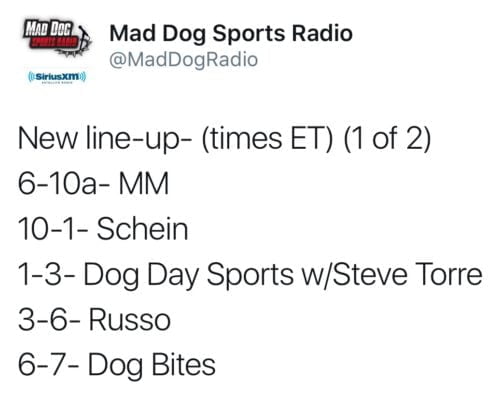
With Stephen A. Smith leaving for ESPN Radio, Mad Dog Sports Radio has been forced to have to make adjustments to its weekday lineup. The channel confirmed on Friday how they’d fill Smith’s void and position the brand to have future success.

Program Director Steve Torre will take over for Smith and host a new program “Dog Day Sports”. Torre has been with the channel since it first launched in September 2008. He will continue hosting “Dog Bites” from 6p-7p.

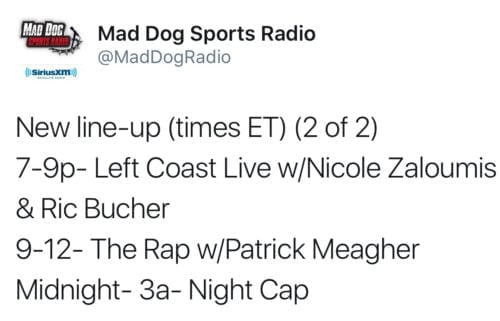
The channel is also adding Ric Bucher and Nicole Zaloumis to evenings, which is afternoon drive for west coast listeners. Bucher and Zaloumis will host weeknights from 7p-9p ET. They had been hosting mornings on Bleacher Report radio.

To close things out, Patrick Meagher hosts “The Rap” from 9p-12a.

The changes go into effect starting Monday January 9th.

Kate Scott Announces She’s Leaving KNBR

0

For the past six years, Kate Scott has been a mainstay on KNBR 680’s weekday programming in San Francisco. She’s been an anchor and on-air contributor to Murph and Mac’s morning show, and Gary and Larry’s midday show, and even stepped into the 49ers broadcast booth to call a few preseason games, becoming the third female to call NFL action.

But as they say, all good things must come to an end.

Scott has revealed that she’s moving on from the radio station. In a post on Twitter, she said that she loved her time with the station, and grew up listening to it, and the past six years have been an absolute dream. She credited her co-workers for helping her advance her career and the audience for their passion, honesty and willingness to connect with her and help her become a better broadcaster.

As far as the future is concerned, Scott says she’ll be busy calling women’s basketball games during the week and anchoring Sports Report on Sunday’s on the Pac-12 Network. She’ll also provide play by play of select men’s basketball games on CSN Bay Area and CSN California, plus plans to add softball play by play on Pac-12 to the list soon.

Sports Radio WNML Adds Erik Ainge To Middays

0

Sports Radio WNML has made a lineup change which should get the attention of Tennessee football fans.

Earlier this week, the radio station launched The Erik Ainge Show, featuring the former Volunteer and New York Jets QB, and nephew of Boston Celtics GM Danny Ainge. Ainge is joined weekdays from 9a-12p by Brian Rice.

Ainge is an Oregon native who played for the University of Tennessee from 2004-2007. During that period he racked up numerous awards and honors from the SEC and across college football. He was then drafted by the Jets in the 5th round of the 2008 NFL Draft, and spent 2 seasons in the league before his professional football career came to an end.

Sports Radio WNML’s new weekday lineup is listed below.

  • 6-9         The First Quarter with Mickey Dearstone and Heather Harrington
  • 9-12       The Erik Ainge Show with Erik Ainge and Brian Rice
  • 12-3       Sports 180 with Josh Ward and Will West
  • 3-7         SportsTalk with John Wilkerson and Jimmy Hyams

For more information, visit www.sportsradiownml.com.

The Barrett Sports Media Podcast Is Coming Soon

0

If you frequent this website, chances are you’ve noticed the podcast section has been quiet for the past few months. Starting in February 2017, that’s about to change.

I am excited to announce that the Barrett Sports Media Podcast will debut February 8th, and this time it’ll be yours truly entering the podcast arena, and taking his place behind the microphone.

The goal of the new podcast is to feature one episode per week, and when news or situations warrant, and time allows, provide additional audio offerings. I considered launching a podcast in 2016, but with BSM in its development stages, I wanted to be sure I could afford the time to produce it consistently. Since then I’ve been fortunate to grow the business, and work with a number of excellent clients, and I now have a better handle on my schedule and commitments.

For those of you wondering about the status of the Podcast About Sports Radio, the answer is life has happened. Zach McCrite has done an excellent job with the PASR, but his daily responsibilities have required a heavier focus. Zach still hosts radio shows in Louisville, and if you’ve listened to any of his previous 77 episodes, the good news is that they’ll remain available on the website. When Zach produces future episodes of the PASR, they too will be included and promoted by BSM. Our friendship and professional relationship remains unchanged.

I want to thank Steve Stone for lending his voice to the new podcast. He’s not only an industry friend, but an exceptional voice guy who I had the good fortune of working with during my time in San Francisco at 95.7 The Game. Brands looking for a new fresh sound for their stations are encouraged to check out his work. He and Jim Cutler remain two of my favorite voice talents in the sports format.

It’ll take a little adjusting to the host’s chair. I spent the first eight years of my career on the air, but decided I liked too many other parts of the industry to want to focus solely on hosting. When I did occupy the airwaves, the parts of it that I enjoyed the most were interviewing interesting people and connecting with the audience. Those are two parts of this new venture that I’m looking forward to.

The content of the podcast will be focused on the business and art of sports radio. However, there may be a few occasions where I venture into sports television, digital audio, and/or print to conduct conversations and address issues from each of those mediums. My goal is to talk with personalities, programmers, reporters, producers, business leaders, and corporate executives, and supply a deeper look into what it takes to create and be successful in today’s sports media environment.

If you work in the industry, and would like to be considered for a future guest spot, email JBarrett@hvy.tcp.mybluehost.me. I can’t promise an appearance to everyone who’s interested, but I’ll try my best to respond back. I have a number of plans already in progress, among them include spending a few days in Houston during the week of Super Bowl, and conducting a few conversations in person. That also happens to be the week where this year’s Top 20 will be revealed.

To find out which future guests will be appearing on the podcast, stay tuned to the website or follow me on Twitter.

I appreciate your continued support of BSM, and look forward to hearing your feedback once the podcast officially launches. I must now end this blog in order to return to practicing my vocal exercises.

ESPN Hartford Names Ben Darnell New Program Director

0

97.9 ESPN in Hartford has found their next program director. The station has hired Ben Darnell to run the radio station, filling the vacancy that was created when Tim Spence moved to Denver in October to program two of iHeartmedia’s spoken word brands, including Denver Sports 760.

Darnell, moves to Hartford after a long stint in Wilmington, North Carolina where he had served as program director and on-air host for ESPN Wilmington 95.9FM and 630AM. The stations are owned and operated by Sunrise Broadcasting.

As part of his new opportunity, Darnell will contribute alongside Rob Dibble on the afternoon show on 97.9 ESPN. He’ll also handle day to day programming matters for News Radio 1410 WPOP, 960 WELI, and ESPN Radio 1300.

Making Sense of The Latest Houston Ratings

0

The Houston sports radio ratings were published this week in the Houston Chronicle, and I usually refrain from interjecting my opinion on other ratings pieces, but given what I just read, I felt it necessary to do so.

One of the major challenges radio faces as an industry is having their story told by the print media. Most writers don’t understand the complexities of the ratings game or the way radio stations evaluate short-term and long-term success. They simply look at a number for one demographic (Men 25-54) and compare it to the one the station generated the month before. They then use that gain or decrease as the evidence to support their position on defining whether the station was a success or failure for the current month.

First, it’s clear that the intent of this particular article was to stir up controversy by using Josh Innes’ name as the centerpiece. I’m sure Josh won’t mind the exposure, and the publication is probably satisfied with the traffic they’ve generated from it, but unless you understand the way new shows are measured, this is simply an attempt to create buzz around manufactured drama.

Let me be clear, Innes is off to a slow start. That part of the story deserves to be told. But, most new shows take time to develop and capture an audience, which is why most programmers provide a 1-2 year cushion when evaluating the growth of a show. iHeartmedia in Houston didn’t hire Innes with the false belief that he’d lead them to the top of the ratings in 3 months. If it were that simple they’d have hired him sooner.

There are certain situations when shows on highly rated brands win faster, or certain shows are a mess and need to have the plug pulled sooner, but Innes inherited a small audience, and provides a stark contrast in style to his predecessor Charlie Pallilo. That means he has to build an entirely new audience because Pallilo’s listener’s are less likely to stick around for Innes, at least in the short-term. To expect Josh to reverse the station’s ratings woes in afternoons in 90 days is unrealistic.

I understand the local press’ affinity towards Pallilo, but he was given a long leash by the iHeartmedia brass in Houston. I’m sure local executives wrestled with making a change for a while before deciding it was time to change direction.

Every host understands when they accept an opportunity to host a show in this business that they’re a prisoner to the ratings. Unfortunately for Charlie his numbers weren’t there. That doesn’t mean he’s not talented, a good guy, or someone capable of helping another station make money and enjoy success. It simply means he didn’t generate enough ratings to satisfy 790’s business objectives.

The even bigger part of the story that was missing was the credit that Sports Radio 610 deserved for winning the month. There are some very talented people on the airwaves at 790 and 97.5, and to win the head to head competition against them and remain in control as 610 has done for the majority of 2016 is a feat worth highlighting. The station literally received one line of recognition in the first 8 paragraphs of the story.

Since the local outlet didn’t provide it, let me be the first to extend a congrats to Ryan McCredden and the 610 staff on their latest performance.

If the goal was to generate buzz off of negativity, one could’ve pointed to the fact that the ratings were down for all three stations during the past three months. It’s football season, and the Texans were playing for a chance to make the playoffs, and there was a lot of drama surrounding the team’s starting Quarterback Brock Osweiler. The Rockets were also one month into the season, and playing great basketball. You’d think those things would help generate a spike in listening, but for whatever reason, the shares were slightly lower.

Was that due to Nielsen losing 8% of their sample? Maybe. But even if the 8% was located, I don’t believe the numbers would’ve matched what each brand produced in October.

I realize the Innes-Pallilo story provides drama. That then leads to clicks, and given Josh’s track record in Houston and Philadelphia, he’s a newspaper media writer’s dream. But I don’t think it’s too much to ask for the whole story to be told.

I have no horse in this race, I just like seeing the performance of sports radio brands reflected in a fair and honest way. For Houston listeners, I see it as a positive that they have three good options to choose from when they’re in the mood to consume Houston sports radio. Regardless of the ratings, if the brands are generating revenue and showing a profit, then all will be fine inside the walls of each operation.

When you add it all up, here’s what you have.

Sports Radio 610 is in the driver’s seat, and has consistently led the market.

790 is in building mode and counting on Innes to provide a ratings boost in the future, but they need time to take that next step.

ESPN 97.5 remains in the conversation in second place, and is currently giving 610 their strongest ratings competition. Their best performance though is coming from Mike and Mike, which could be problematic down the line if changes occur with ESPN Radio’s morning show.

Here are the numbers the Chronicle published which show how each station and it’s key weekday shows performed in the latest December book.

STATION TIMESLOT/LOCAL SHOWS 16-Dec 16-Nov 16-Oct
M-F 6A-7P
Sports Radio 610 3.2 3.6 3.7
ESPN 97.5 1.6 1.7 2.2
SportsTalk 790 0.8 1.1 1.7
Mornings
Sports Radio 610 Mad Radio – 6a-10a 3.4 3.9 4
ESPN 97.5 Mike & Mike – 5a-9a N/A N/A N/A
SportsTalk 790 Proper Gentlemen – 6a-10a 0.8 1.3 1.8
Middays
Sports Radio 610 John Lopez & Cody Stoots – 10a-2p 2.6 3.5 3
ESPN 97.5 Granato & Ramzanali – 9a-11a 1.5 1.8 2.4
ESPN 97.5 Granato & Salisbury – 11a-1p 2.2 2 2.5
ESPN 97.5 Joel Blank – 1p-4p 1.6 1.3 2
SportsTalk 790 Koch & Kalu – 10a-12p 1 0.8 1.3
SportsTalk 790 Jones & Clanton – 12p-3p 1.1 1.5 1.8
Afternoons
Sports Radio 610 The Triple Threat – 2p-6p 3.8 4.4 4.5
ESPN 97.5 The Blitz – 4p-7p 1.7 2.7 2.7
SportsTalk 790 Josh Innes – 3p-7p 0.9 1.4 N/A
SportsTalk 790 Charlie Pallilo 2.3

*** Mike and Mike’s ratings were not provided but the show delivers the three strongest rated hours of the entire broadcast day on ESPN 97.5. From 5a-6a M&M produce a 5.8. During the 7a-8a hour they record a 3.0, and from 8a-9a they generate a 2.6.

Nick Cattles To Join 98.5 The Sports Hub

0

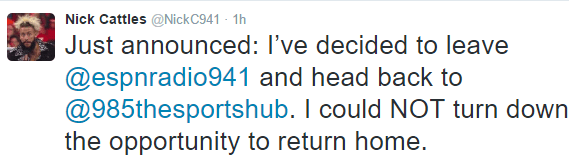
New England native Nick Cattles is returning home. The afternoon host on ESPN Radio 94.1 in Virginia Beach announced today that he’s accepted an opportunity to join 98.5 The Sports Hub. He’ll host his final show in Virginia Beach on January 9th.

Cattles began his radio career in Boston working for the Hub from 2009-2012. He’d been hosting afternoons in Virginia Beach for the past four and a half years. Upon his return, Cattles will join Adam Jones on the evening program, filling the void left behind by Rich Keefe who recently left the station to join WEEI’s afternoon show.

In a Facebook post, Cattles said that the decision was difficult because he grew up as a man, host, husband, and local business owner in Virginia Beach, but the opportunity to return home and talk about the teams he loves in a top 10 market, close to his friends and family, was something he couldn’t pass up.

Cattles did add that he plans to remain tied to the Virginia Beach area through his local ownership of the Tailgate Sports Bar, which he’ll remain invested in with a few other business partners.

The Challenge of Covering Sports in 2016

0

This week it was Richard Sherman. Last week it was DeMarcus Cousins. Prior to that, Jeff Fisher, Colin Kaepernick, Donald Trump and others found ways to deflect criticism, and blame the media for the difficult positions they placed themselves in.

Which raises a few questions.

Is the media not supposed to hold high profile people accountable? Are an individual’s words and actions not fair game to scrutinize, especially when they create a distraction or potential threat to their organization? Does the paying public not deserve answers from the local athletes and teams they spend their hard earned money supporting?

In 2016, the media is under a microscope more than ever. At times it’s justified, but not always.

Industry professionals are operating during a time where sensitivity has swept the nation by storm, and the media blame game gets introduced whenever a challenging situation arises.

If you missed it, Sherman threatened the career of longtime Seattle reporter and on-air host Jim Moore after he didn’t take kindly to Moore’s line of questioning. Rather than ignoring the question or providing a bland response, Sherman let it become personal.

To his credit, he’s since backtracked and acknowledged regret for making a mistake. But it’s difficult to buy that he’s accepted any wrongdoing because this isn’t the first time Sherman has had a dustup with a member of the media. In fact, it’s happened on a number of occasions.

But let’s forget about Sherman for a minute, and take a closer look at DeMarcus Cousins. The star forward of the Sacramento Kings jabbed a finger into the face of Sacramento Bee writer Andy Furillo after being angry over a piece that was published in the newspaper. He also has a history of refusing to answer questions from beat reporters whenever a member of the media is present who has written an unflattering story about him that he doesn’t appreciate.

After the incident, Cousins apologized and was docked fifty thousand dollars by the Kings. He issued a statement which said, “There is a time, place and manner to say everything, and I chose the wrong ones. Like most people, I am fiercely protective of my friends and family, and I let my emotions get the best of me in this situation. I understand my actions were inexcusable and I commit to upholding the professional standards of the Kings and the NBA. I apologize to my teammates, fans and the Kings organization for my behavior and the ensuing distraction and look forward to moving on and focusing on basketball.

Maybe I’m being cynical, but that statement looks like it came from a public relations official, not Cousins. If he truly felt he made a mistake, and wanted to repair the damage, Cousins should’ve sought out Furillo to express his remorse man to man. That’s how respect is regained, and it puts an unfortunate incident for both men in the rear view mirror.

Instead, the only media attention that has come Cousins way during the past week has been about whether or not he’s too thin skinned to handle the heat in a larger market, and if he’s worth the headache and huge price tag.

When a player’s resume details a history full of explosions against the media, it stays with them. If Cousins wants to earn the benefit of the doubt from those who cover him on a regular basis, he has to give them the same courtesy in return. That’s something he’s yet to do.

So if trust is shattered, and a lack of respect exists between the media and the athletes, coaches, and executives that they cover, how do we make it better?

For starters, I don’t believe change is created by one specific act or individual. It takes a series of events, and communication on both sides to create a better working relationship. A little bit of respect, understanding, and compromise wouldn’t hurt either.

Professional and collegiate athletes, coaches, and executives need to remember why media members occupy space inside their buildings. In a nutshell, coverage of a team fuels public interest. That leads to increased ticket sales, merchandise sales, a spike in the ratings for the club’s radio and television partners, and support of the franchise’s business partners.

The athlete or coach may not necessarily view the media’s role in this way, but their presence and consistent content delivery on the franchise’s key storylines plays a huge part in the franchise’s financial success. If you don’t believe the media has that type of influence, I dare one professional franchise to hold a game in their stadium with no radio, television, or digital coverage involved.

While the disrespect for the media can be frustrating at times to those who work in the industry, it’s naive to think that this issue is a one way street. There’s plenty of blame to go around on our side as well.

During the past decade, the expansion of the industry has created a ripple effect. Much of it due to the growing influence of digital and social media. When locker rooms were filled with 10-20 media members, mistakes were marginal, and agendas were easier to pinpoint. Now with hundreds of outlets invading locker rooms, providing similar content, and rushing to be first on every story, the quality in coverage has slipped.

Another factor to take into account is that in each city there are many individuals attending games, practices, and press conferences who don’t invest the time in fostering relationships with the teams and people they cover. The focus on quality reporting takes a backseat to sensationalism because it leads to more clicks, views and tune ins.

We’ve also seen a growing number of media folks entering team facilities unprepared, untrained, and with hidden agendas. They arrive on site in search of a soundbyte to fit their story, rather than telling the one that’s been provided. Others may even use their positions to demonstrate to the team and its players who they are and why they need to be given preferential treatment from the rest of their peers. This is the type of nonsense that leads to certain players with hall of fame resumes, not receiving votes for the hall of fame after their career is done.

On a few occasions, I’ve turned on the television to watch sports programming, only to find a personality or two buying into their own hype, and using their platforms to step over the line and get personal. It’s fine if a broadcaster and athlete have differing opinions on a performance related subject, but when commentaries tuns personal, respect for one another goes out the window, and without that, you can’t move a conversation forward.

As a rule, I’ve consistently preached the importance of providing strong candid opinions on the performance of a team or individual. That’s fair game in my book. We cover sports and the people who play them, and if someone has a bad game or commits an act that hurts the team, that coach or individual needs to be thick skinned enough to handle a series of tough questions. They don’t have to like the way we ask our questions or the subject matter we’re asking about, but they owe it to their league and organization, and the fans who support them to face the music. It’s part of the job responsibility that they accept when they sign a contract to play professional sports.

I also believe the media has a right to question athletes, coaches, executives or owners when the decisions they make outside the lines have a carryover effect on their organizations. Whether it’s Michael Floyd’s DUI arrest, Aaron Hernandez being linked to a murder, or Colin Kaepernick’s choice to kneel instead of standing up for the national anthem, if an individual creates headlines for the wrong reasons, the media has the right to ask questions about it. We can’t control their answers, but questions do need to be asked.

https://www.youtube.com/watch?v=umYJjZuUY9Q

It may sound simple and cliche, but respect for each other and the jobs we do, goes a long way towards preventing ill will. In the current climate of our society, many athletes, coaches, and executives have this perception that the media are in their buildings to uncover dirt and make them look bad. That’s not how the majority of reporters, and hosts operate. They also feel that if they form a business relationship with the media member’s organization, that they’re entitled to a different set of rules which is not the case.

Those who earn the privilege of covering a team can also do a better job of building trust with the people they cover. When solid relationships are established, it leads to more give and take from both sides. It also leads to receiving more information which helps you do your job better.

However, the individuals who represent professional franchise’s also need to realize that they don’t decide what gets reported. If they want to avoid creating distractions or headlines which can paint the organization in a negative light, there’s a simple solution – don’t make a mess. It’s not the media’s job to clean things up. It’s our responsibility to inform the public that it happened.

But if there’s one part of the media’s decision making that can be improved it’s having a better grasp on who from each organization is entering a team’s workplace to cover them. Some people are professional and thrive in the environment, others are unfit, unsure, and unlikely to help the brand by being there. Not every member of your organization deserves to be in the room, and if they are going to be there, they should know what to do and how to do it.

I remember being in St. Louis at a Rams game a few years ago when I was running 101 ESPN, and enduring the wrath of a Rams PR official for the way one of my staff members was representing the station inside the press box. I began to think about who I had credentialed for the game, and I couldn’t come up with anyone who I thought would harm the station’s reputation.

The Rams PR official then pointed to the individual who was wearing a Rams jersey in the press box, and I discovered that it was a member of our promotions team. This person wasn’t part of the programming team, but they had access to the stadium because they were working in our tent and helping the station connect with listeners.

Were they there to cover the team? No. Did they mean to make the station look bad? Of course not. They didn’t even know it was a cardinal sin to wear a team’s jersey in the press box. It was a place inside the stadium that they hadn’t been to before, and they only entered the room to grab a sandwich and cup of soda.

An honest mistake it might have been, but they worked for my station, therefore they represented my brand, which means I messed up. I took the heat that day, and spoke to the individual afterwards, and it was never an issue again. But what it taught me, was the importance of making sure all staff members knew the ground rules for how to act and conduct themselves in specific places when representing the brand. It would’ve been easy to blame this person for heading into the press box without my permission, but it was just as much on me for not making sure they understood the rules before doing so.

All it takes is one media member conducting themselves improperly in the wrong location for the entire group to look bad. Had my employee entered the locker room that day after the game dressed in that jersey, it would’ve compromised every other reporter, writer, anchor and host’s ability to do their job. That’s permanently damaging to one’s reputation, even if it isn’t intentional.

I bring that specific example to light because in stations across America, I’m sure there are times where an intern or staff member is given a press credential to a local team’s games, and we think nothing about it. We assume they’re going to watch the game, post a few details about it on social media, possibly record some audio afterwards, and then exit.

But have you spoken to them about the way to conduct themselves inside that locker room? Have you given them specific instruction on what to do and how to help the brand while they’re in attendance? Are they shadowing a member of your organization who provides a positive influence and helps them learn the ropes? Or are they going to the game because the food is free and the press pass gives them access to players that they may even attempt to bother for a selfie or an autograph?

I don’t want to insinuate that the media was at fault for the situations that occurred with Richard Sherman and DeMarcus Cousins because I don’t believe they were. The coverage was warranted. Whether each athlete liked the line of questioning or the story that was written is irrelevant. They have a responsibility to be professional, even towards people they don’t see eye to eye with.

But let’s also learn from these situations, and prepare ourselves the best way possible.

Not everyone from your organization belongs inside a locker room. When they do earn the right, make sure they’re prepared and conducting themselves in a way that doesn’t embarrass you, their teammates or the brand. Be specific about your expectations of what they should be doing when they enter a stadium or arena on behalf of the company.

We can’t control the respect others have for us or our medium. But we can be responsible for our own actions and behavior. If we’re treating the people we cover fairly and with respect, maintaining a professional demeanor during the process, and meeting the standards that our employer has outlined are necessary, than that should be enough to help you sleep well at night. The rest is beyond your control.