Home Blog Page 650

John Catsimatidis: Curtis Sliwa’s Future with 77 WABC ‘Up to Him’

0

77 WABC host Curtis Sliwa is currently polling in third place in the New York City mayoral race. Station owner John Catsimatidis says Sliwa’s future with the outlet is up to the Republican nominee.

In an exchange with Gothamist, Catsimatidis was asked if Sliwa would return ot the brand once the election concludes.

“Up to him,” Catsimatidis replied.

The comments from Catsimatidis came after the Sliwa campaign said that he was not on a leave of absence, but had “quit” his position with 77 WABC to run for the top office in the Big Apple.

Additionally, John Catsimatidis stated in an interview with the station’s morning host, Sid Rosenberg, that he believes Sliwa should drop out of the race in an effort to help former governor Andrew Cuomo defeat challenger Zohran Mamdani.

“Look, I love Curtis,” Catsimatidis said. “But Curtis has to realize that he should love New York more than anything else. And it certainly looks like Curtis should pull out right now.”

The New York City mayoral election is scheduled for Tuesday, November 4th.

Barrett Media produces daily content on the music, news, and sports media industries. To stay updated, sign up for our newsletters and get the latest information delivered straight to your inbox.

Pat McAfee Blasts “Old White People” & “Old ESPN People” in Early Morning Instagram Story

0

Pat McAfee is no stranger to stirring conversation, and his recent appearance on College GameDay this past Saturday from Eugene, Oregon, proved no exception. A reel of McAfee’s on-air introduction quickly circulated online, sparking widespread commentary—some critical, some celebratory. In response, the former NFL punter-turned-media personality did not hold back.

Sharing a graphic of comments from what McAfee later called “old white people” in a video posted to his Instagram story, McAfee provided context on how he feels about criticisms from those online.

“It was nice to read those comments. I’d like to let all you old f***s know I hate you too. Never got along with that class of people, teachers, principals, you name it. Since I’m a kid, always hated me, it’s kind of a part of life,” McAfee said, addressing viewers and critics alike.

The comments highlight a recurring theme in McAfee’s public persona. A mix of irreverence, self-assuredness, and an instinct to confront detractors head-on. Known for blending sports commentary with humor and bold opinions. McAfee has cultivated a following that thrives on his willingness to push boundaries, both on television and online.

His commentary also included a pointed nod to the broadcasting establishment, particularly ESPN veterans, a group he says has consistently expressed some disdain for him over the years.

“To think about old white people and old ESPN people. Those are really the people that hate me the most at this stage of life. Now, granted, there’s some other groups that certainly have threatened my life on a pretty regular basis. I’d say they hate me too. But throughout the entirety old whites and the old ESPN people over the last like three years have really hated me. That’s who all the producers are of GameDay too. So now you know that’s it’s been a fun run. College football is great,” McAfee said.

McAfee hinted at the production staff in his message relating them to the persona he was speaking about. However he did not name any names or mention his potential future with the program.

The comments reflect both McAfee’s contentious relationship with portions of the sports media world. Plus his enduring enthusiasm for college football. McAfee has not been shy about challenging ESPN management, including a very public feud with former ESPN executive Norby Williamson.

McAfee joined College GameDay on a full time basis in 2022, and has become the defacto closer to the program with his final selection following the retirement of Lee Corso.

ESPN has not released any statement on McAfee’s latest comments regarding “ESPN people.”

Barrett Media produces daily content on the music, news, and sports media industries. To stay updated, sign up for our newsletters and get the latest information delivered straight to your inbox.

Saga Communications Inks Deal to Sell 22 Tower Sites For More Than $10 Million

0

Saga Communications has announced it has struck a deal to sell 22 of its tower sites for more than $10 million.

In total, GTC Uno will pay Saga Communications $10.7 million for the land that the tower sites currently occupy.

As part of the deal, the company will continue to utilize the existing equipment at those locations on a cash-free lease basis.

In a statement, the company’s CEO, Chris Forgy, said that the deal is part of a great plan to ensure Saga is operating at its peak potential.

“Saga previously announced its plans to optimize our portfolio of assets, and this is a significant step in doing so,” said Forgy. “We are committed to evaluating every asset we own while still efficiently and effectively operating our businesses.”

With the influx of cash, Saga shared that it plans to enact a round of stock buybacks, whether it be public, private, or block purchase. The company’s board of directors has made no firm plans on how it plans to approach the stock buybacks with the $10 million acquired in the deal.

Barrett Media produces daily content on the music, news, and sports media industries. To stay updated, sign up for our newsletters and get the latest information delivered straight to your inbox.

Why So Many Of Us Prefer To Stay In Over Going Out

0

For many of us, Friday nights meant dressing up in our finest club clothes and going out for a night of drinking, dancing, and revelry. It feels like it has been ages since you last dedicated your weekend to going out. But it’s not just you; this trend has been sweeping the nation, with many surveys revealing that most Americans want to stay in over the weekend instead of hitting the nightclubs.

In fact, almost three-quarters of Americans would rather stay home and invite friends over than go out. This has been a dramatic shift in behavior across generations. FOMO (fear of missing out) once motivated millions to head out over weekends, but today that has been replaced by new trends: JOMO (joy of missing out) and JOSH (joy of staying home). 

It’s not like we’re becoming hermits and never leaving our homes… Instead, we keep going out for special occasions. Here’s why staying home is the new going out.

Saving Money

One of the biggest drivers for us all becoming such homebodies is because of the cost of going out. You can easily spend more than $100 on dinner and drinks, and that’s excluding club entrance fees and taxis. 

It feels like everything has become so expensive, and it has stripped away the fun of going out. Even going to the cinema can cost you over $50 for a ticket and popcorn, so it makes sense that we’d rather stay home and watch movies in our living rooms. 

Cost savings is also important for those who do occasionally want to leave the house. Most of us enjoy going to special events, like bachelor parties, when a famous musician comes to town, or going to a festival. By staying home most weekends, we can save up for when big one-off events roll around.  

Entertainment At Home

Our homes have become entertainment hubs. Perhaps you recall as a kid often complaining that you’re bored. That is a thing of the past, with our smartphones, smart TVs, and laptops connecting us to the entire world. 

You can bring the casino to your home with 99Bitcoins top Solana casinos. These platforms allow you to play all your favorite casino games without setting a foot outside of your door (not to mention your potential winnings can be put towards those rare nights out). 

The entire cinematic experience is possible thanks to streaming platforms like Netflix, Disney+, FOX One, and Amazon Prime Video. Then there are games. From console games that will suck you in for hours to mobile games that entertain you while watching The Office in the background, you have no reason to be bored at home. 

Kindle allows you to access an entire library in your lounge, arcade games are freely available online, DoorDash brings the restaurant to your home, and a well-stocked liquor cabinet means drinks are essentially on tap.

Still Able To Socialize

Just because we’re at home doesn’t mean we don’t have anyone to talk to. Studies have found that 74% of Americans prefer having meaningful conversations at home instead of during an outing. Discussions tend to focus on personal life, gossip, and politics. 

But we’re not just hosting chats at home, we also prefer bigger events, like birthday celebrations, dinner parties, movie nights, game nights, and watching series together. 

The younger generation has also turned to online socializing. Social media has made it incredibly easy to remain connected to anyone around the world, and many of Gen Z consider their online friends as important as their in-person friends. 

Being home isn’t lonely. It is a more engaging way to connect.

A Need To Unwind

Let’s face it, life is stressful. Many of us feel like we are always on the go. Whether we’re commuting to the office, working from home, doing chores, or heading to the gym, it feels like we have no time for ourselves. 

The events of 2020 forced most of the world to stay at home for weeks at a time, and this changed how we view being at home. Home because a place of peace, and isolating yourself for a couple of days or just a weekend has become a coping mechanism for today’s many anxieties. 

Many people also simply don’t feel the obligation to be social anymore and are more willing to say no to invites (without having to come up with a fake excuse). 

Cocooning, bunkering, or hermiting; whatever you want to call it, we’re doing it. Many people opt for phone-free weekends, when they can immerse themselves in a book or game without any distractions. It is a way to unwind from life’s stressors, and our homes have become our sanctuaries. 

Control Of Your Environment

Staying home gives you complete control of your environment. Who among us has not stood in a crowded bar, shouting to your friend standing right next to you just to be heard? Or, who hasn’t gotten home from a night out and immediately tossed their clothes in the washer because of the smoke smell that clings to them?

When you’re staying home, you are in complete control of the sound, scents, and comfort levels. You can create the perfect atmosphere, whether for yourself or for guests. You get to eat what you want without being restricted to a menu, go to sleep as soon as the need strikes you without waiting for an Uber, and get to select who you interact with without being inappropriately hit on at the bar.

Final Thoughts

The shift from public to private environments for socializing is a big change in our habits. Many Americans state that this has been a recent change (in the past few years), but it can be seen across the world. 

The timing of our preference to stay in is because of several factors, including the cost of going out, the craving for intimate connections, and the need for our creature comforts after a stressful week. It is likely that the change in going-out habits will impact many entertainment venues, which will have to adapt to meet the needs of their home-staying consumers.

NewsTalkSTL Names Susie Moore Morning Show Co-Host Alongside Mike Ferguson

0

NewsTalkSTL has announced that it is adding Susie Moore to its morning show.

Moore will join Mike Ferguson, who was already in the daypart, for The Mike Ferguson in the Morning Show.

Currently, Moore serves as the Deputy Managing Editor of the digital outlet RedState. She also hosts RedState Radio on Sundays at 4 PM on the St. Louis station.

“It has been such a privilege to be part of the NewsTalkSTL team from the outset,” Moore said. “I am thrilled to be joining The Mike Ferguson in the Morning Show as co-host. I can’t wait to be part of the conversation with Mike and our NewsTalkSTL listeners every weekday morning.”

“Susie is the perfect addition to the show,” added Ferguson. “We’re fortunate to be able to add someone who does such great work in the conservative movement through RedState and also knows our community here in St. Louis. Our audience knows Susie, likes her, and respects her. We’re going to miss Gabe, but we’re excited about what Susie brings to the show.”

Moore will step into the shoes vacated by Gabe Phifer, who is stepping down to spend more time with his family.

 “Gabe’s departure leaves big shoes to fill, and we’re very excited to have someone of Susie’s talent step in,” the station’s President of Programming, Jeff Allen, said. “She will be a great addition to our live and local commitment.”

The Mike Ferguson in the Morning Show airs from 5:30-9 AM on NewsTalkSTL.

Barrett Media produces daily content on the music, news, and sports media industries. To stay updated, sign up for our newsletters and get the latest information delivered straight to your inbox.

Warner Bros. Discovery Reveals Company Is Open For Sale

0

Warner Bros. Discovery’s Board of Directors has opened the door to potential change at one of the world’s most powerful media companies. The company announced Tuesday that it has begun a formal review of strategic alternatives following unsolicited interest from multiple parties for either the entire company or its Warner Bros. unit.

The move comes as Warner Bros. Discovery continues to advance plans to separate into two independent entities — Warner Bros. and Discovery Global — by mid-2026. That process remains on track, but the company said its board will now weigh a broader set of options designed to “maximize shareholder value.”

According to the company’s statement, the board will evaluate a range of possibilities. There include completing the previously announced separation, pursuing a sale of the full company, or negotiating separate transactions involving Warner Bros. and/or Discovery Global. Another potential path under consideration would merge Warner Bros. with another partner while spinning off Discovery Global to shareholders.

President and CEO David Zaslav said the review reflects the increasing recognition of Warner Bros. Discovery’s asset value and the company’s progress in repositioning itself for the future.

“We continue to make important strides to position our business to succeed in today’s evolving media landscape by advancing our strategic initiatives, returning our studios to industry leadership, and scaling HBO Max globally,” Zaslav said. “We took the bold step of preparing to separate the Company into two distinct, leading media companies because we strongly believed this was the best path forward.”

He added that outside interest was “no surprise,” given the strength of the company’s portfolio. He stated the comprehensive review is designed to “identify the best path forward to unlock the full value of our assets.”

Board Chair Samuel A. Di Piazza, Jr. emphasized that while the separation remains a compelling option. The decision to open a wider review is about ensuring no opportunity is left unexplored.

“Our decision to initiate this review underscores the Board’s commitment to considering all opportunities to determine the best value for our shareholders,” Di Piazza said. “We continue to believe that our planned separation to create two distinct, leading media companies will create compelling value. That said, we determined taking these actions to broaden our scope is in the best interest of shareholders.”

The company cautioned that there is no deadline for the review and no guarantee it will result in a sale or other transaction. Warner Bros. Discovery said it does not plan to make further announcements about the process. Unless a specific deal is approved or additional disclosure is deemed necessary.

Barrett Media produces daily content on the music, news, and sports media industries. To stay updated, sign up for our newsletters and get the latest information delivered straight to your inbox.

ESPN Signs Multi-Year Extensions With NBA Writers Ohm Youngmisuk, Tim MacMahon and Dave McMenamin

0

ESPN has reached multi-year extensions with three of its most prominent NBA writers — Ohm Youngmisuk, Tim MacMahon, and Dave McMenamin — further solidifying the network’s deep bench of basketball reporting talent ahead of another highly anticipated NBA season.

The trio has been a cornerstone of ESPN’s NBA coverage for years, providing comprehensive reporting across television, digital, and audio platforms. Their renewed deals underscore the network’s commitment to maintaining its status as a leading destination for basketball news, storytelling, and analysis.

Youngmisuk will continue covering the Atlanta Hawks, Miami Heat, Orlando Magic, and Charlotte Hornets, along with contributing to ESPN’s national NBA coverage. A versatile journalist, he’s been a key figure for ESPN since joining the company in 2010, known for his blend of insider reporting and features that bring players and coaches to life.

MacMahon, a Senior NBA Writer who covers the Dallas Mavericks, Oklahoma City Thunder, and the broader Western Conference landscape, will also remain with ESPN. MacMahon joined ESPN in 2009 as a reporter for ESPN Dallas, where he covered the Cowboys and Mavericks. When ESPN phased out its local sites, he transitioned to a national NBA beat and has since become one of the most respected voices on the Western Conference, regularly reporting from team markets and playoff series across the country.

McMenamin, also a Senior NBA Writer, will continue to cover the Los Angeles Lakers and other national stories. A longtime ESPN fixture, Dave McMenamin joined ESPN as an NBA reporter in 2009, working as a beat writer and television analyst and primarily covers the Los Angeles Lakers. He has contributed to several ESPN platforms including NBA Today, ESPN the Magazine, SportsCenter, Outside the Lines and more. McMenamin began his career covering the league in 2005 for NBA.com after having played basketball collegiately at the University of Limerick in Ireland and graduating from Syracuse University, where he was a student manager for the 2003 national championship team with Carmelo Anthony.

The extensions come at a time when ESPN continues to evolve its approach to NBA coverage, balancing traditional reporting with multiplatform storytelling that spans streaming, podcasts, and social media. Each of the three writers plays a central role in that strategy, bringing both local expertise and national perspective.

Barrett Media produces daily content on the music, news, and sports media industries. To stay updated, sign up for our newsletters and get the latest information delivered straight to your inbox.

Football Pushes Broadcast Television Viewership Surge in September

0

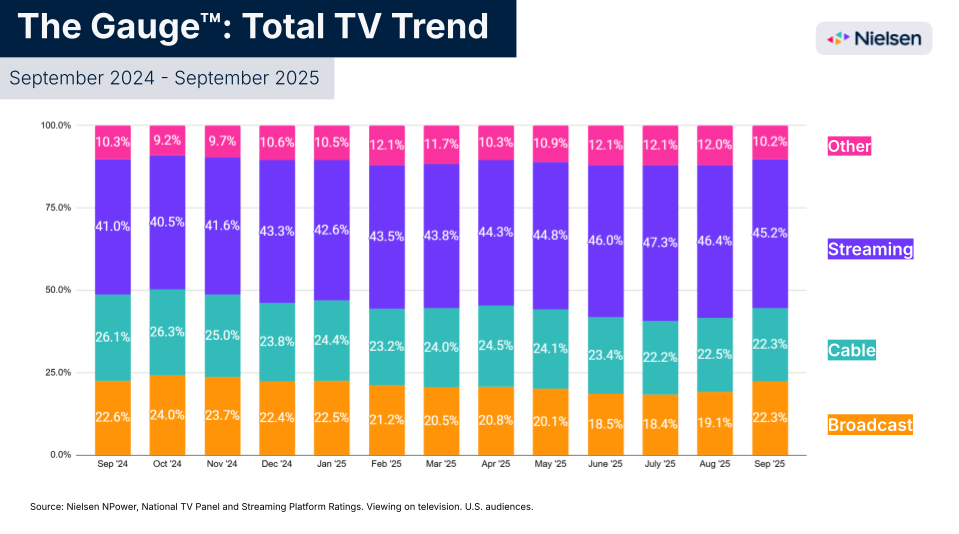
Broadcast television roared back in September, powered by the return of the NFL and college football. According to Nielsen’s latest Gauge report, the category posted a 20% month-over-month spike in viewership — compared to roughly 3% growth across all of TV — marking the largest monthly increase in volume and share since Nielsen began tracking in May 2021.

The football-fueled surge pushed broadcast to a 22.3% share of total television viewing, allowing it to edge past cable on an unrounded basis for the first time. Sports accounted for a major share of that growth, tripling from 11% of broadcast viewing in August to 33% in September.

Fifteen NFL telecasts across CBS, FOX and NBC topped last month’s most-watched broadcast, with September’s highest-rated game more than doubling August’s peak audience.

Cable also matched broadcast’s 22.3% share, driven by news and sports programming. News viewership increased 9% and represented more than one-quarter of all cable viewing, while sports gained 11%.

ESPN’s slate of Monday Night Football games dominated the top of the cable charts, joined by NFL Network’s first international game of the season to round out the top five telecasts.

The viewing rebound was particularly strong among younger audiences. Nielsen reported that broadcast viewing among adults ages 25–34 jumped 65%, while cable rose 16% within the same demographic — a sign that live sports continue to be one of the few appointment-viewing draws for younger viewers.

Even with the surge in traditional television, streaming maintained its dominance, capturing 45.2% of total TV usage in September. However, the category saw fewer breakout titles than earlier in the summer. Only 10 programs surpassed one billion weekly viewing minutes, compared to 18 in July.

YouTube led all streaming platforms with a 12.6% share, though usage declined 2% month over month as younger audiences returned to school. Netflix followed with 8.3%, buoyed by Wednesday, which racked up more than 7 billion viewing minutes for the month. Netflix’s animated film KPOP Demon Hunters placed second with 3.6 billion minutes viewed.

Disney’s combined services — Disney+, Hulu and ESPN+ — delivered a 4.5% share to place third among streamers, while Prime Video held steady at 3.9%. Amazon also logged its most-watched Thursday Night Football game ever on September 11, as the Commanders-Packers matchup generated more than 3 billion minutes viewed.

Barrett Media produces daily content on the music, news, and sports media industries. To stay updated, sign up for our newsletters and get the latest information delivered straight to your inbox.

Kwame Dankwa Exits As Program Director at 95 Triple X, Burlington

0

Vox Media has announced the departure of Kwame Dankwa as Program Director of WXXX (95 Triple X), which serves the Burlington, Vermont–Plattsburgh, New York market. The company cited “a difference in programming direction with management” as the reason for the change.

Dankwa joined Vox AM FM in 2021 and quickly became an influential part of the company’s leadership team. Earlier this year, in January 2024, he expanded his responsibilities, taking on additional programming oversight for News/Talk WVMT and Sports/Talk WEAV “The Game.”

During his tenure, Dankwa helped guide 95 Triple X through evolving audience trends in the contemporary hit radio format.

His background in multiple formats and markets brought a fresh approach to the brand’s sound and local engagement.

He previously served as Brand Manager and afternoon host at WJBQ Portland, Maine beginning in 2019. Prior to that, he was Program Director at Star 104 in Erie, Pennsylvania, and earlier worked as Assistant Program Director and afternoon host at Power 93.3 Seattle.

Barrett Media produces daily content on the music, news, and sports media industries. To stay updated, sign up for our newsletters and get the latest information delivered straight to your inbox.

Why Cumulus is Drawing a Line in the Sand in Its Lawsuit Against Nielsen

0

I’m interrupting my regularly scheduled column due to the news on Friday that Cumulus sued Nielsen in U.S. District Court for the Southern District of New York.

I’ve read over the complaint, and while I’m (thankfully) not a lawyer, I’ll offer some context and thoughts.

Cumulus’ attorneys regularly used the phrase “upon information and understanding,” which apparently is part of federal fraud pleadings and requires further facts. Some of what you’ll read here is upon my personal “information and understanding.”

When I started in this business, Arbitron reported every commercial radio station that met minimum reporting standards regardless of subscriber status. It was assumed that clients, broadcasters, agencies, and advertisers paid for a complete view of the commercial radio marketplace. This was back when one entity could own no more than seven AM and seven FM stations nationally.

Occasionally, the system was abused. Everything was on paper, so someone might borrow a book from a friend at an agency or another station in town that had access. While they couldn’t use the numbers for sales purposes, when you know the numbers, you can negotiate rates. As a television example, when I worked at WPXI-TV in Pittsburgh in the early ‘90s, Arbitron introduced ScanAmerica there, and our owners, Cox Television, did not subscribe.

However, we received overnights via fax from a syndicator, had access to the book, and set rates accordingly. For avails with Arbitron shops, we had rates but no numbers — yet the rates somehow matched up to the ratings.

In this century, access became limited, beginning in 2014 when Nielsen stopped reporting non-subscribers in the topline data release. Apparently, some stations used data that appeared in the trade press or local media for sales purposes. That avenue was cut off.

Next, Nielsen adopted the “Subscriber First” policy in 2021. “Subscriber First” should be named “Subscriber Only,” as the policy removed any non-subscribing stations from the summary data set. That’s the data set that goes to agencies and advertisers, so non-subscribing stations were no longer visible to buyers and planners. The non-subscriber estimates continued to appear in the respondent data set that subscribing stations received so programmers could see a full view of the market.

Let’s move to the present and the motivation for Cumulus’ suit. Cumulus owns Westwood One, one of the two major radio networks (there are others, but none on the scale of Westwood and iHeart’s Premiere, and no other network owners also own local stations). Westwood uses Nielsen’s Nationwide service for sales and programming. Network radio is a numbers-driven business.

When negotiating for a new Nielsen contract, according to the filing, Cumulus decided they no longer wished to pay for local Nielsen ratings in a majority of their 80 local markets. An example is Los Angeles, where the only Cumulus-owned outlet is KABC-AM. KABC was a big deal in its heyday, which passed long ago. Cumulus sees no reason to pay L.A. Nielsen rates for one station with a small audience.

Nielsen cited a new “tying” policy stating that if a company owns a property in a market, it must subscribe to the local service to allow its network to have access as well. If KABC doesn’t subscribe locally, then Westwood One will not have access to L.A. estimates. Westwood does business with multiple stations in Los Angeles that are not owned by Cumulus.

Per the filing, Cumulus would prefer to use Eastlan in some markets or go without estimates in others. However, Westwood can’t operate without the full Nationwide data set. Cumulus in Memphis already subscribes to Eastlan instead of Nielsen. Under the tying policy, Nielsen will not include Memphis in Westwood’s Nationwide data set.

Cumulus asserts this violates U.S. antitrust law under the Sherman Anti-Trust Act. The Sherman Act was passed in 1890 when Marconi was 16 and having fun at his family’s Italian estate. David Sarnoff’s mother was pregnant with that broadcast pioneer when President Harrison signed the Act into law.

The Act has been updated over the years. Cumulus’ key accusation falls under Section 2: Every person who shall monopolize, or attempt to monopolize, or combine or conspire with any other person or persons to monopolize any part of the trade or commerce among the several states, or with foreign nations, shall be deemed guilty of a felony and, on conviction thereof, shall be punished by a fine not exceeding $100,000,000 if a corporation or, if any other person, $1,000,000, or by imprisonment not exceeding 10 years, or by both said punishments, at the discretion of the court.

Cumulus argues that Nielsen has a monopoly on national radio ratings and is using that monopoly power to force Cumulus to buy Nielsen data in its 80 local markets. Its position is that if the company doesn’t give in to Nielsen, Westwood One will be greatly harmed, as its full U.S. audience will not appear in Nationwide.

The company sent a “cease and desist” letter to Nielsen in August explaining the tying policy was “anticompetitive and illegal.” Cumulus stated that Nielsen then offered to sell the Nationwide data set without the tying policy but at a price nearly ten times (italics theirs) what Cumulus currently pays. Cumulus says this price would be equivalent to what it would pay for Nationwide and local data in the 80 Cumulus markets. In other words, the company pays the same if it wants Nationwide for the whole country.

When I started at the National Association of Broadcasters in 1987, on my first day, the report of economists working for NAB and an ad hoc group called the Radio Audience Measurement Task Force (RAMTF) was being reviewed. The issue at the time was the high price for Arbitron data and whether Birch, the competitor, was being unfairly held back due to monopolistic behavior by Arbitron.

My memory of the RAMTF was that the economists said Arbitron was a monopoly — but a legal one — in the sense that the company had become a monopoly not by harming other companies, but by offering better products. They also found that Arbitron was much more expensive in markets that did not have Birch than in those that did. Amazing how competition affects prices!

A current analogy might be Google. There are search competitors to Google, and in the distant past, I used Yahoo and even AltaVista at times. Today, Microsoft offers Bing. ChatGPT may soon be a real competitor, yet when someone looks up something online, they often say “Google it.” Google holds a huge share of search but grew organically.

In my experience, “tying” has happened before. When I worked at Birch/Scarborough, I heard we lost out with some agencies because they wanted the BAR service (national ad spend data), which was part-owned by Arbitron. Arbitron would either throw it in or tie radio data to BAR. We had no equivalent to BAR, so some agencies went with Arbitron Radio for just that reason.

More recently, Nielsen has tied co-owned Scarborough to the local ratings service to thwart The Media Audit. I’ve heard that Scarborough is thrown in at little or no cost, thus keeping The Media Audit out. No broadcaster will complain that they may be paying below-market prices for Scarborough.

Cumulus also cites Eastlan in the complaint. Eastlan has been around since 1999, generally measuring small markets that can’t afford Nielsen service, although the service is available in Raleigh-Durham, Greensboro, and Memphis — all three Nielsen PPM markets.

As Cumulus’ counsel notes, Eastlan is far less expensive than Nielsen. However, it does not appear in one of the major agency platforms, MediaOcean. An agency using MediaOcean does not see Eastlan data as an alternative to Nielsen. However, Eastlan data is in Strata and Advantage, per the Eastlan website. Eastlan is an alternative for local ratings. Although considering my issues with Nielsen methodology, it is not at Nielsen’s quality level.

What’s different here is not only that a broadcaster filed suit against Nielsen — shining a public light on negotiations with Nielsen — but that the dispute was not settled before Cumulus resorted to this step. If you trust Google Gemini, the vast majority of cases like this one are settled out of court. Cumulus has requested a jury trial.

This is a game of “chicken.” Considering the issues with network radio, Westwood One without full data is hard to imagine. In their Q2 financial release, Cumulus said their network business was down 14.7% in the first six months year over year. In Q2, the decline was 20.5%. Imagine the state of Cumulus’ network business without Nationwide!

However, Nielsen also needs revenue, especially with private equity ownership. As one of the Big Three ownership groups, Cumulus makes up a solid chunk of Nielsen Audio’s topline. It’s not enough to cause any serious financial issues for Nielsen, but it will sting if Cumulus walks. That infers that Cumulus may go without Nielsen data even in the 32 markets where the company wants it. If Cumulus does leave and holds up financially, it would be a seismic event that one of the big groups made a go of it without Nielsen data.

Is this Eastlan’s opportunity to finally become a true competitor to Nielsen? Assuming the company could bulk up quickly enough to cover many more markets, especially larger ones? Would MediaOcean agree to include Eastlan data so that Cumulus and potentially other companies would have a lower-priced alternative?

Antitrust litigation is expensive. Nielsen will not want to discuss its pricing and negotiation strategies in open court. Cumulus on the other hand is not profitable. Taking a further hit to revenue in the absence of Nielsen data, even after removing the Nielsen expense, will be hard.

All it takes is one desperate or foolish Cumulus AE to use Nielsen data obtained under the table, and Cumulus will be talking with a different set of Nielsen lawyers. If you don’t think this can happen, just ask Saga. In 2014, Nielsen sued for piracy (copyright infringement). Saga, which under Ed Christian had traditionally demurred from buying Nielsen data, eventually licensed five markets.

I expect some sort of deal between the parties later this year. Nielsen will drop the tying language. Cumulus will keep Nielsen in more than 32 markets while adding Eastlan in smaller markets that are barely profitable for Nielsen. I have no inside information to support this, but it only makes sense. What do you think?

Let’s meet again next week.

Barrett Media produces daily content on the music, news, and sports media industries. To stay updated, sign up for our newsletters and get the latest information delivered straight to your inbox.