Yahoo Sports is making its biggest bet yet on streaming video, announcing Tuesday the launch of the Yahoo Sports Network, a free, ad-supported streaming television channel (FAST) created in partnership with C15 Studio.
The 24/7 channel features more than 60 hours of original programming each week across the NFL, NBA, MLB, combat sports, college football, and beyond. The channel is currently available now on LG Channels and Sling Freestream, Yahoo Sports Network is also set to roll out on Samsung TV Plus, Amazon Fire TV, Fubo, Plex, Prime Video, and The Roku Channel in the coming weeks. Fans can also stream the channel directly on yahoosports.tv, a new digital hub for Yahoo Sports video.
Ryan Spoon, president of Yahoo Media Group, said the expansion underscores the company’s strategy to meet fans wherever they are consuming sports content.
“Our video business is growing rapidly – across the number of shows we produce, the hours of content we deliver, and most importantly, the viewership by fans,” Spoon said in a statement. “We are excited to officially launch the Yahoo Sports Network and make it widely available across leading FAST services.”
Programming spans live and on-demand shows from a lineup of notable names and insiders. The schedule includes The Ariel Helwani Show, Yahoo Sports Daily, Inside Coverage, and Yahoo Fantasy Forecast in live windows, along with recorded staples such as The Kevin O’Connor Show, Football 301, and Network with Rich Kleiman, which debuts in September. The lineup builds on Yahoo Sports’ momentum in the digital space, with YouTube watch time for its shows increasing tenfold over the past year.
Alongside its live programming, yahoosports.tv will serve as a central destination for highlights from nearly every major league, in addition to content partnerships with OneFootball and Motorsport Network.
The channel’s development comes at a time when sports media companies are increasingly leaning into FAST distribution as a complement to traditional linear and subscription streaming. By inserting commercial breaks into programming, Yahoo Sports Network creates new ad inventory for brands looking to tap into a growing audience.
The ad-supported structure makes the channel accessible to fans without additional subscription costs while offering advertisers direct access to a sports-hungry demographic.
C15 Studio, which operates premium sports channels for organizations such as Formula 1, DP World Tour, and MotoGP, is overseeing operations for the new network. Earlier this month, C15 partnered with MotoGP to launch its own FAST channel, signaling the company’s continued push into global sports media.
For Yahoo Sports, the launch doubles down on a rapidly expanding content portfolio. More than half of the shows on the new network have launched within the past 18 months, highlighting the brand’s push to broaden its voice in both traditional coverage and niche storytelling. Daily shows like Yahoo Sports Daily, hosted by Jason Fitz and Caroline Fenton, aim to provide fans with a consistent news cycle, while specialized series such as Baseball Bar-B-Cast and The Cooligans deliver personality-driven coverage of specific sports.
Introducing the launch of Yahoo Sports Network, a free, ad-supported streaming TV channel available on leading FAST services, as well as https://t.co/BByMAUNjas!
The first Yahoo Sports (FAST) channel will feature original programming that covers a range of sports (NFL, NBA, MLB,… pic.twitter.com/v2CZnvBxUP
Barrett Media produces daily content on the music, news, and sports media industries. To stay updated, sign up for our newsletters and get the latest information delivered straight to your inbox.
Major League Baseball appears to be on the cusp of a sweeping media rights overhaul, as continued talks signal a significant recalibration in how fans will consume MLB beginning in 2026.
According to a report by Kendall Baker of Yahoo Sports, MLB is “close to being done” hammering out multiple broadcast and streaming deals, which could reshape the national baseball media landscape. These talks reportedly involve NBC/Peacock, ESPN, Netflix and Apple—with Apple poised to exit the MLB broadcasting arena entirely.
Sources indicate to Baker that NBC/Peacock are likely to assume rights to Friday Night Baseball, as well as Sunday night games and the Wild Card round—rights that Apple or ESPN will no longer hold following the conclusion of this season. Meanwhile, Netflix has emerged as the leading contender to acquire exclusive streaming rights to the Home Run Derby.
For Apple, they signed a seven-year agreement with MLB worth $85 million per year in early 2022. Losing the rights just three years into the agreement would reportedly land NBC/Peacock with Sunday Night sports in the fall/winter (NFL), winter/spring (NBA), and spring/summer (MLB).
ESPN, despite formally opting out of its longstanding national agreement earlier this year with MLB, is poised to stay deeply involved in baseball, but in a markedly different capacity. Sources report the network is in discussions to acquire MLB.TV—the league’s out-of-market streaming service—presumably to house it within ESPN’s direct-to-consumer app.
As negotiations unfold, industry observers note that MLB aims to limit the duration of these deals to three years, through the end of the 2028 season, aligning with the expiration of its current contracts with FOX Sports and TNT Sports. That strategic alignment would pave the way for a sweeping set of rights to be collectively rebid in 2028—possibly including local and regional rights.
MLB Commissioner Rob Manfred has previously expressed optimism that, despite the complexity of the negotiations, the league is well positioned to lock in new broadcast partners by year end. Although he had set a goal for the annual MLB All Star break last month, Manfred said on ESPN’s telecast of Sunday Night Baseball he expects to make announcements in the coming weeks.
MLB, ESPN, NBC, Apple, or NBC/Peacock have not commented publicly about the latest report.
🚨 SCOOP: MLB rights deals are “close to being done,” per sources.
What I’m hearing:
– Apple is fully out. RIP Friday Night Baseball
– NBC/Peacock is in, for Friday and Sunday exclusive and Wild Card
– MLB TV being sold to ESPN (for a boatload of $$$)
Barrett Media produces daily content on the music, news, and sports media industries. To stay updated, sign up for our newsletters and get the latest information delivered straight to your inbox.
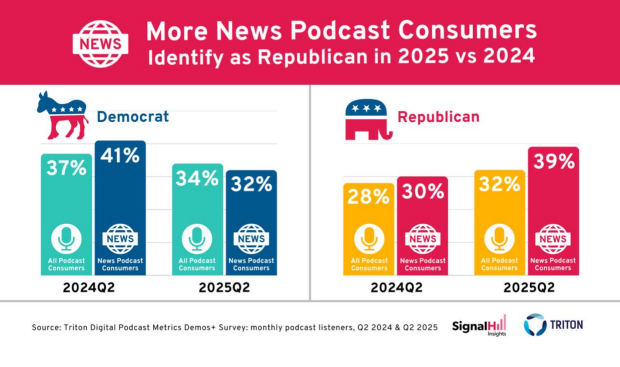
For years, Democrats heavily outranked Republicans as news podcast consumers. But new data from Signal Hill Insights and Triton Digital shows that it has changed dramatically.
According to new data, in 2024’s second quarter, 41% of survey respondents labeling themselves as Democrats were news podcast consumers. In the same quarter in 2025, that figure had dropped to 32%.
On the other side of the political aisle, in 2024, 30% of news podcast consumers self-identified as Republicans. That number jumped to 39% in 2025.
Of those podcast listeners who started consuming in the past six months, 42% called themselves Republicans, compared to 27% of Democrats. On the other hand, of those who had been podcast listeners for five or more years, Democrats were the larger share.
“News podcasts are not only finding themselves increasingly at the center of the national conversation, they are appealing to an inquisitive and attractive audience that’s growing even faster than podcast consumption in general,” Signal Hill Insights President Paul Riismandel said. “All good reasons for publishers and advertisers to keep a close eye on the category.”
The data from Signal Hill Insights and Triton Digital lends more credence to “The Podcast Election” moniker that was given to the 2024 presidential election, with high-profile interviews and stories relating to both President Donald Trump and challenger Kamala Harris dominating the news cycle in the run-up to the election.
During 2025’s second quarter, the news podcast genre hit a new high in share of podcast listening. 27.3% of monthly podcast consumers said they listened to or watched a news podcast in the past month. That figure is two full percentage points higher than the same window in 2024.
Barrett Media produces daily content on the music, news, and sports media industries. To stay updated, sign up for our newsletters and get the latest information delivered straight to your inbox.
Bill Hobson, a prominent voice in Michigan golf media, has found himself at the center of an access battle with LIV Golf just days before the tour’s event at The Cardinal at Saint John’s Resort in Plymouth Township. Hobson, host of the syndicated television program Michigan Golf Live and the Fore Golfers Network podcast, was informed Tuesday that his credential for this weekend’s event had been revoked.
The decision came after Hobson released a podcast interview with former LIV player and current broadcaster Pat Perez, according to The Detroit News.
According to Hobson, LIV Golf officials were displeased with two questions he asked Perez during the 20-plus-minute interview. One addressed the controversy surrounding the tour’s funding by Saudi Arabia’s Public Investment Fund, while the other touched on the departure of former CEO Greg Norman earlier this year.
Perez, known for his candid personality, answered both questions before moving on to lighter topics about his experience with LIV and the tour’s first visit to Michigan. But Hobson said the pushback was swift once the episode was published Sunday.
“It’s a self-fulfilling prophecy, talking about the lack of freedom — talking about the lack of tolerance, all of the things that regime is known for plays a factor in what just took place,” Hobson told The Detroit News. “And it’s super unnecessary. You talk about unforced errors, goodness gracious.”
Hobson, 57, who has worked in broadcasting since his teens and is based in Saginaw, stressed that his intention was never to provoke controversy. “In 26 years, I’d like to think that I’ve developed a reputation for being very fair. I had no desire whatsoever to have anything come out of this except for a fun conversation with a guy I find interesting,” he said.
Instead of full media credentials, LIV Golf offered Hobson general admission grounds passes for the week. Those would have allowed him entry as a fan but without media access to players. Hobson declined and will not attend the championship this weekend.
LIV Golf confirmed the revocation but declined to explain who made the decision. In a statement, the organization said, “LIV Golf values open and honest dialogue with media partners and has welcomed a wide range of perspectives since our inception. We are committed to working with journalists who approach interviews with fairness, integrity, and respect for the players and the sport.”
According to the report, Hobson said he then began fielding a flurry of texts and calls following the publication of the podcast from Outlyr and LIV Golf officials, who asked him to edit out those questions. He refused. They then, Hobson said, offered to get him another guest if he pulled down the podcast. He refused. They then, Hobson said, demanded the podcast come down, and suggested credentials could be revoked if he didn’t. Again, Hobson declined. His credentials were officially revoked Tuesday.
The controversy is not without precedent. LIV Golf has clashed with media outlets in the past, though revoking credentials after they have already been granted is rare.
This is not Hobson’s first tense interaction with the tour. In June, during a radio appearance for WJR 760-AM, he asked LIV CEO Scott O’Neill about the organization’s Saudi backing, drawing noticeable pushback at the time. Despite that, Hobson’s credential was approved for this week’s team championship until the Perez interview reignited friction.
Hobson insisted he never agreed to avoid certain topics in the podcast, although he was given suggested areas of discussion. He said Perez himself later texted support, telling him, “It’ll be fine. I don’t think you were antagonizing in any way. You are entitled to your opinions and thoughts.”
For Hobson, who has covered more than 100 professional golf events nationwide, this marks the first time in his career that his credential has been rescinded. The incident underscores the ongoing tension between LIV Golf’s tightly controlled media strategy and journalists seeking accountability on sensitive issues tied to the tour’s origins and leadership.
Barrett Media produces daily content on the music, news, and sports media industries. To stay updated, sign up for our newsletters and get the latest information delivered straight to your inbox.
When we introduced the Gold Standard in Business Award last year, the focus was on revenue. Joel Oxley of WTOP received the first award for a very good reason, his brand, WTOP, stood atop the revenue department. It didn’t hurt that WTOP was also a dominant ratings and digital force in the nation’s capital.
But business extends beyond dollars and cents too. Growing digital impact, ratings, reach, and partnerships are all a part of it. If you take those things into account, it’s hard to ignore the outstanding performance Premiere Networks has had in 2025.
Given the network’s success, it is my pleasure to announce Premiere Networks President Julie Talbott has been named our 2025 recipient of the Gold Standard in Business Award. Julie becomes the first person to receive one of our awards at both the BNM Summit and BSM Summit. It is a well deserved honor for the future radio hall of famer.
Under Julie’s leadership, Clay Travis and Buck Sexton are now heard on over 550 radio stations. Michael DelGiorno has quickly made a mark, landing on 100 stations in mornings in just over a year. Even Ted Cruz’s weekend program has gained ground, being added by more than 200 stations. That doesn’t include the already impressive reach of Sean Hannity, Glenn Beck, George Noory, and Jesse Kelly, all Premiere Networks shows.
Julie has been with Premiere Networks since 1999, serving as president since 2014. She oversees more than 100 radio programs and services, while managing business partnerships with talent, and leading and maintaining key affiliate relationships to sell and service Premiere Networks, Total Traffic & Weather Network and the 24/7 News Network.
Not one to seek the spotlight, Julie was both surprised and grateful when I informed her she had been selected as this year’s honoree. Her exact words were “I am overwhelmed! That is so lovely. I certainly am honored to accept this. Thank you so very much.”
Please join me in congratulating Julie on her well deserved recognition. The Premiere Networks awards ceremony will take place at the 2025 BNM Summit on Thursday September 4th at 11:30am at the Ailey Theater. For tickets and additional details about the Summit, visit BNMSummit.com.
Talking to Phil Becker, Alpha Media’s Executive Vice President of Content, will leave you walking away believing that radio’s best days are still ahead.
Recently, when I was invited on a couple of radio podcasts, I was asked what I wanted most for radio. My answer then and always is, I want to see people take some chances.
Becker is someone who is willing to take those chances and is determined to build radio’s next era on creativity, connection, and community.
“I try to remember that great performers can’t be great at everything. So, one of the things I ask myself is, okay, what can I do that is a little bit different than what others do? And I kind of am fearless, Jeff, to be honest with you.”
That fearlessness is not just philosophy; it’s a practice Becker lives by in every decision.
“No one remembers the stuff you got wrong. So, you might as well try a bunch of stuff. If I do an idea and it doesn’t work, they don’t remember that. So why am I so afraid?”
Becker believes that fearlessness is how radio survives and doesn’t have an “always done it this way” bone in his body.
“No One Else Is Going to Show Up to Save Us”
Becker doesn’t wait for change to come from outside the industry.
“No one else is going to show up to save us. There’s no magic major corporation that’s going, hey, let’s go fix radio real quick. So, we that are in it need to be the ones that push it forward.”
That philosophy has fueled some of his boldest decisions: syndicating Brooke & Jubal before they became a national brand, debuting AI Ashley, and most recently, giving Greg Beharrell a professional comedy writer, voice actor, and evening host on Rocker 95.5 KLOS in Los Angeles, a role on Country station 98.7 The Bull in Portland.
“The last thing a 42-year-old woman did was wake up this morning and go, you know, I should find a new radio station. So I have to create those marketable moments to get people to want to come back to the medium.”
Rethinking the “Throw-In” Station
When a cluster has a station pulling a 0.5 share, sales teams often treat it as a “fries with that” product, adding it to bring down the cost per point. Becker doesn’t see it that way.
“Fear really dilutes the ability for someone to create. When I used to be a GM, I didn’t ask, ‘What should we do?’ or ‘What would you do?’ I’d ask, ‘What do you want to do?’ That’s where the passion fires. That’s where ideas come from. And when you do that, they get bought into the vision of the station, and that may actually fix the sales challenge.”
Becker acknowledges the structural challenges.
“We need to acknowledge that there are just too many FM and AM frequencies in the United States. You’re going to have that .5 station unless you actually do something super interesting.”
While cluster sales teams were designed to streamline by having one team sell all stations, he sees unintended consequences.
“When we moved to cluster sales teams as opposed to station sales teams, that might have hurt us a little bit. Because now you don’t have that cheerleader from that life group out exciting clients for that specific station. And we also tend to build radio stations for Nielsen performance as opposed to building them for passion.”
Becker shares an interesting thought regarding how sales entry-level should mirror the program director’s path to entry.
“When you’re aspiring to be a programmer, you start with a smaller market, a smaller-rated station. Shouldn’t it be that way with sales? You don’t hand a first-time PD a Z100 New York. Why do we hand it to them in sales?”
Betting on Funny: The Greg Beharrell Move
“Whenever I look at a station, I ask myself where are we strong and where are we deficient. On The Bull, Bobby Bones was the connection to Nashville and the artists. Jamie Tanchyk and now B-Dub were our local dayparts, so they were the community. But we didn’t have anything that was true entertainment value. We had Nashville, we had local, but we were missing the funny.”
That’s where Beharrell came in.
“Sure, we could try to write funny sweepers and promos. But what if we just had someone on the team who was genuinely funny? Greg is a professional comedy writer. He’s written sitcoms, TV monologues, voiced Super Bowl commercials, and he’s the voice of the Impossible Burger. Funny plays no matter what.”
Becker was impressed by Beharrell’s commitment.
“He went to CRS, every panel, every artist showcase, every consultant meeting. He was investing in his career to a level that most people don’t. He’s the quote-unquote rock guy who wants to grow his offerings. If he’s willing to put in this level of work, why am I not willing to take the chance?”
AI Ashley: The First Through the Wall
Of all Becker’s moves, none made a bigger splash than AI Ashley, the first artificial intelligence-powered radio host Alpha Media introduced in 2022.
“The first thing that worked was Ashley’s attitude, the company’s attitude, and the client’s attitude. We have a three-customer model: the listener, the advertiser, and the coworker. None of them had a problem with AI Ashley. In fact, the research said, ‘Oh, I thought you guys were already doing that.’ They’re surrounded by AI content in their lives.”
AI Ashley
The backlash, Becker says, came mostly from within the industry. “Everyone thought it was going to be, ‘Here we go, AI is going to be doing all the air shifts everywhere.’ Well, that was two and a half years ago. We never put it on anywhere else. It wasn’t a cost-cutting thing. We still paid Ashley the same.”
Ironically, he argues, AI Ashley made radio more live. “I didn’t know what it was going to say until it said it, because it was pulling real-time information and content. Meanwhile, most of us voice-track hours or days in advance. My point was, we’re more live than we were before.”
Becker learned a valuable lesson.
“It’s a line from Moneyball: the first guy through the wall always gets bloodied. Caterpillars don’t speak butterfly language, but they eventually get there. Now there are half a dozen AI radio stations. Vendors are pitching 24/7 AI stations. We were right, and it aged well.”
Beyond Fear: Why Broadcasters Should Embrace AI
When asked why broadcasters shouldn’t fear AI, Becker points out they’re already using it.
“When you schedule a log and hit F10, that’s AI. When you let the playout system segue elements, that’s AI. When your Optimod evens out your volume levels, that’s AI. We’ve already been using it.”
“Where people got freaked out was, oh no, it sounds like a human. But it had already replaced the index cards in the recipe box. It already replaced the board operator. This is the same thing. It’s an evolution, not an elimination.”
He believes the industry’s history of broken promises, from local shows that became syndicated to live shows that became voice-tracked, has created distrust.
“Because the business has often not been forthright, I think that makes everyone afraid of AI. But I don’t think you need to be. This one is different.”
“It can help us create better marketing messages, reach people we couldn’t reach before, and write better commercials that get better results. It’s not here to eliminate us. It might become the thing that can save us.
AI’s Broadcast Future
“I think the AI will be on all formats. It will be used more than just for voice tracking. I think that you will get a situation where if you’re listening, now this is level 201 here, Jeff, but you asked me where I think it’s going.”
“I think when you listen on a smart speaker, you’re going to receive different ads than I’m going to receive. Because it now knows so many things about us. Think about it. We’ve been accepting cookies in our browsers for eight years every time we visit a website.”
“It’s going to give me a different ad experience than it’s going to give you. It’s going to give me a different musical experience than it’s going to give you. And it’s also going to give me different content. So if it has learned that I find this to be funny and you find that to be funny, it’s going to alter what it says. It’s still going to be under the wrapper of X radio station, but all of the elements will be customized to exactly who we are.”
Radio’s Most Overlooked Advantage
“I don’t believe the sky is falling. I just believe the color’s changing. Our upsides as a business are to fix unit loads, bring young people back by putting young people on the radio, and fix measurement. The next great morning show is probably a Twitch streamer. If I were a Hip Hop station, I’d be figuring out a way to get Kai Cenat to do my morning show.”
And he reminds broadcasters of radio’s greatest overlooked advantage: it’s free.
“Did a radio station ever charge your credit card? No. But Spotify, Apple, Netflix, and Amazon all do. Our overt benefit is that we’re free. Why are we not talking about that?”
Creativity, Connection, Community
For Becker, everything comes down to a simple framework.
“If you run any winning station through the filter of creativity, connection, and community, they do all three. If you look at an underperforming station, it’s missing one of the three, if not all three.”
“We have to be creative to get noticed, we have to make connections so people feel something, and we have to do it for the community we serve. If we do those three things, we’ll be just fine.”
Barrett Media produces daily content on the music, news, and sports media industries. To stay updated, sign up for our newsletters and get the latest information delivered straight to your inbox.
ESPN finds itself in an odd place on the eve of launching its direct-to-consumer product tomorrow. The network is trying to adapt to how a younger audience consumes information while maintaining the credibility and brand awareness it holds with older sports fans. It’s a challenge any network, radio, or television station faces: how to reach the next generation without alienating the current one.
This is why people such as Jimmy Pitaro, Eric Shanks, Kelli Turner, and Bob Pittman make the big bucks and wear suits.
That’s why I found Rich Eisen’s appearance hosting SportsCenter on Monday evening following Monday Night Football so fascinating. It was a throwback to a time when sports highlight shows mattered, when journalism mattered, and when personalities grew in-house rather than being licensed from outside Bristol. Promoted as a throwback celebration to help promote the new ESPN DTC coming this week, Eisen’s appearance was more of a window into what once was and will never be again.
I’m a child of the ’90s. I remember waking up at the early hours of the morning every weekday to get my SportsCenter fix. I had that desire to know what my favorite teams and players did the night before. It was layered in personality, quick liners, and Booyahs. I found my solace in the destination known as SportsCenter.
Calling Back the Past Attempting To Market the Future
When ESPN announced the return of Rich Eisen to SportsCenter, I was interested in what I saw on Monday night. The scrolling SportsCenter lettering in deep gold and red mixed with black and white. The return of the bloopers tease, well-crafted and written to fit the fun of the program returning. Then you see Eisen at the desk, suit and tie, ready to say, “Welcome to SportsCenter” for the first time in over twenty years.
There were callbacks to Stuart Scott and NFL Primetime music during highlights of the Commanders-Bengals game. I was 13 again in a 44-year-old body. I smiled, but I also felt a pang of sadness. The old man in me reminded my inner youth: this is what it used to be like.
It felt so right but also felt so wrong. I knew tomorrow would not be the same. Tomorrow would be back to business for ESPN, the network attempting to connect with youth and cord-cutting while teasing the older generation to stick around through remembrances of what they were.
I woke up yesterday and found one simple truth regarding the flagship program for the company’s historic rise to success: the destination is no more.
ESPN used Eisen’s return to pitch the upcoming ESPN direct-to-consumer product, promoting that his radio program would arrive on Disney+ and ESPN platforms on September 2. Marketing a new product by showing what was, not what will be—leaning into nostalgia only goes so far when the network has moved away from its signature program far too long ago.
The Game Has Changed
Simply put, SportsCenter is no longer a go-to for the younger generation. Short-form video and real-time social media have ruined the experience of joining the party through the vessel of SportsCenter. Granted, the show’s branding will live forever. We all know the da-da-da, da-da-da theme music, which rings true to our heartstrings.
The times call for different. The era of the sports highlight show is done, and ESPN must pivot for its own survival. What once carried the network is no longer needed by it, but is being utilized as a callback to market the next generation of the network. This makes little sense.
ESPN is in a bind because you can tell the network doesn’t want to admit the known truth for some time now. Adapting the SportsCenter brand to Snapchat, TikTok, and other short-form video platforms is trusting the algorithm of those platforms to value their content.
This is why ESPN is moving to a TikTok-like model of short-form video with their direct-to-consumer rollout tomorrow: conform to what has destroyed your highlight show model, but control how it’s consumed on your own platform.
It’s a smart business play for the network, but it’s behind the times. The younger generation is not only more adept at using what they know already, but they’re also the generation of free. Why pay $29.99 a month to get what I already get for free?
Do you really think ESPN is going to stop playing in those “free” spaces to house everything in their DTC product? I don’t think that would be wise for the top digital and social ranker in the United States.
The other challenge for ESPN is the influencer economy. The younger generation is attracted to people they can connect with. My kids call their favorite influencers ones they can “vibe with.” Who from ESPN hosting a personalized highlight show can the younger generation “vibe with”?
Who has the “cooler than the other side of the pillow” mantra like Stuart Scott today? Who is the odd yet intriguing personality of Kenny Mayne today? ‘The Big Show’ with Olbermann and Patrick—who’s that tag team in sports media today? Who’s Rich Eisen in today’s ESPN culture?
The answer you would get from most is Scott Van Pelt, who does a phenomenal job in the late hours of the network. But late-night television, from all indications, is dying.
Randy Scott and Gary Striewski are a notable tag team of their own, but they’re still developing a niche audience of their own on a platform that isn’t known for sports (yet) in Disney+.
Ask yourself: is that enough to keep a flagship program alive for ESPN? Ask the 13–15-year-old sports fan who their favorite SportsCenter anchor is, and you may get more responses such as, “What is SportsCenter?”
The “First Inning” Begins Tomorrow
This is the odd place ESPN finds itself in today. In its ramp-up for the launch of the ESPN direct-to-consumer product, it’s utilized the past to market it to a generation that will, more than likely, have to buy it. It’s done little (at least on the network television side) to market it to the generation that the DTC product needs to reach—the younger end of the demo.
A younger end of the demo that has grown up in the age of free and pay-for-nothing.
Credit ESPN Chairman Jimmy Pitaro for crafting the big swing at the next generation of ESPN. He deserves credit for breaking barriers, taking chances, and creating what he calls “the first inning” of what the launch of the new direct-to-consumer product will be.
The marketing for the launch, however, has leaned far too much on what was instead of what is to come. Rich Eisen’s return to SportsCenter is a central example of that: a star of the past coming home. Hosting a former destination program was a small piece of that marketing to a generation that already is there for the network.
Will ESPN’s “first inning” be a home run and go….all…..the…….way?
Only time will tell, and I wish them luck.
Barrett Media produces daily content on the music, news, and sports media industries. To stay updated, sign up for our newsletters and get the latest information delivered straight to your inbox.
Ahead of the BNM Summit, we sat down with Phil Boyce, the Senior Vice President of all Spoken Word Formats for Salem Media Group.
We spoke with Phil Boyce as the Salem Radio Network has undergone many changes in 2025. First, Dr. Sebastian Gorka left the radio network to join the Donald Trump administration. That departure led longtime morning host Hugh Hewitt to return to mornings. The network, in a corresponding move, elevated Chris Stigall to national syndication in morning drive.
Additionally, the network has added Scott Jennings in a one-hour afternoon window to air after The Charlie Kirk Show, which was added to dozens of stations with the news that longtime host Dennis Prager was not going to be able to return to the network after suffering a spinal cord injury during a November fall last year.
To say Phil Boyce is busy would be an understatement. In advance of the BNM Summit, he gave us a small taste of what he will be talking about, plus some insight into his outlet’s latest moves.
Krysitna Carroll: Can you give us a teaser about what your main focus will be when we hear you speak at the Barrett Summit?
Phil Boyce: The future of spoken word radio and podcast. Where is this thing we love headed?
KC: Salem recently added Scott Jennings and Chris Stigall – What made them right for the Salem brand?
PB: Both Chris and Scott stand up for the values that all conservatives love. They are fearless, courageous, and unafraid. We have a major culture war going on in America today, and these two are on the right side.
KC: What would you like to see happen with them in the future?
PB: Getting them cleared on as many talk stations as possible is our first goal. Second, we want them both to be influencers for good, so we are working to get them both noticed. We have a unique ability in Salem to do that.
KC: You also brought back Larry Elder. What went into making this decision?
PB: Larry has made a true difference in one of the country’s most difficult markets: Los Angeles. We felt that if he could do that there, he would deserve a national platform. He’s killing it for us in LA and all over the country.
KC: What can Salem Media Group expect from Larry in the future?
PB: We want to find more ways to use his expertise. We recently launched his latest podcast on the SalemNow platform, helping his audience understand “Electric Vehicles, the Good, the Bad, and the Ugly.”
KC: Dennis Prager is navigating some health issues. What do you keep in mind when it comes to managing expectations from great talent, like Prager, and keeping the proverbial ship afloat?
PB: Dennis is a pioneer in talk radio, and we miss that voice dearly. He’s continuing to recover from his injuries, and we hope and pray for the day when we can once again hear this man speak. Imagine hearing what he thinks about all the changes since the Trump election. I can’t wait.
KC: Managing a lot of different personalities is key in your role. What is your secret to keeping it all together and making sure Salem stays the course?
PB: The secret is to find the right hosts to begin with. If I have the right talent, the rest will fall into place. I look for hosts who are driven to succeed, and who wake up every morning with a show screaming to get off their chest. If they are smart and articulate, the rest will take care of itself.
KC: What are some of the challenges to building news outlets today?
PB: The internet has changed everything. People still consume what we produce, but sometimes in a very different way. The secret it to make your product visible and available on every platform possible.
KC: What are the challenges you foresee for the media industry in the future?
PB: I have always been concerned that if the wrong powers come to be in this country, there will be an existential threat to what we do in this business. Fortunately, the right powers seem to be running the country now, and that fear is lessened. But just because things are good today, it is no guarantee that we won’t have to fight for our rights to talk about the things we believe in. This thing called “freedom of speech” is a hidden value that we should never take for granted, and we should always be willing to stand up for.
KC: In your eyes, what is the current state of news media, and what direction would you like to see it go in?
PB: I think the mainstream media has done great damage to its image. People no longer trust the media to tell the truth, regardless of what they believe. It’s a matter of telling the truth, and if they do that, they could repair the damage. If they refuse to learn from these mistakes, that damage will never be repaired, and will only get worse.
Barrett Media produces daily content on the music, news, and sports media industries. To stay updated, sign up for our newsletters and get the latest information delivered straight to your inbox.
The mainstream media are in unison: Donald Trump didn’t get what he wanted from Russian President Vladimir Putin. And those on the left and right, for days after the Alaska summit, covered the story wall-to-wall, debating whether Putin was the clear winner.
“We had an extremely productive meeting and many points were agreed to; there are just a very few that are left,” Trump said. “We didn’t get there, but we have a very good chance of getting there.”
Without a concrete deal, many in the media – including Fox News – piled on by calling the summit, where no questions from the assembled journalists were allowed, largely a waste of time.
Jacqui Heinrich, Fox News senior White House correspondent, said the president lost control: “The way that it felt in the room was not, not good. It did not seem like things went well. And it seemed like Putin came in and steamrolled, got right into what he wanted to say, and got his photo next to the president, and then left.”
Fox News chief political anchor Bret Baier said he couldn’t understand what had been decided by the leaders. “This joint news conference was anything but. It was not a news conference. There were no questions taken by either leader. There were many yelled by reporters there. But we don’t have a sense of what exactly is in this agreement or this deal.”
MSNBC’s anchor Alicia Menendez put it more harshly: “It is not Yalta. This was not a global superpower sitting down and carving up territory and talking about maps. This was egomaniacs.”
Predictably, MSNBC opinion host Nicolle Wallace lambasted the president for his what she described as his timid answers.
”And today we had an American president standing next to a ruthless dictator who got that American president to refuse to affirm who we are, and our commitment to NATO, and our commitment to this sort of post-World War II global order.”
Despite the criticism, by Monday, President Donald Trump offered rare praise for the media. Yes, praise!
“I think the media has actually been very fair…that’s all we ask for is fairness,” he shared. That’s not what he said in the morning on Truth Social, railing against “fake news” for violently distorting what he’s done. Why was he praising the media when we know he can’t stand them?
Almost all, including the media, agree on a long-term solution: an end to the war. “I’m in this to stop the killing,” Trump said. Zelensky told reporters during Monday’s sitdown with Trump that the guarantees he needs from the U.S are “everything” and was careful to praise Trump, unlike his meltdown the last time they met. Yet he insisted, “Peace will take time.”
Trump, according to multiple media reports not denied by the White House, is pushing Ukraine to give up land now controlled by the Russians in the crucial Donbas region, with the president abandoning the notion of a cease-fire that he had embraced before the Putin meeting. He does want to give Zelensky NATO-like security guarantees.
I haven’t heard anyone say Russia should give up land, and that’s a nonstarter for Ukraine. Plus, Donald Trump said Ukraine needs to give up any hope of joining NATO. Trump now seems to be siding with Russia. And many in the media have their claws out.
Maybe it’s because Putin showered him with praise at the summit, saying if Trump had been president, this war never would have happened. Putin endorsed the claims about the 2020 election being stolen. Trump said “he and Putin got along great.” Why does the president keep changing his positions since he was for a cease-fire up until he met Putin in Alaska? The president seems more concerned with pleasing Putin than taking a consistent position.
On the table is giving up land that Russia does not control. Bill Taylor, former Ambassador to Ukraine, said on MSNBC, “This makes no sense.”
Also on MSNBC, Washington Post columnist Max Boot called the meetings “happy talk…I don’t think this war will end in the foreseeable future.” Fox News anchor Martha MacCallum had a more positive spin for the president. “We’re now further along in this process than ever before.”
Did the Donald Trump/Vladimir Putin summit, or the meeting with Volodymyr Zelensky, move the needle? It doesn’t seem like it. Will more meetings — possibly one with both leaders and Trump — more phone calls, stop the killing? If so, when? There is still so much that is not clear.
As both sides know, after three and a half years, time is running out for Ukraine. And even the leader of the biggest superpower can’t seem to solve it. The media need to get behind the president — at least for attempting to solve what is seemingly an impossible problem.
Barrett Media produces daily content on the music, news, and sports media industries. To stay updated, sign up for our newsletters and get the latest information delivered straight to your inbox.
When the New Heights podcast featuring Travis and Jason Kelce landed Taylor Swift as a guest, it should have been a masterclass in how to maximize not just attention, but revenue. Instead, the episode became a cautionary tale for news/talk radio.
For all the buzz generated, what was striking was the almost universal lack of advertising in that episode. While fans were thrilled with candid insights from Swift, the creators essentially gave away one of the biggest celebrity interviews and one of the biggest podcast episodes of all time for free. News/talk radio cannot afford to make the same mistake when it secures high-profile guests or lands an exclusive interview.
The lesson is simple: attention without monetization is wasted potential. News/talk radio already understands this truth better than most, but the New Heights example is a fresh reminder that capturing an audience’s attention is only half the job.
The other half is ensuring that the attention translates into dollars, which fuels the business and funds the very content listeners enjoy. Having Taylor Swift on your show and not layering in host-read ads, sponsorships, or even a premium offering like exclusive content for Patreon subscribers or YouTube memberships, is like striking oil and refusing to sell it.
Radio’s advantage is that the medium has always had built-in mechanisms for monetization. Commercials are part of the listener experience, and audiences have been conditioned for decades to expect them. Unlike podcasts, where ad loads can be sparse and many creators fear turning off fans with too many sponsor messages, radio has always struck a balance between content and commerce. But that balance must be recalibrated when the opportunity is bigger than normal. If you know you’ve booked a headline-making guest, your commercial load should reflect that reality.
News/talk radio thrives on personalities. Listeners don’t just tune in for the latest political scandal, cultural debate, or breaking news story. They tune in because they like and trust the host. They want to hear their take, their perspective, and their voice. That’s the secret sauce of the format, and it is also the most powerful tool for monetization. When a host they trust reads an ad, it carries exponentially more weight than a generic commercial. It feels authentic, because the bond between listener and host has been built over years of companionship in the car, at work, or at home.
So, if a news/talk radio station lands a major interview — say, with a sitting senator, a controversial author, or even a celebrity like Taylor Swift — the content will get attention on its own. But attention is fleeting. What remains is whether the opportunity was maximized. Did you sell a presenting sponsor for the interview? Did you increase your ad load around the segment, knowing more people than usual would be tuning in live or catching the replay online? Did the host integrate advertiser messages into the build-up, the interview itself, and the aftermath of audience reaction? These are the questions that separate smart programming from squandered opportunities.
Some in radio worry that adding commercials around marquee moments risks turning away the audience. But the opposite is often true. Listeners understand that when something special is happening, there will be added value — and added commercials. They accept that the exclusivity of the content makes it worth sitting through an extra ad or two. More importantly, if the host makes those ads feel personal and tied to the moment, they can become part of the experience rather than a distraction.
Consider this: if New Heights had Taylor Swift on and included carefully tailored sponsor messages, advertisers would have paid a premium to be associated with the moment. Fans would have heard Travis Kelce say, “Before we bring Taylor on, I’ve got to tell you about the Nike gear I wear every day,” and they would have been more receptive than usual, because they were hooked, waiting for Swift. That’s the kind of leverage news/talk radio can use every time it has a big interview or guest lined up.
Another angle is digital monetization. News/talk radio is increasingly extending its brand online through social media, YouTube, and podcasts. A big guest is not just a radio moment anymore — it’s a digital moment. If you land a Taylor Swift-type interview, clips of that conversation will travel far beyond your terrestrial signal. That reach is valuable. Selling sponsorships for the social rollout, attaching pre-roll ads to digital clips, or creating subscriber-only bonus material ensures that you are not leaving money on the table.
The real danger of what happened with New Heights isn’t that they didn’t maximize Taylor Swift’s star power. The danger is that others might look at the buzz they generated and forget that buzz without monetization is empty calories. Radio, with its decades of experience balancing content and commerce, knows better. But it must apply that knowledge with discipline, especially in a world where every show is fighting for attention in multiple mediums.
In the end, news/talk radio doesn’t just have an audience — it has an invested audience. People don’t tune in casually; they build relationships with hosts. That loyalty is what allows the format to weather competition from podcasts, streaming, and social media. And it’s also what makes monetization so powerful. If your audience trusts you enough to give you 15 hours a week, they’ll trust you when you say, “Here’s a product that I believe in.” That trust is currency.
When big moments come — and they always do in news/talk radio — don’t fall into the New Heights trap. Don’t celebrate the attention while leaving the revenue on the table. Because in this business, attention is fleeting, but monetization is what sustains the format. And there’s no bigger pitfall than letting an invested audience go to waste.
Barrett Media produces daily content on the music, news, and sports media industries. To stay updated, sign up for our newsletters and get the latest information delivered straight to your inbox.