According to research recently released by Crowd React media, afternoon drive is on its way to becoming the most important daypart in radio. That’s great news for Alan Cox who has been hosting a personality-driven all-talk afternoon show at iHeartRadio Rock station WMMS/Cleveland for more than fifteen years. Indeed, if afternoon drive is taking over from mornings, Cox is more than ready for the spotlight.
Cox took over the slot from The Maxwell Show in 2009 when contract negotiations broke down. Moreover, what made the transition interesting was the difference in the two shows.
“My predecessor was really popular,” Cox says. “So, I stepped into a situation where many listeners were understandably upset.” His message to the audience was simple: his show would be different, “but I think you’re going to like it and have fun. And I guess they did, considering it’s been sixteen years.”
The Secret of His Success
Cox says the ratings took off fairly quickly, which he attributes partially to being a good fit for the market. “I’ve been on the air in a lot of places, but I still have that Midwestern sensibility. I’m a literate guy and I like to be a little more cerebral but not to the exclusion of people who like farts.”
Another key to his success is his approach to the show, which includes a great deal of preparation each day. “You’re never going to hear me say, ‘so what was I talking about.’ Whenever you punch into me there’s going to be something going on.”
In fact, he tries to be overprepared. “If the phones were down and the internet were down and everything was down, I would still be able to do a show, and it wouldn’t be fumbling for four hours. That’s what I want. That way everything else, like phone calls and voice memos, is just gravy.”
He says the show includes daily audio to make it sticky and short pieces he writes that the station’s production team assembles. “People figured out real fast that I was doing a show that moves pretty quick. Thus, I think that continues to serve me as attention spans have gotten shorter.”
In fact, the show is so well prepared there is a running joke with listeners that it’s completely scripted. Occasionally when Cox trips over his words, his co-host – and WMMS Program Director – Rob Anthony will ask “what page” meaning what page of the script is Cox on. “I’ll make up a number and then hit the music bed. Rob will say, ‘three, two, one’ and I’ll start over with the exact same thing I was saying as if we are picking up the script from that point.”
Learning From the Best
The urge to be overly prepared comes from studying at the knee of a Chicago radio legend, Jonathan Brandmeier. “Gary Shandling once said he never wanted another man’s approval more than Johnny Carson. That’s what Brandmeier was to me. His show just moved so fast and that’s not easy to do.”
Like many personalities from that era of radio, Brandmeier was notoriously tough to work for. He was famous for screaming at his staff and throwing carts at people. Nevertheless, none of that bothered Cox. “I worked at a hotel when I was barely old enough to see over the counter and they made me the manager because people would scream at me and I would just say ‘that’s fine, we’ll figure it out.’ Things like that never fazed me.”
What did catch Cox’s attention was how hard Brandmeier worked on his show every day. “I looked at the level he was at in his career and thought this must be what it takes. Now I’m never going to yell at people or throw things, but I did learn the value of the creativity and the very intentionally prepared content.”
Pulling Back from Politics
That ability to let criticism and conflict roll off his back has served him well during his career. “It’s not like I grew up in that environment. My parents were as nice and quiet as people could be. It’s probably from being heckled doing stand up.”
Regardless of why Cox isn’t bothered by criticism, it’s especially helpful when talking on his show about politics, which he used to do a lot more than he does today.
“I had to make a conscious effort to pull back because there were a couple years during the first Trump term when my soapbox was worn out,” Cox recalls. “I’ve never been quiet about being very progressive and there are plenty of people here who agree with me. But if you go off on that stuff, the people who agree with you already agree with you and that’s no fun. And the people who don’t agree with you won’t agree with you and that’s no fun either.”
Talking politics didn’t negatively impact the ratings, but Cox says he was uncomfortable with the direction of the show. “It felt weird to me. I knew I needed to recalibrate.”
The change in focus also helped him move away from what he felt everyone else in all forms of media was doing: arguing. “We were always told people love conflict, and that is true. However, when everyone in every format is arguing I would like people to come here and find that we’re just goofing around.”
It also helped to have Anthony join the show as his co-host. “I love bantering with him. He’s an easy laugher. And I also like to joke that I’ve always been kind of curmudgeonly, but he makes me sound downright delightful.”
The current iteration of the show also includes Jess Hutchinson who serves as phone screener and participates in the show. “Jess is a direct contrast to the females I’ve had in the past,” Cox says. “She’s probably the least stereotypically female person I’ve had in that role, and her brain goes in really weird ways that we can’t figure out.”
More Attitude, Less Family
While he’s not afraid to take on controversial topics like politics, one area Cox does temper is how much of his family and life experiences come to the show. “We’ll talk about our lives, but I don’t lean super heavily on that. Our spouses didn’t get into this business. And I’m not talking about how ‘my kid did the funniest thing today’ because nobody cares. They are my family, not fodder.”
Instead, he relies on having a unique attitude that sets the show apart. “I normally have a different view of things than a lot of other people do because I’m not particularly sentimental or especially nostalgic. In fact, if I’m anything I’m pragmatic to a fault.”
But to be clear, Cox says he’s not trying to shock the audience with his viewpoint. For example, a caller complained recently that he was talking too much about diarrhea. “I thought wow any other week you could probably knock me for that but right now it’s a national outbreak. Even CNN is saying diarrhea with some frequency.”
Dealing with Complaints
Other times when he does get complaints, Cox says he prefers not to argue. Instead, he likes to use people’s own words against them. For instance, he still occasionally gets callers who prefer his former co-hosts Bill Squire and Mary Santora. “People will say the show’s just not the same without them, and I’ll say you are correct; it is literally not the same.”
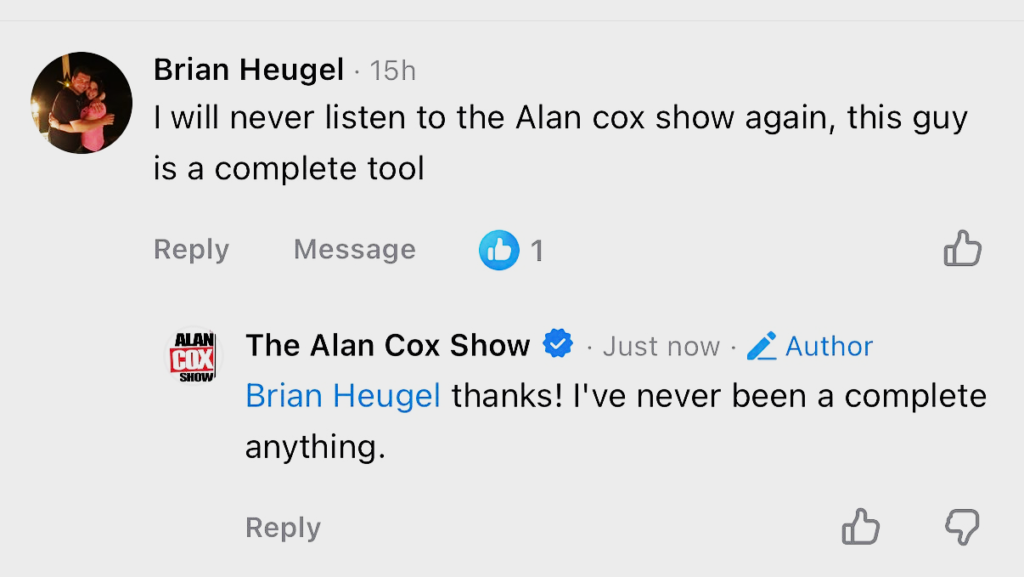
Cox also chooses not to argue with people on social media because he sees it as a waste of energy. “Instead, I’ll screenshot people’s nasty comments and respond with a pithy joke. Then I’ll post that and let the audience have fun with it.”
That wasn’t always his approach, though. “Earlier in my career, when I was a lot more insecure, I had a much more adversarial relationship with the audience because they were being critical and I was worried they were right. But I’ve put enough time in that they can’t say anything that’s going to bother me.”
Instead, he just wants people to enjoy his approach to doing a show. “This is my show; it has my name on it. I want to be silly, but also to convey that this is my job not my hobby,” Cox says. “I want people to have a good time but also hopefully know a lot of work goes into it. They don’t have to know how the sausage is made but hopefully they hear the effort when they tune in.”
Barrett Media produces daily content on the music, news, and sports media industries. Sign up for our newsletters to stay updated and get the latest information right in your inbox.