The upcoming season of Netflix’s program My Next Guest Needs No Introduction, featuring legendary late-night host David Letterman, will premiere on the streaming platform on Tuesday, April 8. Notably, the first guest of the new season—announced late Monday night—will be Indiana Fever superstar Caitlin Clark.
To build anticipation, the platform released a teaser clip of the upcoming program on social media, which featured the WNBA star discussing her competitive drive in all facets of her life. The defending WNBA Rookie of the Year is set to begin her sophomore campaign with the league in May.
This announcement from Netflix comes on the heels of the league’s schedule release earlier in the day, revealing that the Fever will be featured on national television for 41 of their 44 games this season.
Clark’s impact in just her first year in the WNBA cannot be understated. According to several reports, ticket sales surged by an astonishing 265% for games in which she played. Additionally, her star power fueled a record-breaking increase in jersey sales, which skyrocketed by over 1,000%. Meanwhile, the Fever experienced a remarkable 225% jump in corporate sponsorships.
Given her immense popularity, it makes complete sense for the streaming giant to capitalize on Clark’s rising star by placing her alongside Letterman for an in-depth and insightful conversation about her upbringing and ascent to the WNBA.
In the clip released Monday afternoon, Clark candidly discusses how her competitive drive sometimes has unintended consequences off the court. She referenced moments when she frustrated her family and friends by being overly competitive during game nights. Additionally, she recalled Halloweens as a child when she would race from house to house in her costume, determined to collect the most candy in the neighborhood.
As of now, no additional guests have been announced for the new season of My Next Guest Needs No Introduction
David Letterman will interview WNBA star Caitlin Clark in an upcoming episode of My Next Guest Needs No Introduction with David Letterman. Coming April 8. pic.twitter.com/rWaHyDh6Bu
Barrett Media produces daily content on the music, news, and sports media industries. To stay updated, sign up for our newsletters and get the latest information delivered straight to your inbox.
It wasn’t that long ago that sportsbooks were making everyone in the sports media rich. Every talent on local stations where gambling was legal had talent doing live reads for one company or another. Some even had so many books looking to advertise that they were securing endorsement deals for producers or in a few cases, launching brand new shows.
On television, every network was hiring a gambling expert. They were including odds information on the ticker at the bottom of their screens and creating segments in pregame shows brought to you by FanDuel and DraftKings. The books had money to burn and the media was happy to build the fire for them.
But I noticed something with the start of the 2025 NCAA Tournament that seemed to indicate we are in a new era of sports gambling money.
Remember, it’s not just the media. Leagues, teams, and schools used to take the very public position that if people were allowed to bet on their games, their entire enterprise would be in jeopardy, but the second they could, a lot of them signed sponsorship deals with sportsbooks and were quick to justify the change in position by saying that in the digital age, games would be harder to fix and problem gambling would be easier to snuff out. Ask the NBA how accurate those statements were.
“Don’t Be a Loser“
The NCAA’s new “Don’t be a Loser” is a very public declaration by the organization that gambling has changed the public’s relationship with sports and that maybe letting the industry run roughshod over the way we watch games has not been a good thing.
Athletes have a history of calling out fan harassment. They will publicly declare that they do not care about how our fantasy teams perform. They will remind us that their kids see when fans burn their jerseys in effigy. They may be very skilled and in some cases, very rich, but they are human beings too.
The Don’t be a Loser campaign puts the spotlight on a very different type of harassment – people sliding into athletes’ DMs and making threats because they lost on a parlay.
It’s a fine line to walk. The NCAA knows that gambling is a key component to the success of its postseason basketball tournaments. The ads even say that betting on games is okay. It’s even fun! But stories of bettors bullying and even threatening to harm players have become too prevalent to ignore.
Now, don’t get me wrong. I think the NCAA is doing the right thing with this ad campaign. Shame can be very effective, and nothing is more shameful than being called a “loser”.
But I can’t help but wonder if the message is only being given this much exposure because sports gambling money ain’t what it used to be.
Spending Less and Losing Control
Sportsbooks used to throw money around like they were on a float in a Mardi Gras parade. Local radio stations and TV networks were happy to show a little metaphorical skin to have the beads (dollars – we’re still on the Mardi Gras metaphor) come there way. But every Fat Tuesday is followed by an Ash Wednesday.
All of that advertising was about getting new players to download the app and start playing, but once these new players burned through their promotional money, a lot of them never logged on again. The focus shifted from adding players to retaining them. That means the gambling industry was spending less on advertising.
It’s not just anecdotal evidence. A study released last year by the American Gaming Association confirms it. 2023 was the first year without the regular sports schedule being affected by the Covid-19 pandemic that advertising revenue from the sports gambling industry dropped from the previous year. In fact, since 2021, ad revenue from sportsbooks has dropped by 21%.
Just look at DraftKings! Not every sportsbook was benefiting from all that advertising. DraftKings was and still the company spun off VSiN, jettisoned Marie Donoghue and ended a lot of its original programming. Meadowlark Media now stands alone as the company’s major media investment and maybe it’s fair to wonder how long that lasts.
FOX couldn’t make FOX Bet work. ESPN seemingly can’t make ESPN Bet work. NBC sold its equity stake in PointsBet.
Media companies are learning the hard way that sportsbook money isn’t the guarantee it once seemed. That probably made it easier for ESPN and the fraternity of CBS and Warner Bros. Discovery to silence any objection when the NCAA told them that the 2025 basketball tournaments would include messages that encourage people to think twice about gambling.
Reassessing the Sports/Gambling Relationship
John Oliver did a great segment earlier this month on Last Week Tonight on how online sports gambling became such a big business in the United States and the problems that have come along with it. While gambling itself is not inherently bad, Oliver pointed out that it’s getting harder and harder to deny that a lot of bad can come with it, including losers thinking there is nothing wrong with harassing the players involved.
I gamble. I think it’s fun. I usually limit my betting to college football season, but I do have both a “head parlay” (Florida to win the men’s national championship and South Carolina to win the women’s) and a “heart parlay” (Alabama to win both) on March Madness.
At one point, on this very site, I advocated for moving all of the studio coverage of the NCAA Tournament to Las Vegas. I thought it reflected the way most of America followed the tournament, and look, maybe it still is, but I also think I was wrong.
Ads for gambling may be unavoidable but they don’t translate into people everywhere playing. If most people can’t be convinced to play, there is less reason for those sportsbooks to spend money advertising to potential new players. That reduces their influence on the networks and leagues and that is how you get to a place where no one bats an eye when the NCAA brings a commercial to the networks that tells gamblers in no unspecific terms “you have to stop”.
Barrett Media produces daily content on the music, news, and sports media industries. To stay updated, sign up for our newsletters and get the latest information delivered straight to your inbox.
Musical Fault Lines have been on the radio for a century. When the first commercial radio station—KDKA in Pittsburgh—signed on one hundred-five years ago, long-form orchestra movements were the order of the day. KDKA-AM set the base standard for radio-driven Musical Fault Lines, delivering their symphony pieces live and without interruption.
A Musical Fault Line is an event that shakes the cultural fabric, always aided by radio. It is not simply a new artist, song, or album release.
Without much ‘buzz’ on their philharmonic presentations, AM Radio evolved to spoken word Serials that adults and kids enjoyed, like “The Lone Ranger,” “The Shadow,” and “Dragnet.” The development of television busted the radio bubble as the picture box stole most of the radio Serials, leaving radio to adapt.
Hello, First Musical Fault Line.
Mid 1950s – Led by Rock Around The Clock by Bill Haley and His Comets, the charts reverberated with the loud, almost sinful sounds of Elvis and Chuck Berry. Cleveland Disc Jockey Alan Freed named it Rock and roll. By the time The Beatles and their “Mop Tops” stormed into America, The Beach Boys, The Lettermen, and The Four Seasons were aurally painted like choir boys.
Hello, Second Musical Fault Line.
In February 1963, Chicago Disc Jockey Dick Biondi was delivered a fresh copy of “Please, Please Me” by Vee-Jay Records, who initially held American rights to The Beatles’ music. By the end of the year and driven by giant Capital Records, The Beatles shook the psyche of every American teenager.
A British counter-culture movement featuring The Who, The Rolling Stones, and The Kinks blasted a sonic invasion not heard in America, generating long hair and loud fashion.
Our third Musical Fault Line wasn’t a band – or movement. Say HELLO to The Moog Synthesizer.
Invented in the early 1960s and perfected by the decade’s end, Art Rockers The Doors, Yes, and Emerson, Lake, and Palmer rapidly embraced Robert Moog’s contraption. Psychedelic rock was now blasting out of teenagers’ bedrooms. Weekend three-day audio festivals would follow.
That same programmable Moog machine, with synth loops and electric mayonnaise (who said AI was bad?), built our third Musical Fault Line in the mid-1970s.
No genre saturated pop radio and advanced the acceptance of racial confluence and LGBTQ rights like disco. As hot as it burned in the late 1970’s, it died in a historic flurry of flames.
While the 1980s provided our best pop and rock decade, spawning Prince, Bruce Springsteen, Madonna, and Bon Jovi (among dozens of others), no measurable music cultural ‘movement’ developed.
Our next cultural Musical Fault Line that altered the musical landscape steamrolled out of Seattle – Grunge.
Led by the garage band-like sound of Nirvana, Pearl Jam, and Soundgarden, Grunge rejected anti-consumerism glam excesses. The ripped jeans and flannel combo became a dress code while lyrically addressing mental health issues. The wake of Kurt Cobain’s tragic suicide brought the subject out of the dark.
Arguably, our last socially measurable Musical Fault Line developed in the late 1980s. With artists like NWA and Run–DMC popping into our social consciousness. Tupac and Notorious B.I.G. exploded into the mainstream with the sounds of Beyoncé and Jay-Z.
Mid-1990s Hip-Hop was the voice for marginalized communities, police brutality, and economic struggles. Fashion soon followed with streetwear like baggy jeans, Timberland boots, and loud, oversized jerseys. Slang such as “bling,”“dope,” and “word” worked its way into lyrical storytelling and visual art.
On this parallel history line, THINGS that culturally helped on Musical Fault Lines:
Magnetic Tape – stolen from the Germans after World War II, making recording easier than our – Wire Recorders.
Music Portability – acetate albums, 45 RPM singles, cassette tapes, 8-track tapes, and compact discs created mobile music.
MTV – every great single now required a video to increase record exposure
The Internet – which begat file sharing, downloading of music, and live streaming
Satellite Radio – which at one time approached 10% of all audio listening but far less of a radio threat mainly due to the point above
Autotune – embraced by hundreds of artists to improve their craft, it’s an AI tool that most didn’t bother to complain about.
We took you down this (not so short) history lesson to point out that we’re due for another Earth-shattering Musical Fault Line.
So, what did we miss?
Taylor Swift’s effect on music and concert consumption could fit that category if her road to billionaire status didn’t take 18 years.
Here are a few places to keep an ear on to start the NEXT Musical Fault Line:
AI-Generated Virtual Artists
It’s not going away. Artists are already creating music with AI tools, and virtual influencers are gaining traction. Artists like FN Meka and Hatsune Miku use AI tools—and often the aforementioned Moog Synthesizer—for production, songwriting, and entire performances.
Indie Alt-Music
Artists are increasingly finding online success without labels, often blurring format lines. Country’s Zach Bryan blew up BIG before his partnership with Warner Records. Chance The Rapper developed straight-to-consumer music and merch, while Nine Inch Nails frontman Trent Reznor produced straight-to-streaming tunes.
Short-Form Music
Both The Box Tops and The Beach Boys had hits under two minutes long. With the advent of TikTok, is the next social music influencer offering a :45 second – song? How long does a song need to be?
“A Musical Fault Line is an event that shakes the cultural fabric, always aided by radio.”
If music radio fails to focus attention on emerging trends and initiate risk-taking, the NEXT big Musical Fault Line might not need radio – at all.
Barrett Media produces daily content on the music, news, and sports media industries. To stay updated, sign up for our newsletters and get the latest information delivered straight to your inbox.
Peter Rosenberg owns a broadcasting resume that most personalities lust for but shudder to consider chasing at the same time. At 45-years old, the Maryland native has molded his love for hip-hop, sports, and professional wrestling into a career that marvels peers of his age and tenure in broadcasting.
Since graduating from the University of Maryland with a degree in journalism and working at UMD’s campus radio station WMUC, Rosenberg’s professional journey landed him at the wildly popular HOT 97 in New York City in 2007. Since, Peter Rosenberg has continued to work for HOT 97 and added to his impressive abstract with experience such as ESPN New York, MTV, HBO, BET, and now his newest venture as the voice of the WWE’s developmental program EVOLVE which debuted earlier this month.
“I adore great wrestling commentary,” said Rosenberg. “At its best I feel like it’s almost like listening to radio but while watching television. It’s the sound that fills your home for hours while you watch the action in the ring.”
The WWE’s latest programming project is just the latest addition to the multi-billion-dollar company’s portfolio, which historically has been at the forefront of merging professional sports and American culture performing what has been dubbed ‘sports entertainment.’ Rosenberg’s fondness for professional wrestling runs deep from child to professional, as he exercised his work-first mindset born early in his career to eventually land a position with the WWE in 2016.
Just under five years later, Peter Rosenberg would become the play-by-play voice for the next evolution with a focus on the future superstars of the WWE. A challenge his already established resume prepared him for over time.
BREAKING NEWS: @ShawnMichaels has announced that @Rosenbergradio will be THE VOICE of WWE Evolve, which starts Wednesday, March 5 on @Tubi at 8pm
“The approach I must have for play by play is just so different than any of my other endeavors,” Rosenberg stated. “It just requires so much more prep and thought – especially in wrestling where stories are being told.”
Some of Rosenberg’s earliest influences with the performance art of professional wrestling served as his guide as he understood that EVOLVE would add another layer of skills to an already established biography.
“I would say my first real introduction to play-by-play in general was Gorilla Monsoon,” Rosenberg referenced. “Then I was so drawn to the comedic style and just ridiculousness of Bobby “The Brain” Heenan. To this day I love so much about their style.”
Consistency Is The Key To Success
The art of calling play-by-play is all in telling the story of the event. Grabbing the consumer by the wrist and leading them on a journey through the hills and valleys to the eventual outcome of the contest. The key is consistency, a trait that becomes harder to accomplish in an ever growing on-demand culture.
However, for Rosenberg, his consistency in his approach of balancing a new opportunity with EVOLVE isn’t one that he hasn’t done before.
“I don’t have one specific key to consistency. My life is consistent by nature because the work is so consistent,” says Rosenberg. “I just get up every day and do my thing. I think working on some more consistent routines would be super helpful. But right now, I just do the work, sleep, spend time with the family and repeat.”
For Peter Rosenberg, his career path has been a model of evolving through change keeping an ever-present mindset of staying consistent. Taking his experience working on New York City’s top hip-hop radio station HOT 97, and building the successful podcast Juan Ep is Life, featuring co-host Cipha Sounds. Evolving his skill set learned in music radio and applying it to his passion for professional wrestling leading to the Cheap Heat podcast, which began in 2013.
Rosenberg: Signing With ESPN New York
Then hard work was rewarded in 2015 for Rosenberg, when he signed with ESPN New York as a contributor on The Michael Kay Show featuring the play-by-play voice of the New York Yankees, Michael Kay, and ESPN New York original Don La Greca. A lifelong Washington D.C. sports fan, Rosenberg now had the opportunity to bring his devotion for sports and apply his layered broadcasting acumen to entertain New York sports fans in the most coveted and competitive daypart for the market.
The competitive nature of going head-to-head with WFAN’s Mike Francesa for many years was a characteristic the Rosenberg already grew to know from his experience working for HOT 97. Now, several years following Francesa’s departure from WFAN along with ESPN New York officially unsubscribing from the Nielsen ratings system, he said it was a relief to not worry about ratings any longer when it came to his mentality.
“Several years ago, the rivalry was big on both stations and less so now. It a relief honestly,” said Rosenberg. “I always took it so personally and held such negative energy towards some of my competition. Whether it was founded or not, it didn’t benefit anyone. I’m happy to not care about it as much.”
Rosenberg: Evolving Through Changes At ESPN New York
When Good Karma Brands entered into a local marketing agreement in 2024 with Audacy, the company assumed responsibility for the programming on ESPN New York but now on the legendary 880AM, which had been the radio home of WCBS since 1967. The step meant a large amount of change for everyone associated with ESPN New York in a very short amount of time.
Within one calendar year, Good Karma Brands ended its ratings contract with Nielsen in January, dropped its 98.7FM signal in August, and then moved ESPN New York programming from its longstanding 1050AM signal to the 880AM signal in the same month. Then in early December, The Michael Kay Show featuring Peter Rosenberg announced a lineup change coming with the new year where Kay would move to a solo show in mid-days, with La Greca and Rosenberg remaining in the afternoon drive timeslot on the station.
“There have been lots of changes over the last year and change is always scary and it certainly was in moments,” said Rosenberg. “Change also leads to new opportunity so I never got overwhelmed with fear.”
Following the announcement from Kay about his departure from the daypart, there was high speculation if Rosenberg would remain not only in the daypart but also with the station. That was an element of the timing Rosenberg was fully prepared for, and ready to evolve once again one way or another.
“Regardless of whether I was a part of the future of the station, I absolutely knew I would be doing something fun,” noted Rosenberg. “I have built a good enough name and reputation over the last 18 years in this market to find a microphone somewhere.”
Due to his dedication and passion for the format, he was awarded a new agreement with ESPN New York, and Don, Hahn & Rosenberg was born. The new opportunity featured La Greca, and studio analyst for the New York Knicks on the MSG Network, Alan Hahn. Three months later, the new program in the daypart continues along the same path of evolving as has everything in Rosenberg’s career path.
“I think we’re building something special,” said Rosenberg. “I’m excited to get to build something new on this station that I have really grown to love.”
Rosenberg: Becoming Nationally Recognized By Billboard
The evolution of Peter Rosenberg continues to mold him into one of the more celebrated voices of his generation. So much so, this February Billboard recognized Rosenberg as one of its Sports & Music Power Players for 2025. The entertainment and music magazine says of the ranking that the combined power of the sports and music worlds is stronger than ever and will only keep growing.
“It was super cool. I obviously am very deep in music and sports so to be recognized for my connecting the dots there was super appreciated,” Rosenberg notes. “I was pretty early when it comes to mixing those worlds so it’s gratifying to get some recognition for it.”
While change is always ever-present in entertainment, Peter Rosenberg is prepared to roll with it. He has always attempted to be one step ahead and forward thinking on how he can consistently evolve with how the audience in changing. From his humble roots in hip-hop radio, to advancing his passions in the podcast space, along with expanding his sports radio profile and now growing as a signature voice with the WWE.
Peter Rosenberg is a singular representation of following your spirit, being ahead of the game, and always finding new avenues to consistently evolve.
Barrett Media produces daily content on the music, news, and sports media industries. To stay updated, sign up for our newsletters and get the latest information delivered straight to your inbox.
I got so much great feedback on last week’s feature on the “Chet Buchanan Show” on 98.5 KLUC, Las Vegas (BMM 3/21) that I couldn’t help but feel like a follow-up would be of interest to not only the industry crowd but also the general public. After all, the show was voted one of the Top 20 CHR Shows on The Barrett Media list for 2024, an honor voted on by industry peers.
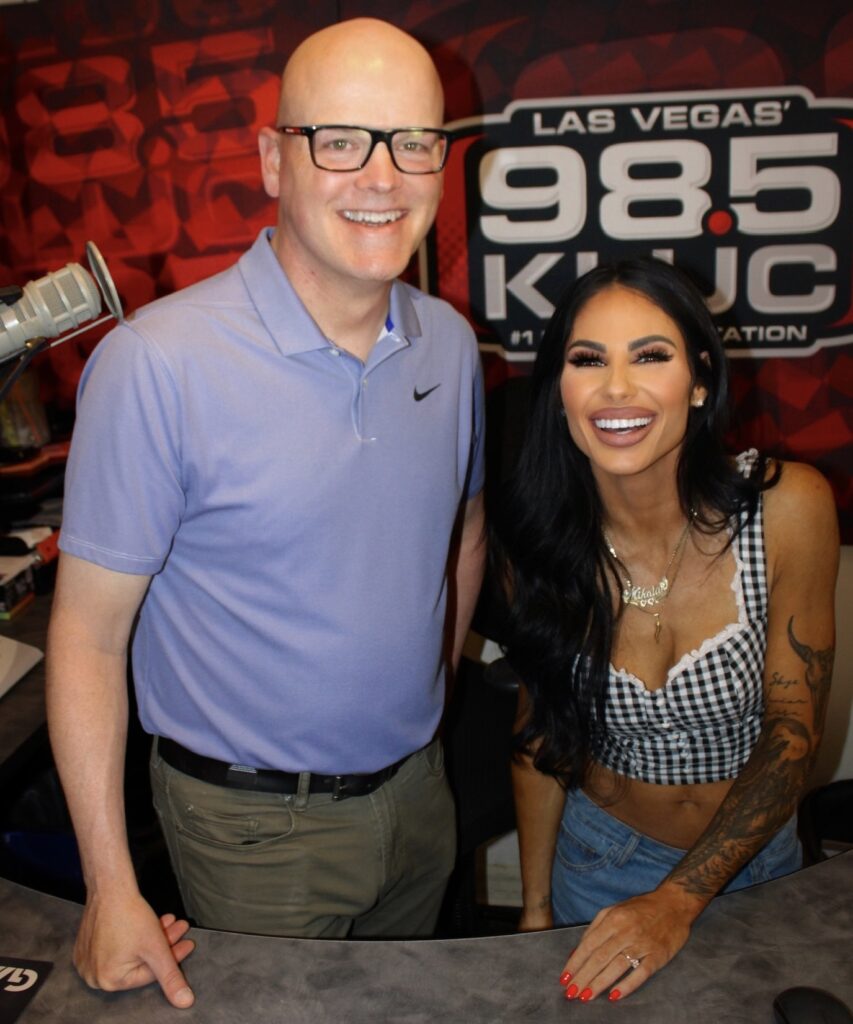
Buchanan mentioned one of the hosts on the show, Mikalah Gordon. She’s been there for about a year now, but she is very well-known as one of the youngest finalists on American Idol. The Las Vegas native was 16 when she competed on Idol, the year Carrie Underwood won. That’s how she and Buchanan met. He would host viewing parties at her high school all the time.
Just to quickly recap, Gordon moved to Hollywood after graduation to pursue acting and entertainment, where she met her Super-Star fiancé, DJ Lisa Pittman. After Gordon fell victim to cutbacks as a host on a national morning show on Channel Q, the couple moved back to Las Vegas, where she and Buchanan rekindled their friendship.
In addition to Gordon’s responsibilities for the KLUC morning show, she also headlines two Las Vegas residencies at the Wynn and Fontainebleau. At the same time, Lisa is a fixture at every major club in Las Vegas.
Before moving back to Vegas, Gordon also became the Host for “American Idol Extra” and “The Tyra Banks Show” and eventually became a recurring character on shows like comedy legend Fran Drescher’s “Living With Fran” and “The Unit.”
“Embracing comedy, I launched my stand-up career in 2012 and performed in a play Off-Broadway with my impersonation of Melania Trump,” says Gordon. “My viral series ‘Inside Melania’ garnered 1.6 million TikTok followers and even led to a feature on Jimmy Kimmel.”
Like Buchanan, Gordon has many side hustles. Two she is immensely proud of are So “Funny It Hurts” and “Vivian.” “I interview fellow comics on a podcast and delve into the trauma that fuels their humor,” she explains. “As a stand-up comic, I’ve discovered that authenticity and vulnerability are what truly make comedy resonate. This podcast has become not only a fantastic outlet but also a platform for discussing challenging topics in a relatable way.”
Gordon has also recorded an album. “It’s the first project that I wrote and recorded on my own,” says Gordon. “It encapsulates the experiences and emotions that have shaped me into who I am.”
“I’m currently performing tracks from the album at my shows, and I have an exciting concert planned for the end of April. It’s a thrilling time, and I can’t wait to share this journey with my audience!”
As for how Gordon transitioned into radio as a singer and stand-up comedian, it’s kind of a wild ride. “In 2018, while I was in LA hosting “American Idol Extra,” something unexpected happened. I was driving down Santa Monica Blvd, heading to the studio, when a man suddenly darted out in front of me.”
“Before I could panic or yell, he called out, ‘Hey Mik! Don’t run me over!’ It turned out to be my friend Jai Rodriguez from the original “Queer Eye for the Straight Guy.” We both laughed—probably a bit nervously, grateful I didn’t hit him—and exchanged a quick hello and an I love you before I continued on my way, thinking nothing of it.”
“About two hours later, I got a text from Jai that read, ‘Hey girl. I just got an offer to host a national LGBTQ morning radio show, and I want you as my co-host.’ At the time, I had zero experience in radio and fully intended to say ‘No!’ In fact, I did initially say no.”
“But then I remembered a line from a book I was reading, How to Win Friends and Influence People, which emphasized the importance of saying ‘YES!’ It felt like a sign, and I figured I owed Jai one for nearly running him over, so I agreed to meet with him the next morning.”
“On October 11, 2018, “The Morning Beat with Jai and Mikalah” went live from The Abbey (In West Hollywood), and that’s how Channel Q was born. I had the incredible opportunity to work for Jeff Federman and my beloved Program Director, Brian Holt, for four amazing years. Looking back, I can honestly say it was one of the best times of my life, filled with laughter, growth, and unforgettable memories that I will always cherish.”
“As for my current role on KLUC as co-host of the legendary “Chet Buchanan Show,” it’s pretty surreal for me. Growing up in Vegas, I listened to KLUC religiously. When I left at 16 to compete on American Idol, both Chet and KLUC covered my entire journey.”
Buchanan and Gordon
“I’m grateful for my time in LA, but it’s true what they say: ‘There’s no place like home.’ I have a deep appreciation for Las Vegas and the people in it—my friends, my family, my tribe. Every morning, my eight-year-old niece tunes in to listen to me before she heads to school. Those morning moments fill my heart, so I do my best to pour my whole heart back into the show.”
Follow Mikalah Gordon on Instagram @mikalahgordon and TikTok @mikalahgordon88.
Barrett Media produces daily content on the music, news, and sports media industries. To stay updated, sign up for our newsletters and get the latest information delivered straight to your inbox.
Arthur W. Ferguson, better known as Charlie Tuna, was a radio and television performer. He was born in Kearney, Nebraska, and is best known for his time in Los Angeles.
In 1975, Charlie Tuna was with 102.7 KIIS-FM Los Angeles when it started the AM/FM simulcast and hosted the first show on the FM.
Tuna was active in syndication and had radio stops in San Diego, Boston, Wichita, and Oklahoma City.
He also appeared as an announcer on Casey Kasem’s “American Top Ten” television show. He raised nearly $2.5 million for Children’s Hospital Los Angeles.
A complete list of his radio, television, and film credits is far too extensive to list here.
This aircheck is from 1986 and KRLA Los Angeles.
Have you ever had someone give you this advice: Smile while you’re on the air or make the smile come through? Tuna doesn’t necessarily do that. Instead, his voice is warm and welcoming. There is no hype, just a very smooth, comfortable presentation that paces well.
He does a great job of teasing ahead with his promotion of an upcoming interview with Steve Kanaly from the TV show Dallas.
I love the custom jingles. It’s also interesting how he brings the traffic personality. Even though he violates the one thought per break philosophy in that spot.
Tuna passed away in 2016 at the age of 71.
Enjoy Charlie Tuna.
Barrett Media produces daily content on the music, news, and sports media industries. To stay updated, sign up for our newsletters and get the latest information delivered straight to your inbox.
Last week, WRVA announced that long time sports talk host Rich Herrera had been tabbed to become the new morning host of the Audacy Richmond news/talk station.
It marks not only a change in format but a change in scenery for Herrera, who will move to Richmond from his current home in Tucson, Arizona.
But that move isn’t going to waste. In his first official act as a WRVA host, Rich Herrera is turning his cross-country move into social media and digital content for the news/talk brand. In a video series dubbed “Herrera Across America,” the new morning host is documenting his travels and stops along the more than 2,200-mile journey.
He says the idea was a natural one.
“It’s something that I was thinking about: when do the people on the East Coast and the West Coast talk to the people in the middle of the country?” he shared. “So when we decided to drive to Richmond, I said ‘Wouldn’t it be great if we stopped and we talked to people along the way?'”
With a sponsor in tow, Herrera set out a plan. A road map, if you will, of how the trip would go. He and his wife — who he admitted was “doing most of the driving” — would stop at gas stations, truck stops, and rest areas and speak with average, everyday Americans to get their perspective on four questions.
“We ask them ‘What do you love about America, if you could talk to a founding father, what do you want to say to them, we’re asking what the big pressing needs and issues are for America, and then finally, how do we bring people together?’ Our country is so divided, and it’s really been inspiring. It almost brings you to teares when you see these people. They’re just random, everyday Americans.”
Additionally, Rich Herrera is stopping at interesting sites on the way to Richmond, like the George W. Bush Library in Dallas and Graceland in Memphis, as well as stops planned in Nashville and other planned pit stops to gather content before reaching Richmond.
Herrera has a long history in the sports talk radio format. He’s worked at large stations like 790 The Ticket in Miami, 97.3 The Fan in San Diego, KNBR in San Francisco, KMOX in St. Louis, in addition to his time at Infinity Sports Network — previously known as CBS Sports Radio — and MLB Network Radio on SiriusXM.
With all of that experience in a different format, it would be easy to question why the change to a different format with a different company more than 2,000 miles away. But Herrera said the chance to work at a heritage brand like WRVA was too good to pass up and gave credit to Audacy executives like Chris Olivero, Jeff Sottolano, and Drew Anderssen for giving him the opportunity.
“I did a couple of sample shows of what it would be like. And (Anderssen) said ‘You actually might have a knack for this. You’re pretty good at this.’ And he goes ‘Let’s see if we can get you to fill in at some places and kinda kept me in mind. I said ‘If you find the right place where I could take my skill set and come to a new radio station.'”
A little while later, the call came in that WRVA morning host John Reid was going to exit the Audacy Richmond station in an effort to run for Lieutenant Governor of Virginia. When asked if he would be interested, Rich Herrera didn’t hesitate.
“That’s a legendary station,” he said of WRVA. “I did a couple shows out there and said ‘Wow, this place is special. and I was thinking to myself ‘If you’re gonna be anywhere, wouldn’t you wanna be in Virginia for the anniversary of the 250th birthday of our country, on a station celebrating their 100th anniversary?’ I’m in. I want this job. And I’ve been filling in for the last, I don’t even know how many weeks.”
He added that reactions from his friends in the sports talk radio world have been overwhelmingly positive since the news was announced last week.
As he gets set to get to Richmond and get starting as the morning host of the heritage signal, the new WRVA host shared that he has some experience in landing in a new market. He hopes those past experiences help him hit the ground running.
“You have to be authentic, you can’t just read something in the newspaper. You gotta go see it,” he said. “I have a rule. I won’t say anything on the radio that I won’t say to your face. So I better make sure I go meet you face-to-face before I start talking about things on the radio. And the other part is, I’ve done this just about everywhere we’ve gone. I want to give back. My dad was an amazing person. He was a migrant farmworker who grew up to be a cop. All he cared about was making a difference. And he kind of imparted that on me and my siblings. So we’re gonna find some things at WRVA in Richmond that I can I can get involved with.
“I just think it’s a great opportunity. Audacy Richmond is so supportive and encouraging me to be out in public and be part of the community, which is one of the reasons why I said ‘Hey, listen, I’ll jump from the desert and cactuses of the 48th state and great Mexican food and move across the country to one of the original 13, just because this opportunity is incredible. And I’m just grateful, thankful, and excited.”
Barrett Media produces daily content on the music, news, and sports media industries. To stay updated, sign up for our newsletters and get the latest information delivered straight to your inbox.
We know that usage of “traditional” media (sounds better than “old media”) is declining. That’s to be expected because when consumers are offered more and more choices yet have only so much time to listen to radio, podcasts, watch TV or YouTube, the result is greater fragmentation.
Sure, broadcast radio’s audience has declined in recent years. Some of the decline is self-inflicted and some stems from changes due to the COVID pandemic and “work from home.” One of radio’s strengths is listening while commuting. No commute equals less listening.
But perhaps the situation is not as bad as we think. Consider that local newspaper circulation has been decimated to the point that some states and localities have proposed or passed legislation to promote local journalism through subsidies or tax breaks.
I don’t have access to the data, but how much audience remains for local television? The broadcast networks aren’t helping when they’re happy to promote that every network show is on their streaming service. Remember when radio turned down ads for SiriusXM because there was no desire to help a competitor? Local TV promotes its network’s streaming service and pays “reverse compensation” for the privilege!
Two weeks ago, I tossed out a few Nielsen numbers with respect to the change from the “five-minute rule” to the “three-minute rule” for PPM. AQH estimates showed nice gains, as expected. But what if we went back further to pre-COVID times? What if we compared January 2020 to the present?
First, let’s consider the changes to the audio landscape since the start of 2020. Broadcast radio (and I include streaming of the AM/FM signal as part of broadcast) faces far more competition today. In streaming music, Spotify users in North America increased from 77 million to 107 million since 2020 while subscribers increased from 40 million to 64 million. Apple Music and Amazon Music count as well (the three services together account for over 90 percent of the paid music streaming in the US). Pandora still exists, too.
Let’s not forget other major options for music including TikTok and YouTube. The Pew Research Center trends showed TikTok was used by about a third of Americans in 2024, but that varies widely by demo. For 18-29, the figure was 59%, but for 50-64, the percentage was just 26%. Yes, TikTok is used for more than music, but was just taking off in 2020.
Then there is podcasting which has achieved strong growth in the battle for ears. Per Edison Research, in 2020, 24 percent of Americans 12+ listened to a podcast weekly, essentially a podcast cume. Last Thursday, Edison released the 2025 figure, which was 35 percent for audio podcasts (adding video podcasts pushes the figure to 40 percent).
SiriusXM, while having problems of their own, has cut their “trial” subscription fees. Forget telling the call center rep that you won’t pay over $5 a month. That’s $3 now and a free ad-supported version is expected to arrive later this year.
That’s a hell of a lot of competition for the time Americans can devote to audio information and entertainment.
Some caveats as this was not a pure “apples to apples” comparison. The January 2020 monthly started on January 2, while the 2025 version began on January 9. Back in 2020, panelists carried the “pager-style” meter while in 2025, panelists wore the PPM watch to record their media usage. And we have the increase in 2025 AQH due to the change to the three minute rule.
Once again, we’ll examine four demos for the Monday-Friday 6 AM-7 PM daypart for the PPM markets. The demos are Persons 18-24, 25-34, 35-44, and 45-54. And again, the last two are not discrete weighting variables. The results are for AQH persons, meaning New York and Los Angeles carry far more weight than West Palm Beach and Memphis.
AQH Persons
P18-24
P25-34
P35-44
P45-54
Jan 20 vs. Jan 25
-29.7%
-43.6%
-24.3%
-27.0%
In my view, other than Persons 25-34, the results weren’t bad considering the circumstances. The previously cited changes suggest that the differences could be a lot worse. And as more workers are told that work from home is no longer acceptable, the results may even improve a bit.
We know that January 2025 was not a true “apples to apples” because of the three-minute rule. Let’s compare January 2020 to January 2024, as both months used the five-minute rule.
AQH Persons
P18-24
P25-34
P35-44
P45-54
Jan 20 vs. Jan 24
-38.3%
-47.6%
-34.8%
-34.7%
The results weren’t pretty, but I’ll bet some other traditional media would happily take those figures.
Where does this leave us? Sure, AQH listening is down over time, but other than P25-34, we’re not at death’s door.
The results brought to mind one of the funniest movies of all time (if your taste is similar to mine), “Monty Python and the Holy Grail” and the “Bring Out Your Dead” scene. Set in the Middle Ages, a man pushing a cart with dead people, calls out “Bring out your dead” and pays for the bodies. A resident offers up a body for nine pence, but the person protests, saying “I’m not dead”, “I’m getting better”, and “I feel fine”.
Sometimes, it feels like radio is the body being sold to the cart master, constantly saying “I’m not dead”, while the person trying to get the nine pence suggests death is imminent, “Well, he will be soon. He’s very ill.”
If you know the movie, the next event is the “not dead” person is conked on the head, the customer gets his nine pence, and the cart master moves on. If you’ve never seen the movie, watch it (available on Amazon Prime and other streamers).
Much like the expected demise of radio in the ‘50s after television took off, the business is not dead yet, but there are plenty of competitors who would gladly help kill it off (and perhaps a few insiders as well). Don’t let them do it. We can get better and even feel fine.
Let’s meet again next week.
Barrett Media produces daily content on the music, news, and sports media industries. To stay updated, sign up for our newsletters and get the latest information delivered straight to your inbox.
Jenn Ryan is stepping down as the morning co-host at Audacy’s AC B101 Philadelphia. Of her 32-year broadcasting career, 16 have been with B101 and 14 years on “The B101 Morning Show with Jenn & Bill.”
Ryan who will host her final show on March 31 said, “This is with very mixed emotions that I want to tell you guys that I am retiring from radio. After 32 years of working in radio, which has been the best career that I ever could have had. Exactly half of it, 16 years, has been right here on B101, and this has been the most joyous time of my life – I mean my marriage, my kids, and my job here on the B.”
Ryan is a Gracie Award winner and was named Best Morning Show by the Pennsylvania Association of Broadcasting.
“Philly sports fans are the greatest fans in the world, and I truly feel like Philadelphia radio listeners are the greatest,” Ryan added. “So, we have a lot of memories that we are gonna take with us, that I’m going to take with me to my next chapter…I want this last week to be fun. I really do. I do not want this to be sad. Change is good. Life happens. Change happens. Let’s have a great last week together. Let’s have fun, and thank you guys for listening.”
Bill Tafrow said, “I could write a book about you and I. Jenn, you’ve heard every story from me because we carpool together, but I will tell you one story that sticks out.”
“I’ve been with this morning show, in so many different versions of this morning show since 2004. Friends was still on, think about that. You and I started in 2014 doing this together. I had three shots at being the co-host and three shots at the job. The first two failed. The third time was with you.”
“A Coworker said to me a year after, ‘Well, I guess the third time was the charm.’ I said, ‘No, the charm was Jenn Ryan, that was the charm.’ I can’t do this without you. I can’t imagine doing it without you. You’re my best friend here, my work wife. We’ve been through pandemics together, snow storms together, sleepless nights, lots of whining and crying, and I think this is justified. Doing this show, my heart is full with you.”
Morning show partner Bill Tafrow will continue in mornings alongside producer Laura Boss.
Barrett Media produces daily content on the music, news, and sports media industries. To stay updated, sign up for our newsletters and get the latest information delivered straight to your inbox.
The WNBA is expanding this season, not only with the addition of the league’s 13th franchise but also with an increase in the number of regular-season games. As a result of this expansion, the league will now feature a 44-game schedule. Teams will play four games against five opponents from the same conference and two teams from the other conference, while facing the remaining four teams three times each. With these added games on the schedule, there is even more opportunity for the league to showcase its signature talent, Caitlin Clark. This led FOX Sports Radio host Colin Cowherd to think how the WNBA could have cashed in further with Clark’s presence.
On Monday, the WNBA officially announced its league schedule, which notably includes 41 of the 44 Indiana Fever games being broadcast on national television. This marks the first time in WNBA history that a team has had such a significant portion of its regular-season schedule featured on national TV. Consequently, Colin Cowherd reflected on what he would have done with the broadcast rights, particularly in regard to the Fever, if the league had prioritized that many of their games for national coverage.
“If I were the WNBA, I would have considered a separate television package to a network on just Caitlin Clark games,” stated Cowherd. “I would have had two packages. The WNBA package, and then a separate 15-18 game Caitlin Clark package.”
Cowherd’s suggestion stems from the remarkable impact Clark had in her rookie season. Ticket sales surged by an astonishing 265% for games in which she played. Additionally, her star power fueled a record-breaking increase in jersey sales, which skyrocketed by over 1,000%. Meanwhile, the Fever experienced a 225% jump in corporate sponsorships.
Not only did teams benefit from Clark’s presence, but networks also reaped the rewards. Each of the WNBA’s broadcast partners recorded their highest viewership numbers ever for Indiana Fever games. The biggest winner from Monday’s announcement appears to be CBS, which will feature Clark in the WNBA’s first-ever primetime games on broadcast television. With networks vying for coverage of the highly anticipated Indiana Fever and Chicago Sky matchups—showcasing the rivalry between Clark and Angel Reese—CBS will air two of their showdowns on June 7 and August 9.
“The league wasn’t ready for her last year,” stated Cowherd. “They just weren’t prepared. She was prepared. She’s going to be great. The league just didn’t know what to do.”
However, this season, the Indiana Fever will receive unprecedented exposure. Ten of their games are slated to air on ABC/ESPN, while eight will be featured on ION. Additionally, seven games will be broadcast on CBS and CBS Sports Network. Furthermore, NBA TV and Prime Video will also showcase Fever games throughout the season.
Barrett Media produces daily content on the music, news, and sports media industries. To stay updated, sign up for our newsletters and get the latest information delivered straight to your inbox.