Diane Rehm has been a fixture at WAMU in Washington D.C. But her tenure at the station is set to end later this year after 45 years.
Rehm has announced that she has accepted a buyout from the NPR partner station and will exit on Friday, May 2nd. She told The Washington Post that the staffing cuts that took place at the station last year motivated her to leave, but needed to settle on a date before officially accepting a buyout offer from the outlet. Last February, WAMU ended its digital news arm — DCist — which led to 15 members of its staff departing.
In recent years, Diane Rehm has been hosting a podcast — On My Mind — with the outlet, and a monthly book club program that will end in April ahead of her final day.
The 88-year-old joined the station in 1973 as a volunteer before ascending to host her first program in 1979. She later rebranded the show in 1984 to The Diane Rehm Show before stepping away from the daily program in 2015.
While Rehm is exiting WAMU after 45 years, she told the Post that she would not label it a retirement, simply a change of her professional home.
Barrett Media produces daily content on the music, news, and sports media industries. To stay updated, sign up for our newsletters and get the latest information delivered straight to your inbox.
As teams within the National Basketball Association approach the playoffs, the final live game broadcast of the league by TNT Sports platforms draws closer. The league announced 11-year media rights deals with The Walt Disney Company, Comcast Corporation and Amazon that will take effect beginning next season, reportedly worth a collective $76 billion that distributes games across broadcast, cable and streaming television. Warner Bros. Discovery was unable to retain U.S. live game rights to the league, a fate that was materialized a few months after TNT Sports chairman and chief executive officer Luis Silberwasser said at its annual Upfront event that the company looked forward to “reaching an agreement that makes sense for all the parties.”
Warner Bros. Discovery will nonetheless continue to work with the league in a partnership that grants it rights to promulgate NBA content on the Bleacher Report and House of Highlights digital platforms. On top of that, the company will also have free access to league highlights for the next 11 years and the chance to distribute games in some overseas markets. David Zaslav, the president and chief executive officer of Warner Bros. Discovery, recently stated that not doing the NBA deal was “a great decision” for the company and that the company could invest the money into other content.
The company has continued to add sports rights to its portfolio over the last year, reaching deals with properties such as NASCAR, the Big East Conference and Roland-Garros. Furthermore, TNT Sports will continue to broadcast the NHL, MLB and Unrivaled Basketball, along with select College Football Playoff games under a sublicensing agreement with ESPN. Silberwasser reflected on the progress and divulged that TNT Sports is “always open” for opportunities as they percolate so long as they make sense for the company.
“Clearly, I don’t pretend to say that not having the NBA is important,” Silberwasser explained during a recent appearance on The Varsity podcast. “Having the NBA was very important for us, but we’re very pleased with where we ended up because now you have a portfolio that it has more diversity and that it’s sort of always on, and has a variety, I think, that I think it’s going to be really interesting as we navigate those objectives. Whether it’s to defend our linear networks or whether it’s to grow Max, we have things in our portfolio and sports rights that are very valuable for different types of sports fans.”
Silberwasser delineated two negotiations taking place surrounding NBA rights, one being the actual conversations surrounding the rights and the other being what was occurring in the press. When the company reached the conclusion of its exclusive negotiating window without a deal, he could tell that things were going sideways but maintained that the media conglomerate always had interest in retaining the league rights.
“I think what helped us through this was that we were very disciplined in our modeling, our financials,” Silberwasser said. “We knew exactly what we needed to do or what we could do, and it was trying to find this combination of, ‘What’s the right price and the right package?’ I think everybody, us and ESPN, we knew that we were going to have a lower or a lesser quantity in terms of the package and that we were going to have to pay more. But the question is like, ‘How much more?,’ and, ‘How less is that package?,’ and so we were always very clear about what we wanted.”
Although Silberwasser felt there were paths to a deal on several occasions, he eventually evinced that the balance between the price of rights and the package of events was moving in the wrong direction. In the end, the company recognized that it should not be doing the deal and contextualized the numbers as becoming “completely irrational.” Even though Silberwasser does not want to speak for the league, he acknowledged that it had their objectives and knew the right balance for them.
“At the end of the negotiation, some of the changes in the package and the conditions made it really impossible for us to move forward,” Silberwasser said. “And then once it was sort of outside the negotiation exclusive window, then you had sort of all the players come in, and then it became much more difficult.”
Silberwasser added that the company wanted to exercise its matching rights clause on the Amazon deal because of the balance between cost and the package itself, but it did not end up landing the package. In the end, Silberwasser stated that he “really like[s] the outcome” and the financial flexibility it is providing for the company. The two sides reached a legal settlement that cleared the path for the survival of Inside the NBA, which will continue to be produced by TNT Sports but presented on Disney platforms under a sublicensing deal with ESPN. Warner Bros. Discovery subsequently reached new carriage agreements with Charter Communications and Comcast that reportedly kept affiliate fees for TNT flat.
“We invested so many years and sweat, blood and tears on crafting that show and producing that show that I think it’s really cool that we’re going to be able to keep doing it and that sort of very special talent – Ernie and Shaq and Chuck and Kenny – continue to be with us and that the life of the show will continue, and they continue to work with us and trying to do other projects as well,” Silberwasser said. “So I think it’s one of those rare examples where I think everybody kind of won here.”
Barrett Media produces daily content on the music, news, and sports media industries. To stay updated, sign up for our newsletters and get the latest information delivered straight to your inbox.
Craig Carton will be joining FanDuel TV as the host of a new monthly television program looking at problem gambling recovery. Carton, who has been serving as a responsible gaming ambassador for the sports betting company since 2021, has used his experience and platform to illuminate issues surrounding problem gambling throughout his life. In addition to his new television enterprise with FanDuel, he continues to serve as a host on Breakfast Ball, the FS1 morning show with Danny Parkins and Mark Schlereth.
Through this venture with FanDuel TV, which is titled The Comeback With Craig Carton, Carton will sit with those who have felt the highs and lows of gambling addictions. Through their conversations, he will amplify stories while also breaking down stigma surrounding gambling disorder, raising awareness of support resources for individuals and families and demonstrate the possibility of recovery.
“As someone who has personally navigated the challenges of gambling addiction, I understand the impact it can have on your life and the lives of those you care about,” Carton said in a statement. “The road to recovery isn’t easy, but I’ve committed myself to helping others who are facing similar struggles. My mission for this show is to inspire hope, offer support, and remind everyone that the path to regaining control starts with understanding.”
The first episode of the program, which is now available to stream on YouTube and FanDuel TV Extra, features 11-year NBA veteran and recovered program gambler Randy Livingston. Facets of the conversation talk about his final wager, seeking help and how his life has changed from the better. Randy’s wife, Anita Ondine Smith, also took part in the show to talk about the struggles she had as the spouse, warning signs and how their marriage is now stronger than ever before.
Both Randy and Anita also recently joined FanDuel as responsible gambling ambassadors for the company. The couple also launched ‘Trusted Voices: Conversations About Betting,’ a resource hub that provides tools and resources to discuss the risks of gambling with young people and places for support.
New episodes of The Comeback with Craig Carton will air every month on Mondays at 10 a.m. EST on FanDuel TV Extra and will also be available to stream on the FanDuel YouTube channel. The show also launched a Substack page where viewers can find information surrounding episodes, the latest interviews and other resources.
“Our hope for The Comeback With Craig Carton is to raise awareness of problem gambling and foster open dialogue to tackle the stigma that still exists today,” Cory Fox, senior vice president of public policy and sustainability, said in a statement. “Whether those conversations are amongst friends, spouses, parents or coaches, we want to educate our audience on what the warning signs are and be comfortable asking for help.”
Barrett Media produces daily content on the music, news, and sports media industries. To stay updated, sign up for our newsletters and get the latest information delivered straight to your inbox.
Cumulus Media is in the midst of dropping several AM radio stations from its portfolio as the signals go silent. It says it has a method to its madness.
In the past few weeks, the company has silenced stations like KZAC — previously known as KSFO before that brand moved to 810 AM — on 560 AM in San Francisco. Additional stations signing off include 1070 WAPI in Birmingham, Newsradio 1440 in Montgomery, 1260 WRIE in Erie, Sports Radio 1440 KPUR in Amarillo, and Sports Radio 1560 in Melbourne, Florida, among several others.
As Cumulus takes the stations silent, the company says they are necessary steps to continue moving forward.
“As part of our ongoing efforts to optimize our portfolio and allocate resources effectively in our local markets, we have determined that certain stations are no longer the right strategic fit within their respective markets,” the company said in a statement. “As a result, we have made the decision to suspend operations at these stations — an adjustment that impacts very few individuals — while we evaluate the best path forward, allowing us to focus on strengthening and maximizing the impact of our other brands.”
Cumulus Media has also taken some FM stations dark, in the process, including stations in Muskegon, Michigan; Bloomington, Illinois; and Wichita Falls, Texas, among others.
The company is not alone in shuttering stations in recent weeks. Townsquare Media has also taken stations silent during the month of March, according to filings with the FCC stating that economic conditions in the market forced the move to temporarily take stations in the Quad Cities, Maine, and New Jersey silent.
Barrett Media produces daily content on the music, news, and sports media industries. To stay updated, sign up for our newsletters and get the latest information delivered straight to your inbox.
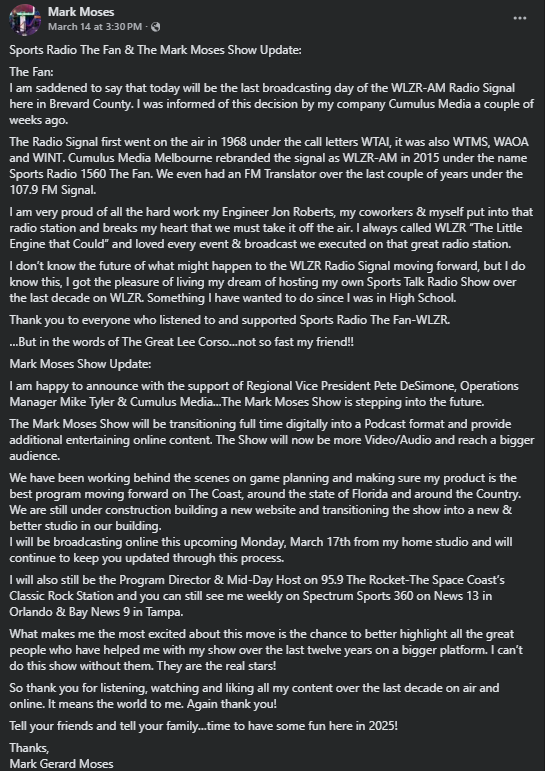
Sports radio listeners on Florida’s Space Coast are now in search of a new destination after Cumulus officially powered down Sports Radio 1560 The Fan on Friday. The daytime-only AM signal, which simulcasted on a low-power FM translator, was silenced as its only local talent, Mark Moses, announced the news via his Facebook page.
“I am saddened to say that today will be the last broadcasting day of the WLZR-AM Radio Signal here in Brevard County,” posted Moses. “I was informed of this decision by my company Cumulus Media a couple of weeks ago.”
Sports Radio 1560 The Fan lasted for just over a decade, having been a member of the Infinity Sports Network.
Moses, who joined Cumulus Media in July of 2013, took a moment on Friday to express his gratitude to the station’s staff.
“I am very proud of all the hard work my Engineer Jon Roberts, my coworkers, and myself put into that radio station, and it breaks my heart that we must take it off the air,” said Moses. “I always called WLZR ‘The Little Engine that Could’ and loved every event and broadcast we executed on that great radio station.”
Moses hosted a weekday program from 3 p.m. to 6 p.m. on the sports talk signal and covered several major events around Orlando and the Space Coast, including multiple stints at Super Bowl media row.
“I don’t know the future of what might happen to the WLZR Radio Signal moving forward, but I do know this—I got the pleasure of living my dream of hosting my own Sports Talk Radio Show over the last decade on WLZR,” Moses stated. “Something I have wanted to do since I was in high school. Thank you to everyone who listened to and supported Sports Radio The Fan-WLZR.”
Looking ahead, Moses is now moving into a new role within the company. He announced that his sports radio program will transition to a full-time digital and podcast distribution model supported by Cumulus. His first broadcast in the new format will take place today as he also steps into a new position as Program Director and mid-day host on sister station 95.9 The Rocket.
“What makes me the most excited about this move is the chance to better highlight all the great people who have helped me with my show over the last twelve years on a bigger platform,” Moses said. “I can’t do this show without them. They are the real stars!”
As of now, there is no official word from Cumulus on the future plans for the 1560 AM signal or the specific platforms where Moses’ new venture will be distributed.
Barrett Media produces daily content on the music, news, and sports media industries. To stay updated, sign up for our newsletters and get the latest information delivered straight to your inbox.
The Savannah Bananas made history on Saturday night, selling sold out an NFL stadium. 65,000 strong flocked to Raymond James Stadium in Tampa to watch the minor league baseball version of the Harlem Globetrotters take on the Savannah Party Animals. Banana Ball has swept the nation, and fans can’t get enough of it.
The Bananas won the game 11-10 but the final score never mattered. Neither did the names of the players or the stakes of the contest. People felt they needed to be there or they’d miss something special. That’s what FOMO (Fear of Missing Out) creates. The game had fireworks, live musical performances, in-game contests and interviews, and the most important ingredient, non-stop entertainment.
To put it in perspective, the Tampa Bay Rays would need 3 or 4 games to attract that many people to watch them play at home. The Miami Marlins may need five or six. One could argue that the Bananas come through a city like a traveling circus, so it’s a unique experience. That’s true. Although I’ll remind you that whether they win or lose and regardless of who’s on the field, people want to see the show. That’s what spectacular marketing and creative content can deliver.
As I looked on social media at the buzz surrounding the event, I thought about the reasons why Banana Ball has caught on with fans in all cities. For starters, it’s fast paced, and entertaining. Next, it’s affordable. Then comes the understanding of being social media friendly and interesting. Finally, it feels big, special, and an event you can’t afford to miss.
The Bananas have become the baseball equivalent of a Taylor Swift concert. Except people who attended Taylor’s ‘Era’s Tour’ had to spend thousands to go. They knew something great was happening, and needed to be there. The Bananas deliver that same feeling except you can still pay your mortgage at the end of the month.
What’s wild is that this team just arrived on the scene as a brand in 2016. In less than 10-years, they’ve become a cultural phenomenon, and massive success. Jesse Cole wanted his team to own a different identity, and look and play a certain way. They created their own league and lingo, sped up the game, introduced live performances and stunts, and championed lighter commentary. Most importantly, they’re priced differently.
Claiming to be fans first is easy but backing it up is harder. The Bananas have done that by introducing a cost effective, family friendly, creative, unique, and entertaining experience that people are drawn to. It’s reflected in the team’s broadcasting approach too, where games air on YouTube for free rather than on TV where it costs and inconveniences fans. Jesse Cole has said before, ‘normal gets normal results‘ and ‘attention beats marketing 1000% percent of the time‘. It’s exactly why this team and league is red hot.
Consider now how that relates to the media industry. If I gave you ten years to build a brand that would change the game and your industry and business, could you do it? How would you do it? What would you eliminate that you’re currently doing?
Keep in mind, the Bananas don’t have Major League Baseball budgets. You wouldn’t either. But they have something many inside media circles lack, guts. They’ll try things, and fail because they know that when they connect, it results in an NFL stadium selling out. You’re not going to enjoy the biggest wins of your career and take a brand to record levels by playing it safe. If your strategy is built on chasing meters rather than creating fan connections, and understanding how those connections relate to revenue, you’ll lose every time.
FS1, CNN, MSNBC and others have had a decade to try and beat ESPN and Fox News but they haven’t. Radio brands like Z100, WTOP, and WFAN keep winning regardless of who they feature and compete against, which is a testament to the connection they’ve formed with their audience, and advertisers. It also suggests though that competitors haven’t done enough to force a change in behavior. If all you have are different talent, a different name, and a different channel or dial position, you’ll continue to get beat.
When people are emotionally connected to the talent, content, and brand, it makes them more interested. The more interested they are, the more loyal they become. Why do you think Apple leans in each year to branding the NEW iPhone? It’s to create urgency, and make you feel that you can’t keep up in the world without their latest model. Because they’ve earned trust, value their customers, and never stop innovating, they’re still one of the world’s most dominant businesses.
A decade or two seems like a long time to change the world, but it really isn’t. The Bananas are living proof. I’m not going to suggest that Banana Ball is going to replace MLB anytime soon. That’s highly unlikely. But if the best don’t evolve, and others meet the moment, people will pivot and find other forms of entertainment. Once they do, it’s hard as hell to get them back.
As it relates to media brands, if you’re in the driver’s seat, don’t take your foot off the gas and assume that you’ve figured it out. Improvements can always be made regardless of your ratings or revenue success. If you’re the new kid on the block, examine where the opportunities are, what the market lacks, experiment with new ideas, and don’t stop tweaking until you’ve created something special. If you play your cards right, maybe one day you’ll have your own identity and lingo, and a nation full of fans.
A Tribute to to Bob Rivers
I didn’t grow up in Seattle and listen to Bob Rivers yet felt like I knew him and his show 3,000 miles away. During my early radio days, I worked in rock radio for two years. The hosts I produced played Rivers’ bits in Albany and Poughkeepsie NY, and never told me they were from a morning show in Seattle. Instead it’d be something along the lines of ‘JB, this came in from the production house, can you load it in for tomorrow’s show’? I’d take the CD or minidisc audio, load it in, and it’d air the next morning.
At last year’s Radio Hall of Fame, I had the pleasure of meeting Bob for a few minutes. It was a cool moment because I was a fan of Bob’s radio brilliance. I shared how I learned of his work, and he informed me that many morning shows across the country helped themselves by using his material. We posed for a quick photo, I congratulated him on his HOF honor, and then chatted with Spike O’Neill for a few minutes.
Few were as creative, funny, and unique as Bob Rivers. His passing saddened me when I heard the news last Tuesday. The stories shared on KISW last week showed how important he was to Seattle radio. If there’s one thing we can do to remember Bob, take a minute today and log on to YouTube to listen to one of his Twisted Tunes. You’ll laugh a lot and be glad you listened.
Quick Hits:
The 2025 BSM Summit is shaping up very nicely. I’ll have a few more speakers to announce tomorrow morning. Those interested in attending the show can purchase tickets here. We’ve also just sent out details to a number of Midwest Universities on how students can win free tickets to the event. I’ll be giving industry members a chance to win tickets as well this week. Stay tuned!
A major blunder was committed recently at MSNBC. Details of the network’s planned layoffs were printed out, and then discovered by a staffer, who then alerted co-workers of what was coming. Deciding who to keep, cut, and how to grow a business is hard. But leaders are trusted with proprietary information, and tasked with handling sensitive situations. Sloppiness like this should never happen, and when it does, it raises questions about whether or not a manager can be counted on to execute the next situation.
One of the best things I saw last week was this post by Audacy Houston Market Manager Sarah Frazier. I attended CRS and listened to Sarah talk about big ideas, and her goal of selling a sponsorship for the ‘Glitter Shitter‘. Well, she did it, selling the opportunity at CRS to Monument Records. I get frustrated when I see brands create bland opportunities that do little to excite audiences and advertisers, so when I see great ideas discussed, brought to life, and executed well, I think it’s important to pass it along. Creativity is far from dead in the radio industry. We just need more Sarah Frazier’s.
Photo of Sarah Frazier at the Glitter Shitter presented by Monument
Congrats to Pat McAfee and his team on selling out PPG Paints Arena in Pittsburgh for the upcoming ‘Big Night Aht‘. Time spent with McAfee and friends is usually filled with laughs, high volume conversations, and appearances from popular sports figures. Pittsburgh folks will be in for a treat.
Did anyone notice that the text size on YouTube is now smaller on mobile? Does this mean longer titles will become more popular? I’m not sure, but the latest update has to mean something. Keep an eye on this.
Anytime I see my guys doing well, it brings a smile to my face. ESPN has been giving Joe Fortenbaugh a little more run on First Take and each time he’s been featured, he’s delivered. I hope to see more of it.
The team at ESPN New York deserves props for creating a masterpiece. This video below was created to unveil the station’s new studios. The Full House vibe and buy in from the talent made it fun to watch. I did so multiple times. Well done by all involved. Whoever came up with the idea for this, give them a raise Vinny 🙂
I’m a huge fan of Inside The NBA on TNT. Shaq, Kenny, Charles and Ernie are as good of a team as there is on television. But as much as I enjoy the crew, it’s indefensible for Shaq to not know who the head coach of the Detroit Pistons is on a basketball show. Personality may be the key to the show’s success, but is it too much to ask for an analyst to be prepared?
The conversation between B-Dub and Craig Morgan about exposing legendary artists to younger musicians, and the role social media platforms play in launching and growing music careers was very interesting. Worth your time to watch this.
If I gave out a Star of the Week award it’d go this week to Texas Men’s Basketball Coach Vic Schaefer. The Longhorns coach last week recognized a few young reporters who made a 16-hour drive to cover his team. Schaefer showed his gratitude by offering to list himself as a reference on their resume. It was an example of all that’s right between media and athletics. Kudos to Paul Finebaum for giving it attention, and sharing his own story of how LSU Men’s Basketball Coach Dale Brown befriended him, and allowed him to list him as a reference on his resume when Paul was trying to break into the business.
iHeartmedia Dallas, San Antonio and Austin Director of Operations Jason McCollim is a sharp guy, who is bullish on the radio business. If you haven’t read his thoughts on Facebook or LinkedIn, make it a point to do so. He always gives you something to think about. This post in particular was excellent.
Jeff Lynn came up with a 10-question survey to see how music radio professionals are feeling following another round of industry layoffs. If you work in a music format and haven’t participated yet, please do so. The results will be shared in a future column. All who participate in the survey will remain anonymous.
I watched Terrie Carr‘s interview with former Quiet Riot and Black Sabbath bass player Rudy Sarzo. The interview was easy to follow, and I loved Carr’s line ‘music is time travel‘. More importantly, Terrie’s energy and passion for conversation and the music she plays is infectious. Great job, Terrie.
Barrett Media produces daily content on the music, news, and sports media industries. To stay updated, sign up for our newsletters and get the latest information delivered straight to your inbox.
The herd is thinning. This week, Cumulus and Townsquare Media threw in the towel and announced the shutdown of twenty radio stations overall.
Some of them were AM stations which probably last had listeners in 1981; a few of them were rimshot FMs, which were a business opportunity in the days when listeners didn’t have as much choice and would put up with a weak signal on the far side of town but can’t compete anymore. The filings at the FCC offer some vague hope that the stations might someday come back, maybe in the event someone comes forth and offers to buy them.
The question — as it was when Stephen King gave up on his Maine radio stations — is why someone would buy these stations, and what would they do with them? It’s one thing if you have a big signal FM and KLove or WayFM aren’t yet in the market, and another when it’s a weak AM, even with a translator. Lance Venta at Radio Insight took a few minutes off from his Spring Training tour (hey, you were just up the road from me!) to compile a list of the doomed stations, and there isn’t a lot of opportunity there.
As it turns out, one of the stations that went silent was the AM side of the combo where I got my start and met my wife. WJLK in Asbury Park. At the end, it had swapped call letters and become WOBM, which was once a big deal, and the heritage station in Monmouth County at the Jersey Shore. WJLK was where everybody turned for school closings (and lunch menus), local news, sports, and weather. It was full-service radio, replete with a market legend (Dick Lewis) and the unmistakable sound of Grandma’s living room. You could almost hear the crinkle of the plastic slipcovers on the couches and chairs.
I don’t know when, exactly, that kind of radio went from comforting and wildly popular to creaky and old, but it was already at that stage when I arrived, and after some brief success as an Oldies station, no format worked. Nobody was tuning into 1310 AM for anything, not Standards, not Sports, not a simulcast of an FM with a dodgy local signal. That game was over years ago.
While this obviously doesn’t mean that all radio stations are about to be taken off the air – and many stations are profitable as going concerns, their problems arising from debt – it’s not a good sign. Or maybe it is: taking money-losing, technically challenged signals off the air means less competition for what revenue is left in the market. (Assuming, of course, that those stations earned any revenue. I’m skeptical.) I wonder if any listeners even noticed that the stations are gone. It’s also proof that FM translators can’t save every AM station.
Maybe nothing can save some stations. Nobody wants to pay for them, many sold off their real estate and towers years ago, and I haven’t seen a new format that can pull listeners back to AM/FM radio from streamers in years. Personality radio is pretty much a goner, too expensive and taking years to develop.
You can argue about the reasons we got here, but we’re here, and maybe it was inevitable. Nobody guaranteed that the radio industry would be around forever. It’s just that I didn’t expect stations to become worthless quite as quickly as this.
Barrett Media produces daily content on the music, news, and sports media industries. To stay updated, sign up for our newsletters and get the latest information delivered straight to your inbox.
Jim Ryan, Audacy’s SVP/Programming and PD of NEW 102.7 will step down at the end of April. Ryan will concentrate on his consultancy, which includes nationally syndicated nighttime radio host Delilah.
Ryan has been programming in New York since 1996, so I asked him why he is stepping away now?
“As a day-to-day program director, I’ve achieved everything that I’ve hoped, wanted, and dreamed to achieve. We had all those number one rating books at WLTW when I worked across the street. We’ve taken CBS FM to number one. It didn’t stay, but we got it there. We relaunched WNEW as a Hot AC in 2017, and the station is hugely successful. It’s the biggest Hot AC station in America. We’ve got a morning show that’s killing it.”
Ryan enjoys the talent coaching part of the job.
“The other aspect of the job involves working with other radio stations. When I was at Clear Channel, before they became iHeart, I worked with all the AC and Hot AC radio stations. When I came to CBS, I started working with all the other ACs, worked with the Classic Hits stations for a while, and then went back to doing AC.”
“Then they had me do some morning show coaching. Rather than doing music logs and worrying about which weekender I will have on and how I will come up with a sales promotion to get this client. I think I can teach others how to be better, score better in PPM, and have better personalities. And that’s what I really want to do.”
Knowing that one size doesn’t fit all, I asked Ryan to share some talent coaching techniques.
“There are certain basic things that need to be done to be successful in PPM. But you have to see how far they’re willing to go. The audience needs to feel that they know you. It’s sometimes hard to get people to open up about their lives and be real and be honest on the air. But if you look at Howard Stern, nobody was more honest and open about his life, including his penis size, for God’s sake. That really resonated with people. They bonded with Howard. I think Howard is probably the best interviewer in the media.”
“It’s not something everyone can do. If we’re going to keep making appointments and getting people to tune in every day, we have to have that kind of talent that people tune in because they think they’re going to miss something.”
“Oh, my God, I have to hear what this show is going to do tomorrow. And we’ve done that with the show in New York. They’ve done a lot of things to stand out. Yes, we have our benchmark features and all that. But, when we did a charity drive for toys in the fall, one of the guys on the show had a fear of heights. So, we put him on a Ferris Wheel and said he wasn’t going to come down until we got a certain number of toys.”
I mentioned that one of the shows I admired, along the lines of sharing, was Audacy’s “Karson & Kennedy” at Mix 104.1 in Boston.
“They are phenomenal and I’ve enjoyed watching the growth of that show. Kennedy just went through breast cancer. Right? I was on the edge of my seat. How is she doing? It’s so great to see their success. They are far and away the biggest female show in Boston. I know that the guys at the sports do well, but that’s more male-leaning. They’re consistently doing double-digit female numbers. It’s really exciting to see.”
It’s no secret that Ryan stayed three months longer than he originally intended. He waited to see the initial impact of Nielsen’s three-minute qualifier. So, did he see anything?
“I am seeing younger stations do better. I think the reason you see it in contemporary is that the songs are so short nowadays. At one time I was programming the music for CBS FM and WNEW at the same time. The number of songs each station played in the hour was so different because you got Hotel California, Born in the USA, and your average song is over four minutes long.
“Espresso by Sabrina Carpenter is 2:51. That’s a three-minute occasion. That makes sense. If you’re playing Espresso and following it with, say, Lady Gaga, and you’ve got a listener who goes, I don’t like that Lady Gaga song. Then they tune out and come back in the next quarter hour, and the next quarter hour you’re playing APT, which is 2:41 then you get it for another three minutes.”
Aside from technology and consolidation, I wondered what the biggest change that had impacted the business since 1996 was.
“We sort of peaked in revenue as a business in probably 2006, 2007 in that time frame. And revenue has certainly declined. Covid obviously hurt that as well. But I think it comes down to the fact that digital marketing companies are very, very aggressive. If you owned a couple of car dealers in the New York metropolitan area, it may make more sense for you to use Google or Meta to get people to come to your car dealer. Whereas in 1996, there was no social media.”
“Digital was not a factor. People bought commercials on the radio. I do think for the big national brands radio still makes a lot of sense. Brand reinforcement is key to people using your product. But I think we lost that part of our revenue stream.”
“And sadly, there was a great deal of overpaying for radio stations. So they got choked by the debt. I was there at Clear Channel in 2008 when the venture capital firms and the banks did a deal to buy the company for twenty-one billion dollars. And the market started falling apart, and Lowery Mays actually had to sue to get the deal done so that he could take his twenty-one billion dollars.”
“iHeart has still not worked out of it. They’ve been through bankruptcy, but they still haven’t worked their way out of the debt. Audacy bought the CBS radio stations. When they bought the CBS radio stations, the stock for what was then called Entercom was trading at sixteen dollars a share. Well, it’s no secret we just went through bankruptcy because the stock is worthless. So, you might say that they overpaid a little bit.”
I asked what Ryan would tell a young programmer starting out in an unrated market that aspired to one day have a long run in New York.
“I’m not the smartest guy in the room. I’ve never been the smartest guy in the room, but I think I’ve always worked harder than anybody else. I sort of threw myself into it seven days a week to learn as much as I could possibly learn”
“If you’re in a small, unrated market, you can really connect with your listeners. Be out there as much as you possibly can. Shake as many hands as you can with your air staff. I live in the summer in Traverse City, Michigan, and the stations there did a campaign to “Visit A Store With A Door.”
“They were very aggressive about that. And it really created a great sense of community. Do I have Sirius in the car? Sure. But did I ever listen to it? No, because I was engaged with their local campaign and their talent being around the city. Just go out and touch as many people as you can within the law.”
I asked Ryan if there was anything he wanted to add or anyone to shout out?
“If anybody I want to shout out, it’s Chris Oliviero. I worked for Bob Pitman very early in my radio career. I was very young when he hired me when he was a program director. He’s always sort of been a mentor of mine.”
“I was consulting briefly between Clear Channel and CBS, and when CBS made me the offer, I had lunch with Bob and said, ‘Bob, what should I do? Bob said, ‘oh, my God, leave your consultancy and go to CBS’. Spend three years there, and then you will have CBS on your resume as a consultant, which will make you much more valuable.”
“Well, three years turned into 15 because of Chris Oliviero. He was the head of programming at CBS and then he came back as the New York market president. I have so much respect for him. I can’t even put it into words.”
“He cares about people, and I consider him a friend. And I truly love working with him. It hurts leaving now, but I’m very excited about my replacement who is going to be announced next week, who I’ve known for many, many years. I think I’m leaving the station in great hands. And Chris will really love working with my friend who’s coming next week.”
Barrett Media produces daily content on the music, news, and sports media industries. To stay updated, sign up for our newsletters and get the latest information delivered straight to your inbox.
This week’s eavesdropping turned out to be very different from what I was originally expecting. I have heard episodes and seen many clips of The Pivot podcast featuring former NFL players Ryan Clark, Channing Crowder and Fred Taylor. Generally, what I heard was a lot of their personalities and good conversation between the hosts and guests who would add to the conversation.
As I loaded up the March 14 edition of the show, as I drove from Nashville to St. Louis, I expected I would here much the same. However, this episode was very different in that the guest, WNBA superstar Natasha Cloud, did most of the talking and the hosts did most of the listening.
To be candid, the episode was riveting. The word a lot of people in our business like to use a lot is ‘compelling.’ When you have content that is truly compelling, you win. This episode had it in spades.
I don’t want to make it sound like Cloud talked for 75 minutes, the hosts were engaged in the conversation, she just had a lot to talk about and really opened up in the conversation. Nonetheless, you still got to feel the genuine camaraderie between The Pivot hosts Clark, Crowder and Taylor, and you really got a chance to see their ability to create a space where athletes feel comfortable sharing raw, unfiltered truth. This particular conversation was honest, deep and full of humor, and nobody from guest to hosts was afraid to be real.
From the moment Cloud started, it was clear this wasn’t just another media hit for her, it was a chance to speak freely, to educate, to challenge, and to reflect. Right out of the gate, Cloud set the tone by acknowledging the platform Clark, Crowder, and Taylor have built and the role they play in uplifting Black voices, especially Black women.
“I appreciate what y’all do,” Cloud said about The Pivot. “Before we even start, I think it’s really powerful to have Black men that constantly speak up and talk about issues that not only plague our community, but especially for how y’all speak up for Black women.”
Clark wasted no time getting personal, diving into Cloud’s unique upbringing as a biracial woman raised in a white family, navigating what she called being a “gray area kid.”
“You were never white enough, you were never Black enough,” she added. “It was just like, you’re somewhere in between, so you have to figure it out for yourself.”
Cloud credited her mother for instilling strength in her, but admitted she didn’t truly “find her Blackness” until she got to the University of Maryland, where she was surrounded by a more diverse environment.
If you know anything about Natasha Cloud you know she doesn’t just talk, she acts. Her decision to sit out the 2020 WNBA season in protest after the murder of George Floyd wasn’t a PR stunt or a moment of fleeting activism, it was a conviction that led to action.
“For me, I just couldn’t go in and not be on the front lines, not be in those conversations, not be in rooms that are deciding policies for our communities moving forward,” she explained to the hosts.
It’s no secret that WNBA players have long fought for better pay, resources, and respect, but Cloud laid it out plain and simple saying, “You’re going to give us our money, and you’re going to give us our money now.”
She wasn’t asking for NBA salaries, but she was demanding fair compensation based on the revenue they generate. She even pointed out the fact that WNBA players don’t even receive a cut of their own jersey sales.
“How is that even possible? My sh** is sold out, so why am I not receiving money for that?”
Cloud’s frustration wasn’t just personal, it was systemic. And yet, rather than dwell on the inequities, she made it clear she’s going to fight for the next generation of players.
At one point, the conversation turned to Cloud’s on-court mentality, her reputation as a ‘dog’, and why she embraces the role of an enforcer.
“If I got to crash out to get us fired up, I think sometimes people look at me and they’re like, ‘Oh, she don’t know what she’s doing.’ If I get a technical, most of the time it’s very intentional.”
The hosts, particularly Crowder, couldn’t help but laugh. “You get mad real easy,” he joked, mimicking her aggressive style on the court.
It was in these moments, with humor meeting truth, where the realness of The Pivot podcast shined.
As much as Cloud spoke about her passion for activism, she also revealed the emotional toll it takes.
“People thought I was just chilling at home. I was working 9 to 5. I was in meetings, panels, hard discussions, reliving vulnerable moments, talking about our trauma in the Black community, and then still being demanded to do more.”
Clark jumped in, saying he’s felt the same burden, feeling like if he didn’t speak on an issue, he was letting people down. “I had to get to the point where I was comfortable enough to say, ‘Hey y’all, I can’t talk about everything. I can’t fight everything.'”
By the end of the episode, it was hard not to be moved. Clark, Crowder, and Taylor embraced Cloud’s story, her struggles, and her fight.
“I’m just a normal human being that speaks up when I see something wrong,” Cloud said.
This episode of The Pivot podcast wasn’t just sports talk, it was real talk.
Barrett Media produces daily content on the music, news, and sports media industries. To stay updated, sign up for our newsletters and get the latest information delivered straight to your inbox.
Although Jon Rothstein has established himself as a consistent television presence on college basketball broadcasts for countless iterations of March Madness, scores of fans keep up with him throughout the year on social media with posts emphasizing the enthralling drama and emotional changes associated with the NCAA tournament. Over the years, Rothstein has devised a cavalcade of catchphrases disseminated on social media that have been compiled into digital guides, printed on merchandise sold to benefit charity and embedded within basketball vernacular.
Early in his tenure covering the tournament, he recognized that the University of Wisconsin-Madison men’s basketball team had never finished lower than fourth place in the Big Ten Conference standings under the direction of head coach Bo Ryan. Upon discerning this invariable proclivity, he declared to his audience that three constants in life are “death, taxes and Bo Ryan,” starting a tradition that imparts distinctive panache and tangible passion for the sport.
“I said, ‘Wait a minute, there might be something there,’ and, ‘This is March,’ [and], ‘We sleep in May,’ are, again, just other things that have come to the forefront that have resonated that I have used on social media,” Rothstein explained. “I don’t force taglines, but it’s something, again, that I know you can’t force but you’re always kind of thinking about.”
Rothstein has positioned himself as an expert who exhibits an indefatigable work ethic and invaluable flexibility as a multiplatform personality. Although some consumers may view his dispatches as outlandish or hyperbolic, the conjectural assumption itself is an utter fallacy. Rather than adopting an embellished persona, Rothstein portrays his authentic demeanor with the audience and offers his genuine insights and emotions for all.
“I’m the same person on social media as I am on television or as I am in real life,” Rothstein explained. “There’s really not too much to distinguish, which I know a lot of people probably don’t believe, but it’s the utmost truth. The things that are happening in real life I just translate to social media, so there’s not much of a change in the two.”
With encyclopedic knowledge and unparalleled proficiency of the sport, Rothstein leverages his knowledge to enhance the overall game presentations and represent CBS Sports in a positive light. As a college basketball insider, he is constantly working the phones and staying in touch with industry sources to discover and convey the latest news and information.
“I think you learn as you go through this more and more that you have to be accurate and you have to be tight with your reporting,” Rothstein explained, “and the only constant I have this time of year that’s going to be consistent is you know you’re going to get a lot of inaccurate information across your desk, and you have to be able to decipher what’s real and what’s not, so you have to get as strong of a source as you can before you report something of that magnitude.”
With the start of March Madness fast approaching, Rothstein is transfixed on the unrelenting cadence of the tournament and caught amid an incessant work schedule replete with prodigious responsibility. Yet he does not loathe the occurrence, instead craving the chance to grind and excavate hidden storylines and developments on social media and television.
“I would say if there’s news stories, injuries, coaching changes, things like that that I’m following up on, you want to obviously start early in the morning, but if I’m on the air during the NCAA Tournament, there is nothing else I will do or entertain during that time,” Rothstein said. “It is all about the broadcast, the broadcast, the broadcast. Nothing is ever more important than a broadcast when you’re on the air.”
With the NCAA Tournament on the precipice of tipping off, the sports media world is remembering the life and legacy of award-winning broadcaster Greg Gumbel, who passed away last December after a battle with cancer. Gumbel covered the tournament for CBS Sports starting in 1998 and was a beloved presence among his colleagues and sports fans around the country.
“Greg is an icon in the sports broadcasting field, and he is a person who was so warm, who was so welcoming,” Rothstein said. “And I guess the best way I could describe Greg Gumbel, who I miss and everybody misses, especially this time of year, is he could do anything on the air – any sport, any task, any assignment – and make it look beyond easy, but he also, off the air, was as welcoming as any person you would ever meet in your life. Greg took his work incredibly seriously, but he never took himself that seriously.”
CBS Sports broadcasts the NCAA Division I Men’s Basketball Tournament under an agreement with TNT Sports, a joint project first established between the two divisions in April 2010. The entities currently share the rights through 2032 under an eight-year extension reportedly worth $8.8 billion, which was negotiated under CBS Sports chairman Sean McManus. Following the conclusion of The Masters last April, McManus retired from the company after 27 years and led to the promotion of David Berson to president and chief executive officer of CBS Sports.
“There’s no better boss than David Berson,” Rothstein said. “Sean McManus leaves a legacy and obviously is another icon in the sports broadcasting business, but there’s no better leader than David Berson. He’s somebody – you can quote me on this – I’d take a bullet in the shoulder for.”
The respective sports divisions are said to be paying $995 million for rights to March Madness this year, and as price escalators are reportedly set to take effect within the agreement, there have been conversations surrounding potential tournament expansion. While Rothstein hopes the partnership between the Paramount Global and Warner Bros. Discovery divisions will continue for years to come, he is vehemently against this hypothetical alteration.
“I don’t want to hear about NCAA Tournament expansion,” Rothstein articulated. “Jeff Goldblum said in the film ‘The Lost World’ in 1997 that, ‘Taking dinosaurs off this island was the worst ideas in the long, sad history of bad ideas.’ This would usurp it.”
The conference tournaments that occur leading up to March Madness have significant implications and have a plethora of dramatic moments. This past weekend alone, both Big Ten Conference semifinal games came down to the final minute, and there were various upsets that altered bracket projections, especially in one-bid leagues. Part of the rationale behind Rothstein’s disdain towards potential expansion relates to how it would affect certain games ahead of these competitions.
“I think what would happen [is] we would see the regular season devalued, especially the last month of the season,” Rothstein explained. “One of the biggest things starting February 1 that brings everybody in for college basketball is people being interested in following the bubble. If we extend the NCAA Tournament to include more teams, part of that’s going to be gone.”
For the first week of the tournament, Rothstein is going to be on the road delivering sideline reports from the First Four in Dayton, Ohio and will be on the broadcasts from another region thereafter. Working in the multifarious position over the last several years, he has been afforded the chance to distinguish himself by attending practices, speaking with personnel and traveling the country. Rothstein has built an expansive network and fulfills his role with aplomb amid millions of consumers being invested in the exhilarating high-stakes play.
“My perspective is much different than other people who are just kind of giving news and then throwing it back to a host,” Rothstein said. “In certain transactional sports where there’s free agency in Major League Baseball or there’s other things, I think it’s a little bit different. In college basketball, because there’s so many storylines, there is, I think, a closer gap between the person who is the information person and the player or the coach.”
— CBS Sports College Basketball 🏀 (@CBSSportsCBB) February 1, 2025
Appearing on college basketball coverage distributed to various verticals, Rothstein has received assistance in being able to separate his tasks and come through for the audience. Through experience on the job, Rothstein has become acclimatized to the entropic nature of the month and always remains ready to pivot to the latest developments, showcasing his versatility amid a vortex of blithesome mayhem.
“It’s massively important because you have to be comfortable doing sidelines for a game as a reporter and asking key questions,” Rothstein said. “You have to be able to do interviews, you have to be able to be comfortable in the studio show, you have to be able to be comfortable doing a podcast. This is media in 2025, and it’s media that obviously is always forcing us to adapt, and you better be nimble if you want to survive in this climate.”
After graduating from Ithaca College in 2004, Rothstein started forging connections in the business upon winning a “Dream Job” contest through which he reported for ESPN New York. Shortly thereafter, he purchased air time on a New Rochelle radio station to host a weekly midday sports talk show and compiled a reel. Although Rothstein eventually started working in television, he has always maintained a passion for audio and started the College Hoops Today podcast for Compass Media Networks.
“The media world is changing, and while I had this podcast home, I knew that at some point, getting into the video space for podcasts would be a move that eventually had to be made, especially with the following that I have on social media,” Rothstein said. “So it was something in the latter part of last year [where] my bosses at CBS granted my attention [and asked if] I [would] be willing to bring this over as part of my portfolio.”
Oregon has quietly won eight games in a row entering today’s game against Michigan State.
Rothstein recently started a new podcast with CBS Sports where he provides insider information, expert analysis and game selections for all upcoming college basketball matchups. As the new project moves forward with new episodes throughout March Madness, he will look to keep the sport at the proverbial center of the conversation.
“Each day is its own separate opportunity to get better, and I owe it to myself, I owe it to my bosses who have given me all these great opportunities, and you owe it, I think, to your family as well to make sure that your reputation and everything you’ve worked so hard to build maintains at a high level,” Rothstein said. “And just because you’re getting certain assignments that are obviously of major cache, it doesn’t mean you can’t keep getting better.”
Citing an outlook proffered by businessman Max De Pree, Rothstein is consistently working to improve himself because he will be unable to become what he needs to be by remaining stagnant. Rather than sinking into a unyielding state of inertia, he remains ambitious and wants to keep expanding his role while not losing sight of the opportunities he currently holds. As the victorious team cuts down the nets, Rothstein will embrace the moment while remaining cognizant of his obligations and how to best serve CBS Sports.
“My philosophy is to make the next task the most important task and then keep on trying to be in a situation where you’re knocking tasks out the best you can do because here’s the thing,” Rothstein construed. “If you’re looking at a pothole a half a mile down the road, you’re going to miss the road that’s being traveled in front of you. I’m not living my life that way, and I never intend to.”
Barrett Media produces daily content on the music, news, and sports media industries. To stay updated, sign up for our newsletters and get the latest information delivered straight to your inbox.