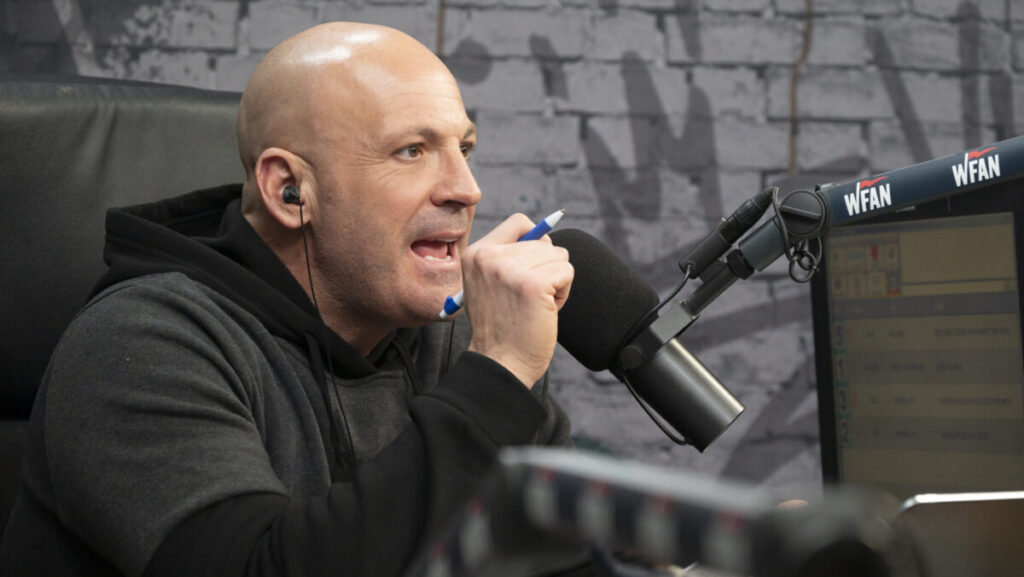
Former WFAN afternoon drive host Mike Francesa had an idea about how he wanted to plan his eventual exit from the station over ten years ago. SiriusXM radio host Adam Schein appeared on the Marchand Sports Media podcast this week and revealed that he had a dinner meeting with Francesa in 2014 to discuss a potential succession plan. According to Schein, Francesa envisioned him as his replacement on the New York sports talk powerhouse.
Schein, the morning host of Schein on Sports on Mad Dog Sports Radio, recalled being asked by Francesa to meet and discuss the plan.
“Mike and I had a meeting in 2014,” Schein explained. “He called me and said, ‘I want to go over a potential plan that includes you replacing me.’”
The SiriusXM host recounted how Francesa wanted to meet at a local establishment, which happened to be in the same building as the SiriusXM studios. Notably, this meeting followed Francesa’s infamous interview with then-New York Yankees third baseman Alex Rodriguez, in which A-Rod repeatedly denied purchasing or using PEDs after Major League Baseball handed down a year-long suspension.
“So I go in, and I’m talking to Felix, who’s the big maître d’ there, and Scott Goulds, who was the GM,” Schein recalled. “Then they asked me, ‘Do you have a reservation?’ I said, ‘I’m meeting Mike Francesa.’ Then Felix goes, ‘You’re the special guest Mike told me about?’ And I’m like, great.”
He then went on to describe how Francesa laid out his vision for Schein to succeed him at WFAN, calling it a “surreal” conversation.
“That was crazy, and that was intoxicating,” Schein of SiriusXM said.
A decade ago, Mike Francesa presented his WFAN succession plan to Adam Schein. And there was lemon cake.
Francesa ultimately retired from WFAN’s afternoon drive slot twice—once in 2017 and again in 2019. He now hosts The Mike Francesa Podcast via the BetRivers Network. Francesa began working at WFAN in August of 1987 beginning with a weekend program discussing college football and basketball, leading eventually to be paired with Chris “Mad Dog” Russo in 1989. Mike and The Mad Dog was a staple of WFAN from 1989 to 2008, when Russo announced his departure for SiriusXM.
Barrett Media produces daily content on the music, news, and sports media industries. To stay updated, sign up for our newsletters and get the latest information delivered straight to your inbox.
Cumulus Media has released its 2024 financial results and while the total revenue for the company was down, there was growth in other areas that the company found encouraging.
In total, the company featured $827.1 million in revenue during 2024. That represents a year-over-year decline of 2.1%.
Digital revenue accounted for 19% of total revenue for Cumulus last year, finishing with $154.2 million. The 5.3% year-over-year increase was accompanied by a 27% growth in digital marketing services. The strong finish in the digital sector can be attributed to the Cumulus Podcast Network ending 2024 as one of the top podcast networks overall. The company added that its digital marketing pacing for the first quarter of 2025 is up 30%.
“Though the industry environment remains challenging for now, our 2024 refinancing efforts provided us with the time needed to both execute our day-to-day blocking and tackling and, in parallel, continue to reimagine the ways in which we can get the most out of our key assets to create new revenue streams and build additional long-term value,” said Cumulus Media President and CEO Mary Berner.
Overall, Cumulus reported a net loss of $283.3 million during the year. It did execute actions that resulted in $43 million of annual reductions, with $28 million of those savings being realized in 2025. The Adjusted EBITDA was $82.7 in 2024 compared to $90.7 million in 2023.
“Since the pandemic’s onset, the radio industry has experienced tough economic and secular headwinds,” Berner added. “In the face of those, we outperformed our peers through the end of 2023 on key metrics including cost takeouts, EBITDA margin recovery, free cash flow generation, net leverage, and liquidity.”
Barrett Media produces daily content on the music, news, and sports media industries. To stay updated, sign up for our newsletters and get the latest information delivered straight to your inbox.
ESPN has announced a new spinoff of its iconic program, SportsCenter, set to debut on Disney+ next Monday. The network revealed that SC+ will launch exclusively for Disney+ subscribers, offering a streamlined and concise format that highlights top sports moments, key stories, expert insights, and exclusive commentary.
As the latest extension of the multiplatform SportsCenter brand, which first aired on ESPN in September 1979, SC+ builds upon more than 45 years of sports coverage. ESPN says the new show will center around the highly popular “SC Top 10” daily countdown while also delivering the most important sports news of the day, featuring insights from ESPN’s top insiders and reporters.
“It’s an absolute honor to take one of ESPN’s most prestigious and historic brands, SportsCenter, and infuse it with the energy and creativity afforded by Disney+,” said Mike Foss, Senior Vice President, Studio & Entertainment.
SC+ will stream live on weekday mornings at 9 a.m. ET, with each episode available on demand for 24 hours on Disney+. The weekday program will be hosted by Gary Striewski and Randy Scott, who will also continue anchoring the 7 a.m. ET edition of SportsCenter on ESPN.
On weekends, hosting duties will transition to Hannah Storm and Jay Harris following their SportsCenter:AM program on ESPN.
“SC+ aims to tell the best stories in sports every day in an unforgettable way,” Foss continued. “This fresh approach, combined with the expansive reach of Disney+, will resonate whether you’re a die-hard sports fan or simply looking for something new to watch after your latest series binge.”
Alisa Bowen, President of Disney+, also expressed her excitement about bringing the program to the platform.
“ESPN has long defined excellence in sports programming, and now Disney+ subscribers will have daily access to the most exciting sports news, moments, and stories,” said Bowen.
With the addition of this daily show, Disney+ standalone subscribers will continue to enjoy a curated selection of content from ESPN+ and Hulu, including live sports events, studio shows, ESPN Originals, TV series, and films—all in one place. Meanwhile, subscribers to the Disney+, Hulu, and ESPN+ bundle will have full access to ESPN+ programming, which features more than 30,000 live sports events annually, along with an extensive library of on-demand replays, original content, and studio programming.
Barrett Media produces daily content on the music, news, and sports media industries. To stay updated, sign up for our newsletters and get the latest information delivered straight to your inbox.
The NFL Combine delivered drama before the more than 300 prospects even took the field in Indianapolis, IN. According to a sourced report by Mike Florio of Pro Football Talk, NFL Network Insider Ian Rapoport and FOX Sports NFL insider Jordan Schultz were involved in an incident at a Starbucks inside the JW Marriott hotel in Indianapolis. The report states that Schultz “verbally accosted” Rapoport while the NFL Network insider was in line, engaged in a conversation with another individual.
Neither Rapoport nor Schultz has addressed the report from Pro Football Talk.
According to PFT, Schultz approached Rapoport in line and said, “We need to talk.” When Rapoport declined, Schultz allegedly responded, “If you have anything to say to me, say it to my f*****g face.” The incident was reported to NFL Security, which has since spoken with several witnesses.
As with any confrontation involving media members, the situation quickly sparked reactions on social media. Many in the sports media world weighed in, some even poking fun at the report’s details.
At this time, there is no word on whether any further action or disciplinary measures will be taken against Rapoport or Schultz. Barrett Media will provide updates as more information becomes available.
Just a good old fashioned source fight. Fair is fair until security gets called. Gotta settle it on the internet on your phones like men! https://t.co/WbTzHvX5vA
Barrett Media produces daily content on the music, news, and sports media industries. To stay updated, sign up for our newsletters and get the latest information delivered straight to your inbox.
TNT Sports secured the top audience on cable television since Opening Night of the NBA season for its presentation of the Los Angeles Lakers game against the Dallas Mavericks from Crypto.com Arena. As Lakers guard Luka Dončić garnered a triple-double while facing his former team for the first time since being traded to Southern California, the game averaged 2.5 million viewers on TNT, truTV and Max. The game peaked with 2.9 million viewers during the 10:30 p.m. EST quarter-hour and was the most-watched NBA regular-season telecast on the Max streaming platform of all time. Moreover, the Lakers-Mavericks game broadcast won the night within the Persons 18-34, Persons 25-54 and Adults under 50 demographics.
According to Jon Lewis of Sports Media Watch, the last regular-season NBA game that averaged more viewers on cable television was when the Lakers faced the Oklahoma City Thunder in February 2023. This game, which also featured play-by-play announcer Brian Anderson on the call, averaged 2.98 million viewers as Lakers forward LeBron James broke the NBA all-time scoring record. Pertaining to this season, the Lakers have played in six of the 13 most-watched games of the year, which is the most among any team in the league.
Despite the storylines surrounding the contest, this is not the highest viewership average for the Lakers in the last week. ESPN NBA Saturday Primetime on the ABC broadcast television network averaged 2.87 million viewers when the team defeated the Denver Nuggets. This game peaked with 3.35 million viewers at 10:45 p.m. EST and was up 29% from the comparable matchup in the previous season. The Lakers have won three consecutive games and currently occupy the fifth seed in the Western Conference playoff standings, avoiding an appearance in the SoFi NBA Play-In Tournament.
Entering the second half of the regular season, viewership of TNT Sports national television broadcasts of NBA games had been down by 11%. The game marked the third instance through which a TNT Sports presentation has ranked within the top-13 most-watched NBA contests of the year, and the first instance of which since Opening Night. As a whole, national NBA television viewership at the half was down 5% from the previous season.
Barrett Media produces daily content on the music, news, and sports media industries. To stay updated, sign up for our newsletters and get the latest information delivered straight to your inbox.
In these ridiculously polarized times we are living in politically, there is a pretty clear yet often ignored line between “illegal” and “I don’t like it, so it’s criminal.” There is a greyer area and blurrier distinction between them, and a lot of presidential conduct seems to lie there lately.
MAGA people cried violation of the law when the Biden administration repeatedly attempted to wipe student debt. Ultimately, the courts mostly shot the policy down as the left howled it was necessary.
Opponents of President Trump have objected to just about literally everything he’s done. With the courts, sometimes agreeing, sometimes limiting, and sometimes not.
While I personally respect something vaguely called “presidential conduct,” i.e., behavior behooving the Resolute Desk and the solemn oath to serve, there is a perfectly legitimate argument that a POTUS can and should test their power and limits whether half the country is offended or not. As long as they don’t obstruct justice and the rule of law, it’s their right to wield power in such a way.
This all brings us to the newly installed FCC Chair, Brendan Carr. It’s clear Carr’s modus operandi will be activist, even aggressive. That’s certainly within his authority and discretion and what the White House is instructing of him.
Here are some areas where, political allegiance aside, broadcasters should worry and push back, particularly through the lobbying arms of the NAB and RAB.
President Trump signed an executive order entitled “Ensuring Accountability for all Agencies,” exerting more direct control over “independent regulatory agencies, ” including the FTC and FCC.
Does the White House control what the FCC does? What does Carr do to the degree he’s terminated if he objects? That’s concerning because the Commission is independent, so it acts in a non-partisan manner.
Here’s the gray: if there has been partisan action, mismanagement, or budgeting issues that Congress isn’t addressing, how does the executive branch respond? The trouble is it opens the door for Trump and future Presidents to direct the FCC to regulate or even directly influence media the executive doesn’t like
To this point, Carr investigating any network’s editorial judgements as he is doing with the big three in television is grossly overstepping his role to burden political adversaries. More alarming, there was no investigation of FOX (a political ally) and both Comcast and Disney to varied degrees have capitulated.
This is a slippery slope not only for journalists but for all broadcasters as it relates to the First Amendment, decency rules, perhaps mergers and acquisitions, and even satire.
With Carr (and it would appear DOGE) looking at NPR and PBS, we are in the gray again. Uncle Sam controls the purse strings largely by asking taxpayers to fund them in part. Hence, an audit of operations seems warranted and appropriate but where is the line in a conservative FCC Chair simply trying to defund an organization which has shown a liberal content slant? No one is certain
Carr’s letter to Bob Pittman at iHeart regarding broadcasters, payola, and concert promotion is where my eyebrows arched. Is this a warning shot? Is it simply a muscle flex? What’s the objective?
Since the 1960 Payola hearings, every broadcast group has required programming personnel to sign a form stating their understanding of the law against and those who’ve ignored it (with major busts in the 80s and early 2000s) have paid the price. For Carr to directly poke iHeart over what is a non-issue is strange, particularly the specific claim that negotiations with artists for radio station concerts leading to reduced talent fees in return for airplay is not explicitly payola and is easily disclosed on the air.
One Trump-friendly congresswoman raised the issue, so perhaps the White House is asking the FCC to scratch her back by flexing on this. However, iHeart replying with anything other than, “We refer you to council who welcome any inquiry and subsequent hearing in a court of law or arbitration” is odd to me and again potentially puts broadcast radio and the FCC on a slippery slope of being bullied at the executive branch’s whims.
Radio should carefully assert its sovereignty and independence as keepers of the public airwaves and as private sector businesses, cooperating when appropriate and taking legal action when necessary. The FCC ought to be doing the same. It appears that’s not going to be the hallmark of Carr’s term.
Having said all of this, he’s certainly the first Chairmen I’ve seen climb an AM tower in his first month on the job, so I commend him for that!
Barrett Media produces daily content on the music, news, and sports media industries. To stay updated, sign up for our newsletters and get the latest information delivered straight to your inbox.
MLB Tonight has become a flagship program, airing nightly on MLB Network. The program provides comprehensive coverage, highlights, commentary, and opinions on all things Major League Baseball. It also offers postgame interviews and expert analysis from former players, coaches, and front office personnel.
One thing is for sure, MLB Tonight does not lose its fastball in the offseason. In fact, it maintains a tremendous repertoire. I caught the program on Sunday hosted by Brian Kenny and Dan Plesac. These two veterans of MLB Network have become welcome fixtures.
Kenny is the engine that makes MLB Network run. His unabashed knowledge and dedication to analytics may rankle some baseball hunch mavens, but he is ultra-prepared and always on point with his commentary. Kenny is a ‘tough out’ in terms of debate because he has statistical knowledge that brings down any flimsy argument.
Plesac brings a whole different perspective. The former MLB pitcher has boundless enthusiasm for the game and a wealth of knowledge from his playing days and longtime broadcasting career. What I like most about Plesac is the excitement and passion he has for the game.
During the guts of the MLB season, MLB Tonight features several hosts and analysts at the anchor desk. For this preseason edition, Kenny and Plesac were a terrific combo – more than enough to satisfy the Spring Training baseball appetite. Like a steaming hot dog on a hot summer day at the ballpark, Kenny and Plesac are the perfect snack for baseball-starved fans.
The pair have excellent chemistry. Often times, opposite personalities click best on air, but in this case, both of these conservative, button-down, veteran broadcasters mesh very well. Kenny knows how to set Plesac up for commentary, and Plesac knows how to come back at Kenny to initiate discussion and debate. The great thing about Kenny is that he’s not just a set up guy, he has the knowledge and ability to analyze the game as deeply as any ex-player. He can act the straight man and deliver the punch line.
Kenny teased upcoming segments on the show and then he and Plesac jumped right into Red Sox highlights. Kenny mentioned that the Sox were a .500 club last year, but have made some key off-season acquisitions including Alex Bregman and pitcher Garrett Crochet, among others. Throughout all the game highlights, Kenny sets up the action and smoothly works in a question to Plesac.
The MLB Tonight production staff ably uses graphics to punch up the host and analyst commentary, offering a sort of electronic box score of each game. For the Red Sox highlights, a graphic worked right into the theme of new Boston acquisitions showing that
Bregman was 3-3 with a home run and 3 RBI, and that Crochet pitched 1 2/3 innings giving up 3 hits and no earned runs. In addition to the highlights and commentary, MLB Tonight often shows images of social media posts from various MLB reporters talking about injuries, player movement, and other news.
Coming out of the Dodgers versus Padres highlights, Plesac made a great point that MLB teams are bringing young players up more quickly than in the past because they don’t want to waste their immense talent in AA or AAA. It’s always fun to see new broadcasting talent blossom on air, but sometimes, it’s nice to just sit back, relax, and watch two seasoned pros do their work. Kenny and Plesac keep audiences riveted. They are the Maris and Mantle of MLB Network.
The duo took a deep dive into the Los Angeles Dodgers’ pitching rotation options while a graphic displayed definite starters, pitchers battling for the fifth spot in the rotation, and overall pitching depth. It also noted that Shohei Ohtani and Clayton Kershaw are expected to return in May or June.
When Plesac predicted that the Dodgers would win 96 games, Kenny laughed and said it was an insult. Ever the statistician, Kenny said that he would be disappointed if the Dodgers didn’t reach the PECOTA Projection of 103 wins. PECOTA, which stands for Player Empirical Comparison and Optimization Test Algorithm, is a Baseball Prospectus system that takes a player’s past performance and tries to project the most likely outcome for the following season.
The topic made for a lively debate.
Projections were a running theme on this edition of MLB Tonight as Kenny and Plesac looked at the Atlanta Braves pitching rotation and the Yankees’ outfield situation among other topics.
If you are a baseball fan, there is nothing like highlights of Grapefruit and Cactus League in February. Plesac and Kenny understand this. They get how baseball is tied to the season. Even if you look outside and see gray skies and snow, a look back at your TV shows players catching pop-ups and fielding grounders, and you know that spring is imminent.
Plesac and Kenny are dressed in conservative suits and ties. They look like they should be seated at the uncles’ table at a wedding, but they are hardly stodgy. These dudes know the game completely. They bring a traditional style, but see baseball from a contemporary perspective. They know the young players coming up as well as their collective potentials and possibilities. They also provide solid analysis during and between highlights.
In another closer look graphic, Kenny and Plesac discussed the Cardinals’ young shortstop, JJ Wetherholt. The 22 year-old was the 7th overall pick in the 2024 MLB draft and is currently the number 23 Prospect at mlb.com. Wetherholt delivered solid stats at the single level last season with a .295 batting average, 20 RBI, and an .805 OPS in 29 games.
Baseball, more than any other major sport, lends itself to statistics. Kenny and Plesac take these numbers and turn them into great discussion. In the ‘Digging In’ segment, Kenny referenced MLB Network’s omnipresent Shredder, talked about, and ranked his top ten relief pitchers currently playing. Devin Williams of the Yankees, Tyler Holton of Detroit, Emmanuel Clase of the Guardians, and the A’s Mason Miller were mentioned. Looking at their stats, Kenny picked Miller as the best reliever in the game while Plesac went with Clase openly spouting that he’s the closest thing we’ve seen to Mariano Rivera.
Beyond numbers and decimal points, Kenny and Plesac have fun doing their jobs. At the end of the show, they showed video of Alex Rodriguez hitting a half-court basketball shot at a Bucknell University basketball game helping a fan to win money. They even reran the video with a voice over of legendary Yankee broadcaster John Sterling calling the shot.
MLB Tonight is a terrific program largely because of talents like Kenny and Plesac. To put it in a statistical perspective, I love their OPS – Observant, Passionate, Skilled.
Barrett Media produces daily content on the music, news, and sports media industries. To stay updated, sign up for our newsletters and get the latest information delivered straight to your inbox.
With the conclusion of the NFL season, football fans across America shift their focus from the biggest stars of today to the prospects of tomorrow. The NFL Combine officially begins today in Indianapolis, IN, as 329 athletes with dreams of football immortality perform in front of hundreds of team executives, coaches, and scouts. This marks the beginning of the NFL Draft hype. For the league, the combine also serves as the kickoff for another season of content, with the NFL Network providing more than 50 hours of live coverage, offering a first-hand look at the 2025 NFL Draft class.
For fans of teams picking high in the draft, this event provides an opportunity to turn the disappointment of a losing season into future success. Teams must decide whether to select the best player available based on their scouting or choose the best player to fill a specific roster need. This is what makes the NFL Draft the single greatest reality show in professional sports, as college athletes see their dreams realized in a single moment when Commissioner Roger Goodell calls their names.
Sports radio listeners are always hungry for football-related content, and the NFL Combine is the first opportunity of the offseason to feed that appetite. However, the challenge for sports radio talent is determining the best way to cover the start of “draft season,” particularly in markets with top-five draft picks. Since every NFL market has unique interests and priorities, the level of focus on the combine varies significantly.
Speaking with several sports radio hosts from each of the top five draft markets, it was surprising to hear that several do not plan to place a heavier emphasis on the combine.
“I wouldn’t say there will be a shift in focus,” said Brandon Tierney, who co-hosts middays with Sal Licata on New York’s WFAN. “We will certainly weave draft notes and other observations about the top QB prospects and potential trades into our shows. But we’ll also maintain a healthy balance with Yankees, Mets, Knicks, and NCAA Tournament coverage.”
Jonathan Peterlin, who co-hosts Afternoon Drive on 92.3 The Fan in Cleveland, echoed Tierney’s sentiment.
“I don’t think there will be an overwhelming amount of discussion about the combine itself, especially since the top two quarterbacks aren’t throwing,” Peterlin said. “The on-field drills, measurables, and workouts in shorts and T-shirts just don’t generate much excitement.”
While Tierney and Peterlin plan for limited added combine coverage, Jared Stillman, co-host of Stillman & Company on Nashville’s 102.5 The Game, takes a different approach.
“We are pretty much talking draft 99% of the time now anyway,” Stillman said. “We are virtually all Titans and draft all the time right now.”
Mia O’Brien of 1010XL in Jacksonville, co-host of the all-female midday show Helmets & Heels, noted that the NFL Combine is always appointment radio for their audience.
“Given the state of the Jaguars over the last 15 years, the combine is practically a holiday for our city and fanbase,” O’Brien joked. “Even with the head coach and general manager searches this year, the combine and draft still snuck up on us.”
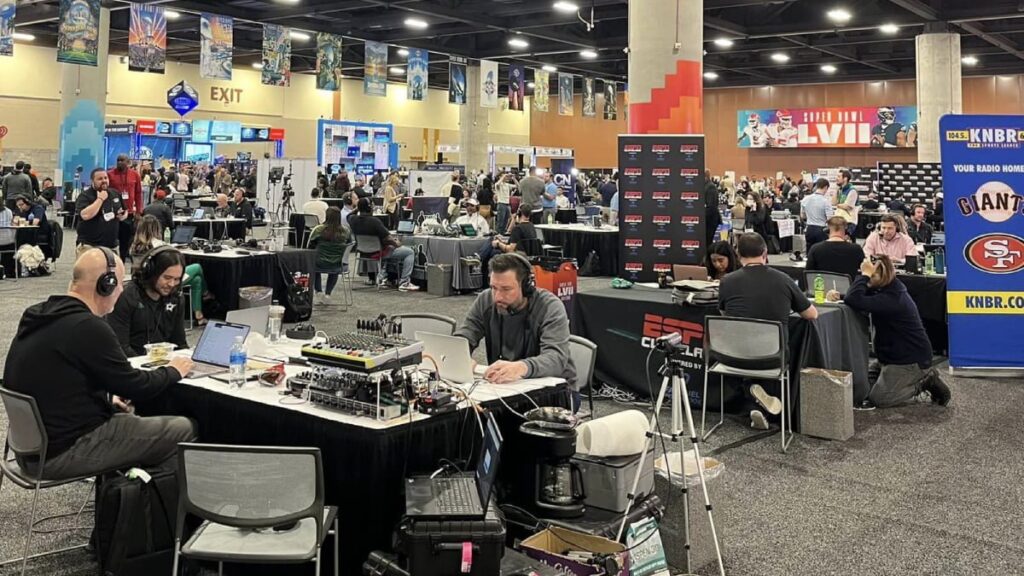
Much like the Super Bowl, the NFL Combine features its own version of “radio row.” Media outlets from radio, television, and digital platforms set up to gain exclusive access to team executives, draft prospects, and league insiders. However, the atmosphere is far less commercialized compared to the Super Bowl.
With sports radio budgets shrinking and the demand for content growing, some wonder whether a week of live shows at the NFL Combine could provide stronger content at a fraction of the cost of a Super Bowl trip.
Former NFL linebacker and WEEI Afternoons host Ted Johnson believes that, despite the potential benefits, the combine doesn’t compare to the Super Bowl for a radio row setup.
“I think radio row at the Super Bowl is more valuable to attend,” Johnson said. “The week leading up to the Super Bowl attracts more celebrities, NFL players, and other big names.”
Stillman agrees, noting that it all comes down to investing in an event with the biggest stars.
“The combine just doesn’t have the same star power as the Super Bowl,” he said. “It has a lot of media and coaches, but not the same level of recognizable figures.”
There is no doubt that the Super Bowl boasts more star power. However, that also means countless corporate pitches, making the week sound like one long advertisement. From a pure content perspective, the NFL Combine might be more useful for sports radio, offering greater access to team personnel and prospects that local fans care about.
“In terms of sheer substance, I think the combine offers much more—and much more ‘inside scoops,’” O’Brien explained. “That’s exactly what our audience in Jacksonville wants.”
Thoughts, notes, scoops 🍨 from Day 1 of 1010XL’s live coverage of the #NFLCombine?
Jeff Rickard oversees 93.5/107.5 The Fan in Indianapolis said his plans are to have live shows all week from the NFL Combine gathering content and interviews as they serve their local consumers. He said he understands the value of the content you could create from broadcasting live from the NFL Combine, but also believes in the current state of the industry it has to sense for the bottom dollar.
“I think it’s important to your audience. I think they’re invested, and they want to hear what their general manager and their coach plan on doing, what their plans are going to be,” said Rickard. “They like to know that their teams are doing something, and of course we’re the conduit for that. We let them know what’s going on. I do think it’s important, if you can afford it to do that.”
Rickard understands the challenges being both a brand manager and morning show host about expenditures being a huge hurdle for many markets considering trips like the Super Bowl or the NFL Combine.
“Can we turn around and find somebody to underwrite that cost for us and use it as an advertising vehicle,” Rickard questioned. “I think that’s really the important question to ask in today’s world.”
Even for some of the largest sports radio brands, broadcasting live from the combine isn’t a priority at all.
“Broadcasting from the combine is not something we have explored, nor do I envision us doing so in the future,” said Tierney of WFAN. “Wouldn’t be opposed to it, but I just don’t see it happening on the local level.”
Courtesy: Derek Futterman, Barrett Sports Media
The NFL Combine features four days of on-field drills designed to test the strength, speed, and durability of each prospect. It’s the only event where a fraction of a second or a single dropped pass can heavily influence a player’s draft stock and future earnings. However, despite the high stakes, these workouts don’t always translate into compelling sports radio content.
“The real allure of the combine isn’t the actual on-field work,” Peterlin said.
“Too much of that info is boring, quite frankly,” Tierney added.
NFL Network’s coverage of the combine often involves analysts raving about a player’s “great hands” or “quick feet” while comparing them to Hall of Fame legends. While this event is crucial for draft prospects, its overall significance within the draft process is up for debate. When asked to rank the importance of the combine compared to the Senior Bowl and pro day workouts, most agreed that the combine stands above the rest.
“The NFL Combine is definitely the most interesting event,” Johnson said. “It covers the top 300 college football players. No bowl game or all-star event matches what the combine brings.”
For sports radio hosts, knowing what not to discuss is just as important as knowing what to highlight. Some draft-related topics can quickly become listener tune-outs.
“The constant regurgitation of draft phrases like ‘quick and loose hips, anticipation, and ability to process’—give me a break,” Tierney said. “The verbiage is tired and corny.”
Additionally, while some prospects shine during drills, they may lack the personality to make engaging radio guests.
“My biggest tune-out is listening to players on the air. Maybe one out of twenty college players is remotely interesting in an interview,” Stillman said.
With 329 prospects participating in the combine, there’s a vast amount of data to analyze. For sports radio hosts, the challenge is determining how deep to go in discussing individual players and how it impacts their local team.
“At some point, you can get too deep into the weeds,” Peterlin said. “If we’re breaking down the seventh-best player at a given position who’s projected to go in the fifth round—what are we really doing here?”
Since 1987, Indianapolis has hosted the NFL Combine, where football dreams can be realized or shattered in a single moment. Last year, the NFL Combine had its highest viewership on NFL Network since 2018, with a 12% increase from 2023. This year’s event follows the most-watched Super Bowl of all time, which had a record average audience of 127.7 million viewers. You can expect the attention and desire for content from this year’s NFL Combine to continue to grow.
Sports radio programmers and talent alike understand that the NFL and content surrounding every aspect of the league reigns supreme. Sports radio listeners in every NFL market expect their favorite shows to deliver content that matters—content that helps fans understand how their team is preparing for the future and chasing the ultimate dream of Super Bowl glory.
Like any individual team’s playbook, the challenge is in the execution. From pivoting content strategy to accessing exclusive moments with key figures that matter in enhancing the fan experience, the game within the game for sports radio talent is to meet that expectation with the NFL Combine setting themselves up for a successful path to ‘Draft Day.’
Barrett Media produces daily content on the music, news, and sports media industries. To stay updated, sign up for our newsletters and get the latest information delivered straight to your inbox.
For many years, both the radio industry and listeners have complained about long stop sets. Recent research has indicated that bad commercials are just as likely to cause turnout as the long break from music.
Program Directors often cringe when they hear that commercial that has the phone number in it three times or a grammatically incorrect, poorly produced piece.
So, what should be done about it? I spoke with a former producer for a major broadcast company who agreed to speak on the condition of anonymity.
“I think there’s a couple of boxes that need to be checked off to fix what’s wrong. One of them is to get rid of long spot blocks. Then you’re in a position where you can start to hit and run with smaller, quicker commercials.”
“And one idea per spot. I know jocks who do the same thing. How many times have we said, as Program Directors, one idea per break?”
“Well, spots should be the same, one idea per spot. If you’ve got a client who has multiple things going on or multiple services or wants to hone in on two or three things that he thinks are pain points that he’d like to get across to his customer, then do separate spots for each one and rotate them. I don’t know how many times I see 30-second commercials crammed with two or three ideas.”
“Studies have shown that every time you introduce a new idea into a commercial and step away from your original idea, retention goes down by 60%. If you’ve added three, then it’s even worse than that.”
“I think that’s another reason why some people hang on to 60-second spots, because they have a lot of territory they want to cover, and they can’t do it in a 30. But why it doesn’t occur to them to do it in separate spots is beyond me.”
The idea of “selling something” in the commercial is something he sees as a waste.
“Focus on people who don’t like to be sold to. Think in more macro terms; when you’re putting radio commercials together, don’t list off prices and particular products. Think about lifestyle; look at the commercials that you think are successful. People say, oh, listeners hate commercials. No, they don’t. They hate bad ones.”
“Half this country tunes into the Super Bowl, not for the game, but for the commercials. Good copy and entertaining commercials can be effective. And you look at any of those commercials that you see that are memorable; they aren’t rattling off price and features. They’re dealing with lifestyle issues.”
“You’ll hear bundle home and auto together. But other than that, it’s a comedy routine. So, you need to think about those kinds of terms to make your copy entertaining.”
He also considers it critical to have a copywriter and never lets a salesperson pick up a pen, with one exception.
“Never let a salesperson pick up a pen unless it’s to fill out an order. Don’t let clients or salespeople write copy. I don’t want a salesperson sitting at his desk writing copy; I want them out selling.”
It sounds like there might be a story there.
“I had an AE come in with a commercial written on a napkin from lunch with a client. I looked at it and said, ‘”Did your client write this copy himself?”’
And letting them write bad copy cascades into more significant issues.
“What is this thing going to run for a week or so, two weeks? And you know what’s going to happen? You’re going to go back to him to try and get him to re-up, and he’s going to tell you, no, I tried radio, and it didn’t work.”
“And the worst part is, he’s going to go to the Chamber of Commerce golf tournament in a week or two, and he’s going to tell everybody that he plays golf with at the Chamber of Commerce that he tried radio, and it didn’t work, because you couldn’t leave $500 on the table. That’s the worst part about putting bad copy on the air for clients. But typically, I find that our problem is we have AEs who were trained improperly, if at all, by guys from the 90s who were over-glorified order-takers.”
What are some of his copy pet peeves?
“Nobody should be in this day and age when listeners have a smaller attention span than a goldfish airing 60-second commercials anymore. I hear them all the time, especially on small-market radio stations. I’m not going to cite the market, but I did some work for it.”
“Their rock star salesperson, who’s been there for 25 years, still sells 60-second commercials to her clients. She had one restaurant client who ran off every lunch special they were having for the entire week in their commercial. This commercial gets updated every Friday for the following week.”
“Now, if you’re driving along listening, are you going to retain what each special is for the entire week? No, of course not. I suggested to her that she put a 30 together and change it each day with at least that day or tomorrow’s special.”
And how was that idea received?
“They’re still airing that 60-second commercial every week, rattling on every single special for the for the week. And that’s just not effective. But that thing that you and I hate, what do you hear when you try to suggest something different? Well, that’s the way we’ve always done it.”
We agreed that the copy that says, “next to McDonald’s or Walmart” is problematic.
“You’re assuming that the person who’s listening knows exactly where you are and what McDonald’s you’re talking about. And I mean, in some smaller markets, I suppose the geography is not that complicated.”
Another idea is to use a shorter commercial as a gateway to your own platform, which will allow you to cover more territory at a lower cost.
“In this day and age, where we have the internet, where you can have a website that’s got all kinds of good stuff in it, or even send out a weekly email blast to your customers, which is a highly effective way of reaching advertisers.”
“When I first started doing websites 30 years ago, I used to tell my clients who at that time were used to buying 60-second radio commercials, or worse half, page newspaper ads for hundreds of dollars, Buy a smaller ad and sell lifestyle don’t sell price, don’t sell particular items, sell a vibe about what your business is and then drive people to your website. Because the real estate there is not being charged per agate line or 30 seconds or per minute, you can put as much stuff as you want there.”
“Use your radio, newspaper, and television as your gateway to a platform that’s not costing you as much. And I think that can be the same with social media and email newsletters that people can sign up for.
“Use your radio to entertain; there’s no reason radio commercials can’t be as entertaining as everything else on the air. You certainly wouldn’t be as apt to lose listeners when commercial breaks came on if the commercial content was as entertaining as everything else that you had on the air. And if you’re looking for radio to be in a position to charge more for spots, that’s certainly one way to do it.”
Final thoughts?
“Hire a writer, hire a writer, hire a writer, there used to be writers in radio stations back in the 70s and 80s copywriters. And they were one of the first things to go along with the promotions budget.”
“The average American spends about 15 to 20 minutes in the car in the morning or afternoon drive time. If you’re running an eight or nine-minute spot block, you’re pushing the entire drive time that that guy is spending in the vehicle. He’s going to be lucky if he hears one song.”
“Nobody wants to listen to that. I think the only saving grace radio still has is that a lot of older demographics don’t like to mess around with technology, having to hook their phone up when they get into the vehicle or having to find an app or a stream icon and put they just want to get into the car on and have the music there.”
Barrett Media produces daily content on the music, news, and sports media industries. To stay updated, sign up for our newsletters and get the latest information delivered straight to your inbox.
April 1 is not far away. Does your station take part in the annual April Fool’s Day effort to trick people into believing the bizarre or absurd? One of the most fun April 1 promotions I ever did was the “Fools On Parade.”
It’s labor intensive, but invite your listeners to enter the parade with their most foolish idea. The first critical step is to design your parade route and get the proper permit from the city. Once your permit has been accepted the city will be ready with things such as blocking off streets and having police in the area.
I made the route way too long the first time I did it. That left both sparse and packed viewing along the route.
It will work best if there are first, second, and third place CASH prizes. Make sure you invite the local television stations. Another way to gain attention is to invite well-known people in your city to serve as judges.
Set up a viewing stand along the route and stream the parade live on your socials.
There are far too many moving parts to list here. If you are interested in more details, email me here.
Closest To The Pinhead
Try this if you’re looking for a different way to raise charity dollars, raise awareness, and get coverage.
First, you need to get with the local hockey team and borrow a goal-tender outfit. Then, take your marquee personality clad in hockey gear and wired for broadcast and put them about 150 – 175 yards out on a local driving range.
Invite listeners and let them have a bucket of five balls. You can charge a set amount or let them offer a free will donation. I’ve generally found that giving people that choice will cause them to give more than with a fixed amount.
Then, they drive the balls of the tee toward the pinhead. If someone hits them, and I only had this happen twice, and it was on a bounce, they win the sponsor-provided grand prize. Otherwise, throughout the event, put down a pin where someone comes close.
If someone insists on participating without a contribution, let them so as to not violate the prize, chance, consideration.
Caution: When I did this promotion, it was with smaller companies that were not heavily regulated or burdened by legal. Get a signoff from legal before proceeding.
Givin O’ The Green
If your state has a lottery, as most states now do, except where I live in Nevada, where, surprisingly, the lottery is not allowed.
Most games and states have a promotion budget, and I have found that they can be generous with their “lottery bucks.” Give them out to listeners at a St. Patrick’s Day remote. It’s a fun event. Make sure you give them away with no purchase necessary, or you will run afoul of the very people who provided the prize.
I’m guessing that a few of you rolled your eyes when I said give them away at a remote. I want to share some thoughts on that.
When I was programming, I did everything I could to persuade the sales team not to sell remotes. I was wrong.
In the CRS NuVooDoo research presentation, the value of local personalities being out in the community and connecting one-on-one with listeners stood out. In a recent feature piece I wrote about Steve Salhany, PD for Audacy in Boston and Providence, he told me, “I think if you don’t do that, you’re screwed. I tell my folks all the time it’s kind of equated to politics. It’s about your ground game. The people need to see you, and you meet people, and one leads to another. We have to win our audience’s affection and time.” (BMM 2/21)
Looking back, I had let something slide, which I had taught for years about how to do remotes. We/I had gotten lazy.
The excuse was that the Saturday car dealership remote was just a way to feed the salespeople free hot dogs or pizza or that the same ten people always came for the free food. If that is the case, you are to blame.
Every event has a vibe. It is implicant on your talent to describe or create it. In remote breaks, don’t sell, “Come on out and spin the prize wheel or grab a free hotdog.” Do you think most people will come out to spin the wheel for a free station koozie?
Instead, have the talent play to the listener’s imagination. Imagine yourself sitting on a brand-new Harley. Running down the road with the exhaust pipe saying potato potato potato. There are 40 new Harleys here at Jeff’s Harley Davidson. Come by, and we can help you make that dream happen.”
Granted, a new Harley is not exactly an impulse buy, but the point is to tap into the vibe, put the listener into the experience, and invite them to come and take part.
When you get the listeners there, you must look like the showbiz personality they think you are. A card table and a table skirt won’t do that.
Most importantly, don’t just stand behind a table looking uninterested. Don’t use the excuse of going somewhere quiet to do your break.
Many personalities are surprisingly shy and self-conscience outside their studio’s comfort. Remember, it’s show business, and people like to see you in action. Get out from behind that table, interact, and let them see you do your thing.
Look at the dealer if you have ever been to a casino and passed an empty blackjack table. You will most likely see them standing with their hands on the table with their palms up. Of course, part of that is to discourage theft, but it also serves as a subtle invitation to join.
These simple steps will create an event and bring listeners to your client’s location. It’s your job to get them there and let their team take it from there.
I would love to spotlight and share what your station is doing. Email me at jeff@barrettmedia.com.
Barrett Media produces daily content on the music, news, and sports media industries. To stay updated, sign up for our newsletters and get the latest information delivered straight to your inbox.