Barrett Media produces daily content on the music, news, and sports media industries. To stay updated, sign up for our newsletters and get the latest information delivered straight to your inbox.
The National Association of Broadcasters (NAB) has named Sean Perkins its new chief marketing officer and senior vice president for Global Connections and Events (GCE). In this role, Perkins will guide and oversee all marketing efforts for two of NAB‘s most prestigious events – the highly-anticipated NAB Show and NAB Show New York. Perkins will report directly to Karen Chupka, managing director and executive vice president of GCE.
Perkins brings over 30 years of expertise in both business-to-business and business-to-consumer marketing sectors. His resume includes time spent in media, technology, digital commerce, and nonprofit organizations. Throughout his career, he has spearheaded successful marketing campaigns for notable brands such as AOL, Amtrak, AARP, Intel, Sage, Neustar, and the Consumer Technology Association (CTA). Most recently, he served as VP of Marketing at CTA where he oversaw marketing and advertising decisions for CES – the association’s annual trade event that draws global attention.
“We are excited to have Sean join NAB during such an important time for the industry,” said Karen Chupka. “Sean’s extensive experience in marketing and his proven success in driving growth and visibility will be a tremendous asset to our team. His expertise in event marketing and digital transformation will help us elevate NAB Show and other key initiatives, ensuring we continue to deliver extraordinary value to our members and partners.”
Perkins holds a Bachelor of Arts degree in English and Communications from Canisius University. He is also an active member of various professional organizations within the marketing industry.
Barrett Media produces daily content on the music, news, and sports media industries. To stay updated, sign up for our newsletters and get the latest information delivered straight to your inbox.
Core Communicators has launched Hip Hop Streetz 100.3 on Coastal Broadcasting’s ESPN 100.3 KLRZ in New Orleans.
Streetz 100.3 is launching with 5,000 commercial-free songs in a row.
Core returns to New Orleans nearly 20 years after its On Top Communications hip-hop station, Hot 104.5 (KNOU), was destroyed by Hurricane Katrina in 2005. This disaster ultimately led the company to file for Chapter 11 bankruptcy in early 2006.
Further setbacks occurred when Hurricane Gustav damaged temporary facilities in 2008. The station changed ownership twice before officially relaunching, as in the 1980s, Hits “Z104.5” in 2013.
According to the LMA filed with the FCC, the $10,000 monthly fees associated with the LMA will be credited towards the purchase if the option is exercised.
Barrett Media produces daily content on the music, news, and sports media industries. To stay updated, sign up for our newsletters and get the latest information delivered straight to your inbox.
With Veterans Day coming up next week, ESPN has unveiled a new episode of ESPN E60 remembering the life and tragic death of NFL defensive back turned Army Ranger Pat Tillman. 20 years after Tillman died from friendly fire in Afghanistan, E60 presents new reporting and interviews that shed light on the story of one of the most famous soldiers in U.S. history, whose decision to turn down a multimillion-dollar football contract and enlist in the military drew major national news coverage during the War on Terror.
Pat Tillman: Life. Death. Legacy. debuts Thursday, Nov. 7, at 7 p.m. ET on ESPN, and will stream afterward on ESPN+. According to the network, the episode “examines the role of military leadership in fateful decisions in the tragedy and in keeping the truth from Tillman’s family and the public for more than a month. The one-hour program will be hosted and reported by Jeremy Schaap.
Viewers will hear from Tillman’s mom, Mary ‘Dannie’ Tillman, and her quest for answers. They will also hear from former Secretary of the Army Pete Geren, speaking publicly on the subject for the first time in more than 15 years.
Additionally, viewers also hear from Eric Godec, Steven Elliott, Don Lee and Bryan O’Neal, who were with Tillman’s platoon when he died and who discuss the trauma and shame they’ve endured in the years since as well as how they’ve tried to move forward.
Others interviewed in the program include former Arizona Cardinals head coach Dave McGinnis, Tillman teammate Jake Plummer and more. E60’sPat Tillman: Life. Death. Legacy. was directed by Frank Saraceno and William Weinbaum and produced by David Seronick.
Barrett Media produces daily content on the music, news, and sports media industries. To stay updated, sign up for our newsletters and get the latest information delivered straight to your inbox.
After almost 20 years as the voice of the Boston Bruins, NESN announcer Jack Edwards was forced to retire from calling games as he continues to battle with an unknown condition which has slowed down his speech pattern. Edwards announced early last season it would be his final year calling Bruins games and he signed off after 19 seasons in the booth.
Last night, the team honored Edwards and unveiled a mural that will remain in the NESN booth with Edwards’ famous intro line, “From high above the ice…” posted on it.
Edward appeared on the broadcast and said, “I’m grateful and filled with thankfulness…I’ve lived a fantasy life for 45 years.” Later he would meet with the media and say, “The doctors still haven’t been able to determine what is going on between my brain and my mouth. Despite Toronto fans insistence, there is nothing wrong with my brain. So, I am full of gratitude for the players, the organization and the fans who have put a roof over my head for 19 years and it is truly an honor to have my families name on the wall of the booth where I made a living in a world class arena.”
In May of this year as Edwards signed off the air for the final time, he said, “The past 19 years, to witness and describe some of the greatest moments in the New England sports pantheon has been a thrill of a lifetime. I want to thank every employee at NESN, especially our production team…Most of all, I want to thank my broadcast partner Andy Brickley. You’re the brother I never had until I started working with you. And it’s been a joy ride for 19 years. And this is my goodbye.”
Barrett Media produces daily content on the music, news, and sports media industries. To stay updated, sign up for our newsletters and get the latest information delivered straight to your inbox.
In a recent Myers Report, 2,766 advertising and agency professionals participated in a survey which looked at how more than 30 media industry attributes relate to workplace culture and professional resources. One specific area of focus was the availability of trade publication subscriptions and other resources to keep professionals informed of industry trends and developments. According to the data, satisfaction with access to trade publication subscriptions ranked last among all attributes evaluated in the survey. The low ranking suggested a pressing need for industry-wide action to improve the availability of information resources.
As I read Jack’s article, I thought about our value to media professionals. Do they consider what we’re doing important? If we stopped covering the business and shut down tomorrow, how much would it matter? Thousands across music radio, sports and news media, advertising agencies, tech, podcasting, sports teams, record labels, political offices, and colleges read us daily. Many say they love our website and the insights and information provided, but plenty are unaware of what’s happening in their industry. They get tunnel vision and become so focused on the work in front of them that they lose sight of what’s happening and how it could eventually effect them.
When I see Broadcasting + Cable, All Access, Axios, and TV News Check reduce staff, coverage or completely shut down, it forces me to question how much the industry values coverage of itself. Publishing layoffs have hit Catena Media, Better Collective, Vox Media, Vice, Sports Illustrated, and other print, radio and television entities too. That suggests that no matter how good the writers are, how helpful the coverage is, and how personally invested the owners are, earning attention and support from media professionals and the companies that employ them is tough.
We’ve worked tirelessly to cement our position in the media coverage space. In fact, we just spent the past month on calls and zooms talking to different groups about their 2025 goals and marketing plans, and how we might be able to help. I believe that no trade site offers the complete mix of media coverage that this one does. But if the content created isn’t worth the radio or TV industry’s time or marketing support, and charging to read isn’t an option, then how do trades like ours survive?
Running an independent publishing brand is fun but it’s also hard. People see the content but not the process, time or costs involved. Keeping twenty eight people on point is challenging, especially with everyone working in remote locations. Yet somehow we pull it off. If all breaks right in November and December, we’ll record our best year of traffic since 2015.
But as great as the content end is, there’s also the challenge of growing the actual business. I’ve received tons of feedback since we rebranded in July. I’m aware that many felt there were too many programmatic ads on the site. I prefer a cleaner operation too but business has to be done to invest in writers. To avoid charging readers to consume the content, there’s a necessary trade off. We have removed some of those ads for the short-term but I can’t say they’ll be gone forever. We are trying to run a profitable business.
I have never put content behind a paywall even as other publishers have pursued that path. I’ve thought about it, and wondered if we were making a mistake by not doing so, but I still believe that reaching the masses outweighs connecting with a smaller crowd, especially for a brand of our size. Whether that’s right or wrong, it’s how we run our business. We are thankful to have direct and programmatic advertising partners with us because without them, we couldn’t do this. Speaking of which, thank you to Crankin’ Audio for signing on as a new advertising partner. Be sure to check them out in our Voices section.
If there’s one thing I’ve learned in the past decade, it’s that groups like Point to Point Marketing, Steve Stone Voiceovers, Jim Cutler, Premiere Networks, MRN Radio, Ramsey Solutions, Backbone, Core Image Studio, JJ Surma Voiceovers, and others we’ve been blessed to work with are the real champions of the industry. They invest in supporting the industry much more than larger radio and television companies who earn the majority of attention. We’ll have a few more partners coming on board in 2025. I can’t wait to work with them and help them reap the rewards of a business relationship with Barrett Media. I hope you’ll think of each of these groups when your brand or company has future needs.
We’ve established lots of relationships, and have met and pitched many groups, but far too often radio, TV, and digital companies take for granted what industry trade sites do for them. From recruiting employees to furthering education, highlighting staff, boosting morale, influencing future business, sharing tips to be more successful, and supplying salespeople with content to help close advertising deals, industry folks benefit from websites like ours more than they sometimes realize.
Each year at this time, I do what many executives do. I examine all areas of our business. Are clients and marketing partners happy? Am I? Is my team passionate, creative, and consistently performing? We generate revenue through consulting, website advertising and memberships, newsletter advertising, branded and sponsored content, and conferences. Fortunately, we are profitable in most of those areas but the exceptions are the website and newsletters. It costs a lot to field a team of nearly thirty people, and create daily content. Thankfully we have consulting clients, and advertising partners to help soften the blow, but our goal is to grow, not just exist.
2025 is coming up, and next September marks our 10th year in business. I’m proud as hell to reach that milestone, and we’ve got some special plans for it, but as I prepare to put the past decade in the rear view mirror, I’m trying to figure out what the next one looks like.
Which areas make sense to invest in? Where is our business lagging or overleveraged? Who gives us the best chance to grow audience, influence, and revenue? What can we do to earn more business from companies targeting the media industry? How can we excel across social media when platforms are devaluing written content? I love what I do, and hope to do it for years to come, but just because we’ve survived 10 years doesn’t guarantee anything in the future. The only things certain are stress, disruption, adjustments, and higher costs.
Being fully transparent, our current content approach is not where I want it to be. Our features and original projects are strong, but we’re too reliant on press releases and on-air reactions. Entering 2025, we will continue offering news but we’ll place a higher priority on reporting, features, and original projects. Those stories perform best, are higher quality, and showcase our brand in a better light. I’ve never liked aggregation or low hanging fruit that creates clicks while compromising credibility. There are times when it’s necessary, but I’d much rather publish a Meet The Leaders series, Dave Greene Eavesdropping feature, Derek Futterman interview or BSM/BNM Top 20 series than regurgitate content from other outlets.
I am also bullish on growing our music radio coverage. We launched in July, and have only scratched the surface of what we can do in this space. Transactional news (someone gets hired/fired, a radio station flips format, etc.) has received most of our focus. Though that will remain a part of our content strategy, we will add more creative benchmarks and original projects. Equally as important is strengthening our sports and news media coverage. Many know us in these areas, but I still believe there’s much more room to grow.
Additionally, after spending years writing individual market ratings stories that depended on data being sent in by local sources, we’re finally able to change our approach starting today. If you look up top at the menu on our website, you’ll find a new tab that says RATINGS. Click it and you’ll find data available for the top 200 radio markets. I hoped to have this ready in July, but I’d rather roll something out right than rushed.
We’re able to share the numbers thanks to a partnership with Nielsen. Our goal is to update the information monthly, and showcase how the top 200 markets are performing. A big thank you to Harker Bos Group for supporting the ratings section. If the stars align down the road, maybe one day we’ll add television and podcasting to the mix.
I built our brand by sharing knowledge, telling stories, forming connections, learning what mattered to the audience, serving their needs, and helping clients grow their businesses. I want to continue doing that in 2025, and to do that, we need your help. I’ve created a survey to learn what matters most to you. The more informed we are, the easier it is to deliver a better experience for you. And if our product continues getting better, who knows, maybe one day your colleagues will read it, and your employer will invest in us the way we invest in covering them.
2025 BSM Summit in Chicago
The 2025 BSM Summit is coming to Chicago’s Edlis Neeson Theater inside the MCA on May 8-9, 2025. Our hotel partner for the event is the Westin. Later this month we’ll share details regarding discounted room rates. Day 1 of the Summit will run 9a-5p. Day 2 will go 9a-1p with the annual awards ceremony taking place from 12p-1p. Our annual After Party will take place at the Chicago Sports Museum after Day 1.
There are two more things I’d like to put on your radar.
#1 – Tickets for the Summit go on-sale on Black Friday, November 29th. We’ll have a special sale price for Black Friday weekend. A December sale will follow, with prices higher than the Black Friday offer, but less than the standard ticket price that goes into effect in January.
#2 – We’re sending an email blast today to open up the submission process for speaking opportunities. We’ve done this for our news summit, but never for sports. Please understand that just because you’re interested in speaking, doesn’t mean I’m going to put you on stage. This event connects the industry, and examines key issues facing decision makers. The goal is to deliver information, ideas, and solutions to help brands and individuals. We’re expecting a full room, and a strong group of industry heavyweights.
Coming Soon
I’ll have a separate column later this week which will cover our plans for our annual Top 20 series for sports and news/talk radio. I’ve also got something extra to share, which I’m excited to reveal. Stay tuned for details.
Quick Hits
Thank you, Bob Costas. Many people today live in the moment and think about being part of social media conversations when something happens. Though there’s nothing wrong with that, they often lose sight of one’s accomplishments and skills from prior years. Costas may not be the perfect baseball announcer for a 2024 audience, but over the past few decades, he was outstanding. The game of baseball was better with Bob in the booth. I’m glad I had a chance to enjoy his work. If you haven’t read Dave Greene‘s column from Friday, check it out. It’s a good read.
Pat McAfeetook a shot at Big Noon Kickoff on College Gameday, which got the attention of numerous outlets. McAfee’s infectious energy and bold personality firing up a University crowd is awesome television. That said, his remark about Big Noon Kickoff lacking people at their set wasn’t exactly accurate. This tweet shows Fox had no shortage of support on gameday.
The election is tomorrow, and it can’t be over soon enough. The constant noise and attack ads have become exhausting. That said, this creative piece on Joe DeCamara was a brilliant way to connect to election season by Sports Radio WIP. Job well done by Rod Lakin’s team.
One of the best things I saw last week were a series of tweets from Emmanuel Acho. After winning a $1500 bet from LeSean McCoy over the World Series, Acho took to X and rewarded 10 fans with $100 each. He wrote, ‘When I make money, The Facility viewers make money‘, and proceeded to show proof of payment along with a note that read ‘Appreciate you watching The Facility. Treat yourself to dinner on me.‘ That’s a great way to build fans for a new show. The Fox Sports marketing department could easily create a ‘Win Acho’s Stash of Cash‘ promotion and monetize it.
Barstool Sports inviting Mike Francesa to the office and streaming his visit during Game 5 of the World Series was perfect. The social media content created from Mike’s appearance generated a lot of traction, and with the Yankees melting down, it became even more must see. When big events come up, Barstool does a strong job of getting people to watch along on a second screen. Local brands can learn something from this.
Another solid job by Alex Feuz, who had Chiney Ogwumike on his 06010 podcast. Chiney discussed finding her voice, her contract extension, balancing dual roles of playing and broadcasting, and more. I especially liked her three E’s, ‘Education, entertaining, and elevating’.
One Request
Hawk Tua proved that sports teams and media outlets will do anything to steal a few minutes of attention. I’m just hoping that outlets aren’t dumb enough to give the two moronic Yankees fans who grabbed Mookie Betts’ glove their own show. Their fifteen minutes of fame are up. They should never have existed in the first place.
Barrett Media produces daily content on the music, news, and sports media industries. To stay updated, sign up for our newsletters and get the latest information delivered straight to your inbox.
Is a newspaper a newspaper if there’s no paper involved?
The trend of newspapers giving up the ghost and ending or restricting their print versions has been going on for a few years now, with the latest example being the announcement that the venerable Newark Star Ledger, the paper known for influential coverage of New Jersey politics and for being the paper on Tony Soprano’s driveway every morning, will be ceasing its print editions soon and will be purely online at NJ.com, as will its sister papers in Trenton, Gloucester County, and Hunterdon County; the tabloid Jersey Journal will be collateral damage, with the closure of the Star Ledger’s printing plant causing the smaller paper to shut down for good.
The decision of the Newhouse/Advance Media chain to entirely shut down print editions of the paper follows a trend that the company itself kicked off. Want a local daily in Birmingham or Mobile? Yeah, sorry about that. There’s still news in Alabama, but the papers are now a website and the racks up front at the 7-Eleven are empty. Maybe they have USA Today, but it’s getting harder and harder to find actual print versions of local papers.
How much does that matter? Probably not much to a typical reader. Some of the papers have digital e-editions that look like the old print papers (and have horribly outdated news stories, just like the paper versions). Websites and social media offer a practically infinite news hole, as opposed to the limited number of pages the print editions could offer. And, well, when was the last time you picked up a print newspaper?
Where you can get one, they’ve gotten terribly thin, dated, and really expensive. Also pointless, because you’ve already read the articles if you’re online. Print papers are probably important only to the very elderly (I still see a handful of homes in my neighborhood with the Sun-Sentinel or Palm Beach Post wrapped in a plastic bag on the driveway) and the unions that printed and delivered them.
The newspaper industry has taken a lot of well-earned criticism for its failure to react to changing technology in time. Surely, the early resistance to paywalls cost them a lot of revenue. You can also criticize them for failing to extend their brands to digital, or to create new digital-only identities to build upon their histories. Pivoting to video also didn’t turn out so well, because video (and for many papers, audio) isn’t their core competence. Many of the problems faced by the not-really-newspapers-anymore industry were self-inflicted, and the continuing layoffs and shutdowns are the result. And don’t get me started on private equity.
But a lot of the problem is that there was little newspapers could do as the technology train thundered towards them and consumer preferences evolved. The internet brought with it a better way to disseminate news. People wanted their entertainment and information on demand and on their phones. Newspapers were slow to embrace the changes. And the same happened to radio, and broadcast TV, and music, and movies. Some could adapt. Many could not. And so, Tony Soprano, if he survived the hit at Holsten’s, won’t be finding the Star Ledger at the end of his driveway starting in February. He’ll have to rely on NJ.com instead.
What happened to the Star Ledger could happen to your company. The owners might wonder why they bother with FCC licenses and transmitters and towers when they could just stream content and sell off the real estate (or cancel some leases). Radio has already largely gone to voice tracking and syndication, and younger generations, if they choose to listen to radio, are streaming it anyway. Linear TV has been “the old people’s medium” for years. There are better ways to distribute your content.
Which is why it was so important a few years back to establish your brand as the go-to for news in your market. If you did that, people will seek you out online; despite the recent controversies and spate of subscriber defections, consumers still turn to the New York Times and Washington Post even if they don’t get it in print.
If your news product is good, and people identify your station or paper as the leading source of information, you can survive even without whatever medium was your origin. Will people miss the tactile pleasures of reading the print paper at the breakfast table? Sure. Would people miss your radio station if they could still get it with streaming? Maybe. But technology changed, times have changed, consumer preferences have changed.
Barrett Media produces daily content on the music, news, and sports media industries. To stay updated, sign up for our newsletters and get the latest information delivered straight to your inbox.
Halloween morning. One of my first conscious thoughts was, What music will I play on the porch tonight as I’m handing out candy and searching for endless Dad joke opportunities? The morning routine and the noise of the day were getting ready to take over and vaporize that thought. But radio’s social media kept it alive.
My morning routine is as predictable as it gets: I let the dog out, ignite the toaster, and push the power button on the Keurig coffee machine. (I used machine instead of maker on purpose. That device doesn’t make coffee; it produces coffee.) Then, I start an audio experience. Typically, I rotate between a radio station app, an Amazon smart speaker experience, or an analog radio I carry around the house.
You know what’s next: I look at the first app of the day. It’s almost always Twitter/X (or is it X/Twitter?) Habits are hard to break. That’s a good thing. It’s how the world stays in order. If you want to change one of those habits, the order fights back. Twitter used to be a quick window to the world. I could find out quickly what was trending and feel informed and ready to participate in the new day.
Now, it’s about who hates who more. I can find good content if I work at it or if the algorithm is kind. My habitual self looks at Twitter/X quickly each morning over the pod of French Roast coffee before I scan the other sources, start email subscriptions, and meditate. Don’t be impressed. It’s 10 minutes per morning, three out of the seven days.
Halloween On The Radio
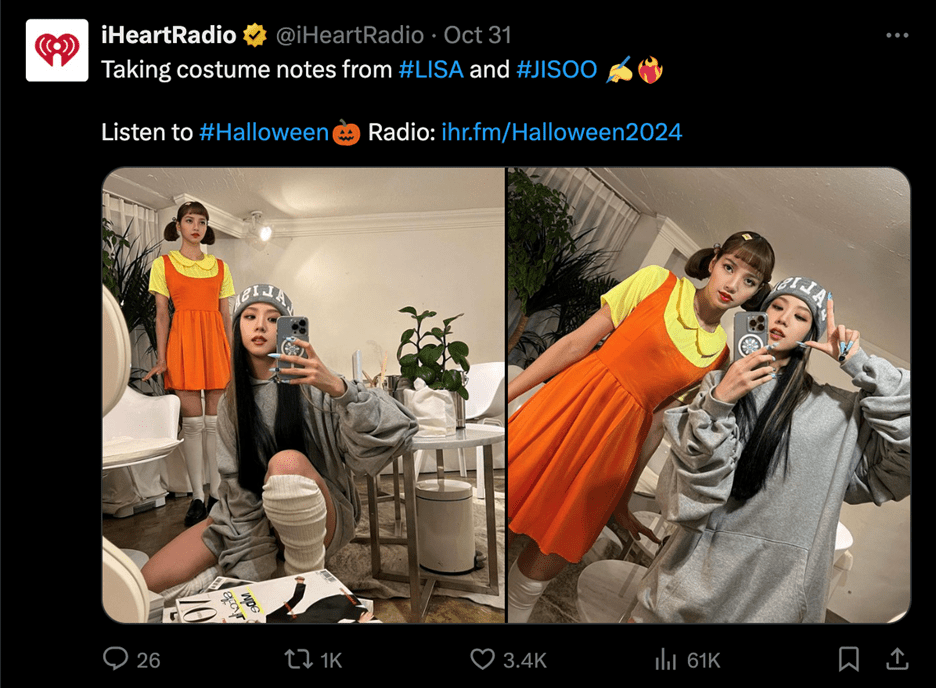
The Halloween morning ritual reignited the thought I mentioned in the first paragraph. What music will I play on the porch tonight as I’m handing out candy and searching for endless Dad joke opportunities? Scrolling through Twitter/X, I was triggered by this iHeartRadio post:
Lisa and Jisoo are members of the K-Pop group Blackpink. As you can see from 3.4k likes on the post, they have some fans. However, the second line of the tweet caught my attention. Listen to #Halloween Radio.
Right! iHeart has a Halloween channel. Problem solved. What problem? Every year, my habitual self does the same thing. Play Michael Jackson’s Thriller on an endless loop. It’s a very Nielsen-friendly tactic. I’m playing one of the most popular Halloween-themed songs to an audience that changes every 60 seconds. My audience always gets a great song. Plus, it’s easier to press repeat.
However, I felt revived this Halloween because I was going to place the Echo speaker on the porch and play the iHeart station with a variety of theme songs for a more enjoyable experience.
Halloween On The TV and IG
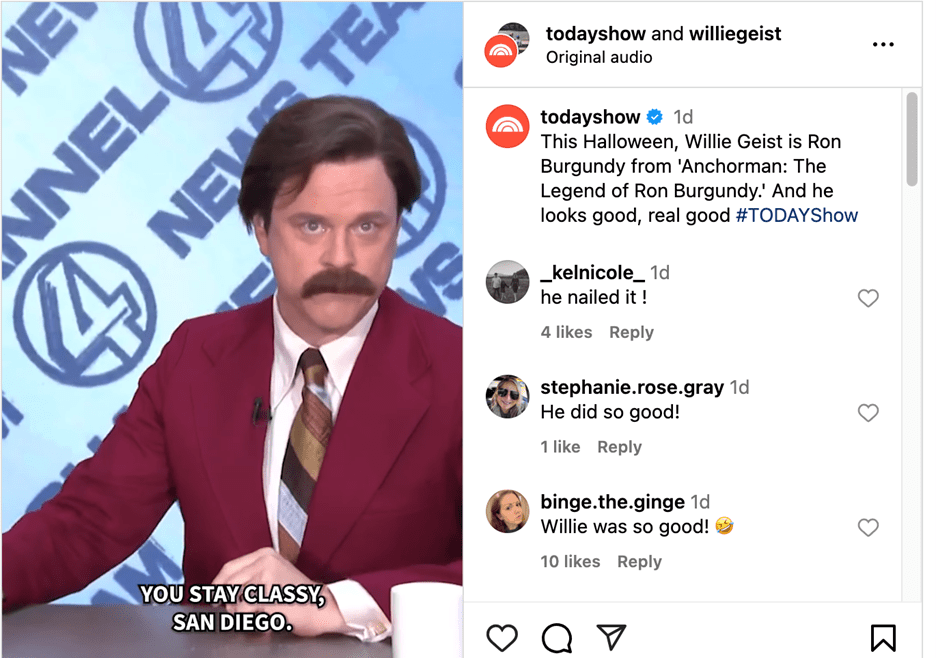
It didn’t stop there. During my habitual lunch break, a Today Show reel caught my eye. I didn’t know who it was, but I knew this person was impersonating Ron Burgundy from the movie Anchor Man. It was Willie Geist from MSNBC and the Today Show. Today Show Halloween
Halloween Tricks & Treats I Learned This Year
Don’t Assume Your Audience Knows It. Sounds basic and trivial. However, I’m a career radio insider with a folder full of radio station apps and multi-station apps like iHeart, Audacy, TuneIn, and Sirius/XM. Let’s not forget my Pandora, Spotify, Amazon Music, Apple Music, and YouTube Music apps.
We struggled twenty-five years ago to promote a feature or a benchmark because of the radio station competition. Add the noise from the apps I mentioned, plus the social media attention-grabbers, and we’re repeating ourselves to an audience like we’re training a toddler.
Radio’s enduring difference is the power of reach and frequency. In the spirit of election week, do it early and often when promoting something that needs attention.
2. Use What You Have. Organizations like iHeart and NBC have girth and scale. Don’t be intimidated by Goliath, therefore, resulting in inactivity. My Amazon Echo Show wasn’t nearly as big or impressive as the neighbor’s stereo component system.
However, I placed the device between the rock walls on the porch at a distance where the sound would get more reverberation. It sounded much thicker than you would think when you looked at the box.
Remember the effectiveness of a simple but powerful idea. Wait, you have a Halloween channel? Perfect. I learned about it by reading a social media tag. The tag wasn’t strong, but the access to the music I wanted was the strength. iHeartRadio just used what it had to promote a simple but powerful concept.
NBC made videos of their cast members impersonating famous movie characters. Sure, they make world-class videos and TV every day. But the concept is as simple and powerful as your radio station’s Halloween party. There’s a drama kid on your staff who would love to champion the concept of creating theme Reels next year. Use what you have.
3. One Improvement At A Time: If your goal is to be better at promoting Halloween on-air and on your social channels, start planning for Halloween 2025 before Thanksgiving 2024. Why so early? Because Christmas, New Year’s, MLK Day, Valentine’s Day, St. Patrick’s Day, Memorial Day, Summer, July 4th, Labor Day, Back to School, and a half-dozen other holidays and opportunities happen before Halloween next year.
All those holidays should fall into the same ritualistic planning and nurturing as Halloween. If this is overwhelming or intimidating, plan to improve one event, promotion, or benchmark at a time. Not all of them. Just one, then another, then another.
For planning purposes, 2025 is here. Get the ideas started and get the audience’s attention with the power of your reach and frequency.
Barrett Media produces daily content on the music, news, and sports media industries. To stay updated, sign up for our newsletters and get the latest information delivered straight to your inbox.
Last month, Nielsen announced that the New York PPM monthlies for June and July 2024 would be reissued because the company had an incorrect age for one of the panelists. This doesn’t sound like a big deal, but the individual was 50 years old while Nielsen had the person’s age as 49. Let’s talk about how reissues work.
In this case, the age discrepancy matters because the panelist’s listening was included in the 18-49 demographic (as well as 25-49, 35-49, etc.). More importantly, their daily weights will change which would potentially revise the estimates and ranks. Remember that Nielsen weights the data on discrete age cells and because we want to see demos ending in both 49 and 54, the 45-54 demo is split into 45-49 and 50-54 for weighting purposes. That means smaller sample sizes and a greater opportunity for large weights.
Even in New York, market number one, the sample size in these cells is small. So, a change for one person changes the weights for every panelist in those cells. Remember, a PPM monthly is the average of 28 one-day surveys and panelists have different weights each day because the sample is different every day (not everyone wears their meter every day). I hope this makes sense to you once you get past the initial reaction of “It’s 2024, how can the industry be dependent on a system that works this way?”.
This reissue will be an even greater pain in the butt for Nielsen than what is noted above. My assumption is Nationwide data for the New York DMA will also have to be reissued, and for two quarters!
When Dave Willinski was in charge of this aspect of policy in the Arbitron days (I used to refer to Dave as the “Diary Detective”), many reissues resulted from someone in the business getting their hands on diaries, whether directly or indirectly. He said it was typically jilted ex-spouses or ex-lovers that would turn in their former other half. In other words, if you’re going to cheat (and please don’t as it can be a career-killer), don’t tell your spouse or significant other.
Also, if you’re going to cheat, don’t use industry terminology. When I worked the TV side at Clear Channel in the ‘90s, Bob Paine at Nielsen called me about a problem with some Albany TV diaries. They were apparently filled in by an employee of our Fox affiliate. One of the giveaways was that few TV viewers ever wrote in “Paid Programming” as the program being viewed.
Sometimes, diary editors make systematic mistakes that matter, such as confusing a station name and crediting the wrong station. Other times, it was a processing error. Shortly after joining Arbitron in 1999 following my Clear Channel tenure, Arbitron reissued Fort Myers-Naples because of a previous mistake. The general manager at Clear Channel had a letter from Arbitron stating the issue wouldn’t happen again, but it did. We didn’t want to reissue, but when the letter was produced, the market was reissued.
Only media research geeks can have a “favorite reissue” and mine was in late December 2018 when every PPM market had to be reissued or re-run for the December monthly. Somehow, one day of the month was left out of the calculations. I was reviewing New York for Cumulus and checked the day-by-day estimates. On one day, every station in the market had a zero AQH with minimal cume. The only way iHeart’s WLTW could get a zero in New York during the Christmas season was if a neutron bomb wiped out the entire population of the New York metro. I hadn’t heard that news, so it had to be a Nielsen error.
It wasn’t easy to find anyone at work at Nielsen during the week between Christmas and New Year’s. I eventually tracked down my friend Danny Monistere and he got the ball rolling. Every released PPM market was reissued and the ones that had not been released were re-run. Kudos also to Dr. Gary Heller at Audacy who was only a couple of hours behind me in discovering that fiasco.
Reissues can happen for any number of reasons and while Nielsen has developed policies over the years, there is still nuance involved. How bad does the “error” need to be for a reissue to take place, assuming someone finds the bug? Generally, look for a change in rank in the top stations in a key selling demo/daypart.
If a post-reissue change would have station A moving up from 18th to 17th, forget it. If Station A moves up from 4th to 2nd in P25-54, that’s reissue territory. Market size can play a role, too. The top ten stations in Los Angeles may matter while in Bowling Green, it may be the top three. Much like penalties in hockey, reissues can be a judgment call.
There are times when tampering results in the removal of the household from the panel with no reissue. I was involved in one in a Cumulus market that decimated a competitor, but you never heard about it. We had another one that Nielsen never acted on. The PD for our station reached out to me that he chatted up someone in the VIP area of a local concert. The individual was not in radio nor had a link to the performers. He was a friend of a competitive PD because his household had meters or that’s what he claimed. Nielsen was never able to find the household.
Reissues are a double-edged sword. You may not believe it, but Nielsen wants to ‘do the right thing’ despite the problems caused by reissues. Reissues upset media plans that are already in place in the market, which is why Nielsen looks for situations that are likely to directly affect commerce or bring the integrity of the survey into question.
While reissues make the trade press headlines, they are actually few and far between considering the volume of data that Nielsen handles each year and the number of reports the company issues. This isn’t being a ‘Nielsen apologist’ but instead the result of ‘been there, done that’ for a lot of years. I think we can agree that we’d rather see Nielsen reissue when warranted than stonewall and cover up mistakes.
Barrett Media produces daily content on the music, news, and sports media industries. To stay updated, sign up for our newsletters and get the latest information delivered straight to your inbox.
Tracy Johnson is the President/CEO of Tracy Johnson Media Group. He began his career at KNLV Radio in Central Nebraska at age 14.
Over the years, he has been a Music Director, Program Director, Consultant, Operations Manager, Market Brand Manager, and Director of Audience Engagement.
Johnson has won numerous awards, and his book “Morning Radio” is described as “The Bible of Personality Radio.”
Tracy Johnson Media Group website quotes Johnson: “My gift is the ability to identify talent and inspire great performances. I understand the importance and nuance of nurturing content creators like radio personalities, video streamers, and podcasters to find their unique voice and use it to their full potential.”
Johnson is this week’s featured consultant.
Jeff Lynn: How do you see the state of the radio industry today?
Tracy Johnson: Radio is at a crossroads and the industry is faced with critical decisions. The world has radically changed, and new entertainment choices have cut deeply into radio’s position. We cannot apply the same thinking and solutions to problems and challenges with new variables. This isn’t new. Radio has been challenged by technology and societal changes since Marconi, but this time, radio’s survival depends on making smart choices. It won’t happen by fine-tuning our music format, manipulating clocks, and gaming the rating systems. Radio must innovate with difference-making personalities that can attract and lead a passionate fan base.
JL: Along those lines, what do you see as the biggest challenges the industry is facing?
TJ: Three key things: First, we have to find new ways to monetize influence with listeners rather than allowing a flawed rating system cause stations to be hard to listen to for most of the audience. Loading a massive amount of poorly-produced 30 and 60-second commercials is a one-way track to irrelevance. Second, stations must stop selling against one another and promote radio’s remaining strengths. One of those strengths is older demographics, yet stations continue to obsess over beating one another up over 25-54-year-olds. Third, personality is the future, and stations are not a) developing or training talent, b) providing tools and resources so they can compete, and c) allowing the freedom to create meaningful engagement.
JL: What advice do you have for stations and talent to rise to the top in the competition for the ear with all the audio sources available?
TJ: There are three steps to becoming difference-making personalities on the radio. First, personalities must discover their “voice” and understand who they are on the air, a character based on their real-life personalities. Second, they need a reason to exist. I call it a programming wedge. It’s usually a feature that creates audience anticipation and expectation, similar to how Carpool Karaoke made it possible for James Corden to become famous. And the third step is becoming larger than life by turbo-charging content. That includes promotions and teasing, but also learning to apply the Three E’s of Entertainment: Exaggeration, Enhancement, and Embellishment. Personalities need to be big, bold, and loud to cut through in a crowded marketplace while staying within their personality lane.
JL: Why do you think radio stations consistently play it so safely and no longer take chances with things like new music or innovative programming and features?
TJ: Fear. Most broadcasters are punished more for poor ratings wobbles than rewarded for success. Tom Peters once said that winning management “Rewards massive failure and punishes mediocre success.” We wring our hands over what might go wrong, leading us to fail to commit to potentially winning ideas. We take a “wait and see how the ratings react before promoting it” approach. We need to take smart risks with commitment.
JL: How do you coach on-air talents to extend their brands through video and podcasting?
TJ: There are so many opportunities for innovative storytellers who can lead an audience, but most personalities are stuck on trying to expand their brand by doing a better radio show. The interesting thing is that they have the skills podcasters and video talent lack. They just need to apply it to a different medium. Some of my shows are doing podcasts and not just repurposing their on-air content. They’re starting YouTube and Twitch channels, showing the audience their show behind the scenes. Some are creating paywalled content and generating very impressive new revenue. There’s unlimited potential!
JL: When working with on-air talent, what tips do you give for ceasing a moment and making the show local?
TJ: There are two issues here. First, broadcasters think capturing the moment is “talking about the story” but that’s just reporting! Creativity starts with the topic but must be curated into entertainment only you can do. The other issue is the importance of being connected locally. Yes, it’s important, but it’s a tie-breaker. Being entertaining and engaging beats local every time. Having said that, being “local” is more than just making a “We’re live and local” claim. It is about reflecting the lifestyle and culture of the community. That doesn’t happen with promos, liner. cards, or making gratuitous statements. It has to be cleverly threaded through the fabric of the personality and station.
JL: How do you see AI impacting the industry, both good and bad?
TJ: AI is the single most important innovation since the introduction of the personal computer. Is it good or bad? It’s both, depending on how it is used. Learning to use and deploy AI is the most enlightening and exciting thing you will discover. It will help you become more efficient, creative, and successful. But if you don’t learn to use it properly, you’ll become a relic from the past. You won’t be made irrelevant by AI, but will become a victim of those who know how to use AI.
JL: How important is contesting, and how do you compete against huge national contests?
TJ: Contests are effective in manipulating ratings because they appeal to the type of listener who participates with rating services, so I understand both the value and why so many companies are using contesting. But they’re tactical tools that don’t build little to no brand equity. You have to constantly stimulate those participants with incentives to achieve the desired result. Those contests are usually not entertaining and fail to impress the 97% of listeners that don’t play. Having said that, national contesting is effective in moving the rating needle. I hear many locally owned stations trying to compete by claiming “local winners.” Guess what? That doesn’t work. Most of the audience isn’t playing, and those that do play (the contest/rating respondents) don’t care if it’s local or not. They’re simply motivated by the incentive. Dozens of research projects prove this point. If you want to compete with national contests, check out what the Independent Broadcasters Association is doing. For a small fee, you can participate in group contests even if you’re not a part of a large group.
JL: How can programmers balance the need for programming integrity with the need to get every revenue dollar in the door?
TJ: This is a chicken-or-egg thing. You can’t monetize a product without an audience for it. Yet revenue has declined to the point that managers are desperate for every dollar. One answer is to learn to tell our story better (and differently) beyond a rating discussion, then nurture more direct relationships with decision makers and business owners. It’s a compelling story if you tell it properly. A client’s morning show was so frustrated over the lack of sponsors for a key feature. One morning, he went on the air asking for business owners who would like to advertise on his show and gave his email address to contact him if they’d like to get their message out with an ad. He had more than 75 responses from local businesses and took it to the sales manager, who reviewed the list and said, “None of these people advertise on radio. They’re not on our account lists.” They did nothing with it. The morning host asked for permission to contact those businesses and sell ads. He was told “no” because we can’t have our talent competing with our sales team. Let that sink in.
JL: What was the best piece of career advice you ever received?
TJ: I had several mentors who helped me in many ways (Larry Brewer, Scott Campbell, Dick Chapin, and Ed Trimble), but the single best advice came from Alan Burns, who I worked for from 1989-1992. He had the greatest influence on my career, and one of the things he taught me was that for every problem you encounter, there are ten possible solutions. Two or three will be terrible ideas and can’t possibly work, no matter how much you try. A couple will be perfect solutions and can’t fail no matter how poorly it’s executed. That leaves five possibilities somewhere in the middle. Those ideas can work if you commit to it and rally the entire team around the concept. The point is to try and find the ideas that can’t fail, avoid the ones that can’t succeed, but regardless of the path you choose, get everyone working together toward the same goal. You can make it work.
Barrett Media produces daily content on the music, news, and sports media industries. To stay updated, sign up for our newsletters and get the latest information delivered straight to your inbox.
When Ricky Bottalico was a relief pitcher on the Philadelphia Phillies, he would sit one seat in front of team broadcasters Harry Kalas and Larry Andersen on flights, placing him in close proximity to the narratives being discussed beyond the clubhouse. Although Bottalico did not have a bad relationship with media members, he knew that they usually desired to speak with him during postgame availability when he had subpar performances on the mound.
While these outings were relatively scant, he safeguarded against becoming the subject of misconstrued storylines by taking accountability and a forthright approach. By being true to himself, Bottalico was able to avoid becoming ensnared in falsehoods and controversy while building trust with the fourth estate.
During flights between cities on road trips, Bottalico conversed with Kalas and Andersen and heard their perspective on current events surrounding the team. In fact, Bottalico remembers laughing when Kalas predicted that he would be part of the media business upon retiring. Although it was a prognostication at the time, this foresight turned out to be correct and has led him to afternoon drive on 97.5 The Fanatic.
As one-half of the hosting tandem on The Best Show Ever?, Bottalico diligently works to hit the airwaves with candid, compelling sports talk. The afternoon drive nucleus is working to build an indelible legacy for the show amid consumers in and around the “City of Brotherly Love.”
“I don’t think beating around the bush in Philadelphia is the best thing in the world,” Bottalico explained. “I think getting to your point and having points to back it up is always a positive, and whether it’s a negative thought or a positive thought, you beat that until you are either proven wrong or you don’t feel like it’s the right thought anymore.”
Before earning a permanent spot in the weekday prime programming lineup, Bottalico made weekly hour-long appearances with John Kincade in morning drive. After gaining tangible on-air experience, the station added him to its new afternoon drive show that would occupy the spot previously held by Mike Missanelli. Alongside co-hosts Tyrone Johnson and Hunter Brody with producer Jennifer Scordo, The Best Show Ever? made its debut in August 2022. Yet over the last two years, 97.5 The Fanatic has endured a variety of seminal changes altering the environment around them as area teams realized sustained periods of success.
Brody was let go from the station as a part of cuts last July that also included assistant program director Eric “Coach” Camille. Even though it was short-lived, the four-person configuration proffered a unique on-air sound while presenting difficulties for those in the studio. Throughout the four-hour show, Bottalico surmised to discover pockets and interludes where he could interject while advancing discourse traipsing through local professional and collegiate sports. Scordo was part of additional cuts this past May that also included Tom Calococci and Pat Egan, requiring the program to make an adjustment with two original hosts and new producer Sylvana Kelleher.
“You don’t ignore it because you can’t ignore it because it’s people that you’ve been working with and it’s their livelihoods, but the one thing that you have to do is you have to keep moving forward because if you stop, then everything’s going to stop,” Bottalico said. “The one thing that we’ve learned is you keep pushing forward until they take that mic away from you someday.”
Earlier in the year, Beasley Media Group announced that Scott Masteller was joining the company to serve as program director of 97.5 The Fanatic. As a former employee of ESPN Radio and Hearst Corporation, he entered the role with vocational knowledge and background in the field, along with the ability to work with talent and remain at the forefront of innovation. When Masteller arrived, he spoke to the afternoon drive team and informed them that he believed in their show and that he would be there to help them gain ratings and move in the right direction.
“With Scott, it’s just he always says one thing: ‘If you ever need to talk to me, pick up the phone. I don’t care what time it is,’” Bottalico emphasized, “and if you need something; if you think something you did on a show wasn’t good or something like that, he’ll literally go listen to it and then he’ll get right back to you on what he thought of it because sometimes, in your own mind, you might not be doing something that you like, but it comes off differently over the airwaves.”
Six months into Masteller’s tenure at the station, Beasley Media Group divulged that it had promoted Paul Blake to serve as cluster manager of its Philadelphia stations. This occurred after the sudden departure of Joe Bell, which Bottalico said caught he and his colleagues by surprise and left them both shocked and disappointed. Although the staff does not deal with Blake as closely, Bottalico regards him as accessible to his employees and observes how he speaks to everyone in the office.
“Here’s the whole thing with radio,” Bottalico articulated. “The show doesn’t stop. We’re on every day; the show doesn’t stop. You have to go on and give your best performance. It’s no different than if you’re an actor or you’re a baseball player, you have to go back on that stage and do what you need to do to make that show better and better every day, so it’s been a pretty smooth transition for us.”
Bottalico recently signed a multiyear contract extension that enables him to continue co-hosting afternoon drive on 97.5 The Fanatic. The comfort level cultivated throughout his employment factored into his interest in agreeing to the new deal, which was expediently drafted and signed. Prior to the deal, Bottalico met with Blake and spoke about the show and direction of the station as a whole. Shortly thereafter, the outlet revealed that Missanelli was returning to host in middays with Bill Colarulo and debuted a new lineup in mid-August.
“You start to feel pretty comfortable with who you’re with and what you’re doing,” Bottalico said. “I look at it this way – they came to me right when my contract was up and wanted to re-sign me, and I’m pretty loyal in the sense that when somebody’s there for you and they recognize what’s going on and that a new contract is a necessity at the time, they got the job done, and it was fairly quick.”
Whereas the original launch of the afternoon drive program followed the exit of Missanelli, the show now enjoys having him as a lead-in. Over the years, he has crafted a loyal following and thrived in the marketplace in a content ecosystem competing for engagement and penetration.
“People love Mike, people will tune into Mike and his show is different than ours in a sense that they play their games, they have their trivia and things like that, and people love him,” Bottalico said. “We don’t have an issue with that. We just go in there at 2:00 and flip a switch and do our show, so we know there’s people listening to Mike, so the carry-over is probably pretty good.”
Moving into its new iteration, The Best Show Ever? has sustained its growth trajectory through deft industry expertise, comprehensive sports knowledge and tangible rapport fueled by an indefatigable work ethic and genuine passion for the craft. Bottalico understands the level of preparation that Johnson lends to the show, and he seeks to shield against complacency or negligence by watching matchups, analyzing trends and parceling out opinions based on his experience and aptitude.
“[W]e don’t necessarily go by a firm script because things change,” Bottalico said. “Even during our show, things will change [where] we’ll get breaking news, and that’s one thing we’re very big on is breaking news.”
As it pertains to afternoon drive, there is a deluge of events occurring preceding action that often begins mere hours later. While the program sometimes serves as a prelude to pregame shows, Bottalico regards it as a dynamic setting wherein he gives opinions, speaks to guests and resonates with the listeners. In facing stiff competition from other multiplatform outlets, such as SportsRadio 94WIP in the sports talk radio format, he focuses on the key topics, implements relevant insider reporting and facilitates the audience being heard.
“We want to talk about the sports,” Bottalico said. “We’re not necessarily talking about everyday things that go on all the time. I mean, obviously you get side-tracked once in a while, but for the most part, we stick to the sports, and we take our callers and we’ll react to what they say, and that’s that.”
Bottalico grew accustomed to making clear and concise points through his early endeavors in sports media within the aegis of professional baseball. In providing analysis for Lehigh Valley IronPigs games, he stayed true to himself and became acclimated with enunciating his instant reactions and observations. NBC Sports Philadelphia included Bottalico on its pregame and postgame coverage for the Phillies, which led to him occasionally taking the air for various radio stations. In disseminating his insights and viewpoint of being a professional athlete in the city, he has been able to afford consumers with streamlined means of reasoning and synthesis.
“I think a player’s perspective, especially on sports radio, is important in the sole fact that people at home are watching the games and they’re having feelings and these players are not robots,” Bottalico said, “and I think a lot of times, especially a fan sitting at home [thinks] every single play should got your team’s way, and it’s just not the case.”
Reflecting on the first two years of The Best Show Ever?, Bottalico is proud to have persevered through external changes while maintaining the essence of the program. Taking daily steps to procure strong ratings and broad multiplatform appeal, he evaluates his performance within the scope of the episode. Bottalico feels he is a high-strung individual and fluctuates between good and bad days on the airwaves, but despite how he feels, he makes sure to rise above his hardships and demonstrate his sensibilities at all times. Akin to his time on the mound, he perceives the importance of the aggregate and is working to stack effective outings to contribute to the team effort.
“There’s certain days where you go in and you don’t feel that emotion,” Bottalico said. “You kind of got to get yourself more involved and get your head back in the game, and I think that’s one thing that I would say that Ty and I do extremely well is that we get [ourselves] back to center and then work from there, and that’s a thing I think we’re both very proud of.”
Even though Bottalico signed a contract extension with 97.5 The Fanatic, he is conscious of volatility in media relating to an absolute guarantee of job security. Whether someone has been employed by a company for three decades or three months, professionals can suddenly find themselves searching for new opportunities. Demonstrating alacrity, dedication and skill does not oftentimes supplant the bottom line, nor the necessity of innovation, and Bottalico is grateful to have a part in this new chapter at the station.
“The good thing is people are always going to love sports,” Bottalico said. “That’s the best thing about this is that there’s always going to be people out there that are thirsting to hear about sports each and every day.”
Showcasing a love of sports on a daily basis, Bottalico cherishes his spot in afternoon drive and has made a commitment to continue bringing his best. Regardless of if the consumers are listening on radio, watching on television or viewing clips on social media, he aspires to keep them informed, entertained and invested in the conversation. Sports are firmly cemented in the cultural landscape of Philadelphia, inextricably tied to the metropolis in a manner that Bottalico underscores is not a joke. In a city that revolves around its four major sports teams, he strives to be a voice of reason and keep emerging from the noise to bring listeners the unequivocal truth without any artificial sweeteners.
“Hopefully, [I am] here for a long period of time, and the one thing you want to do is just keep reaching for the top,” Bottalico said. “You want to be the best – the best that you possibly can be.”