Home Blog Page 1358

Altitude Sports and Tegna Partner for Denver Nuggets, Colorado Avalanche Over-the-Air Broadcasts

0

Kroenke Sports & Entertainment announced a broadcast rights agreement for Altitude Sports with TEGNA for 20 Denver Nuggets games and 20 Colorado Avalanche games to be shown for free over-the-air on Denver’s 9NEWS (KUSA-TV) and My20 (KTVD-TV).

A new subscription-based direct-to-consumer platform coming in October, Altitude+, will offer Nuggets and Avalanche games not exclusive to a national network. The Altitude Sports network will continue to carry local games for subscribers of DIRECTV, DIRECTV STREAM, Fubo, and Spectrum TV.

“Thanks to the vision and creativity of my father and our leadership team, the hard work of many across this organization, and a tremendous partner in TEGNA, we are thrilled to deliver a comprehensive solution so that our fans can watch all Nuggets and Avs games this season and beyond,” said Josh Kroenke, KSE vice chairman in a release.

“As we embark on the 25th season of Ball Arena and not only celebrate the past but look toward the future, it is fitting that we introduce the next evolution of our Altitude Sports network that includes Altitude+ and games on 9NEWS and My20. Thanks to this innovative model, our fans can be with us every step of the way this season in our quest to bring both the Larry O’Brien Championship Trophy and the Stanley Cup back to Denver.”

Arthur Crofton Longtime WEJZ Jacksonville Morning Host Has Died

0

Arthur Crofton, the long-time morning host of Renda Broadcasting’s AC WEJZ 96.1/Jacksonville, FL, has passed away at the age of 72.

The station announced the news on social media.

Crofton was the morning host on WEJZ for over 30 years, joining the station in August 1990.

Visit the obituary here.

Mentoring And Inspiring Women in Radio Names Jenelle Vannoy ‘Behind The Mic’ Mentee

0

Mentoring and Inspiring Women in Radio, Inc. (MIW), dedicated to advancing female leadership in radio broadcasting, has selected Jenelle Vannoy as the 2024 “Behind The Mic” mentee. Vannoy is the Afternoon Drive Host at Cumulus Media’s Top 40 KOBQ/Albuquerque.

The “Behind The Mic Mentorship” program is a year-long experience exclusively for women on the air in any U.S. based music format. Eligible applicants must have at least 3-5 years of experience in local or national radio programming and have demonstrated a desire to grow their on-air career. Selected mentees receive personalized guidance and advice from various industry professionals. Additionally, the program provides the opportunity to attend Radio Show 2025, the premier event for the audio community, held this April in Las Vegas.

“We are absolutely delighted to announce Jenelle Vannoy as our ‘Behind the Mic Mentee,’” said MIW Board President Ruth Presslaff. “This mentorship program is not only a wonderful opportunity to discover rising talent within the industry, but also to highlight exceptional individuals like Jenelle and connect them with experienced leaders who can help guide their journey. We’re thrilled to support the next generation of media professionals in such a meaningful way.”

“I’m so grateful and appreciative to be in this industry for over 15 years, but it is time to turn it up a notch, and I believe being in this program will do that for me,” added Vannoy. “Thank you to the MIW board for choosing me. I’m excited to take this ride. Let’s GOOOOOO!!!”

ESPN and WNBA Average Nearly 1 Million Viewers in Playoff Game Without Caitlin Clark

0

It has been a record-breaking year all around for the WNBA with the addition of Caitlin Clark and a very talented rookie class. Clark’s first playoff game drew an average of 1.8 million viewers to ABC on a day they were going up against NFL football. Now, the league has aired another playoff game on ESPN that averaged just under 1 million viewers that did not feature Clark and the Indiana Fever.

This game featured the Seattle Storm and the Las Vegas Aces and Jon Lewis of Sports Media Watch reports the viewership gives the league its second highest viewership for a playoff game and the top one that didn’t have Clark playing. The previous high was for a Western Conference Finals game in 1999.

The Fever have now been eliminated from the playoffs after falling in two games to the Connecticut Sun. The semi-final rounds will now feature New York vs. Las Vegas and Minnesota vs. Connecticut with all four of the top seeds advancing.

The semi-final round will begin play on Sunday Sept. 29.

Joe Brand Honored to Be the ‘Baseball Guy’ Who Got the Pittsburgh Penguins Radio Play-by-Play Job

0

Earlier this month, the Pittsburgh Penguins named Joe Brand their new radio play-by-play broadcaster. A quick glance at Brand’s resume and you’ll see a lot of baseball games, over 1,500 in fact, with all but one of those being in the minor leagues. You’ll also see a ton of other sports for which he has called games from football to basketball to volleyball, soccer and even swimming. High school and college, you name it.

What you won’t see are a ton of hockey games, however, he spent the last three seasons working as part of the Chicago Blackhawks radio broadcasts as a producer, then a reporter, then the pre- and post-game host. Along the way he filled in on occasion doing play-by-play and also had the chance to call games for a team in Rockford when it matched with his schedule.

When the Blackhawks were looking for a new television announcer following the retirement of the legendary Pat Foley, Brand said he didn’t have a hockey tape together at that point and realized he needed to change that if he wanted to be considered for a position like that should one open again. He said he spent time in his apartment practicing games to work on the cadence for calling hockey games. Little did he know, his first NHL action as a play-by-play announcer would come when he was called in out of the bullpen, midway through a game.

“It was early January, John Wiedeman is calling the [Blackhawks] game, and his throat just gets shot,” Brand explains. “He was battling illness, and his throat was a little hoarse, and then it was getting progressively worse as the game went on. So, they moved him out for that game and had me take over, midway through the game, Hawks-Tampa Bay, no time to really prep.

“So that was baptism by fire, and then John’s voice hadn’t healed yet, so I ended up doing the next three games, and that helped me a ton because I actually got to prepare, I got to gear up for doing the game, and just felt a lot more at ease. I ended up doing six games that year, and then I did three more last season.”

Regardless of the sport, Joe Brand has a track record of being a strong play-by-play broadcaster and he worked his way up the ladder and put in the time. “I’ve been in the minors for so long, riding the buses and everything,” he said. “And I know a lot of people do that with hockey. And I’m sure a lot of people are kind of raising their eyebrows that, a mainly baseball guy got this gig. But you just go where the opportunities are and you take advantage of them.”

Brand said no matter what he was doing, he always felt as if he was preparing for what would come next in his career.

“I always thought everything I do, whether it’s play-by-play, reporting, podcasting, writing, everything just kind of prepares you for everything in this industry and in this business,” he said. “And once I finally got the opportunities to call some hockey, I just tried to really hunker down and get it right. And, you know, it’s just fun. It’s a lot of fun. It’s the complete opposite of baseball. That’s why I like it.”

When Brand finally got that call letting him know he was the new voice of the Penguins, of all places he was in the chair at the orthodontist’s office.

“They were moving from my top jaw to my bottom jaw, and I said, ‘I’ve got to take this call,” he said. “So, they let me hop out of the chair. So much is going on through your head at that moment. It’s like you have to remind yourself that this is real, and this is what you’ve been waiting for because when you go through the process of all the interviews and the conversations, you’re focused on getting everything right and showing your best self and doing all the right things.”

Brand said his wife got the first call. “I got in the car and first I called my wife, and just said, ‘I got it.’ And then the emotions start to take over the way they probably should. A lot of crying and just a lot of silence…That was something that you always dream about.”

Brand said he excitedly told family and friends mostly on FaceTime. “That way we would get to see their emotion and everything,” he said. “It was cool.” And speaking of cool, Brand also received a call from his now partner and former Penguins player Phil Borque. Brand said Borque’s first words to him were, ‘Welcome to the show, kid.’

When asked about not only getting a play-by-play job in the NHL but getting one with a team filled with so much history in a town that is passionate about hockey, Brand said, “You go for these jobs, these opportunities your whole life, and you can’t be picky about which ones you want.”

Brand said that when he started preparing for the season it really started to hit him about the magnitude of the position as he was learning more about the history of the team. He said he appreciates “how the fan base just resonates with who the organization is as a whole. There’s just so much of an identity placement with the fan base and the team.

“And I could not be more honored to be a part of that now and to be somewhat of a spokesman for that. I got into this industry in the first place because of a diehard feeling I had for sports teams. And now to actually accomplish that with what I was gunning for in this role, in this capacity, it’s really something. And I’m super grateful for it.”

Brand says his style is one where he just tries to make sure the audience gets what is called for in any particular moment.

“I feel like the best trait a broadcaster can have in terms of play-by-play is the inflection of your voice matching the action, that’s the best thing you can do for the listener, the viewer, whomever,” he said. “I feel like I was really grateful to have a lot of people to look up to in Chicago. Jeff Joniak is a perfect example, he could be speaking a different language, but you know how serious the Bears’ drive is based on the inflection of his voice and the ability to move the tenacity of his voice to completely match the action.

“What I want to do the most, is just portray the game the best way I can to the fans, and that means if this is a tight game, let’s make it a very intense broadcast. Let’s draw that emotion to the game. If it’s a dull game, if it’s lopsided either way, let’s bring in some conversations. Let’s talk about what the team is trending towards or some storylines.”

To Brand, it is all about the viewer and making them comfortable. He used an example of the Penguins being up or down by five goals late in a third period, and said, “I don’t think the placement of the puck in the corner with two minutes left is that important anymore. It’s more what can we provide for the listener at this moment to keep their whole experience enjoyable.”

Pittsburgh Penguins radio broadcasts air on iHeartMedia’s 105.9 The X. Their first regular season game is Wednesday Oct. 9.

Meet The Leaders: Ginny Hubbard, Hubbard Broadcasting

Hubbard Broadcasting may be a big business, but it’s still a family business. That’s why you shouldn’t be surprised that the leader of most of its divisions share a last name.

Ginny Hubbard (formerly Morris) is the Chair and CEO of Hubbard Radio. She oversees stations and staffs in eight large markets across the country as well as in four cities in Northern Minnesota.

Her company’s portfolio is diverse. It’s not just because of where it operates. Hubbard is also involved in every format you know. The company even has a history of creating formats when it sees an opportunity to not only innovate, but also generate an audience.

Our conversation for the Meet the Leaders series presented by Point-to-Point Marketing is about more than just the company that bears her name. Ginny Hubbard and I talk about changes in audience measurement, the real value of AI in radio, and more.

Demetri Ravanos: I wanted to start with the news of Nielsen reportedly planning to change quarter hour measurement to soon credit stations after three minutes of listening instead of five. Is that a good thing that’s more reflective of actual listening, or do you have some skepticism about it?

Ginny Hubbard: I think it’s a very good thing and I think it’s a hopeful thing. I think it’s completely appropriate. When we’re being compared to various forms of digital media, we know that exposure to those are often a fraction of three minutes. So I think it’s appropriate.

DR: As we are sitting here staring down the barrel of 2025, are there other aspects of the way the business is judged that you think are in need of serious innovation? 

GH: That’s a good question, and in part, I think that question lays at the feet of the industry – how we think of ourselves, and how we portray ourselves. Obviously, embedded in your question is how the advertising community views us or even considers us.

I think in life, we teach people how to treat us. I think the industry, in some ways, inadvertently has taught the media and the advertising industry to see us in a certain light that in many cases is not accurate. So, I think that the Nielsen change will certainly help. But how we tell that story and how we update our story will be inherent upon us to do it constructively.

DR: I know you’ve had leadership roles both with the RAB and with the Radio Board of the NAB. Have you seen ways that the story of radio is told to the advertising community that is inaccurate or that is damaging? Or is it just sort of that it needs the story itself, sort of needs a modernization? 

GH: We are such a fragmented industry in terms of size, and the markets that we serve, and in terms of breadth of companies and ownership. I think a cohesive message has been tough to attain, and the RAB is working very intently to try and change that.

I think COVID really kind of opened everybody’s eyes to some of the evolution that was happening and got accelerated. You know, when the world stopped, and people were at home. So, the industry is working on it.

I’ve long believed that if radio companies spent more, invested more in advertising their own brands in their local marketplace, that radio as a whole would be healthier, because I think the consumer doesn’t necessarily relate to radio or the industry. They relate to the morning person that they like, the sports host that they like, the music, the shows. Those are the things that they grab on to when they listen to a radio station.

DR: That sort of goes into something that you guys did a few years ago with your sports brand in Minneapolis. Skor North was this multi-platform brand that became more about its digital offerings than the AM signal that it was on.

I wonder if that is a vision you see for the future of Hubbard. You own a number of AM sticks, but I wonder if you see us heading towards a future where the company is better off making those exclusively or at least largely digital brands.

GH: I think that very clearly Phil Mackey and Dan Seeman and the team at Skor North have really worked to refine that model. They’ve done a spectacular job. You need the right people, and as with radio, digital brands need personalities for consumers to attach to as well. It’s not about the information, as you know. It’s about the person telling the story that the listener, however they consume that content, relates to.

So, we do not have any immediate plans to try and replicate the success of Skor North in our markets where we do have AMs that may be a little bit overlooked these days, but we’re very pleased to see what’s happened with Skor North and what a difference that team has made. 

DR: So, Skor North is a good example of and really it’s almost like chapter two in Minneapolis for you guys when it comes to thinking about innovation and new approaches to spoken word formats. MyTalk was a pretty revolutionary thing when it was first turned on, and still is pretty unique in the talk radio landscape. It’s the only one I can think of off the top of my head that targets women.

You guys are doing the alternative talk format up in Seattle. Can you tell me a little bit about how your group views the potential in the future for spoken word formats? Surely, it’s not just going to be sports and angry political shouting forever and ever.

GH: I think, again, it gets back to the strength of the storyteller, and personality. As was the case with MyTalk, and as is the case with Skor or any morning show or afternoon drive show that draws a large audience. There will always be a place for not just spoken word radio, but personality-grounded radio, whether it’s an AC station or a classic rock station or a CHR that has a large personality presence. That’s what sets us apart from the pure play streaming services, and I think will probably be very much the foundation of the industry as it takes new and different forms, and as we find new and different platforms for our content to survive, and audiences to create results for our advertisers with.

DR: So, those things together sort of lead me to wonder about where we are with artificial intelligence when it comes to radio. I hear a lot that it’s coming, but at the same time, the argument for radio over faceless digital audio is exactly what you just said. It’s local. It’s human connection. I just don’t think you can sell anyone that those two things jive.

GH: Well, we are not going to be early adopters with anything relating to AI. And I guess “microphone” wouldn’t be appropriate in terms of representing or trying to communicate with our local communities through an AI voice. What do you even call it? I don’t even know.

We’ve got a committee here that’s studying all things AI. I think we’ve implemented AI rather seamlessly into some sales functions and some operational functions, but I really do not see it as a replacement for a human being behind a microphone and talking about what’s going on locally.

DR: In your mind, is that just common sense or is that something that you have come to believe, given what you’re exposed to in the work you’ve done on those national boards? Has that given you the exposure to what may be the downside, or is it just as simple as “No, it’s not a human voice”?

GH: I think the latter for me personally and for our company. But we’re a relatively small company, we’re in eight large markets and some smaller markets in northern Minnesota. I think that we try to rely heavily on the fact that we are local and connected and engaged with what’s happening in our communities. To replace that with the AI version of that would be kind of a violation of our basic core operating philosophy.

It doesn’t mean that we don’t voice track certain day parts and that we don’t share some live talent between markets. We certainly do some of that. It’s become a necessity, certainly as the top line has contracted to think of different ways of doing it. As for AI though, it’s just not even on the drawing board.

DR: Are there ways that what you get to see and the problems you get to tackle with the RAB and NAB have shaped the way that you see Hubbard operating in the future? 

GH: No, I get to hear a lot of things and be exposed to a lot of ideas and different ways that people do different things. There are companies larger than us, smaller than us, and like-sized with us. We do tend to learn what we can from others but kind of march to our own drum there too. 

DR: Whether it’s just for Hubbard or for radio in general, how do you go about finding that next generation of leaders in corporate roles and individual markets? How do you find and retain talent from a generation that has grown up without radio at the top of their mind?

GH: It’s a challenge, but in each one of our markets, we’ve got a large and growing cohort of young people that embrace radio as a part of not only their own listening experiences, but also a part of their professional future. We are trying to listen to them and trying to learn from them and foster their love of connecting with a local audience.

I get around to all of our markets and I’m always impressed and inspired by the fact that we continue to be able to attract young people not just to the industry, but to our company.

To learn more about Point-To-Point Marketing’s Podcast and Broadcast Audience Development Marketing strategies, contact Tim Bronsil at tim@ptpmarketing.com or 513-702-5072.

Scott Van Pelt Represents the Past and Future of ESPN SportsCenter Anchors

0

It is fitting that ESPN SportsCenter anchor Scott Van Pelt is based in Washington DC, because he’s a national treasure, standing as tall as the Washington Monument, noble as the Capitol, and reliable and honest as Abraham Lincoln chilling in his memorial.

Van Pelt represents one of the last vestiges of the old ESPN. He, Dick Vitale, and Chris Berman are stalwarts, legends, and parts of the foundation that helped build the network from a fly-by-night possibility to a world-altering conglomerate.

Van Pelt is truly the last icon that we see regularly and amply, especially now that the network has shamefully cut Berman’s Monday Night Football segment from the Fastest 3 Minutes to the Fastest 1 Minute. The fastest one minute? Seriously, how can one minute be anything else but fast?

Van Pelt is more than just excellent at his job. He’s become the Walter Cronkite of ESPN – a trusted figure, reliable, rock solid, and still vital as hell. Van Pelt can do anything. He is still the best SportsCenter anchor, straight up doling out highlights like a hibachi chef dishes up flank steak. His inflection is perfect. His excitement, anger, happiness, and disgust are impeccably seasoned like paprika on deviled eggs.

The man they call SVP rides the anchor desk like Stevie Cauthen rode Affirmed. If an adjustable chair and script were a horse and reins, he’d win the Triple Crown every year. But Van Pelt is not just a talking head reeling off words. He is a master raconteur, instigator, and interviewer.

Van Pelt is nowhere better than on ESPN’s Monday Night Football showcase. His postgame chats with players and/or coaches should be sent to every communications or sports media class as Interview 101. For as long as he’s been on the air, Van Pelt has never wasted one minute of your viewing time. To him, fluff is something that goes between two pieces of Wonder Bread with peanut butter. He is all about the content. 

When Boston College scored a football upset beating Florida State to open the season, Van Pelt’s postgame interview with first-year BC head coach Bill O’Brien was epic. Listen, this was not the National Championship game. It was Week 1 of the college football season, but SVP delved into the emotions of O’Brien. He asked him about team building and how his players are buying into the plan.

With those questions, he elicited wonderfully frank and emotional answers from the normally staid and sometimes surly head coach. More recently, in the wake of this past Monday night’s game between the Bengals and Commanders, Van Pelt‘s postgame interview with Washington wide receiver Terry McLaurin was wonderful.

Van Pelt recognizes that an interview with a player right after the game is different than a scheduled studio exchange. Nobody knows how to bring out the best in an interview subject better than Van Pelt. He asked McLaurin about the new regime in Washington and how fans in the DC area are longing for a winning team. McLaurin gave Van Pelt some truly enthusiastic and heartfelt answers.

Van Pelt does not kiss up to interview subjects. On the contrary, he’s thinking audience first. What would Jack and Jill fan ask McLaurin after a big win? What do people want to know about this guy who just spent the last three hours running routes and evading tackles? How does he feel about the big win with a new owner, new head coach, and new quarterback? This is what Scott Van Pelt is all about.

Sports is filled with defining moments, but Scott Van Pelt is one of those rare sportscasters who can actually define a moment. He knows the tenor of the games, the players’ blood, guts, and dedication to their respective sports, and how to get the most out of a special moment.

In addition to his meat and potatoes broadcasting expertise, Van Pelt has been someone omniscient. He was incorporating sports betting, odds making, and wagering repartee into his broadcasts long before it became a staple of mainstream sports television. His back and forth, Bad Beats, and lively exchanges with his resident betting guru Stanford Steve have become the stuff of legend.

Before any of these current shows jumped on the betting bandwagon, Van Pelt was unafraid to accept and promote the fact that people bet on sports, and he did this at a time when sports and betting were still a somewhat unspeakable and taboo mix.

I use the word presence quite a bit when talking about on-air talents. Filling up the screen, possessing on air magnetism, and keeping an audience transfixed is part of the game. Van Pelt is not blessed with the classic looks of George Clooney or Brad Pitt, but I compare him to both of these chaps. Stay with me here.

Clooney and Pitt have a natural charm about them. They are both slick and sophisticated, but in many of their roles, they lose, are flawed, and makes mistakes. Similarly, Van Pelt is perfectly imperfect. We love to see him talk about Bad Beats because there’s a good chance he put a few bucks on those games and lost.

Van Pelt is all about presence with his high fashion glasses and suits that remind me of the oversized garb that David Byrne wore in the Talking Heads’ Stop Making Sense video. He’s got that stone cold broadcasting voice, raised eyebrow approach, and a rap that makes people want to stay tuned and wonder what he is going to say next.

Sports TV is home to some truly cerebral talents, but it is also largely littered with hackneyed hot takes and horrid hyperbole. Van Pelt has been around for a long time – a part of our living rooms like that comfy recliner and the end table that you’ve had since college. When you’re around this long, sometimes people forget just how freaking good you are. Scott Van Pelt is really freaking good.

It took me some time to come up with one word that describes Van Pelt, but it finally hit me. That word is authority. Van Pelt doesn’t break the rules, he makes them. He is in charge, running the show, an absolute maestro. This dude can move from hard edge commentary to touchy feely prose to tapping into the angst of sports fans whose team lost or whose wagers went bad.

Scott Van Pelt is equal parts Superman and every man, guru and goof, awesome and awkward. Yes, he’s that clichéd dude we’d like to sit at a bar and have a beer with, but he’s also different. Van Pelt’s popularity is not just based on what he’s done in the past. On the contrary, he is a personality for the ages and shows no signs of slowing down or lightening up for sure.

He may be part of ESPN’s iconic past, but he is also part of its vibrant future. This was no more evident than in the postgame following this week’s MNF doubleheader. In a match made in heaven, Van Pelt was joined by ESPN football analyst Ryan Clark, and the pair made some TV magic dissecting the night’s action.

Once again, Van Pelt showed his strength, navigating Clark en route to great answers. He is a master at the controls. If Scott Van Pelt were Chesley “Sully” Sullenberger, not only would he have landed that plane safely in the Hudson River, but everyone would’ve gotten peanut packets and ginger ale while alighting.

Name the sport, pick the athlete, choose the moment. It doesn’t really matter. Scott Van Pelt is a man for all seasons – a sportscaster for our time, any time, and all time.

News Talk Radio and the Art of the Reset

0

I have been beachcombing the last couple of months and listening to a lot of news talk radio. I am hearing a lot of really talented hosts who are mostly hitting the biggest topics of the day in the nation or their community. Crew, I am hearing a huge weakness. This is happening in major, middle and small markets. It is the reset. I can’t scream loud enough about the importance of this key to radio success.

If the flawed PPM has taught us one thing, listeners are turning you on at any moment of your hour. For whatever reason, hosts seemingly believe that listeners are there from the beginning of the hour. It doesn’t work in that way. Consultant Walter Sabo preached this fact years before PPM. So, you need to reset your topic with every question to a guest or between calls.

Like this, “Tax Attorney Joe Blow on 77 WABC on the Sid & Friends Show.” Repeat that with every question to the guest. This keeps everyone in the conversation. If you were at The Waffle House having an awesome All-Star Breakfast with someone and a friend comes up in the middle of your conversation, would you introduce your friend to the person having breakfast with you? Would you include your friend to the conversation? Of course, you would. Why don’t you do that on your show?

I was listening to a great afternoon show recently. I started at 9 minutes after the hour. No reset up to the break. The host barely sold forward and didn’t reintroduce the guest in the next segment. This was so poorly executed. The host just ruined an amazing guest segment. The host’s questions were short and pointed. The guest knew the subject. When you turn on your favorite music station, the station is playing a song you don’t like, but you know that it is about over. You will stay for the next song. If a listener doesn’t understand what is going on, they will leave. Too many options.

On some PPM Stations, I am not hearing the reset at all. The radio stations are playing to the panel only. While I understand that maximizing the PPM participants is essential, I also know that strong branding is ignored too often. I have a Powerade in front of me. No Vodka added, ok I added up how many times that Powerade is on the bottle. It says Powerade 5 times. That is a visual reminder that you are drinking Powerade. Music radio stations play a liner or have a jock between every record. If you are not saying your name and your station’s name every couple of minutes, you are doing a disservice to the station.

We all think that people know what they are listening to. If you are in a diary market, ask your PD to show you Nielsen Data. You will find that diary keepers almost never mention the host’s name and normally identify the dial position more often than call letters or station name. If a good diary keeper is listening to your station, why make it tough for them to give you credit. Diary markets are essentially married to recall. You must use these facts. Your station may have 6 tune-ins per week. In PPM, we know that people are tuning in over twice that figure. So, all the more reason that there must be a unified mission for resetting the topic, guest, you, and the station.

A note for Board Operators and Producers, you need to keep your host on task on resetting. Hosting a show is a difficult thing to do. There are calls, guests, and topics to juggle. Some hosts need to be reminded to follow the fundamentals of the reset. Every Board Operator or Producer is a gatekeeper for the host. Your heroics of managing the host’s ego and insecurities are essential. I will also tell you that I have seen bad Producers and Board Operators hurt a show. Every Program Director has had a host at one time or another lean into a Producer or Board Operator that did not have good intentions or understanding of the format for the show. A PD will try to manage this, but sometimes hosts will defend to the death someone who does not have their best interests in mind. Producers and Board Operators, you are basically the Program Director of that show. You need to keep the station’s mission at the forefront of your skull.

News Talk Radio needs to focus on inviting more to the party. It is about expansion not exclusion. We must make our shows easier to digest and follow. The reset is a key to your show’s success or station’s success. If you follow human behavior, we like to be tribal. We want to congregate with those who think, look, or feel like we do. It is natural for humans to believe that they are a special group. This is a historical weakness of humanity that goes back to the first civilization. I am not saying to water down your opinions, observations, or feelings. We must look for ways to include all listeners. The secret sauce to News Talk radio is speaking for the people. Are you a host that is speaking for the people? Are you speaking for their concerns, fears, and hopes? I often think that we need to focus on the people first. It’s not about the powerful and it is about the powerless. Don’t cater to the elected officials. Cater to the people. Resetting the topics, guests, show and station allow you to grow the platform. This is our mission.

‘The Bear’ May Have Lessons For Radio

0

Last week, I admitted to watching Bill Maher’s monologue drawing ire of all persuasions as I anticipated. This week, it occurred to me while watching another show that there may be value for radio programmers in it, “The Bear.” Seriously, if you’re not watching “The Bear,” it’s not only one of the best current shows; it’s easily one of the best character dramas that’s ever been on TV, right up there next to “Mad Men” and “The Sopranos.”  

From a production standpoint, the show’s unfailing attention to detail, character development, and atmosphere all jump out. All worthy reminders when considering the execution of format, personalities on air and how your listeners know them, and stationality/presentation. But really, what strikes me watching the show (which, if you aren’t aware, focuses on a family-run restaurant in Chicago) is the passion the characters have for their craft, what they do, for each other, for the restaurant itself.

Whether the loud, fast-paced, stress-inducing scenes of the team during a dinner run, the main protagonist Carmen painstakingly tinkering with the presentation of food on a dish, pastry chef Marcus traveling to Copenhagen for training, Natalie agonizing over the inventory ledger or front of house. Richie, working with a 5-star chef and having a born-again experience, you can see the echo of a great radio station staff.  

The third and current season focuses on the family neighborhood restaurant evolving into a critically acclaimed hot spot, and one episode that stood out involved a heritage 5-star going out of business and how deeply it affects the crew at “The Bear” (that’s the name of the restaurant on the show in addition to the name of the show by the way)

Each of them feels a sense that change is the only inevitability, and it plunges them into working even harder to earn their own place in the echelon of top eats. The question is, do each of us who oversee a radio station(s) have a crew that cares like this and strives for perfection while working to be their best and better every day?

Does our station(s) have that unique, one-of-a-kind local feel and atmosphere? Is the output the finest that can be produced with the highest quality ingredients? Even with a yes to each of these kinds of questions, “The Bear” depicts a staff member on edge and a restaurant that may go under at any time.

Radio’s reaction to that sort of situation seems often to be to quietly quit on itself. Either way, there are episodes to come that I need to catch up on, so don’t spoil the endings for me, okay?

‘The Lift FM’s’ Gretchen Pleshaw Combines Passions For Uniquely Coloradan Life  

0

Gretchen Snyder Pleshaw is on air seven days a week in Colorado. She’s the weekday afternoon Top 40 radio host on Always Mountain Time’s “The LIFT FM,” which covers much of the state, and anchors the “Good Morning, Vail” TV show on weekends. While her professional trajectory is the stuff of fairytales, the 43-year-old has struggled with significant personal obstacles, including domestic violence and social anxiety. She’s flipped the script on her challenges, using her platforms and popularity to educate and entertain with poise, passion, and positivity.

Obsessed with a Dayton DJ

As a child, the Dayton, Ohio native was a devoted fan of radio host Kim Faris on Z 93, when women DJs were rare. (Faris retired from radio in 2021 after 43 years on air in Dayton.)

“I used to tune in religiously every morning on the way to school, and my mom says I’d listen to nothing else.”

A teenage ski trip to Colorado would guide Gretchen’s path.

“My dad said I came back and said things there are artistic, weird, and creative. I loved the mountains, I loved the energy; this is where I’m meant to be.”

After graduating from Oakwood High School, she left Ohio and her folks, Linda and Bruce (who still live there), for the University of Colorado at Boulder. She was determined to be a teacher for deaf children, but she was thrown a curve ball when the school scrapped her major sophomore year. She graduated with a degree in English and then earned a teaching certification from the University of Colorado at Denver.

Hello, Gorgeous – Discovered on the Street

Here’s where the fairy tale stuff starts.

While walking down Pearl Street in Boulder, a man asked to take her picture. She thought it “creepy” at first but relented. That photo was forwarded to a fashion show director who asked Gretchen to model. The 6-foot-tall Gretchen took to modeling immediately but didn’t consider it a career possibility.

She started a teaching position and quickly learned it wasn’t for her. She loved the kids but was frustrated with the inability of administrators to accept young teachers with fresh ideas.

Fortunately, she had modeling mojo.  

Reptile Wrangler

After being spotted on a TV commercial, Gretchen snagged a TV hosting job. While she wasn’t in the classroom, she was teaching children. “It was a reptile show for kids. It was really random, but I loved it. I know I look girly, but I loved the reptiles so much. I had nerves about a tarantula, but after thirty seconds, I was okay. “

New York Model

She scored some high-profile modeling jobs, including walking the runway for the Diwali Festival, where she was admired by 100,000 attendees in Times Square and protected by bodyguards. She would also grace a Times Square billboard for a Dove soap ad, has been a “calendar girl,” and even modeled for a fur company in Vail just last week. She has had day parts in several films and TV shows, including a Hallmark Christmas special.

Road to Radio

The professional fairy tale continued. Currently the host of three Top 40 afternoon radio shows, Gretchen never had a “worst radio job.” She didn’t have to pay her dues on an overnight shift, be on a street team, or fetch coffee for bigwigs. She never even needed a demo.

 “I’ve only ever worked in radio at “The LIFT FM.” A couple of people there had seen my background in modeling and interviews. Always Mountain Time truly took a chance on me. My friend, Megan Pouch, taught me the board and radio in literally two weeks, and they said, ‘Let’s try it out on KKCH and KIFT, and now I’m on KIDM as well.”

“Flash forward six years. Radio is my happiness. I am so amped to do it. I smile through every show. “

Hosting a Top 40 show is not a hard sell for Gretchen, who has always been excited by music and concerts and surrounds herself with artists and musician friends.

“I love talking about songs and bands on the radio (it truly sparks joy). I really like Top 40. One of the people I’m obsessed with is Pink. I love everything she stands for, and I quote her on the radio almost every day.”  Gretchen’s been passionate about Michael Franti and Spearhead for twenty years, and now, it’s Teddy Swims, who she just saw in concert.

 “The way he genuinely cared blew my mind. I haven’t seen anything like that since Michael Franti. He started crying at one point, and I started crying with him. So amped that he’s doing what he loves.”

Living alone during the COVID pandemic, her radio gig gave her purpose. She learned just how much she was helping listeners to make it through a terrifying time. “When I walked my dog, people came up to me and thanked me for being so positive.”

Gypsy, her Jack Russell terrier chi mix, has always been her in-studio sidekick. She also adopted Bali, a Jack Russell, and Pa’Ani, a Chi, who have miraculously been trained to stay quiet when the mic is on.

Hot Pink Sensation on the Slopes

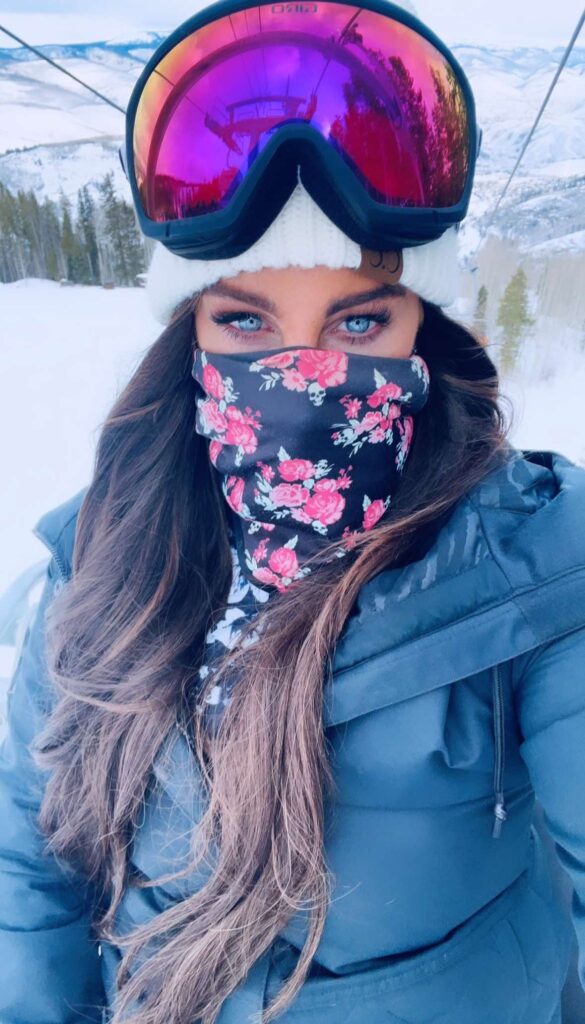
Her love for dogs is matched by her adoration of the ski slopes. During her first ski season in Vail, Gretchen skied 134 times. This season, she says she’ll ski almost every day before heading to her noon to seven p.m. air shift. Not too difficult, as she lives just moments away from both her beloved Beaver Creek Mountain and “The LIFT FM” in Evans, Colorado.

Beaver Creek is her favorite ski spot. “It’s such a local vibe, and I know and love the locals, but you can also get lost in the trees by yourself; it’s so peaceful.”

She’s a well-known sensation on the slopes in her signature neon pink ski pants. She wears them in memory of her aunt, Kathy Neal, who died of breast cancer. Her grandmother also succumbed to the disease, so she’s adamant about raising awareness for the cause, as well as about taking care of her own health, both physical and mental.

Power of the Purse

She’s the emcee and a volunteer for “Power of the Purse,” which raises funds to help girls in Peru escape abuse, domestic violence, and sex trafficking.

“It’s a really powerful event. One of my favorite things. The woman who started the foundation, Robyn Burress Hanson, went to Peru and adopted five sisters, and they all live in Vail; next year, I am hoping to visit to see what our money is doing there.”

Gretchen’s fight against domestic violence is also a personal one. She speaks candidly about the abuse in her past in the hopes of assisting others who are suffering.

Honest About Anxiety

She’s also open about her ongoing battle to overcome anxiety. Hosting, especially on radio, she says, erases her anxiety. “It feels like a safe space to me,” she explains. “It’s not work that makes me nervous; it’s more everyday social stuff where I feel overwhelmed or nervous, like having a difficult conversation with someone.”

In April, Gretchen became the weekend host of “Good Morning, Vail” on TV8 Channel 92 community television. It includes “Glitz and Glam with Gretchen,” which highlights what’s new and swanky in Vail, as well as interviews with community newsmakers. “The main theme of the TV show is self-care and self-love from the inside out,” she says.

Gretchen is single, having just broken an engagement to be married.

 “I like being alone and want to be single right now. I know exactly what I’m looking for, but I love my career, I love my friends, and I love my dogs.” Plus, she says, being single leaves her free to ski whenever she wants.

Filled with Gratitude

Gretchen is grateful. So much so that she just wrote a letter to the folks who hired her in radio six years ago, Pete and Krista Benedetti of Always Mountain Time radio, thanking them for taking a chance on her. She’s proud that she hasn’t become hardened by the often-cutthroat modeling and media businesses, and says she’s come a long way emotionally.

“Ten years ago, whenever anyone said something that wasn’t positive, I would get very down on myself (and I’ve been told some very tough things in modeling). At the end of the day, you have to be okay with yourself and know that you’re doing the right thing. Whatever anyone says about you is through their own lens, and it’s really just about themselves. It took me a long, long time to figure that out.”

Lessons learned. The 43-year-old outdoorsy yet glamorous radio and TV host has crafted a career and life that makes the most of her passion for fashion, music, nature and advocacy for causes close to her heart.