Home Blog Page 1370

The Growing Impact of Bitcoin on Media Broadcasting and Sports Sponsorships

0

Until today, while cryptocurrency enters a realm of different fields, Bitcoin remains a momentous fore in disrupting finance in industries such as media broadcasting and sports sponsorships. History regarding price value has become a critical factor in deciding on investments or partnerships in these industries.

Today, sports leagues, broadcasters and media companies are increasingly deploying digital assets to make payments, underwriting sponsorships and taking initiatives to energize fans. The thing is, it’s very difficult to understand Bitcoin’s constantly changing value- something every organization involved in this new frontier will have to get familiar with.

Bitcoin and the Rise of Sports Sponsorships

One of the most recognizable trends in which cryptocurrencies are making their mark on more traditional industries has been Bitcoin’s increasing role in professional sports sponsorships. Major deals between different leagues and teams have materialized over recent years as the adoption of cryptocurrency in sports seemed to really gain some steam of late.

In March 2021, FTX, one of the major cryptocurrency exchanges, signed a 19-year contract to purchase the naming rights of the Miami Heat’s home stadium, now named FTX Arena. It was at this point that it birthed a wider trend where cryptocurrency companies started using sports platforms for huge visibility. The value of Bitcoin has been one of the core drivers in such dealings, as companies try to get ahead when the price data of Bitcoin shows growth.

According to recent data from the Sports Business Journal in early 2024, cryptocurrency-related sponsorships in sports continue to boom, with some companies simply recalibrating their strategies in response to the volatility of Bitcoin. This frustrates the fact that Bitcoin price value history indeed plays a major role in determining sponsorship activity, as companies try to time maximum visibility with surges in the price of Bitcoin.

Bitcoin Payments in Media Broadcasting

Entertainment broadcasting uses Bitcoin beyond sports as applications proliferate in digital payment systems. Many major companies have integrated Bitcoin payments into their customer service infrastructure, including AT&T. In other words, some of its customers can pay for services with cryptocurrencies through third-party processors like BitPay.

Digital media companies’ willingness to consider Bitcoin will, therefore, mean that changes in the data of Bitcoin price affect profitability. The vulnerability of Bitcoin to volatility makes its value a sensitive security that needs constant scrutiny to help curb or benefit from losses or gains. According to research by Deloitte, digital media companies that accepted Bitcoin payments noticed a 12% growth in engagement among customers who are crypto enthusiasts.

Volatility in Bitcoin’s Price and Its Impact on Media Revenue Streams

The volatility in the price of Bitcoin presents a variety of opportunities and risks for media companies and broadcasters alike. At the close of 2023, Bitcoin experienced wild fluctuations: new highs, but also precipitous declines. For companies holding Bitcoin or taking it in for sponsorships, these swings will influence revenue stability.

Conversely, companies with sponsorship deals at the peak time of Bitcoin can reap a lot of benefits. According to Statista, cryptocurrency sponsorships in sports increased by 400%, where most companies capitalized on Bitcoin’s market gains.

The Strategic Role of Historical Bitcoin Data in Media Investment

Past trends in the price of Bitcoin are extremely useful to media companies and investors for making long-term decisions. Keeping track of this virtual currency’s ups and downs can present an indication of when to enter the market or withdraw, especially when converting assets or striking new partnerships. A platform like Binance gives businesses crucial data with respect to the price of Bitcoin, which is really useful in decision-making based on historical trends. 

Media companies leveraging cryptocurrency for payment systems or sponsorships are advised to adopt a data-driven approach, using historical Bitcoin price value history as a tool for forecasting market behavior. For example, companies that converted Bitcoin holdings into fiat currency during periods of high volatility were able to safeguard their financial interests, avoiding the losses that other companies faced when Bitcoin’s value plummeted.

Bitcoin’s Influence on Fan Engagement in Broadcasting

One of the more innovative ways Bitcoin is influencing media broadcasting is in areas of fan engagement and content monetization. Most sports teams and media companies have started using a Bitcoin-based reward system in order to incentivize their fans by offering special content or digital assets in return for cryptocurrency payments.

For instance, soccer teams in Europe have begun issuing fan tokens, which are digital assets, to their fans for voting rights and special access to content on blockchain platforms.

These tokens, usually bought with Bitcoin, allow fans to invest in their favorite teams and unlock special benefits. As the history of price value fluctuates for Bitcoin, so does the value of such fan tokens, adding a new layer of financial engagement by the fans. This itself is supported by a PwC report that showed 54% of sports fans under 30 are more interested in engaging in teams or platforms offering additional cryptocurrency-based ways of enhancing engagement with the entities. The fast-evolving interest in Bitcoin-powered fan engagement is compelling media broadcasters and sports organizations to effectively adapt this new asset class for improved customer interactions.

Conclusion

The influence of Bitcoin on media broadcasting and sports sponsoring is only bound to increase, considering its volatile yet lucrative nature. The more media companies and sports organizations begin to adopt cryptocurrencies for payments, sponsorships and fan engagement, the more valuable understanding of Bitcoin price history will be to successful business strategy. Media companies can actually learn a thing or two from the application of historical data into their investment and marketing decisions as a means to leverage the growth of Bitcoin while hedging against its volatility. It may be no surprise that the future of sports and broadcasting continues to take shape meaningfully in an innovation and visibility-thriving industry with Bitcoin.

Cris Collinsworth and NBC Sports Close to New 4 Year Contract Extension Per Report

0

According to a report from Andrew Marchand of The Athletic, NBC Sports and NFL analyst Cris Collinsworth are close to signing a four-year contract extension. Collinsworth works on the network’s No. 1 team alongside Mike Tirico with Melissa Stark on the sidelines.

Collinsworth started on Sunday Night Football in 2009, taking over for John Madden, and worked with Al Michaels through 2021. Starting in 2022, Tirico took over and Michaels went to Amazon’s Prime Video to do Thursday Night Football with Kirk Herbstreit and Kaylee Hartung.

According to Marchand, Collinsworth is expected to get a bump on what is believed to currently be a $12.5 million per year agreement, however, it is expected to be less than the $18 million paid by CBS to Tony Romo and by ESPN to Troy Aikman.

NBC will have two Super Bowl broadcasts between now and what would be the end of the new agreement. NBC and Peacock will have the game in 2026 and 2030, which could make the second one the final game for Collinsworth.

Collinsworth, 65, was a second-round draft pick of the Cincinatti Bengals out of Floriday. He played eight seasons in the NFL, all of them with the Bengals.

Collinsworth started the broadcasting portion of his career with WLW radio and also worked on the acclaimed HBO show Inside the NFL. He has won 17 Sports Emmy Awards in his career and in 2023 was inducted into the Sports Broadcasting Hall of Fame.

Fox News Host Greg Gutfeld Sees Largest Audience in Program History During Donald Trump In-Studio Visit

0

Donald Trump made his first in-studio appearance on a late-night show since 2016 with Fox News host Greg Gutfeld Wednesday. It led to a large audience.

During Trump’s visit, more than 4.9 million viewers tuned into the program according to Nielsen. That figure represents the largest viewership total in Gutfeld! history. Included in that total were more 744,000 viewers from the 25-54 demographic.

The program hosted by Greg Gutfeld was the most-watched show in all of cable and broadcast television in the primetime window Wednesday evening.

The conversation with Donald Trump marks the third time the program has set a new ratings record in 2024. In May, Greg Gutfeld sat down with comedian Bill Maher for his Fox News primetime show, which featured an audience of 2.9 million. That eclipsed the previous high-water mark set in January.

The high ratings for Gutfeld! come after the primetime host inked an extension with Fox News in April.

CNBC Correspondent Jane Wells Retiring After Nearly 30 Years

0

Longtime CNBC correspondent Jane Wells has announced she is retiring from the business network.

Wells came to CNBC in 1996 providing special coverage of the O.J. Simpson civil case. Before joining the financial network, she worked at Fox News, and in local TV for stations in New York, Los Angeles, Miami, and Albuquerque. She has also contributed to international reports for CNN.

“How often does someone last 40+ years on camera? Especially a woman? I’ve been incredibly lucky,” Wells wrote in a post on social media. “As I officially retire from CNBC (and all TV), I’m forever grateful to the photogs, editors, producers & truck ops who bailed me out.”

During her career, Wells won numerous awards, including a Peabody Award, a duPont Award, a Los Angeles Emmy Award, three Florida Emmy Awards, and numerous other honors and accolades.

Lionel Messi Launches Production Company, 525 Rosario

0

In a joint venture with Smuggler Entertainment, the company behind the two AppleTV+ docuseries on Lionel Messi, the international soccer superstar is launching his own production company called 525 Rosario. The production company is expected to create family programming and other premium video content as well as producing film, sporting events and branded commercials for athletes.

Rosario is the name of Messi’s hometown and 525 is the street number of the Messi home. Tim Pastore, co-founder of Smuggler Entertainment will be the chief executive for the new company.

“The goal remains to inspire and connect with people around the world in a completely new way, and we are looking forward to this venture,” the Messi family said in a statement. “We would like to continue advancing in the entertainment sector, bringing new initiatives and productions with global reach through innovative storytelling, programming and experiences.”

Pastore said, “This new venture aims to highlight and build upon everything Leo Messi stands for through not only massive premium content on a global scale but also community outreach and family-focused initiatives.

“We are very grateful to Leo and his family for the opportunity to create and partner on media experiences for local and worldwide audiences while pushing the boundaries of traditional genres.”

Messi currently stars for Inter Miami of MLS and that is where the new venture will be headquartered along with Los Angeles.

Radio Station Talent Not Tied to Revenue or Content Development Can No Longer Be Surprised by Getting Let Go

0

To borrow a line from the great Billy Joel, “I got a call from an old friend, we used to be real close…” This is a radio friend, and he called to let me know he had gotten laid off recently and to see if I might have any job leads for him. “I was shocked,” he said.

Without thinking, I blurted out, “You’re kidding, right?!”

He wasn’t, but since I said that the way I did, he pressed me and asked why he shouldn’t have been surprised about getting laid off, especially after having been with the company of over a decade.

I couldn’t believe I had to have this conversation, but I went ahead with it anyway and told my ol’ pal the truth. “Buddy, you worked for a big radio company that went bankrupt. And you were on AM radio. And you didn’t do anything extra to provide any value to the company. And you kind of always act like you hate the place. And you really haven’t adapted over the years. And I see you post about your whole life on social media but rarely, if ever, about your station/job/company. Would you like me to continue?”

He should have known all of this stuff, but sometimes people just do not, under any circumstances, want to deal with reality or go out of their way to do anything other than what they believe they are being paid to do.

I’ve had the privilege of speaking to many students over the years about careers in the media and the number one thing I say today is – be versatile. One-trick ponies don’t work in this business anymore, unless the one trick is sales. The second thing I say is – learn to sell, even if the only thing you’re ever selling is yourself. If you can tie yourself to revenue, you have value. If you can tie yourself to a lot of revenue you have leverage.

After revenue, revenue, revenue and revenue, audience rounds out the top five things you need to also make sure to provide. And that doesn’t necessarily mean ratings and, in most cases, doesn’t mean ratings at all. Yes, having a big following is awesome, but it’s really about the engagement. We all know this is no longer just about your air shift. It is about engaging with your audience about everything at all times, it comes with the territory now. If you don’t want to be on the socials, or you want to keep your private life private, that’s cool, but you may want to start looking into another industry.

This industry needs creative people who are coming up with new ways to drive revenue and new ways to create content and new ways to lock in their listeners and viewers, because they can’t get enough of that particular person. This is the world we live in today, where people think social media ‘influencers’ are their friends – because those ‘influencers’ are always providing original content for them. I have a wife and three daughters who are 20, 18 and 15 – trust me on this.

Radio loves the ‘we were the original social media’ line – and while it is a correct statement, it doesn’t mean a thing if the industry isn’t taking advantage of the current social media in order to stay relevant.

If you are a talent who is not doing those sorts of things, you are simply waiting out the time until the GM taps you on the shoulder and says it’s time to go.

As the chat with my friend started to wind down and we had talked through how it all has changed, he started to realize that he really had fought it instead of growing with it. Finally, he said, “You’re right. How can I have not realized how unsafe of a position I was in?”

He texted me the next day with an idea he has for a podcast and a weekly video series. He said he is thinking about just doing things on his own and selling it himself because he believes he has the connections it will take to get support.

I had two thoughts. One, good for him, I hope he kills it, and I hope he ends up making 3 times the money he was making before and works half the time. And then the second thought, which was wondering how many others will have to get laid off before they realize the reality of the current situation.

_________________________________________________________________________________

The Best Thing I’ve Heard/Watched Recently

A week ago, 98.5 The Sports Hub and Beasley Media Group announced Ryan Johnston as the new radio play-by-play voice of the Boston Bruins. Johnston has been doing play-by-play for almost 25 years and will now have one of the most coveted jobs in sports.

If you did not get to hear how the announcement was made on the radio station, it is worth about 12 minutes of your time. Not only do you get to hear how obviously excited Johnston is, but you also get to hear how excited everyone else is. If you know much about morning host Fred Toucher, you’ll know he isn’t always…how do I say this?…well, he isn’t always very nice to people.

In this particular case, you will hear Toucher give an incredibly kind introduction about how hard Johnston has worked to earn this new position, how important he has been to the show and radio station and how much they all believe Johnston will crush it as the new radio voice of the Bruins. It was great radio.

You can watch the announcement by clicking here.

_________________________________________________________________________________

In Case You Missed It

Like most people I think Jason Benetti does such a great job doing play-by-play. To me, the mark of a good announcer is that they do well when things are exciting, but they also do well during the down times. They have the play-by-play chops, but they can be funny, insightful and keep you entertained.

Derek Futterman talked to Jason recently I hope you had the chance to read it. One of the quotes that stood out was one where Jason talked about whether or not his goal is to call the biggest games like a Super Bowl or a World Series.

“We have no idea if somebody would put a person with a disability that’s so open and obvious on the biggest game in the world,” Benetti told Derek. “We don’t know that; I don’t know that. Nobody’s tried, so it would be a little far-fetched for me to say that that’s what I’d want to do and my career’s a failure if I don’t get to do that.”

You can read the full article by clicking here.

ABC News Hurt Itself During the Presidential Debate, News Talk Radio Can Learn from Their Mistakes

0

The entire news media landscape has been talking and reacting to last week’s ABC News Presidential Debate. There’s been plenty of criticism given the moderators’ clear bias and their decision only to fact-check one of the two candidates.

But more broadly, what can media outlets and talk show hosts learn from the performance by David Muir and Linsey Davis? Your audience will punish you if you don’t meet their expectations.

Barrett Media wrote about how ABC World News saw its lead grow over NBC Nightly News in the wake of the debate. That’s true. But the bigger story is how they competed against themselves.

Muir’s “World News Tonight” averaged 6.7 million viewers on Wednesday, Thursday, and Friday, the three episodes following the debate, after averaging 7.6 million in 2024 leading up to the debate.

The 12% drop in viewers for “World News Tonight” is more significant than the slight declines “CBS Evening News” and “NBC Nightly News” saw when comparing the three episodes following ABC’s debate to the year-to-date totals. However, Muir’s newscast remained the No. 1 broadcast evening newscast.

So, while Muir can tout still being No. 1 and growing a lead, these numbers are a massive disappointment. Spinning it any other way is gaslighting.

Here’s the takeaway: One week after more than 70 million Americans tuned in to watch the debate, with tens of millions more consuming the content via social media clips, ABC World News saw a decrease in overall viewership in their post-debate broadcasts.

The only other opportunity in America to get your product in front of that many eyeballs is the Super Bowl. ABC had the opportunity to pitch its product (World News Tonight) to tens of millions of Americans, and not only was there no bump, but there was a double-digit percentage decrease.

So, what can any media brand learn from this?

You need to give your audience what they want and then sell that product to them.

In this case, the American people were looking for moderators to not be the story. Instead, along with cats and ducks (Don’t get me started!) in Springfield, Ohio, they were the story.

Credit where it’s due, because back in June, CNN moderators Dana Bash and Jack Tapper were not the story following the first debate between Donald Trump and Joe Biden.

And while there’s an old cliche, “Any publicity is good publicity”, that’s not the case when you pitch yourself as an honest broker and straight news operation.

Now as for who tuned out? We don’t have that data, but no matter what, it backfired. Any right-leaning viewers who tuned into David Muir may have very well tuned out to ABC World News Tonight after the debate performance, but it’s also clear that left-leaning viewers didn’t flock to ABC after the debate performance, or at least not at the pace to make up for the loss of right-leaning viewers.

So what did ABC gain with their moderators’ performance? Nothing.

In fact, they only lost, just like the rest of us who watched it. 

Westwood One Touts Radio’s Strength But Misses Key Points

0

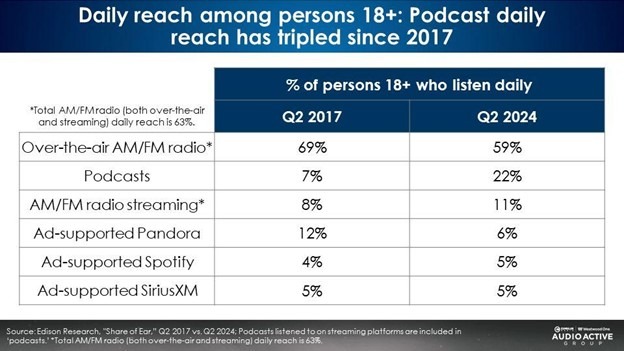
Earlier this month, Westwood One published a breathlessly worded report featuring Chief Insights Officer Pierre Bouvard’s take on Edison Research’s “Share of Ear” study. Titled “What Ever Happened to Pandora? Edison’s Q2 2024 ‘Share of Ear’ Reveals Pandora’s Stunning Collapse and the Enduring Strength of AM/FM Radio and Podcasts,” you can likely guess that the analysis picked apart Edison’s findings to tout radio’s strength amid a media landscape in upheaval.

But behind the charts, graphs, and percentages lie some seriously flawed conclusions. Bouvard’s willingness to cherry-pick certain data points and then trumpet them as a win speaks to a larger issue: Radio is still blind to its waning competitiveness. The apples-to-apples comparison of “ad-supported” platforms no longer applies in the age of subscription music services, where listeners are offered a buffet of music for the price of a couple of Starbucks drinks per month. And if we truly insist on comparing ad-supported platforms, we have to consider that the market has exponentially expanded with the global reach of radio stations thanks to the Internet and services like RadioGarden, the Broadcasts app, and Radio-Browser.info.

Let’s break down some of the claims made by WW1’s and Bouvard’s response, shall we?

CLAIM: “AM/FM radio represents the dominant ad-supported audio platform with a 69% overall share and a massive 86% in-car share.”

COUNTERPOINT: Even by the data presented by this article, that 69% figure is seven years old – and the article shows the current, Q2 2024 reach is 59%, representing a full 10% drop since 2017. Radio’s audience share continues to erode, and the industry’s response appears to still solely be “but we’re still #1!” How much more can the AM/FM industry take before we actually go on offense?

I also question the inclusion of the ad-supported SiriusXM reach since the “Free Access” plan was just announced in August 2024, so I’m not sure where that 5% number from 2017 is coming from. And if SiriusXM already scored 5% of ad-supported listening in just a few weeks, that indicates the Free Access tier is an incredibly in-demand service that should be expected to skyrocket in the coming months and years, especially for in-car listening.

Photo From Westwood One’s Report

CLAIM: “Since consumer interest in Pandora Radio hit an all-time high in 2008, its audience and profile have significantly collapsed, according to Google Search trends.”

COUNTERPOINT: Using Google Search trends to track consumer interest only tells a small sliver of the story.

There’s an excellent reason why Google Search trends may have started dropping off in 2008: That was the year the Apple App Store launched. With the ability of iPhone users to simply find and establish an account through the Pandora app, Google likely stopped being the first step in the discovery process for new Pandora users; they simply looked it up in the App Store, downloaded the app and began streaming.

Statista Research shows that Pandora still has just over 46 million active monthly users as of Q4 2023. Admittedly, that’s a little more than half the number they had back in 2015, but it’s still a healthy chunk of audience share, not to mention the fact that the service pulled in US$2.09 billion in revenue in 2022, with US$1.5 billion of that coming from advertising. Not bad for a platform “in decline,” no?

Statista also says over-the-air AM/FM radio in the U.S. pulled in $11.3 billion in 2022, which means Pandora’s advertising efforts alone represented 13% of AM/FM’s total take, and that radio missed out on that piece of the overall pie. I wonder how much more AM/FM missed because those ad dollars were diverted to other services like Spotify?

CLAIM: “Perception vs. reality: Advertisers and agencies wildly overestimate Spotify and Pandora’s audiences and dramatically understate AM/FM radio audiences. In August 2024, Advertiser Perceptions, the leader in measuring brand and media agency sentiment, surveyed 303 agencies and advertisers with media budget decision-making responsibility. Marketers and media agencies were asked to estimate the audience shares of Spotify, Pandora, and AM/FM radio. The perceived shares were compared to the reality of audiences from Edison’s Q2 2024 “Share of Ear” study. Perceptions came nowhere close to actual audience shares. In the case of Spotify, the perceived audience share (25%) was six times larger than Spotify’s actual audience share (4%).”

COUNTERPOINT: Again, he’s arguing about only ad-supported media and not factoring in the entire audio landscape of paid subscribers who also listen to Spotify.

According to Spotify’s own numbers, only 13% of their accounts are ad-supported. If I did the math correctly, that means 87% of active Spotify accounts are paid. Spotify’s 2022 annual report showed 40.15% of its paid accounts are U.S.-based.

At the June 2023 meeting of the National Music Publishers Association, NMPA President/CEO David Israelite announced that Spotify had 44.4 million paying subscribers in the U.S. alone. He also revealed that Amazon Music had 29.3 million paid subscribers in the U.S.

Going further, Spotify announced in its Q2 2024 earnings report that it had 246 million paid users worldwide with 27% in North America. So that includes Canada and Mexico, but that nets out to 66.4 million paid users in North America. With 626 million Monthly Active Users worldwide, Spotify said 18% of them were in North America, so that’s 112.68 million active North American Spotify listeners every month. How much listening is that taking away from AM/FM radio?

—–

It’s entirely possible that these subscribers are paying for multiple services and that all these paid accounts don’t add up to a 1:1 ratio of paid subscriber to potential listener. But it’s hard not to believe that with tens of millions of paid subscribers to multiple platforms, Pandora, Spotify, Amazon Music, Apple Music and more are taking listeners away from over-the-air ad-supported AM/FM radio.

Overall, I get the need for Bouvard and Westwood One to do that apples-to-apples comparison of ad-supported media. But it’s a distorted picture. It shows an incomplete landscape of what’s actually capturing listeners’ ears. Having to split the adjectives down all the way to “ad-supported over-the-air AM/FM radio” is a big mouthful, especially if you have to slice and dice that far just to show radio’s advantage over other platforms.

Bottom line: Stop touting radio as being great because it reaches so many people. Taco Bell serves two billion customers per year, but I can’t imagine any of us would openly proclaim that Taco Bell serves quality food. Instead, focus on making the product great. You can’t just put up a transmitter in a city and expect people to flock to their radios simply because it’s there. Attracting customers means offering a quality service with compelling content that attracts people to listen. Make it can’t-miss content that makes people want to tune in, don’t just heave whatever at people and expect them to listen simply because it’s “ad-supported” and “over-the-air.”

And yes, that likely means investment from the top. Because, as is shown by that declining audience share mentioned in my first point, “cutting our way to success” doesn’t seem to be working out so far. Something needs to change, or else that 59% will be a high-water mark at some point.

Overcoming Sales Objections: ‘Nobody Listens to the Radio’

1

Cumulus Media and Westwood One’s Audio Active Group recently released eight outdated perceptions about AM/FM held by many advertisers and media agencies. They used insights from research leaders like Nielsen, Edison Research, Maru, and Advertiser Perceptions. As you can imagine, the #1 outdated perception is one that radio reps hear consistently in and out of business settings, “nobody listens to radio anymore.” Handling sales objections requires a blend of empathy, data, and storytelling. Here’s some ideas on how to handle it:

1. Acknowledge the Concern

Start by acknowledging the concern to show that you understand and respect their perspective.

Example: “I get why you might think that. With so many new media options available, it’s easy to assume that ‘old school’ AM/FM radio might not be as popular.”

2. Numbers can help

Research is sometimes the correct answer for a factually oriented person. Just by quoting numbers and a source, you can counter some skeptics.

Example: “However, according to Nielsen, AM/FM radio reaches 82% of us weekly. A recent study says you aren’t alone in that thinking- 82% is nearly double what many advertisers believe is happening. It’s like saying nobody uses keyboards anymore- doesn’t everyone use an Apple pencil?”

3. Get Real

Providing a case study or success story is a tremendous third-party reference, especially when the company is one everybody recognizes.

Example: “Home Depot ran over 51,000 radio ads during one week last summer. They saw a significant increase in in-store and online sales, and customers mentioned they heard about the promotions on the radio.”

4. Get to the real reason

When they say nobody listens to the radio, find out what they think is happening. The answer is usually podcasts, Pandora, or satellite audio.

Example: “Pandora, podcasts, and SiriusXM are fantastic for people who can afford it; most still prefer getting music and local news information and entertainment for free, especially when driving to and from work.”

One possible convo

Here’s how a conversation might flow:

Prospect: “Nobody listens to the radio anymore.”

You: “I get why you might think that. With pods, streaming, and satellite, it’s easy to assume that old-school radio might not be as popular. However, according to Nielsen, AM/FM radio reaches 82% of us each week. That’s nearly double what many advertisers believe.

“For instance, Home Depot ran a radio campaign in 2023 to promote their spring gardening products. They saw a significant increase in in-store and online sales, with many customers mentioning they heard about the promotions on the radio. They ran over 51,000 radio ads in one week last summer.

“One of the great things about radio is its ability to deliver localized content, making your ads more relevant and engaging to listeners in specific areas. Let’s discuss how your business can reach folks interested in doing things and buying stuff in your city.”

Read the seven other myths to bust about radio. By following these steps, you can at least address some people’s concerns and demonstrate the value of radios.  

For Live 105’s Marci Wiser, Radio is Her Playground

0

Marci Wiser is the new Morning Host on the re-imagined legendary Live 105 in San Francisco. Her show “Marci’s Playground” will broadcast live on KITS Monday – Friday from 6a to 10a. Marci describes her goal for her new position: “It’s important for me to connect with listeners and the community itself – that is my top priority,” she explains. “I love to talk to listeners, take requests, be a friend, play their favorite songs, and expose them to new stuff or information they may not know. It’s cliche to say at this point, but personalities are the last line of defense – personalities are all that is standing in the way of radio becoming a predictable playlist with 15 minutes of commercials each hour. And there is research study after research study that says in the Alt and Rock world, personalities are just as important, if not more than, the music. Take away personalities and/or entertainment or information, and not only will listeners drift away, but so will the advertisers.”

Wiser started her radio journey in college. “While studying journalism, I decided to knock out some college credit at the campus radio station. A friend of mine and I did a show called the “Lisa Foxxx & Kasey Wylde” show (I liked the name Lisa Fox and later learned there already was one in the industry). Anyway, I then started doing a solo show at night. A music director at a local popular station happened to hear me while driving through town and called and asked if I wanted a job. I guess you could say this career picked me. The rest is history. I guess I’m doing what I’m supposed to be doing!”

 “I grew up listening to a lot of classic rock by default,” says Wiser. “My passion for the format came from my older brothers and sister, who were always listening, and I learned a lot. And then, as I hit my musical age sweet spot, I fell in love with New Wave. Perhaps I was a music-listening unicorn. When Alt and Grunge became popular, I was there for the ride. There are so many songs I could put on the soundtrack to my life, and it would be a total train wreck. Just the way I like it.”

Wiser’s background in both Rock and Alternative comes from her extensive time in the formats. She’s worked on both coasts and now, once again, she’ll be focusing on the West Coast version of the format. “While the best music always transcends a coast or region, and we hear genre variations all over the country, the West Coast really embraces punk and beach rock,” says Wiser. “As an example, here in the west, Social D and Sublime are more popular than in other parts of the country. We could point out significant differences across the country, but that’s what makes music so special and personal.”

“Being in radio for so long, I’ve been lucky enough to have had the opportunity to meet and interview my music heroes and attend some events I probably could have never gotten into if it weren’t for my job,” says Wiser. “Seeing big bands like the Foos or Metallica in very small spaces, for example. Hanging out at the Metallica headquarters was a blast. One of my favorite experiences was when Tony Bennett sang I Left My Heart in San Francisco to me personally backstage. What more could I ask for?”

“My resume includes some nice accomplishments,” she adds. “Like being lucky enough to work in LA, NY, and DC, but what really stands out is being a part of a radio team that broke fund-raising records for St. Jude Children’s Research Hospital for several years in a row, along with winning a Gracie Award, which was something I never expected.”

While it’s a fact that the rock formats mostly target men and have traditionally been male-dominated formats with mostly male artists and bands, Wiser is proof that things are different now. “It’s true that Alt and Rock have historically been dominated by men, but that is changing … quickly. There are a lot of female artists out there kicking ass, and it only takes a minute to discover a sea of teen girls on TikTok who are playing real instruments and getting their Alternative Rock groove on. Linkin Park just hired Emily Armstrong, a ferocious female, to co-front the band … I think the girls are here to stay, and stereotypes are out the window.”

Speaking of Wiser’s thoughts on the new Linkin Park singer? “I trust they knew what they were doing by hiring Emily. I’m giving them the benefit of the doubt and think it’ll work out great. Some initial apprehension from long-time fans is normal; let’s ask this question again after they have some time to gel.”

As far as what’s missing from the Rock formats right now, “I think there needs to be more of a rebellious vibe on the newer end of the spectrum,” says Wiser. “One of the key calling cards for Alternative Rock was being counterculture and rebellious. I love what’s happening these days, but I’d also like to see the next Sex Pistols emerge.”

Some of Wiser’s favorite shows to listen to: “I admire so many in the business. Frank & Heidi, Kevin & Doug “Sluggo” Roberts, Kat Corbett. Rita Wilde … right now, I’m mostly in work mode. Live 105 all day every day! And I love listening to Live and KROQ as well as other California Rock and Alt stations.”

Her advice for Women who want to get into the format: “If you want to really cut-through in radio or music, you have to be confident and willing to be authentically yourself – that means not putting on an act and being secure enough to let people know you’re not perfect, that you struggle sometimes, knowing that not everyone is going to like you, you’ll make mistakes and be wrong sometimes,” explains Wiser. “Be prepared to be yourself. Do your homework, have an opinion, respect the fans and realize you’re one of them. Lastly, understand the world doesn’t owe us anything – be open to do anything – hanging banners, driving the van, calling winners to get them tickets; learn as much as you can and build your way up. Start by getting in the door. Join the team and work hard.”

“As for me, I’m looking forward to getting settled up north and getting to know the Bay Area listeners,” says Wiser. “I can’t wait to get out there and get involved. I’m also shopping Marci’s Playground- The TV show. Keep an ear out for good news!”

Follow Marci Wiser on FB/Instagram/X @marciwiser