Paramount Global and Skydance Media have agreed to terms on a merger that is likely to be announced in the coming days, according to a new report by David Faber of CNBC. Skydance had reportedly introduced a revised offer of late to purchase National Amusements and merge with Paramount Global that gives nonvoting stakeholders the opportunity to cash out their shares at a premium.
If closed, the deal would reportedly have National Amusements president Shari Redstone receive $2 billion for the company. Skydance would also reportedly buy out nearly 50% of class B Paramount shares for $15 each for a total of $4.5 billion, thus giving shareholders an equity stake in the company. Skydance, along with private equity firm RedBird Capital, will also provide $1.5 billion as a cash infusion to the Paramount balance sheet to assist in reducing overall debt.
“We received the financial terms of the proposed Paramount/Skydance transaction over the weekend and we are reviewing them,” a National Amusements spokesperson said. The deal is reportedly pending a sign off from Redstone, who serves as the chair of the board of Paramount Global.
This agreement comes following several weeks of discussion and a rival offer from Apollo Global Management. Moreover, Paramount’s shareholders will not need to vote on the deal since the entity was part of negotiations. The shareholder meeting will take place on Tuesday of this week. The total value of the deal is $8 billion, which represents an increase of $3 billion from the reported previous offer in which Redstone would have received less than $2 billion for her stake of 77% of class A Paramount shares. Under those terms, shareholders would have been bought out a premium of almost 30% at $11 per share.
The report indicates that Skydance Media and RedBird Capital would own two-thirds of Paramount while class B shareholders would own the additional one-third of the company. Paramount Global is the parent company for CBS Sports, which recently promoted David Berson to the role of president and chief executive officer following the retirement of chairman Sean McManus.
Last month, Paramount chief executive officer Bob Bakish stepped down from his role and was replaced by an “Office of the CEO” consisting of three executives – George Cheeks, president and chief executive officer of CBS; Chris McCarthy, president and chief executive officer of Showtime/MTV Entertainment Studios and Paramount Media Networks; and Brian Robbins, president and chief executive officer of Paramount Pictures and Nickelodeon.
Paramount Global, with its CBS Sports and Nickelodeon divisions, broadcast Super Bowl LVIII and attained a record-setting audience that averaged 123.7 million across platforms, according to data by Nielsen Media Research. CBS Sports is preparing to enter the second season of its deal with the Big Ten Conference that includes an exclusive window on Saturday afternoon. Moreover, the company continues to broadcast various golf tournaments and the NCAA Division I Men’s Basketball Tournament.
With the NBA Finals matchup set to tip off this Thursday between the Dallas Mavericks and Boston Celtics, basketball fans are eagerly awaiting to find out which team will hoist the Larry O’Brien Trophy as champions. Yet on the outside, there is a bevy of speculation pertaining to the future of the National Basketball Association on television. The league is reportedly formalizing new media rights deals with The Walt Disney Company, NBCUniversal and Amazon that would nearly triple its existing fee, according to Tom Friend of Sports Business Journal. As a result, Warner Bros. Discovery would cease broadcasting NBA games, ending a relationship within the company that dates back to the 1984-85 season when games were broadcast on TBS.
These negotiations have been a frequent topic of discussion on The Sporting Class from Meadowlark Media, which began its latest episode reacting to TNT Sports analyst Charles Barkley speaking out against those at his company. Barkley has expressed his disdain for the process on numerous occasions, excoriating his bosses and demonstrating palpable frustration. Many fans are concerned about the future of Inside the NBA, which features the aforementioned Barkley with colleagues Ernie Johnson, Kenny “The Jet” Smith and Shaquille O’Neal.
In the end though, David Samson, former president of the Miami Marlins, believes that the marketplace has reached a point where it is ready to realize that the NBA on NBC is returning and Inside the NBA could need a new home. John Skipper, co-founder and chief executive officer of Meadowlark Media and former president of ESPN, concurred with Samson’s assertion and predicted things will conclude as they are being reported. The ambiguity surrounding Warner Bros. Discovery’s matching rights clause has been something Skipper has discussed multiple times on the show, including whether or not it could be executed in actuality.
“I don’t have any personal knowledge of what’s in their deal, other than I have no recollection of it being in the ESPN deal, and I have never been aware in any circumstance with any rights contract of such a thing as a, ‘Gee, if you create a new package, we get the right to match that as well,’” Skipper said.
“I’m not accusing anybody of mendacity, but I think what’s going on is more of an exercise in spinning the fact that they’re not going to get it, and it allows them to say, ‘Gee, we love the NBA. I never meant it when I said we didn’t have to have it, but we don’t have to have it for this price.’”
Samson feels as if Warner Bros. Discovery president and chief executive officer David Zaslav had and received board approval for a plan with the NBA media rights negotiations and is executing it at this time. An aspect of it that intrigues him is why the company has publicized its right to match in the contract. Samson postulated that if that part was unknown, Zaslav would be able to say that the league wanted to do deals with NBCUniversal and Amazon and that there was nothing his company could do. Even so, it is being posited whether or not Warner Bros. Discovery can genuinely match either offer because of its implementation of broadcast television and exclusive streaming rights, respectively.
“Well that’s why in some ways this discussion if there’s a right to match or not is moot,” Samson said. “If I believe – if they have a right to match, it requires them to match all material terms and conditions, and I think the NBA could cite that they are on a broadcast network; they could cite that their games on Amazon are all only [on a] streaming platform.”
In reality, Skipper thinks that there was a miscalculation by Warner Bros. Discovery that it would be able to retain NBA rights for less money than what is being offered on the open market. NBC is reportedly prepared to pay between $2.5 billion and $2.6 billion for a rights package annually, while the Amazon deal is reportedly worth between $1.8 billion and $2 billion annually.
Warner Bros. Discovery currently pays the league a reported $1.2 billion per year for NBA games, a deal that began with the 2016-17 season. Even though the incumbent rightsholders – The Walt Disney Company and Warner Bros. Discovery – had an exclusive 90-day negotiating window with the league, Samson presumes that there was knowledge of potential outside partners beforehand.
“Adam Silver does not let himself become that exposed,” Samson said. “He doesn’t let the window close unless he knows that he has another dancing partner. It would be irresponsible for him to do that.”
Samson does not believe the commentary made by Zaslav affected Barkley, although he stated earlier in the episode that he thought it could have represented the end of his time with the network. Additionally, Samson argued that Barkley is not the person ultimately signing Zaslav’s paychecks, nor does he negotiate his options or any compensation granted to him.
“All things being equal, I suspect he would prefer not to be the object of Charles’ comments, and I don’t know if he had to be,” Skipper said of Zaslav. “If you’re a shareholder, this is why you’re saying he’s brilliant is because if you were a shareholder, you would be glad they walked away from this very expensive package.”
“I just know very well that as a shareholder, my stock’s been crap,” Samson said, “and it’s nice to have the NBA; it’s nice to have a popular show, but I want my stock to go up.”
Mentoring and Inspiring Women in Radio has announced that legendary radio host Delilah will receive the 9th annual MIW Airblazer Award.
The award will be presented to Delilah during the Morning Show Boot Camp on Friday, August 9th at the Hard Rock Hotel in San Diego.
“I’m honored to be recognized by MIW and MSBC and awarded with the Airblazer Award this year, joining a group of very talented women who’ve also received this award,” Delilah said. “I do my very best to stay true to my audience relationship and provide the best one-on-one communication I know how. If my actions inspire other women on the air to do the same, then I’m all more humbled by this recognition”.
Her nighttime program reaches more than eight million weekly listeners on more than 160 stations, making her the most-listened-to-woman in radio.
“Delilah’s dedication to the radio industry, to children, and to communities far and wide has rightfully garnered an impressive collection of awards,” said MIW Board President Ruth Presslaff. “MIW is proud to add Airblazer to the list. We are, as always, appreciative of Don Anthony for partnering with us on recognizing extraordinary women broadcasters.”
A member of the Radio Hall of Fame and the National Association of Broadcasters Hall of Fame, Delilah has been on the air for nearly 40 years. She was also recently honored with the Gracies Icon Award.
I attended and spoke at the Louisiana Broadcasters Association Annual Convention last week. My focus was on the economic state of the radio business, and the importance for brands to have multiple revenue strategies beyond the radio ad model. I’m still a huge advocate for the radio business and know that the majority of revenue comes from traditional advertising. The lack of growth though is frustrating, and too many working across the country are quick to reject new ways forward.
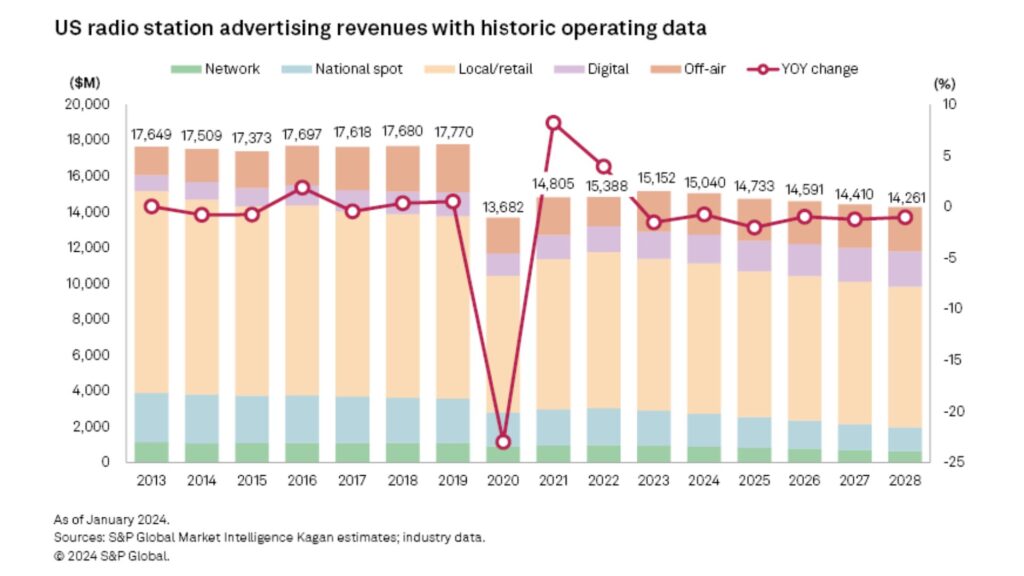
Whether you go by the S&P Global Market, Radio Advertising Bureau, BIA Advisory Services, Borrell and Associates or another group, the story is similar. Radio has been flat to down for over a decade. Television revenues are declining too, with streaming expected to pass TV for the first time ever this year. The IAB also reported in April that digital video advertising spending is growing 80% faster than media overall.
These stories are shared year after year, and it leads me to wonder ‘how is the radio business going to grow if it doesn’t expand its horizons?’ Executives in radio groups are asking these same questions. If you wonder why layoffs keep occurring, it’s because costs are rising, and business growth isn’t. Eventually, you need more revenue to support additional staff and investments. If it’s not there, adjustments have to be made.
In 2023, radio industry revenue topped 15 billion dollars. That’s a respectable number except it’s not much different from what’s been reported annually every year since 2013 minus the pandemic year (2020). In fact, go back 10-15 years and you’ll find the industry was generating two to three billion dollars more each year.
During the past decade though, rent, gas, food, cars, and employee wages have increased. In New York alone where I’m based, minimum wage doubled from $8 per hour in 2013 to $16 in 2024. The level of media competition and the platforms showcasing content have also soared. This is why brands have to be active in business beyond radio if they hope to grow.
I’ve talked about the need to be aggressive in the merchandise space before. It’s been ignored. Yet groups like the WWE, which has seven hours of weekly television programming generates over a hundred million dollars annually in merchandise revenue. I get that the WWE is a global brand, so I’m not naive to think radio can be anywhere near that level. It can’t. But radio has the same access to websites and social media platforms, and 168 hours of programming each week. Are we using our tools the right way and leaning into the opportunity?
Barstool Sports is another great example. They generated thirty million dollars in merchandise revenue between December 2020 and November 2021. The brand has podcasts, social media, and websites just like your radio or TV outlet. They were also on SiriusXM for years, but social media and the web drive their sales. The brand was so on top of its merchandise strategy that it even monetized Mike Francesa better than WFAN did years ago. The difference, moving product is a mindset for Barstool. Radio unfortunately doesn’t think and operate that way.
If a top-20 market brand can’t make six figures annually selling its own products, then the internal execution and strategy is wrong. I’d even go as far as saying the wrong people are likely spearheading it. If you feature personalities that matter to local fans and believe in your airwaves enough to convince advertisers to spend six figures on them to grow sales, then you should be doing the same with your own products.
But it’s not just about merchandise. What’s your live events strategy? Are you doing two to four big revenue generating shows per year? I’m not talking about live remotes at car dealers or restaurants. I’m referring to the equivalent of a concert in your town. Would your audience spend $50-$150 per ticket to attend a function your brand created? To do that, you have to create killer ideas, involve important people, and deliver a memorable experience. Your on-air and social promotion is a key driver of it.
If you’re not producing big dollars from live events, maybe it’s time to review your creative ideas, ticket pricing, venue expenses, branded advertising opportunities inside the event, etc.. What are you creating that’d get the market buzzing? For example, ESPN, Fox Sports and Warner Brothers found a way to create a streaming service together. Could you and your competitor join forces on a co-branded ticketed event? If you brought two notable brands and staffs together for a killer event, and sold tickets, in-event advertising, YouTube/Podcast sponsorships, and co-branded merchandise, I’m sure your listeners would open their wallets.
Podcasting is another area that continues to grow with listeners. On the local level though, monetizing it remains a challenge. Does that mean it’s not worth selling? No. But if you’re limited in your earning potential with the way you currently sell, maybe it’s worth approaching it differently.
Good Karma Brands in Cleveland created a subscription model years ago designed to earn from its audience. Many questioned the approach, but GKB unlocked six figure earnings doing it. Radio is always quick to promote the power of free, and that’s great, but there are brands like The Guardian, The Information, The Free Press, and New York Times who are growing thanks to fans investing in them. Should we be doing it too in spaces we’re less confident monetizing?
I can make a case for many opportunities, but the reality is that you have to care enough about being stagnant to want to do something about it. Cameo is a video service that many of your talent are on and make little revenue from because they don’t promote it. Yet celebrities, musicians, wrestlers, etc. earn strong revenues on it. Is it worth creating a revenue sharing model between talent and brand to help both parties benefit? If you make zero now, what are you losing?
Lastly, do you know how much it costs in 2024 to go to college for four years at a major university? It’s roughly 25K to 75K per year with on campus living included depending on the school and state. Trade schools also profit off of education by charging 7K to 15K per course per attendee.
When those students finish, what do they want? A job in your industry. The instruction they gain at school is good but it’s not as advanced as what they’d receive in a radio/TV operation. Yet brands make nothing (unless the school buys an ad schedule) on education even though they have the best assets to work with.
Most brands employ a programmer, seller(s), imaging director, head of digital, radio talent, producer(s), play by play talent, personalities with TV, writing, and podcasting experience, and have relationships with local teams, athletes, and venues. They also have the one thing most coveted by those paying for an education – a job. If a successful, local brand created a 12-16 week course utilizing the best in the business inside their building, and gave away one FT job and a few PT jobs at the end of it, do you think it’d generate interest? Of course it would. If 25 students signed up at 5K-10K per person, that’s 125K-250K. Do I have your attention now?
I know that selling radio ads is your first priority. I’m not suggesting it shouldn’t be. But you will not grow your business if you aren’t exploring new ways to generate revenue. Maybe it’s events, merchandise, Cameo, podcasting subscriptions or broadcaster training courses. Maybe none of those work but you’re bullish on renting your studio space, creating branded content on social platforms for clients or selling SEO services or AI training. Radio is a good business and the foundation of your brand, but unlocking your full revenue potential requires exploring and mastering new spaces.
The Horn in Austin, Texas is shifting to a digital only product. New owners, Norsan Media believe the Austin sports brand and country station KOKE will reach a broader, more diverse audience, allowing the company to adapt to a rapidly changing media landscape. The changes go into effect on June 1st.
We're thrilled to announce a transformative evolution for The HORN & @KOKEFMAUSTIN.
6/1 we transition from over-the-air radio frequencies to an exclusive streaming delivery. Thank you to our longtime advertising partners & loyal audience.
Good Karma Brands previously announced plans to prioritize its app in New York City for its shows on 98.7 ESPN NY. The one difference, GKB also has an AM signal, 1050AM. The Horn won’t have that luxury, which raises the question, will more of these situations pop up? How are brands going to make up for being less visible inside the vehicle? Will advertisers and play-by-play partners support or reject those who have a minimal or non-existent radio presence?
There’s more to be learned but this should be an interesting trend to follow in the years ahead.
Jim Rome: The first impression on X of Rome’s video simulcast of his radio program was strong. I watched some of it while flying to New Orleans and thought the presentation was visually on point. Judging by the response shared by Linda Yaccarino, moving from TV to X could be exactly what Rome and his team needed to shake things up.
Hey @jimrome apparently you’ve been ???? all week. 5M views, 12 hours of commentary and thousands of fans joining in on the conversation ????
RTDNA: 41.4% of radio news directors and general managers say they’re seeing more evidence of burnout this year. Major markets (58.5%) and larger newsrooms (62.9%) face the biggest challenges. Numbers are even higher among television professionals. The survey included responses from as many as 1,387 television stations (73.9%) and 631 radio news directors and general managers representing 1,902 radio stations.
Though I love to work, and think there are differences between young people entering the industry now and when I started, it’s good to see RTDNA raising awareness to these issues. Broadcasters get worn out when asked to absorb too many duties. I understand the challenge of keeping expenses down, but if not having support leads to your best people leaving, is that worth it?
Colin Cowherd: I had a chance to listen to Colin’s conversation with Erika Ayers Badan over the weekend. It was really good. Folks who enjoy business discussions, take a listen. When Colin uses his podcast to discuss business with accomplished people, it’s always informative.
Keith Hernandez: Keith must’ve skipped mathematics class because a simple equation such as 17 + 8 shouldn’t be difficult. Judging from the response to the Mets broadcaster’s blunder, Hernandez might want to leave the math problems to Gary Cohen and Ron Darling.
Radio Haters: If you’re connected to a lot of people and log on to social media each week, you’re eventually going to find someone who previously worked in the industry and enjoys complaining about it. Is the business perfect? No. Does it have problems? Of course. But it’s still pretty damn good and important to millions of people. I left day-to-day radio life almost 9 years, and still find plenty to be excited about. If you want to suck the life and fun out of social media by pissing and moaning about how much better the business was during your glory days, knock yourself out. I’d prefer to live in the present, and embrace what lies ahead.
We’re getting close to that time of the year where a sports fan’s attention will be taken up by baseball and counting the days until football season. Baseball has been in full swing for two months and the contenders are starting to separate from the pretenders. A good time to eavesdrop in on a podcast dedicated to covering the full landscape of the game while making you literally, laugh out loud – Talkin’ Baseball from Jomboy Media.
I chose the May 28 weekly recap episode, the 842nd overall podcast, because it had two juicy topics in the description. The first was the reaction to the news that Ronald Acuna Jr. was going to be out for the season with a torn ACL and the other was the retirement of longtime MLB umpire Angel Hernandez.
I didn’t know when I picked the episode that Jomboy himself, Jimmy O’Brien, wasn’t on this particular show, but he left it in the very capable hands of his co-hosts, Jake Storiale (also his partner in the business) and longtime Minnesota Twins infielder and Jomboy media investor Trevor Plouffe.
If you know anything about the 21 personalities and the 44 shows created by the Jomboy Media team, you can probably guess what I heard when I tuned in. In its simplest form, it is a very entertaining baseball podcast. But what it really is, is a well-paced, 60-to-90-minute joyride through the current happenings and top headlines in Major League Baseball.
The early part of the episode was a great preview of what was to come over the next hour and a half. There was talk about the NL Central division leading Milwaukee Brewers and their recent propensity to want to fight other teams, which led to the topic of their new manager Pat Murphy and how the team has taken on more of his demeanor. Then, Storiale says, “I think if Milwaukee came out with the ‘Top 25 Hottest Guys in Milwaukee’ right now, it’s obviously Yeli (Christian Yelich) one, but I think Pat Murphy is coming in like 21st now, his stock is flying.”
And that is a lot of what you get throughout the show. All of the information you want about what is going on in Major League baseball, with several side-topics or comments that keep you locked in looking for the next belly laugh.
Storiale runs through the highlights in the American League, hitting on the top teams and the ones who have made a bit of a move that week. He rapidly goes through getting the listener/viewer up to speed on the week and does it in a delivery that isn’t perfect, but it’s not supposed to be.
Plouffe then runs through the American League standings which leads Storiale to say, “Nobody is dead – well, the dead teams are dead, your Rockies, your Marlins, your White Sox, your Halos (Angels), your Athletics. Up until this point and even another week or two, if you put together that 10 game stretch with the expanded wild card, you’re in the mix.”
Some quick discussion on seeing “that blonde lettuce flying around” in regard to the hair of Baltimore Orioles outfielder Kyle Stowers led into one of the main topics of the day, the retirement of Angel Hernandez.
Storiale explains that the story is “big news in baseball,” and that a lot of people are “getting some of their final punches in,” on Hernandez. He adds, “We’ve lost on our end. If you’re in the baseball content game and you want some clicks, put Angel’s name in the mix.”
About Hernandez, Plouffe said, “I think it’s probably time.” He then says he thinks umpires should have to pass a test when they get to a certain age. “At a certain time, your eyesight goes,” he said. “…So now you’re doing an already very difficult job with less than efficient tools, that’s not a recipe for success. So, there needs to be some talk about those guys not going behind the plate…unless they pass the test.”
Plouffe said his interactions with Angel were all positive. “I know he has been controversial; I know there’s been bad calls,” he said. “I’m not going to sit on here and bash him, I’m not going to do that. Like I said, it was time, but you could probably say that about 10 umpires in the game.”
A conversation about Hernandez’s career and what his legacy will be turned into a quick side topic about what could have been had there been a game where it was known as his last game umpiring, and he was behind the plate. Storiale and Plouffe wondered if fans would have come out, perhaps just to boo Hernandez one more time. In predicting a big crowd, assuming a decent location, Storiale said, “Angel has juice.”
Plouffe replied, “People love to hate Angel, so I could see how the fans would rally around that and give him a standing ovation as code for ‘Thank goodness you’re gone.'”
From there, they reel it in and get right back into breaking down more of what is happening in baseball as the conversation circles all the way back around to the Milwaukee Brewers. Plouffe gives some great insight when he talks about an exchange he had with Christian Yelich where Yelich talked about still grinding after having been in professional baseball for as long as he has. And while the nugget of information was great, the accompanying conversation about whether Plouffe namedrops people (Yelich, for example) too often was also great. “Who am I supposed to talk about, these are my friends,” Plouffe asked.
The National League gets the same treatment as the American League with a full report from the week by Storiale followed by a rundown of the standings by Plouffe. That leads into main topic number two, last year’s NL MVP, Ronald Acuna Jr. being out for the season with a torn ACL.
“It was a historic season a year ago for Ronald Acuna Jr.,” Storiale said. “Out for the year, a torn ACL again. And if you are the Braves, the offense has kind of been struggling, at least to Braves standards…that’s a guy you really want in the lineup, and it changes the whole dynamic with the Braves.”
Plouffe challenges Storiale on this a bit saying, “The Braves offense hasn’t been bad just to their standards,” he said and then throws out the stat that since April 27, the Braves have scored the second fewest runs per game in baseball. He also talks about the Braves being the type of organization that will work to try and bring in reinforcements knowing how good of a team they still have.
Plouffe shines as he breaks down what the loss of Acuna means to the team. The conversation wasn’t just simply that the team lost its best offensive player. Plouffe looks ahead and talks about which of their current players could step up, using statistics and seeing how some players are off their career numbers, so step one would be to get those players to get back to form. Plouffe makes the case for Braves fans not to get too down, says that there is hope, before he does offer to be emotional support to any Braves fan that needs it.
As they move to other news within the NL, the Cincinnati Reds come up. While they sit in last place in their division, they did just come off sweeping a 3-game series over the Dodgers. “You need to have a series like this to remind you who you are,” Plouffe said about the Reds. “…Holding the Dodgers to two runs total over the last two games, that’s something to say ‘ok, here we go,’ I like that for the Reds, a lot.”
Later on, as each host selects a player to highlight, Storiale goes with Aaron Judge and sums up his play recently saying, “Have you seen what he’s doing?…First player in MLB history to have 11 homers and 12 doubles in 20 games. 20 games! The dude’s out of his dome right now. Sometimes it doesn’t seem real because he is a bigger than life human, but he’s out of this world.”
The rest of the time is filled hitting on some of the secondary stories from the week and an injury report Storiale called, “the worst segment of the show.” Again, the information is there, and the unique delivery and style keeps you wanting more.
Even the delivery of an ad read in the middle of the show was well-timed, it was tied in with programming and was done with the standard Jomboy personality.
Good, informative content, delivered with a humorous tone and a realization that this is sports, and it is supposed to be fun. That is what this 90-minute show delivered. You sort of forget that at its core it is a hardcore baseball show and when it’s over you realize you are a much smarter fan on the current events going on in the game and you were entertained.
It isn’t easy to have knowledge of and keep up with the entire league and it is another thing entirely to deliver it with wit and not get too far off the rails. Storiale and Plouffe do it with ease and succeed in pulling off good, solid baseball talk mixed with a lot of laughs.
Emmy award winner. Bestselling author. He has a star on the Hollywood Walk of Fame and two syndicated shows. Not to mention he’s run for Governor and President. Renaissance man Larry Elder is now nominated for the Radio Hall of Fame. In his own words, Elder believes “I’m just getting started.”
The Los Angeles native attended Brown University before heading to the University of Michigan for his law degree. He practiced for three years before opening a headhunting firm for lawyers. Throughout the years, Elder always had one dream. “I always wanted to be a writer and still consider myself primarily to be a writer.”
There was one thing that stopped him from writing early on in his career. “I always wanted to eat, and I knew that going out and trying to become a writer full time is a struggle, and I didn’t want to struggle like that.”
After a few years, he began writing op-ed pieces part-time. “I was living in Cleveland at the time, and the large newspapers were the Cleveland Plain Dealer and the Akron Beacon Journal. So I wrote an article and I sent it to them.” The papers said thanks, but no thanks. Determined, Elder wrote a second article, which also got a pass, but his third? “That one got published.”
“The article was about how, in my opinion, racism was no longer a major impediment to hold black people back. Not that racism was gone — it will never be gone — but that if you’re willing to work hard, invest in yourself, and stay focused, you’ll be just fine in America,” Elder recalled.
After his piece was published he got a call from a radio show and was invited to be on. Elder was only booked for one segment but instead, “I was on for an hour and every [commercial break] was always, ‘Can you stay longer?’”
His piece, however, was not well received. “I got all sorts of phone calls. Every single one of them was negative. Cleveland is about 50% black at the time. Almost every single call, it was a black person and they were not happy.”
Elder was called awful names like, “An Uncle Tom, a sellout, a bootlegging Uncle Tom, the anti-Christ. And I was called the word that you really want to use when you want to hurt a black person. I was called Republican.”
When the show was over, Elder said to himself, “That’s the longest hour of my life. I’ll never do that again.” Then his phone rang.
“It’s the station manager and he said, ‘I heard today, you were amazing.’ I said, ‘I was on my God.’ He said ‘You were funny, you have a good speaking voice, you took a difficult position. You defended them without losing your temper or your sense of humor. Have you ever thought about doing a talk radio?’ I said ‘No.’ He said, ‘I’ve got a guy going on vacation. Will you sit in for him?’ I said, ‘No.’”
The station manager asked Elder to talk to his then-wife about it, “She said, ‘What do you think of talk radio?’ I said, ‘No, nothing about it.’ I knew who Howard Stern was … but I never listen to them regularly. As far as I’m concerned, talk radio? Shallow, glib, and stupid. She said ‘It is. You’d be good at it.’”
After sitting in on the show for 20 minutes, Elder decided this was what he wanted to do. “So I took the best 20 minutes of that week. Five shows, I think three hours, three hours long each each day. And I made them into a cassette tape.” He sent the tape out to stations in Los Angeles and never heard back from anyone. So, “I forgot about it.”
Then he met Dennis Prager while doing a show, who invited him to visit the next time he was in Los Angeles. Prager was also Elder’s mother’s favorite talk radio host (at the time). So when she found out the next time Elder flew home she asked, “Did you call Dennis? I said yes. And she said, ‘What happened?’ ‘He didn’t return my phone call.’ She said, ‘Call him again right now. Put the phone in front of me. I call him.’ [Prager] answered. He had me on that night.”
This is how Larry Elder became a conservative radio titan.
Over the years Elder has been called countless names but it doesn’t bother him. One unexpected conversation with a listener sticks out to him, “I walk into the restaurant and there are two black guys sitting on a brick wall smoking cigarettes. And one of them said, ‘Larry Elder! I love you and I hate you. Come over here.’”
The man told Elder,“‘I’ve been listening to you about three, four months now. First time I heard you, I hated your guts. Little by little I said to myself ‘You ain’t doing nothing but telling people to work hard to stop whining.’ You are like castor oil. It don’t taste good going down, but it’s good for you. Keep it up.’ And, at that point, I realized I was connecting with people.” Today, when people call Elder names, he believes it because “They’re out of ammo.”
The “thrill” of his career came sometime later while giving a speech at the Ronald Reagan Library. “My parents were in the audience and I mentioned in the speech briefly and they interrupted my speech and gave my parents a standing ovation. I never will forget that.”
Elder said his relationship with his father inspired the best story he’s ever told, “Dear Father, Dear Son: Two lives… Eight Hours.” After an argument in his father’s cafe then 15-year-old Larry Elder did not speak with his dad for 10 years. It wasn’t until he was 25 when they spoke again.
After unexpectedly showing up at his dad’s cafe, the younger Elder, “Spoke to him for 20 minutes, non-stop. I told him every whipping he ever gave me, every time he ever said anything that insulted me. I told him everything I could think of. After 20 or 25 minutes, I was done. I had no more ammo and my dad said, ‘Is that it? You didn’t speak to me for ten years because of that? Let me tell you about my father.’ For the first time, I saw my father cry.”
The book became a New York Times bestseller.
“I get letters to this day from people all over the world telling me the book made them reconnect with their parents, with their father, made them a better father. I know it’s changed the way a lot of people have felt about their own fathers,” Elder said.
His advice for those looking to follow in his footsteps is simple. “Stand your ground and recognize that you’re gonna lose friends. And I put friends in quotes because they divorce you. Because of your ideology, because you’re telling the truth. They really weren’t friends anyway.” He later added, “I think ultimately, all we can do is tell the truth and hope that common sense prevails.”
As mentioned previously in this column, I look at a great deal of radio and media-at-large trade press. Almost daily, there is a report about one study or another that “proves” the effectiveness of some advertising medium. And it’s not surprising that the person, company, or organization that is touting the study not only had something to do with it, but the results are also positive for the medium in question.
Since these studies have probably been going on for a century or more, we have one clear conclusion: advertising works. In general, if you don’t advertise, you don’t sell as much of whatever it is that you’re selling. And according to the studies, you can use almost any medium to get the word out.
Radio has released any number of studies confirming that radio works for advertisers. Wondery just announced that the company is working with several suppliers to tell you how well your podcast advertising is doing.
Last week, Screenvision told us that ads in movie theatres get more attention than just about any other type of advertising based on their studies. It makes sense because if I’m sitting in a darkened theatre waiting for the movie to start, what else would I do? Check my phone? Chat with my seatmates? Or watch a commercial on the big screen with big sound? Of course, Screenvision sells those ads you see ahead of the flick.
This isn’t to knock Screenvision’s study. The details in the MediaVillage article made sense. I’ve been involved in studies like these over the years and the results are typically the same, in other words, advertising works to achieve a goal, whether it’s attention, recall, etc. Of course, if a study didn’t show some positive outcome, it’s unlikely you’d ever hear about it.
The higher-level goal, product, or service purchase, is always a little trickier. I can use terms like “consumer journey” or other jargon, but what it comes down to is when the consumer wants or needs to buy an item or service, they go to the advertiser. I don’t buy insurance very often, but GEICO, State Farm, Progressive, Allstate, Liberty, and Farmers, all of which advertise constantly, are sure to be in my mind. Flo, Doug, the Gecko, and Mayhem are always selling. Or if I switch to State Farm, can Jake get me some good seats for a Kansas City Chiefs game? He apparently knows everyone on the team. Oddly enough, all my coverage is with Erie Insurance, which almost never advertises.
I wish I had a brilliant answer for this cacophony of research. Would anyone believe the advertising sellers if we said that we don’t need to do any more research because we know advertising works?
The May 23rd edition of The Economist had an article about Walmart’s latest product, which is its consumer (“Walmart’s Latest Product? Its customers” paywall). Walmart sold $3.4 billion in ads last year which sounds very small compared to the $600 billion of items sold in its stores, but the advertising business made up 7.5% of profits and according to the article, one analyst suggests that by 2026, 13% of Walmart’s profits will be from advertising.
Meanwhile, Amazon sold $47 billion worth of ads in 2023 per The Economist article. If you go to Amazon’s advertising site, it’s incredibly simple. The Amazon Ads site has lots of tips and case studies. While I may have missed one, I didn’t see a single study that checked on what consumers think, but instead, you’ll see how to advertise, why do it, and plenty of case studies with companies that successfully used Amazon advertising (any that weren’t successful probably don’t appear on the site). Again, Amazon Ads brought in $47 billion last year. That’s almost three times what was spent on all radio advertising in the US in 2023.
I was never a great salesperson, in fact, I was never a good salesperson. Nonetheless, it seems to me that radio probably needs fewer studies and more innovation, effort, experimentation, especially in what appears to be a flat spending environment. Chris Brunt of Jacobs Media was saying the same thing in last Friday’s Jacoblog.
It’s tough to compete with digital. Amazon can show that the ads led to a specific number of clicks to the product and produced a specific number of purchases. Still, Amazon couldn’t draw those people in for a product if they weren’t thinking about purchasing it in the first place. And according to all the studies, radio advertising works!
When Erika Ayers Badan joined Barstool Sports as the company’s first chief executive officer in July 2016, she was entering a flourishing operation and helped to actualize more of its potential. Ayers Badan had previously served as president and chief revenue officer of Bkstg and immediately noticed distinct aspects of the Barstool Sports business once she started on the job. In fact, she was doing work for the company from the start of the interview process, assimilating into the environment and sentiment among employees. Ayers Badan remained at Barstool Sports until this past January when she left the company and joined Food52 as its new chief executive officer a few months later.
On the day Ayers Badan was hired by Barstool Sports, Ayers Badan remembers watching the Barstool Rundown broadcasting live from founder Dave Portnoy’s apartment. After the show guest made several racial slurs live on the air, she remembers questioning what she was walking into working for the company. During a recent appearance on The Colin Cowherd Podcast, Ayers Badan discussed her early years with Barstool Sports and how she stabilized parts of the venture, including determining which people were employees of the company.
“Dave wasn’t exactly sure who was on the payroll or not,” Ayers Badan said. “It was a lot of like – there were a lot of guys in Boston with Barstool J.J. and Barstool ‘insert first name here,’ and they seemed like they worked for Barstool, [but] they didn’t work for Barstool. Dave wasn’t clear if they paid them or not, so there was a lot of like, ‘Who is this person and do they actually work here?’”
In her time as a new employee when the company was smaller, Ayers Badan became cognizant of the tightrope that Barstool Sports was walking with its content. Portnoy, along with other personalities such as Dan “Big Cat” Katz and Kevin “KFC” Clancy, are people that Ayers Badan described as being affable but also shrewd. Staggering the line of comedy through their content was part of the role she found difficult amid trying to perform her role and position the company for sustained success.
“I had worked at startups and at big companies,” Ayers Badan explained. “Barstool was just very, and still is, very alive in that it was real time. It was building a company [in] real time in the public eye.”
Aside from hosting his eponymous podcast and television program, The Herd, Cowherd is an entrepreneur and operates The Volume, a digital sports media brand with various content offerings. Amid his conversation with Ayers Badan, he recalled a story of befriending Nike founder Phil Knight while working in Oregon and remembers his opening manifesto when the company began. Cowherd has recently spoken to his staff at The Volume about one of these points, which is “It won’t be pretty,” which remains true and has been something he has experienced in business.
“That’s something I think as younger people tend to be a tad more fragile and easily offended, I’ve talked to some people and said, ‘I’m not sure you’re a good fit for my company,’” Cowherd said. “I view fragile as a weakness and relentless as the ultimate strength; that we all step in shit and you’ve got to get over it fast and don’t let one interception become two and one bad day become a week.”
Ayers Badan concurred with this point and described it as encapsulating the essence of her forthcoming book, “Nobody Cares About Your Career: Why Failure Is Good, the Great Ones Play Hurt, and Other Hard Truths,” which is set to be released on Tuesday, June 11. Careers, she elucidated, are built over several mundane and ugly days with many mistakes, and there is a fundamental nature of understanding how to fail and overcome it.
“What was brilliant about Barstool was that it was always trying to understand the line, and that’s what made it so interesting and so alive and so captivating to fans, but also so difficult on the business where I always had to have multiple lines of revenue because I didn’t know,” Ayers Badan said. “Tuesday afternoon, we could be offending an advertiser; we could have said something that’s flaring up in the New York Post. I never knew what was going to happen, so safety and calm could come from having multiple levers to keep payroll going and the business happening.”
Through the process of audience adoption, which comes from having a message, attracting and retaining listeners and then having them advocate on behalf of the entity, she believes there is burgeoning pent-up demand that is extremely palpable in scope. Over the years, Barstool Sports has cultivated brand equity partly through its personalities and the relationship with the audience.
“I am a highly impatient person, but if you put talent on a platform or create content for a platform, and it gets traction, you’ve got to get – the longer you do that, the more you let that marinate, the further you explore with it – I will wait weeks, months,” Ayers Badan said. “I would wait years because the reality is the more audience you grow – and if you find, you’ve got to.”
Conversely, some companies eventually choose to sell for lucrative profit, including Barstool Sports when it completed a transaction that gave PENN Entertainment full ownership of the entity over two deals worth $551 million. Portnoy purchased the company back from PENN Entertainment last summer for $1 as it prepared to enter a deal with The Walt Disney Company and rebrand its sportsbook to ESPN BET. Ayers Badan believes that once entities secure fiscal windfall in this manner, it can cause them to become more indolent.
“The best years at Barstool, I think, were probably the earliest years, and then they were the beginning of my years because it was such a grind,” Ayers Badan said. “We didn’t know if we would make it; we still had so much road to climb. The best years were not after the PENN acquisition, so I think getting the bag also comes with responsibilities and changes things, and that’s hard for a mission-driven, passion-driven brand.”
Newsmax and primetime anchor Eric Bolling have “mutually agreed” to part ways, effective today, according to a report from Mediaite.
“Newsmax wishes Eric Bolling well in his future endeavors,” Newsmax said. “The network looks forward to an exciting period this election season which will include our nightly news coverage with Greta Van Susteren, Rob Schmitt, Greg Kelly, and Chris Plante.”
Bolling told the website he has a new endeavor already planned and will share with viewers where he is headed as soon as he can.
“I can’t wait to tell them about where I am going to next. It’s a huge step for me and something I have always wanted to do, and I’ll be letting everyone know in the next couple of weeks.”
Bolling’s final show with the conservative cable news network was Thursday, the day former President Donald Trump was found guilty on 34 felony counts of falsifying business records in New York.
During Eric Bolling The Balance, the host claimed he had written an entire monologue but was going off script, quipping that “producers don’t know what I’m doing here right now.”
Bolling joined the network in 2021. He had previously worked at Fox News but was ousted in 2017 amid sexual harassment allegations, which he has continually denied.
Earlier in the week, Jim Rome officially launched the live video stream of his popular radio program, The Jim Rome Show, on the X platform. Listeners of the show on terrestrial radio and digital outlets are now able to utilize the social media network, which was formerly known as Twitter, to watch a live stream of the program.
The functionality change in the video component of Rome’s show came after it aired on the CBS Sports Network for six years. Rome’s show can continue to be heard on the Infinity Sports Network and a variety of radio affiliates on the AM and FM dial across the country. Because of the show’s continued presence on airwaves regulated by the Federal Communications Commission, it must adhere to guidelines pertaining to obscenity, indecency and profanity within the broadcast.
One of the program’s callers at the end of the first hour began his discourse by commending Rome for his presence on the new platform. In fact, he stated that he no longer has to hear the show on “scratchy AM” radio, the frequency on which Rome first started broadcasting the show when he worked on XTRA Sports 690 in San Diego, Calif.
The caller discussed how the Dallas Mavericks held a 29-point lead on the Minnesota Timberwolves at halftime of Game 5 of the Western Conference Finals on Thursday night, claiming that the team should have effectively abandoned the game. As he continued, he made an inappropriate remark about what Luka Dončić and Kyrie Irving did to the team, prompting Rome to interrupt the caller.
“You know what dude?,” Rome articulated. “Unfortunately people heard you say that in a clear video stream and not on some scratchy AM radio station.”
Rome denounced the take that had been provided on the show, along with the caller himself for making such a statement. He also stated that he was in the scratchy Radio Hall of Fame and that listeners can still hear the show through that medium.
“Don’t dog our radio stations,” Rome said. “We have a few hundred radio stations that believed in me and us and put our product on the air, and it’s still on the air. This is a radio show still yet, but it is a radio show that is being streamed live on the X platform, and so far, so good. We’ve had a really good first week, and I’m having an absolute blast.”
Before Rome proceeded to commence the second hour of his program to end the week, he explained that he was enjoying the new project. Throughout his career, he has been on terrestrial radio, along with linear and network television, and is now trying to assimilate into digital media as the outlets continue to evolve.
“We have never actually streamed,” Rome said. “I am embracing new media – I love this, it’s a blast. Dude, don’t bring us down. I like this a lot…. I don’t want you doing anything to jeopardize this great new thing we have. My man, do better. Do better or don’t do at all.”