ESPN NFL analyst Ryan Clark has reached a verbal agreement to remain at ESPN, extending his time at the network. This past season, Clark appeared on a variety of programming centered around the National Football League, including NFL Live and Monday Night Countdown. News of Clark deciding to remain at ESPN was first reported by Andrew Marchand of The Athletic. Additionally, Michael McCarthy of Front Office Sports has reported that the deal will pay him over $2 million per year. ESPN confirmed the news on Monday afternoon, stating that he would continue his role across network programming.
Just days after the Super Bowl, Clark outlined how he wanted to prove his worth and leave no doubt the last time he signed an extension with ESPN three years ago. At the time, he felt he was worth more than what he received and set out to end the conversations about who he was in the sports media business. Although Clark’s contract expired before Super Bowl LVIII, he and the network agreed to extend it through the conclusion of the championship matchup.
During the NFL postseason, ESPN studio programming garnered multi-year peaks in viewership. Editions of NFL Live averaged 486,000 viewers over 14 programs between Jan. 9 and Jan. 26, rendering it the most-watched playoff run of the program in nine seasons. The Postseason NFL Countdown show featuring the Monday Night Countdown cast averaged 4.7 million viewers on ESPN and ABC ahead of the network’s broadcast of the divisional round matchup between the Houston Texans and Baltimore Ravens on Saturday, Jan. 20.
Outside of his role at ESPN, Clark recently completed his first year hosting Inside the NFL on The CW. The Emmy award-winning weekly series moved to the network after it was dropped by Paramount+ last April and featured a new cast starring Jay Cutler, Chad Johnson, Chris Long and Channing Crowder. He and Crowder work alongside Fred Taylor on The Pivot podcast, an independent venture outside of ESPN. Clark balanced these roles with his ESPN obligations, which has also included appearances on programming such as Get Up, First Take and SportsCenter.
Former cable news host Keith Olbermann used to be romantically involved with MSNBC host Katy Tur. It’s a topic that comes up on his podcast from time to time, but that doesn’t mean Megyn Kelly is happy to hear about it.
On her SiriusXM show Friday, Kelly lambasted Olbermann for how often he brings up his former relationship with Tur.
During his Countdown podcast last week, Olbermann mentioned that in 2016, Tur asked him for help in writing about book about Donald Trump. The former cable news host then shared that he had previously re-written dozens of stories for Tur on NBCNews.com, which he called a “fireable offense”, but because no one would ever look into who actually authored the articles, they were in the clear.
However, he believed that writing a book under Tur’s name would be too noticeable, so he denied the offer.
The revelation, which isnt’ the first time Olbermann has shared the anecdote, didn’t sit well with Kelly.
“He’s such a bastard. Such a bastard,” Kelly reiterated after playing the clip of Olbermann’s story. “This isn’t the first time he’s done this to her. He continues to raise this story and other stories that he thinks will reflect badly on Katy Tur, who broke his heart or something. Because he is a bitter, bitter man, who continues to do this to his ex. Who was his live-in love, for, I think, a period of years. He’s a sick person.”
Kelly concluded her discussion about the former cable news host by saying “The moral of the story is: Do not date Keith Olbermann. For the love of God!”
NewsNation host Chris Cuomo has never been shy about his high-profile exit from CNN. After departing the network, he sued for wrongful termination in a case that’s still ongoing. But he wants to clarify his problems with the network aren’t with the folks on the air.
In a post to X, Cuomo responded to a user suggesting that if he kept “talking all this common sense” about the practice of hiring minorities in a push for diversity, equity, and inclusion, “CNN will never let you come back”. In his response, Cuomo said his issue has never been with the on-air talent, but rather the network’s executives.
“Look, you won’t hear me bash CNN. Many great people who do the job for right reasons. My beef is with my boss and his boss and why they say publicly they fired me. and sure people I thought were friends went bad on me…but that is not unusual, especially with talent in the media maelstrom,” Cuomo wrote. “I do what I have always done. Far from perfect but never a patsy. No one tells me what to say. No one controls me. Never will.”
Look, you wont hear me bash CNN. Many great people who do the job for right reasons. My beef is with my boss and his boss and why they say publicly they fired me. and sure people I thought were friends went bad on me…but that is not unusual, especially with talent in the media… https://t.co/dOZOG6VBtZ
Cuomo departed CNN amid revelations he helped his brother — former Gov. Andrew Cuomo (D-NY) — navigate accusations of sexual misconduct while he was governor. In response to his ouster, Chris Cuomo sued CNN for $125 million, claiming his “journalistic integrity” was damaged by the network’s decision to fire him.
Pro football columnist Peter King announced his retirement from full-time writing in his weekly “Football Morning in America” column for NBC Sports. King has done the column, previously known as the “Monday Morning Quarterback,” for the last 27 years and he has been a sportswriter for a total of 44 years.
“Who’s complaining? Not me. I’m the luckiest man on the face of the earth,” King wrote this morning. “To be a long-termer in an increasingly short-term business, to write this column for 27 years and to be a sportswriter for 44, well, that’s something I’ll always be grateful for. Truly, I’ve loved it all.
“I’m retiring*. I use an asterisk because I truly don’t know what the future holds for me. I probably will work at something, but as I write this I have no idea what it will be. Maybe it will be something in the media world, but just not Football Morning in America (nee Monday Morning Quarterback).”
In his column, King listed several factors that led to his decision to retire, which included being less interested in the daily news cycle and a desire to spend more time with his family.
“The sacrifices my wife, Ann, and my kids, Laura and Mary Beth, and their families have made for me to do this job at the highest level have been significant,” said King, who previously wrote his column for Sports Illustrated. “To do this job well, you’ve got to have some selfishness in you, and you’ve got to miss time at home—lots of it. I don’t feel great about lots of those times, but I don’t regret them either. To do this job well, it’s a fact that some things in your family will suffer. Also: All three male members of my family (dad, two brothers) died by the age of 64, before ever experiencing retirement. And my buddy Don Banks, dead at 57 in a Canton hotel room in 2019. All of it matters.”
Many media members have put out mesasges on X and other social accounts praising King for his years of hard work:
Football Morning in America is up! And this one’s about the luckiest man on Earth. It’s been real. ????????❤️ https://t.co/HE4hRJsPzY
The two greatest influences in my journalism career – @mortreport and @peter_king – have both now retired. I could not be more grateful to have worked with both and to have friendships with two selfless men of integrity, exceptional reporters and storytellers. pic.twitter.com/RqluUPpBUa
What a remarkable run for one of the nicest, warmest, respected, most giving to others force in NFL media I’ve been fortunate to meet and call a friend.
Congratulations to the Hall-of-Fame reporter and storyteller @peter_king, who announced he is “retiring*”. Nobody went where he did, interviewed who he did, and loved what he did more than Peter. He is a legend.
Monday mornings, and this business, won’t be the same without him.
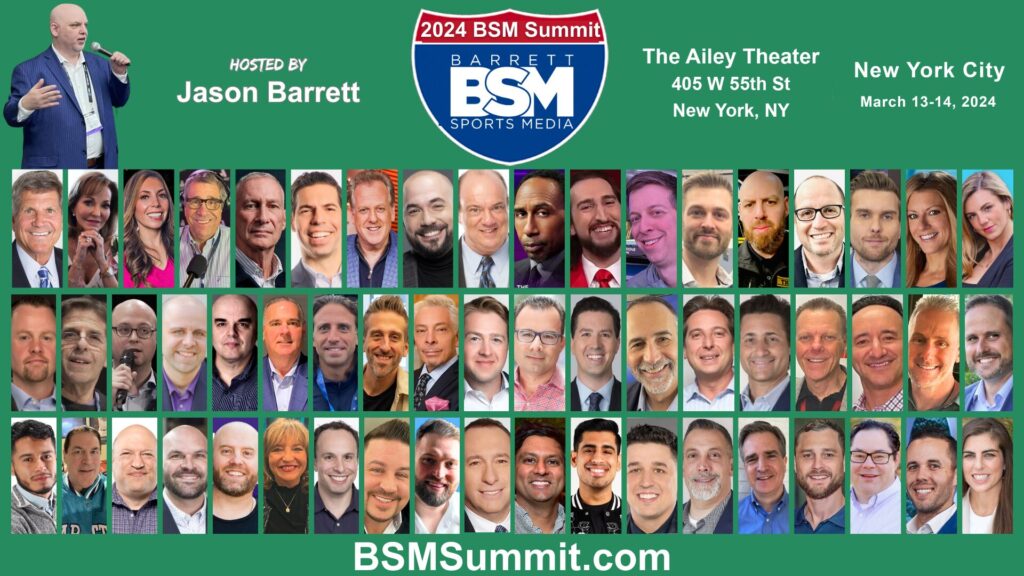
This week’s column is going to focus a lot on the upcoming 2024 BSM Summit. We released the full schedule today on BSMSummit.com. This is also the final day for event sponsorships to be secured. If interested, email Stephanie at Sales@barrettsportsmedia.com. We only have a few remaining opportunities.
If you’re participating at the show, be advised that emails will go out today to all speaker groups with details on date/time of session, content focus, the address of the venue, and who to contact on the day of the event. I have a few names I still have to add to our advertising panel. Getting CMO’s and/or media buyers involved isn’t always easy but I think it’s important. More on that soon.
But let me not bury the lead. We have a major addition to announce. I am both personally and professionally excited to share that Stephen A. Smith will join us at the 2024 BSM Summit.
A month ago I wasn’t sure if this was going to work out. As a longtime fan of Stephen A.’s, this has been a session I’ve wanted to do for six years. Sometimes schedules don’t line up though. But when things do fall into place, it’s pretty cool. This is one of those times.
Stephen A. Smith is a man who needs no introduction or hype. He’s one of the most successful on-air talents in the industry today, helping First Take enjoy nearly 15 years of unmatched success. Aside from his on-air excellence and the impact he’s created at ESPN and during the course of a three decade career, Stephen A. also serves as co-executive producer of First Take, and operates his own production company, Mr. SAS Productions. His book, Straight Shooter; A Memoir of Second Chances and First Takes is a New York Times best seller. He’s also created a hit podcast The Stephen A. Smith Show, which continues to attract a wide range of notable guests and thought leaders, and large audience.
On March 13th, Stephen A. and I will close out day 1 with a wide-ranging, in-depth conversation on the state of the sports media business. It’s a discussion that I know our professional audience will want to be present for. Given his rise to stardom, and ability to maintain a high standard while expanding into other areas of business, there’s a ton to tackle. We’ve got thirty five minutes to do it, and I’ll make sure we make the most of it. My thanks to Stephen A. and his team for moving a few things around to be able to join us.
8 More BSM Summit Speakers:
Stephen A. is going to attract a lot of attention, rightfully so but I don’t want to ignore how valuable these next eight speakers are to the Summit too. I am thrilled to welcome sports media’s top news breaker and a man whose recent arrival at The Athletic instantly elevated the brand’s media coverage, Andrew Marchand.
Joining Stephen A. and Andrew as additions to the Summit are Omaha Productions host Kevin Clark, Outkick’s SVP and Managing Editor Gary Schreier, Audacy Chief Digital Officer J.D. Crowley, Executive Editor and SVP of the Cumulus Podcast Network John Wordock, Matthew Berry’s Fantasy Life CEO Eliot Crist, 98.5 The Sports Hub program director Rick Radzik, and KOA 94.1/850 program director Dave Tepper.
I also want to thank SiriusXM, Quu and Bonneville International for signing on as Summit partners. We operate our shows independently and can’t pull them off without industry support. I’m grateful to every group that has pledged support for our 2024 show, and each individual who’s making time to join us in the big apple next month.
One-Day Only Sale:
To celebrate today’s schedule release and the addition of nine speakers, I’ve rolled out a one-day only sale on Summit tickets. We’re taking $50 off of individual tickets. To take advantage of the sale, click here. Prices return to normal on Tuesday February 27th. Ticket prices increase on March 4th to $324.99 so act now to avoid paying more.
Complete The Phrase:
Last week we tried something new in our 8@8. We introduced a full week phrase, which gave our newsletter subscribers a chance to win tickets to the BSM Summit. Congratulations to Heath Cline, Nick Cattles, Karlos Ortiz, Logan Ward and Michelle Rabinovich on being selected as our winners. Thanks to all who participated in the contest.
Thumbs Up:
96.7/1310 The Ticket: What The Ticket has created in Dallas with Ticketstock is pretty damn cool. The free event is well supported with sponsorships, giveaways, merchandise, contests, and live content from the entire on-air staff. In a time where sports radio isn’t active as it should be producing big money making live events, it’s good to see one of sports radio’s originals out there creating an impact.
More photos from last night’s appearance with the great Mike Modano at the Mullen & Mullen Injury Law Firm Ticketstock
Remember P1s if you want to meet Daron Bland or Christopher Reid – get to the Plano Event Center at noon for a FREE meet and greet pass while supplies last. pic.twitter.com/TJdRv5N9wU
Rob Parker: In May of 2016 I wrote a column and asked why no station in America featured an all-black sports radio lineup. Corporate groups didn’t rush in but someone finally took the leap eight years later. Congratulations to Rob Parker and his investors on the upcoming arrival of Sports Rap Radio in Detroit.
Battling 97.1 The Ticket for sports radio dominance isn’t going to be the focus for the new local sports radio brand. Creating an alternative for the black community and launching new stars is. Will it work? Only time will tell. But I appreciate folks who take risks to innovate. That’s something sports radio needs more, not less of.
670 The Score: I absolutely loved what The Score did to turn debate and discussion around Caleb Williams and Justin Fields into an event involving their audience. Having the access to an in-house room to invite fans in is a great asset Audacy Chicago has. Mitch Rosen, Ryan Porth and the Parkins and Spiegel team made good use of it with their QB1 Town Hall. The content was crisp, the room was full, and 670 took a normal day of Bears talk and turned it into an opportunity to create a stronger bond with its audience. Nice job by all.
Our Bears QB1 Town Hall is underway on @ParkinsSpiegel. The guys used the old-school method of asking everyone to yell to see who in here supports Justin Fields and who wants Caleb Williams.
Jonathan Zaslow and Q Myers: I’ll eavesdrop on a show every now and then and if I know the host(s), I’ll send a text to let them know I was listening. Especially if I like what I hear. That was the case last Thursday night. I’m not usually out at 10pm on a weeknight but while I was in the car, I scanned the dial and landed on Q and Zaslow. Their energy and chemistry was great, and the NBA topics and discussions were relatable and easy to process.
Having worked the night schedule before, you sometimes wonder ‘is anyone listening?’ The good ones focus and perform whether they have an audience of one or one million. Twenty to thirty minutes may not be a ton of listening time, but capturing even five minutes at night is difficult. Nice job by Q and Jonathan. They were on target and kept me interested.
Thumbs Down:
JJ Redick: Since bursting on to the scene, I’ve enjoyed JJ’s opinions and willingness to mix it up. It’s clearly worked because ESPN recently added him to their top NBA broadcast team alongside Mike Breen and Doris Burke. What I don’t understand though is his constant complaining about what people enjoy. Insulting the audience and their preferences is a sure fire way to lose fans. Kudos to Nick Wright for calling it out.
I totally understand folks who aren’t into televised sports discussion/debate. It’s not for everyone!
I will *never* understand someone who is incredibly wealthy, opts into working in the space, and then simply uses the platform to complain about how useless/dumb the space is.
Drama and opinion will always outsell education. Nobody is suggesting that JJ shouldn’t try to make fans smarter. I myself appreciate that. But if you expect people to prefer analysis over entertainment, prepare to be disappointed. Furthermore, despising the audience and what they value leads to more people tuning you out instead of in.
ESPN 97.5: Six months ago the station lost a promising afternoon show with Jake Asman, Brad Kellner and Cody Stoots. Fortunately, they had a strong midday show with Jeremy Branham and Joel Blank that was ready for the afternoon slot. They then added a new midday show with Joshua Beard and Michael Connor, and all seemed to be moving in the right direction.
The station has once again cut staff, killing the new midday show just six months into its run, and parting ways with the only program director in the building. It’s hard to say you want to compete when your decisions suggest otherwise. Frequent change also gives local clients less incentive to stick with you. Here’s to hoping it works out for John, Lance, Joel, Jeremy, Paul and Joe. Good, talented guys who deserve more help and stability.
Talent and content management company Workhouse Media is strengthening its leadership team. Former ESPN executive Scott McCarthy has signed on to serve as President, Workhouse Sports. McCarthy joins CEO Paul Anderson, EVP John McConnell, and EVP Keith Kauffman to expand Workhouse’s first-in-class talent and content business. His specific focus will be on the sports category.
The Los Angeles-based McCarthy spent 7 years in investment banking and venture capital before entering the media business. He spent over 25 years in audio, television, print, gaming, and digital, 12 with ESPN as a senior executive. Until companywide layoffs were issued in April 2023, McCarthy had served as Vice President of ESPN Audio.
“We are beyond fortunate to have Scott as part of the Workhouse family. Scott is a smart, disruptive thinker whose background and entrepreneurial drive make him the perfect person to lead our new sports vertical” said Paul B. Anderson, Principal & CEO of Workhouse Media.
“I’ve worked alongside and across the table from Scott for 30 years. He is a best-in-class executive and is perfectly positioned in this role” added John McConnell, Workhouse’s EVP.
“I could not be more excited or honored to be joining the Workhouse Media team and getting the opportunity to work alongside Paul, John, and Keith,” shared McCarthy. “Over the years, Workhouse has clearly established itself as the preeminent management company for talent and content developers to expand their brands and businesses across multiple entertainment platforms, and I look forward to helping Workhouse further develop their presence in the sports category.”
McCarthy will be in New York City for the upcoming BSM Summit. Those looking to reach out to Scott to congratulate him or learn about his new role can email here.
In his 11th year detailing cars for players of the NFL’s Seattle Seahawks, it would have been understandable for Gee Scott Sr. to never envision a career in the talk radio world.
After all, Scott had previously worked as a door-to-door salesman before a chance meeting led to him working as “just a guy washing cars” for players and employees of the franchise, never giving a career in any media, let alone a news/talk radio format, a second thought.
But, as is often the case, life had other ideas for Gee Scott Sr.
Using his connections with the Seahawks, Scott began hosting a podcast, which led to an interview with the popular running back Marshawn Lynch. After the interview with “Beast Mode” went viral, Scott began to see more media opportunities.
After a stint hosting on then-710 ESPN in Seattle, Scott Sr. moved to sister station KIRO Newsradio 97.3, becoming the first regular Black voice on the venerable station. After joining the station in 2018, he now hosts The Gee Scott and Ursula Reutin Show from 9 AM-Noon on the Bonneville International outlet.
Despite his success and ascension with the Seattle news/talk station, Scott Sr. admits he struggled in the space, mentally, until the final months of 2023 after being in the medium for more than a decade.
“I did not truly believe that radio was for me until about the last three to six months. I’ve had impostor syndrome this entire time,” Scott admitted. “I’ve been in a space where I’ve been trying so hard just to make sure that I don’t fail…This is no one else’s fault. This was my fault. In life, the most important thing is belief. Belief is more important than talent. Because if you believe, whether you’re right or wrong, it doesn’t matter.”
When asked about the process of finding his voice on the air, the Seattle midday host shared a shift in mindset included embracing his personality and what set him apart from others in the community to begin with.
“It took almost 10 years. It almost took the entire time that I’ve been in radio, and I’ve just recently realized that ‘Oh, I don’t have to sound like that person. I don’t have to be as smart as that person. I don’t have to know this specific topic like this person. Oh, wait, you mean to tell me that there is a space for me?’ So, I believe right now, in what I do, nobody can do what I do. Wanna know why? Because they’re not me,” he said.
“That’s why they can’t do what I do. So it took me almost 10 years to realize that the most important thing in this space is to be you. You can’t be this person or that person. It took me almost 10 years to realize that ‘Oh, I’m enough.’ And so when people open up that folder, and whenever your favorite soda is, if it’s right if it’s Dr. Pepper, if it’s Mr. Pibb if it’s a Pepsi whatever it is. So you have to be you, and there’s gonna be people that don’t like you. And you gotta be okay with that.”
Many in the business have aspirations of eventually reaching a national audience with a syndication deal. Gee Scott Sr. admits he couldn’t be less interested in the development of his career.
“I’m staying local. I’m staying with my people. I will tell you that they couldn’t pay me enough to go on a national level and do this. I’m staying local,” Scott declared. ” Why? The reason why I believe that the platform that I’ve gotten today is because of the people here that are local. That’s why I always want to stay living with them.”
Scott was quick to note he — in his view — isn’t a trailblazer for other aspiring Black hosts in Seattle. He argued outlets like Converge Media and former radio host Eddie Rye Jr. as pillars of hope for Black media members in the Seattle market.
He did say, though, that a deep belief in oneself can carry even the most disadvantaged and unlikely people to great heights.
“The only thing that separates me and someone else, I actually believe I can do it. Somebody else might have more talent than me to actually do it. So I don’t think it’s necessarily me that does that. The motivation might be that employers and people looking to hire folks like me, maybe it might be easier because they’ve seen it happen with me,” said Scott Sr.
“I was a car detailer for the Seattle Seahawks for 11 years, man. That was my experience for radio. So maybe this will encourage news stations or program directors across the country to be like, ‘You know what? That person doesn’t have a background, but I like that person. And he or she has an opinion.’ That’s all it is.”
Having the experience of working for the Seahawks, especially during the franchise’s heights as a Super Bowl winner and contender, helped shape the view of his potential future. And despite being gone from the organization for more than a decade, Gee Scott Sr. shared he still carries lessons and values he learned from his time with the NFL club.
“I watched all of those young men come in, and I saw regular people coming in every single day, working as a day to do something spectacular. People ask me all the time ‘What did they do?’ They came to work every day. That’s all they did. It really is that simple,” said Scott Sr. “You just gotta come into work all the time. That 11 years, being behind the scenes, really gave me a lot of courage to understand ‘You just gotta work hard.’ I attack doing radio the same way I watched those guys attack football.”
Michael Kay and Don La Greca have been working together since 2002. The duo was able to accumulate success together for over a decade, but in September 2015, management chose to add a third host. Kay and La Greca did not desire the change, nonetheless, they welcomed Peter Rosenberg and were receptive to his ideas and perspectives. As a result, they’ve ascended to a higher level, creating exceptional chemistry while leaving an indelible mark on the sports talk format.
Before Rosenberg joined The Michael Kay Show, he frequently listened to it. He detected an overall warmth from the show and felt included as a listener. Combined with the confidence and track record he had procured in media, Rosenberg was able to assimilate into 98.7 ESPN New York and the sports talk format while continuing his music radio duties. He was certain he would be able to find his way and make meaningful contributions and believes the program found its groove in the new structure quickly thereafter.
“I knew that I would bring goods to the table, and once we did a few shows together and we got along, it was pretty easy to see how it was going to work,” Rosenberg said. “Probably easier for me to see than for Michael and Don, but I could tell how this thing was going to work.”
Prior to each show, Rosenberg and his colleagues consider what people are discussing and what they feel passionate about. There are times when his views diverge from that of the group, but he is given the latitude to express himself and offer his viewpoint. In the end, he feels that the show oftentimes gets it correct and finds a way to resonate with the audience. A common remark directed towards Rosenberg, however, is his tendency to not speak all the time. The practice comes from discipline he has accrued over the years, along with a cognizance of the three-person format and ability to suppress hubris.
“If I don’t have a lot to say on a subject, we have three people,” Rosenberg explained. “I refuse to be the guy who’s like, ‘Let me just repeat the same point so you hear my voice and I sound like a sports talk host.’ I would rather wait for the spot and be impactful or make that little quip.”
Rosenberg will be on hand at the 2024 BSM Summit along with ESPN New York co-host Michael Kay, taking part in a Day 1 discussion. Having previously attended the industry conference several years ago, he remembers interacting with industry professionals and learning more about the industry as well. The conference will highlight many aspects of the sports business while examining current challenges, changes, and opportunities.
“There are a lot of jokes about sports talk radio – it’s very easy to make fun of – but it really is an art form to do it well,” Rosenberg said. “I’m not putting every show we do in the Louvre. We do three-and-a-half-hours a day, five days a week, but there are days that belong in the Louvre.”
Outside of his job with ESPN New York, Rosenberg works as a commentator for World Wrestling Entertainment, appearing on television one to two times per month for events. The mode of entertainment blends athleticism with storytelling and is something he considers to be an art form. Additionally, Rosenberg hosts a variety of digital programs and podcasts surrounding the sport, including Cheap Heat with The Ringer and independent YouTube endeavors such as Wrestling with Rosenberg and Real Late with Rosenberg.
“There’s a phrase in wrestling called, ‘Getting your shit in,’” Rosenberg said. “Wrestlers will joke about having a match where it’s like, ‘Well, I want to get my shit in; I want to get my moves in.’ I don’t need to get my shit in every day.”
Despite Rosenberg co-hosting the show with La Greca and Kay, the program is titled The Michael Kay Show, something that people could assume may cause derision or divisiveness. On the contrary, he does not regularly think about the subject and instead focuses on how he can help the program thrive on a daily basis.
Throughout the show, Rosenberg delivers his opinions and insights when appropriate and most salient to the overall discussion. Even so, he is able to talk at length and lead segments if necessary, equipped with a skillset fostered through countless repetitions behind the microphone. The balance between speaking and listening took time for him to implement, and through years of practice, he has become more adept at choosing his spots.
“I take a lot of pride in the sort of humor that I bring to the show, and a lot of that comes in when Michael and Don are being very serious,” Rosenberg said. “You may not hear me very much and it may just be an ad-lib that if you’re a real fan of the show and you listen, it cracks you up because you know sort of what my angle is.”
Although sports media was Rosenberg’s primary interest in his youth, he transitioned to the music format while studying at the University of Maryland. Considering his skills and passions, he determined that the hip-hop genre would be conducive to success and had dreams of hosting on venerated radio station HOT 97 in New York, N.Y. Rosenberg positioned himself for growth in these years, starting his own radio program on the student-run radio station in the summer ahead of his freshman year.
By the time he was a sophomore, he was interning with Darian “Big Tigger” Morgan and Keith “DJ Flexx” Clagon where he learned about formatics and how to run the board. Upon graduation, Rosenberg had stints working at WPGC and WHFS before landing his own talk radio show on WJFK.
Eponymously titled The Peter Rosenberg Show, the program featured Rosenberg and co-host Daryl “Quartermaine” Francis and fused hip-hop with sports and other topics. Even though many perceived the program to be primed for growth, Rosenberg was fired after one year at the station following an on-air feud with colleague Don Geronimo. During the ensuing week, he was broadcasting online from his bedroom while thinking about the future.
Ebro Darden, the program director and morning show host of HOT 97, decided to hire Rosenberg to work at the station in 2007. Since then, Rosenberg has co-hosted Ebro in the Morning alongside Darden and Laura Stylez. The cast provides listeners with honest, candid discussions, exclusive interviews, and plenty of hip-hop. Together the group has thrived within the sprawling media marketplace, building a unique camaraderie across the airwaves.
“Not a lot of teams at this level get along this well, as evidenced by what happened to our competition in the market,” Rosenberg said. “It is not easy for people’s ego to be in check and also for people just frankly to have good relationships – even beyond the ego, actually enjoying each other’s company.”
By hosting in a marketplace considered a consensus birthplace of hip-hop with extensive platinum artists along with many accomplished professional sports teams, topic selection in New York City can seem like a daunting task. Despite not being from New York, Rosenberg tries to captivate and enthrall listeners on two very different programs. The dichotomy between the two formats is something he believes has allowed him to appeal to different segments of the audience.
“When you do music radio, a lot of young women listen to you,” Rosenberg said. “It puts you in a different space – the way that you entertain; the way that you talk – what’s interesting [and] what’s cool is different. When you get on sports talk radio, you’re mostly talking to 50-year-old men, so I think every once in a while it’s useful to be able to inject some of the things that make it work for you with that different audience.”
In August, Good Karma Brands will leave the 98.7 WEPN-FM signal, shifting its focus to its app and the 1050 WPEN-AM signal. Despite enjoying a steady presence on the FM band since 2012, the local marketing agreement (LMA) established between ESPN and Emmis Communications will expire, and Good Karma Brands has elected not to pursue purchasing the signal. With roughly 60% of its listenership taking place outside of radio, ESPN New York will move forward with its focus on digital distribution, relying on 1050 AM for over the air availability.
“I think it’ll force us to be creative in terms of how we market and things like that, and I’m excited to see what everyone does, but I don’t spend a ton of time concerned about it,” Rosenberg said. “I think if handled the right way, you can really make it a positive with how you push the listening online and maybe find a way to surprisingly expand the show into reaching a bit more of a broad audience.”
The head-to-head competition between ESPN New York and WFAN is frequently scrutinized in each quarterly ratings book and has been addressed on various programs between the two entities. Although The Michael Kay Show has finished behind WFAN in the daypart, Rosenberg measures the success of the program through a variety of factors. For example, the program sold out its 20th anniversary show in New York City and has loyal callers who frequently chime into the discussion.
“We just get up every day and act like good people and talk about things that we’re passionate about. I wouldn’t trade it to be one of these screaming lunatics who talks about subjects they don’t actually care about just to get people to bite,” Rosenberg said. “It’s not what we do. To me, I think being yourself is what it’s all about because then if you’re never lying, you don’t have to keep track of what you said in the past.”
While they all have deft knowledge of various sports, Rosenberg tries to stay away from breakdowns that could either be difficult to ascertain and actualize or are too obscure to render enticing. In fact, his least favorite editions of the show are those that closely examine techniques and schemes associated with the games themselves. There are times when it is necessary, but he feels that it evokes previous theories on how to engender interest in the format and a motif of the transformation of consumer options.
“I think that the future of sports talk, to me, is going to be audiences who really want granular sports talk seeking out specific podcasts around the teams and sports that they’re obsessed with,” Rosenberg said. “I think the role of mainstream sports talk radio as we know it will be people who love sports and want to talk about it in a very entertaining way while being themselves and doing other things as well.”
While he still enjoys hosting in the format, he also understands that technological advances, paradigmatic shifts in consumption patterns and proprietary, athlete-driven content has obliged traditional outlets to adapt and exercise prudence. Avoiding misfortune is sometimes out of one’s control, but it is something that Rosenberg attempts to prevent by always staying at the top of his game.
“You’ve got to be talented and innovative because there are going to be less jobs. That is for sure,” said Rosenberg. “In terms of what the jobs are that are offered by big companies and where you can get yourself a nice little salary and insurance, those will be limited if you’re not a former athlete. I think it’s super important that we’re ready to pivot and do different things because otherwise, there’s just going to be so much competition among people.”
Throughout his media career, Rosenberg has amassed many accomplishments while cementing his position with ESPN New York, HOT 97, World Wrestling Entertainment and several independent undertakings. Despite generating consistent success in the country’s number one market in multiple formats, he does not consider himself to have reached his pinnacle as a broadcaster. Rosenberg undoubtedly cherishes his past and present work, but he exhibits tireless determination to augment his standing by aiming to perform at a level commensurate to and exceeding the ingrained standard.
“I know we live in a world where if you get a lot of viewers on Twitch and you’re 19 and funny, you’re hot, but I view what we do a little differently,” Rosenberg said. “I’m probably finishing up my 10,000 hours or just did in the last couple of years, so I’m really trying to master this craft and get to another level that I haven’t gotten to yet. I’m still working on it.”
If you are a fan of the NBA, you are familiar with the term ‘load management’ which has become popular in the last couple of seasons. I should say, if you are a fan of today’s NBA, because the NBA I fell in love with in the 80’s and 90’s had players who played unless they were hurt. Somehow I don’t think the thought of just sitting out a game here and there because it is a long season ever occured to the ‘Showtime’ Lakers or ‘Bad Boy’ Pistons.
Look, if the season is too long for today’s pampered players, we need to figure out how to shorten them. If not, maybe the players can sit out any game they want, they just don’t get paid for it (bet we see a change in behavior then).
I would love to spend this whole column writing about ‘load management’ from the player and fan side. Since I don’t have an NBA team in my city, I have to travel to see a game or two each year. I don’t even want to think about spending the kind of money it takes for me to get to an NBA game and then add in having to wonder if the player or players I am really wanting to see sit the game out for ‘load management’ purposes.
But, I digress. We cover sports media, not sports, so why am I bringing up the topic of ‘load management?’ Well, if you are a fan of The Pat McAfee Show on ESPN, you know that the show is taking a two-week break until March 4. The whole show. Just not happening. For two weeks. Instead, those that tune in to ESPN looking for McAfee, are getting SportsCenter. So, now, we have ‘load management’ going on with talk shows? I’ll come back to this.
Over the last decade or so, it has also been happening in the play-by-play booths of our favorite teams, especially in baseball. Recently here at BSM we have covered some stories of play-by-play talent being hired by baseball teams as Spring Training broadcasts get set to begin. If you are paying attention you are starting to see more announcers referred to as the “primary” play-by-play voice and then there is someone who serves as the backup. In some cases, there’s more than one backup.
What in the name of Vin Scully is going on?
Now, not only are our athletes managing their loads, but our broadcasters are, too?
What happened to the days when you would tune in to a team’s broadcast and you knew unless someone was sick or had a major life event, they would be the voices you would hear? In most cases you had one play-by-play announcer and a color analyst and they stayed in their lanes. After all, the two jobs are very different.
Today, you listen to a baseball game on the radio and you have play-by-play announcers switching off, you have color analysts doing a few innings of play-by-play, you have some innings where people disappear altogether. It’s like one of those lightbulb jokes, “How many broadcasters does it take to call one Major League Baseball game?”
Look, I get that people need breaks. I understand the grind of these seasons, especially baseball. So, perhaps you miss a game here and there during the 162 game (at minimum) season and the fill-in person sits in for you. Every once in a while, that’s understandable.
However, the nonsense that goes on now with people needing multiple innings off every game is a joke. Let’s put some consistency back in to our broadcasting.
The same can be said about your favorite sports television show, radio broadcast or podcast. Pat McAfee works his tail off. He is more than entitled to take some time off. What I don’t understand is why does the whole show need to shut down? Why does ESPN allow their programming lineup to be completely disrupted?
I think it is a bad decision by any content creator to not have consistency. It is so tough these days to pull audience away from their other habits. Letting them look for other programming for a couple of weeks while you take time off is a terrible idea and, in my opinion, shows little care for the people writing the checks.
Fans tune in to The Pat McAfee Show because they like the mix of sports talk, humor, bravado and all that comes with the show. I doubt many of them flip on the station, see SportsCenter running in place of the show they tuned in to see and leave it on. What percentage go somewhere else to find what they get from PMS in another show? What percentage of those discover something new they like? What percentage doesn’t tune back in because the habit was broken?
You can’t tell me The Pat McAfee Show couldn’t put together some great ‘Best Of’ shows or find a suitable fill-in host. Taking time off to refresh, spend some quality time with your family, take a vacation or just sit around and do nothing is great and needed. I just don’t get why the whole show has to do it at once. Give your audience something in place of your normal show that gives them a reason to stick around.
In my radio station management days, I always required programming to have a plan for vacations and if there was more than one host on a show, they couldn’t take the same time off unless it was a holiday. It never even occured to me we would ever allow a show to just take a few weeks off, throw the network on and just hope everyone came back when vacation time was over.
Consistency is huge in this business. Whether you are tuning in a game broadcast or turning on your favorite radio or television show, podcast or other digital content, you should expect to be delivered what you are there for, at least in some way, shape or form.
This past Thursday Kevin Clancy, better known as KFC from Barstool Sports, was a guest co-host with Gregg Giannotti on WAFN, filling in for Boomer Esiason (who notably took some time off without shutting down the whole show!). One of the conversations Gio and KFC had was about the behind-the-scenes nature of Barstool Sports. Clancy used the term “reality TV” to describe what viewers feel like they are watching whenever Barstool teammates start arguing with one another. It is like a family and it all plays out for the audience to see. This is great content for any talk show host to hear. Your audience wants to know what is happening behind the curtain.
You can hear the full conversation by clicking here.
On Thursday, Barrett Sports Media founder Jason Barrett announced the addition of Paul Heyman from the WWE as one of the speakers at the 2024 BSM Summit. If you follow wrestling at all, you know how big this is already. However, I know many of you have an aversion to sculpted men rolling around in their underwear in matches that are predetermined, so for those you that don’t know Paul Heyman from Paul Molitor, let me play Jason’s hype man and tell you, this is BIG.
Paul Heyman may be the best on-screen character in the history of pro wresting, he is certainly in the conversation. He is also one of the most gifted speakers on the planet and he flat out knows how to get a reaction from an audience and create great content. He has done it all, in front of the camera and behind the scenes. Bottom line, don’t miss this year’s Summit. Paul Heyman is worth the price of admission alone, and oh by the way, you also get insights from some of the brightest minds in broadcasting and content creation. Hope to see you in New York!
You can read Jason’s full announcement by clicking here.
You can also get just a taste of what Paul Heyman is all about by watching this preview of his WWE Network biography:
Last week, I wrote about the issues surrounding response rates in the Nielsen diary service. This week, word came out that the company is working on a new system to replace the paper and pen/pencil diary system. In the immortal words of Lizzo, “It’s about damn time.”
First, though, it’s always good to study history.
If you’re a regular reader, you know that Arbitron tried an online diary back in 2007. The design worked, but caused an issue with return rates, the percentage of diaries that are returned from households that agreed to participate in the survey. The postmortem determined that some diarykeepers had completed the online diary but failed to use the “submit” button to send the diary back electronically, meaning their diaries were not included. Work on an online diary didn’t resume for a number of years and those results were not promising.
While I do not have any special knowledge of Nielsen’s plans, the trade press comments from Jon Miller suggest that participants will be able to enter listening to streamers, podcasts, and essentially anything audio and do it online. This is a good move considering the growth of these newer audio sources and also gives Nielsen some new sales opportunities, reflecting changes in the business.
Back around 2002, Arbitron proposed changing the definition of “radio” to FCC-licensed AM, FM, and DARS band stations (Canadian and Mexican licensed stations are included as well). The DARS band refers to satellite-delivered radio meaning SiriusXM. You won’t see any estimates for SiriusXM in the diary service (the service is not encoded so does not count in PPM), but the reported listening counts in the diary PUR. Arbitron also announced that streams of broadcast stations would be included.
The change started a firestorm with the Arbitron Radio Advisory Council. Of course, SiriusXM was seen as a major challenge to the industry and the argument against streaming was that all you needed was a pea-shooter in a small market and a big promotional budget in a major market to create a competitive station at a serious discount to the then-high cost of entry. Arbitron stood its ground and proceeded with the changes.
You may not be aware, but there has been a reference to satellite and internet listening in the diary for many years. If you look at the example page, you’ll see entries for “Alpha Satellite” and another one that says “Internet” with a set of call letters. The instructions say, “You may be listening to radio on AM, FM, the Internet, or satellite”. You would be surprised how many diarykeepers do read the directions.
Let’s look at the audio clientele today. Just about every company streams their stations. Just about every company is into podcasting. Having the ability to have a potentially larger Nielsen number against these audio sources could mean greater revenue, although you can expect that Nielsen will charge more for access to the data about more audio sources.
Other than the extensive testing required, what is standing between the end of the paper diary and an online system? The main sticking point will be how the estimates change. Any time you change the survey method, the results change as well. In this case, it comes down to multiple points:
Did overall radio and audio usage increase or decrease versus the present system?
Where do we see the most change? Demos, race/ethnicity/dayparts?
How does sample proportionality look compared to the current system?
Are any specific formats helped or hindered compared to the current system?
What are the response rates?
Can the edit rules be applied the same way as in the present system?
I’m sure this list misses a couple of comparisons, but you get the idea. The ideal result would be no change to the current results or that estimates for radio increase with similar or better response rates and proportionality. That’s unlikely to happen.
Assuming the new system doesn’t look the same, it may come down to a matter of which company’s “ox is being gored”. If one or more of the majors decides not to play, the new system could be dead on arrival unless Nielsen simply chooses to go ahead based on gaining new clients and taking the attitude of “go find another rating service, oh wait, there really aren’t any!”
This confrontation happened once before. Arbitron tried to develop a better system of measuring streaming audio and the effort continued after the Nielsen acquisition. The new system could produce demos based on a combination of “real” data and modeling. In my view (and I was involved directly), it was a better system, but it had one problem. The overall estimates were lower than what the incumbent company was producing.
At least one major group owner said “no” because even with demos, lower numbers were not acceptable. You haven’t heard about that effort, but Nielsen holds a patent on the process (full disclosure: I’m one of the names on the patent).
The trade press will do their best to keep you updated on the progress, but now you have insight into how the process will proceed.