Audacy-owned 670 The Score in Chicago will host a unique discussion to deliberate what the future could hold for the Chicago Bears quarterback position on Wednesday’s edition of the Parkins & Spiegel Show.
Following a 7-10 campaign by the Bears that marked the third consecutive season without a playoff berth for the team, there have been several questions surrounding the future of starting quarterback Justin Fields. The Bears have the No. 1 pick in the 2024 NFL Draft in a class with several accomplished college quarterbacks. Having selected Fields with the 11th-overall pick in the 2021 NFL Draft, the organization could look to move on from him, although he is coming off a season where he threw for more than 2,500 yards for the first time in his career.
Emanating from the Audacy Chicago Blue Cross Blue Shield Performance Stage, afternoon co-hosts Danny Parkins and Matt Spiegel will deliver insightful perspectives and opinions on this quandary that has the football world waiting for a potential resolution. Various football experts will join the program, which will also include a live audience, contributing to the conversation surrounding this pressing topic.
The station ran a contest last week that determined the crowd at Wednesday’s event, known as the “QB1 Town Hall.” Members of the crowd will also be able to express their opinions and ask questions to a panel composed of Audacy personalities and sports industry professionals.
“This decision will determine the entire season’s trajectory and the fans are passionate about their views on it,” Mitch Rosen, vice president of programming at 670 The Score and BetQL Network, said in a statement. “We’re looking forward to opening up this conversation to our listeners and Bears faithful.”
Consumers can listen to the “QB1 Town Hall” broadcast of the Parkins & Spiegel Show on 670 The Score, the Audacy mobile app and company website. Additionally, video functionality will be available through the official 670 The Score Twitch and YouTube channels. The program will run from 2 to 6 p.m. CST.
Avlon is running in the 1st Congressional District of New York, which represents Suffolk County and a large chunk of Long Island. The district is currently represented by Rep. Nick LaLota (R).
In a video posted to X announcing his candidacy, John Avlon said, “Right now, our democracy is in danger. This election is not a drill. It’s up to all of us to step up and get off the sidelines. And that’s why I’m running for Congress in New York’s 1st district. There’s just too much at stake for the country and the community that I love.”
It's official: I'm running for Congress in #NY01 because there's too much at stake for the country & community I love. Long Island families deserve someone who fights for their values, not Trump's. It's time for us all to get off the sidelines. Join Me. https://t.co/fMu8RdLyBLpic.twitter.com/RHWAam8yif
Avlon joined CNN in 2010 as a political contributor before joining the network in a full-time capacity in 2018. He served as a senior political analyst and also served as a fill-in anchor during his tenure.
NewsNation has announced it has signed anchor Ashleigh Banfield to a new multi-year extension to remain with the upstart cable news network.
With her new deal, she will continue to host Banfield, which has seen steady growth in Nielsen ratings since its September 2022 debut. Viewership in the 25-54 demographic has risen more than 250% since her debut.
“Ashleigh is an incredible talent and a seasoned broadcast journalist,” said NewsNation President of News Michael Corn. “She covers crime and the justice system better than anyone and we are thrilled that she has re-signed with the network.”
Ashleigh Banfield will continue to focus on some of the top true crime cases making headlines.
“As the crime genre continues to be an increasingly important staple for Americans, Banfield has become an essential destination for true crime fans,” she said. “We are proud to be a place where viewers can come for a deep dive into the major crime stories happening across the country.”
Banfield currently airs at 10 PM ET on NewsNation.
Salem Radio Network host and Turning Point USA founder Charlie Kirk was the subject of two stories last week about his relationship with the Trump campaign faltering. He says the “hit pieces” are coordinated for a reason.
Both NBC News and RealClearPolitics had stories about the Trump campaign being angry with Kirk over recent missteps, including the statement that he wouldn’t trust a plane being flown by black pilots. Anonymous sources told both outlets that the Trump campaign was working to distance itself from Kirk and his conservative advocacy group over concerns that the link between the two sides could damage the former President’s public perception.
During an appearance on The Megyn Kelly Show, Kirk took credit for being one of the driving forces behind the removal of Republican National Committee chair Ronna McDaniel and believes that’s why the pieces are coming out now.
“We knew this was coming,” said Kirk. “Make no mistake, you don’t focus and eventually end up being successful in getting rid of an RNC chair without them running to NBC News to complain. So I’m unfazed by it. It’s all the typical, quite honestly, like left-wing attack vectors that are repurposed by this disgruntled, outgoing RNC regime.
“It should be illuminating for those in your audience that really want to see Joe Biden defeated in November that the RNC kind of henchmen and their media team were more focused on trying to plant stories against me and trying to lobby NBC News and RealClearPolitics,” Kirk continued. “So two pieces in three days like okay, can you make it more obvious, instead of trying to unite forces and combine forces to defeat Joe Biden in November? It is what it is. I’m unfazed by it.”
I could tell you why you almost certainly didn’t watch the NBA All-Star Game, or why you watched it for only a few minutes and then bounced. Really, though, you already know.
The game has gotten fat. Bloated. Sloppy.
Unwatchable, even with a galactic collection of talent.
And over the past couple of years, the All-Stars themselves have finally given up pretending that either the action or the outcome matters at all. (I mean, they’re right.)
You are not legally required to care about any of that, of course, since it’s not your job. You’re just supposed to create and influence the marketplace by either watching or not watching.
But what happens if holding the broadcast rights to All-Star weekend eventually begins to feel like something a network gets saddled with, rather than something it’s eager to pay good money for?
That question may help explain why NBA commissioner Adam Silver looked like he’d just eaten paste on Sunday night as he presented the winning trophy to the Eastern Conference team after a no-defense-allowed 211-186 shootaround that involved popular players wearing uniforms.
Adam Silver could not hide his disgust during the NBA All-Star game trophy presentation. https://t.co/gQBKgMeuRH
“And to the Eastern Conference All-Stars, you scored the most points,” the Silver Robotron intoned before adding, “Well … congratulations.”
The commish genuinely looked disgusted, but what did he expect? Not only have things been trending in this direction for years (no competition, all open shots, absolutely no fouling or body contract of any note), but the league’s own structure practically screams at the teams — and thus their players — to tank the All-Star Game in the name of stretch-run health.
Which is to say: It’s all about the playoffs.
That’s where the rub lies. The NBA wants its post-season lengthy and lucrative. The league leaves no doubt that the playoffs are where the real money lies, and its more recent bracket renovation involves 10 teams out of a possible 15 in each conference.
Twenty teams — out of 30 — hit the post-season, beginning with the play-ins.
It’s all about bank.
You don’t even have to question that — it simply is. It’s a fact of the business of the NBA. And so Adam Silver can hardly be surprised when the message that goes booming forth through the league’s 30 franchises to their stars is, For God’s sake, whatever you do, don’t go and get yourself hurt in the All-Star Game.
Did you hear LeBron James after Sunday’s debacle? No one is ever going to jump on LeBron when the subject of competitive fire comes up, but in this case, James made it very clear what the big motivation was on All-Star Sunday.
“I think the good thing that came out of tonight was none of the players were injured, and everybody came out unscathed or how they were before the game started,” James said. “So it (a competitive game) is a deeper conversation.”
James noted that while the stars don’t mind the up-and-down style of a defense-free game, it’s not normally in their competitive nature to just avoid guarding an opponent. But the bigger picture — no injuries — won out handily on Sunday.
It’s hard to know where a network is supposed to go with that. Credit the TNT crew with playing things about level — nobody tried to pretend this was anything other than a freestyle show — but there is just such a limited audience for the kind of tripe that was on the court in Indianapolis.
The last two All-Star Games, 2023 and Sunday, are the two lowest-rated in the history of the event. This year’s numbers actually represented a 20% jump over last year, which tells you how low the bar has been set lately. Even the hastily assembled, post-pandemic game of 2021 drew more eyeballs than the last two faux competitions.
Is there a way out of this? The short answer is, not with the game itself, which feels broken beyond repair. But the ratings for All-Star Saturday Night, which included the heavily hyped Steph Curry-Sabrina Ionescu three-point shootout, were up 31% from the year before and equaled the total viewership of the 2023 game itself, which at least signals viewers’ willingness to watch something that is, you know…interesting.
There is still value in having an All-Star weekend. Any time a league can get its brightest stars together under one roof, a massive amount of attention will be paid. It’s actually remarkable, considering the individual popularity of these guys, that they could be the featured players in such a widely trashed game.
Every All-Star game in every sport was originally designed with one goal: Increase positive publicity for the league that sponsors it. In recent decades, the game is also supposed to be a gold mine for the network that broadcasts it, or at the very least not a loss leader.
Now, Adam Silver and his cohorts have to come to grips with the reality that their players, and the people who cut those players’ checks, have no interest in seeing any sort of effort on All-Star weekend that would open the door to an injury, not even a crack. What results, as a broadcast, is a tough watch — and maybe, someday, a tough sell.
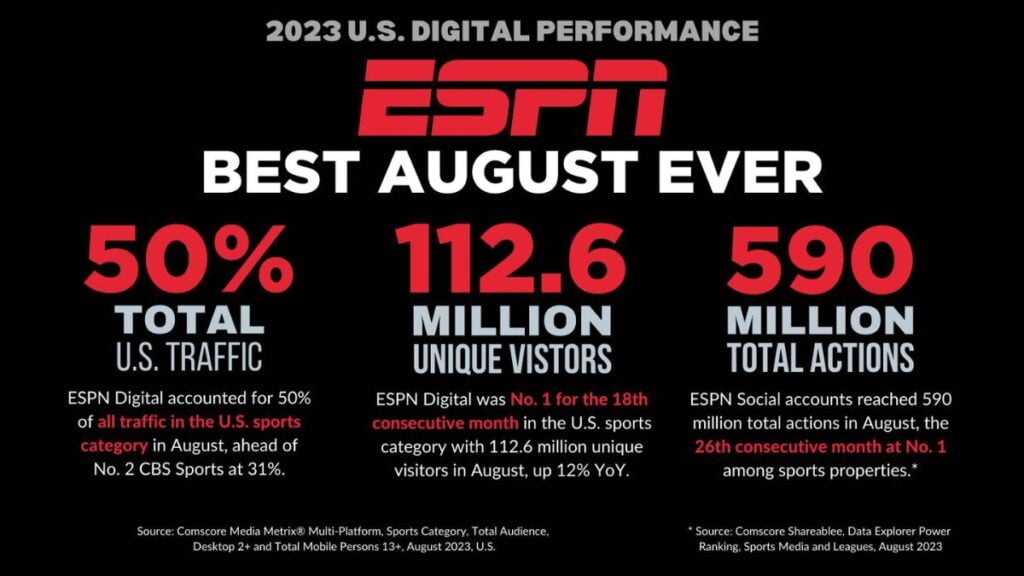
This week’s edition of Social Studies features Amanda Anderson, ESPN’s Senior Director of Social Media. Anderson started with the network right out of college in 2011. When she started with the social team they primarily focused on Facebook and Twitter with Instagram being the “new platform.” Now she oversees an expansive team that works directly with tech companies, teams and athletes to stay on the cutting edge.
In this interview Anderson discusses ESPN’s social media KPIs, partnerships with athletes and how a ubiquitous sports brand like ESPN approaches audience expansion. We also dive into the Creator Network which comes to Bristol February 28th and the value of influencer marketing in sports media.
Note that this interview was conducted on February 16th and has been edited for brevity and clarity. Visit the Barrett Media YouTube Page for the full conversation.
AR: What does the sort of typical day at ESPN in your role look like?
AA: I’m so multifocal focused. I’ll use today as an example. Today we were celebrating a huge part of our efforts that we’ve been planning for more than a month, which was Caitlin Clark, and her moment last night. We started to see the likelihood that she would be breaking this record and we had a full team-wide brainstorm the first week of January to start the build up for it.
So today, I started by doing a clean sweep of all of our content and looking at the numbers. We have a Slack channel. We’re big slack users on the social team that we call ‘Crush Bucket.’ That’s where we celebrate all of our wins and highlight and shout people out for leading an event or discovering an amazing piece of content.
One of the highlights last night was how many different athletes rallied around ESPN content about Caitlin. That was my morning – let’s celebrate this, let’s make sure my leader sees that. Let’s celebrate that we owned a moment that wasn’t on ESPN, it wasn’t ‘ours’ necessarily. But we really brought all the creative energy and creative juices to be a gathering place for athletes and sports fans alike around that moment.
Another big part of my job from an ops standpoint, is engaging all of our partners so right before this, I was on a call with Meta talking about new events that they have coming up some potential collaborations, engaging them around our Creator network, so they can help elevate the creators that we’ve selected in this class using their platform.
Then it’s on to hiring development and one-on-ones. Managing people is such a huge part of any leader on the social team’s job. That’s really important because so many employees on our team, it’s their first job. They’re very young and very hungry, so molding and investing in the energy that they bring and showing them the ropes of how to succeed in a corporate company like ESPN (Disney) is a big passion of mine. It’s really a point of emphasis for our entire team.
AR: So let’s dive in a little more specifically. What do those wins actually look like? Which numbers do you look at and then take to your higher ups?
AA: The obvious KPI and we say it constantly is engagement. So there’s more nuance to it than that. Because ESPN and our team is so focused on so many different sports properties and leagues and sport verticals, how we celebrate that and what engagement looks like varies, and what’s considered success varies.
We know that a women’s volleyball post on ESPN isn’t going to engage at the same rate that a Steph Curry post will and that’s fine. So I would just say engagement is our North Star but we get a lot more nuanced and sophisticated. It’s not just a simple, “our average on ESPN or SportsCenter on Instagram is this, anything above that is a success, and anything below that is not.”
Audience expansion which is such a big part of all of our roles, and mine in particular, especially with regard to women’s sports, or underrepresented sports, which is what we’re trying to account for in the Creator network. We have so many more layers of numbers to say, ‘Hey, did this post about Caitlin Clark, get more people to follow [ESPN] W?’ That’s an added layer besides over indexing. We’re often getting a lot more granular than that. But engagement is a good starting point to say how many fans took action on this? How did it move them in such a way that they had to do something with it? Like, comment, share, etc.
AR: Tell me a little bit about the Creator network, and how the importance of micro-influencer marketing plays into that strategy.
AA: Everyone who works in social knows the importance of creators in the space. With the fans that are coming up, we’re increasingly seeing these younger cohorts identify less and less as avid fans. At the same time, this younger generation, the majority of them are looking to influencers for guidance on how they spend their time, money, and what shows they’re watching. We want ESPN to be at the forefront of that conversation and top of mind, even for people who maybe aren’t sports superfans – who we at ESPN serve really, really well.
This year’s class is all female, which is new from last year, and what we’re hoping to do with the Creator Network is serve not only the super fans, of which there are many, but we’re also trying to find new ones and use the power of sports and storytelling to help new fans connect with either the athletes, teams or creators themselves that look like them. So it’s multifaceted – our approach of what we’re trying to do with this group.
AR: In terms of leveraging personality to reach people, tell me how the social team works in conjunction with ESPN talent who are commanding really big audiences themselves.
AA: It’s the same approach where, Stephen A. Smith, Adam Schefter or Lachina Robinson are talking about something, a fan is going to connect with them like they would a friend, fellow fan or teammate. It’s done in a way that a brand just doesn’t have that versatility and flexibility. And one doesn’t have to compete with the other, we want to do both.
So with our talent strategy, it’s that same goal of how are we connecting with fans in a person-first approach. That is going to be really effective in a different way than our brand handles. It deepens the connection and allows and affords a lot more unique distinction and flexibility, like what a talent can say as their opinion is not the same as a social brand that’s speaking for a large company.
AR: How do your partnerships with athletes play out on social?
AA: Being able to align, as I mentioned before with the Caitlin Clark example, athletes rallying around our content helps us stay relevant. That helps us keep our brand distinct. One example I would offer is, we worked with Mikayla Schiffer last year when she broke the All-Time World Cup wins record. We got ahead of that well in advance, spoke with her agent, and were able to create a storytelling piece that talked about her whole journey and comeback after the Olympics.
Ultimately, that resulted in a collab from espnW to her own handle. Again, it helps us target and be more precise with who we’re reaching. Everyone who is a fan of Mikayla is going to rally around that story from her brand standpoint. And then on the espnW side, we may be telling people about Mikayla’s story that aren’t alpine skiing superfans. So we look at it as mutually beneficial. When we’re able to collaborate with athletes, we’re able to establish ourselves with the fans of that athlete. And on the flip side, maybe create new fans who are less familiar with them with our brand handles that are trying to serve everyone.
AR: So as you mentioned, you’ve been at ESPN since you graduated college. Can you tell me about your experience and how social media at ESPN has shifted over that time?
AA: Oh my gosh, it’s evolved so much. This is kudos to our leader, SVP Katie Daly, who had the vision for this group. She has always seen it as an extension and a way to reach fans in a unique way. When I started, we were programming, primarily Facebook and Twitter and Instagram was like the new thing. At the time, everyone working on social media was also working on other parts of ESPN digital.
It’s amazing to see how it’s evolved from a handful of people in a scrappy, startup-mentality environment working on just the ESPN account and maybe two or three others to now where we are programming 20 different brand accounts on six different platforms 24/7. The fact that it requires an ops management team that I oversee now is just wild.
I like to think that we’re the best of both worlds. We still maintain the scrappiness, hustle and competitive drive as a startup but now they have established it to be a revenue producing and generating group that’s only rising in the amount of fans we’re able to reach.
AR: Does that start up mentality lead to a need to be on the cutting edge? What does innovation look like?
AA: Something we remind our own internal partners outside of the social group is that the platform’s are changing their algorithms and what’s prioritized. They’re rolling out new capabilities all the time. It can be frustrating sometimes to partners when they say, ‘hey, we’d like to collaborate with you on social and the story. Does this thing that we talked about six months ago, is this still what you want to do?’ And oftentimes the answer is like, ‘nope, actually. TikTok is now testing out horizontal video and eight months ago, we said give us everything vertical.’
So we really pride ourselves on being quick to experiment with and be like scientists to some degree of learning the platforms. No one hands us a playbook. So it’s on us to figure it out. And we know that the playbook is constantly evolving. Instagram Reels is another example where at one point it’s really hot and other times we’ll pivot our strategy to a carousel format, depending on what we’re seeing. And that just changes so quickly.
So what does that do for a team’s mentality? No one is ever complacent. And no one ever wakes up and says, I know exactly what’s going to hit today and what works, because there’s always this standard of evolution.
AR: You touched on some of the innovations and things that you’re working on right now. But outside of those, what are the big goals on social in 2024?
AA: Audience expansion is a big one. Finding new fans is our primary focus especially on youth sports and youth fans. Women through the lens of women’s sports and female sports fans is another huge area of focus for us. We measure ourselves every year on certain areas of engagement. So every account will have its own follower goals. Every account will have its own average engagement rate every year.
The other thing that is a constant goal is responsibility. We measure ourselves in trying to up our approach around women’s history. Black History Always is in our internal corporate branding for February. We have leads established every month and we’re always trying to up the game and increase what we’re doing with storytelling. One thing that we’ve learned since this has become a consistent part of managing social is how to show up in these spaces authentically while increasing our storytelling, experimentation and overall reach.
We rally around events like Black History Always, Women’s History Month, International Women’s Day and AAPI [Heritage Month] and now because we’ve been doing it for several years, we create content that performs above our averages. It’s not just like checking a box. We want our storytelling and the ways we show up in those spaces to be empowering. We want to move a fan with what we’re telling them to be a part of change, or to educate them about a trailblazer or a pioneer in sports that maybe they were less familiar with and be inspired by.
That’s a big component outside of the obvious, reach a lot of people and grow and find new fans, but also do it in a way that is reflective of our brand authentically.
AR: Where do you see the social space going forward?
AA: I think that there will be even more platforms. We’ve sort of seen the emergence of TikTok and other platforms emerge, like BeReal and Discord. It’ll be interesting to see where brands decide to be.
One thing we’ve learned as the social space has become more established is that the strategy is not the same for every platform. Therefore, if you’re operating with a small team, or even, let’s say one person, it’s more valuable, for you to be in one space, doing it really well, and connecting with fans in an intentional way, versus what many of us working in this social industry experience, trying to be everywhere, and maybe only doing a 20% effort.
I think more brands and social platforms are going to emerge. That seems like a given. Whether that number doubles or triples, I think brands will have to make harder decisions about where they can feasibly show up in a way that’s having impact from a reach and revenue standpoint.
When news organizations collide, journalism loses. Last week, CNN posted on X saying “US inflation cooled down in January, offering some relief for Americans who have suffered through the steepest price hikes in four decades.” The same day Fox News posted “BREAKING: Inflation rises faster than expected in January as high prices persist.”
While these are seemingly opposite statements, both can be true at the same time. More importantly, both of these outlets are manipulating their audience.
People like their own opinions and want those opinions verified by others. This is what social media has done to news: You read the post, see your opinion is valid, and then move on to the next clickbait (confirmation bias). More importantly, both of these tweets are true because one is based on an estimate, and one is based on actual numbers.
Looking at CNN, while their post on X seems positive, their business headline is a little less positive, “Inflation cooled last month, but some price hikes continue to cause pain.” The change from tweet to headline is striking. One says Americans are getting inflation relief, the other says inflation continuing to cause pain. In today’s world of “Read the headline and move on,” this is why people feel CNN lies. Its post is in conflict with the headline— even though both are true statements.
It’s not until you read the article that people can see how this is possible. The outlet notes overall inflation did cool when comparing January 2023 (6.4%) to January 2024 (3.1%). Four sentences into the article it says, “CPI rose by 0.3% in January.” It goes on to break down why inflation is still high and causing pain in the pockets of Americans. Although the X post is factually correct, people on the right side of the political spectrum feel CNN is untrue because they see the inflation problem in their bank account.
Meanwhile, the Fox News X post and Fox Business headline are identical, “Inflation rises faster than expected in January as high prices persist.” However, the keyword here is “expected.” Inflation did cool year-over-year. However, because Fox is comparing the January 2024 number to what experts expected the number to be, what they have posted is factually correct. This nuance is sometimes lost on readers.
The article does not mention inflation is down year-over-year. However, nine sentences into the article, the business outlet says, “Inflation has fallen considerably from a peak of 9.1%.” The nuance of “expected” combined with the lack of mentioning year-over-year inflation is down is why the left side of the political spectrum believes Fox lies.
Let’s be clear, neither CNN nor Fox News have lied (on this one specific topic). They both chose to present the same data differently. It also needs to be noted, CNN and Fox News are not the only outlets that do this. They all do. Playing with numbers and technicalities is a function of what the media does today. Since the average person just reads the headline, viewers will likely move on if it confirms their own bias. The problem is twofold.
Facts are no longer direct but skewed to fit a narrative.
Some viewers accept headlines and posts without diving deeper into the article.
We have been trained to share a headline without reading the article. We’ve known this since 2016 when Columbia University and the French National Institute found 59% of shared social media links were never read. We’ve gone from headlines selling newspapers, forcing people to read the articles, to headlines being shared on social media, but people won’t read the articles.
This is only a small part of why The Messenger failed: neutrality. The sentiment of unbiased news was well-intentioned. However, America has lacked unbiased news since 1987 when the Fairness Doctrine was abolished. Many on the left believe this has helped right-leaning outlets. This is false. Not only has it benefited both sides of the aisle, it can be argued the progressives have benefited more than the conservatives (but that is a different article for a different day).
When news outlets collide, the American public loses. Not because we lack news, but because we lack the ability to read the full scope of the issues in one place. Outlets are not forced to present all sides of the political argument or present the entirety of data sets. Additionally, news is not being fully read. Headlines are now king. Shares, clicks, and likes keep the lights on in newsrooms. Most importantly, facts are now nuanced. This forces debate instead of continuity and cohesion.
As Danny Parkins was recovering from spinal fusion surgery that stymied his high school athletic career, a science classmate informed him about the institution’s radio station. Finding the studios required a trek to the fifth floor of the building, a tier that Parkins was wholly unaware existed. Shortly thereafter, he was asking a college counselor the best schools where he could pursue a career in sports media, resulting in him selecting to attend Syracuse University and enroll for membership at WAER-FM. The sports division of the outlet had a path focused on play-by-play announcing and another focused on talk show hosting and commentary for students to consider. Parkins explored both segments before realizing his ultimate focus.
When he was a sophomore, Parkins met colleagues Nick Wright and Andrew Fillipponi as he aimed to materialize his media aspirations in the sports talk radio format. Wright was running the talk show staff at the time, and they quickly became close friends who assisted each other by listening to tapes and offering feedback. Moreover, they all engaged in sports debate and spent time together outside of the radio station, strengthening their bond as lifelong friends and Syracuse alumni. The three hosts will reunite on stage at the 2024 BSM Summit in New York City alongside fellow Syracuse alumnus and SiriusXM Mad Dog Sports Radio host Damon Amendolara.
“It will be fun to just be up there with these guys who we talk about the industry [with] all the time off the air doing it in front of people who kind of helped shape the present and future of the industry because I think that the three of us are pretty damn good at it if I’m being honest,” Parkins said. “That will be a valuable exchange of ideas, and they’re just some of my best friends in the world, so I’m looking forward to that and seeing them.”
Outside of his endeavors with WAER, Parkins hosted his own sports talk program on Z89, another student-run radio station at the university. Additionally, he gained professional experience by producing Brent Axe’s talk show on The Score 1260 after completing an internship. Parkins graduated with qualifications that he hoped would lead to a job, but things became difficult because of a hiring freeze at various media companies because of widespread economic hardship amid a nationwide recession.
Parkins had money for graduation that he used to pay the necessary rent to live with his friends in Wrigleyville and spent time playing poker to attain profits. While unemployed, he also traveled to various destinations around the world, one of which happened to be Syracuse where he met Axe for lunch.
Axe revealed that the station was thinking about adding local midday programming, a revelation Parkins immediately volunteered to enact. While Axe was somewhat incredulous that Parkins would move back to Syracuse for the role, which was compensated hourly, he followed through and started hosting The Danny Parkins Show. Furthermore, he produced Bud and the Manchild and was paid for six hours of work per day while living with two people in a home he found on Craigslist.
“[I] was embarrassed that I hadn’t gotten a job with a salary and health insurance and in a bigger market but was thrilled that I was hosting and doing my thing,” Parkins said. “I was doing what I wanted to do, and it ended up being the best thing for me because then I could apply for other jobs and point to, ‘Hey, you can listen to my show on the website.’”
While beginning his professional career in Syracuse, Parkins developed invaluable versatility that he utilized in his ensuing occupations. Collecting sound at Syracuse practices, operating the board while hosting and booking interviews coerced him to effectively balance multiple tasks. Parkins felt the move back was humbling and fostered a deeper connection with the city by meandering to different social outlets and interacting with listeners. After he found success in Syracuse, Wright helped him land a role with 610 Sports Kansas City where he signed a two-year contract and expected to have a short stay in the city.
Conversely, Parkins remained with the station for approximately six years and covered several marquee events, including the Super Bowl and World Series. He was eventually paired with Carrington Harrison for a four-hour afternoon program and reaffirmed his commitment to the city.
“Some people that were there would still go back to Minneapolis for dentist appointments or whatever, and they didn’t really sink their teeth metaphorically into Kansas City and it never really made any sense to me,” Parkins said. “It was like, ‘No, if you’re here, you’re going to be here. You’re going to meet the people and go cover the practices and go to the games and go to the restaurants and be about town and really be a Kansas Citian for as long as you were there.’”
Anticipating that Chicago sports radio host Terry Boers would retire, he signed a one-year deal with 610 Sports to position himself for a move back to his home market. Sure enough, the situation ended up working out and led to him being partnered with Matt Spiegel in afternoon drive on 670 The Score. Parkins underscored that the outlet usually promoted from within and that his hire from another market was rare.
“I just kind of had to prove myself to everybody, including myself,” Parkins said. “I knew I was good enough to do it, but until you do it, there’s always going to be that shred of doubt. There were certainly challenges, but it was still getting behind a microphone and talking sports for four hours a day, and I knew that if I was given enough time that I was good enough to do the job.”
Parkins continues to host in afternoon drive with Spiegel today, forming a duo that has frequently finished among the top programs in the marketplace. There was a stretch, however, where he was hosting with Dan McNeil, a former member of the illustrious Mac, Jurko and Harry program on ESPN 1000 Chicago. Parkins had interned with McNeil and expeditiously formed a connection with the host with a cognizance about his controversial opinions and fickle nature.
Jimmy de Castro, former senior vice president and market manager of then-Entercom Chicago, split Parkins and Spiegel to form the new afternoon pairing in an overall downsizing at the station. Despite the adjustment, no changes were made to Parkins’ contract and he was referred to by de Castro as “kid,” a moniker he felt indicated that he needed to further prove himself.
“It was not a perfect set of circumstances to work with one of your radio heroes, but I’m really glad it happened in the whole,” Parkins said. “Mac and I had and have a great relationship, and I love the man.”
McNeil was fired in 2020 after posting a misogynistic comment towards a sports media host on social media, marking the conclusion of his third stint with 670 The Score. The station utilized Leila Rahimi and the aforementioned Spiegel as temporary co-hosts with Parkins as they deliberated the long-term solution. After some time, Parkins and Spiegel were reunited and have been hosting their show together ever since.
“I think that Spiegs and I work really well together because we complement each other,” Parkins said. “We’re similar in ways that are valuable, and we’re different in ways that are valuable.”
As they prepare for a typical program, Parkins and Spiegel focus on how they can offer a unique perspective for the listeners to prevent the station from sounding repetitive. There exists a lot of content within the media ecosystem, and it is essential that the Parkins & Spiegel Show stands out from others.
“The goal is to make four hours feel like four minutes and help people get through their day and be an escape for people,” Parkins said. “….People are not going to remember the brilliant point I had about the Cubs bullpen or a fourth-down call, but maybe they’ll remember an honest story that I shared about personal hardship or parenting or a story of being an incompetent homeowner and that makes them relate and laugh and smile a little bit while they’re sitting in their cubicle.”
The show does not take many listener calls, but it seldom goes more than two segments without some form of listener interaction. Aside from listening to the program on traditional AM radio, consumers can access the show using the free Audacy app or livestream on Twitch, which includes a live chat functionality. Shane Riordan and Chris Tannehill contribute to the show as well in producer roles, both of whom infuse the show with additional energy.
“It needs to be entertainment-focused,” Parkins said. “I hate when people say on a show, ‘Later on, we’re going to have some fun,’ but the whole thing is supposed to be fun. I think that’s what the great shows do – they put every story they can through the prism of fun.”
As the vice president and brand manager of 670 The Score, Mitch Rosen has a responsibility of overseeing programming and ensuring that the station is achieving its goals. Rosen is responsible for hiring Parkins in the first place and is someone he greatly respects and appreciates for his efforts and reliability.
Although the media marketplace is changing, Rosen and Parkins are continuing to execute their roles to safeguard the consumption of sports media content. Parkins used to intern with ESPN 1000 Chicago, and he believes it is a good thing to have two successful sports talk radio outlets in the city. Yet there is an element of competitive fervor, especially going against another local program, that adds to the fuel Parkins has to be the No. 1 program in the city.
“I think people come to The Score because we’re the heritage radio station with the great signal that’s live and local all day that is going to be raw and authentic and genuine and edgy and unapologetically ourselves,” Parkins said. “We’re not going to do any sort of sanitized version of a story, and I think that’s our strength.”
There is a contrast in Parkins’ desire to be the No. 1 show, however, related to a philanthropic project for which he utilizes his platform. Parkins lost his brother last April after he suffered with glioblastoma, a form of brain cancer, and is committed to raising money and awareness surrounding research to treat and cure the disease. Over the summer, Parkins will host a 24-hour radio-thon in partnership with the Chicago Cubs to expedite these efforts and has a goal of raising more than $1 million.
“We have a pretty selfish job,” Parkins explained. “I know people don’t like to admit that, but I get to tell my wife, ‘Hey, I have to watch this game for work,’ and then I get to come in and BS with three of my buddies about sports for four hours a day and judge success based on how many laughs we have in the greatest city in the world, get paid handsomely for it and then go home. It’s a pretty awesome way to make a living and live your life, so it would feel selfish to not use that platform for some good.”
Parkins recognizes there to be considerably more supply than demand for content and evinces dedication from aspiring professionals looking to break into the format. He is cautiously optimistic about the future of the audio format if executed correctly but also asserts that the glory days of radio have come to their conclusion.
“The Score will exist in 20 years,” Parkins said. “Will it exist primarily as a radio brand? I don’t know, but The Score will be doing live sports talk content in Chicago in 20 years – there’s no doubt in my mind about that. It’s just got too much brand equity in the market, so I just want to be sure that it’s as relevant as possible in 20 years.”
58 panelists ranked 34 afternoon shows and @ParkinsSpiegel placed 2nd in the country. Also highest ranked show in Chicago in any time slot.
Although he cherishes the Chicago marketplace and the platform he has built, Parkins values his versatility and continues to take part in other areas related to sports. For example, he co-authored with a close friend titled “Pipeline to the Pros” is set to be released this April. Parkins is also continuing appearances on television programs with Marquee Sports Network, a local regional sports network. Through it all, he remains committed to the Parkins & Spiegel Show trying to do his part in achieving a consensus No. 1 finish.
“I don’t have undisputedly the best show in the country yet; we aren’t No. 1,” Parkins elucidated. “I haven’t done this next radio-thon to hopefully raise seven figures for cancer research, and then after we do that radio-thon in August, I’m going to say, ‘Well, when’s the next one and can we beat it and raise more?’ I’m always looking for the next thing; the next side-hustle; the next project.”
A recent trend in the television play-by-play and analyst world should be welcomed by each and every announcer out there. Networks are dishing out millions of hopes of their broadcasts having the gravitas expected from big games and big moments.
That’s a perfectly well-intentioned idea. It makes logical sense that outlets like CBS Sports, NBC Sports, FOX Sports, and ESPN want to have high-quality announcers for their biggest moments.
But at the same time, are those same outlets getting the best bang for their buck when it comes to salaries like Tony Romo ($18 million), Troy Aikman ($18 million), Joe Buck ($12.5 million), Cris Collinsworth ($12.5 million), and Jim Nantz ($10.5 million)?
As someone with quite a bit of time under my belt looking through the biggest and best sports radio station in America on a daily basis, would you be surprised to hear that Nantz, Romo, and Collinsworth aren’t exactly sports radio regulars? Probably not. But should you be surprised? Shouldn’t Sunday Night Football, Monday Night Football, and the NFL on CBS want these folks doing sports radio hits around the nation, especially in the markets where the teams playing in their properties are located?
To their credit, Aikman is a weekly guest during the season on The Ticket in Dallas, and Buck is a weekly guest on The Michael Kay Show, and isn’t shy about appearing on a station where the MNF competitors are.
But Romo? What’s he doing on a Thursday or a Friday that he can’t hop on 810 WHB in Kansas City or 1010 XL in Jacksonville to chat about the game he’s doing that weekend? Is he too busy preparing for the game? I think we all know that isn’t the case.
Collinsworth not only has his gig with Sunday Night Football, but should have a vested interest in getting Pro Football Focus in front of more fans. And yet, I rarely hear him on sports radio outside of The Dan Patrick Show.
When Tom Brady takes over the top FOX booth, will he be more of the Romo or Aikman type? My money is on a Romo-esque schedule where you’ll rarely hear Brady on a local sports station.
So why don’t networks expect more out of their top-flight analysts, rather than just showing up on Sunday or on Thanksgiving? Why wouldn’t they want their talent on every local and national radio show they can get them on? It only benefits their products, unless you’re afraid your analyst is going to say something to land them in hot water. And if that concern is in the back of your mind, wouldn’t you rather have that instance happen during a local sports radio appearance in say Milwaukee rather than on the biggest American TV properties?
Additionally, why aren’t the networks pounding the table for their analysts to be featured in video games? That isn’t just NFL-specific. With a new College Football 25 game upcoming from EA Sports, shouldn’t ESPN want Chris Fowler, Kirk Herbstreit, and the entire College GameDay crew in the game? Shouldn’t FOX Sports want the Big Noon Kickoff cast, plus Gus Johnson, Joel Klatt, and Jenny Taft in the game?
Video games are the last great frontier for announcers. The video game industry, in 2023, brought in $365 billion in revenue, more than the music and movie industries combined. EA Sports brings in tens of millions of dollars with its Madden franchise and will see a huge groundswell for the first College Football game in a decade.
I just don’t see how the networks — who have invested tens of millions of dollars in their top broadcast teams — can just be ok with their analysts showing up on Sundays and that’s it. Even a weekly spot on SportsCenter, Good Morning America, The Today Show, or as a guest judge on some reality show or a cameo on a cop drama should be the bare minimum for what’s being shelled out for these salaries.
And yet, it appears that the status quo is just a-ok. You would be dumbfounded if the Kansas City Chiefs didn’t use Patrick Mahomes in its marketing materials, and you’d be bewildered to see LeBron James never get an endorsement deal.
And yet, after investments that rival players’ salaries, and in many cases eclipse them, I just can’t seem to wrap my head around the complete lack of promotion and use of these big-time personalities and well-known figures in their stables.
At a time when budgets are being cut, jobs are being slashed left and right, and you’re pinching every penny, it seems unjustified to not get a little more bang for your buck from high-profile talent in 2024.
Thick skin. If you work in media, you gotta have it. If you don’t, you either won’t last or you won’t sleep – or both.
Even if you are neutral politically, super nice, and in it for all the right reasons, there always will be people who criticize you, and some will even make it personal.
Having “thick skin” is a cliché I’ve been thinking about and dealing with for years. I find it fascinating that, somehow, I am way more sensitive at home than I am at work – and by at work, I mean on the air for hours every day.
Even the angriest of listeners are engaging, and engagement is what I want. Sometimes, it can throw a show off-balance, but if handled properly, it should never fully derail you.
Over the years, I have modified my professional behavior, perspective, and attitude, yet my foundational approach has not changed. It began with my first full-time television job when a journalist/mentor of mine told me not to ever act interested in ratings. Rather, he said, focus on my performance and content — the rest would take care of itself.
In my first two anchor/host jobs, it worked wonderfully. I immersed myself in the job, and the ratings were strong. I thought it was a mandate to always take this approach, although in retrospect, I was probably more lucky than good. Regardless, following that mantra actually allowed me to learn my craft and not be overly aware that ratings mattered.
Ignorance was journalistic bliss.
Flash forward to 2024 and it all seems rather naïve, but I think the approach really works well with criticism, too, whether it be on social media, through phone calls or even with fellow hosts.
Just a quick note on nuance: Look at the sentence four paragraphs above – don’t act interested. Looking back at the guidance given by my mentor, his point also seemed to be that even if you are laser-focused on how a show is rating, don’t make it a major topic of conversation, and don’t let people think it defines you as a broadcaster and journalist.
All of it may seem like advice from Fantasyland, but in an indirect way, this approach also makes me less vulnerable to criticism. I simply don’t focus on it too much, and over time, it stopped bothering me even if I did focus on it. Make sense?
Of course, it’s not as if I like it when a listener rips me or the show, either directly or on social media; but I never engage emotionally, and if I do respond in any way, it’s usually content-focused.
That’s the key.
Engage in the content of the criticism and ignore the rest – or at least take the high road. If that gets difficult, end the conversation.
You have the conch. Never forget that.
Ultimately, you’ll feel better, especially knowing you did not take the bait and handled it professionally – no need to create any more tension than is already out in the media eether.
That brings me to the moment a host of a show on my station was sharply critical of an interview I had done, saying it was soft, and not holding the guest (a sitting U.S. Senator) accountable enough.
Specific questions were put forth that absolutely should have been asked, according to the host, and honestly, it was used as a chest puffer for that person to show why certain guests were scared to come on that later show.
And … I thought it was great.
Great?
Well, maybe not great, but I actually had no problem with it. First and foremost, they were talking about it, which is good. When I can provide that kind of grist, it’s good radio. It wasn’t always easy to listen to — I was still in the office doing some booking — but for some reason, it did not bother me. This from a guy who gets a one-second side eye from my wife of 20 years, and I think our marriage is in trouble.
In the end, a few of the criticisms were helpful, believe it or not: One or two of the suggested questions put forth on the later show should have been asked.
It’s all part of the balance I seek to create a place where members of both political parties feel comfortable coming on our network. I always reserve the right to ask difficult questions, and I do ask them (apparently not enough for some), but I also try and be balanced and manage relationships.
It’s delicate, and sometimes, elicits criticism – sometimes deserved. Meanwhile, I just focus on the content, naïve as that may be.