On January 1st, insulin costs were capped at $35 per month for diabetes patients, which was part of the Inflation Reduction Act. However, a CNN medical correspondent credited big pharma for the move, which drew the ire of Keith Olbermann.
During an appearance on CNN News Central, medical correspondent Meg Tirrell said “These are initiatives that the drug makers…started introducing last year, capping the co-pays — basically the out-of-pocket costs — for people who need insulin at $35.”
She also credited the drug companies for dramatically reducing the list prices of medication needed to fight diabetes.
However, those decisions were mandated by the Inflation Reduction Act, which was signed into law by President Joe Biden on August 16th last year.
In a post to X, Olbermann angled for Tirrell’s firing, claiming the credit should have been given to the President and not to big pharma.
“Hey (CNN) have you fired this smug idiot yet for crediting this to big pharma when it was the Biden Administration’s doing and big pharma fought it all the way?,” Olbermann wrote.
Hey @cnn have you fired this smug idiot yet for crediting this to big pharma when it was the Biden Administration's doing and big pharma fought it all the way? https://t.co/eVK3WhhacD
After announcing his exit from Little Rock’s 103.7 The Buzz late last month, John Nabors has announced the launch of a new digital outlet — Natty State Sports.
In a video posted to X, Nabors shared his appreciation for his nearly four-year run at 103.7 The Buzz, but said “Now is the time to take the next step into a whole new platform.”
Natty State Sports will be “a new digital space, powered by Arkansas, for Arkansas,” Nabors said.
Nabors will host a daily two-hour afternoon show on the outlet’s social media channels, called The John Nabors Show. Additionally, Nabors claims he has assembled a staff of Arkansas media members who will join the new digital outlet. However, those members won’t be announced until Friday, January 12th.
The outlet will be based out of newly renovated studios in downtown Fayetteville, the home of the University of Arkansas. Natty State Sports plans to have NIL deals for content and interviews with Arkansas Razorbacks athletes.
Sorry for the delay folks. Overslept a bit this morning. Dickson Street man…it'll get ya.
Sean Hannity has announced he has completed a move from Long Island to Florida, and will host his nationally syndicated radio show and cable news program with Fox News from the Sunshine State.
To open his first radio show of 2024, Hannity revealed he had been threatening to make the move for “quite a while now”, before finally accomplishing his goal.
“We are now beginning our first broadcast of my new home, and that is in the free state of Florida,” Hannity began. “I am out. I am done. I’m finished. New York, New York? Goodbye. Florida. If you can make it here, you can make it anywhere. But it’s great to be here.”
“I was told even before this that it just — the time was right,” continued Hannity. “I was able to put the final exclamation points on what needed to be done. And here I am.”
Hannity wouldn’t be the first host to broadcast from a home studio. Many prominent radio figures have done so. Additionally, several cable news programs have been helmed from home studios, too, including former Fox News host Tucker Carlson hosting shows from his home in rural Maine, and Joe Scarborough hosting Morning Joe from his vacation home in Florida. Hannity himself has previously hosted shows on the cable network from his home in Long Island.
Sean Hannity espoused the ideals of Florida Governor and 2024 Republican Presidential hopeful Ron DeSantis, as well as Senators Rick Scott and Marco Rubio as reason for his move, claiming “for the first time that I can think of in my adult life, I actually have representatives in the state that I’m living in that share my values.”
Additionally, unlike the state of New York, Florida is one of 10 states that does not have an income tax.
What has long been rumored and hypothesized is reportedly ready to come to fruition: Audacy is preparing to file for bankruptcy.
According to a report from The Wall Street Journal, Audacy is likely to officially file for bankruptcy in the coming weeks after it has become unable to handle its nearly $2 billion debt load.
The report claims the company has agreed to a “prepackaged bankruptcy plan” with its lenders, which will help finance the bankruptcy proceedings.
Audacy has repeatedly made attempts to strengthen itself in previous months. The company missed an interest payment on its loans in October. In December, it signed an amendment to its credit agreement hoping to give another 68 days to reach an agreement to avoid defaulting on nearly $19 million in loans that were set to come due.
2024 was set to be a difficult year for Audacy’s debt, with more than $925 million scheduled to mature with lenders. That debt load, coupled with a decline in advertising revenue, made filing for Chapter 11 bankruptcy the company’s best option. According to The Wall Street Journal report, Audacy senior leaders are expected to assume ownership of the company once it emerges from the proceedings.
The company owns 235 radio stations in 48 markets.
Following the Jacksonville Jaguars win over the Carolina Panthers on Sunday, the Chicago Bears’ officially clinched the No. 1 selection in the 2024 National Football League Draft, a pick they are getting from Carolina. Although the team is not making the playoffs this year, a point of emphasis off the field was on its new radio broadcasts, produced and disseminated throughout the Chicago marketplace by ESPN Chicago, owned and operated by Good Karma Brands.
The outlet inked a multi-year contract to become the team’s new flagship radio station after it had spent more than two decades affiliated with WBBM NewsRadio 780 and 105.9 FM. As a result, ESPN Chicago is now the radio flagship station for the Chicago Bears and Chicago White Sox, two teams that consistently generate interest and engagement across the “Windy City.”
In having these play-by-play rights, it is fundamental to emphasize live and local programming surrounding the games themselves. Danny Zederman, director of content for Good Karma Brands in Chicago, has control over what goes over the airwaves of the station, which includes AM 1000 and 100.3 FM (HD2). Moreover, consumers can access the content utilizing the ESPN Chicago mobile app and through a variety of outlets online in addition to being able to listen to programming afterwards as a podcast.
“Right now, we’ve got live sports on our air year-round,” Zederman said. “So, if there’s something you want to hear and there’s live sports happening, you’re going to hear it on ESPN Chicago.”
Throughout the day, ESPN Chicago consumers can listen to a variety of local programming, including shows hosted by David Kaplan, Jonathan Hood, Carmen DeFalco and Tom Waddle. All these programs discuss the Bears at length throughout the entire year, part of a quartet of content buckets that Zederman wants filled at all times. The station would be talking about the Bears just as much if it was not the flagship home of the team; rather, the difference comes in the access it is able to receive.
For example, Waddle & Silvy broadcast their program once per week from Halas Hall, the team’s official practice facility. The radio studio is approximately 100 yards away from where general manager Ryan Poles and head coach Matt Eberflus have their offices. Aside from the proximity, ESPN Chicago is ensuring that the relationship does not affect the integrity of its lineup.
“If the play on the field is bad, our talent has every right to say it’s bad,” Zederman explained. “If things need to change, our talent has every right to say things need to change. The Bears are aware of it; they understand it.”
Having a mutual understanding about the importance of balancing objectivity with subjectivity has played a part in an innovation within the live game broadcasts. On a given gameday, ESPN Chicago has a plethora of Bears-related programming leading up to the contest itself, which is broadcast by play-by-play announcer Jeff Joniak and color commentator Tom Thayer.
Most of these shows implement callers and allow them to express their opinion about the game, in addition to keeping viewers informed about the latest team news. Additionally, the outlet airs proprietary one-on-one interviews with quarterback Justin Fields and Eberflus.
Halftime stands out because of the 15-minute clock in which outlets must recap the first half, give scores from around the league and preview what’s coming up. With a change in station concurrent with innovations in technology and altering consumption habits, ESPN Chicago decided to take a markedly different approach.
Zederman and the rest of ESPN Chicago are cognizant that part of the outlet’s value proposition is in its sports talk programming. Because of this, they decided to lean into that by creating a show of this ilk in lieu of the traditional halftime program. Featuring afternoon personality Marc Silverman, the program begins with a brief recap of the first half before implementing callers. Fans evidently want to react to what occurred and are interested in what others have to say about the game.
“We found quickly that it was a popular thing because now the phone lines are lit up before even [the] midway point of the second quarter,” Zederman said. “People are calling in when there’s still 10 minutes left in the second quarter, and our phone lines, by the time we get to halftime, are just overflowing with people that want to participate.”
The station can accommodate about six to seven callers during a typical halftime, but it had to overcome early challenges. Upon initially beginning this new endeavor, the time passed quickly, underscoring the importance of effective call screening. Although it is modeled after a sports talk show, it does not have the wherewithal to implement long greetings or other chatter.
“Everybody’s got to get ready to just fire off whether they want to say something negative or positive or whatever,” Zederman said, “but we’re moving fast at halftime.”
Silverman previously covered the Bears as a beat reporter for WGN Radio and joined ESPN Chicago upon its launch in 1998. Ahead of every contest, he works as a co-host on the pregame show alongside Dionne Miller and Lance Briggs and then watches the contest from the radio booth at Soldier Field.
Once the game reaches the halfway mark, he starts the program by discussing the play on the field and what adjustments, if any, need to be made. Then the calls begin and take up most of the remainder of the program. In essence, this in-game programming represents a deviation back to the native sports talk format of the station.
“I think just because something’s always done one way doesn’t mean that you can’t do it a different way, and I’m grateful that we were given the opportunity to try something new and different and fresh,” Zederman said. “We could have easily just gone along and done the highlights and done the normal halftime, but we took a risk; we tried something new.”
As time goes on, Zederman believes the station will alter other areas of the broadcast, but having a solid base off which to work was integral to producing such possibilities. Although the station does not need the Bears’ approval to make changes, it presented the new format to the organization as part of retaining a strong partnership.
“They like the creative approach we’re taking,” Zederman said. “They like the idea that we’re trying different things and things that might work [or] things that might not work, but we have ideas because to us this is really, really important.”
More than half of NFL teams are affiliated with a flagship radio outlet that focuses on sports talk, which continues to garner sizable audiences across various platforms. The impact of the NFL on television is palpable, and the interest translates to radio where many outlets have football discussion as a prominent aspect of programming. ESPN Chicago is no exception.
There was no guarantee this model would yield success, but the return on investment is ostensibly paying dividends. Hard Rock Casino Northern Indiana, the presenting sponsor for the halftime show, has had great results by virtue of being associated with this endeavor. People at the station are interested in the program because of its different approach, and fans are calling in droves to try to receive airtime.
“If the game’s on a Sunday at noon, everybody’s either watching or listening to the Chicago Bears in this market,” Zederman said. “We know that – it’s a fanbase that just loves it. Would taking calls at halftime work in Philly? I think it absolutely would. Would it work in New York? I think it absolutely would because they have the same kind of fanbase that’s just absolutely obsessed with their football team.”
ESPN Chicago has prioritized digital content over the last several years, developing its own mobile application and giving fans more ways to interact with the outlet. Last year resulted in significant growth on these platforms, including YouTube and Twitch, avenues through which the station simulcasts its programming and produces original digital shorts.
“We don’t want people to have to look for us; we’re going to show up,” Zederman said. “Wherever you consume content, ESPN Chicago will be there. The Bears have the same philosophy, so we’ve been doing a lot of digital stuff and they’ve been embracing it and we’ve been embracing their stuff and it’s a lot of cross-promotion.”
There has not been a bevy of criticism directed towards the halftime program during the season, but the outlet knows there are improvements to be made. While Silverman is active on social media and frequently responds to fans, Zederman wishes there was a way to include all the fans who call in.
“Luckily it’s had a lot of success,” Zederman said. “People have been very interested and I think it’s been great content. That’s really the most important thing.”
Taking calls at halftime was the first step in a larger process related to transforming the broadcasts, a step of which could include introducing an alternate-style stream down the road. Currently, the station simulcasts all programming from AM 1000 onto the 100.3 FM frequency, its HD2 station, and it remains unknown if the outlet would consider introducing programming unique to the latter. The goal during this first season has been to effectively air the games and perfect the process before further changes are made. Exploring the capabilities within streaming is an ostensible next step as the broadcasts continue to develop over time.
“We’re going to try to do a lot of new, different, innovative things on these Bears broadcasts,” Zederman said. “Taking calls at halftime was just the start.”
Amazon Prime Video and FOX NFL studio host Charissa Thompson made headlines towards the end of 2023 for comments she made about being a sideline reporter, but FOX Sports NFL insider and Good Morning Football co-host Peter Schrager thinks that’s overshadowed her body of work as a studio host.
Schrager appeared with CBS Sports Radio host Andrew Perloff on the SI Media Podcast hosted by Jimmy Traina to look back on the year that was in sports media, and Peter went to bat for Thompson the FOX NFL Kickoff host when talking about some of the standout sports media personalities of 2023.
“Charissa Thompson deserves a lot of kudos for the job that she does hosting two of the most prominent studio shows in the NFL,” Schrager said. “Sideline reporter drama aside. Charissa corrals that nutball crew on Thursday nights, which is full of personality with (Richard) Sherman and (Andrew) Whitworth and our guy Fitz (Matt Fitzpatrick) and Tony (Gonzalez) – who I worked with – who is all over the map and great and amazing in a lot of ways.”
“But Charissa does that, and then three days later is on with my dumb ass and (Julian) Edelman and (Charles) Woodson and (Michael) Vick, and Terry Bradshaw wandering into the set and Strahan coming on over,” he continued. “And she corrals us. I think Charissa’s one of the best hosts and because of this sideline reporter thing, she got just totally discredited.”
Schrager added that it’s quite something to see Charissa Thompson work so hard to deliver on two of the league’s top pregame shows.
“There’s only four or five big pregame shows, she hosts two of them!” he said. “And she’s great and is well-liked.”
Traina chimed in saying he was 99% sure Peter campaigned for Thompson the year before on their sports media retrospective roundtable, and that it was clear he thought highly of Charissa’s work.
Perloff agreed with Schrager’s sentiments and said of the sideline reporting controversy that it kind of took on legs of its own and became bigger than it needed to be.
“I think she’s the coolest. I’m a huge fan,” Perloff said. “I hated that story about sideline reporting, and I knew that must have been really tough on her.”
“It was sort of misrepresented by everyone, too,” he added. “I think it was overblown in a weird way, but anyway.”
Schrager thought it was a good thing that many in sports media turned around and demonized Thompson for admitting there were times she fabricated halftime conversations with NFL head coaches and presented it on the air.
“You find out when people reveal themselves,” he said. “So now Charissa knows what people think of her and who thinks what and you take your list.”
Traina said he wasn’t a fan of the mob that used the story as an opportunity to dunk on Thompson to get attention on social media.
“I think it happened with Romo where like everyone just decided Romo’s not good anymore,” Traina said. “So then it became a thing. They’re doing it now with Al Michaels like now it’s like get on there and say Al Michaels sucks.”
“I think so many people don’t even believe what they say, and they just want to chime in and sort of just be part of the group,” he added.
Dan Le Batard sensed it was coming and pleaded with his ensemble cast behind the glass not to go where he thought the discussion was going. But ultimately there was little Dan could do to keep The Dan Le Batard Show with Stugotz on Tuesday from devolving into a sports talk pitfall.
Le Batard was leading a discussion on the Miami Dolphins and their playoff chances as the team stares down a division-deciding game against Buffalo on Sunday night. But Billy Gil and Greg Cote on the back row quickly shifted the course of the discussion into what a win or loss would mean for Miami’s playoff seeding.
“Please, please let’s not do the show where we’re going through all of the playoff permutations, and everyone gets confused and you guys don’t know. Like let’s please not do that!”
Gil, Cote and executive producer Mike Ryan Ruiz then started running with the bit as Le Batard knew it was flying off the rails and couldn’t stop it.
“I am about to throw all of you in the penalty box together, OK?” Le Batard joked.
Dan Le Batard pointed out that considering this was their first show after two weeks and everything else happening in the world of football, the last thing he wanted was to devote a chunk of time to talking hypotheticals.
“I don’t want to do this,” Le Batard said. “I vowed, resolute, after New Year’s to have more patience and more joy in my life, OK, and you guys are really, really testing it. Because I believe there is no worse thing that we could do as content today in sports than give me playoff permutations.”
Stugotz threw some gas on the fire by jokingly asking Le Batard for another tired sports talk discussion.
“If you don’t like that game, how about which Super Bowl matchup would you most want to see? I mean there are some doozies out there. How about Tampa and Cleveland? Bakers versus the Browns!”
As the bit continued even after a commercial break, Dan just tried to squeeze in that the topics on the rundown for the show haven’t really been touched on like he wanted.
“God Bless Football didn’t have a place to exist yesterday,” Le Batard said of the Meadowlark football podcast hosted by Gil and Stugotz. “I don’t know why that was, I was hoping that Stugotz and Billy would get to the microphones and break down all of the football permutations there. You could have done that there for an hour and 30 minutes nonstop.”
“But this is not a welcome place for it,” he continued. “Because there are other things to talk about that are better things to talk about, and we’ve had 10 days off and there’s a lot to be said that isn’t the Colts permutations.”
After Dan Le Batard pointed out further that playoff hypotheticals could be better left to hosts like Pat McAfee, Ruiz couldn’t help himself.
“I think McAfee’s talking about college football,” he joked. “Let’s zag.”
The noise around Al Michaels right now mostly concerns the games he’ll be missing, following the New York Post’s report last month that NBC has decided not to include Michaels in its NFL playoff coverage this year. Fair enough: The network’s decision is a watermark of sorts, separating Michaels from post-season work in a league in which he has called a record-tying 11 Super Bowls.
It’s hard to quietly separate. Michaels clearly wanted to continue doing playoff work, and his agreement with Amazon as the voice of its Thursday Night Football production allows him to do so for NBC in an emeritus status. He appeared to be caught off-guard by NBC’s decision to move on from him, at one point telling the Post’s Andrew Marchand, “It’s in my deal. Where are you hearing that from? That’s part of my deal. Are you hearing something that I’m not hearing?”
So, you know – messy. The NBC/Michaels parting in 2022 wasn’t rosy. It was necessary because the network had been promising SNF to Mike Tirico for years, and for years Michaels had continued to fill the role and want the job. ‘Emeritus’ became a sort of escape hatch (NBC has applied the title to Tom Brokaw and Bob Costas, for example), and Amazon happily moved in to scoop up Michaels for its new NFL venture.
But what gets lost in all of this is that Al Michaels, at 79, is still in the thick of things. He still matters enough, to enough people, that even a relatively minor decision like NBC choosing someone else to cover a first-round NFL playoff game constitutes news.
Considering everything, that’s almost – almost – a compliment.
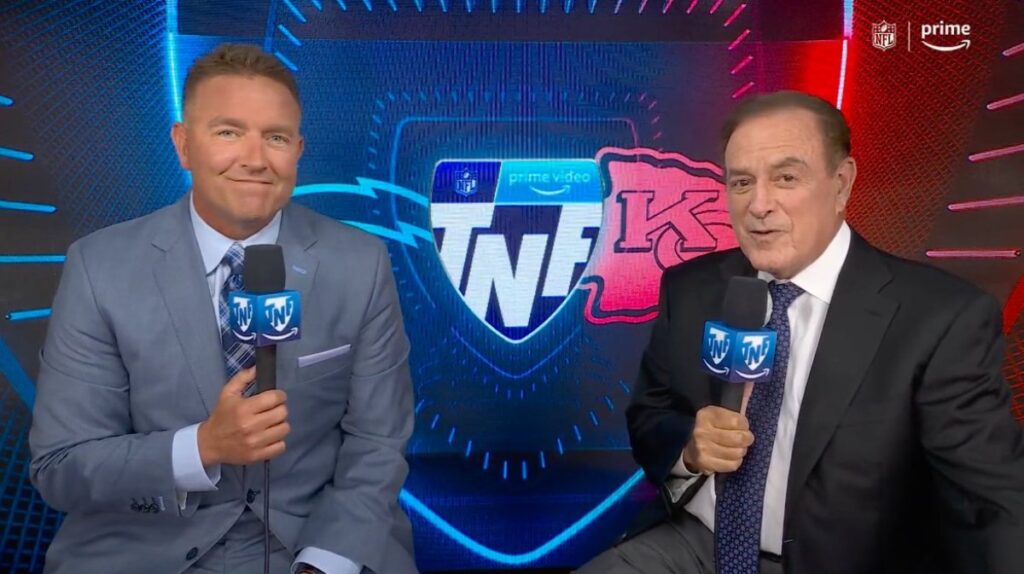
You can’t blame Michaels if he feels otherwise, although he has taken the high road on the topic publicly. Michaels hasn’t said much. After calling the final TNF game of the season with partner Kirk Herbstreit, he told USA Today that he will absolutely be back for a third season with Amazon. Michaels didn’t directly comment on the NBC stuff.
“I feel good,” the broadcaster said. “I feel healthy and fine. I’ve told Amazon that I’d do three years and next year will be three, and I’m definitely doing it. We’ll see after that.”
It’s impossible to talk about the NBC decision without noting how forcefully Michaels and Tony Dungy were criticized last year for their low-energy call of the Jaguars’ stunning comeback from 27 points down to beat the Chargers 31-30 in the first round. Again, totally fair – the pair laid an egg. Jacksonville’s victory appeared almost to sneak up on them. Bad day at the office.
But there wasn’t much residue from that performance to be heard on Amazon’s broadcasts this season. The Michaels-Herbstreit pairing will produce fans and haters in roughly equal measure, but Michaels calling an NFL game still feels like a routinely normal thing – and given how many lower-quality games the Thursday short-rest schedule tends to produce, Michaels’ cadences didn’t strike me as out of balance very often. Some of those games didn’t merit much shouting, put it that way.
Is Michaels the same broadcaster he was at 57, Mike Tirico’s age now? Of course not. For that matter, NBC’s decision to hand the reins to Tirico two seasons ago wasn’t really controversial. It was simply that Al Michaels casts such a shadow over NFL broadcasting by the depth and breadth of his career with the league, a relationship that goes back decades and ventures into Pat Summerall territory for longevity and quality of work, that the switch was never going to be seamless.
As for the 2024 playoffs, NBC probably got it right again. The network has three NFL playoff games this month, two wild cards and a divisional game, and Tirico and Cris Collinsworth will handle two of them, as they should. With the third, the network wants to try its No. 1 college broadcast team, including fast-rising Noah Eagle and Todd Blackledge, with Kathryn Tappen on the sideline.
Somebody had to be moved in order to make that happen, and that’s business. And look, we’re talking about one early-round playoff game. This isn’t the balance of Al Michaels’ career. It just feels different because the person in question has broadcasting credentials that are virtually unmatched in the NFL’s long history.
As for next season, “I still love this job,” Michaels told USA Today. “I still get a charge out of going into a stadium and watching the best in the world do what they do. I’m still really happy, so that’s the big thing.”
Almost no one in sports gets to write the ending they want. Far more athletes are told that their road has run out than actually get to choose their own exit. Based on his few public comments so far, Al Michaels will do what he can to make that exit as graceful as possible – and the long view says that’s exactly how it should go.
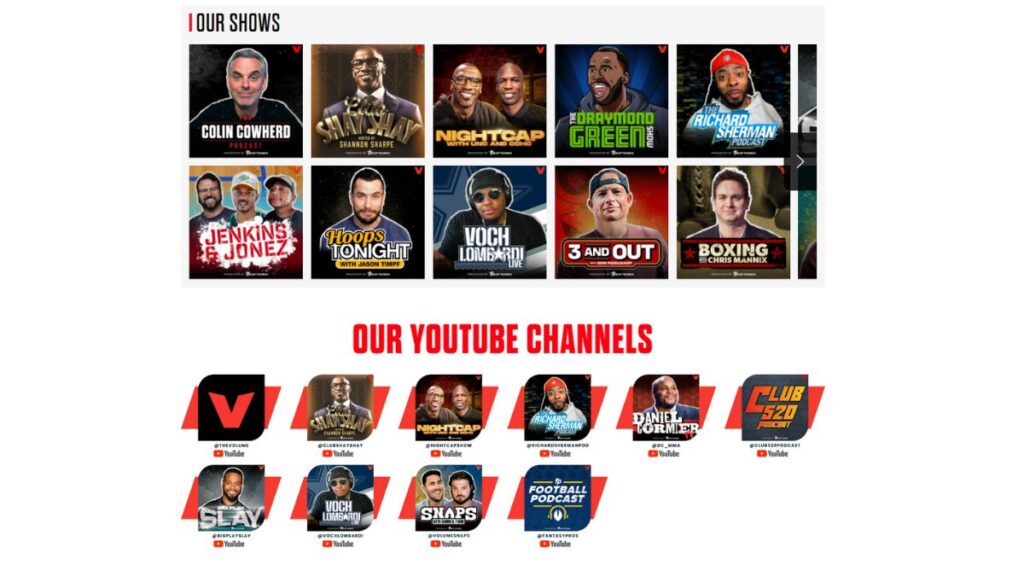
Welcome to the first edition of Social Studies, a nine part series talking with some of the brightest minds in sports social media. My first feature is on Matthew Kline of The Volume. Matthew has been with Colin Cowherd’s company since 2022, choosing to leave ESPN to become a part of it. His team has grown to 10-15 strong , and the network now boasts 17 podcasts including shows hosted by Draymond Green, Shannon Sharpe, Colin Cowherd and others.
To set the table for today’s conversation, I reached out to Matthew to discuss the relationship with his social team and the talent at The Volume. I wanted to learn how the brand measures social success, and get his advice for how to build a social media strategy for brands that can’t afford a large staff. There are a lot of great tips in here for sports media folks of all shapes and sizes. Be advised that the 30+ minute conversation we had has been edited for brevity and clarity. For the full, unedited interview visit Barrett Media’s YouTube channel.
Alex Reynolds: Let’s start by talking about your career. Tell me how you wound up at The Volume.
Matthew Kline: I started right out of college at ESPN as a production assistant doing all the normal stuff. Show logging, prompting, highlight cutting, all of that. I did it for a few years, and really honed my video editing skills. Then I got switched over to the social team. I was the kid at 23 whose friends forced him to have a Facebook account. In college, I created a Twitter profile to track trades in sports, but I never actually tweeted, which is still kind of true. I keep a low profile on the socials since I do it every day for my job.
I got really lucky. I had some tremendous bosses who I’m still very close with to this day. They served as my mentors and taught me. Steve Braband was my first boss. He’s now an executive of digital at WWE. Ashley Braband is an executive at Omaha. I worked for her too. And Michael Buckland is now a SVP for Fox Sports plus I worked with Katie Daly and Mike Foss as well. I soaked up knowledge from all of them and learned about social media’s best practices.
About a little more than two years ago, my former boss Steve Braband called me and said, “These guys at The Volume are doing some cool stuff. They’re looking for someone to come in and create and set up their social and YouTube.” At the time I was really happy with ESPN and I didn’t necessarily see myself leaving, but I trust Steve. I started having conversations, and Steve introduced me to Logan Swaim and we hit it off immediately.
The first conversation I went from being very skeptical to considering it being a real thing. I went through a couple more rounds of interviews, spent a month or two talking to them and ultimately made the decision to leave ESPN and join The Volume. It’s been an incredible ride for the first two years.
AR: When Logan [Swaim] brings you in, he says you’re starting from scratch. Based on what you had learned, your first thought was what? What did that introductory strategy look like?
MK: The first thing that immediately came to mind was, I knew we would ramp up YouTube. That was somewhat in progress when I got here but we knew we wanted to do a big pivot to video. We wanted to incorporate more video into our production strategy and process.
So my first thought process was to maximize our reach, revenue, and relevance. At the beginning, I was worried mostly about number one, and that was reach. How do we expand our audience in the biggest way possible? Early on that meant turning our social team into a content distribution machine.
How are people going to know that these awesome podcasts exist if they don’t exist on social? We had to dig in with the existing team to crank out more higher-end social cuts that are a little bit faster paced, have texts and graphics, and really move.
They were used simply as a marketing mechanism to get people to understand that they should consume these full-length podcasts. I think the biggest difference was learning that it’s not just a marketing play. Social content is content. Show content on social should be valued just as much as a view on YouTube or a listen on a podcast. It has the value of really ingraining itself in a culture, which we’ve seen a lot with Draymond [Green], and Shannon [Sharpe]. Colin [Cowherd] is in that space too. Richard Sherman is as well. We’ve been able to grow the profile of other people by getting them out.
So next was how do we maximize our reach and audience? How do we reach the most amount of people possible? That was again just turning our social into a content distribution machine. In addition to doing original social content, we had to be a part of the live window on NFL Sundays, on big NBA nights, creating content around that.
So it was a pretty holistic strategy all around. I don’t want to leave out the YouTube portion of it, which was obviously huge. We went from primarily being focused on the audio version of our podcasts to equal weight: How are we optimizing our video for both YouTube and social? What are we doing to package it? Are we doing enough breakout clips of single topics or multiple topics on YouTube to get the most out of every single show?
AR: So tell me a little bit about the team. How many people do you have working with you and what do you look for when bringing people on board?
MK: The skill sets on our team are really diverse. The social and YouTube team is about 10 to 15 people. We have a team of producers that work on the shows and aps. I think our entire team is around 50 people including senior staff.
There’s two or three big things that I look for when I’m looking to staff up my team. One is, do you have a unique perspective? Do you have a voice that is going to come through when you are producing a video? I think there are a lot of people that can sit down and set an in and out, export the video and say, here it is.
But what creativity do you have? What creative juices are you bringing to the edit? How are you elevating it? What are you doing to take a conversation about LeBron James and make it appealing to everyone, incorporating maybe a cultural reference, working in something from Photoshop. Again, how people’s brains work. Are they bringing a different perspective?
Everyone on my team also needs to be collaborative. That’s not just true of my team, that’s true of everyone at The Volume. I want everyone waking up on the team, excited to hop into the morning huddle, and start exchanging ideas. What are you working on today? Oh, that sounds really cool. Can I help with that? So again, people being culture setters, and wanting to work hard with the people around them. I think that’s the baseline.
AR: How about the team’s relationship with the talent? In many instances they are commanding massive audiences. How does that intersect with what you guys do on social?
MK: A lot of it depends show to show. How closely we work with Draymond Green is probably not the same as how closely we work with Jason Timpf. Jason has more time to chat about strategy and communicate on a day-to-day basis. Draymond has other things going on. The same with Shannon and Colin. I give Logan [Swaim] a ton of credit for this in terms of who we’ve gone out and looked for. It’s people who are fully bought in. You’ll notice that Draymond is all in on promoting his podcast and encouraging people to ask questions. Tweet at him so that he can talk about it on the pod.
Shannon and Chad on Nightcap are fully bought in on promoting it and trying to get people to subscribe to the YouTube channel. They’re trying to get people into the comments section so they can interact with them on the live show.
Every single one of our talent wants to maximize their growth. They’re all bought in not only on content being shared from our handles, but sharing content on their own handles too, participating in giveaways and brainstorming, both for the shows and for social. So honestly, working with them has been across the board, really rewarding.
AR: Let’s talk about how you measure success on social. You mentioned before that reach, following and engagement are huge. Aside from that, what does success look like? Where have you seen big wins?
MK: It starts with the three R’s, reach, revenue and relevance. Reach being number one for a reason, in that if you have a wide reach, you’re likely going to drive a good amount of revenue, and be pretty relevant. So expanding the reach as much as possible, and that goes across all platforms: YouTube, Facebook, Instagram, Twitter, TikTok, experimenting on Threads, etc.. Any platform that is going to be emerging. Snapchat is something I have a ton of experience with, and we’re having conversations right now with them about expanding our content there. Anywhere that we think that we can cultivate and generate an audience is somewhere we’re going to go.
Then in terms of revenue, our biggest play is going to be YouTube. That’s largely programmatic ads. But by having a big reach and being super relevant on social with all of these clips, we can also upsell our content.
Hey, you have a show sponsorship? You’re also going to get a social sponsorship with that. You’re not going to just get a [ad] read on the audio, you’re going to also get a video read on the video version of the podcast. You’re also going to get a sponsored clip on social that’s going to go on Twitter, Instagram, TikTok, everywhere that people are consuming their content.
So maximizing our reach makes us more attractive to those brands so that we can maximize our revenue.
And then it’s about relevance. When I first started, there were a few people on the social team who, and I totally understand this cause I was the same way when I was 23-24, everyone got really territorial when anyone picked up our content. Maybe they didn’t give us the perfect credit. For me, I’m like, ‘No. Y’all. This is a win. It’s great. This is what we want. We’re getting views. We’re not even doing all the work.’
We’re trying to produce content in a way that cuts through, and get other major outlets to pick it up. We may have a clip on First Take or SportsCenter or Undisputed. Having the relevance not only in the podcast space, but across the sports landscape, that’s been hugely rewarding and something that again, by maximizing reach, we’re able to maximize relevance.
In terms of success, YouTube has been huge for us. When I first started, we were under 50,000 subs and we grew to about a half a million about a year in. We launched Draymond’s Instagram account right around the playoffs of my first year to take advantage of that. That got 100,000 followers within a month and all of a sudden that’s where a ton of our views are coming from.
TikTok has been hugely successful for us. We had someone who started off as an intern, 21 years old, running our TikTok. Now, he’s built our TikTok into a channel with 330,000+ followers. He’s now a producer and talent for us as well – Carson Breber. By empowering people to implement the best practices and do what they know best, it frees them to do their best work. That’s where their strengths on those platforms have been hugely beneficial for us.
The most recent success, which I saved for last, but certainly not least, has been this ramp up with Shannon Sharpe over the last month or 2. We inherited Club Shay Shay, which was a hugely successful podcast with over a million followers on YouTube. We worked to help grow that, but anytime you have someone like Shannon Sharpe, the question is, what more can we do, especially when people went from getting Shannon every morning for a couple of hours to a once a week podcast.
There is a gap there for that audience that we can fill. That’s how we built Nightcap with him and Chad Ochocinco. It’s been a wild ride over the last month. We reached a quarter of a million subscribers right on the one-month anniversary of launching the YouTube channel. We got to 50,000 on Instagram within a month. We’re around 50,000 on TikTok, so that ramp-up has just been amazing. It’s gone as good, if not better than I could have ever imagined. I think in the first month on YouTube, we had about 16 million views and another 60 million monthly views just on social.
That’s obviously going to be the headliner. He’s one of our biggest names with some of our biggest numbers. I’m going to add one more. Jason Timpf actually might be my favorite success story, just relative to where he started to where he is now. I want to be very, very, clear. Jason deserves all the credit in the world. He is immensely talented, smart, and an absolute grinder. When he started, he was a Lakers podcaster, blogger, and didn’t have the biggest profile.Now he has his own YouTube channel with over 20,000 subs. Just a couple of weeks ago, his videos in the playoffs were routinely over a hundred thousand views. His profile across social has risen so much. I remember the first time he told me, ‘I was DMing with Kevin Durant the other day.’ ‘I’m sorry, what now?’
AR: BSM has a strong audio-driven audience, which I feel is starting to catch up. If you create audio content, you now have a video camera in the studio. You’re generating vertical videos whether that’s [Instagram] Reels, TikToks or other stuff. You guys do it exceptionally well. What do you feel are best practices when it comes to pulling audio or video clips and where do you feel other brands still need some work?
MK: I think first and foremost, topic selection is the biggest thing. You need to know what your audience wants to hear about and talk about. That’s step one. Are you pulling the best possible clip from each episode or the best possible two or three clips? Have you identified the moments within an episode that are going to resonate with your audience?
Number two, I think is pacing. That’s something that we emphasize a lot. I’ll give a few compliments out to some other places that I think are doing it really well.
The New Heights podcast and Podcast P, if you look at their social cuts, very pacey. They really suck out all of the air. There’s a lot of jump cuts. There’s text on screen. You can slide in some cutouts or graphics, incorporate some B-roll or pictures, but keep things changing on screen so that you’re keeping the audience engaged and not losing them to the swipe up.
Let’s be honest, social media audiences have no patience for anything. I remember when we were first launched SportsCenter Snapchat, and were having conversations about how best to do it on Snapchat. That has stuck with me for the last six years.
If something on screen does not change every three seconds, you’ve lost your audience. They have swiped out. I bring that to every single social account we want to talk about. I’m not saying it should move so fast that you can’t understand what’s going on and you can’t track it. I think that’s the middle ground that can be a little bit difficult. I think sometimes you see people try to make it go so fast that you don’t understand what is happening. But again, keep the pace up and keep things on screen, changing and moving, I think we do that really well.
I feel a little bad saying that other people in the industry don’t do it as well, but I tend to think that we do it as well or better than everyone or anyone. For the most part, we talk about sports. So are you taking the right take that people are going to be interested in? Secondarily, are you showcasing your talent’s personality in a way that’s going to make people want to watch or seek out additional content? Are you making your talent look good? That matters.
The last thing that I’ll say, which I take a lot of personal pride in is that intentionally we are not going to be the place that does the clickbait headline and pull quote. We’re not going to take someone out of context because then good guests aren’t going to want to come on. That’s something that I think a lot of companies and aggregators focus on. What’s the spiciest thing we can pull out? What might make the most waves? We want to be influential and have people see our content, get excited about it and share it, but we want to do that in a positive way.
AR: We talk to a lot of people in the radio industry, and they don’t have the budget for a 10-person social staff that can be anywhere, everywhere at once. What would be your advice for a station or company that has one or two people handling social? Where would you start? What would you prioritize?
MK: I think that if you have the ability to record video, start there. I think the easiest thing to start is going to be YouTube. It doesn’t require a ton of editing. You’re essentially doing the same thing as you are on audio: in, out, here is your episode.
You do need some understanding of SEO, making sure your titles and descriptions are optimized in the best way for search. You want to make sure you’re creating good thumbnails, but that’s relatively easy to learn and it’s doable for a small team. If you have the ability to do video, I’d put your efforts into trying to get one really good cut per day. Focus on taking your best moment and making it as good as humanly possible. Establish your content as elite and people will slowly trickle in.
I think there’s always a rush to get so much content out. And, yes, if you have the ability to no pun intended, but in mass volume, get a ton of content out great. But, if it’s a bunch of subpar content, no one’s going to be looking for your show. Focus on those one or two moments that you can on to your TikToks, Instagrams and Twitters.
Within that and this is going to get into the voice on social, be organic don’t try to be a sensationalist or something you’re not. Have a voice, and develop a voice. It usually mirrors your talent. It doesn’t have to be exactly the same. But be natural. You want to engage with your audience and being templated is not the way to do that. Start with developing your voice, understand what your brand is, and show them the best possible version of your content as often as you can, knowing that resources are always an issue.
The world is split in two. Fractured. Divided. It is contentious, making people nervous, tense, and edgy. No, Not Donald Trump vs. Joe Biden or Republican vs. Democrat. Heck, not even Red Sox/Yankees (they both stink). What you have is New Year’s resolution people on one side and the aggressive anti-New Year’s resolution people on the other.
It could be the existential crisis of our time.
As for me, I am a card-carrying member of the anti-party, and I will fight you in the town square to maintain the honor of not making them. Meet me there every January 2nd, and I will be ready with arguments armed to the teeth.
I don’t care how fat I get, I don’t care if my book never gets done, I don’t care if my t-shirt drawer becomes two t-shirt drawers (I am not throwing them out!), and I definitely don’t care if I ever learn the piano.
You get the picture. As it pertains to my personal life, I don’t participate in the self-help jolt of the New Year. If I wasn’t doing it on December 31st, that’s on me.
Professionally though, I feel a bit different, especially as we embark on 2024. I have never made a New Year’s resolution for work, and based on my personal view, I probably never will; but two years into solo hosting a morning show, it really feels like it might be a perfect time to take stock, create new ideas and make changes.
It’s only been two years, but some parts of what I do feel stale to me, and if that’s the case, I wonder what it all sounds like. The irony is that the show is doing well, and I get (mostly) great feedback. I could probably slide forward on autopilot and not have too much of a worry.
That’s exactly what worries me.
So, I am going to try and do something about it and recommend you do the same.
As soon as everyone is back in the office (all five of us who work on the show), we are going to do the 2024 version of a radio offsite.
What does that mean in local radio? Low cost, low maintenance.
Instead of renting out a room and having a formal day-long session to brainstorm ideas, we will go out to lunch. That’s all we have time for, and it’s all we can afford. Everyone will bring 2-3 *new ideas for the show, both small and large, and we will start the process of making the show better.
*Listen, we all know that almost everything has been done before, but that doesn’t mean:
There aren’t ANY new ideas.
Because it’s been done before doesn’t mean that it shouldn’t be done again.
During our holiday remotes raising money for the Salvation Army, one listener came in and gave me an index card full of ideas for the show. He said he listens every day, and I often reflect on this very issue; so he decided to share his thoughts.
At first, I was like, “OK, buddy.” Then, I read them, and it was amazing feedback. There is one concept I’m already sold on, even though it’s been done a million times, a million different ways.
Connecticut has 169 municipalities. Once a month, we should do a show in one of them – talk to leaders, businesses, citizens and get a feel for all of it. A little bit of booking work but a no-brainer.
Another idea given that I’m actually not sold on is phone calls.
Sandwiched between all the weather, traffic, and news, I’ve grown somewhat protective of our limited open talk time. Having said that, since I still stink at social media, I need to find ways to engage the audience more. Maybe calls? I don’t know, but that’s one subject that we will discuss off-site. If we go that route, it needs to make sense, be fun, and not hijack the show.
Regular segments are another thing.
For instance, I often do a birthday/movie segment. We take someone famous who has a birthday and pick one of their movies. We give a fun audio clip and then talk about some of the more interesting origin stories about the project. It’s super fun for me because I love those kinds of things, going down to rabbit hole of casting, budgets, and production. To be honest, though, it gets a mixed reception – let’s just say the segment itself is about 68 percent on the Rotten Tomatoes segment scale. People like it but not universally.
I am fine abandoning it but still want to do something fun with media/entertainment/pop culture that isn’t super lame. Maybe we can come up with something.
Put it on the agenda.
The point is, go out to lunch with the people you don’t normally lunch with, and generate ideas. Pick two or three and work to implement them.
For us, I feel like we need to freshen things up, and I’d rather do it when things are going well than do it out of desperation – it’s simply more authentic.
I know budgets are tight but you might want to do it at an actual restaurant with table service and an actual menu. A Jersey Mike’s offsite may last less than 30 minutes, and we need to talk longer.