OutKick host Dan Dakich is sarcastically rooting for ESPN+ exclusive documentary Skin in the Game with Dr. Ibram X. Kendi.
Dakich on Don’t @ Me on Thursday checked out the latest episode recap of the series put out by his OutKick colleague Dan Zaksheske. Zaksheske had written recaps of the three previous episodes in the documentary this week.
“This is ESPN’s race-baiting deal,” Dakich said of the series. It debuted on ESPN+ on September 20. “This is ESPN turning down the temperature on race and politics on ESPN. This is a complete crap show.”
L.A. Dodgers second baseman Miguel Vargas was featured in episode 4, which talks about racism in baseball. Vargas, a 23-year-old from Cuba, detailed the difficulties in getting over the language barrier when he first started playing minor league ball in Michigan and Utah.
Dakich understood the challenge involved with going to a foreign country where you don’t speak the native language. But he said it’s hard to be sympathetic when you’re a pro athlete being paid handsomely.
“Well, I got to tell you, I don’t know what to tell you,” he said. “You come over to the United States, you’re playing a sport. All right. What are you supposed to do? Is the entire sport supposed to change because of you?”
It’s unclear whether there will be additional episodes of the series made or released in the future, but Dakich said he felt like even if it turns out that the viewership of the series isn’t where ESPN wants it to be, the network wouldn’t end it after just five episodes for fear of being subjected to backlash.
“They don’t want to cancel it because somehow, some way they’ll be afraid of X Ibram or Ibram X calling them racist, or Bomani Jones saying they’re racist, or this bigot on TV right now named Martin calling them racist,” he said. “Or Damien Woody, and his up and down wage swings, calling them racist.”
Hall of Fame quarterback and Monday Night Football analyst Troy Aikman has talked to Tom Brady about going into the broadcast booth at FOX in 2024, and he has no doubts that the six-time Super Bowl champion will don a headset next season.
Aikman and his MNF broadcast partner Joe Buck were guests on the Sports Illustrated Media Podcast with Jimmy Traina, and Aikman was asked if Brady had given any indication of remaining committed to getting in the booth.
“I think he has every intention of doing it,” Aikman said. “I think he’s watching this year and seeing what he can pick up. I’m sure at some point, if he hasn’t already, he’ll be in the trucks or be in the booths at some of the games, watching.”
Traina praised Aikman for not holding back and pointing out players if they do something wrong on the field. Jimmy wondered if Brady would struggle with formulating similar opinions on a broadcast.
Troy said Tom’s passion on the field will carry over into the booth.
“He runs pretty hot as a competitor, we’ve seen that side of him, and he definitely has opinions on how he feels the game should be played and as a quarterback, he didn’t have much patience for it. And it’s the reason why he was able to have the career that he had,” he said.
“Part of it is finding his voice and who he’s working with and how he’s able to say what he wants to say,” Troy Aikman added. “I think every guy comes into the booth – whether you’re a coach or a former player – that feels like, ‘Hey I’m gonna educated the world on football’ and then you realize you have no time to do that. So you gotta pick your moments and now the game’s played faster than it ever has been before so you have less time. But yeah, I think he’s gonna give an honest, unvarnished opinion and I think he’s gonna be really good.”
Syndicated radio host Erick Erickson talked about a sensitive subject regarding the ongoing war in Israel and how the media is framing a story that has enraged and sickened millions of people.
Erickson believes the reports that came out of Israel that state that Hamas has killed babies are being complicated by the media because they are on the side of terrorists.
“You should be mindful of those around you and on television, and in politics, who are trying to morally talk about the situation in Israel,” he said.
Erick Erickson was discussing President Biden’s comments about dead babies. Several reporters asked Biden if he had physically seen the gruesome pictures, to which the president responded that he had seen the photos. Social media images and real-time videos have given users more information and more access to any global conflict in recent memory. The White House says Biden made the story up and that he had not seen the pictures.
“The pictures have since come out,” he said. “Are all the reporters and members of the left who can’t believe Hamas would do this? Are they ok with dead babies?”
“How awful must it be for you to concede that it is awful?” He added.
Ken Coleman has inspired many by having the courage to leave an unfulfilling career and pursue his dreams. He is now a well-known personality on The Ramsey Show, a nationally syndicated program, and a two-time Wall Street Journal best-selling author. His work on the show allows him to engage, provoke thought, evoke emotions, and inspire action to improve people’s lives.
Almost a decade ago, Ken Coleman realized he wasn’t on the path he truly desired and was still unsure about his future. However, he summoned the courage to take the necessary steps towards his happiness and never looked back. This journey has eventually led him to the pinnacle of his success today.
Since the onset of COVID-19, The Ramsey Show has undergone some changes, including a name change to reflect the involvement of multiple hosts. Dave Ramsey now shares the spotlight with his team numerous days weekly, with Coleman often stepping in to substitute for him. Along with Rachel Cruze, Jade Warshaw, and George Kamel, Coleman carries The Ramsey Show forward, aiming to engage and entertain millions of listeners while improving their lives.
Ken Coleman often reminds his audience that persistence and being in the right place always lead to opportunities presenting themselves. His success is a testament to this, having gained clarity on his chosen life goal and embarking on the journey towards achieving it, consistently handling even the most modest tasks.
Ramsey Solutions is highly confident in its product. Ken Coleman advises talk radio executives to recognize the abundance of political talk shows available, whether local or national that provide a wide range of content for radio broadcasts. However, he firmly believes that no show can match The Ramsey Show, which has been consistently present for over 30 years.
During an interview with Barrett News Media, Ken Coleman discusses the biggest benefit he’s received working alongside Dave Ramsey, how The Ramsey Show is consistently able to connect with the news/talk audience, how the Ramsey brand prioritizes content for social media, and what he wants radio executives to know about The Ramsey Show.
Ryan Hedrick: How long have you been with Dave Ramsey? How did the relationship start?
Ken Coleman: 9 years. We have mutual friends. A few of his employees were also long-time friends of mine, and my wife worked for Dave many years ago, for about two years. So, we had all those mutual connections, and so we were acquaintances, and he was aware of my budding broadcast career and was following along.
RH: How did your career start?
KC: I was in my early 30s, and I was beginning to question the path that I had been on, which was the path to run for political office. I began to question that and lost the fire in the belly for that. In the process of doing some self-discovery to try and figure out what I was going to do, I got to a point where I realized there were some similarities between the public service role and broadcasting.
So, I started small. I took a broadcasting class with a bunch of 20-year-olds, started doing high school football play-by-play, and through a series of hustling and connecting, I built my way onto a Saturday morning radio show and, from there, started hosting a daily drive-time show. I was doing a podcast in the leadership space, where I interviewed Dave for the first time. I had all these irons in the fire. That’s how that happened.
RH: What is the most significant benefit and lesson that you have gained while working with Dave Ramsey?
KC: The most important blessing I’ve received from him is his unwavering belief in me. He has provided me with an invaluable platform. The biggest takeaway is that for Dave’s persona and gruff kind of irritating tough love, he does have a good thermometer to hear what’s going on with people. Some of those calls are not boilerplate problem and answer. Some of them have a lot of deep issues, scary things going on behind the scenes, and sometimes there’s a lot of confusion, and he’s able to see through that, and I’ve learned how to read people, even if you can’t look at them you can listen and hear things in their voice, even if they’re not saying it.
There comes a time when you are watching him (Dave), sitting next to him, dig behind the question; there’s always a question or two or three behind it, underneath the questions. That’s been something that I’ve learned.
RH: When creating content for radio listeners, how do you think your show connects with the news/talk audience?
KC: The Ramsey Show is caller-driven. Dave has instilled in us that when you’re taking that call, you have to take it and do it in a way that helps the rest of the audience. You’re addressing the caller’s need, but you’re addressing it in a way that the rest of the audience can get it. A caller-driven show is an intimate conversation that people are eavesdropping in on, and if you do it right, they feel like they’ve pulled up a chair and they’re listening in on that conversation.
RH: How do you prioritize and adapt content for Ramsey’s social media channels?
KC: With all the social platforms, you have to program to the platform. It’s important that in 2023, any media company or any media personality understands that you can have one clear message based on some principles, and so the principles don’t change, but the platforms dictate that the process has to be different on how you deliver the principles.
So, if you go on LinkedIn, that platform offers a lot of written content. Facebook is leaning more towards that. Instagram is video content, TikTok is video content, and YouTube is all video. But now you have to look at what works and what people want on YouTube. If you juxtapose that with a podcast audience, podcast audiences skew a little bit older, they’re wealthier, more educated, and they’re looking for more personal growth content. You have to program to the platform.
With every social media platform, you’re delivering the same content, but you’re delivering it in a different way.
RH: Has radio become a secondary priority for the Ramsey brand, or is it merely a bonus for the social content created by The Ramsey Show?
Ken Coleman: Radio is still the platform by which everything is standing. You’re still talking about 600-plus stations, the second-largest radio show in the world. The show that is distributed via YouTube, podcast, and social media is still from a radio format. We are still doing a traditional radio format every day, three hours a day, and then that content is being cut up and distributed on those other platforms.
Make no mistake, it is, first and foremost, a radio show, and everything else comes out of that. If you’re going to be a radio show or a television show, you are going to have to diversify. The digital world is here to stay. The Ramsey Show started as a radio show, still a radio show, but now it lives on multiple formats.
RH: As the show continues to grow and evolve, is there one important thing that you would like news/talk decision makers to understand about your team and the future of your show?
KC: I would for every talk radio executive to understand that there are plenty of political talk shows. You look at local, regional, and national political talk shows; there are more than enough to fill the airwaves but there is no show like ours that has been consistent for over 30 years beating the drum beat that is as important to your listeners as political talk.
In fact, I will remind you of a famous political moment when James Carville took a shot at George Herbert Walker Bush when he was running against Bill Clinton and said, ‘It’s the economy, stupid.’ He was reminding the president that it’s not about foreign policy; it’s not about any of that. People vote their pocketbooks.
The Ramsey Show is the only show in America that has taken on money, which is the most important thing to Americans. We’re certainly not hurting for radio exposure, but I would be baffled by any major talk network or station that doesn’t have The Ramsey Show in its daily lineup. All the policies and all the politics in the world don’t matter because it’s up to you to figure out your policy and your pocketbook and figure out your household budget. The money conversation we bring is more relevant than any political talk show. That is my very bold belief.
Every radio station in America should be carrying The Ramsey Show because of its relevance, not because we think that we’re good, not because we think that we’re better than anybody, but because for over three decades, we’ve met people where they are in the most intimate and most stress-filled areas of their life, and that’s their money.
RH: What are some of the individual and show goals you and your team have for the future?
Ken Coleman: Dave has said that your income has been your greatest wealth-building tool for decades. We know that from the largest net worth millionaire study ever done by Ramsey Solutions, ten thousand plus millionaires, 96 percent of millionaires said they enjoyed their work. We want to expand into work; we want to expand into relationships. Dr. John Delony has been a great success as well.
So, he and I represent the non-money personalities. If you look at the content of The Ramsey Show, obviously, it’s always going to be money-focused, but we’re now talking about work and relationships. You can’t talk about money without talking about relationships; you can’t talk about money without talking about work.
Expanding the content to meet people where they are and bring those three areas of life into balance through hope and practical steps for people to win in all three of those areas.
As the clock counts down to the end of the fourth quarter, Molly McGrath stands at the ready. Prepared, alert and energized, she sprints onto the field at the sound of the final buzzer to interview West Virginia head football coach, Neal Brown, after his team claimed a 17-6 victory over Pittsburgh. Once her work was done, she posted the video to social media, which garnered a significant number of views and remarks commending her dedication to the craft.
While it may seem like an aberration from the norm for viewers, the occurrence represented a typical day on the job for McGrath, who has been working for ESPN as a college football reporter since 2016. Whenever she is on site for an assignment, her objective is to provide information and insights by serving as a resource on the field.
“He just shook the hand of someone that he just beat on the field, [so] you want to get that interview right after that moment,” McGrath explained. “[I] can’t say I don’t hustle and work hard – I definitely do. I’m a little aggressive; maybe some people think it’s too much, but I do that pretty much after every game.”
Having the wherewithal to hustle is essential to McGrath’s occupation, which necessitates extensive preparation, collaboration and synergy. Keeping her role in perspective, she is able to execute her tasks at a high level, which pay dividends to the aggregate output. Additionally, possessing a keen interest and shrewd understanding of the psychology behind the broadcast renders her adept at addressing the needs of her colleagues.
When McGrath moved from the West Coast to Boston to study broadcast journalism at Boston College, she made it a point to stay in the metropolis each summer. Although she had completed internships with WHDH-TV and NESN, the impending start to her senior year heightened concern over a lack of genuine reporting experience.
Despite serving as captain of the cheerleading team, McGrath met with athletic director Gene DeFilippo to solicit clearance to interview student athletes, coaches and personnel in a student-reporter role. Evoking evidence of an ostensible schism between the athletes and other college students, she pitched her ability to bridge that gap through journalism.
“He always tells the story, [and] it’s so funny because he’s like, ‘Here comes in this little blonde cheerleader spitting piss and vinegar, and she’s telling me I need to give her a job and let her do all these things,’ because I guess I was pretty demanding or strong in what I wanted,’” McGrath shared. “….I said, ‘This is what I want to do. I want to be a sports reporter, and I want your help.’”
Throughout her senior year, McGrath was vigorous in her pursuit to compile a demo reel to facilitate her job applications. Despite reaching out to more than 100 different sports networks at every corner of the United States and enduring universal rejection, she remained persistent and eventually received a lucky break. McGrath, as it turns out, was afforded a chance to work at ESPN as a production assistant, where she experienced the competitive nature of the profession firsthand.
While there is a discernible yearning for obsequiousness in dedicated professionals, vitriol and acerbic rhetoric can demoralize self-confidence and engender animosity and contempt. McGrath always looks to succeed in her endeavors and simultaneously has avoided becoming ensnared in malice, substantiated through her relationships with other colleagues. Part of that emanated from developing a kinship with her cheerleading teammates.
“There’s this perception that women are competitive and unkind with each other, but I’ve found that in this industry, at least in my experience and especially at ESPN, the women are all really supportive of each other and we want each other to succeed because I think it makes all women look better,” McGrath said. “If we’re all succeeding, it’s better for women in this male-dominated industry in general.”
After six months, McGrath departed ESPN and drew the attention of the Boston Celtics, which brought her on as a web reporter and in-arena host. Repetitions both on digital platforms and at TD Garden refined her ability in cohesive storytelling, along with being comfortable addressing a crowd.
“When I’m on TV and it’s just me looking into a camera, sure there might be millions of people watching me, but it doesn’t faze me because being in an arena live with people is so much more difficult,” McGrath said. “I think it taught me to persevere and to stay clear-headed, and to tell my story, in a way, around a bunch of people.”
As her second season with the Celtics came to a close, McGrath felt she needed to do more to ensure sustained growth. One day, she spontaneously looked at her Facebook messages and saw a FOX Sports executive had reached out, sharing that the company was starting a new sports network. Jacob Ullman, senior vice president of production and talent development, discovered her work on YouTube and thought that she may be a good fit.
McGrath then noticed it had been sent two weeks earlier, and she rapidly followed up and flew to Los Angeles to audition. By May, she was on the air as an in-studio host and update anchor, on the ground floor of what proved to be a burgeoning property. Once it became time for football season, she was added to the NFL on FOX lineup to work as a sideline reporter with Sam Rosen and Heath Evans.
“I was terrible, but I had so much fun, and to be at an event live is so invigorating,” McGrath said. “I remember in that moment before one of my first games thinking, ‘I think this is something I really need to do, and I need to be the best at it,’ because why else would you do it if you don’t want to be one of the best?”
McGrath’s hard work was rewarded with a promotion to serve as the network’s lead college football reporter the next season. Working alongside Gus Johnson and Charles Davis was an invaluable experience for her to grow accustomed to different settings, build her network of contacts and become more proficient in reporting.
“I was still learning, but [I] worked really hard,” McGrath said. “I had a couple of moments where I’m like, ‘Oh shit, I’m on TV,’ and I would get really nervous because I was still so young and inexperienced.”
McGrath ultimately made her return to ESPN ahead of the 2016 college football season to contribute on Friday night college football telecasts and occasionally host College Football Live. The demand for excellence was still very much present, and McGrath felt motivated to prove to executives that they had made the right decision in bringing her back.
“Being a part of game broadcasts at ESPN [brings] heightened expectations and a heightened level of, ‘Everyone needs to be great,’ and, ‘Everyone needs to pull their own weight,’” McGrath said. “That’s something that I learned at ESPN that I think has made me better.”
In the years that have ensued, McGrath has ascended through the ranks, much of which can be attributed to her preparatory regimen leading up to an assignment. In working as the lead reporter for ESPN Saturday Night Primetime, she usually finds herself on a flight home on Sunday morning and begins her work at cruising altitude. Throughout the rest of the day, McGrath works to schedule conversations with the athletes and uses her time on Monday to complete her film study.
“I think that I’m at my best when I’m just reacting and when I’m working unscripted because I have confidence from my preparation,” McGrath said. “….Is there burnout? Yeah, but I wouldn’t be able to prepare any other way.”
Staying prepared to react to dynamic circumstances while gathering and disseminating content enhances the aggregate presentation effort. McGrath feels an innate fear of failure and approaches the week-by-week grind as if she is studying for a final exam that she has no choice but to ace.
McGrath has an affinity for perfection, but she willingly embraces alterations in the plan and unforeseen occurrences. Embedded within each win and loss lies an immeasurable number of sequences that can determine the final score, and she needs to remain nimble to parse the contest accordingly. She hardly remains idle, always staying locked in to the action and focused on deftly carrying out the task at hand.
“I don’t want to tell some fluffy stories that I could have told on Friday afternoon,” she explained. “I want to tell you exactly what the quarterback is saying to his offensive line after that sack, [and] I want to tell you exactly the look on the players’ face and the sounds that they made when they come off of the field with an injury.”
With four minutes to go in the contest, McGrath can usually discern who is going to win, although there are plenty of last-minute changes in fortune. As the end of the game approaches, she begins to contemplate events in themes and prioritizes what is most important. McGrath has a limited amount of time to execute a postgame interview, and she usually prioritizes clarifying ambiguity and highlighting the emotions of the moment.
“A good reporter is a good listener, so I listen to what my booth is talking about,” McGrath said. “[For] the most important things that my booth has talked about, it is my responsibility to ask about those things because it adds to their conversation and their story.”
McGrath works alongside play-by-play announcer Sean McDonough on Saturday nights, someone she considers to be a trusted colleague and close friend. With his vast experience in various disciplines of broadcasting, he is able to be candid and honest with his colleagues.
“Sean is someone who elevates everyone around him because he demands the best,” McGrath said. “He demands us to know every statistic and to have everything perfectly correct and to have the reports be succinct and to have the questions be thoughtful.”
Greg McElroy also joined the broadcast team this season as the color commentator and provides a consistent level of energy and work ethic. The relationship between broadcasters, producers and other personnel is especially important considering weekly travel and collaboration in addition to the final on-air product.
“We’ve seen in the past [that] there have been broadcast booths where the chemistry wasn’t great, and it affects the way people call the game,” McGrath said. “The fact that we all love each other, want what’s best for each other, and make each other better, I think makes our broadcasts so special and great.”
Throughout the game, McGrath aims to be the best teammate possible and is genuinely indifferent as to how long the camera is on her. Namely, she contributes in many different ways on the air and does not always receive attribution, underscoring her commitment to the viewing experience.
“The game is not about you,” McGrath said. “The game broadcast is about the game, [and] it is about the athletes on the field. You are there to highlight them.”
McGrath recently returned from maternity leave after welcoming her second child into the world, and she treasures the moments she gets to spend with them. Watching them in the early stages of their lives has refreshed the reason why she performs the role, focusing more on the impact it will have on her children than her own success. The sacrifices in being a working mother often away for days at a time can complicate retaining harmony, and it requires a true passion for the craft.
“I think that I’m a better mother because I love what I do,” McGrath said. “I hope someday my kids will understand, and I hope that they’ll be proud of me.”
In addition to being a role model for her children, McGrath wants to serve as an example for women aspiring to forge a career in the industry. In articulating that women have had an uphill battle since the beginning, she referenced previous criticisms pertaining to her reporting and appearance on social media. McGrath overcomes the adversity by focusing on her inner circle and knowing that they would defend her no matter the outcome.
“I think it’s just leaning on the people that I work with and knowing that it doesn’t matter what other people think,” McGrath said. “All that matters is that the people I work with know that I work hard and that I’m a good teammate. That’s the kind of thing that I just repeat to myself.”
Last night, I attended my first Sports Emmy Awards as a nominee. Today, I missed my cross country flight and am flying in the middle seat in the back of the plane. Humbling. Life is all about balance. ???? pic.twitter.com/i54ksVNQ6Z
When McGrath begins her responsibilities as a college basketball reporter, she knows that it will likely not be as time consuming and intense as the college football season. The sport is more conducive to one-on-one conversations, which usually take place at shootaround, and the games are usually shorter. Even so, she will approach the situation in the same way with an intent to be the best reporter on the air.
“[The athletes] are out there working their butts off to try and win a game; you should be working your butt off to cover them properly and fairly,” McGrath said. “I think it’s just working hard. You can’t be afraid of hard work, [and] you can’t be afraid of hustling and taking any opportunities that you can to get better.”
For McGrath, continuing to establish herself in the space and garnering career longevity are appealing, and while she values her concentrations, she has always wanted to report on the Super Bowl. The Walt Disney Company will broadcast the season-ending contest in February 2027 from a location to be determined, and while there are no guarantees in this industry, taking the air from the game would fulfill a lifelong dream.
“It’s something that hopefully I’m able to do,” McGrath said. “I want to have a really long career, but it’s hard to break from one sport into the other. It’s hard to navigate trying to cover more of the NFL, and hopefully, I’ll have an opportunity to do that down the line.”
Whether or not she is in the presence of the Vince Lombardi Trophy, McGrath remains committed to excelling on the collegiate broadcasts. Although she never ran track, she is always in the start position and ready to sprint, literally and figuratively, to actualize her role in effectuating a premium broadcast.
“I always get a, ‘Hey, Molly, great game,’ after games like that, and it’s because I know that I added a ton of value,” McGrath said. “For me, it’s those games; it’s the unseen things, I think, that can sometimes be the most important.”
Every now and then a story makes the rounds that leaves me scratching my head. The latest one involves the NY Post’s report of Pat McAfee paying big money to Aaron Rodgers and Nick Saban to appear on his program.
This is nothing new. Paying people to appear on media outlets on a set day and time has been happening for decades. Maybe the amount being paid is more but looking at it through the lens of the Pat McAfee Show, this is a no-brainer. I applaud him for defending it. He has every right to do it. If you’ve paid attention to the rise of his show the past few years, he’s clearly invested in the right type of difference makers. If what Pat said is true, and the value of his company has grown from 2-5 million to over 500 million, heck, even if it’s half of that, you can’t tell me you wouldn’t be doing the same exact thing. It’s business 101.
What bothered me when this story dropped is that it felt tied to a different issue than whether or not Aaron Rodgers and Nick Saban should be paid for their time. I’ll get to that in a minute. Given how many people watch Rodgers on Pat’s show, listen to him via the podcast, and how much media attention each appearance generates, Aaron’s more than demonstrated his value.
Saban may not be as popular as Rodgers but he is the greatest college football coach of my lifetime, speaks his mind, and he’s in charge of one of the nation’s top college football programs. We’re not going to seriously suggest these aren’t valuable assets, right? Both men are filthy rich and don’t need to do these appearances. If you want them to make time for it, which likely leads to extra discussions with local and national media about the comments they make on the air, they’ve got to see the benefit in doing it. Providing a ‘platform’ isn’t enough of a reason for them to make time each week to doing it.
The bigger issue I have involves this fascination by some in media circles to look for a way to make it political. Let me be clear, that is not what I believe was behind the New York Post’s story. I’ll get to that later in this piece.
As is the case often, when a story like this drops, it’s followed by aggregation and reactionary columns. You’re reading one right now. If you’ve read up on Rodgers, you’re aware that some don’t like his staunch defense of not being vaccinated or how he views the world. He’s a complex personality who some would prefer to silence because his beliefs don’t jive with their own. Quite frankly, I could care less if anyone is vaccinated or unvaccinated. Those are personal choices and they have no effect on my life or what we focus on covering on BSM or BNM. If there’s a media issue to explore, we examine it. If not, we move on.
As it relates to Rodgers, he’s a future first ballot hall of famer who speaks his mind and gets people to watch or listen. That’s usually what media folks want from the athletes they cover. The second I heard him call Travis Kelce ‘Mr. Pfizer’ I knew there’d be media outlets chomping at the bit to write about it. Some see it as an opening to question ESPN for allowing him on the air to share his views, just as they may question why Mad Dog can admit taking a gummy on a Disney owned network.
Maybe you noticed, maybe you didn’t but we didn’t touch Aaron’s remarks about Kelce. Nor did we write about Kelce’s response. Why? Because we cover the sports broadcastingbusiness, not the world of sports. Unless you’re on a mission to chase clicks, which we’re not, this was a sports story involving two athletes. I’m sure in the coming days some athletes will speak about the issues between Hamas and Israel and some will write about that too. We will not. That doesn’t mean I won’t read those stories and find them interesting, they’re just not sports media business stories.
If ESPN pulled the plug on Rodgers appearing, dropped Mad Dog for his hilarious admission or if a discussion on Israel-Hamas led to an issue between broadcasters, then we’d dive in. That makes it a media matter. Otherwise it’s an interview on a show with an athlete who has an opinion and there are hundreds of those happening daily. We’ll leave that for reporters and hosts covering the world of sports.
Having managed brands in multiple cities and consulted outlets for the past 8 years, I’m very familiar with the paid contributor game. I know stations spend a lot of money on weekly contributors. When I ran 95.7 The Game in SF for Entercom (now Audacy) we spent 100-200K per year on baseball, football and basketball players appearing for weekly hits. Guess what, it worked. There was more attention placed on the station’s programming, we increased revenue through weekly segments and appearances, and the perception of the station was elevated. Those are called smart business investments.
When we rolled out a weekly feature titled ‘GIANT Tuesday’ and made Buster Posey and Matt Cain the focus of it during the height of the San Francisco Giants championship run, it instantly lifted the brand. First, it prevented two key stars from appearing on the competition, gave us exclusive access each week which grew tune ins and local buzz, the players took part in on the field meet and greets with the audience, and we were able to connect advertising partners to their segments and run adjacent spots. The same structure existed with Jerry Rice, Klay Thompson, Billy Beane, the San Francisco 49ers, and other key players from the three main leagues.
Before managing in SF, I experienced the same thing in St. Louis at 101 ESPN. We paid a rights fee to air St. Louis Rams football, and we received perks in the deal such as a weekly coaches show, suites, tickets, seats on the team plane, etc. but players cost extra. I was lucky enough to work for Bonneville who believed in investing in its programming, and they allowed us to strike deals with Steven Jackson, Rick Venturi, Tony Softli, Andy Van Slyke, Chris Duncan, and more. Those deals weren’t cheap but they helped grow ratings and revenue.
This doesn’t mean that every contributor is compensated for appearing on a podcast or radio or TV station but those providing value that can produce profit are going to be given different consideration. We can debate whether or not anyone is worth paying seven figures to appear on a show but if you ran that person’s business and saw it grow by 200-300% are you really going to suggest you wouldn’t make the same investment to retain what you built? You’re full of it if you’re saying otherwise.
What the general public sees or hears is the individual’s weekly appearance but what they don’t are the additional items that come with these paid relationships. Sometimes a paid guest signs a bunch of merchandise for sales people to use to try and attract clients. Sometimes they include a 1-2 hour private or public appearance for the media group to use to recoup some of its investment. Other times they may voice spots, take part in social media chats, meet fans or clients on the field/court or take part in a phone call with a key advertiser to try and close business. I’ve even seen some donate part of their uniform to help brands raise money for important causes.
These are the bonus items beyond calls that make deals even more valuable. It’s why I checked in regularly with agents and key players during the course of an agreement to make sure they were happy. At times, I’d even go down to the locker room and bring additional restaurant gift certificates, a bottle of wine or a copy of a new video game for a player to bring home to his kids. That’s what you do when you’re involved in a successful business relationship.
Do you know for sure that Aaron Rodgers hasn’t done things beyond the appearance to help Pat close bigger deals? Do you think ESPN and FanDuel before them didn’t see the value of working with McAfee knowing he had exclusive access to people like Rodgers and Saban? How much marketing money would’ve been needed to gain the attention that the McAfee show has received the past few years due to having Aaron on regularly? It’s enormous. To think that Aaron shouldn’t command a high fee when he’s providing that type of value is silly.
When McAfee addressed this story on his program Thursday, I thought his response was spot on. You take care of the people who help you grow your business. He’s made investments in people who move the needle. If the audience rises, the advertising increases, and your own brand gains significant value, which leads to a major deal with the industry’s largest sports media company, why would you even think a key contributor wouldn’t be paid let alone not expect a fortune to come on? Do you think WEEI in Boston paid peanuts to the Patriots for weekly calls with Tom Brady, Bill Belichick, additional players, and to frame two days of their weekly content around the Patriots name?
Big dollars have been attached to star players and personalities since the beginning of time and it’ll continue long after we’re all gone. The reason is simple, they grow audience, revenue, and brand/company value. To think this wouldn’t be the case indicates a lack of understanding of the way the media business works.
The only issue I took with Pat’s on-air commentary was his personal dig at Andrew Marchand. I understand Pat being frustrated with the story being out, and feeling there was an attempt to make him look like he was doing something unethical by paying valuable people to appear, but Andrew’s job is to report media news. He does a damn good job of it. Maybe the headline could have been different, and from McAfee’s chair he can question why it’s even a story, but Rodgers is a popular figure, those Tuesday visits produce a lot of interest, and people are going to be interested in those details. The attention only increases when you operate under the ESPN lights, and that’s something Pat has to get used to because it’s not going to change.
The bottom line, nobody got hurt, the world will go on, and the media business will continue investing in people capable of producing interest and business. Pat McAfee is taking care of the right people, and it has paid dividends for his brand and those part of his journey. That’s something we should be applauding not criticizing. Why? Because it works.
Demetri Ravanos will be taking a look at this issue from a different angle on Monday. Be sure to check back then to see how he views the situation.
Heroes come in all forms, makes, models, and in this case, pitching velocities. Tim Wakefield was a knuckleballing Steel City phenom-turned-bust who came to Boston as a last resort and became top three all-time for the Red Sox in wins, games, strikeouts, innings pitched and starts.
He became a Boston icon, seamlessly transitioning from a 19-year playing career to a stellar position as a Red Sox analyst on NESN. Throughout his journey, Wakefield was involved in numerous charities and community outreach endeavors. Sadly, this journey ended on October 1, 2023, when Wakefield passed away at age 57 after a battle with brain cancer.
Wakefield’s career as a major league pitcher was a series of ups and downs. A converted first baseman, he burst onto the scene with an 8-1 record down the stretch becoming a postseason hero for the 1992 Pittsburgh Pirates. When things soured in Pittsburgh, he joined the Red Sox in 1995 and went 16-8.
Wakefield would remain in Boston for 17 seasons as a starter, reliever, and closer, the longest-tenured pitcher in team history. He won more games as a Red Sox than anyone not named Cy Young or Roger Clemens, but still had to fight for a spot on the club each spring.
Wakefield surrendered a home run to the Yankees’ Aaron Boone that lost the 2003 A.L. pennant but was a leader on the 2004 team’s surge to an historic championship. He had ERA’s as low as 2.81 and as high as 5.48. He had double digit wins 11 times and single digit wins 6 times. His career truly was a profile in determination.
I spoke to Wakefield in a 2016 interview and he talked about his career. “I never in my wildest dreams envisioned that I would be the longest tenured pitcher in the history of the Boston Red Sox. I was called up in August of 1992 with Pittsburgh and really was running on the fear of failure.
“I didn’t have any mentors at the time. I enjoyed playing for (Pirates’ manager) Jim Leyland, but he really didn’t like rookies or pitchers. People thought it was lightning in a bottle or that I was just a flash in the pan.”
Wakefield’s post-1992 career in Pittsburgh upheld that notion. Having worn out his welcome with the Pirates, Wakefield was brought to Boston by then-Red Sox GM Dan Duquette. Team scout Eddie Haas suggested that he work with knuckleball legends Phil and Joe Niekro.
It worked. In Boston, Wakefield was effective as a starter, middle reliever, setup man, and closer, but even with the wins piling up, he never felt a sense of career serenity. “I was pretty much in survival mode in Boston from day one,” he related.
“I was always scared to lose my job and I just grinded it out for 17 years. Even after six or seven years with the team, I never felt confident with the Red Sox. I could never relax.”
The high point of Wakefield’s career was that 2004 title. He told me, “In 2004, I really saw the concept of Red Sox Nation come to fruition. Winning the championship was most special because of the generations and generations of Red Sox fans, people going to the cemetery after we won it. It was all pretty amazing.”
Wakefield would win another title in 2007 and retired after the 2011 season. While a career in television was not on his planned retirement agenda, he jumped at the opportunity when it presented itself.
“(Red Sox owner) Tom Werner asked if I’d be interested in joining NESN,” Wakefield explained. “I didn’t want to get into anything full-time, so I did five or six games to see if I liked it. It’s a great way to stay in the game.”
As an analyst, Wakefield was adept at pinpointing pitchers’ issues with mechanics, location, and confidence. He could also analyze hitters, fielders, and specialists due to his years in the game. His style was laid back and calm, and his analysis was always on point and enlightening.
In the aftermath of his passing, several media personalities expressed their sadness on social media. NESN’s Tom Caron stated, “Worked with him for 12 years. Covered his career for 17 years. Don’t think I’ll ever meet someone who meant so much to Red Sox Nation and did so much for so many.”
Former teammate and current MLB Network personality Kevin Millar posted words of friendship, memories, competition, and family stating, “I will miss you and never forget you. I thank you, and may you rest in peace my friend.”
NBC’s Kathryn Tappen, a former NESN reporter, added, “Tim was pure goodness. I will cherish the memories we shared over the years. Heartbroken for all who knew him. Heaven gained a special angel. We love you, Tim.”
As a pitcher, broadcaster, and philanthropist, Wakefield always remained true to his reputation as one of the really good guys in sports, a trait I experienced first-hand for that 2016 interview.
I was writing a column for a Boston baseball magazine and wanted to interview Wakefield for a story. I worked through the media relations staff at NESN to secure a telephone interview with him.
At the time of the interview, he was driving to an event, so we had about a half hour to chat. We talked about that phenomenal start in Pittsburgh, some down years, his arrival in Boston, and his yearly challenge to be part of the Red Sox rotation.
In the course of our conversation, it became clear that Wakefield was also a tremendous golfer. In fact, he had played such hallowed golf grounds as St. Andrews, Kingsbarns, Castle Stuart, Royal Dornoch, and Augusta.
As he neared his destination, and what was supposed to be the end of our interview, I asked him if we could maybe chat another time so that I could also feature him in my column for a regional golf magazine.
Instead of giving me the brush off or telling me to give NESN a call back, he parked his car at his event and said he could talk with me as long as I needed to get the second interview done.
It was a grand gesture from a man who had something to do that was obviously more important than an interview with a writer whom he had never met. We ended up talking for another 20 minutes about his golf game, favorite courses, and his passion for both sports.
When I asked Wakefield about his 2004 Red Sox World Series experience, he was predictably unselfish, saying, “I thought about ex-Red Sox players who never had the chance to win a championship like Johnny Pesky, Luis Tiant, Carl Yastrzemski, and Dwight Evans.”
Tim Wakefield was smart, engaging, interesting, and as friendly a media personality as I have ever interviewed. He was not only a terrific pitcher and commentator, but a giving man whose grace, perseverance, and impact will be sorely missed.
We all know that radio advertising buyers can be exceptionally well-informed, especially ad agency buyers, if they choose to be. On the other hand, plenty of small to medium business (SMB) owners who handle advertising or allow internal employees to handle it rely on sales reps or industry experts to educate them and don’t spend hours online. Others do. You better know the difference in your buyer.
Plenty is written that the balance of power in the sales process has changed from sales reps to buyers. I believe it has changed, but we are still in control if we adjust to the new information flow of being helpful vs pushy. The key to this transformation lies in understanding the unique radio ad buying cycle. We must match the right approach to meet the buyer with where they are at.
What is the Radio Buyer’s Process?
Some advertisers don’t make decisions on a whim; they follow a structured process, becoming aware of their needs, exploring options, and ultimately deciding on buying radio. Others will buy from a rep they met socially or is referred to them by a business friend. We must know the challenges advertisers encounter along the way and the factors shaping their choices. Then, we can help them.
Let’s look at the three stages of a typical radio buyer process, or as most say, journey.
Awareness Stage
At the awareness stage, advertisers realize they have an advertising need, perhaps due to not getting results with their current advertising or wanting to model a successful business that buys radio advertising. They aim to find a solution and might seek information to understand their needs better. They may even search’ branding through radio’ to get a feel for the results they could expect.
Consideration Stage
In the consideration stage, advertisers have identified their needs and are actively researching radio advertising options. They may want to understand how radio advertising can help them achieve their goals—especially when pinpointing formats, how many stations to buy, cost, and ROI.
Decision Stage
In the decision stage, advertisers have chosen a radio advertising strategy and are evaluating clusters. They may have even decided on a monthly budget, commitment length, and the formats they want to buy. They may even start comparing pricing, ratings, and proposals. They are looking for the station or stations that match their needs.
Your Sales Process to match the Buyer’s Cycle
Most buyers will gather information and make decisions at their own pace. We need to ask the right questions at the right time to provide the info they may require that’s not online. Like this:
Awareness Stage: They know their challenge and are deciding whether they should prioritize radio advertising.
Ask them:
How are they getting their information on the potential benefits of radio advertising? Please send them this on radio from Pew Research.
What would happen if they did nothing? Are they getting enough results from their current advertising?
What are their most significant questions about radio advertising?
Send them white papers, third-party testimonials, or industry-specific radio data to help educate them. Be seen as a resource, not an order taker. Ask questions, respond appropriately, and follow up judiciously.
Consideration Stage: In the consideration stage, advertisers know their needs and actively explore different radio advertising options.
Ask questions like:
What formats do they listen to or think their ideal prospect listens to?
What kind of monthly spending is sustainable? For how long?
How do they see the +/- of branding, high-frequency campaigns, or call-to-action copy?
How will they make the decision? Meet reps? Rfp? Ask the owner?
Help them navigate through the variety of radio advertising options. Are they digitally savvy? Are they open to a digital/broadcast package? Show them how you stand out in the market.
Decision Stage: Buyers have chosen a radio strategy and are now evaluating stations as potential vendors.
In this stage, consider questions like:
What criteria will they use to evaluate your stations’ proposals? Ratings? Efficiencies? Cost?
When they see your proposal, what do they like about it compared to alternatives? What concerns do they have?
Are they making a short or long-term decision?
Do they need help with creative, production, etc?
Anticipating potential objections and presenting a clear, Unique Selling Proposition (USP) that sets your radio station apart from competitors is crucial at this stage.
Understanding how your client makes decisions is invaluable to empathizing with them, addressing objections effectively, and providing the correct information at the right time. Ultimately, this will help you close more deals.
Align your approach with where they are in the buying cycle- not where you are! Everybody knows you want a sale- what does your buyer want? And when?
The founder of The Young Turks and former MSNBC/Current TV host, Cenk Uygur, has announced his intention to challenge President Joe Biden for the 2024 Democratic presidential nomination.
On Wednesday, Uygur revealed his bid for the White House as a guest on a show hosted by Ana Kasparian on his online news and politics network.
“We have got to get Biden out of the race,” Uygur said. “Thank you for winning in 2020, but if he loses this time around, it’s not just his problem. It’s all of our problems. I actually think democracy is on the line. And so if it takes me running, then that’s what I’m going to do, and we’re all going to do it together.”
Uygur suggests Biden’s candidacy is an emergency response, noting recent polls indicating a tight race between him and Trump and alleged opposition to Biden from within the establishment.
“Yes, I am a ‘break glass in case of emergency candidate’ it should not have been me. It should have been someone else,” Uygur added. “But unfortunately, it was not anyone else.”
Uygur came to the United States in 1978 from Istanbul, Turkey, and is not a natural-born U.S. citizen, so there will be arguments about whether he’s qualified to run.
Nonetheless, he states that the “natural born citizen” clause in the U.S. Constitution would not disqualify him from running for president of the United States. The issue would likely reach the Supreme Court, and Uygur predicts it would be an easy win.
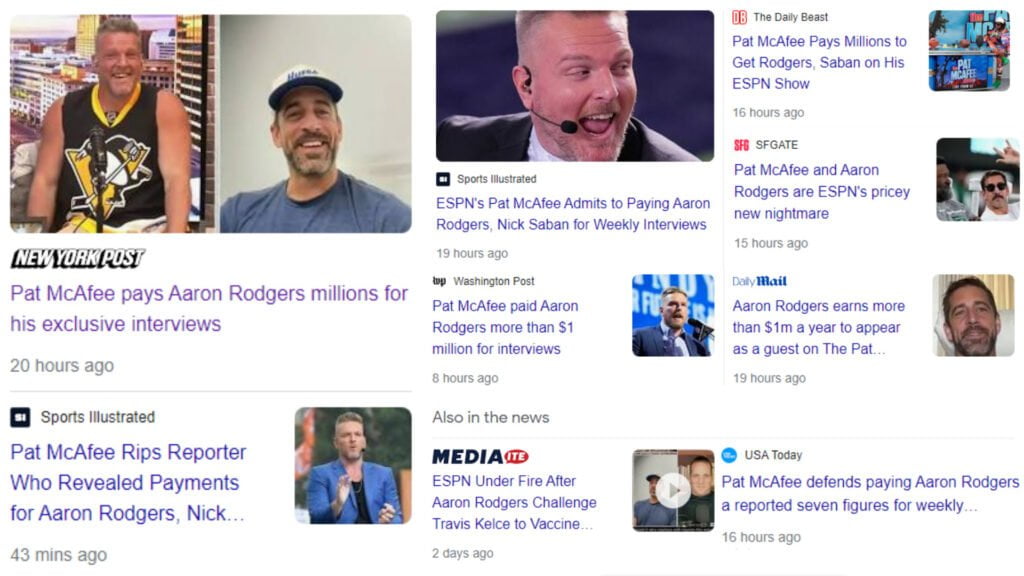
Pat McAfee has a large following. He’s grown that following by having high-profile interviews with players like Aaron Rodgers and now Alabama head coach Nick Saban. And he says its going to stay that way.
During an interview with The New York Post, McAfee shared that there’s value in paying for access to newsmakers.
“I know there’s an old viewpoint that billion dollar corporations have tried to make a standard that players and coaches are lucky to get on the platform and talk.. Well, as the human who owns my company and sees the value directly associated with these guys sharing their stories and thoughts, I think that’s bullshit,” McAfee said. “‘If somebody’s making money off of this, I’m making money off of this. If nobody’s making any money, and it’s all for good will, I’m making no money as well’ is my mindset for doing stuff and I treat my company the same way. I give rather large bonuses as thank you’s and I genuinely believe it’s the only way to operate.”
The report from The Post claimed McAfee has paid Rodgers north of a millio dollars, and he shared his belief that Rodgers deserves more.
“To be transparent, Aaron deserves much more than what he’s gotten for the time and effort he has put into ‘Aaron Rodgers’ Tuesdays’,” Pat McAfee concluded.
After McAfee’s comments were published, he addressed them, taking issue with the way he was conveyed.
“Our company went from being valued — and I know this because I own the company — from anywhere between two to five million a few years back to like over $500 million. And I’m not saying that just to flex. I’m saying that because as a human that knows that all the people that have helped have all been paid very handsomely,” McAfee said, defending the payments to Rodgers. “That is what business is in my eyes. That is what you do in the world.”
McAfee then shared that appearances from Rodgers on the program “turned us into the biggest show on Earth”, so before the holiday season, he wrote the NFL star a check for $450,000.
“Aaron’s very uncomfortable with that, obviously” the former NFL punter revealed. “But then I started breaking down ‘Hey, let me tell you what you have done for our company, and you shut the f— up. That is basically how this is gonna go’.”
He added that after he wrote the check to Rodgers, McAfee became aware that the process usually entails guests appearing for free with the increased exposure radio and television hits provide instead of compensation.
McAfee continued by calling out New York Post sports media reporter Andrew Marchand for the story he wrote about the show and its payments to Rodgers.
“I’m completely ok being known as the guy that appreciates people’s time, effort, and things that happen for us. So, with that being said, Andrew Marchand of The New York Post is a rat, ok? That is what he is. He tried to paint this in a way that makes me look like a bad person.”