TV has a tremendous influence on every sport. That is just the nature of media rights deals that reach the hundreds of millions of dollars. College football is making rule changes in 2023 to accommodate complaints of long games and RJ Choppy isn’t sure that is a good thing.
In college football, the clock would stop after a first down for the referees to reset the chains. That won’t be the case in 2023, as the NCAA has eliminated that rule in order to shorten the run time of games on TV.
Choppy cited a tweet from FOX’s Geoff Schwartz about what this does to the college game.
12 plays and half the quarter is gone after one drive. Just like the NFL. Congrats on the new clock rules in CFB. Something everyone wanted. Thanks.
The running clock on first down mirrors the NFL’s rule. Choppy says adopting it for college football is short-sighted.
“If you try to mimic the NFL, you will now be compared to the NFL and nobody is going to want to watch minor league football,” he said on Tuesday’s edition of Shan & RJ.
This isn’t the first time the NCAA and broadcast networks have altered the rules of the game in order to create more intrigue to get people to tune in.
Choppy says College Football Playoff expansion is another example of making changes to create a more enticing TV product that hurts the sport’s stature in the long run.
“If you’re going to have a tournament like the NFL, you’re going to be compared to the NFL and nobody can be compared to the NFL. And that is going to be like minor league football.”
With the new rule, the clock will be running more frequently, but that doesn’t mean the games are going to get shorter. In fact, Choppy cited a study of Week 0 that showed there were 7% fewer snaps under the new rule, but games only got 1% shorter.
He said the explanation is pretty simple. The NCAA has given so much power to TV that there is nothing stopping the networks from replacing game time with more commercial inventory.
“I mean they can just do it every possession change, they can do it right after and before punts, they can do whatever they want to,” he said. “You know, sometimes in the NFL you have a punt and there won’t be a time out and they won’t go to commercial every once in a while. College football doesn’t work like that. So you are getting so many more commercials and networks are like, ‘Okay, you want to take 30 minutes away from our game? We’re just going to add commercial timeouts for this and we’re going to do more commercials and more minutes of commercials.’”
He added that no one can be happy that there is a rule in place now that limits the number of plays fans will get to see from superstars like USC’s Caleb Williams and North Carolina’s Drake May each week.
Fox News host Brian Kilmeade scored an interview with former Ukrainian prosecutor Viktor Shokin, who was reportedly fired at the insistence of then-Vice President Joe Biden. 1210 WPHT host Rich Zeoli believes Kilmeade deserves credit for getting to the bottom of the story.
During The Rich Zeoli Show Monday, the Philadelphia host argued that the work by Kilmeade overshadowed much of the media’s attempts at finding out what happened in 2016.
“Brian Kilmeade had on the prosecutor Ukrainian prosecutor Viktor Shokin. Now, remember, the corporate media in this country has done nothing in terms of figuring out what he was supposedly accused of doing,” said Zeoli. “That led Joe Biden, as vice president of the United States to threaten to withhold a billion dollars in aid from the Ukrainian government. Biden bragged about that.
“Brian Kilmeade of Fox News did a great job of talking with Shokin… Nobody had ever actually accused him of corruption. Joe Biden just destroyed this man. And the corporate media in this country never bothered to ask any questions. So good for Kilmeade for getting him on his show.”
During the interview with Kilmeade on One Nation Saturday evening, Shokin shared his belief that Joe and Hunter Biden were bribed to call for his removal.
The Brooklyn Nets have reaffirmed their commitment to WFAN. The team has inked a multi-year extension with Audacy.
WFAN and the Nets have been in business together for the last twenty years. The new extension ensures that the station will remain the flagship home of the team.
“For two decades, WFAN and the Nets have been committed to bringing fans the very best NBA coverage in town,” Chris Oliviero, Audacy’s Market President for New York, said in a press release. “The passion for the Brooklyn brand is unique and we are proud to continue to be the soundtrack for the Nets as another season is about to tip-off.”
The broadcast will sound familiar as a new deal begins. Play-by-play man Chris Carrino and analyst Tim Capstraw return to the radio for their 22nd season together with the team.
“The Brooklyn Nets are thrilled to extend our longstanding partnership with WFAN,” Andrew Karson, BSE Global EVP of Marketing, added. “WFAN is the home of New York sports and our flagship station for the last 20 seasons. We look forward to our fans enjoying Brooklyn Nets basketball on WFAN for years to come.”
2024 Republican Presidential hopeful Vivek Ramaswamy went on a miniature press tour Sunday, appearing on both NBC’s Meet the Press and CNN’s Inside Politics. It was the interview with CNN’s Dana Bash that caught the ire of WMAL host Chris Plante.
During The Chris Plante Show Monday, the Washington D.C.-based host took issue with the way Bash conducted the interview.
“Joe Biden won’t debate anybody, but Vivek Ramaswamy went on CNN and then you get what you expect from CNN,” said Plante before saying the interview was more of an interrogation.
After playing a clip of the exchange between Bash and Ramaswamy that turned contentious, Plante sarcastically said “You should interrupt him. I think maybe you should interrupt him and not let him finish his sentence….First of all, you just cut me off like 35 times,” Chris Plante continued.
“And I didn’t express anything that would advocate violence and you guys have been burning our cities for years now. Sacking and plundering and looting our stores, and burning police stations and police cars, and injuring thousands, murdering dozens.”
“Seig heil. Because CNN? It’s a party front group,” Plante concluded.
Brian Boucher is switching teams. He will leave ESPN to take a role on TNT’s top NHL broadcast, according to Andrew Marchand of the New York Post.
Boucher will join Kenny Albert and Eddie Olczyk on the broadcast as the between the benches analyst. He will replace Keith Jones, who left the role after last season to take a front office job with the Philadelphia Flyers.
After 13 years in the NHL, Brian Boucher immediately began his media career in 2013. He joined NBC’s national coverage of the league in 2015. When the network lost broadcast rights, he moved to ESPN.
Last season, Boucher worked with Bob Wischusen in the play-by-play booth.
A new bill presented to Congress would give small businesses a tax credit for placing advertising with local newspapers, television, and radio stations.
The proposed bill would create $5,000 in tax credit for the first year and $2,500 in subsequent years for grocery stores, restaurants, and other small businesses that advertise with local news sources. The businesses must have fewer than 50 employees, and the tax credit would account for 80% of their advertising spending in the first year with radio and television stations.
Additionally, the bill would offer a payroll tax credit to news organizations of $25,000 per employee for the first year and $15,000 for each year following to retain or hire local news reporters. Local journalists would be required to dedicate 800 hours per year to local newsrooms.
The bill has received bipartisan support. In addition to being co-presented by a Republican and Democrat, the bill was co-sponsored by Reps. Brian Fitzpatrick (R-PA) and Andrew Carson (D-IN).
The tax credit was estimated to cost $1.67 billion over five years before the program expired.
After former President Donald Trump was booked in Atlanta in his fourth indictment, his physical attributes were broadcast to the world. CNN questioned some of the statistics, and Megyn Kelly spent time wondering why.
During the Monday edition of her show, Megyn Kelly pondered if CNN had anything better or more important to devote coverage to than the former President’s height and weight.
“The booking record lists him as having blonde or strawberry hair (and) a height of six feet three, weight of 215 pounds, which is 24 pounds less than the White House Doctor reported him weighing back in 2018,” Kelly noted.
“CNN had a meltdown over this discrepancy in the weight because ‘You can’t trust Trump on everything and he needs to be called out for any lie’. Hello? There’s not a person on earth who hasn’t lied about their weight, but ok.”
After Megyn Kelly played a clip of CNN’s Jake Tapper questioning the former President’s weight and hair color, she returned to criticizing the network, turning her attention to the primetime lineup.
“What we saw on CNN was Kaitlan Collins coming out and saying, ‘Oh, it’s ironic he should post never surrender because that’s exactly what he was forced to do down in Georgia. He had to go in surrender himself’. As though he meant it literally. Like if you say he’s only a tough guy if he runs from the law and makes them track him down, capture him, and drag him to the court otherwise you’re not a man.”
Nielsen is trusting Amazon and using the company’s data in reporting viewership for Thursday Night Football this season. That makes Jeff Bezos and company happy. The competition, however, is less than thrilled.
Media Rights Council can approve the plan at a meeting on Wednesday. The plan has been audited for accuracy and that has network television executives and the Video Advertising Bureau raising questions.
A spokesman for the VAB, a trade group for network television, questions the speed of the audit. The group is also questioning the fairness of the practice.
“Having DNA-level factors that are inherently biased baked into the system is putting [Amazon] at an advantage,” VAB CEO Sean Cunningham said. “That’s not fair to the other players, especially since there hasn’t been any constructive engagement from the co-authors of this.”
He added that Nielsen has been “completely opaque” regarding how Amazon’s numbers are measured and how they are incorporated into overall audience measurement.
Amazon has denied that it has tipped the scales in its favor with the plan. It should be noted however, that in 2022, the company’s internal reporting estimated audiences 18% larger for the average Thursday night game than what Nielsen showed.
Cunningham says this is an example of Nielsen putting “its thumb on the scale” for Amazon. Linear networks have tried to strike similar deals for audience measurement in the past only to be rebuffed.
Sean McManus addressed the controversy on an NFL on CBS media call on Tuesday.
“A fair and accurate audience measurement across all platforms is absolutely vital to our industry,” the CBS Sports chairman said. “Anything that is not impartial and unbiased is unacceptable to us. I must say that we think it’s extremely odd and unfortunate that different rules are suddenly applying to one platform, and I’ll leave it at that.”
“Nielsen is committed to evolving our methodologies to provide the most accurate measurement of what the audience is watching,” a company statement from Nielsen announcing the move reads. “We are making modifications for live streaming measurement to more accurately reflect the growing impact of streaming and first party data. We will continue to leverage newer data sets as they become available in order to drive our measurement capabilities forward, with the ultimate goal of counting and reporting the viewing habits of everyone, everywhere.”
Nielsen has said that streaming data from platforms will be used only to measure the audience for live events.
During an interview on Sirius XM’s Breitbart News Saturday, Howie Carr gave his perspective on the changing landscape of the news industry. He noted that in the past, the industry was primarily made up of working-class reporters who started at local news sources and worked their way up to larger media platforms.
“I mean, the, you know, newspapers in the old days, it was a sort of a working-class, blue-collar trade,” Howie Carr explained. “And after Watergate, it just the sort of the upper classes, the elites, the legacy started moving into it, and it’s totally different now,” he said.
Carr says the industry is mainly controlled by a small group of privileged individuals who often defer to those in positions of power.
Howie Carr discussed his new memoir, Paper Boy – Read All About It. The memoir covers Carr’s journey in journalism, radio, and television. Boyle recognized Carr’s influence as a conservative figure in Massachusetts for many years and asked him to share his observations on the changes in the newspaper industry throughout his career.
“As I say in the book, there used to be a farm system. You know, I started at the Winston-Salem Journal, worked my way up back to Massachusetts, and Tom Wicker, who worked for The New York Times, he came out of the Winston-Salem Journal too and worked his way up, but now, Matt, as you know, I mean, there is no farm system. If there’s a farm system, it’s, you know, you work as an aide to a coat holder on Capitol Hill to the Democrats,” stated Carr.
Carr highlighted the past work of CNN’s Jake Tapper, NBC News’s Chuck Todd, and ABC News’s George Stephanopoulos for Democrat politicians.
“Jake Tapper, you know, he worked for Chelsea Clinton’s mother-in-law, and she was married to a corrupt congressman, and she was a congresswoman,” Carr said, referring to Marjorie Margolies.
“Or you have seen Chuck Todd, who worked for stolen valor Tom Harkin, a senator, or Stephanopoulos, who ran the bimbo eruptions unit for the Clinton campaign in ’92. I mean, that’s the farm system now… It’s not just the internet that’s destroyed newspapers,” he added.
According to Carr, modern-day reporters act more like obedient pets, following the orders of those in authority instead of questioning their actions. As the author of The Brothers Bulger, he has always aimed to serve the working-class audience, including the people he encountered on his train rides and at bars.
“And, you know, it’s like one-man bands now. It’s guerrilla journalism is what it is, and it’s really unfortunate,” he added.
When Atlanta Braves second baseman Ozzie Albies launched a three-run walk-off home run to secure a sweep of the New York Mets in early June, Truist Park was in a state of bedlam. As Albies rounded the bases and approached home plate, fans were jumping out of their seats to be a part of the mass exultation. Moreover, his teammates stood ready to douse him with liquids and mob him in celebration. For the team, it was another show of dominance against their divisional rivals, but the triumphant moment garnered additional significance for Bally Sports South/Southeast, the local regional sports network.
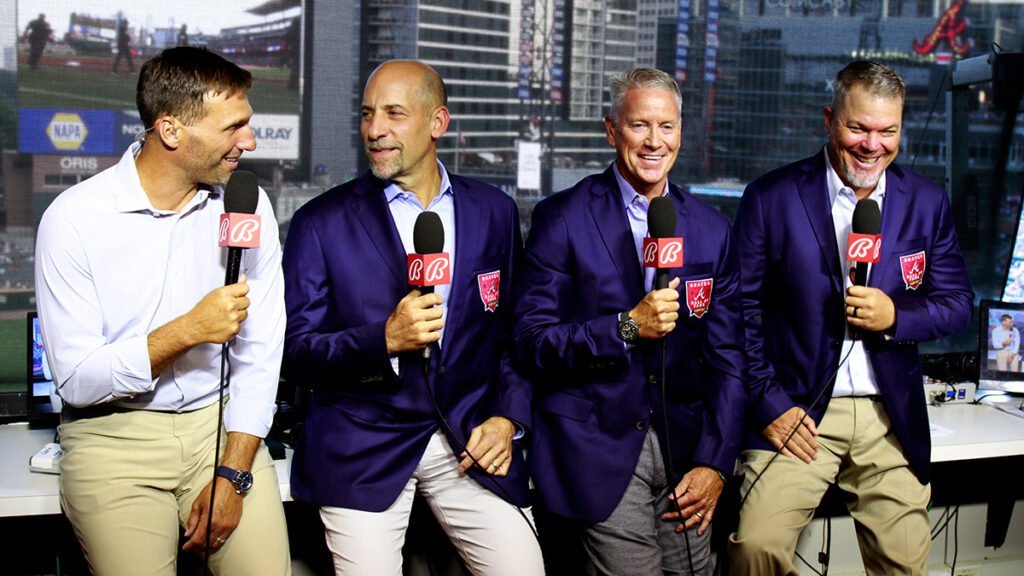
The broadcast entity had taken a chance by pairing four Braves legends in the broadcast booth together to call the game – without a play-by-play announcer – for the first time. Even though all of these analysts had some form of broadcast experience, the network opted to make their alternate broadcast the primary offering that night.
The performance was undoubtedly helped by the vacillating nature of the game, during much of which the Mets held the lead. The situation set itself up for Albies to walk it off, but led to a moment of brief confusion in the booth about who was responsible for making the home run call.
Lead FOX Sports analyst and Hall of Fame pitcher John Smoltz punctuated the moment by saying, “That’ll do it!,” and let the crowd tell the rest. Chipper Jones, Tom Glavine and Jeff Francoeur joined in the fun as Atlanta regaled its young superstar and supremely talented baseball team.
“Smoltzy went nuts and said all the things and I just looked over,” Francoeur said. “Chipper’s been a friend of mine forever and I know he loves Crown Royal, and so I just said, ‘Pour Larry a Crown!’ It was perfect.”
Francoeur’s pithy statement stuck with Braves Country and was plastered on T-shirts instantly. The catchphrase is now associated with the team as it seeks to capture its second World Series championship in a three-year span.
“I think we captured that moment pretty well even though we weren’t maybe 100% prepared for it, but I think that’s the stuff you just react to,” Glavine said. “You know you have to call those moments even though you’re not doing play-by-play on every pitch.”
The success of that broadcast compelled Bally Sports South/Southeast management to plan a sequel last week when the Mets returned to Atlanta for the teams’ final meeting of the season.
As a member of the Braves, Glavine was afforded the luxury of national exposure through a unique arrangement with the Turner Broadcasting Company. Before being granted a national MLB media rights contract in 2008, the Atlanta-based broadcast company presented Braves games to the nation starting in 1973. Skip Caray, Pete Van Wieren and Ernie Johnson Sr. became household names, and the Braves garnered backing from all corners of the country en route to a World Series title in 1995.
“No disrespect to the [Dallas] Cowboys – we were ‘America’s Team’ – that’s what we were dubbed after a while and [it was] certainly true in baseball and that’s the way it was,” Glavine said. “We would go on the road, and the amount of support we had on the road because of the people who watched us on TBS was off the charts.”
Once his playing days were reaching an end, he began to think about what would come next and had conversations with professionals and mentors about assimilating into sports media.
“I don’t think anybody’s perfect, but my dad always used to tell me when I was going to play ball, ‘You’re going to have a lot of people tell you what to do and they’re all trying to help you, but it’s up to you to figure out what works for you,’” Glavine recalled. “I think that’s been the case in broadcasting too, just like it was when I was a player.”
Throughout the 2010s, baseball went through a variety of seismic changes that rendered the game more difficult to watch, largely linked to a new sabermetric philosophy. Because of tactical decisions being made by organizations, the sport began to inherently change in terms of adventitious outcomes and the overall fan experience.
“You’re playing a three-and-a-half-hour game every night with 100 pitching changes and not much going on,” Glavine said. “It wasn’t the greatest product to watch, let alone talk about.”
Combined with the loss of his father during the previous summer, Glavine decided that he would step away from broadcasting in the 2022 season. He spent the summer with his mother in Massachusetts, cherishing time with his family after devoting several decades to “America’s Pastime.” In weighing the decision to return to the broadcast booth after his mother’s death in December, Glavine recognized how much he enjoyed watching the game and noticed rule changes that had the potential to hasten the action.
In being scheduled for 35 to 40 broadcasts throughout the year, he knew that coming back would mean adjusting to a new play-by-play announcer after Caray signed on to call St. Louis Cardinals games. Brandon Gaudin, the voice of the Georgia Tech Yellow Jackets and a presence on the Big Ten Network, ended up landing the Braves television job.
Similarly to Glavine, Francoeur had been working with Caray since his broadcast debut in 2017, although his initial assignments were on the studio’s pregame and postgame coverage. Being recently removed from 12 seasons in the big leagues – including parts of six years with the Braves – he focused on providing intel regarding the modern game and what adjustments players have to make in real time.
As a player, Francoeur remembers Braves manager Bobby Cox addressing the team before each season about their obligation to media members. Cox was forthright by expressing that it is the job of the team to provide journalists information to disseminate to the public. He understood that if they tried to take advantage of the players, coaches and personnel, it could lead to issues. In an effort to avoid acrimony, he inculcated how to best handle these interactions to cultivate a professional working environment conducive for success.
“When the visiting teams come in, I have them out to my golf course – a couple of the players or something – and kind of just get some information and see what’s going on,” Francoeur said. “I’m usually able to interact in that style.”
Cultivating and maintaining relationships formed throughout his playing days and beyond are fundamental aspects of any success Francoeur may have on the broadcast. Whether it is with those in the dugout, executives or other journalists, everyone is enmeshed within the labyrinthine information highway. The stream of consciousness generates interest and the ability to enterprise stories and editorialize with merit rather than exuding persistent obsequiousness.
“That’s your lifeline; that’s how I get my stories,” Francoeur said. “….I make sure to stay on top of that, to talk to them and be a part [of it] because ultimately, that’s where I get my content [and] that’s where I get myself to be good at my job.”
Francoeur considers analytics and other statistics more in the purview of the play-by-play announcer, realizing that the top priority for analysts should be to expound on why something unfolded in a specific manner. On national broadcasts, he is often paired with Brian Anderson and dissects each team at surface level, making sure that they inform viewers and provide close to equal coverage on both teams. Conversely, local broadcasts have a narrower distribution and appeal, leading most of the discussion to center around the play of the team instead of the opponent.
“When you do the national approach, it’s one of those things that you’re obviously [discussing] both teams; you’re trying to give the info you can. I’d like to say you can dig in more,” Francoeur explained. “When you’re doing your team obviously, look, you’re not going to be a complete homer, but at the same time, 99% of your fans are Braves fans watching the game so you also want to be cognizant of that.”
National broadcasts frequently add new voices, whether it be through studio shows, game broadcasts or alternate presentations – and Francoeur and Smoltz are the two members of the alternate booth with that level of consistent experience. Glavine does not wish to travel as much and chooses to remain close to his family.
“It’s nice what I have with the Braves because I can pick my schedule [and] pick my spots,” Glavine said. “I’m never gone from home for more than six days, so that’s the important stuff to me.”
Prior to the 2023 regular season, MLB implemented various rule changes intended to hasten pace of play and increase offensive output. The pitch clock in particular has shaved 25 minutes off of the average time of a nine-inning game, leading to a 9% increase in attendance and broadened interest in the sport across the board. When the contests are deadlocked in the final innings with a chance for a momentous finish, most broadcasts proceed to fixate on the pitch-by-pitch action with minimal extemporaneous discussion. No matter the scenario though, Francoeur conveys that the game should take precedence.
“I will not talk over a pitch,” Francoeur said. “Even if I’m telling a story, I can slowly kind of bring it to a stop, and then of course if there’s a pitch thrown and nothing happens, I can pick it up. I always want to give that ability to, whether it’s Brandon [or], in the playoffs, Brian Anderson, I want to give them that ability to make the call if they need to.”
Both Francoeur and Glavine want the Braves to win when they show up to the ballpark. When they were working with Jones and Smoltz devoid of a true play-by-play announcer, their fandom for the Braves shined through. This was by design by the regional sports network though, granting viewers a new way to consume sports and a template for other baseball teams to consider in crafting new methods to reach the fans.
“It’s not that the Braves fans can tune in to another broadcast if this style is not what they want to watch,” Glavine explained, “but I do think there is a level of people tuning in because they’re intrigued by the broadcast and what’s going to happen and just having the opportunity to hear the four of us together.”
Courtesy: Bally Sports
For the second edition, the Braves and Mets were squaring off in the rubber match of the three-game tilt. From the first inning on, Atlanta was in full control of the contest thanks to starting pitcher Charlie Morton posting seven scoreless innings on 11 strikeouts. Without the play-by-play announcer, the analysts had the responsibility of keeping viewers informed and executing other tasks, including sponsored elements. They also had to contend with the challenge of interacting with special guests throughout the game, including Braves legends Greg Maddux, Fred McGriff and Brian McCann.
Entering the first iteration of the alternate broadcast, the alumni had a plan in place about whose inning it was to narrate a home run should one be hit. In the end, Jones, Francoeur and Smoltz all got to announce the five home runs hit during the game, leaving people wondering how Glavine would deliver such a moment.
Last week, Glavine finally got to make his first home run call on the alternate broadcast saying, “It’s too early for a Crown, but it’s gone!” as outfielder Marcell Ozuna launched the only home run of the contest. His remarks elicited laughter from the rest of the broadcast booth, reminiscing on the viral moment from last game that conceived a second outing.
“It’s being around these guys, which is always fun,” Glavine said. “I think that’s the one thing as an ex-player that we would all tell you we miss. It’s not necessarily going to the ballpark every day and playing – I think to some extent we all do miss that competitiveness. The blood-flowing; you’re getting ready to go play a big game; we miss that, but we all kind of miss the clubhouse banter [and] the camaraderie.”
After the first broadcast, Glavine remembers being approached by a fan and saying that the games should be disseminated in that format all the time. While he is unsure if alternate styles of broadcasts will ever become the primary means of viewership, he is aware that what the Braves have differs from anything on other niche presentations.
“I think it’s something that had a good enough reaction that I think it only makes sense for Bally and the Braves to try and do more of,” Glavine said. “I would venture to think that other teams and other sports are looking at it and trying to see if there’s a way that they could integrate something like that with their teams.”
“Fans like seeing the action,” Francoeur added, “but I think if you had to do it all the time, I think that’s probably a little less desirable.”