Home Blog Page 2709

Is Dan Le Batard Right About Mina Kimes & Monday Night Football?

4

For the first time in a while, ESPN will feature the same Monday Night Football booth in consecutive years. The crew of Steve Levy, Brian Griese and Louis Riddick will be back to call the action on Monday Nights. The trio debuted last season and got mainly good reviews, but the bar was set pretty low after the Tessitore/McFarland era. 

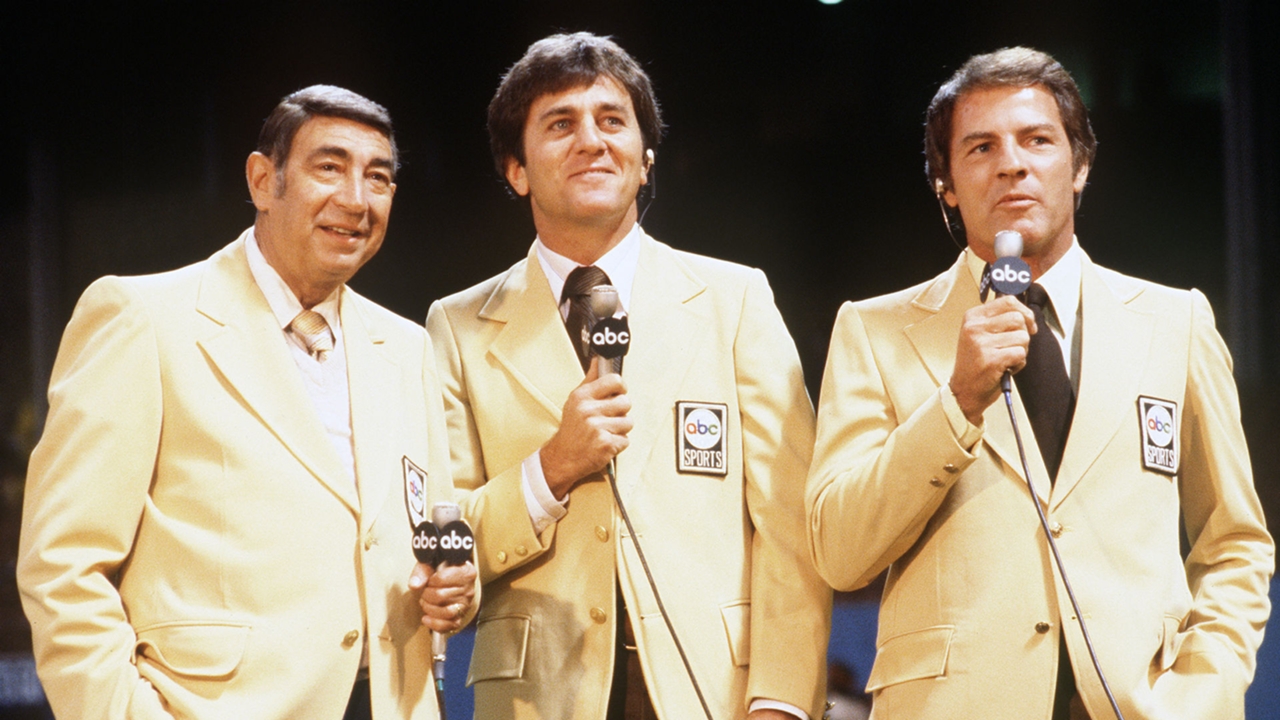
I didn’t have a major problem with the booth as constructed. I thought the addition of Riddick was a great move. Levy is a pretty solid play-by-play guy and Griese has been around for a while, so I’m used to him as an analyst. Probably not a glowing review on my part, because I grew up in an era of Monday Night Football being a spectacle, and an event. Howard Cosell was the star, “Dandy” Don Meredith was the jokester, and Frank Gifford was a former player turned pretty darn good play-by-play man. I’m spoiled, what can I say?
The perfect fit': Glory days of 'Monday Night Football' with Cosell,  Meredith and Gifford | Sporting News
Courtesy: ESPN Images

Over the years as things evolved on the broadcast, television executives tried to fix what wasn’t broken. Wanting to do things differently. Like the failed experiment of Dennis Miller. I’m not sure what the attraction was. I mean Miller was hilarious on Saturday Night Live, but come on, why was he in the football booth? Tony Kornheiser had a crack at it to, but it wasn’t the right fit. My point being, if you’re going to change it up, change it for the better while keeping the integrity of the game and booth in mind. 

I bring this up because of Dan Le Batard. Last week he tweeted about having only 17 percent battery life on his phone and he’d been drinking tequila. He opened up his Twitter account to anyone that wanted to ask him anything. One of the first questions he received was from Mina Kimes, the ESPN NFL analyst. 

She asked: Do you think Rico Dawdle cemented his position as RB3 on the Cowboys depth chart with his explosive performance tonight?

Le Batard responded: Yes. And I think they need to be smart and put you in the Monday Night Football booth because your analysis is better than anyone’s and no one cares more about football or is better on football than you are.

Le Batard later tweeted he doesn’t want to see Kimes as a sideline reporter on an alternate simulcast. He wants her in the booth each week. To which Kimes tweeted back, “Please drop me off a block away from school; you’re embarrassing me in front of the other kids.”

The former ESPN’er said he didn’t want to see Kimes in a sideline reporting role or on an “alternate broadcast”. He says she belongs in the booth. 

Could this be a legitimate option for ESPN, say if Riddick gets a front office position in the league? What if Griese decides he wants to coach? I’m not sure that’s even an option, but you get my point, what if there is an opening as an analyst in the MNF booth? Would Kimes be considered? 

First off, if Kimes gets offered a role to host on the MNF Alternative broadcast, she should take it. That would be a great way to get some broadcasting “reps” and better prepare her for a possible role in the main booth. 

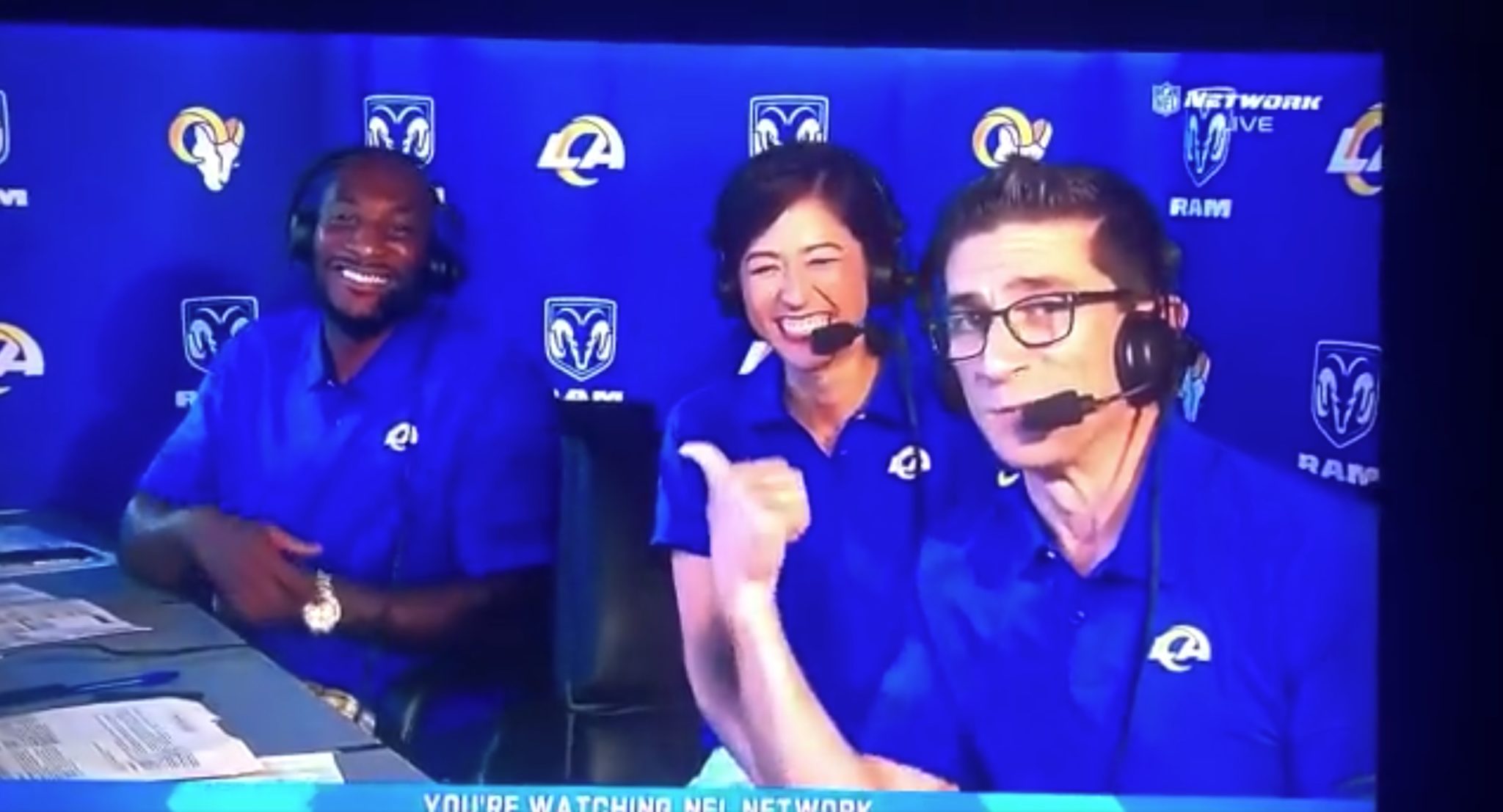
After watching a recent Los Angeles Rams preseason broadcast, I think Kimes would be a hit on the regular broadcast. She worked the Rams/Chargers game for a local LA television station, which was also carried on the NFL Network. Kimes was seated alongside Aqib Talib as the analysts, working with play-by-play man Andrew Siciliano. He is the perfect broadcaster for Kimes to learn from. First off, he does a great job calling the action, but an even better job of setting up his analysts. 
Mina Kimes awkward NFL broadcasting moment goes viral

As I watched on my iPad, while getting my car serviced in suburban Chicago, one thing struck me immediately. Kimes knows her stuff. It was clear to me that she spent time preparing for this game. Her information was excellent. Kimes had in-depth knowledge of the camp battles for both teams and was very informed on what the teams did last season and needed to improve upon. She spoke confidently. 

What also struck me, was that Kimes was not afraid of the moment that’s for sure. Although I would say early in the game, she did defer a lot to Talib. He wasn’t seizing the opportunity to “analyze” right after a play. Kimes though showed respect for a guy that played the game, allowing him to gather his thoughts. But you could tell that Talib respected her. He deferred to her a few times. In kind, Kimes would bring Talib back into the conversation, with on point questions, especially about the DB’s. His area of expertise. It was fun to hear the two work together. I did feel that most of the time, her information was better.

For example, in the second quarter Kimes began talking about the Rams running game. With Cam Akers out for the season, she said fans should keep an eye on who will be running the ball. She asked the question out loud about whether the Akers’ injury would cause a philosophy change in the Rams run game. She wondered if the style would be drastically different without Akers. 

Kimes showed an ability to have a lot of fun in the booth. She joked in the 2nd quarter, after a replay showing a DB grabbing some of the receiver’s jersey. Talib and Kimes laughed about it, with Kimes stating, “I work with a lot of DB’s and I know better than to call that pass interference or holding.” 

She told a few great stories too. One was about Chargers quarterback Chase Daniel and his bank account. Kimes mentioned that Daniel, after this season would have made 38.9-million dollars in his career. She added that he’s only started 5 games in the NFL. She capped it by saying, “Wow, his average (dollars) per throw is more than I make in a year.” 

I enjoyed her information and the way she relayed it. Kimes certainly has a working knowledge of the schemes on defense and on offense, but the information was presented in a very digestible way. The info was very relatable and she wasn’t trying to overdo it. Meaning, she wasn’t saying, “look at me, I know my stuff and I am proving it to you by saying this.” Kudos to her for realizing that and sticking to her style and understanding of the situation. 

If I had a criticism, it would be her ‘feel’ for the booth. It’s probably unfair because nobody ‘gets’ that dynamic right away. Plus, she’s only recently made the transition from writing to hosting and now to analyzing during a game. My biggest gripe is a small one in the grand scheme of things. Every once in a while, she would talk over referee Tony Corrente’s penalty calls, which shouldn’t happen. There were a few awkward moments and a few times where maybe things sounded a little forced. But that was early in the game and it got better as time went by. 

The most awkward moment though was handled beautifully by Siciliano and Kimes. She went viral when she was trying to get into position for a booth shot. Kimes wasn’t completely seated when the director took the shot. When Siciliano said, “Hey look, we’re on camera.”, Kimes responded with “So are my pants.” The ability to laugh at herself is something to respect as well. 

Mina Kimes laughs off awkward NFL broadcasting moment during Rams-Chargers  game

Kimes is a good story teller. I want to hear more stories, especially during a preseason game. Why? Because the casual fan probably doesn’t care that the Rams are in “Cover Zero” with a blitzing strong side linebacker. But I’ll bet they’d love to hear the “SAM” linebacker was an undrafted rookie free agent from a small school in the Midwest. Those are the stories that the NFL is built on. 

I’ve said it before, you don’t have to be a former player to analyze a sport. It’s a bit tougher because you don’t have playing experiences to draw on. But remember, just because you played at a high level doesn’t mean you’ll be a good analyst. If you study the game, if you immerse yourself in it, if you continue to learn from coaches and players, you can analyze the NFL or any sport for that matter. Gaining respect from teams means you’ll get information that others may not. 

Kimes was named to the NFL 40 Under 40: by the Athletic. According to the site, “she’s a skilled interviewer and a masterful writer who in the past year crossed over into a full-time analyst role on “NFL Live.” It’s still exceptionally rare for a woman to sit in the analyst chair, yet Kimes already has become one of the most respected voices in football.”

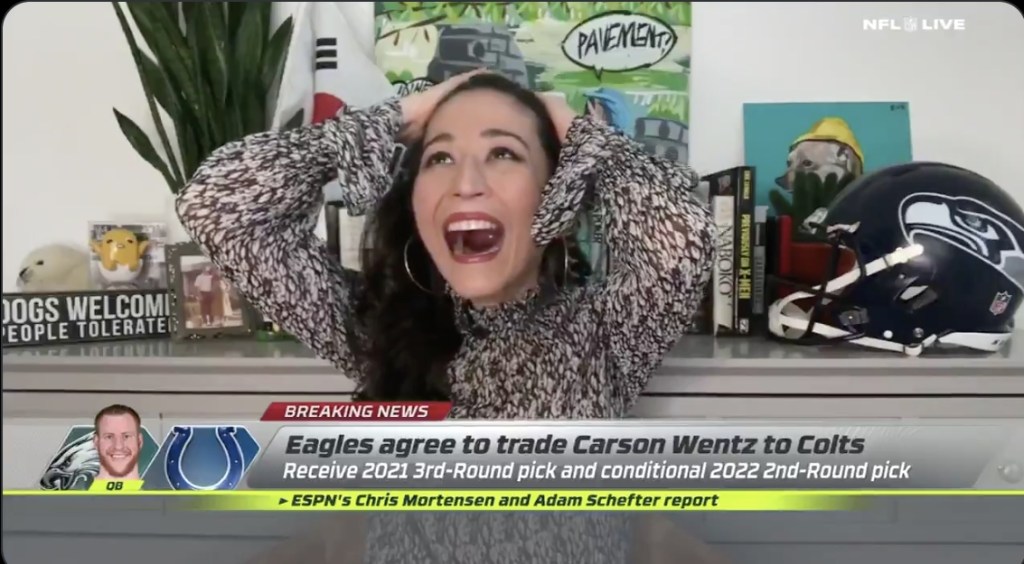
The site interviewed her co-analyst on NFL Live, Dan Orlovsky, the former NFL QB. He added, “Mina is so great because she never wants to live on the surface of a conversation about football. It’s always going down into the weeds, understanding it and then making it surface-level understandable,” said Orlovsky. “Being her teammate is fantastic because you know she’s locked in and forces you to be on top of your game.”
Dan Orlovsky's Insistence Carson Wentz Could Win MVP Broke Mina Kimes

Should Kimes be a candidate if/when a spot opens up in a broadcast booth? Yup. She’s good, oh and she’s qualified too. Her enthusiasm, passion, and knowledge of the game have earned her respect from colleagues and the adoration of many fans. Le Batard is on to something here, hopefully the bosses at his former network are listening. 

She’s already ten times better than Dennis Miller. 

Five Goals: Will Cain

1

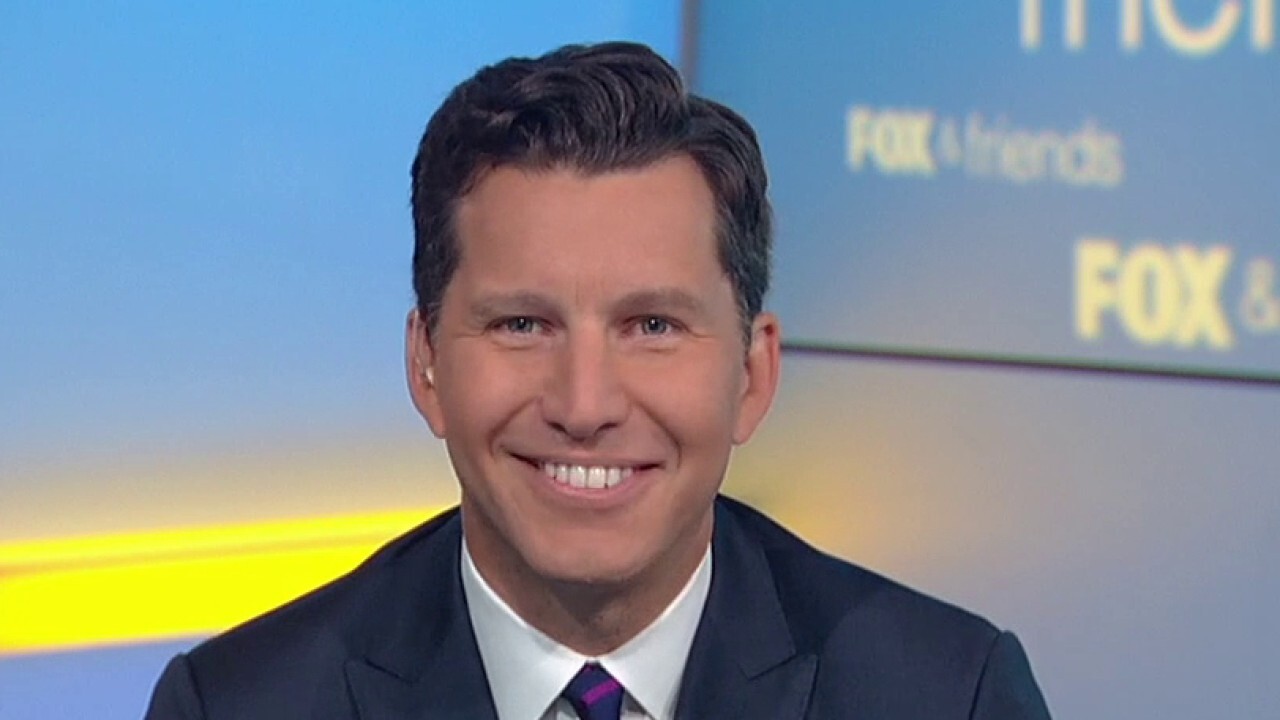
Will Cain is the co-host of FOX & Friends Weekend (Weekends, 6-10 AM/ET) on FOX News and host of The Will Cain Podcast, which recently expanded to three episodes per week. In his own words, these are his five goals.

Will Cain set to join 'Fox & Friends Weekend' alongside Pete Hegseth,  Jedediah Bila: 'We'll laugh, disagree and share the ball' | Fox News
Courtesy: Fox News

1) Do Something. 

One of the statements that’s really resonated with me as I’ve gotten older in life is: Do you want to be something, or do you want to do something in life? 

This week I’m getting to host FOX News Primetime and I’m excited about that opportunity. But whether or not that manifests in a permanent job and whether or not the Will Cain Podcast as a digital platform becomes my outlet, I want to have a place where I can create something. Do something. 

I want to hold a conversation with the audience that pushes towards positive values in this country. I don’t just want to be anti. You know, everything in our industry is conflicts centered around being anti. Anti-racist or anti-anti-racist, always positioning what you’re against. 

I think most Americans largely agree on some positive values that we’ve forgotten. Whether or not it’s FOX News Primetime, or another primetime slot, or a digital platform, I don’t care — as long as I can do something about shining a light and advancing those values.

2) I want to live on the beach.

My wife and I *will* live on the beach. I love the mountains. I lived in Montana for a year. I love the country. I want to own a ranch. I want to spend time outdoors. I want to hunt and fish with my boys. 

But I know, at some point in my life, and it’s probably after my kids are out of the house, my wife and I fully intend to live on a beach — in Hawaii or Florida or California. 

Ryan Shirts

(RG: I interrupted, laughing, that I don’t see him as a California guy.)

When I lived in New York, I went to the beach all the time in Long Island. You forget that you’re an hour away from the beach when you’re walking around Midtown. We would go to the beach all the way through the Fall. I like all kinds of places. Make no mistake, I’m a Texan, but I don’t think Texas beaches will satisfy my requirement.

There’s something about looking out over that massive body of water. It’s just perspective. I think I have an exploratory part of me where I love going somewhere that it feels like no one has been before. 

There’s a line in Lonesome Dove where Gus says, “There’s nothing like riding a fine horse into new country.” I love that line. There’s something about the ocean, when you’re standing on the beach, it just looks endless. It’s not unexplored, but it feels unexplored. It’s always changing. It’s always moving. There’s just the great unknown there as you’re looking out over the ocean and that appeals to my exploration instinct. 

3) I want to become a proficient surfer.

This is totally against the cast type you have for me, but you know there’s those things in life that people love but they’re just not great at but they do it anyway. People should have those things. For a lot of guys, that’s golf. They just keep doing it no matter if they’re any good at it or not. Golf just never did it for me.

This is tied to living on the beach; I’m not any good at surfing but I do it any chance I can. I love surfing. Fun is not the right word. I understand the spiritual nature of it when you’re out there. You can’t conquer the ocean. You can’t tame it. All you can do is try to ride along with it. And even if you’re not, just sitting out there waiting is so spiritual. I want to become a proficient surfer.

4) Swim from Lanai to Maui again. 

This is very Hawaii-centric; I did just come back from there. We go there for vacation every year. 

Here’s the thing. I’ve done this swim before. I did it when I was 39; I wanted to do it before I turned 40. It’s a swim, nine miles, across the channel between those two islands. It’s a relay, with six friends of yours. It was an awesome, humbling experience.

All my friends and I talked about going into it was who’s going to get eaten by sharks. That’s all we thought about, were sharks. But once you’re out there, swimming, you forget about sharks almost immediately. All you can see is deep blue sea and you realize there’s nothing you can do about it anyway — and you’re fighting the ocean.

Drone Warns Surfer of Great White Shark Circling Him Below

I want to do more than one physical accomplishment before this life is over. I don’t really want to run a marathon. I hate running. Maybe hike a peak somewhere, but I haven’t really set that out as a goal. But the one thing I know I can do, and I have done, is open water swims.

I don’t love open water swimming, because it’s usually cold. Like, Alcatraz or the English Channel, which is not something I intend to do. I want to the Lanai to Maui swim with my buddies again; that’s going to be my placeholder for more than one physical challenge that I want to do again in my life.

5) Purpose.

I don’t want this to sound too much like my first goal, but I’ve learned the difference the last few years between careerism and purpose. But, I have two sons, my wife, and myself. If I can do something, beyond all my other goals in life, it’s for all of us to find our purpose. What we’re doing here.

Without that, we’re just aimless. I think a lack of purpose is the major source of depression and anxiety for almost everyone in society. I don’t even think it’s if you have a job or not. I think it’s Why do I wake up every day and do what I do? What actually matters?

Your career can only be loosely tied to that. Maybe more so if you’re lucky or if you’re purposeful in how you create that. But — money, advancement, promotion, fame, platforms … they’ll all quickly lose their allure. They really will, and they’ll show themselves to be hollow. If you can find a purpose, and I do think religion is probably a necessary component to that search, then I think you’re going to find a fulfilled life. That’s what I want for myself and my family when I raise these two boys. 

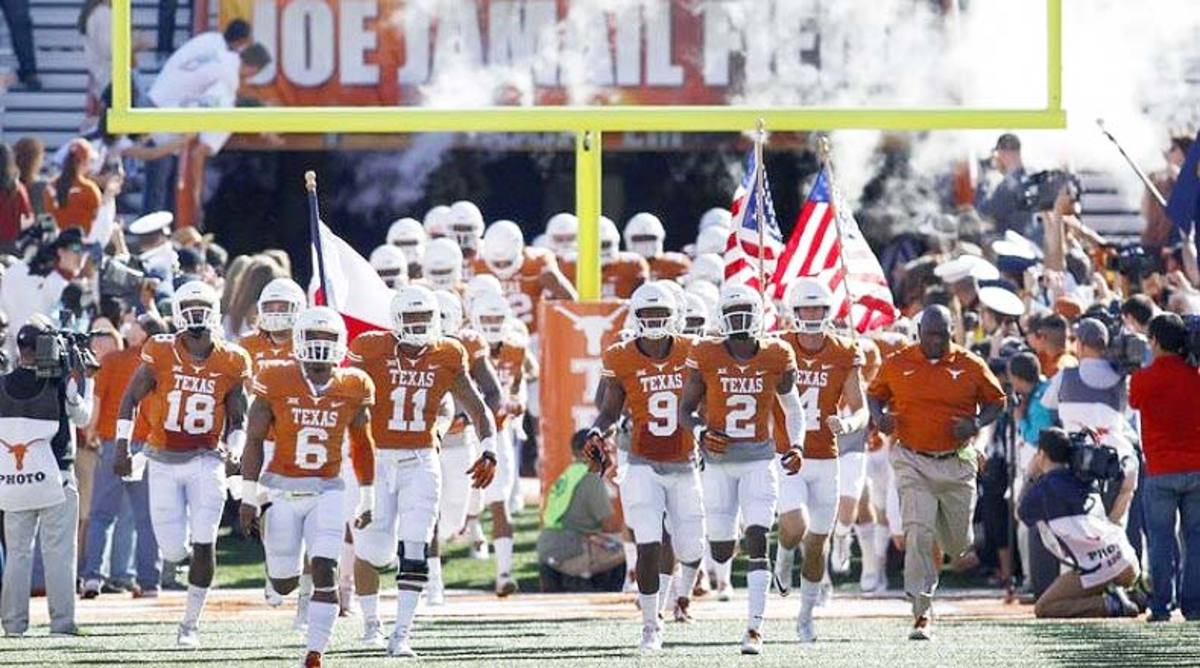
6) Bonus sports goal: I’m torn between whether I want to see, along with my sons, another Dallas Cowboys Super Bowl or the Texas Longhorns dominating the SEC. 

The funny thing about sports is, they’re not my goals how can I have a goal that someone else will accomplish? (RG: I mentioned that seeing a championship before you die is a multi-variable equation in which we do have some control, and that he could eventually gain access to future Dallas Cowboys owner Stephen Jones and/or become a Texas booster funding NIL endorsements.)

Whatever Arch Manning’s son’s name is, playing quarterback for Texas, sponsored by the Will Cain Show on FOX News. That’ll make him popular, too (laughing).

Texas Football Schedule 2021 - AthlonSports.com | Expert Predictions,  Picks, and Previews
Courtesy: Athlon

The way I figure it, if you win the SEC, you win the national title. It would be so vindicating after I’ve heard that Texas is going to be a mediocre team. Maybe they will at first, but they won’t be for long. I want to prove that Texas belongs.

The Tricky Balance Of A Sales Budget

0

The salesperson is the most critical person in the budgeting process for any radio station, cluster, or company…and we are the most unreliable at times.

I watched Audacy VP of Finance Stephen Clare give a RAB seminar on budgeting last Wednesday. It is good for all salespeople to understand where corporate is coming from on issues like budgeting. It is much easier to give them what they want when you know why they want it. Clare went through corporate budget timelines, revenue, and expense details.

Profile photo of Stephen Clare

COVID-19, and now the delta variant has thrown the bean counters a curveball. Typically, corporate accountants would start crunching next year’s numbers any day now. Budgets can take them anywhere from one to three months to prepare. With COVID-19, everything is up in the air, and the budgeting process is almost a quarter at a time process. 

I have seen one of two methods of next year’s budgeting process roll downstream to the AEs:

  1. We forecast what we think we can do and give them a number broken down monthly and annually; submit that, and corporate comes back with our budget.
  2. We are given our budget, and it usually is 1-10% more than what we did the previous year.

In Boise, Idaho, most operators will make their once-a-year sale in the late 3rd/early 4th quarter to lock in business for the following year for the first quarter and any weeks that have perennially low demand. Then AE’s go with #1 or #2 above. 

Clare explained that when Audacy works on annual budgets, they get the forecasts for the industry from BIA, RAB, and Miller Kaplan. They take that increase and turn it over to the AEs, and they hope to meet in the middle or as close to the industry forecasts as possible.

I did learn two things that are important to know.

First, most companies, radio included, are weighing their options to downsize their office spaces permanently. With more employees working from home, the idea of home office reimbursement has come up. When we work out of our house, we use office space, the internet, and furniture. It would help if you wrote that off on your taxes, or MAYBE, soon, your company will reimburse you. Audacy hasn’t come up with a set policy on this but is crunching the numbers as you would expect. Make sure you read this from Entrepreneur to set up your home workspace. 

Courtesy: Getty Images

The other big takeaway I had was how unreliable salespeople are seen in the budgeting process. I think we have earned that in most cases because we don’t know what our clients will do with us next year, how many will cancel, or how much new business we will earn. That takes a lot of planning from salespeople, and only the best and most stable do it well. 

Sales trainer Todd Caponi discussed a pet peeve of mine on a podcast. Caponi wrote The Transparency Sale, an approach I will discuss next week. Have you ever been asked for a pacing number in a month and been given percentages you are sure it will happen? Say you have a $5,000 contract pending for August. You think there is a 50% chance it will happen. So, the manager turns in a $2,500 forecast for August for you. WHAT? You said there was a 50% chance you would get $5,000 and a 50% chance you would get $0! If you get $0, you are now being counted on 100% to find $2,500 for August! I should have put that in my letter every young seller should receive post. Remember, time is like a mountain. It is tough to budget. 

The Irony Of MLB Wanting To Be In The Gambling Business

0

“Make. It. Rain.” So says the Draft Kings spokesmodel ad nauseum every time I watch a baseball game.

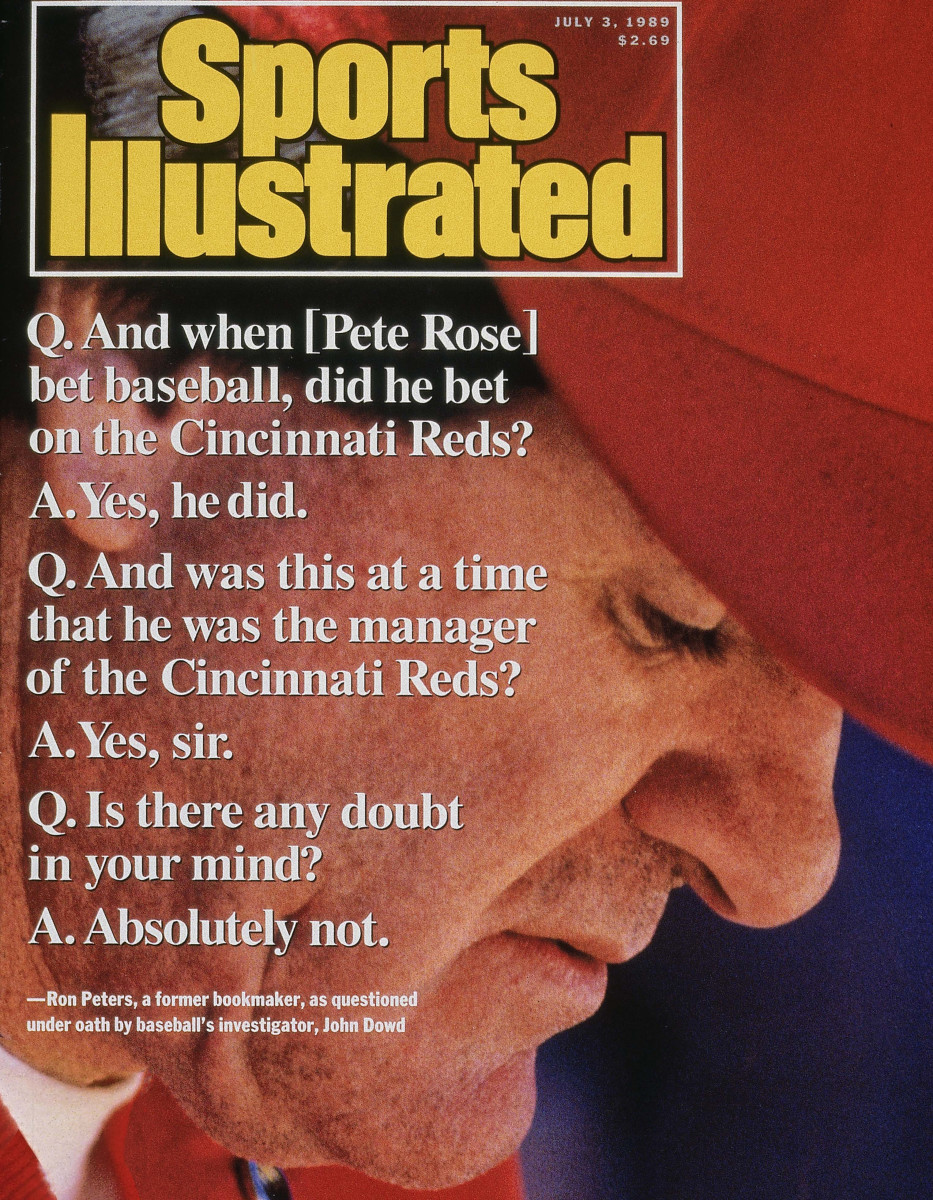
Seems like these days all MLB telecasts have some gambling app advertising their wares.  What was once ‘taboo’ in the game of baseball, seems more like the norm now. Gambling is legal, so I get it. Gambling brings in money, so again I get it. What I have a hard time understanding is the complete change of philosophy by baseball. The sport has been littered with scandals related to gambling, including Pete Rose being banned for life from baseball. 

Pete Rose gambling exposed: Inside the Sports Illustrated investigation -  Sports Illustrated
Courtesy: Sports Illustrated

So now that some teams, most notably, the Chicago Cubs, are lobbying to have sports books built inside of their stadium. The oldest ballpark in the National League would build a two-story facility just outside the stadium at the busy corner of Sheffield and Addison Streets in Chicago. In a statement the Cubs said, “While the game of baseball has largely been the same for the last 150 years, the fans have changed. The way they consume baseball is different through emerging technology and content platforms,” the Cubs said in their statement. “Sports wagering is becoming a big part of that change and this sportsbook will allow us to connect fans to the game in new ways.”

Wow times have changed. So, tell me, when is the press conference to reinstate Rose? When is the press conference to reinstate the members of the 1919 “Black” Sox? I know, before you blow a gasket, these are different times and one doesn’t necessarily beget the other. The transgressions I speak of, were committed during a period where gambling wasn’t legal in most places. That makes it more of a “sin” I guess. 

We are coming up on the 32nd anniversary of Rose accepting his permanent ban from the game he loved. By Rose voluntarily joining the list, MLB agreed to not release the findings of its gambling investigation. Baseball rules state that Rose could apply for reinstatement to the sport, but then commissioner Bart Giamatti said, “There is absolutely no deal for reinstatement. That is exactly what we did not agree to in terms of a fixed number of years.” 

The Black Sox scandal was a completely different animal all together. Those that participated did so because that was really their only way of getting paid. Salaries quite obviously were paltry compared to the game even 40 years after the event. The yearly salaries of the 1919 players were probably less than the highest paid guys of today, pay in taxes every year. There were no player bonuses for making, or winning the World Series. So, there was a monetary carrot dangled in front of the 1919 Black Sox. 

That won’t be an issue this time around. But there are still some folks worried about the Cubs and other teams letting gambling take place in the buildings they play. 

In May of 2018, when the Supreme Court legalized sports betting in many states the prevailing thought was concern. Umpire Joe West said to USA Today 3 years ago, “It scares me to death. I’m not worried about any of my guys doing anything (illegal), but I am worried about their security. People won’t have just a rooting interest in games, but now they’re gambling on them. So, if they lose their money, and they’re mad enough, anything’s liable to happen.”

Gambling hadn’t been a part of the game for a very long time, so why now?

You guessed it, money.

“Sports betting happens,’’ Commissioner Rob Manfred told Yahoo Finance in 2018. “Whether it’s legalized here or not, it’s happening out there. So, I think the question for sports is really, ‘Are we better off in a world where we have a nice, strong, uniform, federal regulation of gambling that protects the integrity of sports, provides sports with the tools to ensure that there is integrity in the competition…or are we better off closing our eyes to that and letting it go on as illegal gambling?’ “And that’s a debatable point.’’ Said Manfred. 

It’s quite a far cry from Manfred’s predecessor Bud Selig, who back in 2013 testified under oath that gambling was an “evil, which creates doubt and destroys your sport.” Selig stated back then that Las Vegas would never have a baseball team, and responded to New Jersey’s ongoing fight to legalize sports betting by saying, “This is corruption, in my opinion.”

Bud Selig leaves a complex legacy - The Washington Post
Courtesy: Morry Gash/Associated Press

This is 2021 and there is money to be made. Audiences are viewing games differently and some sports are trending older, including baseball, which makes the powers that be, well, nervous.

For the first time in a very long time, baseball is thinking way outside the box. It’s being reported by a few media outlets, including The New York Post, that Major League Baseball and Barstool Sports have had significant negotiations about airing national games on the site’s platforms. According to the Post, the discussions are what Barstool founder Dave Portnoy referred to a few weeks ago when he mentioned his company has had talks with “major leagues.”

MLB and Barstool potentially could team up to create a new type of broadcast with a focus on in-game gambling. The Post reported that the talks have only recently started and while they’ve picked up some steam, an agreement is not a certainty. 

What does that actually mean? Well, there is a hole to fill in baseball’s midweek broadcast schedule. Under new agreements with television partners, there are no longer exclusive Monday or Wednesday broadcasts. It’s uncertain if baseball would turn to YouTube, which has aired MLB games before, or if Peacock which just did games in July are really contenders. 

This is where Barstool could come in. It would really be a win-win for both the league and Barstool. The site would serve up a younger audience to MLB. The league has been trying to create ways to target millennials for a long time. Barstool has that built in already and would be able to create an “event” every time they air an MLB game. They would likely deliver games on the Barstool website and also its Instagram and Twitter accounts as well. The site’s many correspondents across the country are terrific at promoting their product and this would be no different. 

As the Post, points out, if a deal is reached and it’s “non-exclusive”, the games would likely still be broadcast on RSNs, making Barstool’s stream an alternative broadcast. That would allow for those that want a traditional broadcast to get that and those that want a different approach, will get what they want. 

The “different” approach would likely not feature a play-by-play and color analyst like you are used to seeing. This would be more like a host, and a bunch of other people, sitting around watching a game, talking about it. They’d also be discussing the gambling aspects, like money lines. It would be a little baseball and a lot of gambling. Just the way some people want it. 

As I write, I’m thinking about how I feel about all of this. Not just as a broadcaster but as a lifelong fan of the sport of baseball. I come to the conclusion that as much as the new stats we use in baseball took some getting used to, so will gambling. 

I don’t think we’ll notice much difference in the way a normal game is covered. Yes, I’ve already seen “tickers” at the bottom of the screen give me different information. During a broadcast I can get the latest in money lines and spreads. I’m sure that broadcasters will have to read promos for the various outlets their teams may have a partnership with. That’s not anything unusual these days, with most every element sponsored. As a play-by-play announcer, I think the audience understands YOU, yourself aren’t endorsing a product. I don’t really think any credibility issues will arise.

I mean, Al Michaels has been alluding to gambling during football games for years. Like, “this game is now OVER”, not meaning the game is finished, meaning the total has gone over the number. All good, because Michaels is one of the best to ever turn on a microphone. 

I have to admit, I never thought I’d see the day where baseball welcomed and partnered with gambling establishments, like apps and casinos. At the end of the day as a fan, I’m not a big gambler, but why would I be against what a lot of people really enjoy?

Oh yeah, and it’s legal. The thing that is strange is how quickly and comfortably baseball has been willing to partner with what was once so forbidden.

Here’s a fact. Whether you want to believe it or not, there are fans, sitting in your favorite ballpark today that are wagering on games. Baseball and other sports are just trying to get in on the action and tap into this very lucrative market. Hard to really blame them. 

The only thing I hope is that baseball seriously does its homework. How will it separate the teams from the wagering? If bets are being placed in the actual ballpark they are playing in, the criticism they’ll hear from the fans will be a little different, I’m sure. “Hey you just cost me money with that strikeout!” Can you imagine? 

Why gambling used to scare baseball and why it doesn't anymore -  SBNation.com
Courtesy: SB Nation

The probability of players or umpires or officials to willingly participate in a conspiracy are low, but you have to consider the future. What haven’t they thought of? What are some of the loopholes? How could baseball be opened up to its next gambling scandal? 

I’d be willing to bet there is a lot of scrambling going on at baseball’s headquarters in New York. 

Sports Media’s Present & Future Has The Attention of New York Broadcasters

0

Sports talk radio has considerably evolved since its inception as a bona fide programming format in the late-1980s. The unique, live, intimate connection the host is able to foster with their listening audience at a dedicated time during each broadcast had been something that no other distribution mediums could initially compete with.

As time progressed, though, the media industry caught up to the once-incipient format – and fast. Thus, the consumer gained, and still holds to this day, freedom over what program they wish to consume; when they want to consume it; and where they wish to do so. With television, radio, print, streaming, podcasting, social media and the plethora of blogs and websites available on the internet, the sports talk format, and all media in general, has had to evolve to meet the demand of the consumer, and stand out among the pack while doing so.

Deep in a potpourri of content within a disquieted marketplace, I asked several personalities across sports media to gather their thoughts on how they see the evolution in the business of sports commentary, and what concerns may lie ahead for the traditional, sports talk format.

Q1: What is the biggest misconception people have about sports radio?

Robin Lundberg (Senior Host, Sports Illustrated): “The biggest misconception people have is that it’s easy and lazy. I think there’s a lot more care and energy put into it than the average person would know. Doing a show of any length, particularly solo, is a challenge in and of itself, as is standing out now-a-days. There are so many different outlets through [which] people can hear things, and distinguishing yourself with a voice or characteristics is a challenge.”

Zach Gelb (Host, CBS Sports Radio): “I would say the biggest misconception is that it’s a dying medium. I just think there’s ways that people need to improve heading into the future, but doing radio locally and nationally, I still think it’s very successful, but there just has to be alterations that are made; you can’t really [hold] an antiquated belief and only do things on the radio. I think you need to have more of a digital presence. The best part about radio is the connection and how personable… it can be from the host to the listener, and also how immediate [it is]. If there is a news story… people [can] voice their opinions right away.”

Jon Rothstein (Host, College Hoops Today): “I think the one thing that a lot of people don’t understand about radio and podcasts is how intimate the connection can be between the host and the audience. It’s a much different medium than television and being a columnist or a reporter and connecting with someone via the written word. It’s just not how it was years ago when the majority of people listening to talk radio were in their cars commuting.”

John Jastremski (Host, The Ringer/SNY): “I think the biggest misconception about sports radio is that your caller [does not] add intellect to a show. I think there are a lot of people out there who honestly believe the callers add nothing. I think that’s so outrageous. Just like anything else… you have good callers and bad callers. By having the [live call] element in there, it shows off their creativity and their wealth of knowledge. No matter how a call may be going, it sets the stage and tone to what you, [as a host], are bringing to the table.”

Alan Hahn (Host, ESPN Radio/MSG Networks): “That it’s all hot takes. I don’t think it’s all that, at least it shouldn’t be. I still think it’s storytelling and interaction with callers.”

Q2: Where do you see sports radio’s biggest opportunity for future growth?

Lundberg: “The media industry right now is the wild west. Everyone is trying to figure out what’s going on, where it’s headed and how to monetize it. When I did an early morning show on ESPN, the one opportunity I saw at the time was to be the first podcast out. As a result, I was second in podcast downloads to the Michael Kay Show — because I was one of the first podcasts of the day. Then, I was told we had to focus on the ‘pizza’ before we made the ‘cannolis.’ I said that’s not a good analogy because [a podcast] is the same product [as a radio show except] with a different delivery method. I would say the biggest opportunity remains expanding [to] other mediums and flexing that presence in that way. In order for a radio show to truly succeed, you’re going to have the base, but if you want to get beyond that, the digital presence has to be there as well.”

Gelb: “I would say in the digital space. I think that there’s a lot of stations that obviously need to make those changes. You still use your content on the air, but once a segment airs or a show ends, there are other ways you can put your content out there, [such as in] certain digital content features that you can put out.”

Rothstein: “You have to always be ready to evolve. We live in a day and age that’s much different than it was many years ago. We’re in a time where people are clicking links off of Twitter if they want to consume written or editorial content; it was not like that 20 years ago. As far as sports radio and podcasts go, constantly being aware of the changing trends are what is going to lead to its long-term growth stability.”

Jastremski: “On-demand content. [The consumer] being able to listen when they want, [and] whenever they want, [along with] the ability of the host to be timely when things are happening. If there’s a trade, you don’t have to wait until your time slot [to talk about it]. It’s the idea of getting your voice out there immediately so that the audience hears from you. Some stories will warrant that more so than others, but I think that’s the biggest change now. When there’s something big going on in your market, you have to be able to react instantaneously.”

Hahn: “The on-demand world. I’ve been all over the place. A lot of people are just looking for your content, so I do think on-demand is going to matter the most. A schedule is still a schedule, but sports radio is also about personalities, and people will find those personalities. Sometimes a podcast isn’t the whole show; you just take bits and pieces. The consumption of a show on-demand needs to be more available in a car just as much as it’s available on a phone.”

Q3: How do you measure your effectiveness as talent and the aggregate success of your show?

Lundberg: “Sometimes it can feel like a popularity contest where you are constantly checking for downloads, views, clicks, listens, etc. I think, in radio in particular, one of the things that’s great about it is that it’s a very intimate medium, so you get that immediate feedback from the audience. The first thing you need is self-belief, and belief within your team that you’re putting out a good product. One person in charge might not like it, and the next person in charge might think it’s the coolest thing ever. The second thing comes from the audience response and the feedback you hear. The third is that you can’t ignore the raw numbers; you have to bring in either revenue or ratings, ideally both. If you’re getting big money, it doesn’t matter what the ratings are; If you’re getting high ratings, the money will eventually come.”

Gelb: “The POKE Scale. Passion; Opinion; Knowledge; Entertainment. For me, if you do a show that’s passionate, that gives opinions, that’s knowledgeable, and that’s entertainment, those are the best shows. Ratings determine that, and being able to make a lot of news. I think it’s establishing that connection with the listening audience and then also behind the scenes, developing good chemistry with co-workers and also just really giving 110% each and every day. There are ways to measure it in terms of ratings, and there’s also ways in terms of a healthy work environment.”

Rothstein: “Consistency, having a plan and sticking to it. The biggest thing I learned from my time at WFAN was the consistency Mark Chernoff had at the station. He wasn’t going to alter the lineup if a big event happened or if there was a big story. He had confidence in the product he was putting on the air and their shows. I think when it comes to my podcast, it’s a certain length each and every week. Over time, that consistency has led to great growth, and I’m proud to say that last year was our best year ever. I’m trying to keep building on that without sacrificing the model that works.”

Jastremski: “The idea of generating reaction. In the radio world, ratings tell the story. I can give you the cliché numbers that we want to have good podcast metrics and we want to have as many listeners as possible — that goes without saying. Getting the interaction; the feedback; the needle moving that way — that’s what I’m looking for more than anything. We recently hopped on a Spotify green room after a Mets game [where] we had 200 people in a room [within] five minutes of starting, and I [took] 15 calls. Generating that reaction within your base is how I’m judging whether or not we are doing what we need to do, whether it’s momentum or traffic. I understand that, from an old-school mentality, it’s all about ratings. Obviously, podcast numbers, downloads and subscribers are gigantic, but I don’t want an inactive listener base; I want an active listener base that’s dialed in, engaged and participating in what I’m looking to do.”

Hahn: “I used to measure it with ratings [when] I was local. That seemed to be the be-all, end-all [and] how you bragged about your success. Feedback has become the more important one. It’s not just feedback from listeners, but also the people at your business and, to be honest with you, I [had] never really considered it before. Being on a national platform, I think what athletes think of the show is [also] important because that also drives the idea [of if you] are talking about what matters. I feel like ratings are so antiquated of a system that there’s no way that’s the [sole] indicator.”

Q4: What do you consider to be sports radio’s biggest area of concern now and moving forward?

Lundberg: “Is hosting a sports radio show enough? As things do change with platforms, we’ve seen podcasts, Sirius XM and digital platforms emerge. The way people get their media has changed rapidly over the last few years. Luckily, sports radio’s steady base has been able to help it survive through it, but if you’re going to be a true crossover star right now, can you do that primarily through radio?”

Gelb: “I would say it would be improvements in the digital space. I think that’s something people really need to focus on. I think companies need to be careful in understanding that Twitter does not reflect [whether you’ve had] a successful show or not. Sure, if you have a host with a bunch of followers, or [put] out a viral video, great — but a lot of the comments on any social media are going to be negative. I think it’s important that radio stations do as much as they can digitally, but I would not let the comments make the program director’s decisions if a show is successful or not.”

Rothstein: “There are so many ways for people to get information. People are not really in the business anymore of consuming things for longer periods of time. People have interest in watching videos on their phone instead of listening to the radio or watching a long-term show. When people are driving, there are so many different options.”

Jastremski: “I think the biggest challenge for any of these sports radio or podcast markets is [determining] how you stand out. There’s so much out there; what makes you unique; what makes you special; what makes you different from a host standpoint, a brand standpoint, a market standpoint. That to me is what I’m kind of looking at down the road as to what might be an obstacle for sports radio; there’s so much out there now. When sports radio started in the late-80s and 90s, they were the only game in town. Now, that’s no longer the case. I think for each talent and or each platform, what makes you different, what makes you unique, what do you bring to the table that somebody else doesn’t. Not just from a program director’s standpoint, I think that has to be the focus for hosts. It’s not that you want to reinvent the wheel and be crazy different, but you want to stand out. If you stick to that, you can have a ton of success.”

Hahn: “Podcasts. Everyone has one now. There’s also a million sports talk radio stations and a lot of shows. Everyone is trying to become the ‘next something’ of this realm. It’s so easy to get lost in that sea; it’s very hard. The oversaturation of sports talk; anyone can do it because the technology is there. That’s a great thing, but the oversaturation just starts to become white noise. There isn’t a delineation of who are the professionals [that] are doing this for a living, who put the time in and who is just regurgitating what they saw on SportsCenter or FirstTake. The saturation of this type of media in the last five years has created a feeling of white noise among content.”

Q5: If there’s one thing upcoming hosts should be prioritizing in order to be successful in the future, what would that be and why?

Lundberg: “I think that comes with knowing what the audience wants. The one thing that doesn’t go away is the instinct of what people care about. The Jordan vs. LeBron debate is the bread-and-butter of what sports talk is: two people arguing about it on barstools. Stories aren’t going anywhere; sports aren’t going anywhere. Knowing how to read what the audience wants and then spin it in a way that is unique to your program is most important.”

Gelb: “You have to have the work ethic. You have to have the reps. And you have to find a way to develop a connection with the audience that makes you stand out differently from the others. Everyone can give an opinion about sports, but can you give an opinion, and can people believe that opinion is authentic, and does it make the person want to come back and stay throughout the show?”

Rothstein: “Authenticity. You hear so much that people want to be the next this person or that person. You have to be the first and version of yourself because there’s only one of us.”

Jastremski: “Watch the damn games — simple as that. I think there’s way too many folks out there who don’t know what they’re talking about. I think it comes across, and it’s easy to point out if you’re a listener. You don’t need to be drooling over the box score of every game that’s played, but in order to formulate the best possible opinions that you can, you have to be dialed in and you have to have a sense of what’s going on around the teams that you covered. That might sound like a real simple answer but in order to have those opinions, you have to watch the games.”

Hahn: “Compelling conversation. You’ve got to be able to not just have a guest, but make it a listenable conversation. I think the most successful people in this business are great at that. Everyone just wants to be the first one to say something or have a crazy reaction to something. To get an athlete or a former player to relax to a point where they can tell you something that can take you into the world that regular people are not privy to makes it a compelling listen. Relaxing the guest and making them feel like they are in a room hanging out is a great conversation. If the guest is boring, it’s your fault [as the host] that they are boring.”

You Can Turn P1 Listeners Into Clients

0

Finding the P1 Listening clients to your station should be mission-critical for any sports radio seller. I have found the most success selling advertising to clients who listened either often or exclusively to my station. Yes, P1 Listeners are also P1 Clients. And they want to spend money with you to hear their commercials on your station. It’s part of who they are. They want to meet your personalities, sponsor your promotions, and find more clients who feel the same way. They are the building blocks of any successful sales effort. A passionate audience is critical to local direct selling and your income.  

Fingers Adjusting Luxury Car Dial Stock Footage Video (100% Royalty-free)  21917956 | Shutterstock
Courtesy: Shutterstock

So, let’s explore some ways to find more P1 Clients for you.

If you are a station that carries high school, college, or professional play-by-play, you have some great opportunities. Let’s say your station has a local college football team. Prospecting activities should ideally put you in social situations where the school is the focus. That’s where you will meet like-minded potential clients.

Join the booster club and design a promotion to improve membership. Sell it to the biggest booster you can find, and you will get access to meeting more clients. Volunteer to go out and ask other local businesses to join the booster organization and become an ambassador. You can also pick up a game program and start cold-calling school sponsors. 

Does your station have any big promotions like a summer bash or Super Bowl party? Make attendees check-in and find out who they are. Give them a registration slip and ask them what they do and if they would be willing to grow your P1 Client base of advertisers. If even only one person volunteers, you have just won a new client possibly.

Can you get access to the station email database? Why not design a sales-oriented email to solicit new clients? Offer the first-timers package and see who emails you back. Offer a healthy referral fee for the rest of the P1 Listeners in the database to recruit new advertisers for you. Ask, and Ye shall receive! 

Demetri Ravanos’s latest column, Sell your Talent, suggests bringing in air talent to visit clients. Make sure you ask every person on air, and I mean update guys, traffic people, and producers, and see if they have a list of friends and family who listen and could influence an advertising win for you. Build-in an endorsement package for the talent, and it’s a win-win deal. 

Networking: Building Your Contacts in New, More Effective Ways

There is a lot of gold when you mine amongst the P1 Listeners for your station. You can learn a lot from them. Edison recently studied how many P1 Listeners of eleven different formats, including sports, use smart speakers, listen online, Twitter ( a lot for ALL SPORTS users ), and whether or not they even own a radio. Check out the Radio Listener Profile Report to learn more. P1 Listeners can lead to P1 Clients! 

Anatomy Of An Analyst: Alex Rodriguez

A polarizing figure on the field and off, Alex Rodriguez has his fans and his detractors. “A-Rod” is now a fixture during ESPN’s Sunday Night Baseball telecasts and he’s making his mark. Rodriguez had a brilliant playing career, though it was marred by involvement in the Biogenesis scandal in 2013. Rodriguez was suspended 211 games by Major League Baseball, but on appeal it was reduced to a full-season of 162-games. He missed the entire 2014 season as a result.  Rodriguez also admitted to using performance-enhancing drugs while he was with the Rangers, earlier in his career. 

Taken by the Mariners with the number one overall pick in the 1993 Draft, he made his big-league debut just a year later at the age of 18. He became the youngest position player in Seattle history. In 1996 Rodriguez played in the All-Star Game as the youngest shortstop in the game’s history. 

MLB draft: Who's the greatest No. 1 pick ever? Ranking the top 25
Courtesy: Gary Stewart, AP

Rodriguez left Seattle in his dust, signing a 10-year deal worth 252-million dollars with the Texas Rangers in 2001. He would only play 3 of those 10 years in Texas. In February of 2004 the team dealt A-Rod to the Yankees to replace an injured Aaron Boone at 3rd base. The Rangers wound up getting Alfonso Soriano and the bill for 67-million of the remaining 179-million on his contract.  Rodriguez would finish his career with the Yankees, despite a big hiccup, which I’ll get into in a moment.  By the time of his retirement in 2016, Rodriguez appeared in 14 All-Star Games, won three AL MVPs and 10 Silver Slugger Awards. 

Rodriguez is arguably one of the greatest hitters in baseball history which makes one wonder why a natural talent would use PED’s. His 696 home runs rank 4th all-time, as do his 2,086 RBI. Rodriguez is one of four players in history to hit 600+ home runs and account for 3,000+ hits, joining Babe Ruth, Willie Mays and Albert Pujols. He was a 14-time All-Star and three-time American League MVP. It was in New York that he won his first and only World Series title in 2009.

MEDIA CAREER 

Rodriguez began his media career shortly after retiring from baseball. In 2016 he joined Fox for coverage of the 2016 and 2017 postseason. He continues to work at Fox, doing studio shows for Major League Baseball. It’s at that network that he tried to repair his image, one of a confessed PED user and for lack of a better term, cheater. 

He’s appeared as a celebrity “shark” on “Shark Tank” on ABC. Rodriguez also had his own show on CNBC, called “Back in the Game”. Rodriguez focused on mentoring athletes and entertainers who have fallen on hard times. It was a four-episode series that debuted in March of 2018. 

Watch Back in the Game, Season 1 | Prime Video
Courtesy: NBCUniversal

We best know A-Rod now for his work on ESPN’s Sunday Night Baseball, alongside Matt Vasgersian. This type of weekly, national exposure has made him one of, if not the most, polarizing figures in sports broadcasting. I haven’t come across too many people that tell me how great he is. More often people will say something like, why is he still on my television? I don’t have the answer to that. I’m a bit in that camp as well, trying to figure out the appeal of having him in such a prominent role. Apparently, it’s all in a name. 

IN THE BOOTH

Sunday Night Baseball is an event, much like the old days of Monday Night Baseball on ABC. Your team is in the national spotlight and on display for everyone to see. It’s a big deal and sometimes I don’t get the impression that Rodriguez understands that the only baseball analyst with a more prominent platform might be Jon Smoltz, who is part of FOX’s World Series broadcast. I say that based on most of his commentary during a game. There are multiple examples, but I only have so much space in this column, so I’ll have to narrow it down to a precious few. It makes me wonder, when he opens his mouth, did he really play the game he’s talking about? 

Before I get into the evidence, I will say, the job isn’t easy. As I’ve stated before, it takes a special kind of former athlete to be able to translate experience into words. Some have started out shakily and figured out that they have to put work into it to get better, just like they did when they were playing. The ones that understand this, usually go on to great careers as analysts, some are even better at broadcasting than they were playing. Then there are some that seem to believe that they can coast and just show up and because of who they are, people will listen. 

In an interview with the Chicago Tribune media critic Phil Rosenthal in 2019, A-Rod admitted to being a “novice”. He told the paper, “I knew that the first couple of years that I would make so many mistakes, but (I hoped to) learn from them. I’m usually better the second or third time.” He also stated, “Being in the moment is my superpower,” he said. “Being able to see things that most people aren’t seeing.” That was 2-years ago and the mistakes are still coming at a rapid pace. 

Well, I’m not sure most of the time what it is that he’s seeing that I’m not. A lot of what A-Rod says in a game sounds prepared. Likely in a production meeting before the game, he was told to focus on something.

Now, if that “something” isn’t happening, A-Rod still talks about it. It makes me think he’s not paying attention to the action or just not listening to the direction of the broadcast. As a top flight analyst you have to follow the lead of the play-by-play announcer or the producer in the truck. You need to learn that sometimes, silence on a broadcast is better than talking for the sake of talking. This is where most of the awkward moments take place. 

What wasn’t fair to anyone in that SNB booth in the beginning, was three voices. It’s so much more difficult to dole out “air-time” when there are three opinions and commentaries. The feeling of needing to be heard supersedes the best interests of the broadcast at times. A three-person booth is a lot of pressure on everyone, mostly on the play-by-play announcer and producer to try and keep the flow going. But now there are only 2 voices and it’s not much better. 

Hoffarth: Matt Vasgersian ready for prime-time player status in new ESPN  booth – Press Enterprise
Courtesy: Keith Birmingham/ Pasadena Star-News

EXAMPLES

A lack of self-awareness got A-Rod in trouble during a Spring Training telecast in March of 2020. The subject of the Houston Astros came up and Rodriguez launched into his opinion of the cheating scandal. 

“You cheat, you win a championship, there is no suspension, and then there’s no remorse,” A-Rod said. “The last one is probably the worst one. From a guy who has made as many mistakes as anybody on the biggest stage — I served the longest suspension in MLB history, it cost me well over $35 million, and you know what? I deserved that. I came back. I owned it after acting like a buffoon for a long time. I had my apologies, and then I went dark. I wanted my next move to be contrite and change my narrative. You have to be accountable … I felt the hatred from the people and I earned it.”

While there is some truth in the statement, Rodriguez did apologize and did take the heat for what he did back in his playing days. But there are those that have never forgiven Rodriguez for “cheating” and the masses felt that this was a pot calling the kettle black situation.

Self-awareness and understanding of the messaging seemed to slip away from A-Rod in the moment. He wasn’t wrong but the statement didn’t do him many favors. It causes me to wonder if people are talking to him and coaching him after broadcasts. They may be, but he isn’t listening. 

In 2019 during a Phillies/Mets matchup on Sunday Night, out of nowhere, A-Rod explained why he wanted to see the Phillies sacrifice a runner to third. With nobody out in a 2-1 game in the 7th inning, he said it’s about aiming for an even numbered lead rather than an odd number.

Odd huh? 

“You always want even leads versus odd leads. Why? The solo home run doesn’t tie it, and the grand slam does not beat you,” Rodriguez said.

Huh?

Wouldn’t silence have sounded better?

Now as a play-by-play guy, the only thing I can do in that situation, is look at him with a puzzled look and hope he explains further, or just say nothing. I’d try to distance myself from that statement by letting a little silence enter the discussion. 

There are plenty of other examples out there, if you care to search for them. 

CONCLUSION

Watching Sunday Night Baseball has become difficult with him a part of the broadcast. Scratching my head several times an inning, wondering what it is that he just said, is no way to enjoy a baseball game. I’m hoping that as time goes on and continues to get this opportunity, somebody works with him and explains to him what his role actually is. Trying to get in depth on a player’s swing, or something that requires more than his at-bat to explain hurts the broadcast.

Courtesy: ESPN Images

I understand that he played the game and he may have an expertise on this particular instance. That discussion probably is better served for what he does for Fox, a pregame show, where you can take the time and actually educate. Some analysts have the ability to break things down quickly and efficiently, he doesn’t. Hopefully he gets there one day, but today isn’t that day. 

Planning for the Next Generation of Financial Talk Radio

0

For decades, the Dave Ramsey show has talked the talk and walked the walk. Over the past year, the home of EntreLeadership has unveiled the path toward their next stage of financial and business leadership. 

Since its inception, The Dave Ramsey Show has focused almost entirely on the opinions and advice of one man alone, Dave Ramsey. Over the past couple of years, however, the radio show – and the brand itself – has expanded to include new personalities, new voices, and a new way of looking at the company’s future.

The most formal transition points were the name changes. Changes from the “Dave Ramsey Show” to the “Ramsey Show” and “Ramsey Solutions” were signals of the shift toward the future. The baton hasn’t been passed yet, but the team is gearing up. 

On any given day, listeners and viewers can tune in to hear the show’s namesake joined by fresh, new, up-and-coming voices, such as Ken Coleman, Rachel Cruze, Christy Wright, Anthony ONeal, and John Delony. Changing the name of the show and including new members of the on-air team hasn’t been without challenges, however, as on any given day you may hear Ramsey mistakenly introduce the show as the Dave Ramsey Show. Decades-long routines are difficult to break.  

The introduction of new voices apparently signaled a realization by the company that it needed to expand in a younger, more diverse direction that would outlast any one person. Again, a common theme in terms of small business growth and transition discussions. Each voice brings a specific focus to the team, and many host individual podcasts as well on the Ramsey Network. 

In Ken Coleman, the company has an experienced, values-based broadcaster who focuses on career and job advice. Rachel Cruze connects with younger generations to help them “win with money and live a life they love.” Christy Wright brings strong Christian wisdom to topics such as personal and professional development, goal setting, life balance and business. Anthony ONeal hits home with the youth, teaching them about planning for college and their financial future. John Delony brings his two PhDs to the areas of relationship and emotional wellness. 

Together, the group puts forth a well-balanced array of viewpoints to tackle varying areas of financial and business discussions. Some days we hear Dave Ramsey, while other days feature the new personalities with, or without, Ramsey himself. Some listeners may feel that individual programs may lack a little luster without Ramsey. However, the audience is gradually seeing greater value in the Ramsey team as a whole, and the company has clearly broadened its base with the refreshed lineup of new personalities.

The company’s look ahead shouldn’t be a surprise, being that succession plans and seeing down the road have been common themes of the Ramsey brand, and more specifically their small-business-focused business unit, EntreLeadership. 

“The best succession plans are thoroughly laid out and very, very gradual,” Ramsey said, talking about family business transitioning on a recent episode of the EntreLeadership podcast. “Too many people in family businesses grab their chest having a heart attack as they fall back in the grave, toss the next generation the keys and go, Good Luck I’m done.” 

Through their radio programs, live events, books, and other materials, the company has always “talked the talk” regarding planning for the future, especially in a small business eying an eventual transition. Now they are “walking the walk” live on the air. 

“More is caught than taught,” Dave Ramsey and other Ramsey personalities have said more than once over the years. They are growing and planning for the future in real-time, and listeners are taking notice. 

There’s No Shortage Of Exclusives

0

While reading Demetri Ravanos’s excellent article on selling exclusives, I wanted to delve deeper into some developed ideas. Live reads, play-by-play, and special event promos and programming like watch parties and conference media days coverage are all opportunities to sell exclusives. 

Just don’t sell yourself short. Here are some ideas on how to go long on exclusivity.

FAKE IT.

If you don’t have a lot of interest from a category of advertisers, go to one and make them exclusive. I have seen that motivate specific clients because they want to be the only Chevy dealer in a high-profile piece of programming. I would sell the INDY 500 network broadcast and make a local car dealer the exclusive automotive client. They loved it and appreciated the association with the race and bragging rights.   

SPREAD IT AROUND.

I live in the Dallas area and frequently will listen to The Musers on KTCK The Ticket. George Dunham and Craig Miller do live endorsements together for D& M Automotive Leasing.  That enables Gordon Keith an opportunity to endorse a separate dealer solo. Keith and Dunham do a shared live spot for Raising Cane’s Chicken Fingers as well. Allowing each talent to do individual competitive clients would dilute the effectiveness of the live reads. The Ticket also has All-Star Foundation repair using all the station talent on a recorded spot that is unique and probably expensive! All-Star uses it as a web page.   

DON’T RUSH IT.

Allowing talent a chance to try a new product or service before they start an endorsement is the only way to go. Insincere endorsements are money grabs, and the audience will know it. I have done plenty of that in my time and skipped some opportunities that didn’t fit me.  If it is something new for the talent to try, let them say that. If they were doing business with the client before the endorsement, let them say that as well. 

EXCLUSIVES FOR EVERYBODY!

If the market allows for it, there’s nothing wrong with offering multiple exclusives for a play-by-play broadcast. Official truck, sports car, or SUV are all categories you could put up for sale if you have competitiveness amongst the dealers for your air time. When you sell your local team “watch parties,” go ahead and sell several to different parts of your MSA or TSA. You could go a step further and sell the watch parties to one sports bar with several locations separated by thirty miles or more. 

BENCHMARKS.

If it is important enough for you to benchmark a programming element, it may be significant for a client to be the exclusive advertiser. Monday morning QB segments, weekly parody songs, daily listener feedback segments, news, traffic, and weather are all great programming islands for clients to stand out.   

Remind your client of the best you have to offer. Paint the picture. We all know that Toyota sponsors the Sunday Night NFL halftime show.  Macy’s presents the Tom Brady interview on Westwood One Monday Night Football. And, Matthew McConaughey drives a Lincoln. Make it exclusive! 

Olympic Basketball Is Just The Tip Of The Streaming Iceberg

0

If you, like me, were searching for a live broadcast of last weekend’s Team USA/France game, it was not easy to find. NBC decided that one of the more popular sports in the Olympics was only good enough for their new streaming platform Peacock. Yeah, you could have streamed it through the NBC Olympic app, but it was early Sunday morning, who wants to mess with that?

US loses to France 83-76, 25-game Olympic win streak ends | NBA.com
Courtesy: Getty Images

I wanted to see it on my television set without having to hunt for the app. Call me old fashioned. Also, you better call me a technology expert, because I have seen the future of sports and it’s streaming, not beaming to your set. 

I know, it’s been trending this way for a while and I’m not Nostradamus, but it really hit me last week. I have so many questions. How much is this going to cost, on top of what I’m already shelling out for cable? What does this mean for teams throughout all the major sports? Revenue? Lastly, what’s going to become of the Regional Sports Network? Some of them are heavily invested in or even owned by the teams themselves. 

We all understand why NBC aired the basketball game on its new digital network. Money rules the day. Plus, they figured, if we can get people to pay the $4.99 upgrade just to watch this game, we can hook them in for the other features too. Or, maybe they thought, well this is the only sport we’re putting on the premium service, let’s see how it goes and perhaps we’ll get some new subscribers this way. So, let’s not kid ourselves into thinking this was some brilliant idea because they weren’t sure how good the Men’s Hoops Team would be, it’s about cash. And also, let’s be totally honest. Most of you that paid for the game through Peacock are going to cancel the subscription once the Olympics are over, right?

You could have watched the game through the Olympics App, simply by opening the app, then verifying your cable service and entering your user name and password for your service. There were a few hoops, no pun intended, to jump through, but this way, you aren’t paying more than you already are for cable. It seems like a lot of things are set up this way, possibly to gain information on how many users are actually streaming through third party apps. 

Even after all of that, NBC decided to re-air the game on the network hours after it was completed. Hello NBC, maybe you didn’t get the memo that this is 2021 and there’s this thing called Twitter and other things called smart phones. Everybody that wanted to know the result already knew the final score. I feel like this is the majority of those watching the Olympics. It’s a waste of air-time. This is a story for perhaps another time. 

I’m not sure why we routinely stream movies and TV shows and don’t think much of it at the time. Shelling out up to ten bucks a month for Netflix doesn’t seem as painful to me for some reason. For most of my life, sports were on free, over the air television. Yeah, it was a bit jarring when my teams moved to cable but we adapted. I just had to point my remote control to a different station, and there was my team in living color. Until recently this was the case for most of us. Especially since most of the RSN’s linked to professional teams are locked into long term contracts, there hasn’t been a reason to move with the times. Those of the younger generations have been the ones to see the shift to streaming, through an RSN’s app or cable app. 

Now some of these agreements are expiring which means, teams and leagues are starting to explore the world of streaming. Some will have more streaming as of next year for mega bucks. Executives have realized that some of their viewers feel alienated. This, after “cutting the cord” with cable, giving them few alternatives to watch their favorite team.

It’s not a good time for RSN’s, who are basically the middleman between the teams and cable companies. There are instances where the network is actually owned by the team, like the Yankees’ YES and the Cubs’ Marquee Sports Network. The only advantage the RSN’s have now is they are where the fans go to see every local game. Changes to that thought process are in the works too which could leave the RSN out in the cold. 

With streaming becoming such a popular way to catch a game or an event, some executives were caught off guard as to how fast this was taking place. It was time to adapt or die. In an effort to gain new “viewers” online platforms with sports are much more critical and important. NBC is abandoning its NBC Sports Network by the end of the year. With the NHL moving on to ESPN and Turner, some of the other properties like NASCAR and EPL will likely head to Peacock. 

Watch Live Sports Online | Peacock

Major League Baseball has had success with MLB.tv, a way for fans that move away from their home area to view their hometown team. Inherent is the problem of blackouts, which in the not-too-distant future could change, creating a whole new ballgame for the league. Teams recently got the right to sell their own local streaming rights. Now they are still under the guidelines of honoring existing RSN streaming contracts. When those expire, they are free to move on. 

The NFL is streaming too. Peacock will get exclusive national rights to stream six regular-season games, one per season, from 2023-2028. This is in addition to its ongoing streams of NBC’s regular weekly NFL broadcasts. Peacock will also launch a virtual NFL channel highlighting classic games and content from NFL Films. Paramount+ will stream CBS games to local customers on both their ad-supported and ad-free tiers. Then there’s Amazon Prime, which starts exclusive rights to Thursday Night Football next season. 

The NHL’s new contract with ESPN and Turner allows for streaming rights too. The agreement between Turner Sports and the National Hockey League includes live streaming and digital rights across WarnerMedia including HBO Max.

Streaming services don’t require the use of an RSN. So, how will the RSN itself compete? Some have started to develop a “direct-to-consumer” model, which includes an app and streaming without a cable provider or the need for Hulu or YouTube TV. This would allow the cord cutter to continue to watch his/her favorite local team that’s currently carried on the RSN without having to subscribe to cable. It’s not clear yet how much this might cost. 

In an article at Sportico.com from earlier this year, Sinclair President and CEO Chris Ripley addressed investors about the plan to go DTC. Ripley said the company is “currently developing a product to reach consumers on a direct basis, in an app, similar to the way consumers access over-the-top platforms.” Sinclair hopes to roll out the app sometime in the first half of 2022. Ripley added, the service is meant to complement the existing linear TV properties rather than replace them outright.

Ok, well that’s one way to keep yourself relevant in this ever-changing marketplace. Again, what will it cost? Nobody seems to know that information yet and it will be a huge determining factor in what consumers decide to do. 

Here’s the biggest hurdle I see for the DTC approach. Will each RSN be able to handle itself and stay competitive in the streaming space? Probably not. It likely depends on which teams that particular network is providing coverage of and maybe how long the season is as well. 

What do I mean? Let’s say for example you’re an Arizona Diamondbacks fan (no offense Dbacks fans, I know it’s been a tough year, but this furthers what I mean). The team has been on the losing end of the score more often than not. Fox Sports Arizona decides to offer you a streaming package so you can watch all 162 games. Are you really going to do that? Wouldn’t you be more inclined this year to say, “nope, I’m sitting this one out”. 

Diamondbacks Blow Another Late-Inning Lead, Bow to Dodgers - Last Word On  Baseball
Courtesy; Getty

Unless they’re going to offer fans a game-by-game package, it’s going to be a hard sell for the season. Obviously, you have no idea at the beginning of the year how the team will perform, but that’s when they’ll want your money. It’s a gamble for both you the viewer and the RSN, because the latter will come out the loser in this situation. 

Nobody has a crystal ball to predict exactly how this will play out or when this scenario will even be a reality. Right now, there are many ways you can still watch your favorite sports whether you have cable, an HD Antenna or you’ve cut the cord. Things will be changing eventually. How many RSN’s will take the plunge into the arena of streaming on their own? That’s the multi-billion-dollar question.