Jeremiah Crowe has been given the reigns to set the tone and vision for one of the most successful sports radio stations in the country. After serving as Program Director of KNBR 1050 (KTCT-AM) and as Assistant Program Director of KNBR 680, Cumulus Media have elevated Crowe to program KNBR 680, one of the company’s most powerful and successful sports radio properties.
KNBR has been built on a combination of strong local programming and play by play, and fortunately for Crowe he’ll have an experienced hand available to guide him along. Longtime PD Lee Hammer will remain involved and shift to a new position of Vice President of Sports Play by Play Programming. Hammer will become more involved in navigating the relationships and on-air opportunities with the San Francisco Giants, San Francisco 49ers, and other Bay Area sports partnerships.
VP/Market Manager Justin Wittmayer said, “Jeremiah Crowe and Lee Hammer are the ‘Dream Team’ for outstanding sports radio programming and together, will continue to drive the growth of these powerhouse sports stations. Jeremiah has done a remarkable job leading the re-launch of KNBR 1050 over the past year, while expanding our high-engagement social media platforms for Bay Area sports fans. In this new role as Program Director of both KNBR 680 and KNBR 1050, he will focus his considerable expertise and efforts into growing these stations and the KNBR brand as the Bay Area’s most powerful name in sports programming.”
Wittmayer continued, “As VP/Sports Play-by-Play Programming for Cumulus Media-San Francisco, Lee Hammer is a major asset to our senior leadership team. This appointment reflects our continued investment in KNBR, with an enhanced focus on our play-by-play partners, the Giants and the 49ers, and our commitment to bringing the very best play-by-play programming to Bay Area sports fans.”
Crowe joined KNBR after spending four years at crosstown rival 95.7 The Game. He added, “This is an opportunity to bring a fresh perspective to a strong KNBR brand that means so much to Bay Area sports fans. Our format is at a pivotal point in its evolution, and the KNBR staff is primed to pioneer a landscape where terrestrial radio and digital assets are converging. I want to thank Lee Hammer and Cumulus’ leadership for their support. I couldn’t be more excited to get started in my new role as Program Director.”
Hammer also chimed in by adding, “The relationships we have with our play-by-play partners, the Giants and the 49ers, are key components to the overall success of KNBR. This new role will allow me to devote more time to enhance and expand these key partnerships, resulting in increased value for our listeners and our clients.”
Season 2 begins with an explanation of why the podcast went on hiatus for two months. Jason then introduces a new feature called The 5 in 5 which covers 5 topics in 5 minutes. Stories discussed include Mike and the Mad Dog’s 30 for 30, Mike Francesa’s claim that Michael Kay’s ratings win was a fabrication, the slow death of written content, Clay Travis’ choice to reject FS1 and stay true to his principles, and ESPN’s decision to air the O.J. Simpson parole hearing.
The first guest for Season 2 is Josh Innes. He can be heard weekday mornings on SportsTalk 790 in Houston and middays on Sports 1280 in New Orleans. This conversation runs 56 minutes and tackles the trials and tribulations of Josh’s career and covers a number of different subjects related to the sports media industry.
TOPICS DISCUSSED WITH JOSH INNES
How growing up with a father in radio influenced his desire to pursue the business
When he started collecting a check and what his initial responsibilities were
Gaining national attention as a fill-in for Jim Rome and how it developed
Moving into afternoons at 610 with Rich Lord and the challenges it produced
The first 90-days in Philadelphia at WIP and having a target on his back
Dealing with Tony Bruno’s exit and the rumors that circulated from it
Why he believes he was a magnet for media attention in Philadelphia
What he learned from the situation when Andy Bloom was let go as PD
Becoming clickbait for Houston newspapers and handling negative press
Studying successful radio personalities and why he believes in doing it
Battling social justice warriors and how he sees sports radio evolving
The way social media can damage your show and your career
Quick Hits – Best host, PD advice, Dream market, Wisdom for young people
ESPN Radio has set a date to move on from Mike and Mike in the morning. The network has confirmed that it’s new morning program, Golic & Wingo, featuring Mike Golic and Trey Wingo, will debut on Monday, November 27th. Mike Greenberg will move to TV, hosting a brand new morning show on ESPN starting January 1, 2018.
The new Golic & Wingo program will be heard weekdays 6a-10a ET on ESPN Radio. It’ll also include a simulcast on ESPN2 before moving to its new simulcast home on ESPNU in January.
In addition, Mike Golic, Jr. will join the show daily between 6a-7a ET. Golic Jr. will continue as host of ESPN Radio’s First & Last, weekdays from 4a-6a ET before contributing to the new morning show.
Curious sports radio listeners will have a chance to hear ESPN Radio’s new morning team July 18-20. Golic and Wingo are scheduled to host Mike and Mike all three days while Mike Greenberg fills in alongside Don LaGreca on The Michael Kay Show on ESPN New York 98.7FM.
The spring book is officially over and for some sports radio stations, it’s time to celebrate. For others, it’s an opportunity to analyze, adjust, and turn the attention to improving during the summer ratings period.
Although most brands examine a number of different demographics and base their success and revenue potential off of a variety of factors, the focus of this column revolves around Men 25-54. That’s the demographic that most sports stations analyze most.
One last note to pass along, not every major market has forwarded their latest quarterly performance. I anticipate a few others becoming available in the next day or two so keep an eye out for additional stories.
In the meantime, here are how a couple of top cities performed during the months of April, May and June.
Boston:
No market has fueled sports radio’s success better in recent years than Boston. WEEI and 98.5 The Sports Hub have consistently generated double digit performances, but it’s been The Hub who have been in the driver’s seat during recent years. However, the tide appears to be turning in WEEI’s direction.
In the competitive daypart of morning drive, WEEI’s Kirk and Callahan won the spring book, beating The Hub’s Toucher and Rich. K&C finished a point and a half in front of their counterparts and were the top rated morning show in the market in multiple categories including Men 18+, Men 25-54, Men 35-64 and Adults 25-54. An even more impressive statistic was the head to head performance during the month of June. K&C’s share was slightly above a fifteen share, nearly six points higher than T&R who were in the low nine’s. You can read more on the morning show’s success by clicking here.
The news was also positive for WEEI’s midday show featuring Glenn Ordway, Lou Merloni and Christian Fauria. OMF finished in 2nd, beating Zolak and Bertrand of The Hub who came in 4th. The month of June specifically saw WEEI hold a 3 point advantage in middays.
The Hub did claim victory in afternoons, thanks to a solid performance from Felger and Massarotti. The show finished in 1st, 2 full points ahead of Dale and Holley with Keefe who were 2nd. However, keep your eye on this race moving forward. During the month of June, DHK were within one tenth of point of F&M. Will that continue or is it a one month aberration? Only time will tell but each side had reason to feel optimistic.
Overall, The Hub won the spring book among Men 25-54 by one tenth of a point during the weekday prime hours of M-F 6a-7p. They were also five tenths of a point in front M-SU 6a-Mid. But June saw WEEI begin to separate itself from the Hub, winning M-F 6a-7p by three and a half points and M-SU 6a-Mid by two and a half points.
Will that continue going forward? It’ll be an interesting story worth following.
Philadelphia:
In the city of brotherly love, WIP is back on track. The radio station finished the quarter in 3rd place among Men 25-54. The Fanatic experienced a minor setback, dropping to 11th.
As usual, Angelo Cataldli dominated in morning drive. The 66-year old WIP morning man has been a steady force for the radio station over two decades. The only question is whether or not he’ll continue to lead the way beyond 2017. Cataldi’s contract is set to expire at the end of this year.
Aside from Cataldi’s win, WIP also received some positive news in middays. Despite being together for less than a year, Joe DeCamara and Jon Ritchie passed 97.5 The Fanatic’s Harry Mayes and Rob Ellis. DeCamara and Ritchie finished 4th, which was up from 9th last year when Michael Barkann and Ike Reese were WIP’s midday program. Mayes and Ellis on The Fanatic came in 11th. They were in 8th during the same period twelve months ago. Ellis has since announced he’s leaving The Fanatic which will make the midday battle even more intriguing going forward.
Not all of the news was bad though for The Fanatic. The radio station recorded another win in afternoons thanks to Mike Missanelli. However, WIP’s Chris Carlin and Ike Reese have been making strides and are within striking distance of The Fanatic’s ratings king. For the spring book, Missanelli placed 3rd. Carlin and Reese came in 4th.
Washington DC:
Political chaos wasn’t enough to slow down 106.7 The Fan’s momentum. The CBS sports radio station finished 3rd with Men 25-54 M-SU 6a-Mid and M-F 6a-7p.
Driving The Fan’s success for the spring were the Sports Junkies. The station’s popular morning show was above an eight share to command 3rd place with Men 25-54. Grant and Danny in middays and Chad Dukes in afternoons also turned in impressive quarters finishing 4th during their time slots.
Elsewhere in the market, ESPN 980 finished 14th with Men 25-54 M-F 6a-7p and M-SU 6a-Mid. Steve Czaban and Cooley and Kevin tied for the best rated show on the station. Both were slightly above a three share during their hours of operation.
Chicago:
The spring produced another quarter of smiles and success for both area sports radio brands. The return of the world champion Chicago Cubs and playoff appearances by the Chicago Bulls and Chicago Blackhawks were helpful factors in fueling the interest of Chicago sports fans.
670 The Score rode the wave to victories among Men 25-54 M-F 6a-7p and M-SU 6a-Mid. The station was 1st for the full week and 2nd during weekday prime hours.
In mornings, The Score enjoyed a three point advantage over ESPN 1000 thanks to a great performance from Mully and Hanley. The Chicago sports radio duo has consistently outperformed Mike and Mike, which airs on ESPN 1000 but originates out of Bristol, CT.
The competition was tighter in middays. As you process these numbers, keep in mind that the two stations configure their lineups differently so there are some overlaps between shows.
Starting with The Score, during the hours of 9a-1p, Spiegel and Parkins nipped ESPN 1000 by one tenth of a point. However, from 1000’s vantage point, David Kaplan’s show airs 9a-12p, and during those 3 hours he was tied with The Score’s program with just under a four share.
1000’s second midday program, Carmen and Jurko, occupy the airwaves between 12p-2p. That means they go head to head against Spiegel and Parkins for 1 hour and opposite The Score’s afternoon show Bernstein and Goff for an hour. During the 12p-2p hours, The Score was ahead by a little more than a point.
Where the news was strong for ESPN 1000 was in afternoon drive where Waddle and Silvy continue to dominate. The popular drive time show finished #1 between 2p-6p with just under a five and a half share. Given that W&S has to overcome a top notch show on The Score and the addition of Chicago Cubs day games during baseball season, that’s nice coo for the folks inside 1000’s offices.
However, for the folks at The Score, Bernstein and Goff’s afternoon program air between the hours of 1p-6p. During those hours, the show placed 1st with a little more than a five share. 1000 trailed by only two tenths of a point during that time frame.
St. Louis:
A few hours south in St. Louis, 101 ESPN turned in another impressive quarter. The market’s dominant sports radio station finished 3rd overall with Men 25-54 M-SU 6a-Mid. They also placed 3rd in weekday prime, M-F 6a-7p. Their prime number was slightly below a nine share.
Leading the way for 101 was The Fast Lane which finished 1st overall in afternoons with better than a ten share. The show was also 1st during the Winter ratings book, making it the top show in the market among Men 25-54 for the first six months. It’s also averaging double digits for the first six months. Very impressive.
The remainder of the station’s weekday programs also enjoyed strong quarterly performances. Bernie Miklasz in mornings, and Kevin Wheeler and The Turn with Anthony Stalter and Chris Duncan in middays all placed 3rd in their respective timeslots.
Local market competitor 590 The Fan KFNS came in 21st during M-F 6a-7p and M-SU 6a-Mid.
Los Angeles:
Shares for sports radio may not be as high in Los Angeles as they are in other cities but the market is well represented by 710 ESPN Los Angeles and AM570 LA Sports. In the latest spring book, 710 held the advantage, gaining wins M-F 6a-7p and M-SU 6a-Mid with Men 25-54.
In the individual show breakdowns, L.A. mornings with Jorge, Lz and Keyshawn finished six tenths of a point ahead of the Dan Patrick Show. Although the news was positive from a competitive standpoint, the year to year growth is a challenge for both brands. 710 was down close to a point, but 570 has really suffered, losing more than two and a half points over the past twelve months.
Switching to middays, the first hour of Colin Cowherd on 570 bested Thompson and Trudell by two tenths of a point. However, Stephen A. Smith helped the station rebound by holding an eight tenths of a point lead over Cowherd’s final two hours.
710 enjoyed their biggest win between 12-3, when Mason and Ireland nearly doubled Lunchtime with Roggin and Rodney and the first hour of Petros and Money. Mason and Ireland continue to deliver the best ratings of all weekday sports radio programs.
Closing things out, 710 held the advantage in afternoon drive during the hours of 3p-7p PT. Marcellus and Kelvin were nine tenths of a point ahead of 570 to gain bragging rights for the quarter. However, similar to the issue in mornings, afternoons is dealing with some difficulty too. During the past year both stations/shows have lost a full ratings point or more.
Additional Notes:
KNBR in San Francisco finished the spring book in 2nd with Men 25-54. 95.7 The Game was also very healthy earning a top 5 finish.
Arizona Sports 98.7FM in Phoenix enjoyed a top 3 finish among Men 25-54 in weekday prime.
710 ESPN remained ahead of Sports Radio 950 KJR in the Seattle spring book.
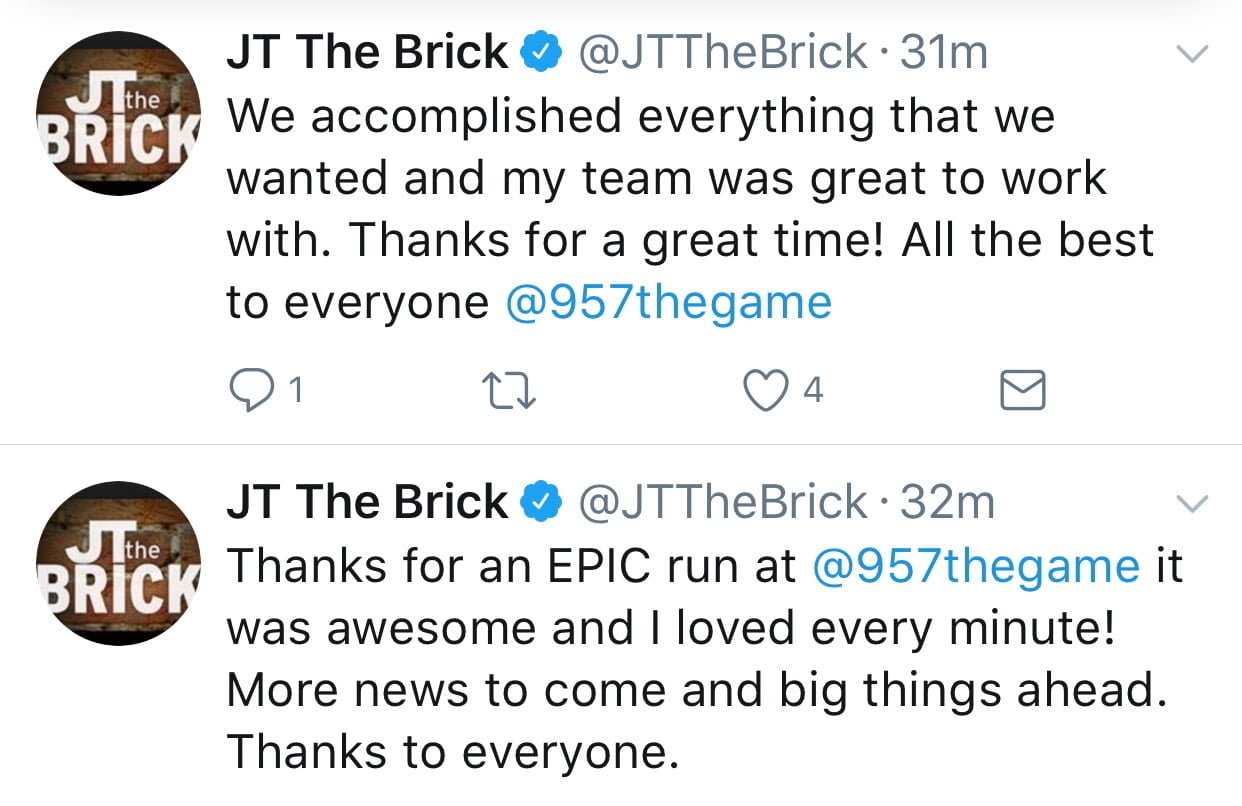
JT The Brick has hosted his final show on 95.7 The Game. The FOX Sports radio host had hosted weekdays 10a-12p PT on the San Francisco sports station since September 2016. He replaced Guy Haberman and John Middlekauff. The news was confirmed earlier today by JT on Twitter.
Sources indicate that a permanent replacement for JT hasn’t yet been made. Brick’s exit from the radio station won’t have any impact on his current role as weeknight host on FOX Sports Radio.
Aaron Judge’s home run display on Monday night during the HR Derby was impressive but despite the slugger treating sports fans to his power display, the week of the MLB All Star game is often very uneventful. It’s a week where MLB action is less significant, NBA news is lighter, NFL training camps are two to three weeks away from opening, and the enthusiasm of sports fans is reduced. People use the time to mentally disconnect from sports, and in the process spend less time listening and interacting with sports radio.
If the audience’s appetite for your brand’s content isn’t strong this week, that poses a short-term problem. Hosts still have the same amount of hours to fill, programmers have the same responsibilities to execute, and advertisers are still purchasing ads and sponsorships and expecting a return on their investments. Your bosses are also expecting the ratings to remain high, regardless of the challenges that exist in the sports calendar.
So what do you do?
From the vantage point of a former program director, this is the perfect time to create something fun or do something different on your airwaves. It’s why ESPN Radio holds the V-Foundation auction this time of the year, and why ESPN television presents the ESPYS and a new episode of 30for30.
Audience interest naturally declines during this week. There’s no getting around that. We can’t expect people who love to watch athletic competition, and debate and discuss news from the world of sports to be as fired up during a time when activity is minimal. It’s the same reason why most sports stations see their audience numbers dip in February and March. You can try to manufacture content but if the audience doesn’t care, you’re in a tough spot.
If you entered this week expecting to rely on the topics of the day to fuel your on-air conversations, you didn’t help yourself. Many hosts and programmers feel stuck this week because they’re at the mercy of the sports calendar. This time of year doesn’t give you much to work with. We can make excuses but that doesn’t solve our problem, nor does it convince the audience to turn on our radio stations during a time when they’re less interested.
In order to be successful during slow periods, you need to prepare in advance. It starts with tapping into your creativity, brainstorming ideas, setting a vision that you feel confident in, selling it to the audience, and then executing it in grand fashion. Some things you try will be home runs. Others will fall flat. But if you don’t try something, you’ve done yourself and your brand a disservice.
It’s not a question of whether or not you’ll generate decent on-air conversation during All-Star week. If your hosts are good, they’re not going to fill the air with bad content. The reality though is that it’s not about your personalities being gifted content generators as much as it is about creating interest in programming during a time when the audience cares less about it.
A radio station is tasked with creating excitement for its fans. The daily challenge is to make them want to listen and feel like they’ll miss something if they don’t. But we both know, there’s not a lot to miss during All-Star week. Think about your own level of interest and enthusiasm in the stories you’re given to work with this week. If you’re less excited, what do you think the audience is feeling?
Do you think ESPN just decided at the last minute to feature the ESPYS, V-Foundation Auction and Mike and the Mad Dog 30 for 30 this week? Of course not. They strategically prepared for it. It’s the exact reason why Dana White scheduled the Floyd Mayweather and Conor McGregor press conference this week. He knew the fight would gain a ton of air time because the media were starving for content, and fans had little to hold their interest.
From the creative side, personalities should welcome risk taking, especially during this week. It’s an opportunity to stretch your legs and do something different. It allows you to explore areas that you might not otherwise get to. Hosts should embrace developing a content plan their excited about instead of trying to create 4-5 angles on the All-Star game, a HR Derby and an ESPYS awards show.
Sure, those conversations will become part of your show too, but are they strong enough to warrant 3-4 hours of conversation? Better yet, does your audience want to hear about them for more than 15 minutes? I think you already know the answer.
When I programmed in St. Louis, I used the All-Star week to create Flashback Week. On Monday’s we presented an all 70’s theme, Tuesday featured the 80’s, Wednesday the 90’s, Thursday the 00’s and Friday the 10’s. All of the music beds leading into our shows were from those various eras, popular actualities and historical sports moments from each decade were inserted into the imaging, the guests booked on every show reflected those various times, and the talent were given free reign to discuss their favorite television shows, movies, sporting events, fashion styles, etc. It was fun, and it’s a tradition that continues today. It was also successfully executed in San Francisco.
If you’re in a host’s position, this makes the job easier and more enjoyable. When you can enter a week knowing that you have the freedom to tap into things that were part of your childhood, and have on-air conversations with people you’d likely never have a chance to talk to, it becomes exciting. That carries over to the audience. I remember numerous personalities having a blast on the air talking to Lou Brock and Ted Nugent, Whitey Herzog and Nina Blackwood, Brett Hull and Biz Markie, and so on and so forth.
The goal with creating weeks like this during dead periods isn’t to spike the ratings. If that happens, even better. The point was to simply not lose ground. You can lose momentum during slow periods not because you weren’t doing quality work on the air, but because it was falling on deaf ears. If you can stay on course when people feel it’s less important to pay attention, you’ve already helped yourself in your next ratings book.
Allow me to make one final point. This isn’t a plea to tell you to roll out a Flashback Week. It’s simply to challenge you to think ahead of how to be creative to better help yourself, your station and your audience during a period of disconnect. The issues of the day may appeal to the audience most of the time, but if sports drama doesn’t exist or is of far lesser value than normal due to a hole in the sports schedule, then you’re stuck between a rock and a hard place.
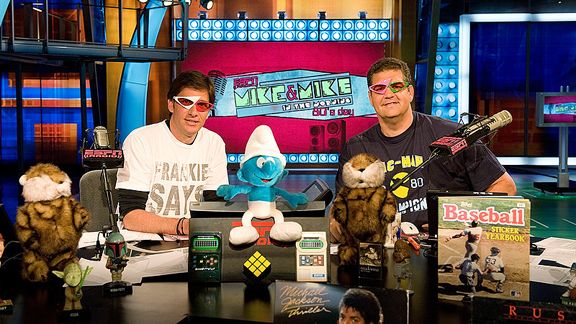
Mike and Mike once created 80’s day. 790 The Zone in Atlanta presented Sitcom week. They weren’t done in July but easily could have been.
Maybe you build the week around a popular local team, former player, historical event, or something important in your community. Maybe you partner with one of your local franchises and have a few of their players host shows on your station all week. There are so many possibilities to explore, and it starts inside your building, months in advance, and all that it requires is a little bit of brainstorming and creativity.
Without trying something, the fate of your monthly ratings are reliant on less important stories generating emotional interest from an audience which has already mentally checked out. That’s not exactly a formula you want to depend on when trying to retain a solid ratings position in the local marketplace.
Sports is a subjective business. On the field or court, players are paid a lot of money to perform and make sound decisions. We determine their success or failure based on batting averages, shooting percentages, yards gained, touchdowns, home runs and of course, wins, losses and championships. It matters less to fans if a player is a good locker room leader or valuable to the organization in other ways. If it can’t be measured in a positive way statistically, we deem them ineffective and replaceable.
But in the sports media business, we’re not paid to play. We’re paid to talk. And as groundbreaking as this news might be, it doesn’t take much to deliver a passionate opinion and generate a response. You simply read or watch a story, form a thought in your mind about how it makes you feel, articulate it to the audience in a passionate manner and support it with a few facts you uncovered while researching the subject.
But not every individual has the ability to provide thought provoking opinions in a unique, colorful and memorable way. It’s what separates a good host from a great host. Colin Cowherd has often said the sports media business is less about about being right and more about being interesting, and in the climate that we operate in where attention spans are shrinking by the second, it’s hard to disagree with him.
Whether you like it or not, sports audio and video is all about entertainment. There are no passing grades handed out for accuracy. And it’s always been that way. This is not a new trend.
When an audience consumes sports content they’re often looking for a mental escape, a breather from life’s challenges. They’re not interested in the additional responsibility of tracking a host’s win-loss record when offering predictions and opinions. They simply tune in and expect to hear an interesting conversation, learn a few things relevant to the story being discussed, and then take that information with them to use with their friends or family members in their daily conversations. If the host turns out to be right, great. If not, life goes on.
But if you survey the media landscape today, there’s a growing belief that we should expect more from public figures who are paid to offer sports opinions. If an individual is given a platform to speak to an audience and inform them on what’s taking place in the world of sports, there’s a contingent of folks who feel it should be expected that the hosts are not only accurate with their facts and information, but also more successful with their opinions.
A big factor in the changing perception among fans is social media. The rising influence of Twitter and Facebook has given people an ability to permanently store, dissect, and use a personality’s commentary against them. That’s certainly different from TV or radio where a listener or viewer’s ability to recall specific points, opinions, and predictions vanishes quickly.
The positive side of this development is that it puts added pressure on personalities to be more thorough and accurate with their opinions and predictions. The negative is that it feeds this growing trend of judging people on fifteen seconds of commentary, while disregarding the countless hours of additional accuracy and entertainment they may have provided.
Maybe in the past it was worse than I’m giving it credit for, but it certainly seems like we’ve seen a lot more misses from talk show hosts over the past few years. That perception has been shaped by the increased visibility on social media. Years ago when Mike and the Mad Dog were the dominant duo in sports radio, they were praised for how much they knew about sports and how often they were right. Today, you’d swear neither knows much if you didn’t listen to their show and relied solely on social media to form your opinion.
One Twitter account which does a fantastic job of keeping personalities in check and showcasing their missed predictions is Fred Segal’s Freezing Cold Takes. It may ruffle the feathers of some personalities who reject the idea of being called out for being inaccurate, but it’s become a badge of honor for others to have their misfires recognized by the account. And it’s clearly attractive to listeners and viewers, because over seventy two thousand are following the account on Twitter.
As much as the audience, media critics and an occasional colleague or two may take exception with a host’s ability to be accurate with their predictions and positions, we’ve also got to remember that opinions are personal beliefs. Many factors can influence how a situation turns out, and each person reserves the right to change their mind.
For instance, you may pick the Golden State Warriors to sweep the Cleveland Cavaliers in the 2018 NBA Finals before the upcoming season begins. However, if Kevin Durant and Steph Curry went down with season ending injuries in November, that’d certainly change the likelihood of your prediction being accurate. That doesn’t mean though that you didn’t provide an informed and rational prediction when initially making it.
If there’s an area that frustrates many critics, fans, and listeners, it’s when a host is unwilling to adjust their stance and own a blemish on their record after misfiring on an opinion or prediction. A personality only helps themselves by doing so. It’s fine if you take your sports seriously and strive to be accurate when delivering opinions, but it’s also OK to be wrong.
I’m a firm believer that one of the best traits a host can possess is self-deprecation. If you can own a mistake, laugh at yourself, and show the audience you’re a human being who’s as flawed as they are, it shows you’re relatable. People tune into a show because they want to laugh and learn. If they like you, that’s even better. When you’re accountable and able to acknowledge your personal blunders, it increases your approval rating. If you’re arrogant and unwilling to fall on the sword when you screw up, it’ll cost you fans.
The idea of being more accountable and accurate is welcomed by most people in the sports media business. It’s also beneficial to every on-air talent to be challenged to do their homework and find unique angles to deliver to the audience. But while those areas can certainly be examined and improved, it’s important to remember and never forget that being right matters far less than being entertaining.
As consumers we sometimes scrutinize every detail of a show and every character trait of a host that we become incapable of allowing ourselves to be entertained. We forget that the biggest reason we watch or listen to a show about sports is because it’s fun. It brings people from different backgrounds and communities together to debate, discuss, and publicly express love and support for a common cause and in doing so, the presentation entertains us.
That connection is what makes a program necessary. It’s far greater in value than any host’s ability to provide a stronger winning percentage when spitting out sports opinions and predictions.
This isn’t to suggest that there aren’t some holes that need patching. For one, I’d like to see hosts and networks spend less time rushing to judgment and invest more time putting things into proper context. That happens a lot, especially after a big sporting event when shows/hosts immediately declare a team, player or play as the best of all-time. They disregard the past and live in the moment because it’s easier to ride an emotional high instead of pushing the pause button to process what’s transpired, research and analyze it, and come to a conclusion about where it belongs in a historical sense.
I was curious how programmers and personalities felt about this topic given that it has a direct result on everything they do on a daily basis. Here’s what I uncovered from talking to a number of industry professionals.
Joe Zarbano – Program Director, WEEI
Ryan Maguire – Program Director, WQAM
Don Kollins – Program Director, 95.7 The Game
Isaac Ropp – Host of Isaac and Suke, 1080 The Fan
Randy Karraker – Host of The Fast Lane, 101 ESPN
Scott Shapiro – VP of Sports Programming, FOX Sports Radio
Evan Cohen – Host of the Morning Men, SiriusXM Mad Dog Sports Radio & Director of Content, Good Karma Brands
Why Is It More Important For a Host To Be Interesting Instead of Right?
Shapiro: It is a human impossibility for any host to be right 100% of the time. Wouldn’t that be nice though? Because it’s a stone-cold lock that our hosts will be incorrect frequently, there’s nothing more important in this business than them being interesting. It’s why Colin Cowherd always refers to the radio industry as the “interesting business,” not the “get it right every time business.”
Cohen: Our job as a host is to properly serve fans, teammates and advertising partners. Nowhere in the job description does it say anything about our opinions needing to be right. It is most important to consistently engage our fans, teammates and advertising partners in relatable conversation.
Zarbano: It’s much harder to be interesting than right. How many times have we heard someone say “I predicted that” or “I knew that was going to happen”? I don’t care. Anyone can get lucky and pick the correct result. Can you consistently tell me something interesting and say something compelling enough that I’m engaged and reacting to what you’re saying? That’s the true indicator of radio talent.
Karraker: To draw a listener in, he or she needs to hear an opinion or a side of a story that they hadn’t thought of and/or don’t necessarily agree with. A good communicator can come up with a strong foundation for their opinion, and that’s what I try to do. I know the background of what I’m talking about, and I’m able to form a reasonable opinion based on a foundation of facts. At the end of the day, we are offering opinions, and there’s no such thing as a wrong opinion. You can take the side you truly believe in, whether it’s popular or not, and be interesting. That said, a talk show host should never present incorrect facts. It’s our responsibility to educate the listener and use our place as “fans with access” to present our opinions based on correct facts, and be interesting with them.
Ropp: Being interesting translates more. As long as your content is interesting you can keep ears on your show. Most reasonable people know a host will be right some but also wrong some. Most are NOT keeping score. And to be honest, the idea of needing to be right is merely an ego thing for the host. The listener’s perspective isn’t coming from that place. They just want something to chew on for the 10-30 minutes they’re tuning in. Hosts fret FAR more about what they say than the listener does.
Maguire: A host needs to be accurate in terms of getting their facts right, but people spend time with the host/show that is the most compelling to listen to. The landscape is flooded with radio shows, podcasts, blogs, vlogs, snaps and tweets of people giving opinions and making predictions. There are so few though that can do so in a way that will make listeners want to invest their precious time with them.
How Concerned Are You of Losing Credibility With The Audience If Your On-Air Opinions and Predictions Turn Out To Be Wrong?
Kollins: The best host(s) can admit they were wrong to their audience. That’s absolutely the most powerful tool in the radio host handbook. It seems there are many hosts that get on their soapbox, spew their opinions, then move on to spew more on the next topic without much back and forth. If a host is willing to listen, ask questions, engage with listeners, and acknowledge when they’re wrong, that’s very valuable and powerful.
Maguire: If a host is compelling enough to listen to, then who the hell cares if they went 0-12 vs. picks against the spread? Stephen A Smith picked seven consecutive NBA finals wrong and is still pulling down an impressive paycheck. Why? Because he knows how to get people talking and keep them watching. The only kind of opinions/predictions that concern me are uninformed ones. A host has to do their homework before opening their mouth and putting themselves out there. Listeners will tune out a host who bloviates for hours with little or no substance behind it.
Cohen: When did I have credibility in order to lose it? I’m being serious. I have no interest in whatever credibility means. Relatability and sellability, those are the abilities I want.
Zarbano: I’m not concerned at all. Predictions aren’t always going to be correct. We constantly see the “experts” getting their predictions wrong whether it’s a game, the NFL Draft, March Madness, season predictions, etc. How many times have Mel Kiper and Jay Bilas been wrong? Tony Dungy is wrong quite often with his game predictions. Media personalities are not going to be right every time and the audience understands that.
Shapiro: What I look for in an opinion on the air is a well-thought out, well-researched opinion. Would I prefer that it ends up being the “correct opinion?” Sure. Who wouldn’t. But with thirty-plus hosts on a 24/7 national network, there will always be times when hosts are right and wrong. What I want is authenticity. I never want someone on the air to take the other side just because. Our audience is smarter than that and can see through the B.S. If the audience are treated like adults, and a strong stance is nuanced via research, context, and storytelling, then I care far less what the outcome of that opinion is. If it’s genuine and sincere, and you can make someone stop, listen, and think, then that’s what good radio is all about.
Ropp: I believe the best approach is to be known for holding a good discussion. If the host(s) present material with good points on both sides of an issue, each listener will identify with the one that matches their sensibilities. It becomes less about right/wrong and more about wanting to listen to a good discussion on the hot button issues of that day.
How Should Talent Be Held Accountable For Providing Accurate and Informed Sports Opinions and Predictions?
Karraker: I try to be as accessible to my listeners as possible. They can reach me on Twitter, Facebook, and via e-mail, and they can call my office phone. If there’s something a listener vehemently disagrees with, I’ll engage them and explain my thoughts more clearly. I want my consumers to hold me accountable for the product I’m turning out. Program Directors should have a playbook for how their hosts present opinions and predictions, and if the talent adheres to the playbook and there isn’t anything to account for, ultimately the listener will make the decision as to whether they like what’s being delivered. That’s the ultimate accountability.
Maguire: A programmer should talk to their hosts and producers and make sure they’re in the loop on what’s important. Usually it’s as easy as “did you see this?” Show prep is like staying shape, you don’t want to let your team skip too many days at the gym. If a host gets something wrong, own it. Some of the best hosts I’ve worked with make fun of their incorrect predictions in a humorous way. Being wrong isn’t a sin. It shows you’re human.
Ropp: This polices itself. Your reputation precedes you. People will figure out if you are a fraud or uninformed, etc. It’s very hard to fake it in radio. The host doesn’t have to be the expert on all things either. He or she can be a person that is thinking the same things about a game or topic that many of the listeners are. It’s OK to tell the audience you don’t have an opinion on something or don’t know enough about a topic to give an informed opinion. It enhances credibility because people know you aren’t going to BS them. It also makes the times when you are very passionate and informed about a subject that much more real and meaningful.
Zarbano: It’s the host’s job to be prepared and put in the proper effort to be the most informed, opinionated, and entertaining they can be. If that’s not happening then that person isn’t doing their job. It should be explained to them what the expectations are and if the prep work and effort still aren’t satisfactory then it might be time to find someone else.
Cohen: Hosts should be accountable for serving fans, teammates and partners. If the #1 thing that all three of those groups care most about are accurate opinions and predictions, then a host should be held accountable for them.
How Do You Feel Social Media Has Changed The Game When It Comes To Recalling Positions and Predictions From Talent on Various Sports Subjects?
Ropp: Predictions or commentary on social media sits on the internet for everyone to refer back to. What is said on the radio vanishes off into the cosmos and most people don’t remember what was said. For this reason, social media has created a currency. It can help some hosts and hurt others. That all depends on the hosts approach on these various platforms.
Kollins: I consider social media the new studio phone. It’s a great way for hosts to get a sample of “how hot” a topic or opinion is. In addition to the phones, it’s absolutely essential to incorporate social media into all opinion based segments.
Karraker: The audience is smart and likes to use social media to remind hosts of things they’ve said. I give opinions for twenty hours a week, and don’t necessarily remember every point, opinion or prediction I make on the air. If a listener hears me say something that they disagree with, especially if it’s one that’s gone awry, then I’m going to hear about it. And I should. That’s what makes the show work. Social media helps increase the engagement.
Maguire: Once you say or post something in a public forum it’s chiseled into the internet for eternity. Don’t try to back track it or split hairs over something you got wrong. You’ll only sound like the kind of person nobody wants to be around.
Cohen: It makes it more fun because we can all be more interactive and trackable in a relatable way.
Zarbano: I believe it has helped. It gives the audience a better opportunity to react to a host’s prediction, whether right or wrong. It also gives the listener a chance to engage in the show and with a personality outside of the normal show hours which helps strengthen relationships.
Why Should a Listener Invest Time In a Host or Radio Station If The On-Air Talent Is Consistently Wrong With Their Opinions?
Maguire: If a host is unique, compelling and entertaining, listeners will return no matter how often they make an inaccurate prediction.
Karraker: As a consumer, I have trouble giving time to someone that hasn’t earned credibility. If they’re consistently wrong, they don’t deserve the listener’s attention. There are hosts that never make it to a game, don’t talk to people to try to find out WHY something happened, and will spout off about things and be completely wrong. If someone is only correct once in a blue moon, I can’t listen to them. There are different kinds of listeners, and I’m glad there are alternatives for those consumers. But, I think people in our business that don’t do their homework and don’t build their opinion on a foundation of facts are being incredibly irresponsible and are doing a disservice to their listeners. We’ve heard the term “fake news” a lot over the last few months, and I don’t think there’s a place for opinions based on fake news in sports talk radio. It’s lazy and unnecessary, and I’d hope listeners would see past investing their time in stations and host that produce it.
Shapiro: A host who can admit he/she is wrong and provide additional perspective, has great potential to gain credibility points with people, even if they were wrong initially. If we can poke fun at ourselves and admit that we aren’t perfect with our opinions/predictions, listeners won’t have an issue investing their time with us.
Cohen: If a fan of a host knows that the host is always wrong, then that host has done a great job of getting the fan/listener engaged enough to track his or her opinions.
Kollins: Sports is opinion and every sports fan and host have an opinion on every topic. IF the topic is well-researched, well-executed and the host has an open mind for discussion on all platforms, it’s worth discussing in the pre-show meeting.
Ropp: If a host is consistently wrong, they should stop trying to be right. If they don’t change up their approach, I’m not sure why a listener would continue to invest their time.
Thirty years is a long time. During the span of three decades much can change. That’s never been more evident than when we analyze the current state of the sports talk radio format.
But before we peak under the hood of where sports radio has been and is heading, let’s have fun first by turning back the clock to 1987.
If you’re middle aged or a seasoned veteran then you should remember that thirty years ago Magic Johnson and the Los Angeles Lakers knocked off Larry Bird and the Boston Celtics to win the NBA title. Gas at that time cost just .96 cents per gallon, the nation’s top film was Dragnet, and the #1 song on the Billboard music charts was Whitney Houston’s “I Wanna Dance With Somebody”.
It was a year when President Reagan challenged Mikhail Gorbachev to tear down the Berlin wall, Vanna White showed us more than just a few vowels in Playboy Magazine, and Eddie Murphy dominated the world of comedy. We played witness to Hulk Hogan slamming Andre The Giant, teenage boys obsessed over knocking out Mike Tyson on Nintendo, the Bangles walked like Egyptians, Gangsta Rap opened our eyes to the harsh realities of life in the inner cities, and wearing denim jackets and acid jeans were universally accepted.
But wait there’s more.
1987 also marked the year that The Simpsons, Married with Children and Full House debuted on television, MTV actually played music, the internet, cell phones and social media didn’t exist, and people relied on newspapers, television and radio for information and opinion.
What a difference three decades makes.
When you think about history, it’s common to place a greater value on what you experienced in your younger years and reject the present. The emotions we feel from our youth remind us of a simpler time, and as we struggle to keep up with the fast paced world we now live and operate in, it can become difficult to survive, let alone thrive.
But as much as things change, there’s one thing which has remained the same – WFAN has been and continues to be the top rated sports radio brand in the nation’s #1 media market, New York City.
It was on Saturday July 1, 1987 that America was introduced to full-time sports talk radio. There had been stations previously that aired programs dedicated to sports, but none that had given a 24/7 commitment to featuring sports talk.
WFAN was the brainchild of Emmis CEO Jeff Smulyan. It was his willingness to take a giant risk that enabled the format to become part of our American culture. When WFAN launched on 1050AM in 1987, it didn’t get off to a hot start. In fact, the brand underperformed for quite some time. Ratings were stagnant, revenues were down, and patience was wearing thin.
“It was a huge failure the first year,” former WFAN General Manager Joel Hollander told Grantland in 2012. “Nine months in, everybody was ready to throw in the towel.”
It wasn’t until Emmis purchased a group of stations from NBC in 1988 that things started to change. It began with WFAN being moved to 660AM at 5:30pm on October 9th. The New York Mets were playing a playoff game that night against the Los Angeles Dodgers. That forced local fans to switch the dial to hear the game.
The next morning, Don Imus would debut in morning drive on the station. Imus had been hosting mornings on NBC and as a result of the sale, Emmis inherited all of the NBC talent contracts.
That move alone allowed Emmis to add a huge personality to the radio station in a key daypart. Imus brought immediate credibility and familiarity, and gave the brand an entry point for conversations with advertisers and listeners. By solidifying mornings with a big name who had established himself as a top performer in the city, it gave the station an opportunity to focus on solidifying the rest of the lineup and create a powerful brand.
Next came the creation of the most dominant sports talk show in the format’s history, Mike and the Mad Dog.
Pete Franklin was hosting afternoons on WFAN, but a heart attack delayed his start, and his aggressive style and lack of connection to the big apple, made him a tough pill to swallow for local fans. Executives weren’t thrilled with him either. But if a big name like Franklin wasn’t the solution, who was?
Depending on who you ask, many claim to be responsible for two lesser known commodities, Mike Francesa and Chris “Mad Dog” Russo, being given serious consideration for afternoons. New York Post media critic Phil Mushnick kept their names alive in print, program director Mark Mason raised the possibility behind closed doors, and Imus himself gave a glowing endorsement to Smulyan.
“We liked Mike Francesa, I thought he was great, and I liked Chris “Mad Dog” Russo, I thought he was fabulous,” Imus told Grantland.”
“Imus said, you’ve got to listen to this guy Russo, he sounds like Donald Duck on steroids,” added Smulyan.
Soon thereafter management was ready to shake things up and the wheels were set in motion for Mike and the Mad Dog to take the reigns in afternoon drive.
As excited as many were internally to rid themselves of Franklin and feature two New York voices in afternoons, the friction Francesa and Russo provided off the air was a problem. The two men were very different from one another, and had different visions for their careers. While it made for a great on-air mixture, it also created tension behind the scenes. Trust was lacking, respect wasn’t shared, and an inability to co-exist at times made many wonder if the combination would last.
“It was like being a kid and just knowing that your mom and dad hated each other,” WFAN producer Ed Scozzare told Grantland.
Despite the internal chaos, the duo were onto something special. When the spring ratings came out in 1989, less than a year of being on the air together, Mike and the Mad Dog had soared to #1 with Men 25-54.
For those of us who currently work in sports media or have done so previously or hope to in the future, Mike and Chris’ place in history is well documented. I could go deeper into their story but I’m sure ESPN’s 30 for 30 on July 13th will supply a much deeper look than I can supply in this piece.
However, what I do want to draw attention to is the impact WFAN has had on our entire industry and what it means for the next few decades. One piece I highly recommend reading if you want to know more about the early days of The FAN is the article Grantland produced in 2012. I used a few quotes from it earlier in this column and it’s a very thorough piece which includes feedback from many of the key players who were involved in the early days of the radio station.
Ratings success aside, when you turn on a local CBS sports radio station today it’s common to hear many similarities in the way they operate to how The FAN presents their programming in New York. Whether it’s WIP, WQAM, 92.3 The Fan or Sports Radio 610 or the CBS Sports Radio Network, you’ll find many use jingle packages instead of individually voiced liners over music. Those liners often feature the same powerhouse voice, Paul Turner, and the music which leads shows back into segments often has a rock vibe. Additionally, the stations rely on live or produced liners to promote station games, events and benefits instead of featuring produced :30-:60 promos.
You’ll also discover that most CBS sports stations implement updates from local anchors two to three times per hour. The stations also feature a plethora of play by play partnerships, which has been critical for generating large local cume, ratings and revenue.
Perhaps the biggest similarity though is the heavy influx of callers each station takes in its local market. WFAN was built on giving local fans a voice, and that’s instantly detectable when you hear how frequently CBS radio hosts engage with local listeners. They’re also a lot looser with their content flow than other operators.
When you add up all of those elements, they’re a part of WFAN’s secret sauce. They’ve gone on to shared that successful recipe with many of the company’s brands in various local markets, and while the formula has certainly produced great results, we’ve also learned over the past three decades that there’s more than one way to skin a cat.
It was initially considered sacrilegious to operate a sports radio brand differently. But now many have blazed their own trails. Some brands prefer to steer clear of callers and interact through texts and tweets. Others have either decreased or permanently eliminated sports updates, emphasized stronger production values, and built programs around as many as five on-air personalities.
What I find fascinating is that everything we’ve learned and been introduced to over the past three decades, which has influenced the expansion of the format, isn’t guaranteed to make us successful over the next three decades. We’ve been fortunate to have amazing talent occupy our airwaves and build strong relationships with local audiences and advertisers for lengthy periods of time. However, many of those hall of fame personalities are now riding off into the sunset. That requires a new wave of hosts to emerge and tackle the challenge of sustaining and advancing the sports talk format into the future.
In pro sports, we’ve become accustomed to watching players fulfill a career and then sign off while a new crop of stars comes along to carry on the tradition. But in sports radio, we haven’t had to worry about those situations too often. A large number of successful sports stations have enjoyed the benefit of featuring the same lineup or personalities for the better part of two decades. As those hosts continue to exit, it leaves listeners, advertisers and colleagues wondering if the brand will remain as important and successful in the future.
Fortunately there have been many instances of shows continuing on without missing a beat. Kirk and Callahan in Boston, Bernstein and Goff in Chicago, and Boomer and Carton in New York are a few that immediately come to mind. You can probably add Mike Francesa going solo after Chris Russo and Tom Tolbert continuing on after Ralph “The Razor” Barbieri to that list as well.
But as we sit here celebrating three decades of excellence for WFAN and the rise of the sports talk radio format, we can’t lose sight of the fact that the next thirty years offers no guarantees.
What happens when the people our audiences have become accustomed to hearing aren’t there anymore? Will they accept new voices? Will those voices be given a long enough leash by their companies to enjoy success? Will we still feature 3-4 hour shows or shorter programs aimed at a public which has more options, increased distractions and less availability?
Then there are the connection questions. If people are using the phone less in life to talk to one another, how does that affect the way they interact with our programs? Does social media continue to rise and become the preferred method of communication? Does texting? Or does something else come along that isn’t presently available?
Next we have measurement and business issues to address. Does sports radio continue to tout its success by using its performance under the Men 25-54 umbrella? Or do we modify the format’s demo? Do ratings continue to matter to advertisers or does the existing model get put out to pasture? How do we combat the challenge of shrinking our commercial inventory yet remain profitable? Will the public pay for great content or continue to listen to whatever is free and easy to locate?
I also wonder about the growth of our population, and how that will impact the way we present our lineups. Given the way the world is changing, I think it’s a safer bet that we’ll see more individuals from different races and genders appear on our brands in the future. I also think we’ll see similar progress behind the scenes in station management.
Maybe the biggest question to answer though is how does the inside of a vehicle and the emergence of voice activated and on-demand technology change the way we reach audiences and satisfy advertisers? In years past we competed primarily against local radio stations, but as the dashboard evolves and devices like Alexa, Google Home and Apple Air Play catch on, how will that affect our recall, relevance and ratings? Will podcasting become a platform that generates significant revenue or is it a great benefit for consumers that shrinks the demand for our on-air product?
And that leads me to my final point.
How do those changes register long-term with professional sports teams? Sports radio depends heavily on local play by play for cume, ratings, and advertising solutions. If the dashboard though didn’t feature the AM/FM band and drivers began to install their favorite apps or use voice technology to listen to anything they wanted, couldn’t teams eliminate the middle-man (the radio station) and offer the broadcast themselves?
The downside to that move is that teams would immediately lose substantial rights fees. The other challenge is that radio provides a free broadcast. But, if there was enough of an appetite from the public to purchase a play by play audio package from the team through its app or website, that could change the conversation.
Some of these challenges aren’t on our radar right now, and may never become problems for us to solve over the next thirty years. But I think it’s fair to expect that a few will become a part of our reality. Some maybe even sooner rather than later.
Before we start worrying though and game planning for the next set of difficulties, let’s take a minute to celebrate where we’ve been and appreciate the progress that’s been made.
The sports radio format now features hundreds of stations across the nation, and gives thousands of people an opportunity to make a living doing something they truly love. We owe a debt of gratitude to WFAN, its executives and employees, and every single listener who spent time listening because they helped pave the way and validate the belief that full-time sports talk radio could be successful.
The future will require us to evolve. Some will embrace change, others will reject it and long for the past. But regardless of what transpires, we should all welcome those conversations. If a group of executives in New York didn’t roll the dice and stay the course on an idea that produced no immediate return on investment, we wouldn’t be in a position to face these issues and debate the best path forward for the format. And now that’s something I can raise a glass and drink to.
FOX Sports is under media attack after releasing a number of staffers from their digital department. The company is trying to modify its digital strategy and the new vision set by Jamie Horowitz has created a mixed response. Some who have lost jobs have taken to social media to express their gratitude or frustration towards the company, and others have talked off the record to Awful Announcing about their disgust with the company’s new approach.
If you haven’t read the piece that Ben Koo put together it’s worth your time. It highlights some of the internal disconnect that was taking place as departments clashed and tried to get a better handle on how to be more effective in the online space.
When I heard the piece was being produced by AA I expected it to carry a negative slant towards FOX Sports because the majority of content pieces about the company on AA lean in that direction. Some may still take exception to the piece and hint at Koo having an agenda, but I thought Ben did an excellent job and tried to be fair with his reporting. Maybe the article doesn’t project the best image for Horowitz but clearly some people inside of FOX Sports weren’t unified in the digital vision for the company.
As I digested the article, I came away with a few thoughts. Allow me to share them with you.
First, whether it was passed along from someone who was let go or from someone who presently works for FOX Sports, sharing private and sensitive information about a company’s strategy is weak. I’m not naive enough to think that leaking sensitive information doesn’t happen all the time, just look at the political world, but when trust doesn’t exist between management and its employees, it’s only a matter of time before changes occur.
I’m not privy to who did and didn’t get along inside of FOX Sports. If the emotions felt in the article though reflected what was being displayed behind closed doors, then I wouldn’t be surprised if Horowitz and his management team aren’t shedding tears over the loss of some talented people who didn’t share their same enthusiasm for FOX Sports’ online future. Those who departed are also probably glad to rid the turmoil from their lives and turn their time and energy to a new situation.
Second, anytime cuts take place it sucks. I don’t like seeing anyone in the industry lose an opportunity, but it’s a reality of the business we’ve chosen to work in. As I was sifting thru the comments online about the staff reductions I saw a few people point out how the people behind the scenes too often pay the price yet it should be the ones in front of the camera or microphone who suffer for a company’s failures.
I’ve been one of those guys behind the scenes. I loved producing and programming sports radio shows and stations, and without qualified, creative, hard working support players, the talent aren’t as crisp and the product isn’t as good.
But let’s not lose sight of what the public comes to a brand for most; the faces of the franchise.
When you buy an admission ticket to a movie theatre, you pay to see the actors. That doesn’t make the work done by writers, producers, camera operators or graphic artists any less important but without the stars, the film doesn’t put butts in seats.
The same formula exists in every other form of the entertainment business.
If you go to a concert to watch a band play live, the musicians get the credit. The road crew, manager, and sound guy might play a vital role in the production, and for their efforts they may receive a pat on the back and an invite to enjoy an alcoholic beverage after the show, but its the band who gains the limelight and all that’s associated with it.
Turn on a professional sporting event and the players on the court or field earn our admiration, while the ball boys, trainers, chefs, and members of the PR staff gain the occasional thank you and a paycheck on the 15th and 30th of the month. Those folks behind the scenes all play a part in making sure the athletes are taken care of to do what they do best, but the reason people pay high prices to watch a game is because of the players.
The next item which stood out, was Horowitz’s belief that putting the name of the network’s high profile television personalities behind written content was better for the overall ability to generate clicks and increase business. I’m not sure how anyone could find fault with that approach. If a column was produced by FOX Sports and had Skip Bayless’ name on it, it’s much more likely to generate a ton of activity than if the column had my name on it.
Pundits have been quick to pounce on FOX Sports for using ghost writers and pushing their personalities as the main attraction but are we really suggesting that featuring the company’s most recognized talent isn’t a bright idea? You may not like Cowherd, Bayless, Jason Whitlock or Shannon Sharpe but they are a lot more likely to generate a click and emotional connection to a piece of content than lesser known writers, reporters and behind the scenes people.
And do we really think ghostwriting doesn’t already occur? I was stunned by how many people took issue with this.
For example, I think The Player’s Tribune does a fantastic job with their website, but do you really think all of those athletes are sitting down to write columns? Not to mention, writing them as if they had spent 10-15 years in the print business?
Not a chance.
If the material is delivered by a recognizable public figure and a professional media member cleans it up and helps it look its best before clicking send to share it with the world, what’s the problem with that? It’s no different than what producers do on a daily basis to help great on-air talent create memorable on-air content. I’ve witnessed outstanding producers like Justin Craig, Paul Pabst and Ray Necci feed lines, facts, jokes and opinions to hosts to present on the air, and I’ve been in that exact position myself. The brains behind the operation are there to support the talent and it’s the host’s job to create, execute and be held accountable for it.
The final opinion I want to express may make a few people upset but it’s how I and many others in the media feel.
Raise your hand if you were visiting FOXSports.com on a daily basis. Now keep your hand up if you could name 4-5 things on FOX Sports’ website (not video related) worth clicking back for regularly.
Those of you who put your hands up, either stop lying or return to your cubicle inside of FOX Sports’ headquarters.
The majority of people I’ve talked to in this industry over the years would tell you that FOX Sports’ website was an afterthought. I don’t doubt that many inside the operation weren’t talented or working hard to make it better and I’m not suggesting that Jamie Horowitz’s commitment to pushing online video and eliminating written content is the holy grail of solutions. What I do know is that when I’ve talked to people about where they turn to for sports information, opinion, analysis, and entertainment, FOX Sports’ website was rarely in the conversation.
When you ask people about their preferred online sports destinations it’s common to hear them recall ESPN, Yahoo Sports, Sports Illustrated and Bleacher Report. Others may list Barstool, The Ringer, The Player’s Tribune and Pro Football Talk, or local newspapers or league/team specific sites where they turn regularly. The majority of those brands thrive without the benefit of a television network promoting their digital content.
I remain a believer in the value of great written content, reporting and analysis but I can’t blame companies for shifting their position towards heavier video distribution if the public and advertising community places higher value on it. In business there’s an old saying “fish where the fish are” and whether it’s popular or not, FOX is trying to reverse its existing online position of being persona non grata and deliver a digital experience that generates more interest and revenue, while aligning their web focus with their television strategy.
In the AA column, Jamie said something during his presentation to staffers which I think is valid. He commented that “the written word is still relevant, but the advertising value of written content, what we call display, is not growing.”
Therein lies the struggle.
I love to read and visit many websites each day for quality written content, but let’s be honest, how much more likely are we to recall content, let alone an advertiser’s message, if we hear it in audio or see it in video? It takes much more work, time and focus to read and process written material, and it lacks the emotional connection that we gain when we watch or hear something. From a business standpoint, the placement of a client’s message at the top part of a website or in the middle of a written column doesn’t generate half the activity that those other options provide.
As I mentioned earlier, seeing good talented people lose employment opportunities isn’t fun, but we have to be mature enough to separate our feelings for individuals from what’s best for a brand’s business objectives. Anytime change takes place in our industry it’s met by immediate overreactions, yet people quickly forget the reality of the situation.
I realize the debate culture frustrates many sports media traditionalists, but national personalities with strong opinions produce interest. It’s why so many of you reading this column right now are able to recall every single smart and stupid thing uttered on the air by hosts like Skip Bayless, Stephen A. Smith, Colin Cowherd, etc.
I’m also aware that FOX has been pretty outspoken and cocky since arriving on the scene. For that reason alone, many in the industry want to see them fail. But whether they’re arrogant, smug, bullish or smart, the real question is whether or not FOX Sports was due for a digital makeover. If the existing strategy was thriving I don’t believe they’d be making wholesale changes.
It’s fair to question if our industry is devaluing intelligence and analysis in favor of sensationalism, but it’s hard to support that stance when the results show that people would prefer watching a LaVar Ball rant over reading an informed column from a top notch writer. It may frustrate those of us who love to read and write but from a business standpoint, if people are drawn to a car crash then it’s the brand’s job to produce more accidents.
As someone who runs a business, I’ve seen this firsthand. I can write a detailed analysis on a specific industry topic that should help an on-air talent or executive and it might generate a few thousand clicks. But if I create a top 10 list or a strong opinion piece on a polarizing show like First Take, it delivers 5-10x the amount of traffic. People may say they don’t prefer that style of content but their actions tell a different story.
Whether it’s popular or not, FOX Sports’ website hasn’t been great, and the brand’s digital content and social currency lagged behind its competitors. Maybe Jamie Horowitz’s digital video strategy will crash and burn, but I’m not going to act surprised or complain about a company taking a chance to reverse its digital irrelevance. It’s easy to be a face in the crowd and operate in the land of white noise, but instead FOX made a difficult choice and took a giant risk to increase their odds of success. In that respect I give them credit.
When a boat has a leak and the water is pouring in, you either abandon the ship or patch it up. FOX has done a ton of patch work over the years, and Horowitz decided it was time to jump aboard a different boat. That decision will either help him arrive safely on shore or sink to the bottom of the ocean floor. Either way, it’ll be a journey worth following.
WFAN is celebrating its 30-year anniversary today by broadcasting live from Grand Central Terminal’s Vanderbilt Hall. Boomer and Carton, Joe Beningo and Evan Roberts, and Mike Francesa are all live on location and joined by a few heavy hitters from the sports and broadcasting business.
Today’s special includes a return visit from Don Imus, a conversation with Yankees broadcaster and the first voice to appear on ‘The FAN’ Suzyn Waldman, and appearances by former weekday hosts Sid Rosenberg, Russ Salzberg and Jody McDonald. A number of high profile New York athletes, executives and owners are expected to check in as well. For the full list of today’s guests click here.
As WFAN reflects back on the past 30-years, it’s also created online content to capture what’s stood out most from the sports world during the past three decades. The station has listed its Top 10 sports figures, sports moments, and favorite teams. To see who cracked the top 10 in each category click here.
WFAN Progam Director and CBS Radio VP of Sports Programming Mark Chernoff said, “We are proud to be a part of the fabric of New York sports. WFAN has wonderful, appreciative and engaged listeners who are the backbone of the station, as well as leading talent, that together allow WFAN to achieve groundbreaking success and have helped the station become an institution in the Big Apple. It is no coincidence that the station is nicknamed ‘The FAN,’ acting as a mouthpiece for die-hard sports enthusiasts.”