Home Blog Page 41

Thursday Night Football Packers-Panthers Viewership Continues Impressive Year For Prime Video 

0

Thursday Night Football continues to attract larger audiences on Prime Video. Moreover, Panthers-Packers extended the platform’s streak of year-over-year viewership gains to seven consecutive games.

What We Know: Prime Video’s Week 8 Panthers-Packers matchup averaged 16.56 million viewers, up 26% from Vikings-Chargers in 2025 (13.13 million). Although down from the previous week’s Patriots-Bears game (19.86 million), viewership peaked at 18.84 million. Moreover, through seven games, Thursday Night Football is averaging a record 17.56 million viewers, up 13% year over year and 15% above its record 2025 full-season average. All seven games have exceeded 16 million viewers, a mark reached only eight times during Prime Video’s previous four seasons. Additionally, 12 of its last 13 regular-season broadcasts have posted year-over-year gains. Meanwhile, Prime Video’s median viewer age is 49 versus 55.2 for linear NFL broadcasts. It’s audience among adults 18–34 is 29% larger, while viewership among adults 55+ has risen 18% year over year. Meanwhile, studio shows are setting records, with TNF Nightcap averaging 3.49 million viewers (+23%) and TNF Tonight drawing 2.25 million (+26%).

What the Data Says:

Category2026 AverageComparison
Panthers vs. Packers16.56 million+26% YoY
Season Average (7 Games)17.56 million+13% YoY
Adults 18–343.42 million+29% vs. linear NFL

Source: Nielsen Big Data + Panel

What Remains Unclear: Prime Video hasn’t disclosed how much of its growth comes from new viewers versus increased viewing among existing audiences. Additionally, it’s unclear how individual matchups and changes to Nielsen’s measurement methodology have influenced year-over-year ratings gains.

What It Means: Prime Video’s continued growth reinforces streaming’s position as a major destination for live sports. Its expanding appeal among older viewers suggests streaming is becoming more established across generations. Meanwhile, growing interest in its pregame and postgame programming demonstrates Amazon’s ability to build engagement beyond the games. Furthermore, these trends could strengthen the value of exclusive streaming rights for the NFL while increasing competition with traditional television networks for future sports programming.

Barrett Media produces daily content on the music, news, and sports media industries. To stay updated, sign up for our newsletters and get the latest information delivered straight to your inbox.

House Democrats Push for Anna Gomez Renomination Amid FCC Confirmation Fight

0

House Democrats are urging Senate leaders to preserve bipartisan representation at the FCC. Their appeal comes as another Republican nominee awaits confirmation.

What We Know: On October 29, 21 House Democrats urged Senate leaders John Thune and Ted Cruz to pair FCC Commissioner Anna Gomez‘s renomination with Republican nominee Danielle Thumann Severs. Severs, senior counsel to FCC Chairman Brendan Carr, had her September confirmation hearing postponed following the birth of her child. Likewise, Lawmakers could revisit her nomination after the November 3 election. The five-member FCC currently has three commissioners: Republicans Carr and Olivia Trusty, and Democrat Gomez. Severs’ confirmation would establish a 3–1 Republican majority. Gomez’s term expired June 30, but she can serve until January 2028 unless replaced. Lawmakers highlighted her defense of broadcasters’ editorial independence. Sen. Ron Wyden argues that an all-Republican, three-member FCC could violate federal partisan representation rules. That scenario could arise if Gomez departed after Severs’ confirmation, potentially exposing FCC decisions to legal challenges. His interpretation remains unresolved.

What They Said: “Ultimately, I know that the Congress intended for this Commission to operate on a bipartisan basis, and it works best when it’s fully staffed and when it has a diversity of viewpoints, which also ensures the stability of our decisions.”- Anna Gomez, FCC Commissioner

What Remains Unclear: The Senate hasn’t announced a new confirmation hearing date for Danielle Thumann Severs or clarified whether it will consider her nomination alongside Anna Gomez’s renomination. The White House also hasn’t announced plans to nominate Gomez for another term. Meanwhile, questions remain over whether an entirely Republican FCC would violate federal law and potentially expose its decisions to legal challenges.

What It Means: The nomination dispute could influence the FCC’s regulatory direction for years to come. For radio and television broadcasters, the commission’s composition could affect decisions involving licensing, ownership rules and regulatory enforcement. Additionally, unresolved questions about federal partisan representation requirements could create legal uncertainty if future decisions are challenged. Ultimately, the Senate’s handling of the nominations could have lasting implications for the agency’s leadership and decision-making process.

Barrett Media produces daily content on the music, news, and sports media industries. Sign up for our newsletters to stay updated and get the latest information right in your inbox.

Zimmer Communications Names Mike Stern Director of Programming

0

After more than a decade advising Zimmer Communications, Mike Stern is joining the company full-time. The veteran radio programmer will take over as Director of Programming on November 16.

What We Know: Zimmer announced via press release that Stern will begin his role on November 16. He spent the last 13 years at Jacobs Media. Likewise, he’ll oversee programming, music and on-air strategy across Zimmer’s 14 Missouri radio stations. He’ll work with Corporate Operations Director Trevor Morgan and General Manager Carla Leible. Moreover, Stern has consulted Zimmer for more than a decade, giving him familiarity with its stations and operations. At Jacobs, he advised more than 50 stations on audience growth, promotions and talent development. Additionally, His career includes programming roles in six markets, including Chicago. There, he oversaw WKQX (Q101) and WLUP (The Loop) for Emmis Communications. Finally, Stern has written for Billboard and Radio & Records and has been a valued member of Barrett Media writing team. Barrett Media thanks Mike for his contributions and wishes him the best in his new role.

What They Said: “Mike has a genuine passion for creating great radio. His creativity, organization, and keen ear for compelling content have already made a tremendous impact on the stations he’s worked with through Jacobs Media. We’re excited to bring his expertise and experience to all our brands as we continue to create great content and find meaningful ways to connect with our listeners and advertisers.”-Trevor Morgan, Corporate Operations Director, Zimmer Communications

“Mike is one of the most respected programming minds in our industry, and we’re incredibly fortunate to have him joining our team. Having worked with Mike for years through Jacobs Media, we know firsthand the experience, creativity, and leadership he brings. He understands our company, our culture, and our commitment to local radio. As Zimmer continues to grow, Mike will play an important role in strengthening our stations, developing our talent, and positioning us for continued success.”-Carla Leible, General Manager, Zimmer Communications

“I couldn’t be more excited about the opportunity to join Zimmer Communications. I’ve consulted them for more than a decade, so I know it is a first class radio operation that still believes in being local and connecting with listeners. I’d like to thank Carla Leible and Trevor Morgan for making this possible.”-Mike Stern

What Remains Unclear: Zimmer hasn’t outlined Stern’s immediate programming priorities or whether changes are planned across its stations. Moreover, Financial terms and the length of his agreement were also not disclosed.

What It Means: Stern’s appointment gives Zimmer an experienced programming leader who already understands its stations, staff and local markets. His longstanding relationship with the company could make for a smoother transition. Meanwhile, the move highlights the continued value of experienced programmers and local programming as stations work to remain competitive across traditional and digital platforms. Stern has previously served as both a features writer and columnist for Barrett Media. With his new role, he’ll depart our publication. We wish him well as he takes over the position at Zimmer Communications.

Barrett Media produces daily content on the music, news, and sports media industries. To stay updated, sign up for our newsletters and get the latest information delivered straight to your inbox.

ESPN Should Use Michael Wilbon’s Absence to Plan Pardon the Interruption’s Future

0

Time always wins. It’s a tale we all face at some point in our lives. The sooner we recognize the importance of taking care of ourselves, the longer we can battle time. Yesterday, Michael Wilbon announced it was time to step away and focus on himself. According to Wilbon’s statement, struggles with multiple health issues in recent months now require him to take an indefinite leave of absence from ESPN and Pardon the Interruption.

Wilbon has earned the opportunity to take this time, and hopefully, it won’t be long before he’s back. As he said, this isn’t retirement but simply a trip to the injured list. However, ESPN should look at Wilbon’s decision as an opportunity. It’s a chance to investigate whether Pardon the Interruption can live on in a post-Wilbon and Kornheiser world.

Before moving forward, we should all wish Wilbon the very best and a speedy recovery so he can return to the desk he and Kornheiser have owned for 25 years. PTI is their show. It’s hard to imagine a day when the program isn’t hosted by one or both of them.

The show remains the network’s top studio program. Its 25th anniversary program averaged an audience of almost one million people. Pardon the Interruption also posted its best October viewership in a decade, despite receiving little promotion or digital support from ESPN.

Getting The Rub

Needless to say, the formula works as well as it has for years. But will it continue into the future? Wilbon will turn 68 later this month, while Kornheiser just turned 78. Despite the amount of ribbing between the two, the likelihood of both continuing into their 70s and 80s is becoming increasingly small.

Make no mistake, ESPN has plenty on its plate right now. What should it do with Troy Aikman on Monday Night Football? What does the future of Inside the NBA look like without Ernie Johnson and, potentially, Charles Barkley? But Pardon the Interruption is different. It’s ESPN’s property and arguably the biggest appointment-viewing draw in the network’s daily studio lineup. It’s an asset that continues to be held in the highest regard.

Now, with Wilbon tending to personal health issues, ESPN has a perfect opportunity to experiment with the show for its future.

The key to any transition is avoiding a departure from the program’s foundation. Pardon the Interruption is rooted in journalism and informed debate. Not hot takes. Not bro culture. It’s a throwback to a time when credibility mattered above all else in ESPN studio programming.

Therefore, any experiment shouldn’t stray far from those roots. Of course, we should expect familiar names like Frank Isola, Pablo Torre and Mina Kimes to fill in during Wilbon’s absence. They’ve been among the most recognizable contributors to the program for years, and their appearances wouldn’t feel out of place with today’s PTI audience.

But this is a unique opportunity, and ESPN’s approach should be just as distinctive.

Endless Possibilities

Kevin Clark is one of the top names ESPN should consider, particularly given his connection to Omaha Productions. His background is rooted in journalism, from his family’s ties to local newspapers to his own experience working for The Wall Street Journal and The Ringer. He’s a go-to voice for football analysis on SportsCenter with Scott Van Pelt, and his This Is Football podcast is among the best in the business.

The opportunity to sit alongside Kornheiser and let their personalities flow would make for must-watch television. Two scribes from different eras going toe-to-toe would provide an intriguing preview of what could come down the road.

While his afternoon program on ESPN New York would likely factor into any decision, Alan Hahn would also benefit from more camera time alongside Kornheiser. His journalism background at Newsday, combined with his experience in radio and television with MSG Network, gives him a terrific foundation for what he could bring to the future of PTI.

Plus, imagine the fodder Hahn’s appearances on PTI would provide Don La Greca and Peter Rosenberg during their afternoon drive-time show on ESPN New York.

Within ESPN, Peter Schrager should also be considered for fill-in opportunities. Brian Windhorst would make a solid guest co-host as well. Why not think outside the network and see whether Tony Reali would be open to returning for an episode or two? Would it be out of the realm of possibility to consider Skip Bayless? PTI has always viewed itself as something of an outsider within ESPN’s programming ecosystem. Why not have Dan Le Batard make a one-time appearance in support of his good friend and former colleague, Wilbon?

For ESPN, the opportunity to try something different is right in front of it. For a show that has found success through consistency, the future is now worth examining. PTI succeeded because it was different. It thought outside the box and bet on an audience willing to embrace sports conversation rooted in factual, informed debate.

Now, 25 years later, it’s about planning for the next 25.

Race Against Time

Time always wins. That’s a reality ESPN can’t avoid, no matter how successful a program has been or how much its audience wants things to remain the same. Pardon the Interruption has spent 25 years proving that great sports television doesn’t need to be reinvented every few years. It needs the right personalities, chemistry and a commitment to intelligent conversation.

Michael Wilbon deserves the time to focus on himself, and hopefully, his absence is only temporary. But ESPN shouldn’t wait until the inevitable arrives to start thinking about what comes next. The network has an opportunity to let the audience see what the next chapter could look like without sacrificing what made the original so special.

Wilbon and Kornheiser built something that has stood the test of time. Now it’s up to ESPN to figure out how to make sure it doesn’t end when their time at the desk does.

Barrett Media produces daily content on the music, news, and sports media industries. Sign up for our newsletters to stay updated and get the latest information right in your inbox.

How Workhouse Media’s John McConnell Turned a Near-Fatal Bike Crash Into a Philanthropy Mission

0

John McConnell, the Executive Vice President of Workhouse Media, has spent decades in newsrooms and on the air. Still, one Saturday morning in 2005 changed how he views the industry.

His résumé reads like a radio history lesson. He worked at 710 WOR and 810 KGO, two of the most storied news/talk stations in the country. He also worked at NBC and ABC News Radio before helping launch ESPN Radio.

Yet McConnell’s most important story has little to do with ratings. It starts with a bike ride, a pair of running shoes, and a broken neck. Now he’s urging media companies to give back.

A Saturday Morning Gone Wrong

McConnell was running late that morning in early November. Then a simple shortcut turned dangerous.

“It was a Saturday morning in early November 2005, and I had overslept the alarm clock,” McConnell said. “I was going to meet my buddies for a bike ride and then a run. Because I couldn’t find the bag where I keep my running shoes, I tied them together by the shoelaces and hung them over the crossbar. As I got close to meeting a friend, I saw the shoes getting close to the front wheel, and I reached down to pull them back. I pushed one of the shoes into the fork of the front tire. The bike stopped completely, and I flew off the handlebars.”

The crash left him conscious but unable to move. Meanwhile, a car approached.

“I hit the right side of my head,” said McConnell. “I cracked the helmet in four places. I was conscious the whole time, and I could see behind me that there was a car coming up, but I couldn’t move. I had no movement other than a little bit of feeling in my right pinky. In that moment, I thought, ‘This is it. I’m going to die, and this is how I’m going to go out.’”

Fortunately, the driver turned out to be a friend of a friend. His humor helped, too.

“The guy got out and walked toward me,” the longtime media executive stated. “He said, ‘Are you okay?’ I said, ‘No, I need you to call an ambulance.’ Then he said, ‘John McConnell?’ It was Alan, Bob’s friend. I said, ‘Hey, Alan, how you doing?’ And he goes, ‘Better than you.’ That was actually the best thing he could have said, because it helped take the edge off a devastating situation.”

‘The Luckiest Patient’

At the hospital, doctors feared the worst. They warned his wife, Marie, that he might not survive.

“They immediately began to slice away my clothes,” McConnell said. “Another doctor told Marie to be prepared that I may not make it. If I did, I would probably never walk again. Later, the doctor came back and said, ‘You’ve fractured the top two vertebrae in your neck. There’s something about your fractures that says we may be able to avoid surgery.’ And then he said, ‘You just may be the luckiest patient I have ever met.’”

Ultimately, surgery wasn’t necessary. Feeling returned over the next several hours.

“My body was in shock,” the Workhouse Media EVP shared. “I was not paralyzed. They released me a number of days later, and a week later, I was actually up and walking. I realized I was the luckiest person alive.”

Running for the Reeve Foundation

Five months later, McConnell read a story about the late Dana Reeve. The article also mentioned that the Christopher & Dana Reeve Foundation needed runners for the 2006 New York City Marathon.

“I looked at the date and thought, ‘Oh my God, that’s a year after I had the accident,’” said McConnell. “That’s going to be my goal. I’m going to do the New York City Marathon. I called my friends and said, ‘This is a sign.’ That week, I got in touch with the Christopher Reeve Foundation. I said, ‘Guy breaks neck, runs marathon. The five of us will raise money on your behalf.’ We trained, and the original idea was that I would walk it, but I ended up running the whole thing.”

That first race raised $50,000. Then the foundation invited him to join its board. He raised another $100,000 the following year.

Where the Giving Began

McConnell’s passion for philanthropy started long before that race. Specifically, it began at 810 KGO in 1991.

“I got interested in philanthropy and fundraising at KGO radio in 1991,” McConnell said. “I don’t think anyone who knows radio can argue that it was the most successful news/talk radio station in history. It was led by Mickey Luckoff, and Mickey, the general manager, was thoroughly committed to community focus.”

Luckoff soon handed McConnell a new assignment on the board of the San Francisco Council on Homelessness. As a result, McConnell saw how a station’s reach could change lives.

“Helping others who are in need, paying it forward, making a difference in someone else’s life, is exhilarating,” the longtime media executive stated. “It was really through Mickey’s leadership, and seeing how it was connected to a radio station with powerful messaging and big audiences, that I saw how rewarding and important this kind of work is.”

Why Media Should Follow

Many stations still carry that torch. However, McConnell sees fewer of them doing it.

“WSB has its annual Care-a-thon that has raised tens of millions of dollars,” said McConnell. “WJR has the Bed and Bread Club. iHeart in Atlanta races for Saint Jude. Unfortunately, as the business has changed, fewer stations are doing that, and yet I would say it’s one of the most important dynamics of a radio station. It’s good karma, it’s good business, and it’s helpful for the community.”

Moreover, he says giving pays off financially. At KGO, a homeless reporter named Harry Sweats helped drive that point home.

“When you do it right, it can also bring revenue from the support of sponsors, and ratings,” McConnell said. “I hired Harry Sweats, a homeless person, to become an advocate-type reporter and open a window into what homelessness really means. When people died on the street, the community reaction was phenomenal. We partnered with Safeway, and our telephones were overwhelmed.”

One Step at a Time

Finally, McConnell offers advice for anyone facing a hard stretch, whether personal or professional.

“It always sounds simple, but it’s always one step at a time,” said McConnell. “No matter how bad things are for you, know that there is somebody next to you who is also having a tough time and also needs help. What will make you feel even better is when you actually do something to help someone else and make a difference for that person.”

Barrett Media produces daily content on the music, news, and sports media industries. Sign up for our newsletters to stay updated and get the latest information right in your inbox.

Bert Weiss Walked Away, But These Radio Talents Still Believe

0

I happened to see a bit of an interview with Bert Weiss essentially saying that radio is over. He spoke about walking away with two years left on his deal simply because he felt those who wanted content would go to a podcast, and others who wanted music would hear it on a streaming service.

While I certainly respect Bert and the incredible success he’s had with The Bert Show, he couldn’t be more wrong. Of course, some of the luster of this great business has diminished. But Bert worked for Cumulus. New York Mayor Mamdani treats that city’s homeless with more respect than Cumulus treats its talent. Just ask Michelle McKormick. You certainly don’t see any of the iHeart greats hanging up their headphones. iHeart has some of the biggest music station talents in America. From Elvis to Bobby to Ryan to Mojo, they were all in their studios today.

Talent That Still Believes

I felt obligated to counter Bert’s points because I see creative people working hard in radio every day, and I don’t believe they should get discouraged in their efforts. Take Radio Big Mack in New York, for example. He started on the fourth urban-based radio station in that city at the outset of the year. He’s competing against The Breakfast Club, the legendary Steve Harvey and Hot 97, which is the biggest name in hip-hop. In a different era, there may have been bus boards in the city with Mack’s face on them. Today, it’s him and producer Wayne Mayo working hard to make a difference. They are truly excited when they get a first-time caller. They believe they will win listeners over one at a time. Yes, they have a long way to go, but they believe in the magic of radio.

Abe Kanan is another who believes. His past even took him to Sirius, but he’s back doing local radio in Sacramento at KRXQ. He’s already been featured in Barrett Media, so I won’t dwell on the enthusiasm and effort he puts in with listeners, except to say the man is everywhere. From concerts to casinos to a local Arby’s, where he managed to get his listeners five roast beef sandwiches for five bucks during a live broadcast. There’s even a pizza named after him at a place called Motorhead Pizza. Abe is passionate about mayonnaise, food in general and radio.

A One-Woman Show in the Motor City

Then there’s Amanda Habrowski (Amanda in the Morning) at WDZH in Detroit. Hometown girl returns to the city she loves, and she shows that love for the Motor City every day on the air. No producer, no social media helper — it’s all her. Her second mic is a dude with a drum kit who calls in regularly and will never be on the payroll. She’s actively involved in mental health and the Detroit music scene. She is entertaining, full of emotion and not afraid to show it. She believes she can make a difference to her audience. To top it off, she’s beating established shows in her target demo in PPM.

The Future of Our Business

Sadly, none of these three people I mentioned will probably ever make in salary what Bert Weiss took home in his best year. But they all believe in the one-to-one relationship they have with each person in their audience. They are all excited to come to work every day and walk through the studio door with great content ideas. Heck, Radio Big Mack may take that too far by refusing to take a vacation. Call them dreamers if you want, but I call them the future of our business. While I just mentioned three that I’m very aware of, there are hundreds more just like Mack, Abe and Amanda. Bert Weiss may be finished with radio, but that doesn’t mean radio is finished with the next generation of talent.

Barrett Media produces daily content on the music, news, and sports media industries. Sign up for our newsletters to stay updated and get the latest information right in your inbox.


How Eddie Olczyk Is Embracing a New Chapter Of A Hall of Fame Hockey Broadcasting Career

0

The sport of hockey has produced many personalities whose names are forever tied to the game’s history on American television. Over time, fans grow to love these broadcasters, often referring to them by their nicknames, much like the players on the ice. Doc, JD, Biz, Grapes and Panger are just a few examples. However, for nearly two decades, one analyst has risen to a level where many consider him the face of hockey in America. That analyst is Eddie Olczyk.

After 16 seasons playing in the NHL and representing the United States at the Olympics and World Championships, Olczyk is set to call his 18th Stanley Cup Final this year as the lead analyst for TNT Sports. However, 2026 began with a different feeling for the longtime American hockey broadcaster. In February, he became part of a moment that hadn’t happened in more than four decades, lending his voice to the memories of Team USA’s gold medal victory over Canada at the 2026 Olympic Games.

“Growing up as a young American-born hockey player and dreaming about following in the footsteps of the Miracle on Ice in 1980, I wasn’t able to achieve that dream as a player. But being on the broadcast side, that was pretty darn close,” said Olczyk. “Feeling-wise. How emotional it was to be there and also beating the archrival. To be able to broadcast that game was such a huge event. I’ve done Cup Finals and gold medal games before, but selfishly, that game was a full-circle moment for me.”

The United States’ 2-1 overtime victory drew an average audience of nearly 21 million viewers and peaked at 26 million. Although the numbers were impressive, the game fell short of the audience for the 2010 gold medal game, when Canada defeated the United States with Olczyk on the call for NBC Sports.

For Olczyk, however, the 2026 broadcast eclipsed everything he had accomplished during more than two decades of calling hockey at the national and local levels. That included even the opportunity to witness American Pharoah win the Triple Crown in 2015 while working for NBC Sports.

A Year Of Change

The United States’ gold medal victory in February marked the beginning of a year of change for Olczyk. Shortly after the Stanley Cup Final, he decided it was time to step away from his role as lead analyst for the Seattle Kraken after four seasons with the organization. He took that position following his unexpected departure from his hometown Chicago Blackhawks in 2022, where he had called games for 16 seasons.

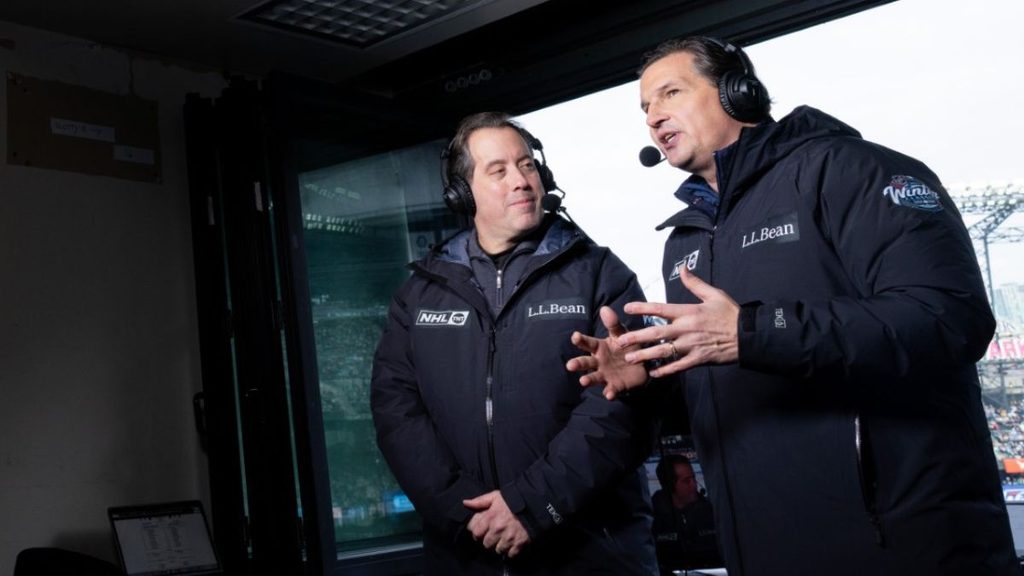
Eddie Olczyk, Kenny Albert (Credit: TNT Sports)

“It wasn’t an easy transition [moving to Seattle], but it was a comfortable one because I had family there. I always thought I’d be doing Blackhawks games. But sometimes in life, decisions have to be made. I made a decision and enjoyed the opportunity in Seattle,” said Olczyk.

Although leaving Chicago in 2022 was difficult, Olczyk remained connected to the Blackhawks organization throughout his time in Seattle. He regularly served as master of ceremonies for franchise events, including the team’s centennial celebration in 2025. Despite spending four seasons with the Kraken, he continued to consider ways to return to his roots in Chicago.

Following his departure from Seattle, that opportunity arrived when the Blackhawks named Olczyk a team ambassador and brought him back as a part-time studio analyst for CHSN.

“Things came together quickly over the summer, but we’ve always remained in contact even while I was in Seattle,” said Olczyk. “I’m honored and it’s a privilege to be an ambassador and carry that torch. I’m grateful. Because it’s all about selling the game and the Blackhawks to the community while chipping in on select broadcasts. It’s been great to be back home.”

At 60 years old — or “50 plus 10,” as he put it — Olczyk is experiencing a different rhythm in his work schedule. With only select games as a studio analyst, he no longer faces the same constant travel demands while balancing his local work with his national role at TNT Sports. The change gives him more time for family, friends and rest before his next assignment, rather than the relentless grind of the road.

Olczyk credits his family’s support for helping him balance his professional and personal responsibilities, especially that of his wife of 38 years, Diana. Over the past two decades, he has been a familiar presence on national broadcasts for NBC Sports and TNT Sports. All while serving as the lead analyst for the Blackhawks and Kraken. He has also taken on national radio assignments along the way.

“From my colon cancer battle and some health issues post-COVID as well, I think getting more rest and not traveling as much will add a few more chapters down the road,” noted Olczyk. “I do miss doing a lot of games, because it has been such a big part of my life. But working with and for great people makes it easier. I’m not as young as I once was, but it’s now about prioritizing things. I’m very lucky.”

Game Evolution, Broadcast Adaption

Broadcasting hockey presents a unique challenge. The speed, quickness, physicality and strategy make the game difficult to master, even for the best broadcasters. Olczyk has never considered himself a perfect broadcaster, but he has always strived to be an honest one. His approach is to call the game as he sees it while recognizing that mistakes are inevitable on live television.

As audiences find new ways to consume the sport, Olczyk has also adjusted his style to meet changing expectations. He understands that today’s viewers may not share the same familiarity with hockey that longtime fans do.

“You can’t assume everyone watching knows all the ins and outs and the slang that makes our game the greatest. Sometimes you do have to explain and teach certain parts of the game in the limited time you have without getting into the weeds,” said Olczyk. “Know who you’re talking to. Hopefully people learn something, and you are a part of the entertainment. We aim to tell the story, not be the story.”

Given his standing in the sport, Olczyk has also become an important figure in developing the next generation of hockey broadcasters. Alongside colleagues Kenny Albert and Brian Boucher, he regularly participates in the NHL’s broadcast boot camp. Which offers current and former players guidance as they explore potential second careers in sports media.

Olczyk began thinking about his post-playing career several years before officially hanging up his skates in 2000. Since then, he has kept a close eye on players who could become the next great voices of the game when their playing careers end.

“I got to know Joey Daccord very well when I was in Seattle. Hopefully he plays another 15 years, but I think he has an opportunity if he wants to pursue broadcasting. He would be outstanding, as well as Sean Durzi. He has the ability to do it with a great personality. I’ve seen him at the broadcast camp and do interviews. He understands it,” said Olczyk. “Erik Johnson also is going to be a star. He’s got the looks, and some new chiclets it looks like. He’s got it all, and I have great respect for him with his work in Colorado and with ESPN.”

The Road Ahead

With the NHL regular season underway, the familiar grind of the schedule has returned. Yet Olczyk isn’t focused on the final chapter of his career. Instead, he is looking toward the next shift, the next game and the next opportunity to connect with hockey fans across America.

Olczyk has spent decades helping fans understand the game. In addition, appreciating its greatest moments and connecting with the personalities who make it special. From the heartbreak of the 2010 Olympic gold medal game to the full-circle moment of calling the United States’ victory in 2026, he has experienced the sport from nearly every angle.

Now, with a renewed connection to Chicago and a schedule that allows him to prioritize life beyond the rink, Olczyk is embracing a new stage of his broadcasting career without losing sight of what brought him here.

“I’m very lucky to be an American-born lead analyst and do that many games in our country. It’s very humbling and I feel honored,” said Olczyk. “I’m always trying to make the next one the best one. That remains the goal.”

For all the championships, memorable calls and milestones that have defined his journey, Olczyk remains focused on the same mission. Telling hockey’s stories in a way that makes fans feel like they are part of them. As long as he has a microphone in front of him and a game to call, there will be another story worth telling.

Barrett Media produces daily content on the music, news, and sports media industries. Sign up for our newsletters to stay updated and get the latest information right in your inbox.

Streaming Has Hit Its Ceiling. Now What?

0

Back when I was living in Portland, a friend introduced me to Sonos. I was all in. All that music at my fingertips, following me from room to room. Suddenly the crates of CDs I’d collected over the years running radio stations looked obsolete.

So I hauled them over to Powell’s Books and sold a ton of them. I kept some. But thousands of discs, going all the way back to my college radio days at WRAS in Atlanta, went right back out into the ecosystem.

I regret it now. Not as a financial decision. Those CDs were the history of what I’d done in radio, and I traded it for the convenience of a streaming app.

Turns out the music business is having some second thoughts of its own.

Streaming Has Stopped Growing

For about a decade, the industry had one easy answer to every hard question. Revenue down? Wait for streaming. Artists underpaid? Relax, the pie is growing.

That answer is running out of road. According to new data from DMN Pro, the total number of paid US streaming subscribers actually declined in Q2 2026. Year over year, the number is up only in the low single digits. DMN Pro calls it a “now-mature” market.

Most of the chatter will be about the horse race. Apple Music briefly passed Spotify in Q1, then handed the lead back. By June, Spotify had roughly 55.5 million US subscribers to Apple’s 49.7 million. But both lost ground in the quarter. When the two biggest players shrink at the same time, that’s not a competition story. That’s a market story.

Bundles and Discounts Didn’t Buy Fans

DMN Pro suggests Apple’s early surge came largely from trial and bundled users who signed up for TV+ or iCloud and found Apple Music along for the ride. When the promos ran out, many walked.

Price didn’t hold them either. Apple was $1 to $2 a month cheaper than Spotify for over a year. Playlists, a familiar interface and years of listening history mattered more. You can bundle someone into a subscription. You can’t bundle them into being a fan.

That stickiness means streamers can raise prices, and Apple already bumped its Individual plan to $11.99 in July. But growth from price instead of people just means squeezing the same customers harder.

Meanwhile, Fans Are Buying CDs Again

Here’s the twist. While subscriber counts stalled, fans went back to the record store. According to the RIAA’s 2026 mid-year report, CD revenue jumped 58.6% in the first half to $171.1 million, with units up 45.7% to 17.5 million. Vinyl climbed 17.7% to $543.8 million.

K-pop deluxe editions did a lot of the lifting. But Luminate found CD sales still grew 6.7% without K-pop, and roughly half of Gen Z and millennial CD buyers don’t even own a CD player. They’re not buying a format. They’re buying a piece of the artist. As Hypebot put it: “Embrace the compact disc. It’s officially cool again.”

What It Means

The growth is now coming from fans, not new subscribers. Overall US recorded music revenue still rose 6.9% to about $6 billion in the first half, powered by higher prices and physical sales. Spotify is loading its app with audiobooks, podcasts and video to keep the customers it has. YouTube Music climbed past 14 million subscribers while Amazon Music slid to 31.1 million.

For artists and labels, the “rising tide” argument is fading. Expect more superfan tiers, more deluxe physical releases and more fights over how payouts are calculated. And anyone who paid top dollar for catalogs on projections of endless subscriber growth may want to rerun the math.

None of this means streaming is in trouble. It’s the business now. But the easy money phase is over. The winners will be the ones who turn casual listeners into real fans, the kind who want something to hold.

As for me, I’d love to have those crates back. Somewhere out there, someone is flipping through my old CDs from Powell’s. I hope they know what they’ve got.

Barrett Media produces daily content on the music, news, and sports media industries. Sign up for our newsletters to stay updated and get the latest information right in your inbox.

Why Election Night is Really Opportunity Night For Fox News, CNN, and MS NOW

0

Election Day is the Super Bowl for everyone working at Fox News, CNN, and MS NOW. It’s the night the entire industry builds toward. Months of planning, rehearsals, and set construction all lead to one marathon broadcast.

Tonight, however, is about more than bragging rights. It’s also a gigantic opportunity to open the door to new viewers. Those viewers don’t visit every night, so first impressions matter.

Plenty of casual news consumers will seek out all three networks tonight. For many of them, it might be the only time they turn to cable news all year. As a result, every minute on the air works like an audition.

The Audience Looks Different Tonight

Regular viewers know the anchors, the graphics, and the shorthand. Newcomers don’t. They haven’t watched the same hosts for years, and they might not know who’s running the decision desk. Consequently, a phrase like “too early to call” can sound like jargon instead of information.

That gap creates a real opening. Networks that explain the stakes clearly will keep people around longer. Moreover, viewers who feel welcome tend to come back. Time spent matters in this business, and election night gives programmers a rare chance to build it. Furthermore, a strong night can pay dividends well beyond the final vote count.

Be Inviting, Not Intimidating

Clarity should drive the coverage. Anchors can walk through the map, define key terms, and explain why a single county matters. In addition, a quick recap every hour helps latecomers catch up without losing loyal fans.

Tone matters, too. Viewers can sense when a network talks over their heads. Likewise, they notice when a panel turns into a shouting match. Warmth, curiosity, and confidence will travel much further than volume. Accordingly, the best election night broadcasts feel like a smart friend explaining the night, not an insider club trading inside jokes.

Pacing matters as well. Long stretches of waiting for returns can test anyone’s patience. Therefore, anchors should fill those gaps with context, not filler. Reporters can bring in voices from battleground communities, and analysts can explain what the early numbers suggest. Similarly, quick explainers on how mail ballots get counted can help newcomers make sense of a slow night.

Showcase What Makes Your Network Special

Every network has a case to make. Fox News can lean on its loyal audience and its familiar lineup. CNN can point to its global newsgathering footprint and its data-driven analysis. MS NOW, still establishing its new name, can use tonight to introduce itself to a wider crowd.

Production quality counts, too. Big screens, sharp graphics, and smooth handoffs all signal professionalism. However, none of it works if viewers can’t follow the story. Thus, the best networks pair flash with substance.

Digital platforms extend that reach. Streaming, social clips, and live blogs give new viewers more ways in. As a result, a network’s election night can start on a phone and finish on a television.

The opportunity is clear. Networks that treat tonight as an invitation, not a performance for insiders, stand to win more than a ratings night. They could win a fresh audience. Of course, the numbers will arrive in the coming days and show who made the strongest case. Until then, the stage is set, the viewers are watching, and the doors are wide open.

University of Illinois At Chicago Ends Radio, Audio Streaming Play By Play Broadcasts

0

The University of Illinois at Chicago has ended radio and audio streaming broadcasts for every Flames sport. As a result, Jonathan Hood’s 14-year run as the Voice of the Flames is over.

What We Know: Hood shared the news in a post on his personal Substack. He called UIC basketball and baseball for 14 years, most recently alongside Hall of Famer Kenny Williams. His run began as a pregame and halftime host in 2012-13, before he moved to play-by-play in 2015-16. Meanwhile, the decision covers all sports, including men’s and women’s basketball and baseball according to Hood.

What They Said: Jonathan Hood (via Substack): “I feel a sense of relief and am ready to move forward. I’m proud of the work we did as a crew and grateful for the opportunity to spend 14 years telling the stories of UIC student-athletes. UIC has outstanding coaches and people who care deeply about the welfare and development of those student-athletes. Their dedication is worth celebrating. That is part of what makes this decision disappointing.”

Jonathan Hood: “In my view, UIC athletics is choosing to celebrate within the four walls of the institution when it has an opportunity to share its achievements with Chicago, the Missouri Valley Conference, and audiences beyond. There are great stories at UIC: stories of success, growth, perseverance, and advancement. Those stories deserve to reach people on all platforms including radio/audio streaming. These broadcasts gave listeners a connection to the players, the programs, and the university. It meant something to me to help build that connection. UIC basketball, (men and women) and baseball stand as the only school in the Missouri Valley without home and road local radio coverage.”

What Remains Unclear: UIC has not publicly explained the decision. Likewise, it remains unclear whether cost, strategy, or both drove the move. Hood will continue hosting his daily morning show on ESPN Chicago, as well as his other work within the Good Karma Sports umbrella and SiriusXM Radio.

What It Means: According to Hood, UIC now stands alone in the Missouri Valley without home and road local radio coverage. Consequently, fans without ESPN+ subscriptions lose their free option for following the Flames. Ironically, UIC once promoted the Flames Radio Network as exactly that free alternative. For Chicago listeners, the move silences a familiar local college voice.

Barrett Media produces daily content on the music, news, and sports media industries. Sign up for our newsletters to stay updated and get the latest information right in your inbox.