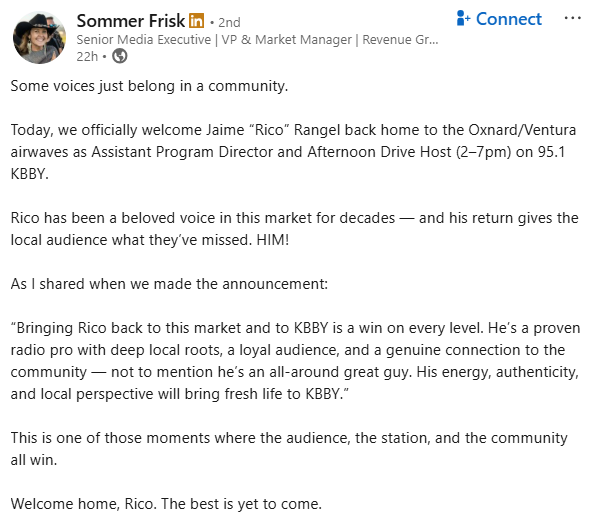
Jaime “Rico” Rangel is returning to the Oxnard/Ventura radio market, rejoining Cumulus Media as assistant program director and afternoon host for 95.1 KBBY.
The move brings a familiar and respected voice back to a market where Rangel built a strong following over multiple decades. He is best known locally for his role on the long-running Rico & Mambo morning show at Gold Coast Broadcasting’s Q104.7, where he teamed with Daniel “Mambo” Herrejon.
The duo first worked together from 1996 to 2005 before reuniting from 2009 through 2020, becoming one of the most recognizable on-air pairings in the region.
Cumulus Oxnard/Ventura Vice President and Market Manager Sommer Frisk described the hire on LinkedIn as a significant win for both the station and the market. “Bringing Rico back to this market and to KBBY is a win on every level,” Frisk said. “He’s a proven radio pro with deep local roots, a loyal audience, and a genuine connection to the community — not to mention he’s an all-around great guy.”
Rangel also spent time at 103.3 The Vibe in Santa Barbara, further solidifying his presence along the Central Coast. Most recently, he has been heard hosting weekend programming at Cumulus’ KRBE in Houston, maintaining an active on-air role while away from Southern California.
Frisk added that Rangel’s presence will have an immediate impact on the station’s overall sound and culture. “His energy, authenticity, and local perspective will bring fresh life to KBBY,” she said.
Barrett Media produces daily content on the music, news, and sports media industries. To stay updated, sign up for our newsletters and get the latest information delivered straight to your inbox.
Ben Shapiro has gone viral for his speech at the opening night of Turning Point USA’s AmericaFest, after calling out Candace Owens and Megyn Kelly.
Shapiro, who has publicly clashed with Owens — his former employee — for a lengthy amount of time, took her to task for her insinuations that the organization and Kirk’s wife, Erika, were somehow involved in the assassination of Charlie Kirk.
He then called out those close to Owens who have refused to condemn her statements on the matter.
“Friendship with public figures who say or do evil things is not an excuse for silence on the matter,” argued Shapiro. “So no, Tucker Carlson is not an excuse to go silent on Candace’s targeting of TPUSA.”
Shapiro continued by directly calling out Kelly, insisting that she has a “moral obligation” to take a stand against Candace Owens.
“The same holds true of Megyn Kelly, a person I consider a friend, characterizing Candace as a young mother and thus shying away from condemning her actions,” Shapiro said. “That is a non-starter. Meghan Markle is a young mother. Ilhan Omar is a young mother. That doesn’t matter. And when Megyn said this week, quote, ‘My goal and my job here is to try to understand, yes, where Candace is coming from on this,’ and says she sees no purpose in inserting herself, quote, ‘into this on one side,’ that is a moral and logical absurdity.
“There is only one moral side here, Erika Kirk’s side,” Shapiro continued. “You know, the side of the widow with two children whose husband was shot live on camera in front of all of us. Friendship with the person accusing TPUSA of a cover-up of Charlie’s murder is no excuse for cowardice.”
Barrett Media produces daily content on the music, news, and sports media industries. To stay updated, sign up for our newsletters and get the latest information delivered straight to your inbox.
The morning of December 2 is one that WFAN host Brandon Tierney will never forget. While pondering over yet another New York Giants loss, news of his immediate future with the radio station was instantly in question. The situation involved the return of Craig Carton to the station for a third time, with reports suggesting that Tierney and co-host Sal Licata were on their final days at WFAN.
It was a unique moment that every talent and company attempts to prevent. However, how one reacts is key, albeit there is no playbook for handling such a situation.
“We had so many conversations about the very real possibility of Craig [Carton] coming back [to WFAN],” said Tierney. “For us, the main checkpoint was that we had a choice here. Are we going to address this and get a deluge of calls and allow the show to go off the rails? You would get people calling in supporting us and denigrating some others. We weren’t going to allow it to turn into that. It’s not professional.”
Uncertainty At WFAN
It was no secret that rumors of a third run for Carton at WFAN lingered following the cancellation of Carton’s program Breakfast Ball at FS1. Tierney stated that around the end of summer, there was a sense that the roster move could indeed happen, with no true formula for how it would affect the station lineup or his own future at WFAN.
“We were not fully caught off guard [by the news of Carton’s return]. Management kept us in the loop and communicated several possibilities, all revolving around Craig’s potential return,” explained Tierney, whose contract officially ends with WFAN on December 31. “About two weeks before Thanksgiving, it [the possibility of Carton’s return] got a little more serious. Then I knew it was going to happen, but the contract wasn’t done.”
Tierney said he requested a meeting with Chief Business Officer & Market President, Audacy New York, Chris Oliviero for the Monday following Thanksgiving. After months of speculation and rumor, as well as his own contract talks being “pushed down the road” due to a potential Carton return. Tierney sought clarity on the situation.
“We met after the show on Monday after Thanksgiving, and that’s when it was communicated to me [that Carton was returning], even though he hadn’t signed the contract,” noted Tierney. “Chris [Oliviero] did explicitly say, ‘Once we announce it, you will know. We will do right by you.’ I believed it, and I fully believed that was their intention.”
Would WFAN Keep BT & Sal?
After 13 years with the company, the Brooklyn native finally had clarity on Carton’s return. However, the speculation about what it specifically meant for Licata and himself remained. While he personally considered Carton’s options, including a potential reunion with former co-host Evan Roberts, Tierney explained that there was an effort to find a way to bring in Carton while keeping BT & Sal on WFAN moving into 2026.
“Chris [Oliviero] bent over backwards exploring the financial viability of creating a fourth show. He didn’t want to move on from BT & Sal,” said Tierney. “At the end of the day, it just wasn’t economically feasible.”
Despite Carton’s eventual return to WFAN and management’s efforts to find a solution, the process in full affected Tierney’s own contract discussions. Typically, talks would begin in late summer or early fall based on previous experiences. But with Carton’s return looming, discussions never truly began.
“This [time] was ‘we don’t know what we’re doing,’” explained Tierney about his feelings regarding the contract talks timeline. “When you hear that and you’ve been in the business a while, you can’t keep your head in the clouds. You have to be prepared mentally for everything. My contract was up, and there was never a concrete dialogue about an extension. It was always about figuring out what’s happening with Carton, and then we go from there.”
Always Professional
Following the reports leaking via The Athletic, Tierney and Licata did not address the news immediately. While management kept both talents informed about a potential return for months, the show agreed to a stipulation to not comment until Audacy officially released the news.
“One of the things that was told to us in both our cases: if this comes to fruition with Craig [Carton], finish when you want to finish. We trust you guys to do the right thing,” explained Tierney. “We did avoid addressing [Carton’s return] out of respect for our company, and out of respect for their request. At the end of the day, we’re employees. We don’t own the company.”
Tierney recalled a discussion with Oliviero, during which the executive acknowledged that news of Carton’s return could leak before the company made an announcement. If that happened, Oliviero instructed both talents to “plow through” while the company sped up the official release so the show could address the news.
The news did leak, and BT & Sal remained silent. However, that did not happen with other WFAN shows. After Boomer & Giodiscussed the reports the next morning, Tierney requested guidance on how to address the issue. At 10am ET, BT & Saladdressed the reports to start their program, promising to go more in depth later.
“We weren’t blindsided by this. It sucks. I don’t think it’s necessarily fair or right. This show is absolutely deserving to be on WFAN,” explains Tierney. “I get it from a business perspective, but we tried to straddle the line, and we did. Was it easy? No.”
Moving Forward
Tierney has no regrets about how he handled the situation at WFAN. He also understands Carton’s value to WFAN. Not hearing from Craig since the news became official though did surprise him.
BT is familiar with the departure process, having seen many colleagues around the country experience it. As he officially closes his “chapter” at WFAN, he looks forward to a future full of possibilities and projects that have been on hold for far too long.
“It is my mission to find the next thing, and it’s exciting. I’m open to talking to anybody. The industry has changed tremendously. I was smart enough to know that I wasn’t going to have a twenty-year run at WFAN and find myself in my sixties with the option to retire. I always knew there would be a next chapter. Not a footnote, but a big chapter that’s going to look very different than the chapters I’ve written so far. I’m excited about that,” said Tierney.
He prefers to stay in New York because it’s home and where he fell in love with sports. However, he’s open to exploring other options, given his national hosting experience.
After the news became public, Tierney thanked every listener and colleague who supported his show with Sal Licata. He saw the program as a reliable space where listeners knew what to expect, crafting its own vein in the DNA of what made WFAN the legacy sports radio brand it is today. In the interim, he says it’d be unwise to shut the door on working for the station in the future. He’s receptive to part-time fill-in work, due to the strong relationships he has built with both staff and the New York City audience.
“The only regret I would have had is if I stepped away from my run at WFAN, looked in the mirror, and said, ‘Man, you finally got there and you didn’t empty the tank,’” explained Tierney. “That would have been very hard for me to live with professionally.”
Reflecting On The WFAN Journey
Tierney feels blessed by every opportunity in his career, because he earned it. The son of a retired New York City detective considers his Brooklyn roots the foundation of his fighter-like approach to his craft. Between balancing play-by-play at Madison Square Garden and sharing the mic with New York sports fans through the highs and lows, he considers his path at WFAN his ultimate career achievement.
“If I hadn’t reached WFAN, it doesn’t matter if it was for three years, three months, or three minutes, with everything else I’ve done, I would feel my career would be incomplete,” said Tierney. “That is something I needed to do. I had to do that for me. I did it my way, with a passion that was evident every single show.”
The show’s success allows Tierney to be at peace with the decision. He will miss working with Licata on a daily basis but the two passionate partners aren’t done talking sports together. They will reunite in January in New Jersey for a live event that includes New York Yankees manager Aaron Boone.
As his final show airs today, Tierney suggests he was a “victim” of unexpected extenuating circumstances at a station he still highly respects. He doesn’t consider his run at WFAN a failure at all. BT and Sal earned the #2 slot in Barrett Media’s Major Market Sports Radio Midday Shows of 2024. Only Zolak & Bertrand at 98.5 The Sports Hub in Boston ranked higher.
“When I walk out of that studio for the final time full-time, I know that the listeners of New York City and the surrounding areas got to listen to somebody who touched a dream. I knew that I couldn’t fail for them,” said Tierney. “That’s how much I respect them, the station, and the city. I didn’t fail. I’m not going away. I gave our audience every fiber of my being, and I couldn’t give them any less. They deserve that.”
Barrett Media produces daily content on the music, news, and sports media industries.Sign upfor our newsletters to stay updated and get the latest information right in your inbox.
Change is never easy. Far too often, the headlines surrounding the sports radio industry revolve around constant change. Hires, fires, and retirements dominate the news cycle. Change continues to be the expectation instead of consistency. When Westwood One Sports announced its official weekday lineup on Thursday, change arrived once again.
For many in the industry, the end of the Infinity Sports Network or BetMGM Network was expected. For a broadcast entity like Audacy, carrying the cost of two separate networks seemed challenging in the current broadcast landscape. That’s why news of the two networks merging and coming under the guidance of Cumulus Media’s Westwood One brain trust wasn’t stunning. It was merely another change.
However, beginning on December 29, the lights turn on and the mics go hot. Is the new Westwood One Sports lineup built to compete with the likes of ESPN Radio and FOX Sports Radio? Or is it designed to compete in a changing marketplace for content creators?
Earlier this year, former Barrett Media sports columnist Demetri Ravanos wrote a piece asking whether national sports radio has a best morning show. The contenders at the time were Unsportsmanlike on ESPN Radio, 2 Pros and a Cup of Joe on FOX Sports Radio, and Maggie & Perloff on the Infinity Sports Network. Ravanos broke down the comparison into five categories to determine which of the three programs could be considered the best.
In the end, after discussing name recognition, network, sound, outlook, and flamethrower (my personal favorite), Ravanos determined there was no clear winner. In fact, the exercise left him believing anything local is better than what national sports radio syndication provides in the mornings.
How Westwood One Sports Compares
That brings me to today. Borrowing Ravanos’ concept of five categories, I’d like to apply three of them to comparing the new Westwood One Sports lineup with ESPN Radio and FOX Sports Radio, respectively.
When it comes to name recognition, Unsportsmanlike still doesn’t have the national recognition that Brady Quinn and LaVar Arrington possess. Chris Canty is certainly a household name in New York City, but the show as a whole hasn’t elevated to the same level of star power as FOX Sports Radio.
With the hiring of Drake C. Toll to host mornings as a solo act on Westwood One Sports, name recognition places the show firmly in third. There are plenty of fans of the Savannah Bananas, but among sports fans broadly, the name value isn’t there yet.
You could say the same for Nick Kostos, Chris Bleck, and Adam Abdalla when looking at the prime dayparts. This isn’t a knock on their potential or what could be. It’s simply a reflection of where their national name recognition stands today.
Sound is a difficult category to evaluate because we still don’t know what many of these shows will sound like on the new Westwood One Sports network. Toll has never hosted sports talk radio in a full-time capacity, so ranking him at this stage would be unfair.
The same applies to the network category. The only proven entity at a national level in syndicated sports talk radio is Jim Rome in afternoons. Rome is also the only holdover from the Infinity Sports Network remaining in the same time slot.
What’s Different
Where the new Westwood One Sports lineup stands out is in outlook, and not for the reasons you might expect. What’s drastically different is the amount of youth and digital fluency across the lineup. Each talent has crafted a niche audience online, often outside the traditional pathways that many personalities on the other two networks followed.
There is no former athlete on the Westwood One Sports lineup. There is no former ESPN talent on the new lineup outside of Jim Rome. These are talents who worked their way up through a mix of traditional and digital methods, building audiences by adapting to how the next generation consumes content.
Can you say that about Dan Patrick or Doug Gottlieb? Can you say that about Clinton Yates and Freddie Coleman? This isn’t a knock on what those talents have provided over many years, nor on the paths that brought them to where they are now.
Westwood One Sports should be viewed as an opportunity for new and young talent to grow. Many sports radio stations across the country stopped trying that years ago. In fact, this approach reflects what much of the industry has come to accept as the norm.
This is change, and it wasn’t easy.
Build Today To Compete Tomorrow
Westwood One Sports wasn’t created to compete today, but to help set the playing field for tomorrow. It needed talent that thinks differently, sounds unique, and offers a fresh approach to reaching new audiences. This is content-first, but not radio-only. The goal is to connect with people on multiple levels, through every viable platform, and to plant a flag in the content spaces they believe they can win.
It doesn’t have to mirror what worked in the past, but it does have to work for the future. That requires bold decisions and decision-makers willing to try something different. That’s why I remain interested in seeing whether Westwood One Sports can penetrate the sports content space that top syndication programs have yet to fully capture.
Westwood One Sports isn’t built to win arguments on social media or comparison charts today. It’s built to challenge an industry that has confused comfort with relevance and longevity with innovation.
In a business that keeps recycling the same voices while wondering why audiences age out, this lineup represents a calculated disruption.
It may fail. But standing still has already proven to be the safer way to lose. That’s a change the industry should welcome.
Barrett Media produces daily content on the music, news, and sports media industries. To stay updated, sign up for our newsletters and get the latest information delivered straight to your inbox.
If the U.S. military ran wars the way radio runs operations, we’d all be speaking German. Leadership would’ve fired the ground troops and stopped investing in tanks and planes.
“Budget” may be the most used word in radio. It’s a word that can be the truth, an excuse, a stall tactic, or permission to be lazy.
Truth: “There’s no budget for that.”
Excuse: “I don’t have budget.”
Buying Time: “We’re working through budgets.”
Seeking Approval: “Let me see what the budget allows.”
Laziness: “There’s no budget. Maybe next year.”
For those of us in RockTernative, “the budget” is the center of our universe. It determines hiring and firing, bonuses, marketing, research, technology, content, and sometimes whether a brand changes course.
Most often, budgets are controlled by spreadsheet armies far from the building who have never sat in your chair, cracked a mic, and think Mammoth WVH is an arctic beast.
That’s not unique to radio. Most industries work that way.
But many inside the radio industry are often just accepting of budgets, without pushing back or creatively finding alternatives.
There are a few budget-driven assumptions or realities that need to change.
The Guillotine Selection Committee
Programmers can only control ratings, not revenue targets. Many stations hit or exceed ratings goals each year only for the collective team to miss budget by a country mile. What happens then is cuts almost always hit programming first, the people who actually did their jobs well.
This creates a self-fulfilling decline.
CEOs and CFOs are paid to make tough decisions, but tough doesn’t always mean honest. Cutting a ratings-performing morning show because sales missed is like firing the grenade maker instead of the guy who couldn’t throw it far enough. It’s the equivalent of blaming the guitar when the amp blew a tube.
Get Involved Before it’s Locked
Most programmers are handed a budget and told to deal with it. Rarely are they invited into the process in a way that can meaningfully shape the outcome. That doesn’t mean accept it quietly. Be proactive, specific, and relentless.
Don’t just say, “We need research.” Instead, “Here’s what happens with and without research.” Show the ROI, lay out the risk and reward, and give decision makers a clear fork in the road to make a choice. They will have more skin in the game that way.
The same goes for sales. If your revenue goals feel off or unfair based on market realities, show the math. Include reports and trends. “Auto spending is projected to be down X% next year, yet my auto budget is up X%. To get closer to that, I’m going to need Y&Z.”
You won’t change the budget by complaining, but you can change the outcome if you present clear trade-offs backed by data and experience.
Marketing
Nine out of ten budgets include zero mass marketing. When marketing exists, it’s often stealthy and digital-only, aimed at a few meters instead of people or an audience.
Talent and programming are often blamed for missed budgets. Just like when critics roast Sydney Sweeney if a movie opens soft but fail to mention no one knew about the film because it wasn’t marketed.
The irony: radio is a marketing platform that touts the importance of marketing but it rarely markets itself.
None of this is a road to bust if brands don’t get a corporate check for marketing. It’s a push and reminder that creativity, partnerships, and a return to quid-pro-quo thinking is where to focus. Radio has audience, inventory, and reach. Many brands would eat their shoe to have such problems. The trick is finding mutually beneficial partnerships to explore.
Everyone Is in Sales — Whether They Like It or Not
Everyone represents the brand and everyone is selling whether they realize it or not. Jocks are selling music and initiatives. Street teams are selling representation, presence and image. Digital is selling brand content.
For programming, if initiatives aren’t being sold — specialty weekends, features, endorsements, the tactical cash promotion — that’s a problem. Step in. Ask how to help. If necessary, go sell it yourself and earn a commission.
There used to be a clear line between sales and programming. Like church and state. Today, that line is blurrier than it’s ever been. It’s like a modern day rock festival, all genres contributing, everyone wearing multiple hats, whether they were asked to or not.
Budgets shouldn’t be excuses. They should be truths. A goal continually worked towards. The budget should honestly reflect today’s reality where flat may be the new up, but pretending growth comes by cutting back or without investment is just fantasy. Budgets also shouldn’t protect being comfortable, but they should be able to fund ambition.
Barrett Media produces daily content on the music, news, and sports media industries. Sign up for our newsletters to stay updated and get the latest information right in your inbox.
The reason most people fail is because change is hard. Nobody likes change. It’s difficult and uncomfortable. The comfort zone has earned its nickname for a reason. We all like to stay there.
In a few weeks people will turn from looking backward at the twists and turns of 2025 to making resolutions to start the new year. Except the resolutions that most people make don’t last. Statistics show that nearly 80% of people abandon their resolutions by the second Friday in February, also known as “Quitter’s Day.”
Enter the hero of our story, Lamont Hollywood.
For 35 years, Lamont partnered with Paul Tonelli on the phenomenally successful morning show ‘Lamont & Tonelli’ in the Bay Area. The show first ran on KSJO then, starting in 2003 on KSAN. In November 2024, the industry wide cutbacks that have cost the medium so many talented shows caught up with them. Cumulus Media ended the show, but a few months later, Hollywood returned, this time without Tonelli. ‘The Lamont Show‘ was born.
After 35 years together, that’s a big change. Unlike so many people who make resolutions but give up, going back to the comfort zone wasn’t an option. “We adapted, but we had to adapt. We were forced to make changes, so we tried to turn a negative into a positive,” Hollywood says.
The first hurdle the new show faced was not disappointing the audience who loved the old show. “If you work with someone for 35 frigging years, you get entrenched and the audience gets entrenched. They have expectations about what the show is,” says Hollywood. “I looked at this as a chance to adapt and change things which I had to do because without (Tonelli) the show would never sound the same.”
His first goal was to keep as much of what made the show successful as he could. It helped that not everything had changed. Chasta, who also hosts middays and is the station’s Program Director, had been a part of the original show but now she had to step up. “I didn’t want to overwhelm her because she still had so much other stuff to do but she naturally had to take on a bigger role.”
Behind the scenes, Executive Producer Eric Smeltzer also came back. That helped keep the overall sound of the show relatable to the existing audience. “I think he’s the best in the business. He gives us the consistent comedy sound that we had when (Tonelli) was there.”
By keeping so many components in place, Hollywood was able to have the best of both worlds, consistency, and change. Ideas for the new show were born from a brainstorming session with himself, Smeltzer and others working on the show.
“We came up with over three hundred pages of new ideas for the show. We thought of everything, promotions, production, stunts, contests, streaming and non-traditional revenue for us and for the radio station. Nothing was off the table.”
That doesn’t mean everything went on the table either. Hollywood says over the last year the team has taken a measured approach to implementing ideas from the big brainstorm. “You don’t want to make wholesale changes to everything. You don’t want to overwhelm people.”
He says out of everything they came up with the team set out to select 12 to 15 things to work on in their first year. If half of them were implemented and worked effectively, that would be considered a huge success.
And it took a while to get everything to sound the way Hollywood wanted it. He says it took almost nine months before he finally felt like the show sounded right. At that point, from the three hundred pages of ideas the show had about four new benchmark features.
“When you start establishing new stuff and you see it’s working, that’s when you know, we may be on to something here. Now it’s time to let that get consistent. Some of these new features have worked out better than the stuff I was doing before.”
One part of the show that has remained is a willingness to take on political topics. “We have impersonators on the show. A lot of people stay away from doing Donald Trump. We have the greatest Donald Trump impersonator ever.”
But it’s not as simple as just making fun of the President. “If you’re going to do something like that, you have to be able to make fun of both sides and not make it that you’re going after one person. You’ve got to have reasons to do it, and you have to remember you are making a parody of the person, you’re not doing it with malice.”
Hollywood feels it’s important because the show must be topical. Whatever is in the news will make it onto the show, just not in a predictable manner. “It may be a ridiculous take on it but we’re still talking about it. I think that’s what’s lost on a lot of good radio shows.”
He also sees a lack of effort that concerns him with some younger shows. “The creative process to really deliver on a show like this is constantly ongoing. And you can see who’s not working at their show. It’s like watching a hockey game. You can tell the guy who goes in, plays for an hour, and then goes home and drinks beer and doesn’t work out. As opposed to the guys who are really dedicated and put in the work.”
But maybe that’s OK because it leaves more opportunity for Hollywood. “Something I never would have even imagined is because we’re in Silicon Valley, we have some venture capitalists that listen to us. I got a call from these guys who want to start a project and among other things I’m talking with them about syndicating. We’re getting close to making things happen.”
Seeing how that new opportunity grew from almost a year’s worth of turmoil is a lesson for all of us. “When you make changes, you’re forced to adapt but sometimes it’s the best thing.”
Barrett Media produces daily content on the music, news, and sports media industries. Sign up for our newsletters to stay updated and get the latest information right in your inbox.
As we get set to put a bow on 2025 and look ahead to 2026, all of news/talk radio will look back on the year that was and ahead to the year that will be.
While it’s still early, there is evidence that the new Nielsen three-minute rule, along with a robust, rapidly advancing news cycle, made 2025 a positive year for the format.
Traditionally, there might be a hangover from an unprecedented election year in 2024, but many stories from stations around the country showcase an even stronger 2025 than 2024.
Many of these stations that turned in great 2025s did so not just with excellent news coverage of the top national stories, but also with engaging local content, effective promotions, events that created opportunities for audience engagement, and shows that were not stale, predictable, or hyper-national political.
Now, every station and market is going to have its own blueprint for success, but there are common themes that I’m noticing are starting to stand out for stations around the country. As the national political landscape gets saturated with content on YouTube, podcasts, and elsewhere, local stations won’t be able to win by trying to compete exclusively in that lane.
This doesn’t mean your local shows can’t, or shouldn’t, talk about a huge national political story of the day. In fact, the audience will likely want to hear your host’s take, with, when possible, some local spin and flair on these stories. But it can’t be wall-to-wall, and it can’t be everything.
As music stations continue to cut local talent, there are fewer options for broad-based conversations on local radio. If local News/Talk can continue to do what it does at its core, cover and discuss the big national and local news of the day, while blending in the wider range of topics that are no longer a part of most music stations in many markets, there can be a winning formula for local News/Talk.
A line stood out to me from WISN’s Jay Weber, who recently announced his retirement. He said, “No disrespect to the new generation of talkers, but I feel like my generation of talk radio is over.”
He’s right. It is over. And that’s no disrespect to anyone.
Sports trends change. Coaches develop new systems and schemes that succeed and get copied. Fashion trends shift as well. Any industry sees dramatic change when innovative minds analyze the landscape, identify opportunities, and take advantage of them.
Why would news/talk radio be doing the same thing it did in 1995, 2005, or 2015 when the local radio landscape is dramatically different and the national topics of the day are over-discussed, with far more competition on various digital platforms, where consumption is also more convenient for the audience?
As we turn the page to 2026, there remains massive upside and opportunity in the talk format on local radio. News and Sports can continue to grow in ways that music stations will have a hard time keeping up with. Local, strong, relatable personalities who can hold an audience can thrive.
But Jay Weber’s point is one that many programmers, hosts, and producers can take into the next year: His generation of talk radio is dead. What are you doing to make sure you’re not stuck planning the funeral of your own station in 2026?
Barrett Media produces daily content on the music, news, and sports media industries. To stay updated, sign up for our newsletters and get the latest information delivered straight to your inbox.
Netflix and YouTube spent the past year reminding the media business of a simple truth: “We all want what we ain’t got.”
Netflix is chasing podcasts and creator culture. YouTube is chasing Hollywood legitimacy. Each move makes sense on paper. Together, they underline how restless success can be.
For Netflix, podcasts represent attention, loyalty, and time spent. Those are currencies the company understands. YouTube owns that space right now. Long-form talk shows, video podcasts, and creator-driven programming live there daily. Netflix wants a piece of that behavior. It wants people to linger without needing a scripted series.
That desire will not come cheap. Netflix is already spending heavily to lure top podcast brands and personalities. The final price tag could reach into the hundreds of millions. When infrastructure, marketing, and churn are considered, billions are not unrealistic. Competing with YouTube on creator gravity is a costly ambition.
YouTube, meanwhile, is flexing in the opposite direction. The platform has dominated user-generated video for two decades. It has become television for a generation. What it has never fully owned is Hollywood’s most guarded territory. Prestige movie culture still lives elsewhere.
Enter the Oscars. By reportedly taking the Academy Awards away from ABC, YouTube signals something bigger. It wants to be part of the movie business conversation. It wants the industry’s crown jewel on its stage. That validation has value beyond ratings.
The irony is hard to miss. Netflix grew by disrupting traditional film and television distribution. YouTube grew by ignoring Hollywood entirely. Now both want the other’s toys. Netflix wants creator intimacy. YouTube wants red carpet credibility.
Neither company lacks strength where it already plays. Netflix remains the leader in global subscription streaming. YouTube remains unmatched in scale, reach, and daily engagement. Each platform already dominates its lane. That dominance, however, no longer feels sufficient.
This is where the old adage hits home. We all want what we ain’t got. Success creates insecurity. When growth slows, expansion feels mandatory. New categories become tempting, even if the margins are uncertain.
Netflix chasing podcasts raises practical questions. Can it recreate YouTube’s frictionless creator ecosystem? Will audiences change habits for another app? Can authenticity be manufactured at scale? Those answers are far from guaranteed.
YouTube’s Oscars play carries its own risks. Prestige does not automatically convert to profit. Hollywood partnerships come with politics and expectations. Owning a broadcast event is different from hosting creators with webcams.
Sometimes, it is ok to be what you are. Media history is filled with companies that lost focus chasing adjacent glory. Expansion can dilute identity. It can also distract from core innovation.
That does not mean these moves will fail. Netflix has surprised skeptics before. YouTube has rewritten the rules of distribution. Both have the resources to experiment loudly and often.
Still, the pattern is revealing. When giants look sideways instead of forward, it says something about the moment. Attention is harder to hold. Growth is harder to find. Even the winners feel uneasy.
Netflix wants YouTube’s community. YouTube wants Hollywood’s stamp of approval. Each believes the other holds the missing piece. Whether that belief pays off remains to be seen.
For now, the message is clear. In media, confidence is fleeting. Ambition rarely rests. And no matter how much you already own, the temptation of what you do not have can be irresistible.
Barrett Media produces daily content on the music, news, and sports media industries. To stay updated, sign up for our newsletters and get the latest information delivered straight to your inbox.
Scott Jennings and Alex Marlow have the unenviable task of replacingThe Charlie Kirk Show in the daily lineup at the Salem Radio Network.
The network announced earlier this week that Jennings’ show would expand from one hour to two, taking up the 1-3 PM ET window, while Marlow’s podcast will expand to a daily one-hour radio show being heard from 12-1 PM ET.
Jennings won’t be a foreign name to the audience. His program joined the Salem Radio Network lineup in July, ironically, as a way to fill the slot vacated by the injury to Dennis Prager that left him unable to host his daily radio show.
Marlow, however, might be a more unfamiliar voice to listeners in the timeslot. A notable name in his own right in conservative media due to his work as the Editor-in-Chief of Breitbart News, Marlow will likely be viewed as the newcomer to Kirk’s former listeners.
The situation is obviously a sensitive one. Marlow and Jennings will assume the timeslot of someone who was assassinated, in public, with the video of their death widely viewed on social media platforms.
We spoke with two veteran news/talk radio professionals — one long-time nationally syndicated host, and one program director who has worked at the network level — to get their insight on how they would approach such a delicate situation. Anonymity was granted to both to speak more freely on the subject.
“I truly believe the succeeding host has to carry the legacy of the host before them,” the host shared. “Because it was a host that Charlie wouldn’t have approved of, I don’t think that would sit right with the audience. There’s also a business to keep going. But it just should never be somebody who would contradict the values, the ideology, and the presentation of the host before them.”
Replacing a host who died — whether expected or tragically unexpected — isn’t a new phenomenon. Perhaps the most famous news/talk radio show host of all-time — Rush Limbaugh — hosted his program until some of the final days of his life, before Clay Travis and Buck Sexton were tabbed by Premiere Networks to pick up his torch.
The longtime news/talk radio program director we spoke with said there’s a right way and a wrong way to address the situation for the incoming hosts.
“You have to address the elephant in the room. You have to,” they reiterated. “To just start a new show as if it was any other day, under any normal circumstances, is getting off on the wrong foot with the audience. The ‘delicate’ aspect of which you speak isn’t the death of the last host, it’s the tightrope of keeping the listeners of the old guy, and trying to build your own listener base at the same time. And the easiest way to drive away listeners from the old show is by not even talking about why you’re behind the mic in the first place. Address it, with reverence, and then begin your new show. That would be my advice.”
The nationally syndicated host agreed.
“I don’t think it ever goes away,” they said of the back-of-the-mind knowledge of why the new host is assuming the show in the first place. “I’ve never known anybody murdered. When a friend of yours or a colleague of yours is killed, you sort of go through weird actions.
“But in terms of the business side, it’s got to just be business as usual. Scott and Alex have to dive in. They can’t dwell on it. They can’t wallow in it,” they said. “But it’s certainly, I’m sure, in the back of their minds that the guy before that was taken from the world in such a spectacular, horrible fashion. And I don’t think that’s something they’ll ever forget. But they have a job to do. You have to keep your head down and do what the audience expects of you.”
Barrett Media produces daily content on the music, news, and sports media industries. To stay updated, sign up for our newsletters and get the latest information delivered straight to your inbox.
I have sold most of my life. In truth, we are all salespeople. Even as toddlers, we were all selling ourselves. You remember! Those times you wanted to go out and meet with friends and you mom or dad said, “No!” I frankly think I honed some serious sales skills when I turned 15. Well, maybe it wasn’t selling as much as it was begging! Whatever I was selling to my folks – I learned a lot.
I’m a bit savvier these days and I’ve developed more “solution oriented” skills. In the end though, we all want something and try to convince or persuade someone else to help us get it. I recall way too many real-world moments when a sales interaction made me cringe, shut down, or walk away in complete frustration. Whether in media sales, retail, B2B, or services, certain habits consistently irritate the heck out of customers and ultimately, cost sales. Here are some of the most annoying habits to eliminate in the new year.
Making It All About You Vs. Them
The classic misstep in my book is from sellers who tend to launch into long, rehearsed pitches before any discovery, or completely forgetting about the customer’s needs. It doesn’t matter what’s being purchased. When customers feel unheard, they disconnect quickly. You will rarely win a sale after that encounter.
Being Overly Aggressive and Pushy
Few things turn everyone on the planet off faster than a housefly’s wing flap is a salesperson who becomes aggressive and rude. I am a firm believer that the real selling starts when a customer says, “no” but using high pressure tactics or telling me how wrong I am will eliminate the chance of creating a real, long-term business relationship. A pitch created by intimidation is a failed sale.
Overpromising to Get the Deal Done
I have detested this ever since I was in programming. This practice annoyed most every program director I ever knew. The promises made by some sellers usually surrounded a promotion that was never created, discussed, vetted, had zero value or merit, and gave away far more inventory than available. Eventually, good managers come to the rescue and help solve the problem before any PD gets arrested for assault! Tell clients what they need to hear rather than what you want them to hear. Overly annoying follow-up: We all agree that follow-up in sales is important, but calling daily, emailing constantly, showing up unannounced at a business, or reaching out after hours annoys customers more than a middle schooler cracking gum in class. It is not in any way impressing clients. Persistence is appreciated and valuable. Pestering is not.
Selling Beyond Available Dollars
Raising your ask is an important tactic. However, when you’ve already done so and the client has clearly stated their budget and available dollars, don’t push way outside that realm. It is viewed as disrespectful and makes you appear tone-deaf. Clients expect solutions that fit their financial reality. If you don’t believe their spend will be enough to succeed, then you owe it to your client to explain it them rather than push them. Remember – it’s their world versus your world – and their world is all that matters.
Don’t Focus on Features
A long list of features rarely excites anyone. Customers of any type of business care about how a product or service will improve their life. Nothing loses interest quicker than neglecting to connect features to real-world benefits. How will you address the issues creating their greatest pain, or the goals that offer them the most gains?
Assume Nothing
I learned very early on that to assume can often make an ass of u and me. Assumption is the mother of all screw ups and often leads to bad advice. When sales reps jump to conclusions before asking questions, customers feel misread, misunderstood, or treated like just another generic prospect. It makes them feel like you haven’t done your homework. Do your research beforehand and conduct your first meeting by asking questions. Each answer should simply be a path to another question.
The “Vanishing Act”
Once a contract is signed, some salespeople disappear. They leave customers with questions and no support. Post-sale service often matters more than the sale itself. Stay in touch with your customers. The goal is to build a relationship, and you can’t do that if you disappear.
Talking Techie or Using Media Jargon
Customers can tell when a salesperson is reciting a script or trying to impress with industry jargon. It is anything but authentic. Speak their language rather than your own. Clear, concise language builds stronger connections. Be interested in their story versus how much you know. You are there to find out all you can about them, not tell them all about yourself.
Being Late, Unprepared, or Taking Longer Than Promised
Respect their time. Leave early enough to be there at the agreed upon time. Do your homework and don’t ask them questions you should have researched in advance. Finally, don’t tell them it will be a quick 10-minute meeting and then keep them for 30 minutes. That all shows a lack of respect and professionalism. Time is money for you and them.
Closing Comments
We sometimes focus on the things a good seller should do and neglect to address those things that annoy potential clients. These poor habits have the same underlying issue; they make customers feel unheard and manipulated. The most successful salespeople don’t win by talking more, pushing harder, or promising more…they win by building confidence.
When the engagement and experience feel good, people buy. When it becomes annoying, they don’t.
Barrett Media produces daily content on the music, news, and sports media industries. Sign up for our newsletters to stay updated and get the latest information right in your inbox.