

Home Blog Page 583

Is Dave Portnoy Missing the Big Ten Championship on FOX Sports Coincidence or Calculated

0

The college football regular season officially comes to an end this weekend. Championship weekend is built for the conferences to crown their best, while the country debates who should participate in the playoffs. The allure of championship weekend has dwindled over the years as the number of bowl games rises and the playoff itself takes center stage.

This weekend, FOX Sports’ Big Noon Kickoff will air its season finale live from the Big Ten Championship in Indianapolis as Ohio State takes on Indiana. The top two teams in the nation will square off for conference supremacy and playoff seeding.

What’s missing from FOX’s Big Noon Kickoff is the biggest signing of the offseason. Barstool Sports founder Dave Portnoy announced following Ohio State’s beating of Michigan last week in Ann Arbor that he won’t be present for the broadcast. The crescendo of the college football season missing its most attention-drawing element is puzzling. Was this the plan all along?

When FOX Sports announced the partnership with Barstool Sports back in July, the deal was hailed as a “one-of-a-kind” brand that connects with a new generation of sports fans. Barstool Sports has undoubtedly built that following with a combination of sports commentary and a multiplatform approach.

It’s no secret that younger audiences prefer personalities over analysis. Fun over substance. At the time, I called Portnoy’s signing by FOX Sports the most important network television signing of the entire calendar year.

Now it’s December, and the Big Ten Championship is Saturday. Portnoy won’t be showing up. Was this planned all along? Was this Portnoy’s call, or did the conference step in and force FOX Sports’ hand?

Going into the partnership, Portnoy turned the announcement into a two-minute PSA for the Michigan Wolverines. He bashed Ohio State and nearly every other school in the conference because they aren’t wearing the maize and blue.

This season, Portnoy was reportedly barred from the stadium at Ohio State for the biggest game on FOX’s calendar. He also hinted that the Big Ten Conference leveraged its influence with FOX to keep him off-site. Portnoy had public back-and-forths with Big Noon Kickoff talent, including Mark Ingram and Matt Leinart.

I questioned last month whether Portnoy had worn out his welcome with FOX Sports’ Saturday pregame show. Partnerships require time to grow. From every indication, FOX Sports and Portnoy didn’t allow enough time to prepare for his role or to build rapport with the current staff.

Oil and water never mix. So, you have to wonder whether FOX Sports was satisfied with the outcome in its first year.

The positives were evident. Viewership increased throughout the season, and the social traction between FOX Sports and Barstool Sports accounts brought in additional impressions and engagement. Big Noon Kickoff became a weekly talking point in more sports media spaces than ever before. Portnoy’s presence always draws attention, and attention was certainly gained.

However, with new measurement metrics from Nielsen and trends in football viewership, can you call Portnoy a traditional ratings draw? Was a quarter-hour segment noticeably stronger because of him?

The better question is: without Portnoy, would Big Noon Kickoff see those same spikes in viewership?

Moreover, closing the season without Portnoy says more about FOX Sports than it does about him. The network’s partnerships with the conferences are far more important to its current and future health than anything involving Barstool Sports.

The last thing FOX needs is Portnoy going off about the conference during its championship game. Conversely, the last thing Portnoy needs is a presence on FOX Sports during championship weekend.

In the end, this decision works for both parties. FOX Sports wanted a spark, and they got it. Some fires they put out, others they couldn’t. It’s not that Portnoy didn’t belong on the program; the recap should be more focused on the wins for both parties.

Did Barstool Sports get more presence on traditional network television? Yes, but how much does that help their bottom line and brand reach?

Did FOX Sports get a bump in interest, viewership, and digital growth from the partnership? Surely. But at what cost to the network’s relationship with the Big Ten?

The fact that Portnoy won’t be part of the network’s coverage of the championship game highlights the fine line FOX continues to walk.

The partnership isn’t ending as the college football season winds down. FOX Sports and Barstool Sports will also contribute to college basketball coverage, including the College Basketball Crown, a postseason tournament launched by FOX this past April.

Neither FOX nor Barstool has revealed the details of this partnership. If the football season is any indication, though, who’s making the call on how much and where? Is it FOX Sports, Portnoy, or the conferences themselves?

At the end of the day, the FOX-Barstool experiment this season showed both the upside and the limits of pairing a digital disruptor with a traditional sports network. Attention was gained, conversations were sparked, and younger viewers took notice. But the absence of Dave Portnoy from the Big Ten Championship weekend serves as a reminder: in the high-stakes world of college sports, network strategy—and conference relationships—still outweigh individual personalities.

The partnership remains intact, but the first season made clear that balancing innovation with tradition is a delicate act. How FOX and Barstool navigate that line next season will determine whether this is a fleeting spark or the start of something far bigger.

Barrett Media produces daily content on the music, news, and sports media industries. To stay updated, sign up for our newsletters and get the latest information delivered straight to your inbox.

How Robert Griffin III Found a Fresh Start With a Bright Future Ahead at FOX Sports

0

Robert Griffin III became a household name to sports fans across the country during the fall of 2011. His 4,239 yards and 37 touchdowns led to Griffin earning the Heisman Trophy. That spring welcomed Griffin to the NFL as the second overall selection in the NFL Draft. He spent eight seasons in the league before transitioning to a sports media career that began at ESPN in 2021 and now continues with FOX Sports.

Every step of Griffin’s journey led to the next, a journey rooted in the game of football.

“This is where God is calling me to be,” says Griffin. “I was blessed to be able to do what I did with ESPN, and now with FOX Sports. To be out for a year, it gave me perspective being at home with my wife and kids. Sometimes you don’t know if this is what I’m supposed to be doing… It’s been a lot of fun.”

Following Griffin’s NFL career ending in 2021, he immediately sought a place in sports media. He auditioned for both FOX Sports and ESPN, with Bristol becoming his entry point into the media landscape.

He served three years as an analyst with ESPN but was let go by the network in 2024 with two years remaining on his deal. Unsure of what his future would hold, he benefited from the positive impression his earlier FOX audition had left with network executives.

“When Brock Huard decided to step down and no longer be on the two team at FOX, the call came almost immediately,” said Griffin. “They let me know how much they wanted me in that spot. This was an opportunity to finally make it happen with the network that recognized my talent from the jump.”

Finding Opportunity at FOX Sports

FOX Sports announced the addition of Griffin to its roster, pairing the Baylor Bears legend with Jason Benetti. Having called games for ESPN previously, the return to the booth was seamless in some respects but not all. Entering the FOX family, Griffin was instructed to be himself. An analyst that celebrates the sport of football while entertaining audiences seeking an escape.

“Me and Jason [Benetti] have incredible chemistry. We are not a crew that is having two different discussions in the booth. Jason has made me better,” explained Griffin. “We give each other the space to finish the story… For me, I always try to take something away from the play-by-play guys I worked with. They’re all different, but Jason has allowed me to truly be myself.”

Griffin says the chemistry he and Benetti have developed in a short time at FOX Sports has been natural. Before the season, the network suggested the pair work some practice games to develop their cadence on air, but both declined.

“FOX wanted me and Jason to do some practice games wanting to see where our chemistry is at. This is the moment I knew we were going to be phenomenal in the booth,” said Griffin. “Both me and Jason looked at each other and said we don’t need a practice game… It’s been like we’re riding a bike from game one this year.”

This season, Griffin’s return to the booth has been a success. FOX plans to expand his work by having him call some NFL games later this season. The 2011 Heisman winner praises FOX Sports’ family feel and is open to finding new ways to play a bigger role with the network moving forward.

“I don’t ask much from Eric Shanks and the crew, but when they call I’ll be ready to roll,” said Griffin. “Jason Benetti does college basketball. That’s certainly something I’d be open to jumping in and helping the network out with. I’m also a massive futbol (soccer) fan, and the World Cup is coming up next year. It’s been fun to see the opportunities that are out there with FOX Sports.”

Crafting a Niche as a Creator

Before joining FOX Sports, Griffin sought ways to remain active in sports media after leaving ESPN. He landed on a unique podcasting concept that blended his sports knowledge with his personality at home.

Griffin launched Outta Pocket with RG3 in late 2023 as a project to connect with digital content consumers. It eventually evolved into a podcast co-hosted by his wife, Grete Griffin.

“You’re constantly evolving with the industry. Working with my wife, it’s fun. I have the knowledge of working with the machine with my time at FOX and being inside the media. My wife is bringing you the perspective of the athlete who’s not all the way in the media and understanding different types of situations,” explained Griffin.

Grete Griffin, an Estonian-born heptathlete, joined the program in August of last year. The show often ventures outside the world of sports, featuring discussions about family, faith, and adversity tied back to athletics. The husband-and-wife dynamic is strategic, aiming to cater to different demographics with a unique blend of content and perspective.

“The networks are starting to understand that some shows that you can produce in-house can garner the same viewership as a podcast could,” explained Griffin. “My goal would be to create and maintain a show that cannot just go on television but can live on TV. That’s the goal because they’re [FOX Sports] our partner. We’re not focused on this to go anywhere else; we want to stay within that family. They’re doing things for us to ensure that happens.”

Griffin said the network has provided access to guests in what he considers a guest-driven creator economy.

“This is the new frontier. [Pat] McAfee and what he’s been able to accomplish at ESPN. That’s what most people are trying to accomplish. From our perspective, we don’t want to be like them. We want to give the viewer something more,” said Griffin.

Growing From Experience

For all the positives with Griffin’s return to FOX Sports, 2025 has been a controversial year as well.

An encounter where Griffin tweeted “Sports shows on tv should be about sports, not politics” caught the eye of ESPN commentator Stephen A. Smith. That led to a public back and forth between the two former ESPN teammates.

Another encounter involved ESPN commentator Ryan Clark. The former Steeler responded to Griffin stating an opinion about Angel Reese and Caitlin Clark, which led Clark to use the race of Griffin’s current and former wife as reasoning why he felt Griffin didn’t understand what “Black women deal with.”

In the end, both incidents originated from Griffin posting his opinions on social media, something he has pulled back from since both situations went viral.

“Any kind of experience, you need to learn from it. Because of the way social media is, there’s very little room for nuance. When you take on topics that require nuance, and we’re in a place right now where everyone has a voice that there is no nuance,” explained Griffin.

While Griffin didn’t specify if any specific instance changed his approach to social media, his behavior has changed.

“What I realized was my family’s health and wellness is much more important than views, likes or anything in between,” said Griffin. “Once it got to people attacking my family, wife, and my kids and the skin color of my wife, what it made me do is say ‘how can I be better even if they’re not going to be’? For me, that was learning and adapting. I think people have noticed I’ve adjusted my approach in certain areas to not touch certain things. It’s not worth it for me.”

Elevate To Celebrate

Griffin has always prided himself on being the best teammate he can be while elevating the game of others. This season at FOX Sports has been no different, a second chance to show the audience at home who he is. Covering games, having fun, and guiding viewers away from the stresses of life remain his focus.

All of it is rooted in the game of football.

“Our crew, top to bottom, make it worth it to me where I don’t have to have a personal goal for 2026 to get what I want out of this,” noted Griffin. “I want them to get what they deserve out of it… That has always been my focus. To help the team around me be the absolute best they can be. That’s my goal for the new year; just continue to show the world who I am and be an all-time hall of fame teammate.”

Barrett Media produces daily content on the music, news, and sports media industries. To stay updated, sign up for our newsletters and get the latest information delivered straight to your inbox.

The Good, Bad, and Ugly of the Rise of Bite-Sized TV on TikTok, Instagram, and YouTube

0

I have a confession to make. When nobody’s watching, I doomscroll through videos on Instagram, YouTube, Facebook, and TikTok, immersing myself in bite-sized chunks of my favorite series and movies whittled down to a single scene.

This guilty pleasure has turned me into a virtual, but joyous, addict. And guess what? I’m discovering I’m not alone.

From Forrest Gump, to When Harry Met Sally, to the current romcom series Nobody Wants This (with a rabbi who falls in love with a shiksa), the algorithms found my sweet spot, and I’m hooked.

TV watching is being transformed from streaming entire movies to watching individual segments, giving us a movie jolt without sitting still for 90 minutes. Sometimes it’s just one classic scene. Think of the  “My name is Michael Corleone” scene from The Godfather. 

Other times, you’ll be served different clips from the same movie, as is the case with Forrest Gump. Forrest runs like the wind, Forrest goes off to war, Forrest and Jenny walk hand in hand with their little boy. Each scene is powerful, and harkens back to when I saw the movie in the theater. Sometimes I can recite the phrases, as is the case with 1942’s Casablanca, when Humphrey Bogart tells Ingrid Bergman, “Here’s looking at you kid.” Nostalgia from watching the movie repeatedly with my parents as a teenager washes over me like a warm wave. 

This micro-storytelling trend keeps viewers coming back and can boost a creator’s account by thousands of followers. Some of these clips are liked hundreds of thousands of times, and commenters find a sense of community.

Washington Post writer Heather Kelly wrote that “instead of seeking specific parts of shows or movies out, people are shown things without looking for it.” 

This made me realize that I’m a slave to random people’s ideas of what they think I need to see. Even though I don’t know these people, I’m grateful for the time and energy they spend giving me the opportunity to go to my room, shut the door, and go down the endless rabbit hole in peace. 

Cristel Russell, a professor of marketing at Pepperdine University, told Kelly, “That’s the weird thing about algorithms. You wonder, is this a universal experience or has the internet figured out that I’m very weird in a specific way?”

But the less-than-ideal production values make it somewhat of a challenge to watch. 

The pirated clips made by complete unknowns like Mark Bisraya or Ayan Ahmed, who I randomly found in my feed last night, aren’t well-produced. So the scofflaws don’t get caught, they use a variety of techniques like inverting the picture, using white flashes in the middle of sentences, speeding up the voices, or creating a split screen with the exact same scene. There are also annoying emojis that pop up, not to mention simultaneous lower-third ads that you have to close in order to see the movie details.

But I’m so engrossed in the content that it doesn’t stop me from watching. I can watch ten in a row, scrolling past ads for must-have makeup or leather pants, and feel satisfied. 

The worst part about watching – other than spoilers – is not knowing what movie is playing. In the description, they use hashtags like #romcom #movies or #oldmovies. To escape prosecution, they don’t put the name of the movie anywhere on the screen, or give a description. So, say you love the scene and think you want to stream the movie; good luck if you can’t remember the names of the actors. I’ll Google something like “man meets woman in bar criticizes her she yells at him.” Surprisingly, I can find it after a few iterations of the same search. If I hear the character’s name, it pops up on the first try. 

Studio execs are none too happy about it, and are strategically battling to take down and replace sloppily edited, pirated content. But, in some cases, companies have realized those short clips actually boost viewership, and Gen Z often discovers movies and series through algorithmic videos first. 

Netflix, Amazon MGM Studio, Hulu, Prime Video, Starz, Warner Bros, Disney+, and others create their own mini-segments with the names of the TV shows and movies, descriptions, and a link to stream the whole movie. Sometimes I find these official scene clips too sterile, and often they aren’t poignant. There’s something charming about the slapdash way the fakes are put together. 

My son, who worked in the entertainment industry for a few years, says it stops companies from making money off the highly produced, original content put together by tons of talented people. He’s right. And he said I’m rotting my brain, deteriorating my attention span, and wiring my brain for instant gratification. Also correct. Of course, he watches these minute-versions all the time, too. 

My editor, Garrett Searight, told me a story about how he told someone how impressed he was with an interview he did with a band. The interviewer said, “Did you watch it on YouTube or listen to the podcast?” And he said, “I watched the entire thing, sporadically, in roughly three-minute clips on TikTok as they showed up on my feed.”

Exactly my point. We are all part of this newfangled way of watching TV, whether it’s good for us or not, and we might as well come out of the closet and admit it. 

Barrett Media produces daily content on the music, news, and sports media industries. To stay updated, sign up for our newsletters and get the latest information delivered straight to your inbox.

WLS-AM 890 PD Stephanie Tichenor Leads With a Chicago-Centric Strategy

1

WLS-AM 890 Program Director Stephanie Tichenor didn’t mince words when discussing The Windy City.

“Chicago is a very unique market in that Chicago loves hearing about Chicago,” she admitted.

So, naturally, the station has taken a Chicago-centric approach, doing everything it can to put the Second City in the spotlight.

Now, the revelation that a local station in a major market is turning its attention to the surrounding area isn’t groundbreaking news. That should be the goal of every outlet. But WLS-AM 890 was a bit of a different animal. A once proud station that had fallen on hard times. It needed to be rebuilt.

So Tichenor rebuilt it in Chicago’s image.

“Local is always the key,” she said. “The focus is always on local or localizing syndicated content. I think the way we really connect is by going out in the community and doing a lot of local events and meeting our listeners. The audio that you hear on air is really authentic. We go out in the streets, and we meet our listeners and talk with them so we can superserve them with local content. Any way we can make it more Chicago is the way to go with WLS.”

Morning show host Ray Stevens is a near-constant fixture in both city and suburban events. Scroll through the station’s social media feeds, and you’ll see Stevens — often accompanied by Stephanie Tichenor — either in a parade, helping out a local charity, or doing a meet and greet with listeners.

It’s paid off. In the November ratings from Nielsen, the morning show daypart had nearly doubled its average share in the Men 35-64 demographic compared to the same window in 2024, and nearly doubled its weekly cume, too. The show, helmed by Stevens, bested rival WGN Radio in the window, as well.

Tichenor said that commitment to being out of the studio and in the community has made a world of difference.

“Working with Ray in getting out in the community … It’s important that we get out there and meet our listeners and not just say hi,” she said. “We talk to them. We sit and break bread with them. And we listen. They help me do my job and be a better programmer. ‘What do you like to hear? What don’t you like to hear? Does this sound great to you?’

“These are the kind of questions that I talk to all of our listeners about, because they’re the ones listening just as much as I do,” she continued, “and they’re a different set of ears. I think that’s what you don’t really get enough of in radio. It’s a lot of people who talk, but not a lot of people who actually listen.”

One might think that regularly fielding questions from listeners wouldn’t necessarily be good for the soul. But the WLS-AM 890 leader said she can’t get enough.

“I love it,” she admitted with a laugh. “You don’t personalize stuff in our business. Here’s the thing: no one’s nasty. Those are the kind of emails I get. But when someone’s actually talking to your face and you’re smiling at them, most people — I would say 99% of people — are actually really kind. They think of the nicest way to say something. A lot of times, it’s really positive feedback, too. ‘We really like this person. When is this person coming to Chicago to do more events?’ Hearing the positive stuff definitely helps fuel us, I think especially Ray, to keep doing good stuff in our community.”

Stevens is the only local host on the otherwise nationally syndicated daily lineup at WLS. So, incorporating hosts from Washington, D.C. and New York into the Cumulus Media Chicago news/talk station’s lineup is an important part of making the station sound more local. And Tichenor said she has a specific plan and strategy to get that accomplished.

“One of our newer hosts, Guy Benson — who’s not new to Chicago, he went to Northwestern — when he started, I just gave him a call and was like ‘Can I have your cell number? I’m not going to be a creeper and share it, but I just want to talk to you and plan events.’ He came to Chicago a few months ago. We were actually texting on Thanksgiving, and he’s like ‘I can’t wait to do more stuff in 2026,’ and I’m like ‘Yes, me too, we need to get you here for an event.’

“It’s a matter of meeting our syndicated hosts and chatting with them and saying, ‘Ok, send me some extra liners. If you have callers from Chicago, put them on the air.’ I think after we speak, they get it. Anytime Chicago is mentioned on air, we turn that around into a promo. My producers know to listen for that kind of content. And Chicago is a huge city, so we’re in the news a lot. Anytime we’re featured on any of our syndicated shows, it’s using that audio and saying, ‘Ok, should we turn this into a video YouTube short? What’s the best way to repurpose this content to make us really shine? And then for me to really communicate with our hosts and say, ‘Ok, come to Chicago. Come hang out with us.””

Barrett Media produces daily content on the music, news, and sports media industries. To stay updated, sign up for our newsletters and get the latest information delivered straight to your inbox.

Why News/Talk Radio Leaders Need to Trust More Than Just Gut Instinct As Digital Continues to Rise

0

News/talk radio has long prided itself on immediacy. The ability to pivot on a dime, to break news as it happens, has been a core advantage for decades.

Yet as we move into 2026, the industry risks clinging to tradition at the expense of growth if it doesn’t take digital seriously. The truth is simple: the audience isn’t waiting. They’re already elsewhere.

All sorts of data points confirm this. Among adults 18-49, streaming news TV is now consumed as much as cable, satellite, and broadcast combined. That’s right — combined. You might think radio is different. That maybe listeners still flock to your AM/FM signal because of the unique experience of live talk, local news, or personality-driven commentary. I’m here to tell you: the differences between mediums are far smaller than you might think. The behaviors are almost identical. Your audience wants access on their terms, when they want it, wherever they are.

This isn’t a call to dismiss AM/FM radio. Don’t mistake me. Radio still matters. It reaches audiences in cars, workplaces, and homes in a way digital alone cannot replicate. But to believe that alone will carry your station forward is naive.

Right now, there’s a massive imbalance in how the format approaches digital. Yes, some stations excel. They post podcasts, clips, videos, social media content, and streaming options that extend their brand. They’re winning new listeners and reinforcing loyalty with existing ones. But they are dwarfed by the hundreds of stations that treat their broadcast signal as the sole avenue for content discovery. If your news/talk radio station isn’t visible online, you’re invisible to a large portion of potential listeners.

Immediacy, which has been radio’s strength, is less of a differentiator than it used to be. Many people are perfectly fine consuming news on-demand. They don’t need to hear it live. They want relevance, context, and convenience. If you’re not delivering your content in formats that match those expectations—clips, podcasts, newsletters, or short-form video — you’re leaving audience members behind. Worse, you’re giving competitors a head start.

Digital isn’t some niche channel for experimentation. It is a behemoth. Audiences are shifting fast, and they have no patience for stations that don’t meet them where they are. Social media, YouTube, podcast apps, and streaming audio are no longer secondary considerations. They are essential touchpoints. Your content must be discoverable, shareable, and accessible beyond the AM/FM signal. Otherwise, you’re ignoring the very audiences you hope to cultivate for the next decade.

The challenge is cultural as much as it is technical. News/talk radio has historically been personality-driven and reliant on live programming. Pivoting toward a digital-first mindset requires vision, investment, and discipline. Stations must reimagine how they distribute content. Clips that work on social platforms, podcasts that expand the conversation beyond live shows, newsletters that engage listeners in long-form — these aren’t optional. They’re the future.

The time to act is now. Digital adoption cannot wait until it’s convenient or until ratings begin to show long-term decline. By 2026, any station that treats digital as ancillary will have ceded ground to competitors who understand audience behavior. This isn’t a guess — it’s a pattern visible across every media sector. Those who meet listeners where they are will thrive. Those who don’t will watch their relevance shrink.

News/talk radio has survived and thrived for decades because it adapts. This is another moment to evolve. Prioritize digital. Meet your audience on the platforms they prefer. Extend your brand beyond the broadcast tower. Because the signals you reach now are just the start. The audiences of tomorrow are already online, and they’re waiting for content they can access on their terms.

Barrett Media produces daily content on the music, news, and sports media industries. To stay updated, sign up for our newsletters and get the latest information delivered straight to your inbox.

Why Record Labels Are Watching Polymarket Like Wall Street Watches Stocks

0

Prediction markets are reshaping the music industry as we know it, as we have now entered what I call the “Music Polymarket effect.”

In recent months, the cryptocurrency-backed prediction market platform Polymarket has garnered massive buzz due to its real-time capability to follow trends and, you guessed it, predict what people believe will happen.

And it’s all backed by money.

Whereas Wall Street is constantly paying attention to what the stock market is doing, record labels, movie studios, and more are beginning to do the same with prediction markets like Polymarket.

And so are fans.

The New Level of Fandom

Users on Polymarket are able to place wagers and bets on future events, essentially creating a new type of “hype-barometer” for not only events like political election outcomes, but also to gauge fandom and buzz in the pop culture world.

If you thought the Swifties or Beyhive were something before, just wait until you realize that there is now a financial interest in fans’ favorite artists’ success.

And if an artist doesn’t live up to the hype they promised, the market will reflect that negatively as well.

“In the weeks leading up to [artist’s record release], I had the Polymarket website tab open on my desktop at all times,” one prominent music manager told me.

The music industry has now started incorporating prediction markets into their album rollouts and content game plans, utilizing them as another way to track momentum — similar to TikTok and streaming numbers.

However, instead of relying on algorithms, prediction markets run on fans’ participation and expectations.

Polymarket’s College Dropout Founder

During an interview with Anderson Cooper on 60 Minutes this past week, 27-year-old college dropout and Polymarket CEO Shayne Coplan explained the logic behind his massive platform, which is currently valued at $9 billion, according to Forbes.

“A lot of people are familiar with the idea of betting on sports,” Coplan explained. “It becomes really accurate, and as a result, there’s a business that sells a Sportsbook with all the odds that they need for sports.”

“[Polymarket] created a marketplace that allows the users themselves to set the odds. You get the same benefits that you would see with these really predictive likelihoods that you see with sports [betting], but for things that actually matter, like elections or what’s going on in the Middle East.”

Although Polymarket does have thousands of different betting opportunities regarding geopolitical issues, other industries, like pop culture, have been growing significantly as well.

Demand Is Seen Through Marketplace Odds

Currently, anyone can place wagers on Polymarket on anything from what they believe Spotify’s Top Album of 2025 will be to the platform’s most-streamed song of the year. They can also place wagers on who they believe will win a Grammy or if they believe an artist will release new music—and, more importantly, when.

This creates a new ecosystem that labels, managers, and artists can utilize to get up-to-the-minute reactions on what fans are thinking.

In the months leading up to Oasis’s reunion last year, the market odds were low that the longtime feuding Gallagher brothers would ever reunite. However, when social media rumors began picking up that the two were seen together and that a potential announcement was on the horizon, the odds began rising. This was all tracked in real time through prediction markets like Polymarket.

And yes, you can even bet on when and if Taylor Swift becomes pregnant—and make money doing so!

Fans Become the New A&R

Prediction markets allow fans to essentially become the new version of record labels’ A&R, helping to break music and identify pop culture trends. Only now, their influence is more widespread.

In the touring world, music festival promoters can utilize these prediction platforms to see which artists fans hope will play their festivals.

For the music media world, program directors can gauge which genres are trending up or down.

It’s the real-time version of “Hot” or “Not.”

Predicting What Will Go Viral

The Music Polymarket effect not only shows momentum or backlash of an artist depending on the current odds, but is also another tool to identify when something might go viral — a huge marketing play in this day and age.

The industry is able to get an early read on whether fans are excited and if an artist, song, or movement is gaining traction and resonating, which can then be incorporated into the artist’s upcoming announcements.

“Polymarket users think Miley Cyrus is going to drop a surprise album this coming Friday!”

“Will Drake’s next album debut at No. 1 on the Billboard Top 200?” (Currently, 26% believe it will.)

It also allows secrecy to become a promotional commodity that can drive hype, buzz, and speculation —something Taylor Swift has mastered in the lead-up to her album announcements, all while letting the market reflect it.

If you haven’t delved into the prediction market world or Polymarket, it’s absolutely worth doing so — whether you work in the music industry or just out of sheer curiosity.

And for artists, it’s another platform they will spend way too much time reloading to see what people think about them.

Thoughts? Questions? Tweet me: @TheGunzShow

Barrett Media produces daily content on the music, news, and sports media industries. To stay updated, sign up for our newsletters and get the latest information delivered straight to your inbox.

Downloading Apps VS Using Browser Options For Digital Services

0

People use digital services in all sorts of ways these days, and the choice between running things in a browser or downloading an app keeps coming up. Each has its merits and usage, as they would not exist if there were not plenty of customers using them. But which one is the right one for you?

Games And iGames – Browser VS Download

Games usually show the biggest difference between the two experiences. On mobile, downloadable games are the ones with more power behind the screen. They can provide console or even PC like experiences using the latest mobile hardware. Smoother graphics, fast loading, and instant reactions are usually associated with these games. A strategy game with heavy visuals benefits from native installation because the assets sit right there on the device. Plenty of iGames have a dedicated app from their platform available to download, allowing those who download them to start playing right away.

That also means you can play while you ride the subway or sit in a spot waiting for your coffee. Push notifications are also readily available for those who track time-sensitive events or competitions. The trade-off between downloadable and browser games is that downloadable games eat storage space. Updates on browser games are sometimes faster, as it’s easier to implement. But for those who want the full experience, as most gamers do, the app version usually beats the browser one by a noticeable margin.

Banking And Finance Services: Hybrid Use Cases

Banking is an interesting middle ground. Most people lean on the mobile app for quick things like checking a balance or verifying a payment with a fingerprint. Those features feel natural on a phone. The experience gets more streamlined, and the security layer ties into the device itself. But too much of such apps can be cumbersome and lead to “wallet fatigue”.

Then there are moments when a browser just works better. You might want to sit with your laptop and look through several accounts, compare transactions, or download PDFs for your records. Doing that on a small phone screen feels cramped. So banks maintain both versions not because they can, but because each one covers gaps the other leaves open. Users just switch based on whatever task sits in front of them.

Storage And Resources: When Less Is More

Storage is a simple but often ignored factor. Some devices only have a bit of room to spare, or they slow down when too many apps fight for space. That makes browser access much more appealing. The site loads when you need it, uses almost no space on the device, and disappears the moment you close it.

Apps can feel heavier, especially if you install several that you barely use. Still, if you open a service every day, the boost in speed from having it installed can be worth the space it takes up. This is one of those decisions where personal habits decide more than anything technical.

User Experience And Design: Native Versus Web

After years of working around app and web development teams, I’ve noticed how much designers value the freedom they get from native apps. They can adjust gestures, animations, and every small movement on the screen. The whole layout fits the device almost like a custom suit. For example, Spotify is growing strong, and its app is certainly contributing to that growth.

Browsers have to play it safe. A page needs to look acceptable on phones, laptops, and even screens that feel ancient. That usually means simpler elements and sometimes fewer interactive details. Still, modern web tech keeps getting closer to app-level richness, and for business tools or productivity platforms, the browser can match or even beat the app because it provides the same layout anywhere you use it.

Cost Efficiency And Adoption

From the business standpoint, apps and browsers follow very different cost paths. Building a single browser platform avoids creating one version for iOS, another for Android, and maybe something for desktop. That saves time and money and lets smaller companies move quickly.

Apps, on the other hand, sit right there on a user’s home screen. That presence alone increases engagement. Notifications pull people back in, and offline features make the service something they rely on daily. A company that cares about long-term use may still invest in the heavier app route even if the browser could technically do the job.

Personalization And Notifications

Apps offer deeper personalization because they reach into device settings. This approach was even adopted by mobile designers, like the new iOS 26 Genmoji, which provides deep user customization. A news app can track preferences and send alerts that feel more tailored. A fitness app records steps or workouts even without the internet and syncs later. Those features often create a sense of routine for the user.

Browsers can show notifications too, but they rarely feel as integrated. Fine if you only check the service occasionally, but not great if you want constant updates. So the browser works well for casual use, not so much for someone who depends on that service every day.

Maintenance And Update Fatigue

Anyone who has too many apps knows the feeling: yet another update notice, sometimes several in the same day. Or yet another notification for the 50th time this day. Updates take data and battery, and occasionally they break something that was working perfectly the week before. Over time, people get tired of managing them.

Browser services avoid nearly all of that. The moment you refresh the page, you see the latest version. You never think about patches or compatibility. This makes browsing a calmer choice for anyone who doesn’t want to maintain a long list of installed apps.

Choosing the Right Option for Different Contexts

Most users already follow the pattern without realizing it. Install the tools you rely on every day, keep the ones you love, and move the rest to the browser. The decision changes depending on the moment and the data should inform that decision, always. A student might use a browser for school documents but rely on an app for transportation schedules. A professional might keep financial apps installed but use browser-based project tools on a bigger screen. There is no perfect rule here, and that flexibility is what makes both options useful.

Final Say

For users who value their time and wish to get the most out of their devices, the downloadable app is the way to go. For others, who wish to engage in a more social and uniform experience, the browser provides the ideal solution. And there is no restriction for gamers who wish to play at both, reaping rewards from each side.

DraftKings Co-Founder Matt Kalish to Step Down as President, Will Remain on Board of Directors

0

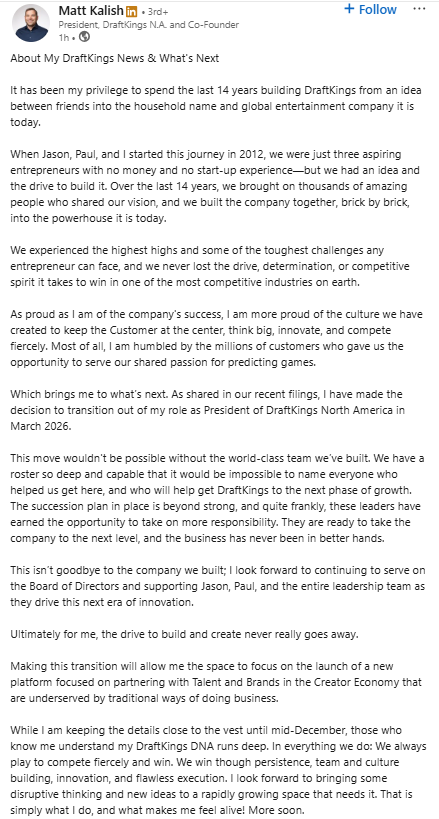
DraftKings co-founder Matt Kalish announced he will step down as president of the company in March of 2026. He also explained that he will be remaining on the sports betting and daily fantasy sports leader’s board of directors.

The decision, described in a filing with the Securities and Exchange Commission, reflects a mutual agreement between Kalish and DraftKings. “Mr. Kalish will transition out of his role as President…effective March 31, 2026. He will also receive director compensation in connection with his continued service on the Board of Directors,” the filing stated.

Kalish, who co-founded DraftKings in 2011 with CEO Jason Robins and Paul Liberman, has served as president during major expansion. Under his leadership, DraftKings became a market leader in daily fantasy sports, online sports wagering, and online casino play. The company also executed strategic acquisitions such as Golden Nugget online gaming and Jackpocket during his tenure.

Kalish reflected on his time with DraftKings in a LinkedIn statement. He highlighted the company’s achievements. He also recognized the team behind those successes.

“It has been my privilege to spend the last 14 years building DraftKings from an idea between friends into the household name and global entertainment company it is today,” he wrote. “As proud as I am of the company’s success, I am more proud of the culture we have created to keep the Customer at the center, think big, innovate, and compete fiercely.”

Kalish described the transition as part of a planned succession, expressing confidence in the company’s leadership.

“The succession plan in place is beyond strong, and quite frankly, these leaders have earned the opportunity to take on more responsibility. They are ready to take the company to the next level, and the business has never been in better hands,” he said.

The move coincides with DraftKings’ recent expansion into prediction markets, a segment that remains legally complex in the United States. Kalish is stepping back from daily operations. He will still provide guidance on product strategy. He will advise on innovation from the board.

Looking ahead, Kalish signaled a focus on entrepreneurial ventures outside DraftKings.

“Making this transition will allow me the space to focus on the launch of a new platform focused on partnering with Talent and Brands in the Creator Economy that are underserved by traditional ways of doing business,” he noted, adding that more details would be revealed in mid-December.

Kalish’s departure as president marks the end of an era for DraftKings, a company he helped transform from a startup into a multi-billion-dollar public enterprise.

Barrett Media produces daily content on the music, news, and sports media industries. To stay updated, sign up for our newsletters and get the latest information delivered straight to your inbox.

TNA Wrestling Announces Multi-Year Rights Agreement With AMC Networks

0

TNA Wrestling is officially on the move. AMC Networks and TNA jointly announced a multi-year rights agreement that will make AMC the exclusive U.S. television home of Thursday Night iMPACT! beginning January 15, 2026. The weekly two-hour flagship show will air live every Thursday from 9–11 p.m. ET and will also be available on AMC+.

The debut episode on AMC will air live from the Curtis Culwell Center in the Dallas-Fort Worth metro area. This marks a significant distribution upgrade for a promotion whose profile has risen sharply.

TNA Wrestling President Carlos Silva said partnering with AMC Networks represents a pivotal next step for the brand’s momentum heading into 2026. He emphasized this new media‑rights deal will expand TNA’s reach and energize its growth.

“We are super excited to bring the in-ring excitement, energy and drama of TNA Wrestling to AMC,” Silva said. “TNA Wrestling heads into 2026 the hottest it has ever been. With intense rivalries and a fan base that loves the TNA stars. We cannot wait to expand the TNA audience with our new partner, AMC Networks.”

Dan McDermott, AMC Networks Chief Content Officer and AMC Studios President, said the company sees alignment with the network’s fan-first programming. He noted the approach fits the promotion’s style. He added this approach matches the promotion’s storytelling style.

“TNA’s impressive growth and success is driven by the stories, characters and non-stop action fans love,” McDermott said. “We put fans at the center of everything we do, and TNA has built its brand and its programming around that same dedication and focus.”

Additionally, TNA will deliver a historic two-night stretch of live events from Albuquerque’s Tingley Coliseum in January airing on AMC.

Founded in 2002 and owned by Anthem Sports & Entertainment, TNA Wrestling has served as a home for some of the industry’s most recognizable names, including Hulk Hogan, Ric Flair, and Sting. Today’s roster features high-profile talents such as Jeff and Matt Hardy, Nic and Ryan Nemeth, TNA World Champion Frankie Kazarian, Mike Santana, Steve Maclin, Eddie Edwards, Moose, Mustafa Ali and Knockouts standout Tessa Blanchard.

The AMC deal comes one year after TNA launched a cross-promotional partnership with WWE and its NXT brand. This allowed talent to appear across both companies’ programming, further elevating the brand’s visibility.

Barrett Media produces daily content on the music, news, and sports media industries. To stay updated, sign up for our newsletters and get the latest information delivered straight to your inbox.
Barstool Sports’ Kevin ‘KFC’ Clancy: Craig Carton Return to WFAN a “Necessary Move”

0

Craig Carton’s expected return to WFAN has generated strong reaction across New York sports media, including from Barstool Sports personality Kevin “KFC” Clancy, who called the move “necessary” for the station while warning that it does not solve WFAN’s long-term challenges.

Carton is reportedly finalizing a deal to reclaim the afternoon drive slot beginning next year, according to The Athletic. It would mark his third stint at the station and his second time leading one of WFAN’s signature franchise positions. The move comes as WFAN seeks to stabilize ratings, reset its lineup, and regain its foothold in an increasingly competitive New York media landscape.

“This was a necessary move for WFAN,” Clancy says. “Now I don’t think this addresses the major issues of WFAN, which is that they are a terrestrial radio station trying to operate in a modern world, and have not pivoted to the digital platforms at all. That’s an entire other problem that needs to be fixed.”

WFAN’s reported restructuring would shift Evan Roberts and Tiki Barber to the 10 a.m. to 2 p.m. slot. The move places them against ESPN New York’s midday show. Chris McMonigle has also emerged as the top internal candidate to join Carton, signaling WFAN’s desire to pair him with a host familiar to loyal listeners.

Carton has remained open about the possibility of returning to WFAN since leaving FS1’s Breakfast Ball, telling Barrett Media in September that he would “certainly answer that phone call” if the station wanted him back. His ongoing podcast venture with FOX Sports and Red Seat Ventures could also factor into any final agreement.

Still, while Clancy praised Carton’s on-air skills and his history at the station, he stressed that WFAN’s long-term success will hinge on its willingness to evolve beyond traditional radio. He said he hopes Carton’s presence will push WFAN to embrace digital audiences more aggressively.

“Would love to see him on YouTube. I would love to see him doing a podcast. I would love to see him doing short-form video,” Clancy said. “That is much better for the long-term success of WFAN, and it’s a station I deeply care about. It was a part of my childhood.”

Carton’s return also carries emotional weight for longtime listeners who followed his rise, fall, and resurgence. Clancy acknowledged the turbulence in Carton’s career. He said hearing Carton back on WFAN would be a win for New York sports fans.

“Congratulations to Craig Carton,” Clancy said. “It’s been a long road and a lot of tumultuous ups and downs, and the fact that he’s going to be back where he belongs is a win not only for him, but all sports radio fans in New York.”

WFAN has not commented publicly on the reported changes.

Barrett Media produces daily content on the music, news, and sports media industries. To stay updated, sign up for our newsletters and get the latest information delivered straight to your inbox.