Home Blog Page 744

Three Keys For Success for Barstool Sports on FS1

1

Next week, Barstool Sports will officially launch their new FS1 daily morning show. The program will originate from their Chicago offices, airing in a two-hour block from 8 a.m. to 10 a.m., with a replay of the program airing from 10 a.m. to noon, leading into The Herd with Colin Cowherd.

The program will be Barstool Sports’ second attempt at daily programming partnering with a broadcast network. Barstool Sports founder Dave Portnoy didn’t hold back last month in sharing how much he regretted the first attempt with ESPN. In an interview with Fox News, Portnoy said he “never liked ESPN” and should have never done a deal with them. Remember, hindsight is 20/20.

With the program launching next Tuesday, no official details of the show and its makeup have been released. While many questions remain, here are three suggestions that would make Barstool Sports destination programming on FS1.

Be Different and Stand Out

Assuming there is a clean slate where no idea is a bad idea, the first suggestion is: don’t be what you already are.

Barstool Sports currently produces several daily shows and weekly podcasts that draw the eyeballs of the Barstool Sports digital viewer. When considering the type of content to bring to the FS1 program, it must differ from what is presented already online.

The first factor to consider is time. FS1’s program will have commercial breaks. Nothing on broadcast television is commercial-free. Sorry Barstool. This will require more planning, coaching, and execution from talent on hitting the points needed to make the television memorable.

The FS1 show cannot be The Yak, Pardon My Take, or even Mostly Sports. There can’t be hour-long interviews or random conversations with “inside baseball” references. The format demands being unique to the platform on which it’s being distributed.

With the constraints of an ad-supported program, the biggest key is to have a definitive host or set of hosts. A rotation of talent tasked to lead the show will cause the audience to fragment, affecting which talent they enjoy watching and choose to follow.

Structure and consistency of the host is vital to the success of the FS1 program. The less put-together it feels, the less likely it will succeed, especially for a television audience where some may not know the Barstool Sports product.

Shaking Hands With FOX Sports

The second suggestion is to lean into the assets the partnership with FOX Sports allows. FOX Sports has ties to the NFL, MLB, college football, and NASCAR. Utilize the assets presented to enhance the program, from highlights to a roster-load of talent. Colin Cowherd has done exceptionally well with this over his time with FOX Sports; there’s no reason why Barstool Sports cannot.

Leaning on the stars of the network and creating buzz around them allows them to use it in their work for the network. Greg Olsen should be a regular, and so should Tom Brady. Find elements during the football season where both commentators can reference elements of the show in their broadcasts on the big network. FOX Sports said the Barstool Sports FS1 show is produced by Barstool, so lean into that creative control, bringing out the personality of the FOX Sports talent roster.

If the goal of this FOX Sports/Barstool Sports partnership is to connect a new generation of sports fans to the FOX Sports product, it must connect with the personalities of the FOX Sports product too.

Don’t Lose What Makes You Barstool Sports

The third suggestion for the new FS1 Barstool Sports morning show is to be authentic. The one element that Barstool has done a great job of since its inception is connecting with a younger audience. Younger audiences don’t watch cable. Younger audiences don’t have filters. If former Barstool Sports personality Pat McAfee has shown anything during his time with ESPN, it’s to remain authentic.

There must be a free stream of the new program living on the Barstool Sports YouTube platform and streamed live on their social channels. You can’t bet on the Barstool audience to go find FS1 on their cable plan or the new FOX One direct-to-consumer platform. The more places you can put the program live, the better for promotion and reach. If it’s only broadcast to FS1, a massive opportunity is missed.

Being authentic also means being yourself. Barstool Sports is not made of clean-shaven professional commentators who wear suits and don’t use profanity. Their vibe is fun, loose, and sometimes profane, with hoodies and sneaker culture always represented. There should be no censorship by the FOX Sports brass; embrace the bold nature of the ‘FOX way’ of doing things. Freedom of expression should always be allowed and encouraged, because it wouldn’t be Barstool if it were any different.

Authentic also means active. Barstool Sports has one of the more active and engaging social media teams in all of sports media. FOX Sports should lean into this and embrace the fun of the new program, even if it’s not theirs to produce. Clips, reels, and interactive, social media–driven content should be an absolute must for the new program. If it wasn’t, it wouldn’t be Barstool.

With the partnership, FOX Sports is attempting again to cut into the attention economy of morning sports programming. With changing habits in how people consume content daily, shifting more to digital, it’s a smart play to embrace Barstool Sports, who already dominates the digital sports content space.

If the FS1 program is destined to be a success, it must play by a different set of rules. It must adapt to the changing landscape while also keeping its authentic Barstool Sports feel.

Could this be just the next example of how networks and creators can coexist in harmony? If so, the slogan should read: “Every day is for the boys.”

Barrett Media produces daily content on the music, news, and sports media industries. To stay updated, sign up for our newsletters and get the latest information delivered straight to your inbox.

How Abby Phillip Handled Jillian Michaels Should Be a Model for Cable News Hosts

0

CNN’s Abby Phillip recently found herself in the middle of a controversy involving fitness personality Jillian Michaels, and the way she handled it should serve as a blueprint for how cable news hosts treat guests who bring opposing viewpoints to their shows.

When Michaels made headlines for comments that sparked a backlash, Phillip responded not with insults or by fueling the fire, but with a measured, thoughtful approach that showed the value of professionalism on television.

“I don’t like to talk negatively about guests who come on the show, because I just don’t think that’s good for them,” Phillip explained. “Even when I disagree with people, I respect their right to embarrass themselves on national television. I think it is their right to do that. But I don’t want to disparage people, even when they disparage me — to be quite frank — online.”

That quote should be plastered on newsroom walls, used in journalism classrooms, and reinforced in production meetings across cable news. It perfectly summarizes how a host can balance civility with accountability while recognizing that disagreements are not something to fear.

Too often, hosts today view disagreements as an opportunity to score viral clips rather than engage in actual conversation. Phillip’s approach illustrates that a sharp host doesn’t have to scream down a guest or land a knockout punch. The host simply needs to provide a forum for discussion while allowing the audience to judge credibility for themselves.

There’s a crucial distinction here: being respectful of people you disagree with does not mean letting inaccuracies or damaging narratives go unchecked. A cable news host should not allow someone to dismiss or distort horrific events in this country, or to peddle ideas that diminish the suffering of others. But that responsibility does not mean devolving into personal attacks or creating a hostile environment where no one with a contrary opinion is willing to appear.

Abby Phillip’s handling of Jillian Michaels’ threads that needle beautifully. She gave Michaels room to share her perspective, regardless of how much it might have frustrated her, while maintaining the standards of accuracy and decency that her platform demands. That kind of balance is missing from too much of cable news, where debates often devolve into shouting matches and genuine engagement is replaced with cheap theatrics.

The reality is that no guest wants to walk into a lion’s den where they’ll be mocked or ridiculed simply for showing up. It’s clear Michaels believes she walked into a similar space, since arguing that Abby Phillip and CNN have lied about the encounter, and arguing that she wasn’t attempting to diminish slavery in the United States…in spite of — in my view — very clearly attempting to diminish slavery in this country.

While tough questioning is absolutely part of the job, creating an environment where disagreement is allowed to play out without the host’s ego taking center stage is far more valuable. Phillip recognized that people are smart enough to hear a questionable comment and draw their own conclusions, especially if the host challenges falsehoods in real time.

Cable news could use a lot more of that philosophy. There’s no shortage of airtime given to hosts who enjoy berating guests, but those moments don’t advance understanding, and they don’t bring anyone closer to the truth. They serve the host’s brand more than the viewer’s interest. What Phillip did with Jillian Michaels is the exact opposite — she preserved the integrity of the show without making herself the story.

And in today’s media landscape, that might be the most important lesson of all. Because when hosts make themselves the focal point, every disagreement becomes personal and every interview becomes a performance. But when the emphasis is on the exchange of ideas, and when the audience is trusted to think critically about what they’re hearing, everyone walks away better informed.

Phillip’s words about respecting a guest’s “right to embarrass themselves on national television” are as sharp as they are true. That kind of restraint takes discipline, and it reflects a genuine understanding of what a host’s role should be: not to humiliate, not to belittle, but to moderate. The responsibility is to make sure the facts are clear and that the conversation doesn’t stray into territory that minimizes real pain or historical truth. Beyond that, letting a guest sink or swim is not only fair — it’s effective.

In the end, the exchange between Abby Phillip with Jillian Michaels is an example of how cable news hosts can better serve their audiences. Respect does not mean silence in the face of inaccuracies, but it also doesn’t require demeaning the people sitting across from you.

If more hosts adopted that mindset, the national conversation might not feel like a series of endless shouting matches. Instead, it could look a little more like what Phillip modeled: civil, pointed, and ultimately in service of the viewers.

Barrett Media produces daily content on the music, news, and sports media industries. To stay updated, sign up for our newsletters and get the latest information delivered straight to your inbox.

Hooks That Work: Keeping Classic Rock Fans Tuned In

0

In last week’s column, I spoke with Matthew Wilkening, Editor in Chief of the website Ultimate Classic Rock. He pointed out that getting attention from an audience today is harder than ever.

“You used to be able to just have a headline such as ‘30 Years Ago: This Band Puts Out This Album’ and it would do great. But now if you don’t have an angle in the story, you’re dead in the water,” says Wilkening.

While I think this is true for any format, it hits exceptionally hard for hosts on Classic Rock stations who often must find ways to tell and retell stories about artists, songs and albums that came out many years ago.

Now, maybe there is such a thing as fate. At almost the same time I was putting the finishing touches on the interview, I came across an article on the Buffer Blog under the subheading of Content Creation titled “The Anatomy of a Great Hook: How to Grab (and Keep) Attention in 2025.” Coincidence? Yes. Opportunity? Definitely.

In this piece, writer Tamilore Oladipo covers a lot of territory and talks a fair amount about the different types of hooks that work best on social media platforms. She details ways to get people to stop scrolling and pay attention.

Tamilore Oladipo Photo Linkedin

And since many, if not all, of you are enhancing your on-air show with social content, I recommend reading her entire post. But for the sake of this article, I’m going to focus on her observations that relate to being on the air.

Defining A Hook

She starts by defining a “hook” as the opening part of a piece of content that is the ticket to gaining the first few seconds of attention. She’s clear that this is not clickbait where you are tricking the listener. The goal is to set up the value that will be delivered in the content. And while a great hook isn’t a guarantee that people will pay attention. A bad hook, or none, in nearly every case leads to failure.

According to Oladipo, a successful hook sparks something in the listener. Curiosity, recognition, tension, or any other emotion that makes them think, “I need to see where this goes.” Interestingly, this mirrors what I tell talent about the process of selecting show content.

If the stories and topics you are selecting to talk about don’t cause a reaction in you, they probably won’t in your audience either. Once you have good content, the challenge is to quickly convey that emotional reaction to the audience to help them engage with you.

Hooks vs. Teases

In our on-air world, a good hook can serve two different roles. It can be a teaser, purposely designed to try to convince a listener to come back to the station later. Or it can be the way you start a break to hold listeners in the moment. Both are valuable, and both are frequently done poorly.

When it comes to teasing, too often I hear talent say things that are worthless to the listener. Things like: “AC/DC is coming up.” Oh really? On a Classic Rock station? I’m shocked. Another is “your chance to win coming up soon.” Great. Don’t tell me when. Sure, I’m busy here with work, but I’ll just hang on your every word, waiting for my opportunity.

When it comes to content, the mistake I often hear is when hosts fall into the trap of using a standard structure to convey a story. They start at the beginning, explaining the background and giving out details while slowly proceeding to the heart of their story and then the climax.

Unfortunately, what we’ve seen in PPM data and many forms of research is that many listeners tune out before the big payoff of the story. Like Wilkening pointed out, content today needs to start with an attention-getting hook. Then, once you have them, it’s OK to start filling in background details.

What Does Work

Having an effective hook really comes down to psychology. Oladipo recounts several emotions you can tap into to try and grab the listener’s fleeting attention:  

Curiosity: the most obvious option. Around their curiosity, and the listener will stay with you.

Fear of missing out (FOMO): if you have information they can’t miss, they will stick around.

Relief of missing out (ROMO): There is simply too much to do, watch, listen to or consume. Hook a listener by helping them know what they don’t need to bother with.

Identity: Appealing to a specific group that the listeners may be part of. Classic Rock fans, parents, and beer drinkers, you are likely to hold them over.

Social Proof: Everyone wants to feel like other people agree with them. Tease them with the idea that you are about to offer proof of something that matches their convictions, and they will want to hear it.

It All Comes Back to Prep

At the end of her post, Oladipo suggests that content creators looking to have a great hook for their content should ask themselves two questions, which I will paraphrase for on-air:

  1. Would you stay tuned to listen to this?
  2. Would you feel satisfied after you heard it?

She says if the answer to either question is no, rework your hook to make it more effective. Of course, that means taking the time before you hit the studio to plan out your content. Because, in all content creation, even if it’s a story about a song that’s forty-five years old, it always comes back to preparation.

Barrett Media produces daily content on the music, news, and sports media industries. To stay updated, sign up for our newsletters and get the latest information delivered straight to your inbox.

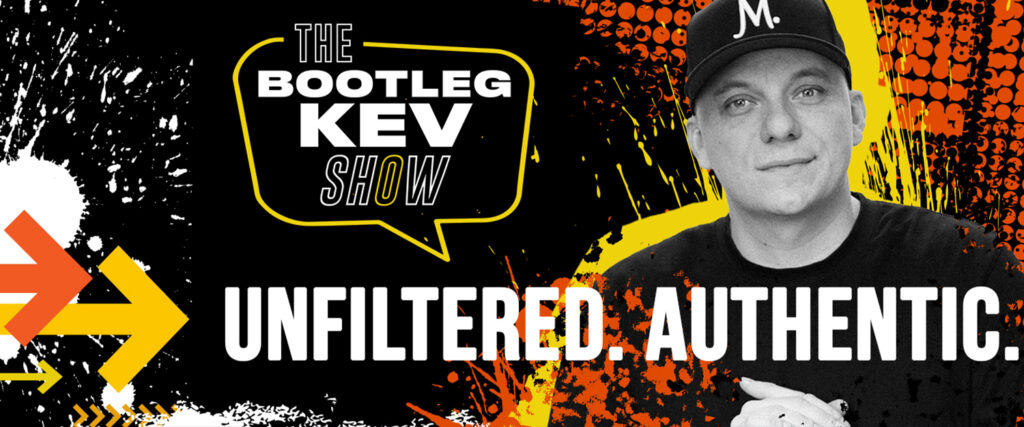
Bootleg Kev’s Journey: Swap Meets to the Mic

0

Bootleg Kev didn’t start his career in a flashy studio or under the bright lights of a major city radio station. He started in high school, hustling bootleg CDs, clothes, and DVDs at the swap meet in Phoenix, while working at a high school radio station.

Today, he’s nationally syndicated by Premiere Networks, and has a thriving podcast, YouTube channel, nightclub, record label and more. But the journey wasn’t simple.

The Origin of “Bootleg Kev”

“I started selling essentially bootleg CDs, bootleg clothes, fake sneakers, DVDs, all that,” Kev recalls. “I would sell at the swap meet in Phoenix. This was all while doing a radio show at my high school station at EVIT in Mesa, Arizona.”

After graduation, he landed an internship at (Power 98.3) KKFR, selling bootleg DVDs to radio personalities.

“Then, JoeyBoy, I started helping on the morning show as their intern. Joey just started calling me Bootleg Kev. That kind of stuck, and eventually it became my on-air name. Karlie Hustle, the APD at the time, started putting me on overnights to board op. Then I finally got a shift, and I just went by that name. That was mid-2006, and by late summer I was behind the mic for the first time.”

Networking: The Key to Syndication

It’s one thing to have talent, but Kev credits his rise to relentless networking.

“I was doing nights in Los Angeles and had this idea that I wanted to do a syndicated show. When COVID hit, my deal was up, and iHeart offered me a deal in April 2020. I signed, because the world was in an unsure place.”

“Six months later, I got a severance and was let go. That gave me a safety net to launch the syndicated show I’d been dreaming about.”

Kev immediately reached out to Tim Richards, a mentor who connected him to United Stations.

“I was confident I could get five stations immediately to launch with. Those five stations were all relationships I had built over the years. We launched and are now in over 100 markets. Networking was imperative.”

From Board Operator to Interviews with Legends

Despite his success, Kev admits it sometimes takes effort to recognize his achievements.

“I got to a point where I stopped taking in those moments. Recently, I had an interview with Snoop, and I had to pause and realize, ‘Damn, I’m living my dream times a thousand.’ My dream initially was just to get a salary at a radio station to talk. Now, podcasts, YouTube, and syndicated shows. It’s all doing well. I feel like I’m playing with house money.”

Balancing Multiple Ventures

Bootleg Kev isn’t just a radio host. He’s a partner in a Scottsdale nightclub, manages a record label, runs a podcast, and has a presence on YouTube. How does he manage it all?

“It comes down to having a good team. Every facet has a team attached. For the nightclub, my partners are superstars. On the radio show, my producer, DJ Sam I Am and co-host James Andre Jefferson Jr. run the day-to-day.”

“On the podcast, my producer handles edits. You can’t scale something at the highest level by yourself. You have to trust people and be willing to share the pie. I didn’t make money off my radio show for a year and a half because I was paying my team. I saw the light at the end of the tunnel, and I want my guys making money. It’s a long play.”

The Power of Industry Events

Kev credits events like Morning Show Bootcamp for keeping him inspired.

“This was my second year there and my first panel. It’s cool to see not just legends like Mojo or JoeyBoy, but younger talent still hungry and passionate. We don’t hear about those people as much because we live in an influencer, YouTuber age. But it’s important to network, learn, and be part of the community.”

He recalls watching Bobby Bones spend hours talking to attendees after a panel.

“I wanted to make sure that if anybody wanted to talk to me, I’d be around. It’s dope to meet people from different markets, morning shows, afternoon shows, even local personalities.”

Vulnerability Behind the Mic

Despite his public persona, Kev admits there were moments when he feared his career was over.

“There were three or four times in my career where I thought I wasn’t going to get another job. I was super scared. I even looked at jobs outside radio. Trying to figure out if I could survive DJing in clubs. But I stayed down, fought through, and here I am. That’s something I haven’t really shared before.”

Gratitude and Shout-Outs

Kev ends with gratitude for the people who supported him.

“Shout out to Tim Richards, DJ Ayo from iHeart, Doc Wynter, Martin from Premiere, Mikey Fuentes, Bruce St. James, JoeyBoy, Orlando Davis, my team, DJ Sam I Am and James Andre Jefferson Jr.”

“I don’t take for granted the affiliates who put the show on. I’m super appreciative.”

Barrett Media produces daily content on the music, news, and sports media industries. To stay updated, sign up for our newsletters and get the latest information delivered straight to your inbox.

Why One Analyst Believes the Nexstar/TEGNA Merger May Face Stiff Legal Challenges

0

If everything goes correctly, Nexstar Media Group will complete its $6.2 billion acquisition of TEGNA in the second half of 2026.

If everything goes correctly.

When the deal between the local broadcasting giants was announced last week, one of the main selling points from Nexstar was that it would have 265 TV stations in 44 states and the District of Columbia. It would also then feature outlets in 132 of the country’s 210 markets.

During a call with Wall Street analysts, Nexstar Media Group CEO Perry Sook said that the move would strength the company against “Big Tech.”

“We don’t think anyone wants their news delivered by a chatbot, and that’s where we’re headed if we can’t become a bigger company, a stronger company to attempt to compete with Big Tech, at least on a level playing field in the United States,” said Sook.

He added that he wasn’t overly concerned with the deal passing through regulators.

“We feel very, very positive about moving forward with the regulatory approval process,” Sook said. “We expect that all of those processes will move forward during the pendency of the transaction, so we feel very confident, as I said earlier, we’re meeting this regulator moment where it is, and we will work together with regulators as they consider modifying and repealing outdated rules and regulations.”

However, one rival company — Newsmax — has already shared its displeasure with the deal. Its CEO — Chris Ruddy — said in a filing with the FCC that the proposed deal should be doomed from the get-go because the commission “lacks authority and a compelling reason to change” current ownership rules.

Currently, the FCC’s national television multiple ownership rule limits a single entity from owning or controlling TV stations that reach more than 39% of all U.S. households. Nexstar Media Group had previously been granted a waiver for its ownership stakes, with many expecting that those regulations would be relaxed or removed completely under the Trump administration.

Tom Basile — a Newsmax host who previously worked as Executive Director of the Republican Party in New York state — believes that the limits which were put in place under the Reagan administration are still needed today.

“(Reagan) had a good reason for — way back then — being concerned about viewpoint diversity in America,” said Basile. “And how individual or corporate interests — or special interests — could create monopolies that weren’t just about business, but about monopolies over the dialogue that is so critical to our form of government. So that’s why the caps were originally established.

“We need to look at this in the context of what is best for the free exchange of ideas in this country,” continued Basile. “The guardrails were put in place for very legitimate reasons, and even though, yes, we’ve seen an expansion and a democratization of our media, the concerns about a few corporations or individuals of interest having a monopoly over broadcast television are still very valid today.”

Some prominent figures in conservative political and media circles have argued for the removal of the ownership caps. Many believe that FCC Chairman Brendan Carr feels similarly, with the strong belief in the industry being that the ownership caps will indeed eventually be removed.

But Basile says he has yet to hear a compelling argument for why so many conservatives believe that way.

“I would love to hear a strong defense from Brendan Carr, or any other so-called Republican or conservative who should rightly be concerned about viewpoint discrimination in this country,” said Basile. “I’d love to hear a defense of why they believe that one or two companies or two individuals should have the ability to own every television station in the United States. And I haven’t really quite heard that yet.”

Basile said the opposition to the Nexstar Media Group/TEGNA merger is largely reliant on conservatives “making their opinions known” to President Donald Trump and his administration.

He added that a legal challenge isn’t out of the realm of possibility, and could be even viewed as more likely than not to take place.

“There may also be a legal challenge to (whether or not) the FCC actually has the ability to provide a waiver that would be such an extreme departure from the law,” he said.

“Look, at no point for the last 100-plus years, have we considered monopolies to be a good thing,” Basile continued. “This country thrives on innovation for competition. And ultimately, that 80% becomes 90%. Well, then, who’s to say that one company then doesn’t own every single broadcast station in the United States? How is that innovative? How is that increasing competition? And how does that also protect viewpoints that perhaps the management of that company disagrees with? I think that there are very strong arguments to be made that this ultimately cuts against a free expression of ideas.”

In addition to hundreds of broadcast television stations, Nexstar Media Group is also the owner of NewsNation, a cable news network that competes with Newsmax.

Barrett Media produces daily content on the music, news, and sports media industries. To stay updated, sign up for our newsletters and get the latest information delivered straight to your inbox.
Why News/Talk Radio Can’t Avoid the Real ‘Bread and Butter’ Issues

0

Remember the price of eggs? Remember how it dominated the news late in 2024? Remember how it became the standard for determining inflation’s effect on consumers, so much so that it became a critical issue — especially on news/talk radio — in the presidential campaign? Remember all of that?

Eggs cost a little less these days, but the rest of your grocery bill has skyrocketed. At least, it has around here, where everything at the already-expensive Publix seems to be even more pricey. (Even Aldi and Walmart prices seem to have risen to the point where hard choices have to be made.) Gas is down, but food is way up, other consumer goods are up, the cost of living is rising, and it’ll get worse before it gets better (coughTariffscough).

Why isn’t that worth the same attention from the news media that eggs got when avian flu led to shortages? Why isn’t talk radio talking about the ultimate bread-and-butter issue, namely the cost of bread and butter?

Okay, there’s a lot going on. Much of it is intended to deflect attention from the Epstein Files, but you’re capable of covering more than one topic in one show or in one publication or social media account. It’s strange, however, that we, collectively, just abandon stories at random.

Or is it random? It makes me wonder who or what determines the agenda for the news media. Political parties and campaigns have always influenced what talkers talk about and what reporters report about, but they didn’t outright direct the coverage.

Now, they’ve found the secret: keep throwing shiny objects out there and everyone will follow. The increasing cost of living, an eye-level topic that affects everyone but the 1%, is yesterday’s news already? Guess so, because we’re about fifty scandals ahead of that now. The one topic that seems to be impervious to the pace of changing the subject is the Epstein Files. This is where a good assignment editor or producer comes in handy. I hope you have one.

There’s so much more to talk about. How about the state of health care, from the slashing of Medicaid and closing of rural hospitals to the quality of care and impossibility of getting an appointment within a month or two? 

How about the miserable state of public transportation in many cities, with no money to fix the problems and traffic on the (deteriorating) roads getting intolerable? How about schools and local governments being pressured into whitewashing their curricula? Or how about the job market, which in reality is far worse than the numbers the feds release, especially for experienced white-collar workers who just aren’t going to work on an assembly line for a pittance?

None of that is more important than Cracker Barrel changing a logo most people didn’t even notice? What are we doing here?

Don’t let the whirlwind pace of “news” distract you from the topics directly affecting your audience. What’s being pushed as news today will be forgotten tomorrow, just like eggs. You have the time and capability to handle more than one topic. There’s room for reporting on the cost of living AND the Epstein Files. Do that.

Barrett Media produces daily content on the music, news, and sports media industries. To stay updated, sign up for our newsletters and get the latest information delivered straight to your inbox.

T-Bob Hebert To Play “Big Part” With Barstool Sports FS1 Morning Show

0

Barstool Sports is gearing up for one of its most ambitious media moves yet, and former LSU offensive lineman turned broadcaster T-Bob Hebert says he’ll be front and center. During a recent appearance on Stupodity with Stugotz, Hebert confirmed he will be a “very big part” of Barstool’s upcoming daily morning show on FS1, which debuts September 2 out of the company’s Chicago headquarters.

“I can’t reveal too much yet, but I’m very excited,” Hebert said. “It’s going to be FS1 Barstool. It’s out of Chicago HQ. We’re building the studios right now.”

Hebert confirmed his role with the new FS1 program to Barrett Media will not be every day, but most days. More details will be announced on the program at a later date.

For Hebert, the move represents a dramatic career shift. After more than a decade in Louisiana sports radio, the Baton Rouge native said the transition to Barstool and a national television platform feels like stepping into another world.

“I’ve was doing local radio for 13 years now. I broked in at 23, and I’m now 36,” he explained. “I was completely content. I was very happy. I loved my life in Baton Rouge. I thought I’d be living there the rest of my life.”

But when the call came, Hebert compared it to Harry Potter receiving his letter to Hogwarts. The chance to relocate to Chicago, join Barstool’s growing national footprint, and become part of a high-profile FS1 morning show was simply too big to turn down.

“Now all of a sudden we’re living here in Chicago. I’m taking the train into work like a city man,” Hebert joked. “It’s just a whirlwind. Then it comes with this opportunity to be on FS1. It’s real pinch-myself stuff.”

Hebert has long been known as one of the most charismatic and unique voices in Southern sports talk. After his playing career at LSU, he built a loyal following through his work on Baton Rouge radio, delivering high-energy commentary and an everyman approach to SEC football.

Barstool’s partnership with FS1 marks another significant moment in the evolving relationship between digital-first sports outlets and traditional television networks. As for Hebert, he’s just eager to get rolling.

“It feels like a fantasy life right now,” he said. “I’m just very excited.”

Barrett Media produces daily content on the music, news, and sports media industries. To stay updated, sign up for our newsletters and get the latest information delivered straight to your inbox.

Zach Gelb Adds NFL Gameday Duties With Compass Media Networks

0

Zach Gelb is adding a new line to his already busy football season schedule. The Infinity Sports Network host announced he will join Compass Media Networks this fall as a studio host for Dallas Cowboys and some NFL Sunday broadcasts.

Gelb shared the news on social media, noting he will handle pregame, halftime, and postgame responsibilities for six total games during the 2025 NFL season. Four of those will be part of Compass Media Networks’ Dallas Cowboys coverage, while the other two will be select NFL games.

His debut is set for September 21 when the Cowboys face the Chicago Bears.

“Thrilled to join the Compass Media Networks team as a Dallas Cowboys and NFL Sundays studio host,” Gelb wrote. “This is a new and exciting opportunity.”

At the same time, Gelb stressed that his new role will not affect his daily hosting duties on the Infinity Sports Network. He will continue anchoring The Zach Gelb Show weekdays from 3 to 6 p.m., while also returning for another season of Sunday Morning Football from 10 a.m. to noon starting September 7.

The addition to Gelb’s resume comes as Compass continues to bolster its live sports programming portfolio. The network has been a consistent rights holder for NFL broadcasts, including a longstanding partnership with the Dallas Cowboys and Las Vegas Raiders. Studio coverage serves as a key connection point for listeners, and Gelb’s national radio presence gives him a familiar voice to guide fans through gameday.

Gelb has steadily built a national profile since joining CBS Sports Radio in 2018, a brand that was rebranded as Infinity Sports Network. He previously hosted the Fanatic Postgame Show on 97.5 The Fanatic in Philadelphia from 2017-2018. Gelb also hosted weekend overnights for CBS Sports Radio from 2018-2019 and also hosted on Mad Dog Sports Radio and SiriusXM NFL Radio.

With football season approaching, Gelb’s expanded presence ensures fans will hear plenty from him whether they are tuning in to Infinity Sports Network or catching a Cowboys broadcast on Compass Media Networks.

Barrett Media produces daily content on the music, news, and sports media industries. To stay updated, sign up for our newsletters and get the latest information delivered straight to your inbox.

Benztown Offers Free Labor Day AudioPack, Hot Mix Special

0

Benztown has rolled out a free programming package for radio stations ahead of the Labor Day weekend, offering both imaging tools and a long-form music special.

The company’s Labor Day Weekend AudioPack includes 20 downloadable elements such as sound effects, music beds, and themed liners. Designed to enhance on-air holiday content, the package features clips like BBQ sizzles, pool splashes, crowd noise, and listener drops.

Also available is the “Hot Mix” Holiday Special, a four-hour, fully produced music program that covers a range of formats. The mix show features hits from major artists including Post Malone, Dua Lipa, Taylor Swift, and Drake, with versions tailored for Top 40, Classic Hits, Rhythmic, Crossover, and 2000s-to-Today playlists. Benztown notes that “Hot Mix” is the longest-running mix show in the U.S.

Both the AudioPack and the “Hot Mix” special are offered at no cost and can be accessed via Benztown’s website through September 1.

Barrett Media produces daily content on the music, news, and sports media industries. To stay updated, sign up for our newsletters and get the latest information delivered straight to your inbox.

CNN’s Abby Phillip After Jillian Michaels Controversy: ‘I Don’t Like to Talk Negatively About Guests’

0

Fitness influencer and podcast host Jillian Michaels caused a controversy on CNN NewsNight with Abby Phillip last week by appearing to downplay slavery in the United States. Phillip has now shared why she hasn’t joined a chorus of those criticizing the appearance.

While discussing the matter with Pivot host Kara Swisher, Abby Phillip said it’s not her nature to denigrate those who take the time to come on her primetime program.

“I don’t like to talk negatively about guests who come on the show, because I just don’t think that’s good for them,” she shared. “Even when I disagree with people, I respect their right to embarrass themselves on national television. I think it is their right to do that. But I don’t want to disparage people, even when they disparage me — to be quite frank — online.”

Despite her insistence that she doesn’t like to talk negatively about guests, Phillip called Michaels’ argument — which defended President Trump’s determination that exhibits at the Smithsonian were biased against Americans when it came to slavery — “nonsensical”, “ridiculous”, and “ignorant”, among other adjectives.

“It’s embarrassing, more for her than anything else,” said Phillip, who noted that Jillian Michaels admitted she was given talking points for the appearance from the White House.

In the appearance on CNN, Michaels said that slavery had been going on for thousands of years and wasn’t a strictly American issue. She also claimed that less than 2% of Americans owned slaves before the practice was outlawed at the conclusion of the Civil War. However, where the practice was legal, more than a quarter of all households actually owned slaves.

In response to the comments from Abby Phillip, Michaels says she was misunderstood and that she was taken out of context.

“There was no moment where I defended slavery,” Michaels said on her podcast. “I would never. I just said it’s evil, but you can’t lay it all at the feet of one race. There was no moment where I tried to litigate who benefited from slavery in America, and I said, specifically, this has been going on for thousands of years.”

Barrett Media produces daily content on the music, news, and sports media industries. To stay updated, sign up for our newsletters and get the latest information delivered straight to your inbox.