Yahoo Sports announced that it has agreed to a content partnership with Boardroom that will delve into the business of sports and entertainment. This new deal will include two major initiatives that will launch later this year, the first of which is a multiplatform video series co-produced by both entities. Rich Kleiman, the co-founder and chief executive officer of Boardroom and business partner of Phoenix Suns forward Kevin Durant, will be hosting the Network with Rich Kleiman series.
This project will feature in-depth conversations with prominent figures in the world of sports focused on business ventures and individual penchants. The program marks the 12th original show Yahoo Sports has launched since the beginning of 2024 and will record from the company’s studios in New York City. A premiere date for the show will be announced later in the spring.
“As Boardroom continues to grow, we’re grateful to partner with a like-minded brand like Yahoo Sports and bring our athlete and executive interviews to their extensive audience,” Kleiman said in a statement. “We’re looking forward to bringing Network to life and to shining a light on stories at the intersection of sports and culture.”
Yahoo Sports will also be revealing a dedicated hub on its website that will include clips and full episodes from Network with Rich Kleiman. On top of that, the section of the website will also include original reporting and features emanating from Boardroom when it officially launches later in the year. The companies formally announced the deal at the Yahoo Sports NewFront event in New York City on Tuesday night.
“We are thrilled to team up with Boardroom and launch a new online destination and video series that help fans go deeper into the business and culture shaping the sports world,” Ryan Spoon, president of Yahoo Sports, said in a statement. “There is immense interest and appetite in off-field and off-court news, perspective, and trends. Boardroom excels in these areas with smart, entertaining content and we are excited to collaborate together on coverage that goes beyond the box score.”
The partnership between Yahoo Sports and Boardroom aligns with the introduction of the cllct hub this past March, an enterprise that focuses its content on the Yahoo Sports website within the sports collectibles business. This arrangement also includes partnerships with Sports Card Investor and Mantel for additional coverage.
Last year, Yahoo Sports started working with The Athletic to create a hub dedicated to women’s sports coverage that enables both outlets to monetize. Furthermore, the company partnered with OneFootball for soccer coverage, Motorsport Network for racing, Ariel Helwani and Uncrowned for combat sports and The Hockey News surrounding hockey coverage.
Barrett Media produces daily content on the music, news, and sports media industries. To stay updated, sign up for our newsletters and get the latest information delivered straight to your inbox.
It’s been called the podcast era, where so-called influencers rule the digital landscape. Television has been dismissed as part of the dinosaur media. Not so fast. When President Donald Trump wanted to extol his record after the first 100 days, he turned to the likes of ABC News’ Terry Moran, NBC News’ Kristen Welker, and NewsNation’s Chris Cuomo, who put together a town hall for the president. Even former Fox host Bill O’Reilly, along with sports mega-commentator Stephen A. Smith, got in on that one.
Turns out all of those obituaries about television news may be a bit premature.
By making the television rounds, Trump reached millions and millions of viewers across the ideological spectrum, not just playing to his conservative supporters.
Cuomo saw 750,000 viewers, about triple the usual amount of his prime-time show. Moran, 65, who is a senior national correspondent and anchor for ABC News’ streaming service, pulled in four million viewers.
Kristen Welker, who began hosting Meet the Press in 2023, drew three million viewers and 2.2 million viewers on YouTube. It was the highest-rated show of her tenure. Plus, clips were replayed by other networks, and elsewhere across the web.
Donald Trump, who got his TV start on a reality show, knew full well that everybody and his brother would be doing coverage of his first 100 days. So, it was a shrewd move to get into the television mix with such frequency, and make sure his views were represented by the person he trusts to do that the most: himself.
And he knew television would have the greatest impact. It enabled him to play defense against criticism over his trade war, immigration policies, and sinking poll numbers. This was a smart maneuver, which also extends to his constant availability to reporters in the Oval Office and elsewhere, where he routinely battles even hostile journalists.
Moran’s exclusive interview on the actual 100-day mark turned into a showcase for the president’s combative style. Moran dismissed Trump’s claim that a wrongly deported illegal immigrant, Kilmar Abrego Garcia, had tattoos on his fingers of the initials of the gang MS-13, saying it had been photoshopped. Trump punched back.
Trump: “Wait a minute. Hey, Terry. Terry. Terry. Don’t do that.”
Moran: “He did not have the letters ‘MS-13.’
Trump: “It says ‘MS-13.’”
Moran: “That was photoshopped.”
Trump: “That was photoshopped? Terry, you can’t do that. They’ve given you the big break of a lifetime. You know, you’re doing the interview. I picked you because, frankly, I had never heard of you, but that’s okay. But I picked you, Terry, but you’re not being very nice.”
The president’s condescension is a hallmark technique he often employs when he is unhappy with a question. And that inevitably makes news. It’s unfair to the reporter — there’s a widespread consensus that the finger tattoos were digitally inserted — and Moran, who co-anchored Nightline for eight years, was right to stand his ground. When a journalist is up against the president of the United States, however, it’s inherently a mismatch. Trump is the leader of the free world, and Moran is, well, some TV guy.
But Trump didn’t let up.
When Terry Moran tried to ask whether the president had “100 percent confidence” in Defense Secretary Pete Hegseth, Trump said, “Ok, anything, do I have a hundred percent? It’s a stupid question.”
Moran said, “It’s a pretty important position.”
Trump shot back, “I don’t 100% have confidence that we’re gonna finish this interview.”
That kind of language pleases the MAGA base while, fairly or not, the insult makes the interviewer look less than intelligent.
Welker, whose interview was done at Mar-a-Lago, complete with a walk and talk around the glittering property, lacked any dramatic confrontations. But, Donald Trump did definitively rule out seeking a third term, and she pressed him on immigration, tariffs, and foreign policy. Most headlines quoted Trump as saying about upholding the Constitution: “I don’t know.” This was blatantly unfair because in the next breath, he said his lawyers “are going to obviously follow what the Supreme Court said.”
Trump’s mastery of the media is in sharp contrast to the determined avoidance of the press by former President Joe Biden, who even turned down the traditionally soft Super Bowl interview. Now we know his mental decline prompted his staff to wall him off from media questioning.
It’s true that many television audiences are shrinking and getting older, and that the technology dates to the early 1950s, but it’s a mass medium designed for mass consumption. Television news has plenty of flaws, and so do journalists, but it still has more impact than all but a few podcasters.
Especially in the hands of a president.
Barrett Media produces daily content on the music, news, and sports media industries. To stay updated, sign up for our newsletters and get the latest information delivered straight to your inbox.
Earlier this week, personnel at 207 Alpha Media radio stations probably got shocking news: their company was being sold to Connoisseur Media.
It’s never easy to hear your company is being sold. No matter the industry, but especially in the radio industry, when so many are predisposed to think the worst.
It’s easy for your mind to wander into “Worst Case Scenario” mode when something like this happens. But as someone who has seen their radio company sold — twice! — here are four tips I’d give to those who are inside Alpha Media stations (or any other company that could be sold in the future) and wondering about their next steps.
Take a Breath
Relax. This is cynical, but you’re going to have plenty of time to freak out and be in a tizzy. Now isn’t the time. Today is about confidence. Take a deep breath and remind yourself that you got your job because you were worthy of it.
The reality of the situation is you’ll have to worry eventually, but not right now. Take a moment to calm yourself. People who do their best work when they’re stressed or worried are a rarity. Those who have the ability to steady themselves and focus on the job at hand are going to have a leg up.
It is easy to be worried in a situation such as this. Choose the difficult route. Choose to be confident and carefree for now.
Assess Your Positionand Become a Necessity
While you’re relaxing, do yourself a favor and look around. How “fat” — not literally — is your organization? Do you see places where a new company can trim? If not, look again. Because as long as there are people in the building, there is “fat” that can be trimmed.
Now, that doesn’t mean you should worry about what is or isn’t going to be cut down the line. But look at your position inside your company, inside your cluster, and inside your station. How do you feel about your position? Maybe more importantly, how do your superiors feel about your position?
In these situations, you’re going to have to look out for yourself first and foremost. And part of that is signing your own praises. If you’re anything like me, that can be a difficult thing to do. It might be almost antithetical to your personality. But you have to become important and a necessity to your current cluster or station, and an immediate necessity to your new company.
Show how you have and can generate revenue for the new company. Come up with sponsorable ideas, interesting promotions, creative monetization opportunities, and non-traditional revenue possibilities. You know what new companies like? Money. And not just money, but an immediate return on their investment. Be the person who can help provide it.
If you’ve ever thought of the sales team as your enemy, first, you thought wrong, but secondly, you need to make them your best friend. The squeaky wheel gets the grease. Time to start squeaking. It benefits you, your station, your cluster, and your company in the long run.
Network
Networking is always a good idea. If there’s one thing I’ve learned from working here at Barrett Media, it’s that people enjoy sharing their ideas and thought processes. There are a lot of aspiring mentors out there. Especially if you reach out and are inquisitive about learning more about the business, your format, or whatever lane you’d like to learn more about.
While I think networking is important, I also think there’s a clear point of differentiation between networking and brown-nosing.
Relationship building is the name of the game. Many jobs are filled — and opened, frankly — by knowing the right people. Reach out to folks. Share your admiration for their work. Ask questions. Build rapport. Don’t just send a LinkedIn invite and hope that’s enough. Converse. Inquire. Discuss.
Find out what you can offer someone else and see what you can take from their insight. There is — in my opinion and experience — a culture of willingness to share, explain, coach, and develop inside the radio industry. It’s one of the best qualities it has. Use it to your advantage.
Save All of Your Work and Update Your Resume
It isn’t all sunshine and rainbows in Mycompanyjustgotsoldland. The chances of cuts are insanely likely.
So, you need to be prepared.
Start backing up everything you do. Save every piece of work that can showcase your talents to a future employer — whether they be inside or outside of the radio industry — and can be of benefit to you. If your company has access to special tools that you might not have should you depart hastily, use them. Whether that be ChatGPT or another premium AI platform, Adobe Creative Suite, Microsoft Office, or whatever else might be of benefit to you.
You never know when the hammer might fall and the market manager, operations manager, sales manager, program director, or HR director might meet you when you walk in the door and say, “Hey, you got a second real quick?” Be prepared for that. Set yourself up for success if you’re one of the unlucky ones.
Use this as an insurance policy. Hope isn’t a plan. Hope that you’re not one of the unlucky ones, be prepared if you are. The faster you can hit the ground running in your job search, the faster you’ll hit the ground running at your new job.
Barrett Media produces daily content on the music, news, and sports media industries. To stay updated, sign up for our newsletters and get the latest information delivered straight to your inbox.
Well, we already know that radio is still one of, if not the most powerful and intimate form of media that offers a direct local connection to people’s lives. We also already know that every station in and out of your market competes for a piece of listeners’ attention, and that crafting a standout promotion is key to grabbing interest that can turn casual, occasional listeners into loyal P1s.
So, what makes a promotion great? Without a doubt, one of the best station promotions I was ever involved in ended up at the top of my list from a station I worked at in San Diego. “What made it great,” you ask?
It started out as a benign idea. It was built around Christmas in July. When you think about it, that really doesn’t sound too exciting, does it? You’re right – as just an idea, it’s based on an old premise. But what if we enhanced the dynamic? What if we tied in a Christmas Wish theme, which generated listener letters and emails about families in need.
But wait, wouldn’t we be better off doing that around Christmas? How about another level that added something different and special? What if the promotion culminated with a Christmas celebration on July 4th, and the station played all Christmas music for 24 hours? The most compelling story submitted wins a Christmas in July celebration at their home. But wait… there’s more!
We supplied a houseful of gifts for adults and kids alike, AND… for the kicker, we tied in the entire neighborhood. We arrived at their home first thing in the morning and blew six inches of snow all over the roof, house, and yard of the winning family. We even provided sleds, hats, and gloves for everyone.
It was 85 degrees that day, and the entire neighborhood was there to share the fun with every TV station showing up to cover the event as well. Mr. and Mrs. Claus were there for one of the most exciting, compelling promotions that drew hundreds of listeners and TV and news outlets. Imagine the kids in the neighborhood snowball fighting and riding sleds on the 4th of July.
At the heart of every great promotion is a meaningful incentive. Whether it’s free concert tickets, exclusive merchandise, a weekend getaway, or cash prizes, or blowing snow on a home in your biggest hot zip, the first rule is to make it something that moves people emotionally and that they can genuinely get excited about.
The more relevant the prize, the more engagement it generates. Tailoring promotions to your listeners’ age, location, and lifestyle makes all the difference.
We’ve all heard of the KISS promotion… Keep It Simple-Stupid! Successful promotions are easy to understand and even easier to participate in. Complicated rules or lengthy instructions risk losing everyone’s attention before they even consider participating.
Complexity is the enemy of good promotions.
A sense of urgency encourages immediate action, so try to take advantage of our innate FOMO (fear of missing out). We all have a desire to be a part of something big and memorable.
Remember that we are a medium built on the power of audio. Roy Williams (The Wizard of Ads) stresses how much more impactful the use of sound and audio is over video. Use sound to tell your story and always include drama, conflict, and humor when possible. We all share in the human experience, and there is no better way to do so than within a well-told story.
On-air talent is one of our most valuable assets, with the ability to connect with the audience through authenticity and originality. Charismatic talent can weave your promotion into entertaining segments and/or personal stories that make it feel less like an ad and more like a shared experience. It’s not just about the giveaway – it’s about who creates and delivers the story.
Back when we promoted the San Diego station’s Christmas in July, there was no social media or even much of an internet yet. but today promotions don’t just live on the air and streams. Promoting through multiple social media platforms, station apps, and websites boosts your reach and engagement.
The promotion should live on every platform with the same level of excitement and zeal. A great promotion can certainly start on the radio, but grows and thrives when it’s part of a bigger, multi-platform campaign. Social media contests, text-in programs, app membership, listener photos, and hashtag challenges can extend the conversation far beyond the air.
Great promotions aren’t just fun, they’re smart, strategic, and entertaining. They can also tie in sponsorships that don’t get in the way but work well to give you even more reach through their participation in retail or via other websites and POP displays. They obviously can help pay for those things you’ll need.
The best promotions are so much more than just a giveaway or contest. They should be a full-blown experience that captures attention, engages listeners, and reinforces your brand. Combining compelling prizes with simplicity, urgency, engaging personalities, and multi-channel reach will turn a routine promo into a memorable moment that resonates long after the six inches of snow melts.
Barrett Media produces daily content on the music, news, and sports media industries. To stay updated, sign up for our newsletters and get the latest information delivered straight to your inbox.
On the eve of the annual BSM Summit in Chicago beginning tomorrow morning, I wanted to address a story that should matter to not only sports media, but all of radio talent in general regarding AI Ashley. When I first started as a columnist at Barrett Media earlier this year, I wrote a piece about how radio stations need to do a better job of telling their story. Radio rarely tends to celebrate its wins, post ratings success stories, or say thank you to the people who allow them the opportunity for success.
This week, radio had a major success story. It didn’t involve a promotion, a charity fundraiser, or a viral social post showing the power of radio. In fact, most people in radio may not even know that this win for the industry even happened. Radio scored a major win as Live 95.5 bid adieu to AI Ashley. Yes, a radio station decided to pivot away from artificial intelligence in favor of a human being.
Where’s the champagne? Where’s the party?
In an age of budget cuts and asking fewer people to do more, radio talnt should take this win and hang its skin on the wall. Live 95.5, which launched AI Ashley in June of 2023, announced the hire of Tamara Dhia as the new midday host on the contemporary hits station. Dhia comes to the Portland radio station with a background hosting for MTV, E! Network, and most recently, NTWRK in Los Angeles.
Most importantly, she’s human.
The Warning Shot Has Been Heard
The AI Ashley experiment by Live 95.5 was a warning shot to radio talent across the country when news arrived just under two years ago. It was seen as a step toward innovation utilizing RadioGPT, where radio stations could use the voices of radio talent through AI to provide a real-time model for “live and local” content between your favorite songs—without the use of an actual human being.
Trying something new in any business is nothing new. Trying something new in business where you publicly remove the personality from the radio station is another. When the news was announced several years ago, I thought to myself: Why announce it and be so public about it?
What were the benefits of telling your audience that their favorite voice on the radio is fake?
What were the benefits of informing the industry you’re test-driving technology with the sole purpose of cutting costs and people?
More importantly, who benefits from trying this in the first place? Don’t be fooled, companies may market AI to help assist workers with daily tasks. In the end, it’s more replacement than an assistant.
NBC News interviewed Live 95.5 content director Dylan Salisbury back in 2023 at the launch of AI Ashley, where he said the purpose wasn’t to try and fool anyone.
“We wanted to make sure that we are always transparent in saying when she’s Ashley Z, she’s going to say ‘Hey, it’s Ashley Z,’” said Salisbury in 2023. “When it’s AI Ashley, she will always address herself as AI Ashley.”
According to the piece done by NBC News in 2023, they said listeners “have been cool with it.” Less than two years later, AI Ashley is removed. Why?
Could it be that maybe those same listeners who were “cool with it” at first fell out of love with AI Ashley?
Could it be that by removing live talent from the station, it became a tougher sell to get local advertisers attached to AI as their endorser?
Maybe Live 95.5 shouldn’t have been so open about their test run with AI Ashley. As radio has always been a theater-of-the-mind type of medium, why not play with the minds of your listeners using AI—without them knowing?
Two weeks ago, an Australian radio station, CADA, made headlines after it was discovered that they had an AI personality named DJ Thy who had been on the station for months. CADA wasn’t up front with their listeners about the use of artificial intelligence at first. Following an admission that they had been using an AI-generated DJ in their weekday middays daypart, the radio station didn’t pull the concept, instead choosing to continue with DJ Thy.
No apology. No removal. No reason given why they continue or why they used DJ Thy in the first place. Even more reason to celebrate the decision made by Live 95.5.
We made history as the world's first radio station with an AI DJ! Our midday host Ashley has become AI Ashley! We can’t wait for you to meet Ashley, the world's first artificially intelligent DJ. As to the intelligence of our other DJ’s…we’ll save that for another post 😉 pic.twitter.com/CtlMhYU0IO
If you’ve worked in a radio station, you know the AI jock trend will likely continue. Too many top jocks on radio stations across the country are voice tracking multiple markets every single day. Why would you pay a radio jock more money to add markets to their daily duties when you can simply record their voice for AI to take over and spread that person’s name, image, and likeness across more brands in more markets for less cost?
Makes complete sense to me. Music radio in general has lost the local personality in its local brands years ago. AI Ashley wasn’t even in Portland—the real Ashley Z is in Michigan. It’s hard enough to relate to someone on the opposite end of the country when you only know the bullet points about the area from what’s provided by the programmer.
We’ve all turned on a radio in our home markets from time to time and heard a mispronunciation of a local concert venue, a key intersection or highway, or even a local sports team or player.
While the radio station, the local media, and industry coverage of the removal of AI Ashley have been mute, this is a win for the people who have dedicated their passion to the radio industry.
Saying Goodbye To AI Ashley Means Investment In People
Back in March, I wrote that radio has forgotten its most important metric: people.
It was the single largest column I’ve written on Barrett Media in terms of feedback from broadcasting talent, staff, sales, and management. I received appreciation, thank-you notes, and texts saying this is exactly what needed to be said for the radio industry. I wrote that piece in response to the latest round of layoffs from Audacy, saying that radio needs to try something different. Invest in talent to connect with your listener before that listener goes and finds something else to connect to.
Ratings depend on entertaining and unique talent that stand out from your playlist. Your local advertising dollars require it. And without those talent, you die in the digital world when you play from behind, like radio has for a generation.
When Live 95.5 took AI Ashley off the air, that was a radio station trying something different. It was a radio station understanding that talent matters, connection matters, and the industry matters.
This was a win for radio, a win for the listener, and it should be celebrated across the industry.
AI Ashley won’t be the first attempt, and it surely won’t be the last, as companies are always looking for ways to do more with less and be cost-effective. For now, this is a moment where radio talent in every format should be celebrating this win across the nation—embracing the news with the mindset that the next attempt to repeat the experiment is around the corner.
Enjoy the last sips of that champagne. Today is a new day to be great!
Barrett Media produces daily content on the music, news, and sports media industries. To stay updated, sign up for our newsletters and get the latest information delivered straight to your inbox.
Over the course of my career, I’ve only worked with a consultant once—and that was entirely by choice. I was fortunate enough to select my own, which isn’t usually how it goes.
I wanted an objective look at what I was doing with the station: the music, branding and personalities. If you’ve ever been faced with management bringing in a consultant, my advice is simple: get ahead of the process.
A common misconception is that consultants are gunning for your job. There was a time when consultants were thriving, and becoming a PD wasn’t even on their radar. But today? Let’s just say, to borrow a phrase from urban culture, “It’s hard out here for a P***.” (That’s a movie reference—apologies, it flew by you.)
When I was consulting, I made it a point to support the PD, not supplant them. My goal was always to be an ally—helping them do their job better, not doing it for them. I treated every PD the way I would’ve wanted to be treated if I were in their shoes.
One of the most valuable lessons I learned from both a PD and a consultant is this: always know your “why.” Have a clear reason for every move you make. That way, when someone questions a decision, you’re ready with an answer that goes beyond “because it sounds cool.”
There’s a phrase I hear too often in this business that drives me up the wall: “That’s the way we’ve always done it.” If that’s your “why”, you’ve already lost the argument. I often would ask a PD what you want the listener to take away from a drop-in, sweeper, or imaging element they played on the air. If your only justification is “I heard it on a station in another market and it sounded cool,” that’s not branding—that’s copy-pasting.
(And don’t get me started on imaging—that’s a whole other podcast.)
Here’s how to get ahead of your consultant situation: Don’t avoid the consultant. Engage with them. Ask them their “why.”
You want to ensure they’re not simply recycling strategies from other markets. Before they propose a direction for your station, ask for their honest assessment.
What’s their impression of your brand, based purely on listening?
Do they understand what your brand stands for?
Where do they see gaps between intention and execution?
Are your personalities aligned with your brand’s message?
These critical questions can reveal whether your consultant is a true partner or just another voice in the room.
I’ve had the privilege of launching over 20 radio stations. Every time, I made it a priority to write out a launch plan, starting with my “why.” Back then, I often had research to guide me. But today, with fewer new launches and more brand takeovers, your why might have to come from conversations, not data.
When I took the reins at WDAS in Philly—a station with legendary status—I didn’t make a single branding change for the first three months. Without new research, I talked to current and former staff and, most importantly, the listeners.
I even walked up to a remote in a North Philly store parking lot just to see how the station was connecting on the ground. The promo team looked at me like I was from another planet—apparently, a PD had never done that before.
By that point in my career, I had some major calls under my belt and had led plenty of research projects. But even with all that experience, it still took time to find my “why.”
Working with a good consultant can help you find yours—whether you’re a seasoned vet or just stepping into the big chair. Use their experience to enhance your own.
A great consultant won’t replace your instincts; they’ll sharpen them.
Barrett Media produces daily content on the music, news, and sports media industries. To stay updated, sign up for our newsletters and get the latest information delivered straight to your inbox.
When the 2024 regular-season slate for the Chicago White Sox came to a conclusion after the arduous 162-game schedule, the franchise found itself in the history books for the wrong reasons. The team accrued a record-breaking 121 losses during the campaign, marking the most single-season defeats registered in Major League Baseball history. Through all of the agonizing defeats and three separate losing streaks spanning more than 12 games each, radio play-by-play announcer Len Kasper felt it represented the best season of radio broadcasts since his arrival three years earlier.
Rather than adopting the approach of sports or news television, Kasper recognizes that his job pertains to discussing what took place and why it occurred surrounding the game action. Within his tenure thus far alongside analyst Darrin Jackson, he has been able to thrive by staying immersed in the action while understanding how to resonate with the listening audience. Kasper has drawn inspiration from former Detroit Tigers broadcaster Ernie Harwell and how he executed the job.
“When you would turn on a game he was calling, you never knew what the records were,” Kasper said. “He’ll tell you what the score was, but the point is he had a consistency of tone and energy and he treated every moment the same, and that really matters to me.”
Throughout his broadcasting endeavors, Kasper has not calculated how to go about different hypothetical scenarios, instead relying on a combination of his broadcast expertise and passion for the craft to carry him through. Earlier in his career, he called a walk-off home run by third baseman Aramis Ramírez that propelled the team to victory in a June game against the Milwaukee Brewers. While the call has endured for almost two decades, Kasper contends that he did not sound like a broadcaster.
“I think the more you think about trying to craft a big moment, the more not genuine I guess it sounds,” Kasper explained. “I’m not averse to a home-run call per se, but I don’t want to create something that sounds like I created it and thought about it. I just like to react to every moment as it comes.”
Ramírez never played for the White Sox, but rather was a longtime infielder for the rival Chicago Cubs. Kasper occupied the Wrigley Field television booth for 15 seasons and followed the team as it built a formidable contender and snapped a 108-year championship drought.
Leaving the North Side for the South Side
A few years later as the pandemic surfaced around the world, the Cubs and Sinclair Broadcast Group formally launched Marquee Sports Network, a joint venture between the companies that would be the new television home for the team. When the season concluded, he began to pursue his aspiration to work in radio, wherefore he asked the Cubs to grant him permission to speak with the White Sox to gauge potential interest.
“Radio as an art form is amazing to me,” Kasper said. “I had never worked in the American League, they’re in the same division as the Tigers, I get a chance to see my parents a little more often. They’re in the same city – I wouldn’t have to move, right? So there were 10 or 12 factors that kind of led me to want to do this.”
Kasper reached a deal to join White Sox radio broadcasts and called four postseason contests in his first season. Understanding the rivalry between the two teams, Cubs fans were perturbed by his decision and expressed vitriol towards the longtime baseball broadcaster. Reflecting back on the proceedings, he also realized that there was a faction of consumers who conjectured that the overall competitive cycles of both teams could have been his rationale.
“Broadcasters don’t think that way,” Kasper said. “It’s just the timing worked out where they had an opening and it just so happened to be then, so that’s kind of how it happened, and yeah, five years later, I’m having a blast.”
As all of this took place, Kasper heard from play-by-play announcers Michael Kay and Gary Cohen, both of whom conveyed how such a transaction could never occur in the New York area. It was a sentiment with which Kasper concurred, but he acknowledged that there has been a history of the crosstown move being a reality in Chicago sports. Several other broadcasters have worked on both sides of the Windy City, some of whom include Harry Caray, Steve Stone and Jack Brickhouse, fostering rapport and acceptance from both fanbases.
“You have to live with your choices and your decisions, and you cannot let what people on social media say about your motives – you know more than anyone what those motives are,” Kasper explained. “So I knew that would happen to a degree, and I just realized that none of it really mattered that much.”
When Kasper first started with the White Sox, there were several marquee moments that unfolded over the season, such as starting pitcher Carlos Rodón tossing a no-hitter and shortstop Tim Anderson hitting a dramatic walk-off home run in the cornfields where the award-winning movie “Field of Dreams” was filmed. Kasper also had to make subtle adjustments to his approach related to the audio medium, frequently recapitulating key information such as the score, inning and number of outs.
“I think there was probably a few moments of, ‘Wait a minute, I’m hearing a voice that I connect to the other team in town,’” Kasper said. “It’s probably a little strange for the listeners who know who you are because you’re in town but they don’t connect you to their team, and that’s where I think the White Sox having a really good ‘21 season probably helped.”
Concurrent with his inaugural season calling White Sox games on the radio, ESPN 1000 Chicago became the flagship home of the live game broadcasts. Kasper is complimentary of both the team and station for deciding to resume broadcaster travel for road games in 2021, especially since he loathed the remote presentations because of the limitations in portraying accurate descriptions of the action.
Kasper perceives the distinctive characteristics of radio and tries to offer a comfortable and leisurely style while also staying ready to adjust based on the game. Although there are instances where he will weave stories into the discourse, he tries not to diverge too far from what he is calling. Moreover, Kasper works to be judicious at how to communicate statistics and analytics commensurate with the proliferation of these metrics and aims to interweave them into stories.
“On television, you have graphics that show those numbers, and you supplement them by talking about them,” Kasper said. “On radio, the only numbers are the ones you mention, and I think that you just have to be careful not to overdo the math, and the best way to do the math is to make the math a narrative.”
Outside of his role with the White Sox, Kasper is a musician and plays bass for the Sonic45 new-wave quintet. Part of what he enjoys about the venture is a lack of connection to his day job, which he regards as more of a lifestyle, along with the elements of teamwork it engenders.
Adapting to Changes in the Game
Major League Baseball is currently within its third season utilizing the pitch clock, an innovation that has precipitously dropped the average length of a nine-inning game since its introduction. MLB has implemented other changes to the national pastime in recent years, some of which consist of limiting defensive shifts, augmenting the size of bases and universally effectuating the designated hitter. These changes have helped attenuate the risk of baseball rendering itself anachronistic, and the league has been accruing stellar attendance and drawing younger fans to the ballpark.
“I know some of the pushback was, ‘Well hey, this is your job, and you want shorter work hours,’” Kasper reminisced. “That’s not what it was. There was so much dead time and nothing happening. I like football, but there would be college football games that would go for hours and I started to lose interest, and I think our sport kind of felt like the last few innings dragged, so the pitch clock, all it’s done is removed a lot of that downtime.”
Kasper is encouraged by the broadened accessibility to discover radio broadcasts, pointing out how listeners can stream ESPN Chicago, listen via satellite radio on SiriusXM or through the MLB App. Even though the modes of distribution have changed, he recognizes a clear thread in his career and aims to maintain tunnel vision through all of the noise. When he considers his future, he thinks about longevity in the position and hopes to continue occupying his position in the broadcast booth at Rate Field as the White Sox organization strives to secure the Commissioner’s Trophy.
“The long-term goal is I want to call a World Series win,” Kasper said. “I’ve been fortunate to be with two teams that have won the World Series, and I want to be with the White Sox when they win the World Series, and I’d love to call the final out or the final walk-off home run.”
Barrett Media produces daily content on the music, news, and sports media industries. To stay updated, sign up for our newsletters and get the latest information delivered straight to your inbox.
Over the last week, I texted and spoke with quite a few programming friends and asked the question, do specialty music weekends work when it comes to ratings?
Overwhelming response was that they can, depending on the situation! I would like to suggest to Hot AC programmers that they do make a difference. Let’s face it, the music difference from Top 40 to Hot AC and Mainstream AC is not all that different.
Sure, there is a difference as to who plays the currents first, but a quick scan of Mediabase and the top 10 currently. Five of the top 10 at Hot AC are currently in the top 10 at Top 40, and every song in the top 10 at AC was in the top 10 of both Hot and Top 40 over the last month.
Coming up with strategic ways to package your music presentation can really make a difference with your audience.
“You Say It, We Play It,” “The Dope 90s Listener Choice Countdown,” “A to Z Weekends,” and many more ideas you can dream up or even rework from stations in markets outside yours.
My point is that for radio to make a difference and stand out in the age of DSPs, satellite, and every other avenue to consume music, giving your audience more reason to stay tuned in is necessary!
Yes, they require advance planning and quite a bit of effort, and with reduced staff at many stations, it can be viewed as something that would be nice if “I only had the time.”
Now, keep in mind I am not suggesting you execute these weekly or even monthly, although monthly would be a great goal. Twice a quarter may be very achievable.
There are certainly enough holidays in the year to build a weekend music feature around. One thing to remember when doing these is to try to make it where audience participation is the driving force.
Now, that most likely won’t be every time you do a specialty weekend, cause a “90s Sounds Like Summer” weekend for Memorial Day, where a few times an hour you spotlight songs from the decade that make you think “summer” does not really require audience input.
However, the “Dope 90’s Listener Choice Countdown” I listed above certainly does! Your station’s webpage and socials are perfect for gathering votes, your talent can do on-air solicits for song suggestions 10 days out from execution. I certainly believe the more control or appearance of control you can give the listener will pay off in your ratings.
“Specialty Programming” is at the top of my programming pyramid for a reason. It’s the special sauce that makes your station stand out from the competition. Yes, you must have all the other layers of the pyramid—music, talent and imaging—working well for specialty programming to be effective.
It can be easy to say these require too much effort for little, if any, payoff! Does anyone who has really succeeded in any competition ever employ that attitude? Not likely. Doing the little things matters and makes a difference! Remember, the radio business is supposed to be fun. Do your best to remind yourself of that every single day!
Barrett Media produces daily content on the music, news, and sports media industries. To stay updated, sign up for our newsletters and get the latest information delivered straight to your inbox.
MSNBC used its lesser-watched dayparts to develop talent to move to primetime, the way God intended when he created cable news. That led to the creation of The Weeknight.
The new program — featuring Symone Sanders Townsend, Michael Steele, and Alicia Menendez — was previously seen on the weekend. It was aptly named The Weekend. So, that’s why the new program is called The Weeknight. What a novel concept.
The Weeknight has a bit of a wonky schedule, airing for two hours on Monday night before only airing for one hour the remainder of the week. Each show starts at 7 PM ET.
I watched the debut episode on Monday evening to get a sense of how well a new show — albeit with a cast intricately familiar with one another — fared on its opening night. I’ve mentioned this several times before, and feel like it bears repeating: I don’t love judging shows earlier in their tenure. They deserve to find their footing a bit. So while I’m judging it on a slight curve, the fact that the hosts have worked together for a while gives me a little more leeway to judge it appropriately.
For the sake of brevity, I’ll focus on two separate segments, one in each hour. In the first segment of the show, the trio of hosts featured a conversation with former Sen. Claire McCaskill (D-MO) — who is now a political contributor at MSNBC — as well as contributor Brendan Buck.
During the segment, Symone Sanders Townsend was yelling. A lot. I don’t think she was trying to yell, but there’s a difference between passion and yelling. And a host has to be able to walk that tightrope. Which she didn’t do. She’s attempting to get her point across via volume instead of substance. It is something that virtually everyone struggles with in the early stages of their career.
There’s a feel throughout the conversation that Michael Steele is the quasi-elder statesman of the group. Which is natural, considering that he’s significantly older than his counterparts.
Alicia Menendez serves as the point guard of the show, setting up her co-hosts and contributors to star in the show.
But the visual presentation of the show is somewhat striking. The camera angles feel much closer surrounding the panel desk than others. To the point that one of the cameras set to focus on the panel is prominently displayed on the screen. The presentation feels somewhat similar to that of CNN NewsNight, hosted by Abby Phillip. It is, however, slightly different in that the table is a circle rather than an almost kidney bean shape, leading to better on-screen visuals.
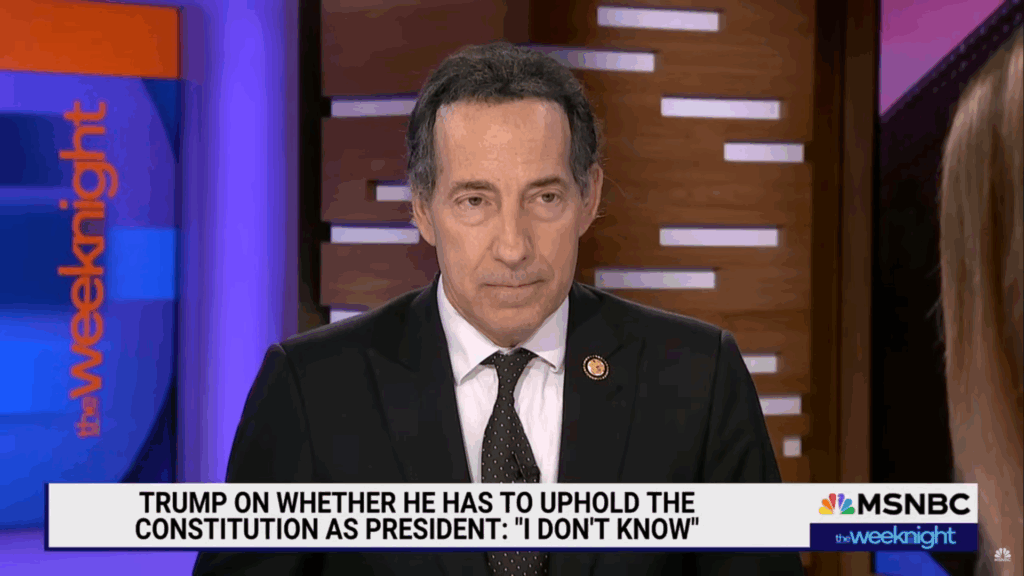
In the second hour of the show, The Weeknight welcomed Rep. Jamie Raskin (D-MD) joined the show to discuss a recent comment from President Donald Trump stating that he “didn’t know” if he had to uphold the Constitution.
Not only is Raskin a good guest to have on in general — as he serves as one of the highest-ranking Democrats in Congress — but he’s also a particularly good guest for this specific topic. Raskin spent nearly three decades as a Constitutional law professor at American University while simultaneously serving as a Constitutional lawyer. Whether you agree with him politically or not, the dude knows his stuff.
The hosts of The Weeknight asked good questions of Raskin, utilizing their time with the Congressman wisely and effectively.
But not always efficiently. Not to pick on Sanders Townsend, but in the middle portion of the conversation with Raskin, she took more than a minute to get a question out to the Maryland Representative, sort of meandering her way to the point of her question. The best questions — almost universally — see a lead-up followed by a question in two sentences or less. The pace of her question didn’t need to be quickened as much as the substance needed to be limited.
I would have liked to have seen just slightly more from Menendez throughout the episode. While she has a commanding presence while steering the ship, sometimes it does seem as if she’s more focused on making sure the ship stays on course than contributing her insight. Every time she spoke, it was clear that she was prepared about the topic, but I would have liked for her to showcase that knowledge just slightly more frequently.
Additionally, I loved the demeanor of Michael Steele throughout the episode. He felt extremely calm and polished. He didn’t present like a television news anchor or pundit. It didn’t feel as if he was all that preoccupied about how he came off as a television host as much as he was interested in talking substance more than anything, and presentation be damned. I’ll always champion focusing on content above all else.
Overall, I found the production of the show fascinating. The camera angles and depths created an intimate feel between those on screen and the viewer. The closeness of the assembled panel was striking.
The still frame above shows the closeness of the camera. You can see Menendez literally leaning in to listen to the remarks from Raskin, which feels rather angsty, despite it being a “friendly” interview.
Essentially, the one thing I wanted to see from the debut of this show was “Is there anything remarkable about The Weeknight? Is there anything that sets it apart from basically everything else on MSNBC, let alone the cable news sphere?
And the answer, to me, was a resounding yes. I thought the presence of Michael Steele was a differentiator, and the presentation was something that would attract eyeballs in the future. I can completely understand why MSNBC wanted to elevate The Weekend to The Weeknight.
Barrett Media produces daily content on the music, news, and sports media industries. To stay updated, sign up for our newsletters and get the latest information delivered straight to your inbox.
Towards the end of last year, Comcast announced plans to create an independent media business through the spin off of select cable networks within its NBCUniversal portfolio. Some of these entities include USA Network, CNBC, MSNBC and Golf Channel among others, and longtime television executive Mark Lazarus was slated to serve as its chief executive officer. The new company has been named “Versant,” it was revealed on Tuesday, the culmination of a process that spanned several months to determine the new title. The company, which had previously been known as SpinCo, decided to select this name because of versatility and familiarity with different subjects and is derived from the word “conversant.”
In addition to the cable networks, Versant will also be the home of digital platforms such as Rotten Tomatoes, GolfPass and SportsEngine. The remainder of the NBCUniversal portfolio, which includes the NBC broadcast network, Peacock OTT streaming service, Universal Studios, Bravo and theme parks, is going to remain under the aegis of Comcast. The company is on track to be spun out from Comcast before the end of the year and will be publicly traded as well. Networks included in the transaction generated about $7 billion in revenue during the last fiscal year.
“Versant represents more than a name – it speaks to our adaptability and embraces the opportunity to shape a new, modern media company. There were many considerations for a suitable name,” Lazarus said to employees in a memo on Tuesday obtained by The Wrap. “Our internal team of incredibly skilled and experienced brand marketers, designers and media tacticians took into account our overarching goal to influence culture, connect communities and signify a unified direction forward.”
Alex Sherman of CNBC reported that Versant is not going to be launching its own streaming service, but rather looking at brands to create their own strategies in the digital realm. Lazarus also divulged that about 20% of the company’s revenue already comes from the digital sector. Furthermore, he does not have much interest in acquiring another group of cable networks but acknowledged that if “a cable network also had associated businesses that had better growth prospects,” it could be a more appealing prospect on a case-by-case basis.
Sherman reported that meetings to select the name began in late December and that the company ultimately had more than 1,000 potential names for this business venture. The employees were told to focus their efforts on names that could draw upon New York, cable television or 30 Rockefeller Center.
“We would be foolish to expect everyone to love the name of our new company immediately,” Lazarus said in the memo. “There were certainly some others that we could have gotten behind, but after sitting with VERSANT for a couple of weeks now, I believe it will suit us well, evoke a sense of energy, and underscore our role in driving progress.”
Barrett Media produces daily content on the music, news, and sports media industries. To stay updated, sign up for our newsletters and get the latest information delivered straight to your inbox.