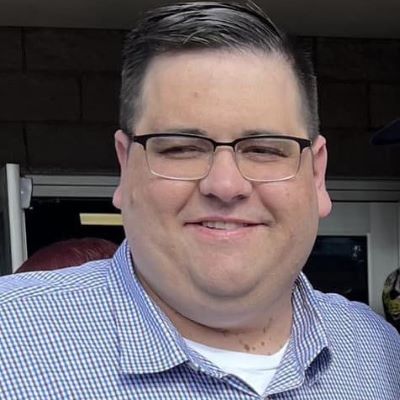
Tim Scheld spent nearly two decades shaping the sound of WCBS 880, and now he’s put his stories on paper. The longtime news director and brand manager, who led the all-news institution from October 2003 until his retirement in November 2022, has released a new memoir, My Front Row Seat, chronicling his decades on the front lines of American news.
Scheld’s motivation for writing came from years of swapping stories with former colleagues.
“You talk to enough radio people, and they can’t stop talking, even after the mic is off,” said Scheld. “We all have great stories. Whenever the WCBS crowd gets together, we sit around the table and tell them, and it’s such a rich collection based on the access we’ve had.”
Family played a role too, since Scheld and his wife have been married 34 years and raised two children who barely remember their father’s reporting days.
“I’m pretty sure both of my kids don’t even remember that I was a reporter,” Scheld said. “They know I worked at WCBS as a manager, but they were too young to know the stories I was doing before they were born, and some of them were really consequential. Part of my motivation was to write it down so my family might see what my history was.”
A Diary Becomes a Book
The pandemic also nudged Scheld toward the page, since he began jotting down a few thoughts every couple of days about what his family was going through.
“That ended up being something I looked at about six months past COVID and said, this is really interesting,” the former WCBS leader shared. “This might be a story worth telling someday. Those were the very first pages I wrote, even though it’s not the first chapter in the book.”
Beyond nostalgia, Scheld wanted to defend a profession he feels has taken a beating in the public eye, tainted by partisanship even as reporters keep doing the work he considers noble.
“I deeply believe it’s a noble profession filled with people who just want to tell stories and shine light on excesses and problems,” said Scheld. “The profession is in a bit of trauma now because trust has eroded. There has to be value in showing the humanity involved in our profession, where people are passionate about being truth tellers and making their communities better.”
Translating decades of broadcast writing into book form wasn’t seamless, so Scheld leaned on longtime friend and author Paul Semendinger to help him shift from writing for the ear to writing for the eye.
“It was a little harder than I thought,” Scheld said. “I was skilled in broadcast writing, and that’s a lot different than writing a book. I had help from a good friend, Paul Semendinger, who’s a writer of books, and he looked at my chapters and said I needed to be more descriptive. After a few chapters, I understood that.”
Some chapters carried more emotional weight than others, and Scheld covered the Columbine shooting as a new parent, so the memory still lingers.
“To see the trauma of bloodied children escaping from the second-floor library into the arms of heavily armed emergency responders, and to see children marched away from their schools with their hands in the air, it’s just so traumatic,” he said. “The fact that it continues is really heartbreaking.”
The Oklahoma City bombing hit close to home too, since it came just months after his son was born.
“The bomb exploded right below the daycare center in that building, and I think 18 of the fatalities were young people from the daycare center,” Scheld said. “You can’t help but look at that and feel the trauma.”
Other memories bring him joy, from the silence of Princess Diana’s funeral procession to Mark McGwire’s 70th home run and George W. Bush’s first pitch after 9/11.
“If you’re a good reporter, those audio and visual notes stay with you forever,” said Scheld.
Life After WCBS
WCBS shut down its all-news format in August 2024, and Scheld admits the anniversary still stings. He was playing hockey that morning and didn’t learn what happened until he got back to his car.
“It feels like such a waste,” Scheld said. “I know the business reasons why. And I’m not immune to understanding the struggles the company had running two AM stations that are very expensive.”
Audacy leaned heavily into 1010 WINS at WCBS 880’s expense long before the shutdown, according to Scheld. He posited that that effectively sealed the station’s fate.
“They made a decision they were going to put all their eggs in that basket,” he said. “It made WCBS a weaker property and signaled to the market that one station was a priority and the other wasn’t. It was kind of a matter of time.”
Despite the loss, Scheld holds no ill will toward the former competitors who survived at WINS.
“I think all of us, to a person, stay pretty tight with each other,” the former WCBS leader shared. “I think every one of us still feels like we lost a relative. It doesn’t mean WINS isn’t good at what they do. They’re killing it in the ratings, and I give them all the credit in the world.”
Still, Scheld believes the tri-state market lost something 1010 WINS doesn’t replace. Namely, deep local reporting across New Jersey, Connecticut and metro New York.
“There’s no question in my mind the market is poorer for not having a station like WCBS covering important stories in the tri-state,” said Scheld. “There are a million stories that could use in-depth reporting. And local news makes a real difference in the communities where it’s served.”
The Path Forward
Looking at the industry overall, Scheld remains optimistic. He pointed to strong all-news outlets like KYW, KNX, and WTOP as proof the format can still thrive.
“Any news outlet worth their salt today must be digitally focused,” he said. “It has to be focused on multi-platform delivery, not just viral stuff. Radio isn’t the only place people get their news anymore. And if you don’t have a digital strategy, you’re going to dry up and blow away.”
The bigger obstacle, in his view, isn’t audience appetite, but rather the broken revenue model propping up local news.
“News and information is not the profit center it was 20 years ago,” Scheld said. “That’s kind of why CBS got out of the business of CBS News Radio. They didn’t recognize the value of promotion. They just said it’s not making us any money, and that was the sad part of it.”
Barrett Media produces daily content on the music, news, and sports media industries. Sign up for our newsletters to stay updated and get the latest information right in your inbox.