Collective Heads Founding Partner Tim Richards is thrilled to announce that, effective immediately, Jimmy Steal is stepping into the role of Co-Content Director at 98.7 The Bull in Portland. The decision marks an exciting collaboration, as Steal will join forces with current KUPL Content Director and Collective Heads Consultant Tim Richards. Together, they will work closely alongside Assistant Program Director Dylan Salisbury.
In his statement, Tim Richards expressed his enthusiasm: “When we were launching Collective Heads, I asked Jimmy if he’d like to co-program The Bull as part of our new venture. I was beyond thrilled that he was interested, and now we’re off to a running start in Portland.”
Jimmy Steal is a highly esteemed programming executive. He brings over two decades of experience from Los Angeles, having worked at Power 106, a station he still consults. Steal also served as Executive Vice President of Programming for Emmis Communications, overseeing 33 stations across 8 markets. Most recently, Jimmy led two prominent Hubbard Chicago teams for six years as Vice President of Brand and Content. In 2025, he left Hubbard Chicago to return to Texas to focus on his new consulting partnership with Collective Heads.
Robert Dove, Alpha Media Portland’s Senior Vice President and Market Manager, is excited about Steal’s involvement. “I’m thrilled to have Jimmy Steal join forces with Tim Richards as Co-Content Directors of KUPL/98.7 The Bull in Portland. With their combined programming successes, I am confident they will elevate The Bull to new heights.”
Jimmy Steal added, “I’m delighted to join Alpha Portland’s Senior Vice President Market Manager Robert Dove, Alpha Executive Vice President of Content Phil Becker, and Collective Heads Partner/KUBL Co-Program Director Tim Richards, along with the entire first-class Alpha Portland team! I eagerly anticipate helping the Bull brand seize every opportunity for optimization.”
For more information on Collective Heads, click here.
Al Smith, who led KMJ as its General Manager for 15 years, has died at the age of 86, the station has confirmed.
A New Orleans native, Smith spent more than 60 years in the broadcasting industry, including the 15 years he spent with the Cumulus Media Fresno news/talk station. He departed the radio station to serve as the CEO of the Fresno Chamber of Commerce, where he worked for a decade before retiring in 2016.
“I loved Al. I began working with him in ’87 and have spent my career in radio cherishing every minute I have had with him,” said current KMJ General Manager Patt Hixson, who succeeded Smith in the role. “He was a great friend and mentor. So many great memories…this is crushing news for all of us. Especially his beautiful family who he loved and cherished so deeply. The sadness is overwhelming.”
“Al was a born leader and a good time was to be had by all and he would darn well make sure of it! You knew as soon as you met the man that he was special,” added host Ray Appleton. “Dear God, this one hurts”.
Even after his exit from the station, Al Smith served as the voice of the “Legends & Legacies” feature on the station. KMJ labeled Smith “one of the more prominent figures” in the station’s 102-year history in a statement announcing his death.
Barrett Media produces daily content on the music, news, and sports media industries. To stay updated, sign up for our newsletters and get the latest information delivered straight to your inbox.
After the death of longtime host Paul Gallo, SuperTalk Mississippi was forced to retool its morning lineup. It has completed that revamp by adding Mornings with Richard Cross.
The new morning show will air each weekday from 6-9 AM on the SuperTalk Mississippi network. Cross said the show will be heavily influenced by what Gallo had previously done in the daypart.
“Paul Gallo set a standard for what morning talk radio, at its best, is supposed to be in Mississippi,” Cross said. “It’s an honor to have the trust of this company and its audience to take on this role, to sit in that chair, to sit in front of that microphone, and try to carry on the legacy of Paul.”
Cross has been a mainstay with the statewide network, spending nearly 30 years with the company and outlet.
“Richard Cross is a name synonymous with radio and TV broadcasting for people around the world. There is no person more qualified, more talented, or harder working than Richard to take on this role as a trusted voice for people to start their mornings alongside,” SuperTalk Mississippi Media President and CEO Kim Dillon said. “I am confident he will take this opportunity and create a lasting legacy just as his predecessor, Paul Gallo, did.”
Paul Gallo died in December at the age of 77. He had been with the outlet since 1990. At the time of his death, the company called him “the heartbeat of the SuperTalk Mississippi network.”
Barrett Media produces daily content on the music, news, and sports media industries. To stay updated, sign up for our newsletters and get the latest information delivered straight to your inbox.
The highly anticipated first-round matchup between the United States and Canada in the inaugural 4 Nations Face-Off tournament garnered the largest average audience for a non-Stanley Cup Final hockey telecast since 2019. The North American rivalry, which featured three fights in the first nine seconds, averaged 4.4 million viewers on ABC, according to fast national data from Nielsen Media Research. Emanating from Bell Centre in Montréal, Québec, the United States tallied a 3-1 victory that peaked with 5.2 million viewers, marking the most-watched telecast affiliated with the NHL in the past two years, Game 7 of last season’s Stanley Cup Final on ABC notwithstanding.
The game also accrued the largest non-playoff NHL audience since the 2011 Winter Classic, a tilt between the Pittsburgh Penguins and Washington Capitals that averaged 4.5 million viewers on NBC. Jon Lewis of Sports Media Watch also added that 4 Nations Face-Off games account for three of the six largest average audiences for NHL broadcasts this season. The game is up 369% from the season average of NHL on ABC games ahead of NHL players returning to the Olympic Games next year from Milan Cortina.
NHL commissioner Gary Bettman recently announced that the World Cup of Hockey would return in February 2028 on a regular schedule. The international hockey tournament last took place in 2016 with Canada defeating Europe to win the championship. The Saturday night prime time showdown between the United States and Canada finished 473% higher than the last matchup between the two teams nine years ago. The gold-medal game between these two teams in the 2010 Winter Olympics averaged 27.6 million viewers on NBC, marking the most-watched hockey telecast in 40 years. Yet three years ago when the two countries faced off without NHL players, the game averaged 1.22 million viewers on USA Network.
The 4 Nations Face-Off replaced the NHL All-Star Game this season, which experienced a 7% decline in viewership last year when it averaged 1.4 million viewers on ABC. The marquee matchup was up against NBA All-Star Saturday Night programming consisting of the Kia Skills Challenge, Starry 3-Point Contest and AT&T Slam Dunk Contest on TNT. Last year’s iteration of these events averaged 4.6 million viewers on TNT and truTV, which included a three-point shootout between Stephen Curry and Sabrina Ionescu.
Barrett Media produces daily content on the music, news, and sports media industries. To stay updated, sign up for our newsletters and get the latest information delivered straight to your inbox.
Media executives are trusted to lead the way forward. Most that I’ve encountered over the years are sharp, strategic, well read, and invested in the future of the business. But one area where many fall short is when it comes to escaping their comfort zones. Knowing what makes radio or television work is important, but learning what drives other businesses is a greater advantage.
I had a conversation in October with a media executive who raved about the progress one of their brands had made on YouTube. They talked up their shift in strategy for generating audience, and how it was producing more traction for a popular outlet. But when pressed further, the executive told me ‘the progress is great, but there’s no money in YouTube’.
A similar conversation was had multiple times during the past few months with other executives. The takeaway, turning on the cameras is great. It looks good, and helps the brand cut through on social media. However, there’s little revenue to be had. The same words have been uttered to me constantly about podcasting. Few believe it can be a key revenue driver for their business.
Hearing that repeatedly has left me scratching my head more times than I can count.
First, if you don’t believe there’s financial value in doing something, why do it? Investing resources in cameras, software, and staff makes no sense if you don’t think it’s worth it. Some brands post 25-50 video clips per day on X, Instagram, and Facebook. They also create 5-10 podcasts per week. You may be satisfying the platforms but if you don’t see a path to monetization, is it necessary to do all of that?
More importantly, why are industry executives so quick to dismiss spaces they don’t know? If there’s more revenue for a local outlet in either in radio or television advertising that’s great. That’s your core business. But why does it have to be one or the other?
Indicating that revenue can’t be earned on YouTube or in podcasting is false. It’s harder for local brands. You need scale, and a sales focus that can’t be provided because most salespeople are focused on selling the brand’s main source of distribution. But I’ve seen shows and individuals earn in these areas. Billions of minutes are spent daily in these locations, and advertisers are prioritizing digital in their ad spending. Brands, advertisers and talent wouldn’t explore digital video and audio if it wasn’t valuable to business.
Which begs a bigger question. If the content that cuts through in podcasting and on YouTube and social media revolves around bigger talent and brands, how do local outlets plan to compete? The word ‘local’ helps radio and TV in a community, but in digital spaces, that matters less.
If your key source of revenue is local advertising, prioritize that. I’m not suggesting this should come first. But, dismissing the revenue upside in video, podcasting, and other digital avenues is a mistake. In 2025, you need dollars flowing your direction from everywhere. Looking at the world of business through one lens is what limits your ability to grow.
I’ve seen numerous outlets fail to move quickly into video, podcasting, merchandise, newsletters, live events, websites, apps, etc.. It’s happening again right now with artificial intelligence. There’s some concerns over AI, but if you don’t think it’s going to get better and be a major part of your industry, you’re not paying attention. Like it or not, it’s here, and it’s going to get bigger.
Those who are quick to pivot and embrace new paths tend to sustain success. Others who move slow and rely on protecting their core business by sticking with what’s stable even if it doesn’t move people to watch, read or listen, often dismiss the rest. They fail to understand that the media industry is becoming a place for the haves and have nots. If you don’t create ‘hits’ and build larger audiences, your value diminishes with each passing year.
The New York Times was once a newspaper, and is now a full-service media giant. Ask them if they think subscriptions and podcasts are good for business. Call the execs at the Morning Brew, see if they think there’s money in newsletters. Check with Jomboy Media, Omaha Productions, The Volume, Meadowlark Media, Barstool Sports, Outkick, The Ringer, Joe Rogan, Tucker Carlson, The Daily Wire and other independent creators, and ask if video, live events, and merchandising has been valuable to their bottom line.
To fully understand what’s happening in the media world, you have to study other spaces, talk to those who invest in them, and watch and/or attend events that deliver information you don’t have. One of the best shows I attended during the past decade was a conference called Social Media Marketing World. It had zero to do with radio or TV. I knew nobody in the room. Yet I learned a ton about SEO, website affiliate partnerships, newsletter growth strategy and monetization, what algorithms value and reject, when-what-how-why to post, organic vs. boosted strategies, etc..
By escaping my comfort zone, I was able to gain insights to be more effective helping my clients, our readers, and my business. It’s the same reason why I’m attending CRS this week. I’ve never been to the show, and my career wasn’t built in Country music. But if I gain a few tips, meet a few successful people, and relay that knowledge to our clients, readers, and staff, then it’s time well spent. It starts with recognizing that I don’t have all the answers but I can become a stronger business leader by learning from others.
People have to decide what’s worth their time, and whether or not they want to run simple businesses that aren’t growing or explore new ways to create multimedia powerhouses. I host two annual conferences featuring some of the sharpest people in the sports and news media industry. It exists to help make the industry better. Yet sometimes it’s like pulling teeth to get folks to attend. Whether it’s our events, shows like CRS, Social Media Marketing World or an AI Summit or Sports Betting seminar, anywhere you can gain information while building relationships to improve your business, you should be there.
When you leave your comfort zone and enter places that are foreign to what you do, it makes you better and wiser. That is of course if you enter the room with an open mind. When you do, you learn that many are making money and creating impact in ways that you’re not. It’s then that you realize that it might be your tactics, strategy, and choice of horse that’s stopping you from winning the race, and cashing in.
Barrett Media produces daily content on the music, news, and sports media industries. To stay updated, sign up for our newsletters and get the latest information delivered straight to your inbox.
If you’ve been responsible for audience ratings based on data derived from listening estimates, then you understand the phrase, “I fed my family on Arbitron and Nielsen results.”
I was looking for a story every week, month, and quarter. It was a more manageable narrative if we won or got our butts kicked. The tougher explanation was the average ratings result.
I had to dig to find something the staff could interpret as momentum or market conditions. After one particular presentation, my APD came up to me and sarcastically said, “Harrell, you know how to find a story.” Wink, wink.
I’ve hung on to that moment and internally branded myself as a Story Finder. When I need a break from the narrow-focused world of Zooms and emails, I jump in the car and turn on my Uber Driver app to experience life outside of my neighborhood and see if something I hear or observe might be useful in a client conversation.
The average shareable story-find is one per week. However, last Thursday night, there was a hat trick, and I will share all three experiences in the order they happened.
Airport pickups are the easiest conversation starters. “Where did your flight originate today?” Their answer produces multiple options for your response.
THE SINGER
Then there’s the client who is faceless and just wants you to take them to their destination. Faceless because it was dark, and I don’t always see the details in the rearview mirror. I verified his name when the imposing figure got in the backseat, and we were off. We talked briefly about the weather as he was scrolling through his smartphone.
I could hear the audio from the videos until he stopped at the story about the humpback whale swallowing the kayaker off the coast of Chile. Of course, I made a Jonah joke when he started telling me about this real story. We spent the next few exits querying, “Would we rather be stuck inside a whale or attacked by a shark?”
Sidebar: the kayaker lives when the whale quickly spits him out. Here’s the story in this link.
After discussing our preferred death wishes, he asked me if I drove full-time. Similar to what I wrote a few paragraphs ago, I told him it was a side hustle as I grow my business. He wasn’t going to leave it there. Now I like this guy. “I’m a media consultant. I work with radio stations, content creators, and the people in charge of the strategy of those products,” I effortlessly explained.
“Well, that’s different…and cool,” he replied. We were two minutes from his destination, and it was easy to share the coolness of my craft with him. Then, he took the next step. “So, there will be a lot of your people in town next week at CRS,” said the big bearded passenger. I immediately knew this was not an outsider when he referenced Nashville’s Country Radio Seminar. I turned around and asked, “Are you an artist?”
His name is Brandon Bing, and he verified his identity by holding up his picture on Spotify. We were in a tight traffic spot. I needed to drop and go, but he quickly told me about his new album. I gave him my card and said, “I’ll look for you at CRS!”
I don’t know if Brandon meant to use the opportunity to promote himself. It was a genuine conversation that evolved into an opportunity to share his craft with someone connected to the industry. He listened and followed the story.
Radio brands and talent compete with excessive entertainment and information options. Be like Brandon and look for natural opportunities to share your craft with someone. People still think the art of radio is interesting.
THE DEAD CAR
The next client was a man who moved to Nashville last month from Atlanta. We stopped behind a car navigating a single-lane roundabout a few minutes into the ride. The emergency flashers on his car started flashing, and we weren’t moving. As the cars behind me piled up, I gave a friendly horn honk. The driver got out, raised his hands, and motioned that the car wouldn’t start.
He got back in his car. About 30 seconds later, I said, “I need to move this guy, or we aren’t going anywhere.” So, I got out of my car and told the driver to place his car in neutral, and I would push. I didn’t ask my rider to help because he was my client. But you know what? He decided to get out of my car when he saw me pushing. Then, another guy got out of his car, and we pushed the stranded motorist to the side. We jumped back in our car to the sounds of happy horns from the other cars.
Leaders have the privilege and burden of guiding others. Sometimes, others need to see you make the first step before they realize they can help or improve the situation. Don’t rely solely on your position and title to get a project or a vision moving.
WE’RE NOT IN OREGON ANYMORE
The next ride was a group at a hotel who flew in from Oregon about an hour before my arrival. They were fresh and ready for downtown Nashville. It was their first time in town.
When we drove down Lower Broadway, these middle-aged adults acted like kids at Disneyland for the first time. “There’s Morgan Wallen’s place!” “Look, the Ryman Auditorium!” “Jason Aldean’s. No way!”
Someone is experiencing your radio station, streaming channel, or video platform for the first time. Welcome and respect their excitement so they will want to return for another experience. As Promotions guru Paige Nienaber used to tell us, “The vast majority of your listeners have never been in a limousine. Don’t take it for granted.”
Barrett Media produces daily content on the music, news, and sports media industries. To stay updated, sign up for our newsletters and get the latest information delivered straight to your inbox.
The on-going distribution dispute between YouTube TV and Paramount is now over as the two sides announced a long-term agreement which will keep Paramount programming on the streaming subscription service late Saturday night.
The multi-year agreement with YouTube TV keeps programming channels such as CBS, Comedy Central, Nickelodeon, MTV among others available for the more than eight million subscribers on the platform.
“We’re happy to share that we’ve reached a deal to continue carrying Paramount channels, including CBS, CBS Sports, Nickelodeon and more,” YouTube said in a statement. “With this agreement, YouTube TV will continue to offer 100+ channels and add-ons including Paramount+ with SHOWTIME and will enable more user choice in the future.”
The news of the multi-year extension comes just days after the two sides announced a ‘short-term extension’ this past Thursday evening.
“We are pleased to announce a renewed Paramount-Google agreement for the continued carriage of Paramount’s leading portfolio of entertainment, news and sports networks across YouTube TV’s platform,” a Paramount spokesperson added. “We look forward to extending our long-standing partnership and giving audiences greater access to their favorite programming.”
There had been some concern amongst sports fans because of the timing of the dispute between Paramount and YouTube correlating with such events as the NCAA Division I Men’s Basketball Tournament next month and The Masters Tournament from Augusta National in April. These concerns also followed a recently unveiled price hike for the streaming service of 14% to $82.99 per month.
Both sides traded barbs over length of the negotiation as the deadline to come to an agreement was near. Paramount went to create a dedicated web page which shared various talking points about YouTube TV accusing the company of “prioritizing their own interests over a fair agreement.” YouTube continued to say in multiple releases they were working on their subscriber’s behalf and calling Paramount “an important partner” in multiple statements.
YouTube TV statement on Sunday ended with a note to their subscribers saying “To our subscribers, we appreciate your patience while we negotiated on your behalf.”
YouTube TV, which is owned by parent company Alphabet, launched its subscription-based service in 2017 also serves as the home of NFL Sunday Ticket under a reported seven-year, $14 billion media rights deal.
Barrett Media produces daily content on the music, news, and sports media industries. To stay updated, sign up for our newsletters and get the latest information delivered straight to your inbox.
Chad Millman, Chief Content Officer of Action Network, has built a career at the intersection of sports journalism and betting analysis. With previous stints at ESPN The Magazine and ESPN.com, Millman has long been a trusted voice for sports fans and bettors alike. Joining him on The Favorites, the podcast I had the chance to eavesdrop in on this week, is Simon Hunter, a seasoned professional bettor with an acute eye for finding value in betting markets. Together, they deliver analysis, entertain and give inside scoops on sports betting.
The Super Bowl LIX recap episode captured all of the emotions of the biggest game of the year. Millman opened the show with a blend of exhaustion and excitement: “Last night, we reached the end of a long, winding, thrilling, sickening, glorious, depressing, fun-filled, drama-inducing, maddening, uplifting season.” Hunter, torn between his emotions as an Eagles fan and a bettor, quipped, “Am I supposed to be a depressed bettor or a really happy Eagles fan?”
Hunter shared his surreal experience celebrating the Eagles’ dominant victory on Broad Street, describing fireworks, spontaneous engagements, and the inevitable mayhem. Millman, whose son studies at Drexel, laughed, imagining his son amidst the chaos. The duo then dissected the game’s key moments, particularly Patrick Mahomes’ uncharacteristic struggles. “Three turnovers? It was brutal,” Hunter noted, emphasizing the relentless pressure from the Eagles’ defensive front.
As the show went on, the hosts explored the unique betting landscape of the Super Bowl, highlighting how even casual bettors echoed the sentiments of professionals. Hunter remarked, “Even Mr. Joe Public was saying the same thing as professionals: ‘The Eagles have the better team, but I like the quarterback and Andy Reid.’” Millman then reflected on the unexpected challenges faced by the Chiefs, particularly Mahomes’ protection issues.
The discussion shifted to the broader implications of the game, both for future betting and the legacy of players involved. Millman and Hunter analyzed how this Super Bowl differed from past ones in terms of line movement, public betting patterns, and sharp money influence. They highlighted how the total points market became volatile with late movement, reflecting how bettors were split on whether Mahomes and the Chiefs could find success against the Eagles’ defense.
Humor and personal anecdotes really added to the content. Millman said his son and friends were more engaged in Kendrick Lamar’s halftime show than the game. Hunter lamented his betting misfortunes, especially a lost under bet due to Mahomes’ final 50-yard pass. “That pass was brutal,” Hunter admitted. “One second I was counting my winnings, and the next, I was watching my ticket go up in flames.”
Despite the gambling setbacks, the hosts expressed optimism next NFL season. Hunter favored the Packers at 25-1 odds, citing their young core and the potential for a breakout season from Jordan Love. Millman backed the 49ers at 17-1, liking their ability to reload despite potential roster changes.
Millman and Hunter also discussed the broader impact of this Super Bowl on sports betting, emphasizing how the game’s unpredictable nature highlighted the thin margins in betting. Hunter shared insights on managing betting expectations, stressing the importance of discipline. “You can have the best analysis and still lose,” Hunter explained. “It’s why bankroll management is key.” Millman also highlighted some of Action Network’s growth in providing bettors with tools to navigate complex betting landscapes.
The hosts praised Nick Sirianni, for the Eagle’s strategic execution. Hunter noted Sirianni’s evolution from a criticized rookie coach to a Super Bowl champion. They also debated potential offseason moves, including Travis Kelce’s possible retirement and the Chiefs’ need to rebuild their offensive line. “Kelce’s leadership is irreplaceable,” Millman remarked. “If he steps away, it changes everything for Mahomes.”
Later, the hosts looked at early odds for next year’s Super Bowl, with Millman and Hunter evaluating teams likely to emerge as value plays in the offseason. They emphasized the importance of waiting for key free agency moves before placing significant futures bets but acknowledged the allure of locking in longshot odds before the market fully adjusts.
Beyond the game, the hosts explored how sportsbooks reacted to the Super Bowl’s outcome. Hunter noted that many books had heavily juiced lines in favor of the Chiefs leading up to the game, creating value for those willing to bet against the public. Millman explained how oddsmakers adjust for public sentiment, highlighting the challenge of finding true value bets in high-profile games.
Ultimately, The Favorites podcast provided an insightful, entertaining, and informative breakdown of Super Bowl LIX. The detailed game analysis, humorous exchanges, and forward-looking betting strategies exemplified why Millman and Hunter are must-listen voices in the sports betting industry. Their ability to blend expert insight with engaging storytelling makes the podcast a standout in the sports media landscape, ensuring listeners gain both entertainment and actionable betting knowledge.
Barrett Media produces daily content on the music, news, and sports media industries. To stay updated, sign up for our newsletters and get the latest information delivered straight to your inbox.
Outside of changes to its morning drive show, the weekday prime programming lineup on 97.1 The Ticket in Detroit, Mich. led by program director Jimmy Powers has remained fairly consistent for more than a decade. Representing an outlier from the standard deviation, hosts have achieved protracted stretches of success through a dedication towards the craft and a supporting cast with enviable depth and proficiency. Commensurate with this auspicious configuration is Powers, who has served as a leader at the outlet for more than 15 years. All while Detroit has seen much rebuilding with their local teams over the years, The Ticket has consistently ranked among the top radio entitles in the marketplace.
While it is debatable which markets rank as the best sports markets in the country, Powers believes Detroit is easily within the top three, if not the best overall. With a sprawling metropolis of fandom exhibited by its population, Powers has adhered to serving the audience and valuing their loyalty while also understanding that listeners wish to hear unfettered and authentic commentary. At the same time, Powers identifies talent who are able to bring knowledge that spans beyond merely sports, recognizing that 97.1 The Ticket is a source of entertainment as well.
“We morph in mass appeal, everyday topics – we call them ‘evergreen topics’ – that appeal to everyone, and all our talent can handle more than just sports if that makes sense,” Powers explained. “All of them could handle that extremely well because they’re more than just die-hard sports fans.”
Powers knows that ratings success is indicative of the marketplace and may not always factor in the traction created or news divulged that makes an impact. Content consumption and station revenue are often barometers to calculate prosperity, but in reality, the complete equation for such is not standardized and somewhat subjective. With an assortment of 46 executives and managers from top audio companies offering their opinions in the voting process for the recent Barrett Media Top 20 series, Powers is honored to have been named the top major-market program director in the country.
“I’m very humbled to be considered to do it because, again, I think there’s amazing PDs across the board that are worthy of the No. 1 position, so to be that guy, obviously, it’s an honor,” Powers said. “I look at it as a team effort though because without the lineup and the guys and the staff that I have, it’s a moot point, so I look at it as a team win.”
Even though Powers has appeared on the list before, it marks the first time in a decade of eligibility that he garnered the first-place finish. Nonetheless, he articulated that having all three primary dayparts finish within the upper echelon of the list contributed to his being recognized and that he views it as a win for everyone.
Powers considers himself to be a laidback manager, and although he can be fiery at times, he has trust in the staff and discerns alignment towards an objective.
“Everybody’s professional here, so you just kind of give them what they need and let them go with it, and I kind of fine tune and add things here and there to kind of steer and keep them on track from a day-to-day standpoint content wise,” Powers said. “Just like anybody else, they’ll get bored with something, so timing is everything to kind of get them back on track from a listener standpoint and just a programmer.”
The job has evolved to a point where program directors need to recognize the digital landscape and make sure that the station is meeting the audience across various distribution touchpoints. Having a keen understanding of different platforms and the process of navigating compelling, engaging audio content through an intricate network of tributaries is essential to the role.
“It isn’t [just] at 97.1 over the radio anymore – it’s through our app, could be YouTube, it could be Twitch – all different ways of consumption,” Powers said. “You’ve got to be aware of that, and keeping an eye on just the social media aspect of promotion and upcoming things. Anything that you can really think of how people may come into your radio station, you got to kind of service that as well.”
While many radio hosts are active on social media, afternoon drive host Mike Valenti, operates devoid of these outlets. Powers explained that Valenti made the decision as its overtones have become more vulgar and devolved into an ostensible cesspool, but the station still promotes his show through its official accounts. Valenti, who is the longest-tenured host at the station, has been working with Rico Beard, a former host on Detroit Sports 105.1, as his partner for the last five years. The duo has continued to provide a credible and entertaining show for the audience, oftentimes finishing at or near the top of ratings books.
“Mike’s probably one of the best, if not the best from my opinion, in the country [with] what he does from a sports talk show standpoint,” Powers said. “He’s highly opinionated, very, very intelligent, and he delivers. He’s a unicorn in the sense that he’s only 44 years old – he can be 80 years old at times and he can be 20 years at times – meaning his Rolodex of knowledge and just the breadth of it, he can pull things from a low-end demographic and a high-end demographic.”
Doug Karsch and Scott ‘Gator’ Anderson have been paired together in the middays for the last 19 years, demonstrating palpable chemistry and accord. There is an advantage of this salubrious partnership, but it also naturally presents a risk of the program losing its luster. The dichotomy between the backgrounds of both hosts, along with contributions from producer Khang Huynh, has permitted the show to remain fresh while keeping everyone on their toes.
“We still were a top one or two station in the market during the pandemic when zero sports were going on because of how we built this thing to be more than just 100% sports, so with that comes challenges with the midday show [of] how to keep it from becoming stale,” Powers said. “They approach each show of, ‘Okay, what’s out there today that’ll be entertainment-based?,’ and they do a tremendous job of doing that every day.”
Powers has overseen several alterations to the morning drive show over the years, one of which occurred after the death of Jamie Samuelsen following a prolonged battle with colon cancer. Samuelsen was a beloved figure in the marketplace, and the station subsequently renamed its studio in his honor. Jon Jansen, a former NFL offensive lineman, was added onto the show to join Mike Stone and Heather Park. Just over three years later, Stone officially stepped away from full-time duties at the station, although he remains a part-time contributor. The station added Jim Costa to the open position, a former intern who had received on-air repetitions in Grand Rapids, and he has excelled in the role.
“When you include the stream, we were second in mornings in the fall book all in for Adults 25-54, and they were No. 1 in men, so it didn’t lose a beat,” Powers said. “Jim’s great – he’s extremely talented, really good No. 1 position on the show and a great broadcaster – so as great as Stoney was, Jim picked it up without losing any momentum at all.”
Following a stint programming Sports Radio 1460 The Fan in Columbus, Powers moved to Detroit and has been the program director of 97.1 The Ticket ever since. Despite collaborating with many industry professionals in his career, he contends to have never met anyone as passionate as Debbie Kenyon, the market manager of Audacy Detroit.
“We just know that, ‘Hey, people get fat and happy,’ [but] we don’t think like that, and it starts with Debbie because she’s just such a great motivator and works her tail off and she loves the industry, and that makes it great for us as well,” Powers said. “We butt heads at times, but the end goal is the same [of] we all want to get better and do the best we can, and hopefully it works for the cluster as well, but it all starts with Debbie.”
While Powers is excited about the future of Detroit’s sports teams, he knows that the hosting lineup will not be pulling any punches in its discourse. The Tigers, Lions, Pistons and Red Wings all utilize 97.1 The Ticket as their flagship radio station for live game broadcasts, and the station also airs broadcasts of Michigan Wolverines football and basketball games. These valuable media rights partnerships can elicit interest and access but potentially threaten autonomy in the process. Powers notes his job is a juggling act of sorts from time to time when monitoring the pendulum effect between some fluctuating extremes.
“The fans [will] call in and rip us a new one if we’re just trying to take it easy on lack of moves, lack of success,” Powers outlined. “It’s a juggling act of partnership and valuing the partnership with the teams and understanding they’re going through a bad time, but you have to put on a different hat and approach it to where, ‘Okay, how can we be fair and honest?,’ and kind of not champion the cause of needing to make a move, but, ‘What are we going to do to get better?’”
The station strives to finish with stellar ratings and revenue after every quarter, reaching a benchmark for success while pushing the boundaries. As it pertains to studio programming, Powers often realizes that various memorable moments are derived outside of the sports angle, and hearing these listener testimonials can be a proxy for success as a qualitative metric. The staff also works on their seldom deficiencies, diligently participating in air-check sessions and seeking to strike a chord with the listeners.
“We forget that we’re actually kind of an escape for a lot of people that have a job they don’t like or going through a tough time in life,” Powers said. “If we can put a smile on their face and make their day better, I kind of measure that with the ratings as well because I think sometimes, being what we do, we forget there’s people out there that rely on us.”
In the end though, Powers recognizes that he is fortunate to be working in the sports media field and is humbled by being considered among the elite in his occupation. The station has won two NAB Marconi Awards over his time with the station and made significant advances in its ability to reach consumers in and around the locale through digital innovation. Powers does not impugn the success of the station, but he aspires to challenge everyone to continue progressing, himself included, to maintain its standing as a preeminent sports talk radio outlet.
“Obviously, I hope we’re the best station in the marketplace,” Powers said “Personally, I love the recognition, the honor of being on top of the Barrett sports list. That’s the cherry on top, but if I take care of business here and we do what we’re supposed to, that’s what I’m looking forward to the most.”
Barrett Media produces daily content on the music, news, and sports media industries. To stay updated, sign up for our newsletters and get the latest information delivered straight to your inbox.
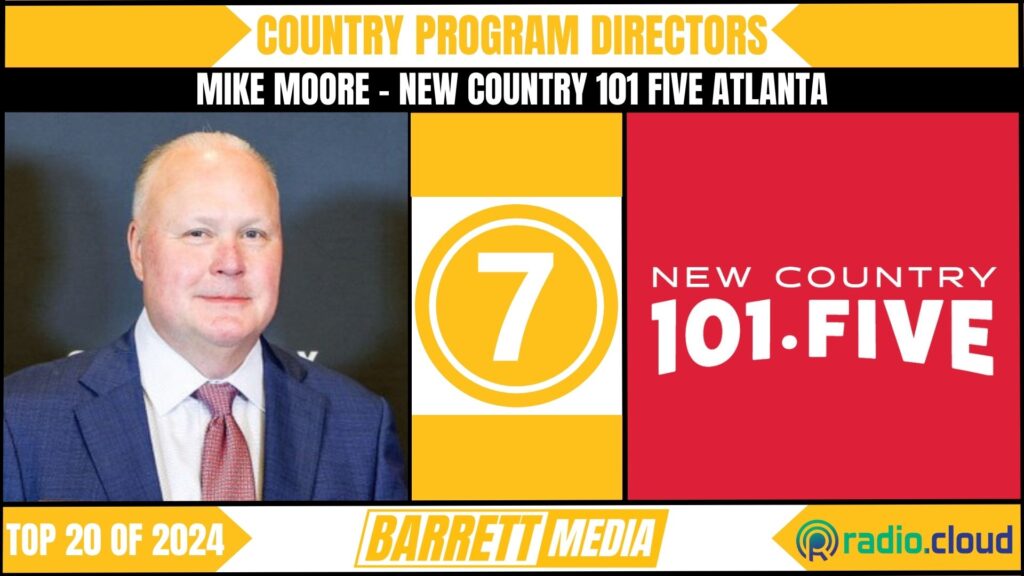
His peers recently voted him to the seventh spot on Barrett Media’s Top 20 Country Programmers. As a long-time CRS attendee, I talked with him about his experiences and what he looks forward to each year.
“I wouldn’t have enjoyed the success that I have and got to do the things that I have done over the course of my career had it not been frankly for CRS.”
“The networking that takes place there. I interviewed there for my first big break. One of the best jobs I’ve ever had in my life. I interviewed for the program director job in Orlando at CRS.”
“I just can’t say enough about it. This year, I’m excited because I always like to go and reconnect with old friends and folks I haven’t seen or talked to on a regular basis. I always find at least a few of the panels interesting.”
Like many AI sits near the top of his interest level this year.
“There’s a heavy emphasis this year on AI, which is top of mind for everybody. So I think the more we can find out about that and how it can be a tool and helpful to us is good.
“I think the research panel is always interesting, and then I would say that you usually end up discovering or finding an artist or two that you really feel good about. Somebody stands out and raises their hand as the next exciting thing coming down the pike.”
The comradery of CRS blends the seasoned vets with the newcomers in an effortless and family-type way.
“I’ve always kind of thought to myself there were so many people who were kind to me as a young programmer. I mean, it’s a long list. Rusty Walker, I’m sure he’s probably on everybody’s list, and Gregg Swedberg, some folks that frankly aren’t a lot older than I am, but they are doing it longer.”
“I always really enjoyed that time because you learn a lot in the hallways. Not to mention just the networking and the connections that you make.”
“I think that’s one of the special things about CRS versus maybe some of the other conventions that have existed over the years, and I also think it’s one of the things that makes this format special. I believe it’s probably a more family environment than some of the other formats, which I think is good.”
Music is a massive part of the experience, and I wondered if a couple of performances stood out.
“One that stands out because I remember it was absolutely the talk of that CRS was Gretchen Wilson back in the day. People saw her perform, and then very shortly thereafter, she just exploded like a rocket ship onto the scene.”
“I think Rascal Flatts was kind of that same way. We went to a listening party with a very small group of folks. It was pre-Clear Channel gobbling everything up. I was in Hartford, Connecticut, at the time.”
“There were a handful of us in the room for this listening session. Greg Swedberg was there, and I think Mike Kennedy and Tim Clausen. We all walked out of there blown away after listening to a new Rascal Flatts project and hearing them play live. “We thought wow This is this is this is a monumental kind of a shift in the sound of the format.”
“I think there are always those kinds of events like that where somebody will literally stop the room. The Ryman lunches are good for that. There have been a number of things that have happened at that lunch where people have performed, and you walk out of there just going, wow, that person just literally flattened in that room I think that’s part of the magic.”
What advice does Moore have for a first-time attendee?
“Don’t spend all your time out late at night. While that can be fun, make sure you get up the next day to attend some of the panels. Do all you can to network with people. Reach out to them and stay in touch.”
“Bring along a business card or be able to share contacts on the phone. Business cards are probably a little old-school these days. You never know who you’re going to meet, and I think networking is key.”
“As I said, I interviewed for my first big break job there. But the contacts I have made there over the years and folks I have met and continue to deal with, you just never know how that might benefit your career.”
“Whether it be another radio person, somebody in syndication, a label person, or even an artist, the relationships you develop with those folks can be valuable down the line.
“I think my advice would be it’s a long race. Make sure you save enough to get you through Friday.”
Barrett Media produces daily content on the music, news, and sports media industries. To stay updated, sign up for our newsletters and get the latest information delivered straight to your inbox.