Home Blog Page 1346

Pete Rose Was Someone Sports Media Never Quite Knew What to Do With

0

Wrong by a mile, it turns out, Scott Fitzgerald once wrote that there are no second acts in American lives. It seemed the proper sentiment at the time. Fitzgerald was both participating in and observing the Roaring Twenties, a time of absurd decadence by the rich that foreshadowed the Great Depression, and perhaps everything looked and felt obvious, good or bad, rich or poor, thriving or suffering. I grant you, that’s pretty high-hatted talk considering our topic. But Pete Rose, as coarse, base and ground-level as any American sports figure in history, died Monday as absolute proof that our lives may have second acts, third acts, encores.

They can do all that and still feel unfinished. Rose’s life certainly did.

It’s not an exaggeration to say that Rose died at age 83 without getting what he wanted. He wanted one thing in his post-playing years, and that was the Hall of Fame. Even though Pete’s presence is all over that building in Cooperstown, he doesn’t have a plaque.

Where the Hall conversation goes from here is unknown — Rose faced a “permanent” ban from baseball, so you’d imagine some reconsideration could occur — but it’s a less interesting one without Rose’s voice in it. He was at turns belligerent and begging about Cooperstown. He for years denied the gambling that cost him his banishment, right up to the moment that he needed to promote a book in which he admitted it.

Rose retired as and remains MLB’s all-time leader in hits, games played, at-bats, singles and outs. The 4,256 hits he compiled should stay up there for a while; the closest active player, Freddie Freeman, has barely half that many (2,267) and Freeman is already 15 seasons in and 34 years old.

But Pete undercut his indisputable greatness, and he knew he was doing it, walking the razor’s edge. It was incredible self-sabotage. In the time that Rose was both playing/managing and gambling, first on the horses and later on anything he could put a wager on, the one thing that everyone in baseball knew was that you couldn’t bet on baseball, period, full stop, no quarter given.

Rose knew it. It’s not like he didn’t know. In those days, when I was covering MLB every day, the warning against gambling was literally posted next to the entry/exit of every clubhouse in the league. It was the cardinal sin.

It’s amazing. There’s this Sports Illustrated cover featuring part of a conversation between Rose and Bud Selig, who was a couple of MLB commissioners removed from Rose’s banishment but still had the issue plopped in his lap on a regular basis:
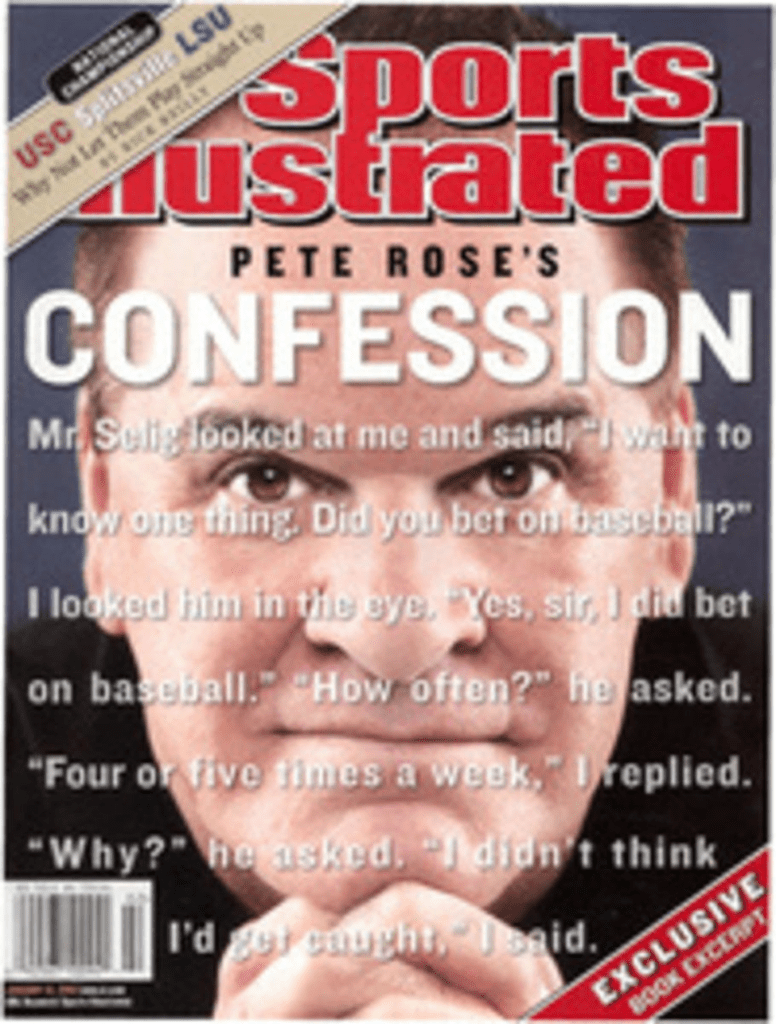
Cover of Sports Illustrated with Pete Rose featured

Isn’t that all of it, right there? Selig asks Rose if he bet on baseball. Rose confirms that he did, yes sir, all the time. Selig asks why. Rose replies, “I didn’t think I’d get caught.”

It made for quite an SI cover. Of course, it was an excerpt from the book Rose was trying to sell at the time, in 2004. In a previous memoir, written 15 years earlier with one of the sport’s most esteemed scribes, Roger Kahn (“Boys of Summer,” etc.), Rose had vehemently proclaimed his innocence. But, you know, things change.

Pete later autographed copies of the mag, sold them at his memorabilia tables in malls and in Las Vegas and in the streets of little Cooperstown, usually within view of the Hall of Fame of which he was not a member.

Maybe you saw some of those autographed copies. They’d be sitting next to the baseballs that he would sign with his name and the inscription, “Sorry I bet on baseball.” (Currently available at your finer online used-merch sites.)

The show always went on.

The media never knew what to do with Pete Rose because he either was or wasn’t what they expected, depending on the day. I’ll tell you this, Rose was a writer’s dream. He always talked and never stopped, and in the instant that he said anything, you were convinced he meant every word of it. He spoke the way he played, bluntly.

Rose’s “Charlie Hustle” routine — remember, that name was bestowed upon him sarcastically, by veterans who quickly tired of the whole sprint-to-first-base-on-a-walk thing — did a weird dilution job on his actual talent, which was overwhelming. He was no average athlete who somehow got over with his scrappiness. Rose was a complete player, every bit as good as the numbers said he was. Journalists who initially understood him as a superstar MLB figure always had trouble squaring that with everything else that Rose was, or later became.

Tax evasion, documented womanizing, accusations of sleeping with an underage girl — there was a lot to the life of Rose. But once you’ve godded up a guy for decades, it can become difficult to find balance or bring things back to center. After the betting scandal led to Rose’s banishment in 1989, the media, much of it uncertain what to do (there were of course exceptions), essentially went hard the other direction: Rose as a devil and betrayer.

That’s not a first for journalism, but that latter portrayal stuck with Rose longer than he might have imagined. It’s fair to say that when he accepted his suspension by then-commissioner A. Bartlett Giamatti, Pete figured that “permanent” meant years, not decades. He was wrong.

Pete Rose was still grinding for his day in Cooperstown when he passed on Monday. In many ways, he died in some disbelief that for everything he did for baseball and meant to baseball, he could still be denied his place in the constellation of the sport. He knew the rules, just didn’t think they applied to him.

How the media will break on his legacy now is one of the fascinating bits of residue of the life of Rose. It was a very American life, size XL. As we all learned, those are hard to contain.

Grading CBS News Moderators Norah O’Donnell and Margaret Brennan After Vice Presidential Debate

0

Being a debate moderator is easier said than done. The job has a simple objective with a difficulty level off the charts. And CBS News moderators Norah O’Donnell and Margaret Brennan learned that firsthand on Tuesday night during the Vice Presidential Debate.

I hold the belief that, as a debate moderator, you have two essential jobs: Get answers to the questions people want and control the debate. At times, both O’Donnell and Brennan succeeded and failed Tuesday night.

Coming into the debate, CBS News stated its moderators would not participate in live fact-checking in the way that ABC News did during the presidential debate last month. That network’s moderators — David Muir and Linsey Davis — were roundly chastised for their performance. So, CBS News wanted to avoid a similar situation for its anchors.

Yet, in what is largely viewed as the biggest moment of the evening, an attempted fact-check was the inflection point of Tuesday’s event. When Margaret Brennan attempted to rebut claims made by Sen. JD Vance (R-OH) that American cities have been “overrun” by illegal immigrants from Mexico, mentioning the city of Springfield, Ohio. Brennan stated that immigrants in that community are mostly of Haitian descent and are in the country legally. That led her and Vance to talk over one another, leading the microphones of both candidates to be muted.

It was an incredibly awkward moment. Hindsight is always 20/20, but even in real-time, I was yelling at the TV screen the few words every debate moderator: “Sir/Ma’am, we’re moving on.” That’s it. You control the debate. If the candidates want to attempt to talk over you, let them. If you take heat for them throwing a hissy fit because they didn’t get their way, fine. But it’s your debate, and you’re giving them insanely valuable airtime to reach potential voters.

The idea that CBS News muted the microphones to stop Vance because he was “trouncing”, “owning”, or whatever word hyperpartisan social media accounts and conservative media members used is, from my viewpoint, ridiculous. The CBS News moderators had decided the points had been made on the subject, and it was time to move on. The idea that anyone was served by Vance’s minutiae of the immigrants being in the United States legally with a “Well, technically,” defense is insane. When it’s time to move on, it’s time to move on. Tackling more subjects during a timebound debate is always a good thing, and to pretend otherwise isn’t a good-faith argument.

The idea that any pushback from either side of the political aisle is bad is, in my opinion, poppycock. I echo the sentiments that former CBS News anchor Dan Rather shared that it’s “spineless” to be weary of criticism. As a debate moderator, your job isn’t to ask the questions the candidates want to answer, it’s to ask the ones they don’t.

I think both candidates fielded questions they didn’t want to answer. For instance, Brennan asked Gov. Tim Walz (D-MN) about a recently resurfaced clip of the candidate saying he was in Tiananmen Square in 1989 during the famous protests and massacre. That certainly does not appear to be true, and Brennan didn’t let him off the hook when she followed up her question by asking for specifics.

Similarly, both Brennan and O’Donnell chased Vance for answers throughout the night, including when he failed to provide concrete details on how a potential Trump administration would utilize federal lands for new housing after being asked for specific details.

One of the toughest strings to pull during the debate is controlling the debate without appearing as if you’re controlling the debate. In a polarized world, criticism exists for literally anything, so attempting to avoid it is futile. I thought both Norah O’Donnell and Margaret Brennan let the debate “breathe” a little bit throughout the evening, being flexible when the candidates would ask for the opportunity for a follow-up. I don’t know that I ever thought while watching “Tell these guys to shut up and let’s move on.” So, I think credit is due there for the two moderators.

There was a moment where Walz technically had the floor, but he and Vance — who both deserve praise for having a quasi-normal debate, something we haven’t seen in what feels like a decade — were being civil in their discussion. But the moderators interjected by saying “Senator, the Governor has the floor.” It felt like an unnecessary attempt to rein in a debate that wasn’t off the rails.

Overall, I’m giving both Norah O’Donnell and Margaret Brennan the same grade for the CBS News Vice Presidential Debate. In my grade book, I’m giving them both a B. I don’t believe it’s fair to criticize the moderators specifically for the questions asked, because it’s unlikely they were each left to their own devices to come up with the queries. I knocked some points for the awkward microphone muting incident because it was clunky, awkward, and led to them becoming the story. But I think they deserve praise for attempting to get answers for their viewers, even if those answers were attempted to be shooed away on account of one candidate being a “knucklehead.”

Additionally, points were deducted for the pair of attempted fact-checks. If the network says “We’re not going to do live fact-checking,” I don’t think you can even come close to that line. There can’t even been a credible accusation that you attempted to fact-check, and I think they failed in that regard. But, generally, I think the idea that Norah O’Donnell and Margaret Brennan wouldn’t fact-check the candidates likely helped the debate overall and helped their favorability ratings after the event.

The debate had good pacing and never felt like a chore or challenge to watch. Much of that should be credited to Norah O’Donnell and Margaret Brennan, as well as the candidates. Finally, it appeared as if CBS News took a different approach than its counterpart ABC News did with its event. David Muir dominated the question asking during the September debate. But from my standpoint, it looked as if CBS News wanted equal participation from O’Donnell — who is preparing to exit the CBS Evening News anchor chair — and the Face the Nation anchor. That, to me, feels like the right approach, so high marks for both moderators and the network’s coverage as a whole.

The Many Components To Building A Strong Team Workplace

0

As a baby-boomer market manager, the generational differences in the workplace continue to become increasingly more visible. I don’t always understand these differences, but in truth, a good manager only needs to recognize and respect them. 

Let’s face it, we have all seen the videos poking fun of various generations. A few years ago, it was this very entertaining Millennial International Charity parody. Back in the day (although whatever day that refers to is always unclear), the core values of the office workplace were all very much the same. Ok, maybe they weren’t all the same, but everyone at least had to pretend since human resources wasn’t even a real thing yet, and managers could fire you just for a bad haircut! Things are quite a bit different today, exhibited in this very amusing Gen Z Interview Video.

All this brings us to the need for some form of office-driven team building, which has become more important than ever. As workplace dynamics evolve, with many operating in traditional offices and/or transitioning back from remote work, the need for a strong collaborative, trusting space within teams has intensified. While traditional team-building activities like retreats and workshops are still valuable, today’s in-office culture seems to rely on flexibility, open communication, emotional intelligence, and the power of face-to-face interaction.

I believe that I personally operate best in an office environment because of the specific advantages that encourage collaboration and daily in-person engagement with co-workers.  I have worked in a few remote situations over my career. I find them more challenging when trying to build relationships, while an office seems more natural and tends to build trust more quickly. An office allows impromptu brainstorming sessions, problem-solving, and some much-needed casual conversations. I will, however, agree that it also tends to include way too many meetings.

I have learned that the best form of team building focuses on one-on-one interaction and can be very effective. Activities such as problem-solving, collaborative workshops, or social events like lunches and outings encourage people to get to know each other far better than virtual meetings or events could. Obviously, anything that yields smoother working relationships and improved teamwork is best for productivity and the greater good.

We have a lunchroom here in the building where many gather for a true, traditional lunch. Whether they bring lunch or go out to get it, they come in, sit down, and share thirty minutes to an hour with one another. I believe encouraging that time with employees helps achieve the goal, versus those who eat at their desks. Even coffee breaks help nurture relationships and keep team members engaged and connected.

Something many forget is ensuring that everyone is heard and valued at the same level. Many corporations want to be sure their offices also focus on bringing in everyone’s unique perspectives. Effective initiatives in the office should involve highlighting awareness, empathy, and respect for different POVs. Exploring communication styles certainly helps strengthen both understanding and cooperation with an added advantage of immediate feedback and face-to-face dialogue.

Another relatively new addition to team building is the importance of EQ (Emotional Quotient), which is commonly called Emotional Intelligence. In an office environment, EQ involves not only managing one’s own emotions but also awareness of others’ emotional cues during interactions. Evidence shows that building emotionally intelligent teams in the office boosts collaboration, reduces conflict, and increases overall productivity.

Recently, I have read more articles on promoting “emotional intelligence,” which really translates to encouraging self-awareness and empathy. This would include role-playing and mindfulness conversations aimed at helping people better understand emotional triggers, improving communication, and working on conflict resolution. In the end, it’s all a part of ensuring a culture of psychological safety in the office.  It goes to something mentioned earlier regarding collaborative meetings and ensuring all have the freedom to speak up without fear of judgment. Managers can play an important part here by truly listening actively and rewarding respectful, honest, and open communication.

My suggestion is to look inside your office space. Talk to your team members openly, whether one-on-one or in group sessions. Ask if they feel like they are included and heard. Do they believe their opinions count, and do they feel they are free to offer an opinion—even if it’s different from the others and management. Explore what you can do as a manager to make them not only more productive but also feel more a part of a cohesive team.

News Media Reacts to CBS News Vice Presidential Debate Moderated By Norah O’Donnell, Margaret Brennan

0

Sen. JD Vance (R-OH) and Gov. Tim Walz (D-MN) squared off in the CBS News Vice Presidential Debate moderated by Norah O’Donnell and Margaret Brennan.

As the debate began, the two opponents shook hands and fielded their first question about the recent bombing of Israel by Iran.

The follow-up question was about the development of Hurricane Helene and the effect climate change has had on strengthening weather events in the United States.

That line of questioning from O’Donnell was roundly criticized by many in the news media sphere, especially from the conservative side of the political aisle.

After the question, CBS News moderator Norah O’Donnell appeared to fact-check statements made by Vance, stating “The overwhelming consensus among scientists is that the Earth’s climate is warming at an unprecedented rate.” That flew in the face of insistence from the network that its moderators wouldn’t engage in such behavior.

However, the next fact-check of the debate, and maybe the biggest moment of the night, was when Margaret Brennan attempted to rebut claims made by Vance that American cities have been “overrun” by illegal immigrants from Mexico, mentioning the city of Springfield, Ohio. Brennan stated that immigrants in that community are mostly of Haitian descent and are in the country legally. That led her and Vance to talk over one another, leading the microphones of both candidates to be muted.

That moment featured harsh criticism from conservative observers.

Reaction to the debate after that moment largely centered on political opinions rather than the performance of moderators Norah O’Donnell and Margaret Brennan.

Sales Meeting: Never Give Your Clients a Reason Not to Trust You

Sales meeting time! Hope your week is off to a great start. Normally we talk in our meetings about what to do in certain situations, but this week we will talk about what not to do. Fortunately, or unfortunately, depending on how you look at it, I have a recent experience I can use to highlight something you should not do as a salesperson – lose the trust of your clients.

I have a car I leased about two and a half years ago and I had to take it in recently for usual maintenance. While I was there, I needed to confirm something I had noticed on some paperwork and ended up sort of talking to two people who were in the same area. One was the person I was directed to see to try and answer my question, and the other was someone just standing nearby.

As my question got answered, the ‘other’ salesperson said something about running the numbers and that this might be a good time to just trade my current car in on a new model if I’m planning to lease again as the more 2025 models that come out, the less mine will be worth from here. Having not been born yesterday, I knew what I was about to get into when I said, ‘let’s do it, run those numbers.’

As I was in a huge hurry (as in no hurry at all but please get me out of here), I asked him to email me the numbers. As I started to walk out the original salesperson walked with me. Now, keep in mind the other guy had said it ‘might’ be a good time to trade it in and he had given me several reasons why I should at least look at it since I was planning to do another lease.

As we are walking to my car, I could tell the seller was less comfortable talking than he was when the other guy was around. I asked him what he thought the numbers might look like and he replied, “You’re definitely going to have some equity coming your way, plus since this is your second time doing this with us, they’re going to do whatever they can to take care of you. If we need to get silly, we will do it.”

Whatever. It wasn’t as if I was holding my breath about the whole thing, but then when he sent over the numbers, as you probably already guessed, there was no equity, in fact it was upside down a little bit. To make matters worse, when I called him on it, the response back was, ‘well, there’s so many 2025’s out already.’

I thought that was fast from the day before when the number of 2025’s out was the exact reason to do this, now it is the reason it may not make sense. I suggested we get that small negative number back to even with some of the ‘silliness’ we had talked about the day before, and that if we could, I was ready to proceed. Now, I was told the car I wanted was “so popular” they were already giving me the best deal possible.

So, what’s the lesson here?

The lesson here is don’t lie to your clients no matter what. Especially when you don’t have to. Not that the seller knew this, but my expectation going in was to be flat and just get a new model and be done with it. However, the seller foolishly lifted my expectations and then on top of it threw in the whole deal about ‘getting silly’ and doing ‘whatever it takes’ because of my loyalty. He could have said nothing, and we would have ended up in a much different situation.

I realize this is an extreme example, but you get the point. Your trust, your word, is a huge part of what you offer. A trusted resource for that company who brings ideas and solutions that help them drive revenue. Do not lose that trust.

I have seen salespeople lose the trust of a client a few different ways. One time a regional client had an order that wasn’t running for a few weeks at the very beginning of a campaign. The seller had made a mistake but instead of owning up to it made up a story about how the traffic system had completely screwed things up for several clients and it was a software error and a big mess. Not that big of a deal until the client comes into the office at renewal time and somehow ends up alone with a traffic manager and mentions the ‘incident’ and how horrible it must have been for them. Yep, the traffic person replied, ‘I have been here for ten years and that has never happened, I have no idea what you’re talking about.’

Whoops.

Another time I had a salesperson who went ahead and made the mistake of answering ‘yes’ when an auto dealer asked if he was getting the best deal possible and that he wouldn’t possibly see or hear of anyone else in town getting a better deal. Turns out the same salesperson had offered a better deal to a smaller dealership and figured no way this other dealer ever finds that out. Which was all well and good until the larger dealership needed a new manager and hired the guy from the smaller lot who was able to verify that he had, in fact, been offered a better deal. That was an expensive mistake.

It just isn’t worth it in the end. On the risk-reward scale, it leans heavily to the left.

I say this all the time, remember that you, the salesperson, are part of the ‘added value’ – a big part of it. You have industry knowledge, you are an expert at putting campaigns together, you are creative and help them write great ad copy. You’ve had campaigns fail and have learned from those as well. You bring a lot to the table, but if you take trust out of the picture, you will never build the right relationship with that client.

The real ‘silly’ thing in my situation is that I am going to lease the car anyway, because I don’t have the time to waste on haggling back and forth to save $40 a month. However, I’ll never refer anyone to the seller or the place and no matter what they tell me moving forward, I’ll think they’re lying to me. This is how the auto industry gets the reputation that it gets…sound familiar?

Do better. Make smart decisions when you are talking with clients and be careful what you say. Always remember what one good, long-term client means to your bottom line and do what I often suggest, which is to treat every client as if they are the last one you will ever get unless they refer someone to you.

We deal with enough fires in our business, don’t add to it by being a salesperson walking around with their pants in flames.

Brent Lane Reflects on Cat Country 98.7’s 20 Years of Excellence in Pensacola

0

Brent Lane is the Program Director and morning host at Dave and Mary Hoxeng’s Cat Country 98.7 (WYCT/Pensacola, FL). The station is celebrating its 20th anniversary this year. Lane has been in mornings for nearly 19 of those years.

With local ownership, Cat Country 98.7 is able to provide local personalities who are active in the community with listeners and charitable organizations. Community service is the foundation upon which the station is built. And that dedication was tested from the very first day.

“I came from San Diego and had a wonderful experience at KSON before coming here. I think that one of the things that made the Hoxengs, who owned the radio station, attractive to me was that we were young and hungry. I got here about 16 months into it, and we were approaching this community very much with how to be good stewards,” said Lane.

“We were the second Country radio station in the market. The first had been a heritage station forever, and they commanded a lot of respect. Our methodology for coming in here and going, hey, we’re new, and we’re the new kid on the block, was how do we take care of the community at the level of supporting charity?

Sometimes, the best-conceived plans run into unexpected roadblocks. That was the case at Cat Country’s launch.

“Kevin King (OM) flipped the switch on this and was here the night that Hurricane Ivan rolled through Pensacola, and then watching people need help and get help from their neighbors, and then we became one of the neighbors that could help, really dictated how this station would be successful over the course of 20 years. This is our 20th anniversary, and when you look back over what we’ve done over the years, it has really tried to consistently be there for people in this community, day in and day out. We have a lot of fun.” said Lane.

Hurricane Helene did not hit Pensacola, but hurricanes are something that the station prepares and plans for.

“Hurricane Ivan 20 years ago taught us a lot. So, we are very much about being hurricane-ready and letting people know that we’re going to be there with them. The goal is always to be on the air.”

“We make decisions based on how we’re going to get through storm season with the best possible way to provide information throughout. That seems to be one of the most important promises that we are making is that we’re here on the air, online, on social, live and local. And it is at a level of how many generators do we have?”

Lane added,” We have practice templates for how to go into storm mode. When do we stop playing music and go to all talk? For us, it was four years ago with Hurricane Sally that we were in full-on storm mode. And quite frankly, we stay in storm mode until 90% of the power has been restored.

Of course, music makes up an important part of the stationality, and Lane says that the station leans into its surroundings.

“We would tell you that we were the salt life country. We love the Gulf Coast. We’re very Kenny Chesney heavy because of the alliteration of the ocean, and I think right now, the music itself is starting to really shine, and we certainly see a lot of the positive vibes from that.

Gold-based 90s music round out the mix, “We just played Mark Chesnutt’s ‘Goin Through The Big D’ and had some Joe Diffie,” Lane said. “It all sounds great. Sonically speaking, it sounds like what the radio should be, and people are having fun with it and the response is great and the ever-swinging pendulum of Country music today tends to be leaning a little more toward Country 90s fun, and I think that is a hugely positive thing both for our industry and certainly for our area.”

The station stays focused on Pensacola and does not alter programming during the high tourism season.

Photo Courtesy of Cat Country 98.7 on Facebook

“I feel like tourism-wise, we really don’t pay attention to that, but there is always something going on here no matter what time of year it is. So, for nonprofit work, for instance, I would tell you, “Making Strides Against Breast Cancer,” we are in that season of promotion from October 1st through the 26th. For the Blue Angels or the fair, we’re in that season of promotion through October 26th. That’s just how we look at seasonal events. But I wouldn’t say we program differently.”

Lane’s social media strategy reflects the station’s overall philosophy of being at one with Pensacola. “We’ve spent years being a part of our community, so I think my philosophy regarding social media is that you should be part of the conversation. I like to see every shift post twice a shift, and I’d love for our jocks to be passionate about stuff, particularly as it pertains to the radio station. We happen to be in a contest-heavy time right this second, and that contest is one of the best contesting opportunities we’ve ever had in the history of the radio station.”

“That is taking up a ton of our social media. We’re trying to let that breathe a little bit. I’m looking for something relevant to our community day in and day out, including the weekends. Try to be cognizant of when people are on the most.”

Lane credits his team with making everything work.

“We like to say we have the best team in radio. The reality is that it’s definitely a team sport. There’s a lot of sweat equity that goes into the stuff that we do,” said Lane. “I think these guys make what is symbiotic with our community something that they each get to buy into, and I think that works for us.”

“That commitment to success through service matters and continues to help the station succeed.

Listen to Cat Country 98.7 here. Connect with Brent Lane by email here.

Phil Boyce is Positioning Salem Media Group as the Antidote to Mainstream Media

With hindsight being 20/20, conservative networks are looking to right the wrongs of the last presidential election. Barrett Media caught up with Salem Media Group’s Senior Vice President of Spoken Word Format, Phil Boyce, to break down the keys to conservative media’s success in 2024. From Big Tech interference to the future of media and Artificial Intelligence, Boyce gives his take on making sure conservative voices won’t be silenced.

Krystina Carroll: Tell me about you. How did you get into the industry and into the position you are in now?


Phil Boyce: I am the proverbial radio rat. I started at the age of 14 in Pueblo, Colorado. It was a 1,000 Watt AM Daytimer, in the gospel format. I just started climbing the proverbial ladder, and made it all the way to New York City, where I programmed the legendary WABC, the most listened to News Talk station in the nation. I got good at developing talk show hosts like Sean Hannity, Mark Levin, Paul W. Smith, Mike Gallagher, Mitch Albom, Sebastian Gorka, Dinesh D’Souza, Larry Elder, Eric Metaxas, Trish Regan, Joe Piscopo, Kevin McCullough, Mark Davis, and Charlie Kirk.  

KC: How are you helping advance Salem in the digital world?


PB: This is our future. Salem joined the podcasting world a few years ago and have developed some of the top podcasters in America.  We began investing in video, and placed cameras in front of all of our talk show hosts. That investment is now paying off with Salem News Channel now getting on major distribution platforms like Pluto-TV, and soon we will be seen on Samsung Plus.  

KC: What is the role conservative talk radio is playing in the 2024 election?


PB: We like to call ourselves “the antidote to the mainstream media.” I have a hard time watching the big 3 evening news programs because they are so biased. Salem Radio Network is conservative, but it sometimes feels like “us against the world.”  We know half the country thinks like we do, and we play a crucial role in getting the word out to that side. Thank the lord for the First Amendment.  

KC: What is Salem’s coverage plan for this year’s election?


PB: This is our Super Bowl. All my hosts are all over this, all the time. We now have the new Salem News Channel which will be wall to wall. SRN will provide separate coverage for all of our radio affiliates. On November 5th we’ll be on the air both radio and TV all night long from all over the country.  

KC: Do you have concerns about Big Tech’s involvement in the 2024 Presidential election?


PB: I am extremely concerned about Big Tech getting involved because they like to put their thumb on the scale. Half the country leans conservative, and Big Tech hates that, so they feel a need to shut down the right side. The left likes to cry about misinformation, but the truth is, anything they disagree with they consider misinformation. It’s really a difference of opinion, and those opinions have a right to be heard too.  

KC: What is Salem doing to help avert the misinformation which is being disseminated from Big Tech and allow the conservative voices to be heard?

PB: It is impossible to track misinformation, because in many cases it is a difference of opinion. The right is not attempting to shut down the other sides right to say what they want, and hope they stop doing that to us.  

KC: What are your concerns when it comes to Artificial Intelligence possibly silencing conservative voices?

PB: It is a serious concern, that news articles could be written by AI, and a left-wing slant could be imposed on those news stories. At SRN we make it our business to play it straight down the middle.  

KC: You’ve developed a lot of notable talent, what are some of the things you look for in talent and help talent accomplish when it comes to getting their voice out there?

PB: I look for somebody who wakes up every day with a show screaming to get off their chest. But those shows must be based on fact, and help us Save the Country, before it’s too late.  

KC: What is the advice you have for young people who want to follow in your footsteps?

PB: There will be plenty of opportunities for young people who have a fascination for this business. I got bitten by the radio bug at 14.  Now there are a multitude of avenues to walk down if you want to create spoken word content. Podcasting is exploding. Video is taking what we did for years on radio and making it look right. America is a great place to develop these skills and turn it into a career.  

KC: Is there anything you think I missed or anything else you’d like to add?


PB: I do sometimes worry that we don’t appreciate the things this country offers. Talk radio does not exist in most other countries like it does here. Having the freedom to say what is on your mind, and take a strong position on the issues, should never be taken for granted. I fear that if the wrong side wins enough elections, they will chip away at freedom of the press, and religion. Don’t let them take that from us. It is what made America strong and will for years to come “if we can keep it.”

ESPN Monday Night Football Averages 20.3 Million Viewers During Titans-Dolphins and Seahawks-Lions Overlap

0

ESPN Monday Night Football had two staggered games again this week. The two games started at 7:30 p.m. ET and 8:15 p.m. ET and overlapped for two and a half hours between 8:15 p.m. ET and 10:45 p.m. ET

The Tennessee Titans and Miami Dolphins aired on ESPN/ESPN Deportes, beginning first, followed by the Seattle Seahawks and Detroit Lions on ABC/ESPN+.

ESPN says the game averaged more than 20.3 million viewers during the overlap. This represents a 7% increase over the overlap from the prior week. The audience peaked at 21.4 million from 9 p.m. ET and 9:15 p.m. ET.

The Seattle Seahawks-Detroit Lions game averaged more than 15 million viewers by itself on ABC and ESPN+.

Next week is back to one game for ESPN, with the 2-2 New Orleans Saints playing at the 4-0 Kansas City Chiefs. The week after will be an AFC East battle between the Buffalo Bills and the New York Jets. The week after that will feature another staggered start doubleheader.

NBC and Peacock Average 22.3 Million Viewers for Sunday Night Football

0

Everywhere you look, big viewership numbers are happening for football with the NFL leading the way. This past weekend’s Sunday Night Football game was no different for NBC and Peacock, as the Buffalo Bills and Baltimore Ravens averaged an audience of more than 22 million. The game peaked at 25.1 million viewers.

The Ravens ran away with the game, winning 35-10.

Sunday Night Football has been on a tear to open the season. It has averaged more than 20 million viewers in each of the first five games. That makes it the best start to open a season since 2015.

Sunday Night Football will be in Pittsburgh next week as the Steelers host the Dallas Cowboys. The following two weeks afterwards will both see New York teams with the Giants hosting Joe Burrow and the Cincinnati Bengals followed by Aaron Rodgers and the New York Jets traveling to Pittsburgh.

2025 Ford C. Frick Award Finalists Announced; John Sterling, Gary Cohen, Dave Sims, Among Nominees

0

The National Baseball Hall of Fame has announced its 10 finalists for the 2025 Ford C. Frick Award. The award is bestowed upon one baseball broadcaster each year for excellence in broadcasting.

The 10 finalists for the 2024 award are:

Former Atlanta Braves announcer Skip Caray

Former Los Angeles Dodgers, Houston Astros and Texas Rangers Spanish-language announcer Rene Cardenas

New York Mets television announcer Gary Cohen

Former Montreal Expos and Toronto Blue Jays French TV announcer Jacques Doucet

Cleveland Guardians radio voice Tom Hamilton

Former Atlanta Braves announcer Ernie Johnson Sr.

San Francisco Giants TV voice Mike Krukow

San Francisco Giants TV analyst Duane Kuiper

Seattle Mariners TV voice Dave Sims

New York Yankees radio voice John Sterling

Eligibility for the award requires an active or retired broadcaster to have a minimum of 10 years of continuous major league experience for a club, network or combination of the two.

The winner will be announced on December 11th.