Soft Oldies “MeTVMusic” is on the air in Phoenix at KXEG 1280/96.1 K241CS/Phoenix and KRPH/Morristown.
The FM signals cover the northern regions of Phoenix with a translator covering North Phoenix, Glendale, Peoria, and Sun City.
The stations are also airing “The TJ Show” from United Stations Media Networks during the morning hours, in addition to their “MeTV Music” programming.
Mentoring and Inspiring Women in Radio, Inc. (MIW), a non-profit dedicated to advancing female leadership in radio broadcasting, and the National Association of Broadcasters Leadership Foundation (NABLF), has announced Rachel Haggerty as the 2024 MIW NABLF Launch Program mentee.
Launched in 2023, the “Launch” program is a pioneering partnership between MIW and the NAB Leadership Foundation. The program is dedicated to supporting and guiding women who are relatively new to the radio industry, fostering the development and curation of their talent.
Ruth Presslaff, MIW Board President, said in the announcement, “We wholeheartedly welcome Rachel Haggerty as the 2024 MIW NABLF Launch Program mentee. Rachel’s impressive journey in broadcast engineering and her dedication to the industry make her an ideal candidate for this program. Special shout-outs to Maria Laing for the heart and soul she pours into this program, to iHeartand Mr. Master for their support of MIW, and to college radio for providing the career start for so many of us.”
Haggerty added, “I’m beyond excited to begin this adventure with Mentoring and Inspiring Women to further my career as a woman in broadcast engineering,” says Haggerty. “I’ve been passionate about radio since I was a kid, listening to the radio in my parent’s car, and I’m so thankful for my college radio station and the NAB Leadership Foundation for helping me to achieve my dreams. I can’t wait to see myself grow with this mentorship.”
Michelle Duke, NABLF President, said, “We are excited to partner with MIW again this year to ensure mentorship and professional growth of Rachel’s career. The NAB Leadership Foundation is dedicated to recruiting, training and supporting the next generation of broadcasters, and as a graduate of our Technology Apprenticeship Program, Rachel has demonstrated her passion for broadcasting and radio engineering. We look forward to seeing her develop into a future leader and becoming a role model for other women interested in pursuing careers in media.”
Rachel Haggerty graduated from Seton Hall University in 2019, where she was actively involved with the campus radio station WSOU-FM, serving as Assistant Technical Operations Director and later as student manager. After graduation, she completed the National Association of Broadcasters Technology Apprenticeship Program, interning with iHeartMedia’s New York City radio stations. She then joined iHeartMedia, working locally and with a national support team before becoming the Assistant Chief Engineer at WABC-AM. Since 2023, Rachel has returned to iHeartMedia New York, working with Premiere Networks on nationally syndicated talk shows. She is also an active member of the Society of Broadcast Engineers and holds a Certificate in Broadcast Radio Engineering.
Can you believe it? Joe Castiglione, this year’s Ford C. Frick Award winner inducted into the baseball Hall of Fame, announced he will retire at the end of the season. The team said in a press release they plan to use Castiglione as an ambassador and there were hints Castiglione could fill in for a game or two down the road.
“I think it’s time,” Castiglione said during Sunday’s broadcast. “Time to give more time at home. I think it’s time to spend more time with my bride of 53 years, Jan. And my grandkids would like to see me at more of their games.”
Red Sox owner John Henry said in the team’s release, “Joe is one of the greatest in baseball broadcasting. His recognition by the Hall of Fame in July punctuated a career of vivid storytelling that has brought the game to life for generations of listeners. His brilliance in the booth is matched only by his exceptional character. Though his role has placed him squarely in the spotlight, he has always let the action on the field take center stage, a trait he has shown even behind the mic with an uncanny ability to put others first.”
Castiglione started with the Red Sox in 1983 and has worked with several different broadcasters next to him including Ken Coleman, Bob Starr, Jerry Trupiano, Dave O’Brien, Will Flemming, Sean McDonough and Lou Merloni.
Four years ago, we expanded our coverage and began covering the world of news media. Barrett News Media launched during a pandemic and presidential race, and at the time, it felt uncomfortable. I knew it was a smart long-term decision, but sports brought people together. News media was more divisive. For that reason, I wrote sparingly back then about news media subjects. As the years have passed, I’ve become more comfortable tackling issues, especially those with a broadcasting connection.
When we started the brand, I told every person involved on my team that I expected them to treat those we cover with respect. We had people on board who leaned left and right, and I believe that’s important. Talk radio is a dominant right-leaning space but the world of media has a lot of balance if you include television, podcasting, print, etc..
Whether we wrote stories on MSNBC, Keith Olbermann, and The Young Turks or Fox News, Clay Travis or The Daily Wire, our job was to examine things from a broadcasting standpoint. There are many successful broadcasters and stories from all corners of the industry, and it’s our job to elevate them and let the audience decide how they feel about what they learned.
I’ve been reminded of how important that type of balance is during the past few weeks.
First, I watched numerous media outlets accept Kamala Harris not being accessible. To date, Harris has done a joint interview on CNN with Tim Walz, and one solo conversation with a Philadelphia TV anchor. Even her running mate (Walz) has done little on the media circuit. Meanwhile, Trump’s VP pick JD Vance is seen everywhere and anywhere.
I asked Brian Kilmeade about this issue at the 2024 BNM Summit. He said Harris is essentially interviewing for a job without answering questions on how she’d do the job. Some such as Jake Tapper, Margaret Brennan, Anderson Cooper, and Stephen A. Smith have questioned why Harris was avoiding the media, but far too many outlets and professionals have been ok with the lack of access. Media groups and broadcasters should never accept that. It’s perplexing that outlets would be ok with a lack of answers.
Kilmeade said the reason this happens is because people want their candidate to win. All of us have personal favorites, but where is the line between being a journalist and a party cheerleader? If we’re going to represent media outlets, and be trusted to educate the public, why would we allow anyone seeking to lead the country to not have to tell the nation about their plans? Do broadcasters and executives really believe this is best for their brands and the audience?
If Kamala’s political strategist’s goal was to keep her away from doing interviews, they succeeded. However, media outlets should be bothered by the lack of access and answers. If Donald Trump was doing it I’d say the same exact thing. I don’t care who you vote for or how you lean. This is simply about media outlets accepting a lack of access, and not holding people accountable.
Our job is to gain access to people, ask tough questions, deliver information to the audience, and allow the public to decide. We don’t work for Team Trump or Team Harris, we work for the audience. It’s the same with sports broadcasters who act as apologists for local teams and players. You’re not on the roster. Your job is to gain information, educate the audience, and let the people decide.
The second example that left a sour taste in my mouth was last week’s presidential debate. ABC News became way too much of the story after a solid start. Donald Trump tends to talk out of his ass. Even those who love Trump know that’s true. If ABC’s plan was to fact check him, that’s fine, but you can’t play favorites during a debate. Kamala Harris raised multiple points that were untrue, but ABC only interjected on Trump. That left a stain on the first and only scheduled debate. Mike Gallagher said it perfectly last week, “the biggest takeaway from the debate was the moderators. You never want that to be the case.”
A second debate has not been agreed to yet, which raises another question. Why are media outlets not demanding a second or even third debate? If the public stands to benefit from learning more about the candidates, shouldn’t we be doing everything in our power to put them in front of the audience to help folks make an informed decision when they vote?
If a lack of fairness from TV networks is the concern, there’s a simple solution. TV groups worked together to simulcast last week’s debate. They can work together to feature two journalists from different outlets. CNN’s Jake Tapper and Dana Bash did a great job hosting the Donald Trump-Joe Biden debate. Delivering a similar type of performance is possible. Regardless, Harris and Trump should be expected to answer more questions in front of the nation. That’s especially necessary after another assassination attempt on Donald Trump on Sunday. Harris and Trump may have differing views, but they should be able to agree on condemning violence.
People get emotionally charged over these issues, which blurs how they view and approach discussions. I had to fire someone from this website once because they couldn’t separate their personal views when talking to broadcasters. Offering opinions on a talk show is different than dealing with breaking news or moderating debates. Those require a different tone and plan of attack. In those situations, you’re expected to inform, and move your personal feelings aside. People are trusting you to provide information, not slant it.
We’ve profiled many people on this site over the years who I think differently than or who I’ve not had great history with. I’ve been critical of some one minute, and offered praise the next. It’s called having respect and being fair. There are times when you are the sender, such as now when I’m writing a column and offering my opinion. Other times your role is to be the receiver, such as when you’re moderating a debate or handling breaking news. Bias exists in all of us. The true stars are the ones who can move it aside to serve their audience.
Powerful people want control, and will try to limit your ability to do your job. It happens in broadcasting too not just politics and sports. Holding people and organizations accountable is critical, and broadcasters can’t lose sight of that responsibility. When the public is on your side, it’s hard for anyone to stop you from pursuing the truth. If by chance you need a reminder of who you work for, check your paycheck. I promise you it doesn’t say Team Trump, Team Harris or display your favorite sports franchise’s logo.
Quick Hits:
Dave Portnoy has many fans and haters, but one thing that gets overlooked and deserves more credit is the work he’s done for small businesses. Barstool’s ‘One Bite Festival‘ drew over 10,000 people over the weekend in NY. Portnoy shared that profits earned from the event would be used to help rebuild Santillo’s Pizzeria in Elizabeth, NJ. A classy move by Barstool’s founder.
Shannon Sharpe‘s act on Instagram drew a lot of attention. Some felt it was planned. Others say it wasn’t. If it was planned, how does it benefit him? Is an increase in views and downloads, and selling some shirts important enough to publicly broadcast an intimate moment? Sharpe already had a strong audience and digital platform, and a prime spot on First Take. If it’s tied to silencing critics over his sexual preferences, was this going to change their minds anyway? Just a strange situation that didn’t provide a win for anyone.
The Dallas Cowboys lost to the Saints on Sunday, which means Stephen A. Smith is already delivering gems on social media.
Sports fans have it really good these days. Between College Gameday, NFL Redzone, and Inside The NBA, some of the best sports shows in the history of television are taking place right before our very eyes. Scott Hanson’s mastery on NFL Sunday’s, and the energy of the Gameday crew on Saturday’s (McAfee’s commentary after the missed field goal and Darius Rucker playing live was phenomenal) is so damn good. It’s amazing how special sports television feels during the fall. Here’s a challenge for you. If I asked you to like one, love one, and leave one, which order do you go with among those three shows?
A tip of the cap to WIBC news/talk radio host Tony Katz. Rather than relying on information from the press about the developments in Springfield, OH, Katz drove there over the weekend to visit with locals and talk to business owners to learn what’s really going on. That’s the type of effort that keeps audiences appreciating the talent they listen to and follow.
The people of Springfield are not angry at the Haitian migrants. They’re infuriated with a federal government that overwhelmed their town without warning, and a state and local government they don’t feel is being transparent.
Is it too much to ask for broadcasters to demonstrate some decorum after an assassination attempt? MSNBC’s Alex Witt and Lester Holt of NBC News not only lacked empathy, they indicated that Donald Trump’s rhetoric was to blame for it. Whether you agree or disagree with his opinions, the man’s life has been in danger twice in less than three months.
Anyone suggesting Michelle Smallmon was to blame for the Green Bay Packers bad luck during week 1 can pipe down. Smalls was in Green Bay this past weekend where the Pack led by Malik Willis knocked off the Indianapolis Colts.
For my money, there’s few better calling football games on the radio than Paul Allen and Greg Papa. Both worked the 49ers-Vikings game this past Sunday. Mr. Allen had more to work with this time around, and his TD call of Justin Jefferson’s 97 yard TD was too good to not recognize.
Tom Brady was much better this week than last week. He was calm, focused, confident, and quicker to attack with his analysis. Keep in mind, this is only his second week broadcasting games. He’s going to be just fine. Everyone rushed to kill Tony Romo and Get Up too when they started. Good talent eventually wins.
Talk about terrible timing. John Oliver accepted an Emmy and was in the middle of talking about losing his dog when the music started playing to send him off stage. I get trying to keep a show on time, but damn producers, read the room.
Stephanie Eads and I will be attending Jomboy Media‘s Upfront on Tuesday night in NYC. We’re looking forward to hearing what the brand has in store for Q4 and 2025.
It’s always been the case that you can be very successful in the news media by being different. You stand out if you’re talking about or reporting on things your competition is ignoring, or if you do it better. Right now, the focus, as it should be, is on the presidential election, and, as it shouldn’t be, on the horserace aspects of the election. (One more out-of-context poll story and I swear I’ll….) What, then, could you possibly do to distinguish yourself from everyone else, especially if you work in local news media?
Down ballot.
It’s the rest of the ballot that news media tends to ignore. Some Senate races are in the news, but there’s a lot more at stake, and the average voter doesn’t know that. They’ll get their ballot, pick someone in the top categories, and then either leave the rest blank or vote a straight ticket without having a clue about what those candidates think, or maybe vote for someone because they have signs on every corner or ads on local TV and radio. The local newspaper may issue endorsements, but readers aren’t paying attention to newspaper endorsements anymore, and many local papers don’t even bother. There’s a dearth of information on candidates for, say, sheriff or school board or county commissioner or city council.
Local civic positions have always been politicized, but never like they are now. The school board chaos over book banning should give you an idea of what can happen if people don’t really know anything about the candidates. The people placed in charge of elections in some states are telegraphing that they may not allow a result that displeases them to be certified. It has never been more important for the electorate to get as much information as possible about the down ballot races.
That’s when you can both provide a public service and also differentiate yourself from the competition, at a time when large swaths of the U.S. are without a newspaper with the resources to do much more than a bland “Voter’s Guide” insert, if that. Report on those races. Talk to the candidates. Hold debates. And…
And I can hear you thinking, that’ll be death for ratings, differentiation be damned. If that’s your concern, technology is your friend: put it all online. Podcasts and online articles can do the job. Create a “local election central” hub on your website. Use social media to promote it. Make it all as colorful and entertaining as you can. Seize the opportunity to not only be different but make a difference. It’s sitting right there in front of you. Oh, and talk about the presidential election, too. I hear people might be interested in that.
Parental connection is a constantly evolving skill set. You connect with your child, and then they mature and change. Suddenly, you’re looking for other connections. Music is a universal bonding category for everyone. Adults, children, teenagers, or co-workers will share a music or entertainment connection.
Food is the most universal connector because we all eat. The opportunity doesn’t come from our love of food, although foodies enjoy a special bond that non-foodies admire. Connection happens because we sit with someone and are likely to talk about anything: food, music, faith, styles, politics, sports, weather, entertainment.
My youngest child is a college student, and my latest parental connection attempt is to have lunch with her in the cafeteria once a week. I get to see her operate in her environment and talk about whatever she wants to talk about. The college brain is hyper-evolving daily, so if you ask questions to the students at the table, you will never be bored. Bonus and selfish: I get a solid variety of fresh food for $13.
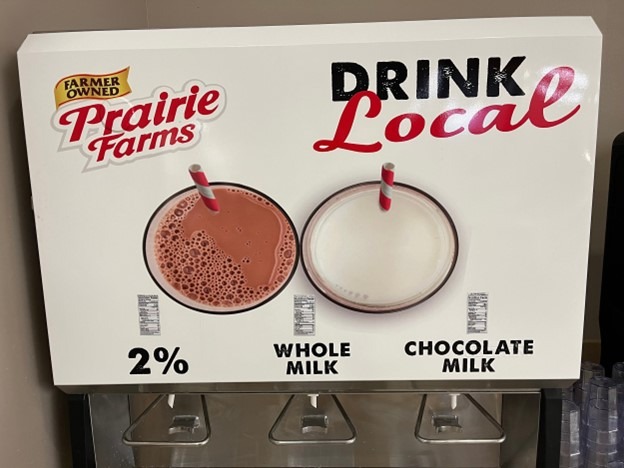
The milk dispenser in this cafeteria is in a separate location from the water, soft drinks, and coffee section, so last week was the first time I noticed it because I don’t drink milk at lunch. It caught my attention because of the logo: Drink Local.
My first question was, “Why?” You can tell from the photo that there’s no room to answer my question. If the designer attempted to explain the virtues of being a local milk distributor, the marketing space would be junked.
However, it challenged me to ask the same question about local radio. Our industry preaches the benefits of being local, one of radio’s greatest differences. I’m not using this space to say radio should be more or less local. But if we make this a marketable difference, we have to show why we’re local. It’s not enough to say it.
Here are two questions to consider when you’re waving the ‘we’re local’ flag:
Why? Do you believe Local makes a difference?
Radio isn’t different from other brands attempting to explain its differences. Often, we proclaim a message without asking a simple question. Why?
Get your team together and ask this simple but critical question. “Why do we think local makes our brand more appealing to the listener?”
Write it down, write it down, write it down. Your ideas have more power, purpose, and persuasion when you can see those ideas.
Where? Open your eyes and smartphones.
Analyze every hour of your operation. Does your talent know the strategy and tactics for local references and mentions?
Talent: Open your eyes and journal about your trips and commutes to make references that your local listeners understand. If you track outside the market, use your smartphone to research the marketplace with map apps. Driving the signal is essential, but the smartphone gives us opportunities we didn’t have 20 years ago.
Rethink: Some programmers think Traffic reports are a waste of time in the smartphone era. Your sales manager may think the revenue isn’t a waste. Can you find an entertaining local personality to deliver your reports and make it a bit? The same applies to weather reports, business, new music, and agriculture features. Where can I find someone to make this feature feel more local? Get a high school student to host your local music or new music feature and watch their local influencers connect to your brand.
Rethink II: Why did we stop announcing school closings? I know why. It’s the smartphone. But would you sound more local if you brought back this feature? If a student from every high school in your district were responsible for calling the morning show, you would get more than a closure update.
Rethink III: One more. If you want to do weather and the local TV station isn’t reciprocating the promotion of your brand on their station, then call a different convenience store clerk every morning to get a weather update.
There are dozens of ways to improve your local appeal, but you have to make it a strategy as crucial as your format strategy. Find the connection to your audience. A local cafeteria is an excellent place to start the process.
If Kelvin Washington were a baseball player, he would be that incredibly reliable veteran player who can play all over the field, be your emergency catcher, pitch in a blowout, get you a big hit when you need it, and he would be the one trying to crack everyone up in the dugout trying to keep everybody loose. As a broadcaster, in his own words, “Utility player is an understatement.”
Consider his new schedule starting today. His weekday mornings will be spent on television working for Spectrum News 1 in Los Angeles where his show airs locally from 6 a.m. to 9 a.m. His late afternoons/early evenings will see him on FOX Sports Radio as the new co-host of The Odd Couple with another savvy veteran, Rob Parker. Washington is taking over for Chris Broussard who decided it was the right time to focus mostly on his television show on FS1. The show airs from 7 p.m. to 10 p.m. ET which is 4 p.m. to 7 p.m. for Washington in L.A.
Sprinkle in 15-20 Los Angeles Dodgers games doing pre- and post-game shows or whatever else might be needed for SportsNet LA along with a (clearly understanding) wife and three kids and you have one busy man.
Washington has worked with Fox Sports Radio & Premiere Networks Senior Vice President Scott Shapiro and Don Martin, Executive Vice President of Programming for iHeartMedia Sports for several years. Washington couldn’t be more excited to have finally found something regular where he can work with people he truly respects.
“Don and Scott have been great to me for years,” Washington said. “We’ve been doing business with each other for quite some time. But finally, being able to find something that makes sense, and everything aligned. The TV station asked, ‘how do you feel about mornings?’ And then three days later, I’m doing lunch with Don and Scott, and they say they have an opportunity for me later in the day, which I couldn’t have done if I hadn’t already decided to move to mornings. Literally it just all aligned perfectly.”
Washington loves what he does and is very pumped up to get started as a regular on FOX Sports Radio. He does say however, he wouldn’t advise anyone to try and follow in his exact footsteps.
“When I talk to young folks and people I mentor, I tell them don’t do what I did. It just happened to work for me. The point is you don’t want to be the jack-of-all-trades per se, what you want to do is master one thing and then other opportunities will present themselves. It’s like that rapper/musician who’s good at it. And the next thing someone wants you to be in a movie or wants you to do a hosting gig. That person mastered being a musician and artist and other opportunities came. For me radio was that thing. Radio was the thing that I got really good at and then TV opened up its doors and voiceover work and hosting events and all of that came after.”
After the announcement was made that Washington would be his replacement, Broussard reached out to him and the two had a conversation that was very important to Washington. He didn’t want to go into all of the details of what was said between them but did say Broussard was very supportive of him being the choice.
“I’ve known him for a little bit, and he just called me and told me that he’s happy for me and that he really was excited specifically for me and this opportunity and he thought I’d be great for it,” Washington said. “He thought I was versatile and talented and that I would be able to add to the show and kind of give it a new spin. It was awesome to get that from him. He’s somebody I look up to in this business, somebody who I have great respect for. Professionally and personally, just a great guy, great dude. He was good at his job, but he’s also a great human. So, it was really great to get that especially considering he’s been there since the show’s beginning and built the house with Rob.”
Washington said he and Parker have known each other for many years, have hosted shows together and socialized, so there is a comfort from the start with the new show partnership.
“I’ve known Rob for years,” he said. “He has come to my birthday parties. I’ve known Rob for probably more than 12 years now. I’ve had him on my shows, he was a guest on my podcast. So, we’ve done things together.
When asked about what he will bring to the show that will make listeners realize they are tuning into The Odd Couple, but a different version of the show.
“First of all, I bring some ‘youthful energy.'” That statement was made with air quotes and as Washington said, “I’m making just fun of my older brothers, my older mentors. But I bring a different perspective. I think my presentation, the way I do sports is different than others. A lot of people are hell-bent on hot takes, and I bring kind of an everyday, average Joe perspective to things. Also, a lot of humor, that’s really my bag that’s my wheelhouse, bringing a liveliness to it, an element of cool too, being honest. You put all that in a blender, we’re gonna have a really good time. I think listeners will have a really good time as well. And that’s the whole goal to make people feel like they can’t miss this.”
While Washington enjoys what he gets to do on television, radio is where it really started for him and is something he really enjoys doing, given the differences in the amount of time you get to spend on subjects.
“Radio is a personal medium and to be honest with you, this is the excitement, this is the joy for me,” he said. “To be able to do what I do on TV, then get to radio where I can expound on my opinions and expound on these conversations…I can spend a whole 12-minute block talking about the Tyreek Hill situation if we choose to. On TV, sometimes it’s ‘here’s an update on what happened.’
“On radio we get to talk the whole segment. It might even be a half-hour. We’re going to dedicate time to this or that because it’s that important or that funny or it might just be a topic that excites us. I am excited to utilize those muscles more than I’ve been able to do in quite some time.”
September 16, 2024, is the date the new era of The Odd Couple begins. For Kelvin Washington, it is a culmination of a lot of hard work over the years paying off. Getting to co-host a daily national sports talk radio show on FOX Sports Radio is a big deal and he is up to the task and ready for what is to come.
“Somebody’s got to still go at Rob,” he said. “Somebody’s still got to keep Rob in line, keep Rob in check. And I think I’m the man to do that. To carry on what my brother Chris Broussard started. I think listeners should be prepared to have a different, unique sound to a sports talk show. I think I bring something different than Rob, that’s what makes it The Odd Couple. And I’m not trying to replace Chris Broussard, I’m trying to add a different element that will continue to move the show forward.”
Among the other things I do in my semi-retirement is hold membership on the National Association of Broadcasters Committee on Local Radio Audience Measurement, better known, if at all, by its acronym of COLRAM. Over the years, I’ve been involved with COLRAM as an NAB staffer, a member (two times), the chair, and presented to the group countless times while working for rating services. One of the rules for COLRAM members is a twist on the old Las Vegas slogan, “What is shown to COLRAM stays in COLRAM.” This “cone of silence” allows Nielsen and other companies to talk about their plans, get feedback from members representing the pantheon of radio companies, and not read anything about the discussion in the trade press.
In late July, Nielsen made a presentation to COLRAM about a potential change in how quarter hours are credited for PPM. It’s major. I’ve not written about it to date because the presentation was confidential. However, the whole industry appears to know about it and Jason Barrett mentioned the change in his closing comments at the Barrett News Summit in DC earlier this month. If Nielsen is sharing, then let’s talk about it.
The planned change is this: Instead of five minutes in a clock quarter hour earns the QH, the new rule would be three minutes for PPM markets. Nielsen has shared some preliminary data and they’re doing more analyses now. You don’t need a Ph.D. to figure out that AQH and cume will increase, which is certainly good news.
Radio listening levels (Persons Using Radio; PUMM is a useless acronym) have been decreasing for a long time. The last boost to levels came in the mid-2010s when stations discovered that the Voltair unit could improve their ratings. For a couple of years, PURs improved as stations installed Voltair in their chains. Once everyone had Voltair, the levels started their downward march again. This change is a way that Nielsen can “goose” the numbers…for a year.
There is a precedent for a “three-minute rule”. While no one at Nielsen knew it, some of us who have been around for a while remembered that the network radio service, RADAR, recently put out to pasture by Nielsen, used a three-minute rule prior to the purchase of the service by Arbitron in 2001. RADAR, when owned by Statistical Research Inc. (SRI), collected their own listening data by phone and used “three minutes gets you the quarter hour”. After Arbitron bought the service, the results were based on diaries (PPM was incorporated later using the five-minute rule. A three-minute rule is not new, but rather an obscure bit of radio ratings history. SRI was run by the late Gale Metzger, considered by many to be “the pope” of audience measurement. If Gale thought three minutes was acceptable, that’s a good start.
So far, so good. AQH ratings go up, cumes, already very high in PPM, will go up, too. There will be some differences by demo, race/ethnic, and format, but we’ll leave those analyses to Nielsen.
What will it mean to programmers? Since PPM was rolled out, programmers have typically used “bow tie” stop sets, around :12 and :42 after the hour. With multiple stations in a cluster and some with overlapping audiences, other stations may have stop sets at different times. I advocate either :06 and :36 or :21 and :51 because having six minutes into the next quarter hour would give QH credit. The extra minute accounts for jocks starting the break early or a condition known as “clock drift” where a panelist’s meter is slightly out of sync with the station’s encoder, in other words, an insurance policy.
In my opinion, a three-minute rule shouldn’t change where you place your stopsets although my preferred option might be two minutes earlier. The initial Nielsen data showed a surprising number of short listening sessions, so making major changes in reaction to the change will probably not be productive. Better programming minds than mine may have other thoughts.
Programmers in PPM markets have been dealing with the concept of short listening sessions for over a decade. While I’ve written about how I disagree that the average listening session is nine or ten minutes (turning down the audio for more than a minute starts a new session) but is perhaps as long as a half hour, keeping things short and sweet and driving forward momentum should not change.
I’m looking forward to seeing the next analyses that Nielsen will present. We’ll see more markets, more demos including race/ethnic, and more dayparts. One question in my mind is if cumes for broad dayparts go up by any significant percentage, does that imply that we have a lot of radio listeners who spend less than five minutes a week with radio? A scary thought.
Fred Jacobs is the president of Detroit-based Jacobs Media. He founded the company in 1983 and created the Classic Rock format when he conceived that Album Rock could be fragmented. He first launched the format in 1985 at WMMQ in Lansing, Michigan.
Before starting Jacobs Media, he was the Program Director of WRIF/Detroit and the Director of Research for ABC-FM-owned and operated stations. In 2018, he was inducted into the National Radio Hall of Fame, the first consultant to achieve that honor.
He is this week’s featured consultant.
Jeff Lynn: As the creator of the Classic Rock Format, you must be happy to see the current success of Classic Rock and Classic Hits. To what do you attribute its ongoing popularity?
Fred Jacobs: There are several things, much clearer to me now than they were back in the 80s. First, was the realization this is some of the best music ever made. You cannot sustain a format at a high level of success for more than four decades if the content isn’t stellar.
The format happened right as 1) 25-54 became the agency demo of choice, 2) It played into the huge bulge of Baby Boomers, by far the most people generationally, 3) radio and MTV at the time were focused on currency and hits, so the contrary position was big and available. And 4) seemingly a small thing, but compact discs emerged right at this point, an opportunity for fans to “upgrade” their record collections. Ironically, 40 years later and CDs are all but extinct, and vinyl is back.
JL: How have you evolved the format since you launched WMMQ in 1985?
FJ: In so many ways! Back then, Oldies stations on FM were something of a rarity, so my Classic Rock contained appropriate “oldies,” including Motown (especially at MMQ), British Invasion material, etc. It pretty much stopped at 1978. Playing U2 was controversial in the early years.
And of course, the first generation of Classic Rock radio stations was deeper. The prevailing criticism was that the format would burn out, so we were always looking for library stunts. That was the period when “No-repeat” days/workdays became popular features, too.
I always believed these stations needed to be full-featured – morning shows, knowledgeable personalities in the dayparts, well-produced with “nostalgic tugs,” and, of course, contests.
We intentionally shied away from Pop and artists with a strong Top 40 pedigree. And while that may have worked for many Classic Rock stations, it opened the door for Classic Hits and the Jack format.
JL: How far has the median age of the music moved?
FJ: As you’d expect, the 60s – even the Beatles – have diminished, the 80s now tend to be more dominant than the 70s, and the early 90s are increasingly fair game.
All these adjustments are about the quest to retain competitive 25-54 demos as the natural audience for Classic Rock ages. It is a generational format, meaning the people who grew up with the music will always cherish it. But many of them are well north of 60 years of age.
Interestingly, millions of younger people have discovered the music in myriad ways – from their parents, TV and movies, social media, video games, and of course, commercials. All that exposure has helped Classic Rock stations sustain a viable level of success.
Interestingly, many of the young people who love the format tend to be passionate about the original Classic Rock – the Doors, the Beatles, the Who, etc. It’s the 45 year-olds who typically are more interested in Nirvana.
JL: To that end, how are you advising stations to handle the 90s product? Sonically, it can sound very different, and it can be hard to make the songs on either side flow together.
FJ: It’s a dance, to be sure. A lot depends on who’s in your building and who’s across the street. If there’s a mainstream rock station in your building, there may be less pressure to dig too deeply into the 90s. But if that station is a competitor or perhaps nonexistent in the market, that’s another question to be addressed.
The 90s tend to test very well among many Classic Rock fans. The harder question to address is whether they want to hear Pearl Jam or the Chili Peppers on their favorite Classic Rock station.
How you position the music on the air and in your marketing is another important question. Does it just show up or do you draw attention and tee it up?
JL: What do you say to the naysayers who say that, eventually, the stations will march off the cliff with the aging audience?
FJ: They’ve been saying it for 20 years (or more)! There’s been enough personality and stationality on these station to help lessen the natural aging of the format.
And, of course, we know the format can fragment, creating several different versions. Again, depending on the cluster and the competitive situation, these formats will continue to endure.
JL: Can you make a statement as broad as “the pre-White Album doesn’t fit anymore?” Or is it 1973, which seemed to form a sonic line?
FJ: I can’t and I won’t. Radio people are far more sensitive to the chronology of the music rather than its sound. The iPod helped usher in a mindset where years and even eras took a back seat to the spirit of a song. Programmers can get too pedantic about adhering to years rather than letting the sound and popularity of songs dictate airplay.
JL: How important do you see talent in the presentation?
FJ: It’s huge – and I’ve believed that since the beginning. My earliest Classic Rock stations included morning shows, maybe not always the market leaders. But it was always imperative to me to have entertaining morning shows along with local daypart talent who mean something to the community.
Today, a younger morning show with passion for the music can create both “cume urgency,” and also a bridge to under-50 demos.
JL: Can you share some advice for a social media strategy?
FJ: My feeling is that your best engagement is to get your audience on social media (typically Facebook) talking about the music and what it means to them. Smart local stations also use nostalgic symbols and milestones (venues, concerts, sports teams, etc.) that conjure up key emotions.
This is a passion format that plays emotional, evocative, and meaningful music. It’s scores in radio research studies often exceed how music tests in other formats. Lean into that.
Photo: Jacobs Media
JL: What is the best promotion or marketing idea you have seen recently?
FJ: Sadly, there hasn’t been anywhere near enough recent marketing or promotion to point to. In the past couple years, in the wake of the pandemic, consumers have shown a desire for the experiential – events, experiences they probably could not afford or arrange themselves. “Getting them backstage” is always optimal, bringing them closer to the greatest music ever made.
Most of the promotion I see – not just in Classic Rock but also throughout broadcast radio – is standard issue stuff: win-it-before-you-can-buy it, 5-4-3-2-1, etc. No wonder radio listeners have a feeling of déjà vu when they tune in local stations.
A contest I thought was fun, interesting, and something even non-participants could play along with vicariously was the “A-to-Z Game” which I believe originated with The Drive in Chicago. It checked off all the boxes – simple, big cash prizes, artist oriented, etc. I like promotions that are “tactegic” – combining tactics and strategy.
Bonus question: How are you using and advising clients to navigate the AI world?
FJ: We’ve been very active on this front. Rather than robot DJs, our focus has been on working with stations on efficiencies from AI that can save time so programmers (and talent) can focus on content creation and creative endeavors.
In our AQ surveys, I find it disturbing how few personalities feel the need to learn about this technology. You future-proof yourself by being tech-forward and proactive. If past is prologue, we know that embracing technology early – streaming, podcasts, social media, video – often give you a leg up over your competitors and even your co-workers. “Innovate or die” isn’t just a slogan – it’s an operating system.
Reach out to Fred by email here. Or by phone at 248.353.9030