Georgia Tech fans are wondering what happened to their radio analyst. The team played Syracuse this weekend in college football and Georgia Tech legend Joe Hamilton was not in his usual spot alongside Andy Demetra in the team’s radio booth. What is more concerning is that the Atlanta Journal-Constitution did some checking to see what the reason was for Hamilton’s absence and has not gotten anyone to explain.
According to the story, they reached out to the school for comment on the situation and they were referred to Georgia Tech flagship station 680 The Fan where Hamilton is also a part of their morning show. Hamilton is one of the co-hosts of The Locker Room with Brian Finneran, Brandon Leak and John Michael.
The College Football Hall of Famer was replaced in the booth this weekend by former team analyst and former Georgia Tech offensive lineman Sean Bedford.
Hamilton is one of the best players in the history of the program. A former South Carolina High School Player of the Year in both football and basketball, he played for Georgia Tech from 1996-1999 and in his senior year was named a first-team All-American who was also a Heisman Trophy finalist.
Hamilton has worked on the team broadcasts since being added to the pregame show in 2021. According to the newspaper, this is the first game Hamilton has missed since he started.
1300 The Patriot in Tulsa has received a new expansion on the FM dial as the iHeartMedia news/talk station can now be heard on 93.5 FM in the Oklahoma market.
In addition to being heard on 93.5 FM, the station will also be heard on 106.1 HD-2, in addition to its 1300 AM signal. The station replaces the previous classic rock format on the signal, 93.5 The Jet.
“The Patriot has become a trusted voice in Oklahoma, and this expansion is a testament to its success,” iHeartMedia Area President JC Lowe said. “By broadening our reach to FM and HD, we’re ensuring that even more listeners can engage with the high-quality talk and news content that The Patriot delivers every day.”
“The expansion to FM and HD radio allows our audience to enjoy ‘The Patriot’ on whichever platform they prefer — whether that’s on AM, FM, HD radio, or digitally through iHeartRadio,” added iHeartMedia Tulsa Senior Vice President of Programm JJ Ryan. “Regional news director and PD Brian Gann has done an outstanding job in transforming KAKC-AM into a trusted source for both local and national news. We’re proud to continue offering top-tier programming from national personalities including Michael DelGiorno, Glenn Beck, and Clay Travis & Buck Sexton.”
Now more ways to listen to The Patriot! You can now hear us on 93.5 FM, 106.1 HD2, 1300 AM and on the iHeartRadio app. We are The Patriot! Real Talk! pic.twitter.com/5Y7T5G18G7
Android Auto is preparing an update that will include a new highlighted AM/FM radio functionality that had previously been missing in the software.
With the update, users will be able to utilize their built-in terrestrial radio features without having to switch out of the Android Auto app, equalizing over-the-air radio with streaming music options like YouTube Music, Spotify, and Pandora.
According to a report from Android Authority, the new features will be unveiled in the version 12.8 update of the app, which is likely to be released in the coming weeks.
In past iterations, users would be forced to exit Android Auto and return to their dashboard’s infotainment center to utilize the in-car radio features. But with the update, that should eliminate the switching back and forth, being viewed as a safety measure as much as an entertainment option from Google.
The 2024 BNM Summit is in the books, and fortunately, everything turned out great. Our lineup was strong, and eighteen amazing partners pledged their support to the show. The Jack Morton Auditorium looked outstanding, and everyone I talked to said they gained value from the conference. The After Party presented by Collette at Circa was also excellent. It was awesome seeing Marsha Landess of Radio One win the trip to Spain. My only regret was not having more time for conversations with everyone. That’s the downside of hosting, producing, and overseeing the show.
I said last week that IF we did a show in 2025, it’d take place in New York City, Philadelphia, Dallas or Los Angeles. Voting is open on BNMSummit.com. I use the word ‘if’ because I go into each show knowing it could be the last. If sponsors don’t support us or if people don’t show up, then it’s a sign to do something else.
We invest eight months creating two valuable days for attendees. I believe it’s important to examine key issues with accomplished people, highlight difference makers, identify areas of weakness and offer solutions, and unite radio, digital, and television talent, executives, sellers, and behind the scenes professionals. Having had a few days to process what took place, here are my key takeaways from this year’s show.
Talent: Clay Travis, Brian Kilmeade, Todd Starnes, Jeff Katz, Tony Katz, Chris Plante, and Steven Portnoy were simply fantastic. Each brought different things to the stage, and showcased why they are exceptional. Plante and Portnoy had excellent chemistry, and a compelling discussion that included some disagreement. I especially enjoyed Chris’s perspective on a neutral news network and if it could work. His response on whether or not the media is hard enough on Donald Trump was also superb.
Starnes, Katz, and Katz (I should’ve named them ‘The Law Firm’) were awesome with Mike McVay. They provided tons of insight on using local events and social media to stay relevant, and grow revenue and relationships. Todd’s points on hiring Gen-Z employees to add differing perspectives in the workplace were also smart. Their points on show prep, and management standing behind their people also were valuable.
Clay Travis and I always have great conversations about the business. There’s mutual respect, and chemistry when we connect to discuss issues. We examined Google and Facebook’s censorship issues with Clay advocating for Google to be broken up. Travis says the tech giant should be forced to spin-off YouTube as part of its anti-trust practices. He also addressed dealing with death threats, the pros and cons of owning your own advertising, how he measures the effectiveness of content in audio, video and written form, the growth of Clay & Buck, and more. When Clay speaks, you learn something. Meet him afterwards, and you’ll find he’s great to interact with too. I’m appreciative that he takes the time to fly to town to join us at the show.
Brian Kilmeade was another guest I really enjoyed talking to. We explored his daily prep process, interview strategy (listen to his Donald Trump interview – short, succinct questions, timely follow ups, control of the conversation), building a national show without owning stations, and what he does to retain trust from affiliates. Brian calls into his affiliate stations, travels to select markets, and has even offered to talk to potential local advertisers. That’s what being a partner is all about. At one point he complimented the prep work put into the session. That was gratifying because I spend hours digging for audio, video, and creating images to support conversations I have with my guests. Keeping an audience interested requires doing the homework. I’m glad he took notice.
Research: Daniel Anstandig of Futuri was simply outstanding. His examples of what is/isn’t AI had everyone recognizing that the quality of content had no slippage when it isn’t human. Nobody who watched his session didn’t learn something about artificial intelligence. The same was true of Gordon Borrell’s reality check on the advertising climate. Professionals in the room were nervous about the AI and advertising realities, but these things are real. It’s on all of us to learn and adjust. Larry Rosin and Laura Ivey also delivered fantastic data on listener habits, information that programmers always appreciate. Jim Cutler was great as well, showing through video and audio creativity how to use imaging/content in better, smarter ways.
Programmers: Seventeen programming executives spoke at the show. Thirteen others were in the room as attendees. I was very happy about that. That doesn’t happen at other shows. Every news/talk program director and executive should be at this show. It covers everything that matters to your business. Swinging An Election with Greg Stocker, Mike Spaulding, Ken Charles, Martha Maurer, and Pete Mundo was very compelling. The same was true of The Network Advantage with Liz Alesse of ABC News Radio, Kevin DeLany of Westwood One, John Sylvester of Fox News Audio, former CBS News Radio GM and current WYPR GM Craig Swagler, and Lee Harris of NewsNation. Their back and forth on AI and what is/isn’t ethically acceptable was especially riveting.
Julia Ziegler, Chris Berry, Drew Anderssen, and Steve Moore joined The Programming Party session and shared a lot of expertise on events, reducing inventory, election fatigue, reaching younger audiences, and more. All four brought excellent opinions and insight to the stage. I also enjoyed putting Jeff Wade, Mike Schaefer, and David Wood On The Spot with special appearances by Erick Erickson, Dave Tepper, and JJ Surma. When the on-demand videos come out, I encourage folks to go back and re-watch each programming conversation. There were many valuable takeaways.
Market Managers: We had more market manager involvement this year, which was excellent. Joel Oxley, Chris Oliviero, and Jaleigh Long were tremendous. From covering the decision to move on from WCBS to exploring the challenge of selling podcasts on a local level, and improving diversity in management, I thought Joel, Chris, and Jaleigh offered a lot of smart takeaways. The conversation led by Dave Greene with Michael Spacciapolli, Marsha Landess, and Tim Wenger was also valuable. What I enjoyed about both sessions is that the room heard from leaders in large and mid-sized markets, discovering the similarities and differences faced by those leading.
Business: Julie Talbott of Premiere Networks, Christine Hoffman of the Daily Wire, and Steve Passwaiter of Silver Oak Political had a very compelling conversation with RAB CEO Mike Hulvey. Some of the information shared by Passwaiter on political spending didn’t make folks feel warm and fuzzy, but similar to Borrell’s session, they know where the money is moving. Knowing that is important if we hope to improve our situation.
Executives: Curtis LeGeyt was candid, engaging, and showed why the industry is in good hands with him leading the NAB. We tackled the AM For Every Vehicle Act, big tech’s monopoly, the pros and cons of artificial intelligence, the decrease of local news, and the role of broadcasters in the upcoming election. He explained why the AM Radio bill hasn’t passed yet, but my bigger takeaway was that he sees a massive problem with big tech. “This is the area where Washington needs to step up, period. We need modernization of FCC limits on ownership limits, period. Make no mistake, there are fundamentals here that no local media is going to be able to compete with Google, Facebook, Apple, and Amazon.” I highly recommend watching the session once on-demand videos are ready.
Another important executive discussion at the show featured Dan Mason and Alfred Liggins. Alfred’s closing story of trying to gain advertising from Pepsi and landing a lunch meeting with their key decision maker that saw him order a coke produced a ton of laughter in the room, but the conversation about AM Radio’s value, and the challenges associated with Nielsen’s PPM measurement were the most important. Hearing two prominent industry leaders examine the future of the industry was healthy for the room.
Recognition: Thanks to Premiere Networks we were able to create our inaugural awards ceremony to honor industry game changers. Joel Oxley of WTOP received the Gold Standard in Business Award, Ken Charles took home the Gold Standard in Programming Award, and David Kantor was the recipient of the Gold Standard in Leadership Award. All three gave fantastic speeches, and appreciated the recognition of their work. David’s advice on forming a now the psychological contract with your people that will get your team to follow you anywhere was excellent. I love seeing great people and work recognized, and am thrilled that Premiere Networks believes in it too.
Closing: In my opening and closing monologues, I talked about news/talk radio leaving dollars on the table due to a lack of video strategy. Digital video ad spending is growing higher than everything else. Social media platforms prioritize video content over the rest. Yet most news/talk stations miss the mark on YouTube, Rumble, and social media. Uploading a daily video isn’t a strategy. Facial recognition in your photos, using the right keywords in your titles, creating a consistent look and style in your images, all of these things matter. You need over 1,000 subscribers and 4,000 watch hours in a year to be eligible for monetization. Based on what I’m seeing, most aren’t capitalizing in this department.
The other big issue that radio folks need to understand is that future revenue growth is NOT going to come from radio. It’s going to come from the internet. You can do what you’re doing today as good tomorrow or even do it 10% better. That assures you of staying even or gaining 1-2%. If you don’t think and operate like a multimedia brand you will remain flat to down, and exist rather than thrive. The New York Times is not a newspaper anymore. It is dominant at video, podcasting, social media, newsletters, and print journalism. The Times understands that growth must come from dominating more than one space. Radio needs to do this too and soon.
We have a few things to adjust on our end next year. We had more people on day 1 than day 2 despite a strong speaker lineup on the second day. Do we adjust Day 2 to a half day? Create a farewell breakfast and one-hour awards show? Stay the course? That’s something we’ll discuss and debate, and figure out in the months ahead.
Less students were also in the room due to the event taking place after the first week of school. With our sports conference taking place in May 2025, we’ll have to determine if September, October or November makes the most sense for the 2025 BNM Summit. An election won’t be in the way next year.
There are news media groups and individuals who still have not experienced this show. I’m disappointed by that but remain optimistic it will get better. The 2024 Summit was stronger than the 2023 Summit so we’re making progress. But there’s no excuse to not be here if you work in news media and care about growing your business. A few folks mentioned the cost of tickets. For 8 months they were priced between $199 to $299 for the two-day event. Other industry shows charge more. Benjamin Franklin once said ‘an investment in knowledge pays the best interest.’ I believe that. More talent, market managers, and programmers would learn that too by joining us.
The next step is editing all of the video of the sessions, and making them available on-demand. I’m hoping to get it all done this week. Look for videos of our backstage conversations in the Core Image Studio Green Room, and a bunch of short clips to hit social media, and YouTube as well, thanks to our friends at Fox News Audio. I appreciate everyone who made the trip to DC. I hope you felt the two days were beneficial. I’m eager to hear you use the information to improve your brand, staff, and self.
Been to a Starbucks lately? Chances are that your local store removed all the seating, or replaced the plush chairs with less comfortable seats, sometimes lined up on one side of a narrow table. Where the stores used to be inviting for spending a lot of time there, perhaps working on your laptop or chatting with friends, they’re now designed to deter you from hanging out there. That’s deliberate.
Even before the pandemic, Starbucks decided that they would make more money by concentrating on app orders and drive-thrus, and having people spend hours in the store without buying a lot of coffee wasn’t generating that kind of income. The Starbucks that sold CDs of its music soundtrack and encouraged community is a thing of the past.
The same thing is happening to Barnes and Noble. You know the sad story of bookstores in the past two decades, and how the big chains hurt or destroyed local booksellers, then got hammered into oblivion themselves by Amazon. But you may also have noticed several articles about how Barnes and Noble seems to have turned a corner and is, from all appearances, resurgent. In fact, the chain recently opened a new store around here, halfway between two existing stores, and other locations are on the way. The difference, though, is this: The new stores are much smaller and don’t have chairs and cafés – they’re not like the older stores, with people sitting around drinking coffee and reading magazines without buying them (you know you did that). Now, it’s go in, find a book, buy it, and get the hell out of there. No lingering.
This is part of a trend that got accelerated in the pandemic: the loss of what are called “third spaces,” places where people gathered away from home. That’s a sociological term that encompasses everything from coffee houses and bookstores to barbershops and salons, shopping malls and bars, churches and libraries. Think “Cheers,” a place where you can gather to just be with other people and “everybody knows your name.”
Or not- maybe you’d be anonymous in a shopping mall, but you’d be surrounded by people walking and chatting and chowing down at the food court: a familiar and comfortable place to be that’s not home. Third places are not entirely gone, but there are fewer and the experience is not the same, and if Starbucks and Barnes and Noble are finding success by making their stores the kind of places you want to just go in, grab what you want, and go away, and malls continue to sport more empty storefronts, the future may find people increasingly in need of a place to be part of a community. With many people still working from home and having little or no in-person interaction with other humans, the need to have places to gather and see others seems to be urgent, just as those places are diminishing. The Covid Effect is real, and it’s not over (and may never really go away).
Some say that video gaming streaming online is a form of third space. Social media strives to be a third space, though, as with X/Twitter, the community aspect tends to be swamped by trolls and bad people, the online equivalent of that sketchy bar where the local Nazi contingent holds its meetings. But talk radio used to be another form of third space, back when it took phone calls, a place where you could hear all kinds of people spout all kinds of opinions, and it can be that again. Social media has that, too, but you don’t HEAR those voices, you read them. It’s not the same. Even if you don’t directly participate (calling in yourself or texting to the host), just hearing a variety of voices and opinions makes you feel less solitary.
As we’ve seen in Jacobs Media’s research, companionship is one of the reasons people use radio in the first place. The live interaction between caller and host is something podcasts can’t easily replicate. It’s one case for taking calls and text exchanges more and filling time with interviews less. No, it’s not the same as a latte and free Wi-Fi at Starbucks, but if it offers even an artificial connection, it’s something talk radio can do to remain relevant well after the election cycle.
Just remember to frequently give out the phone number. They’ll know what to do with it. And they can make their own coffee.
A cheese pizza slice or a Hawaiian pizza slice? Those were my choices at Reagan National Airport. There were more options, but most of the seats at the gates were filled with passengers, so my strategy was to get something I could eat standing up. Sometimes, a bad strategy is better than no strategy.
I was returning to Nashville on a Southwest flight and failed to check in 24 hours before the flight. After making a few C-student dad jokes in line with the last boarding group, I sat in a window seat in the last row.
It was a short flight, and my body space was cramped with my seatmate. I decided to sit still, listen to music in my earbuds, and take pictures of the clouds and the setting sun as the pilots chased it across the western horizon.
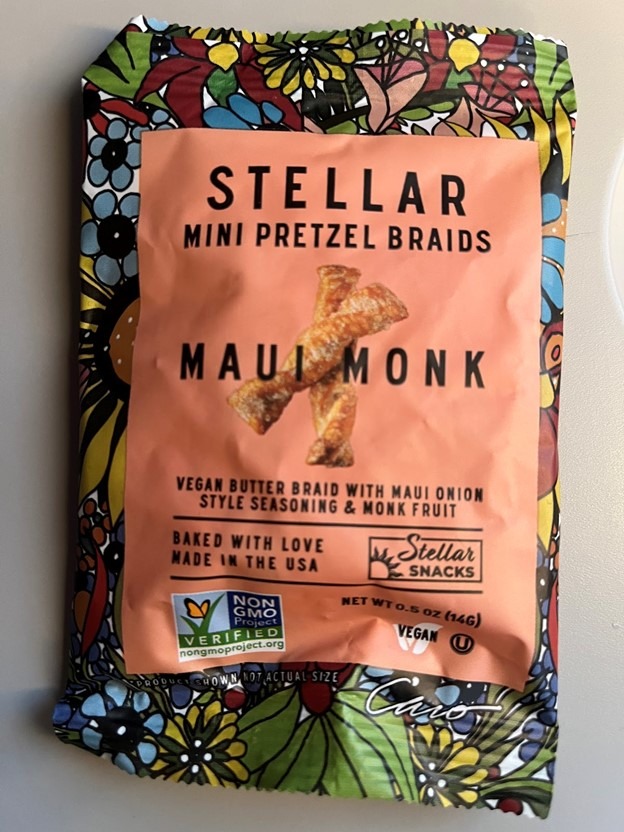
Whether it’s a 5:30 a.m. or a 7:30 p.m. flight doesn’t matter. Coffee is my drink of choice. I expected a snack-mix bag with black coffee. This bag was different. Stellar Mini Pretzel Braids. The packaging was colorful, and the flavor name was unique. Maui Monk is made with Maui onion seasoning and Monk fruit.
I assumed a Maui onion was a sweet onion native to Maui, but I had to research Monk Fruit while writing this. It’s a natural sweetener native to China. Combining flavors from Maui and China and placing the explanation on a multi-patterned bag to be given out to thousands of travelers daily is a lot of effort.
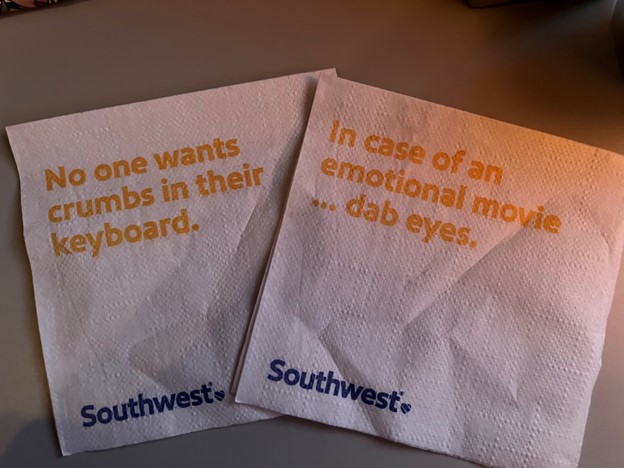
The details didn’t stop there. I turned over my Southwest napkins, and there were two creative messages. No one wants crumbs in their keyboard, and In case of an emotional movie…dab eyes.
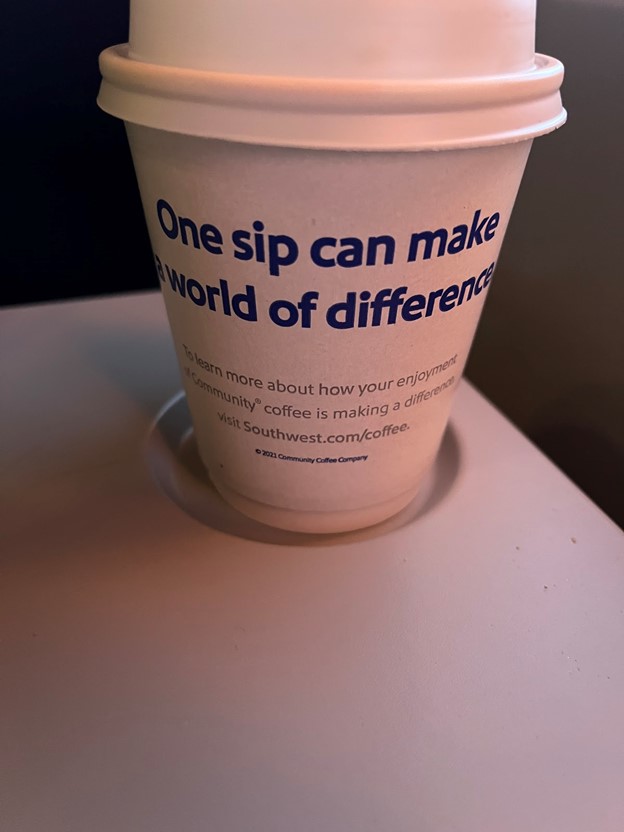
I turned my Community coffee cup around to look for a messaging hat trick, and I found it. Onesip can make a world of difference was printed on the back of the paper mug. I’m not sure what the difference is, but you can go to the link printed on the cup and learn more about the charity benefit. I smiled and thought, “Good job, branding/marketing team.”
Pretzels, napkins, coffee mugs. What’s the big deal? The attempt to make the mundane more imaginative or the routine a bit unusual is the deal.
Radio’s greatest strength is its ability to offer stable, predictable entertainment and information. No matter the format, music or spoken word, play the hits, right? Those hits, music or spoken word, are available from more audio platforms as we glide into the first quarter century mark of this millennium. If our greatest strength is often our greatest weakness, the predictable needs constant review and freshening.
Here are three categories to consider as we prepare for fourth-quarter audience engagement: We’ll stick with the theme of my flying experience.
1. Pretzels: The taste resembles most pretzels I’ve tasted at 30,000 feet. However, the creative packaging and a slight seasoning change made me feel like this would be a different experience. Add the word Braid, now I’m curious.
a. Freshen our music packaging. What makes your music (the pretzel) different from the other stations and streams playing the same music? How is it presented to the consumer? If Better and Best is your strength, great. But in the age of excessive media noise and on-demand access, we need to routinely freshen the package so the listener thinks, “Hmmm. What’s a Braid?”
2. Napkins: Messaging creates emotion. I smiled when I turned over the Southwest napkin and noticed the attempt to make a cramped, tired customer feel something in the moment. Did it change the flight conditions or the acid reflux I had after eating my Hawaiian slice of pizza? No, but I felt like someone in marketing was paying attention. Talent can change the feel of the moment through the power of turning a phrase. Station imaging is a weekly and daily evolving tool to connect your brand with the consumer. Imaging: It’s not just for seasonal updates anymore.
3. Coffee: Community is a vital difference for local radio brands. We can’t say we’re local. We have to be local. Do we communicate a strategy to our talent so they know how to help the brand accomplish a stronger community image? Do we educate our staff about our brand or cluster’s local initiatives like we would introduce the big Spring promotion? If there is no strategy, take a tip from Southwest and do it one sip at a time.
Be bold and imaginative and freshen your resolve to create a better product for the audience. Now, sit back and enjoy the rest of your flight.
It’s been a while, but the radio industry is being forced to give some attention to the Nielsen radio diary. Yes, the paper diary has been around so long that it’s almost eligible for Social Security, a true rarity in the world of survey methodology.
The reasons why the diary has hung around for such a long time are simple. While nothing is perfect, the radio diary works and is cost-effective. It’s easy for respondents to understand (the verbiage is meant to be at a sixth-grade level) and fill out. When you’re done, you just mail it back (postpaid, of course).
Still, everything must be updated eventually and for some time, we’ve had this thing called “the internet” which is used by nearly all of the United States population. Nielsen is right to take another go at adapting the diary to cyberspace.
If you’ve read my column regularly, then you know that Arbitron had an E-Diary back in 2007. It worked for the most part, but there were a couple of issues that caused its demise. Another attempt was made at Arbitron in the early 2010s with something called “Project Leapfrog”. While “Leapfrog” didn’t work out (a point I predicted internally well in advance), the company learned a few things.
Here we are in 2024 and now Nielsen is going at it again. This time, the name of the online diary is “mSurvey”. Participants will still receive incentives, but instead of those crisp dollar bills the company has been including with mailings for the last 60 years, online options will exist.
And “mSurvey” isn’t the only planned change. The initial screening questionnaire will also go online under the name “EScreener” (not very original, but the respondents won’t see that anyway). Again, it’s a positive move by Nielsen.
The big question will be around performance. What will response rates look like? More importantly for the client base, what will the listening levels look like? For now, Nielsen is telling us that they expect everything will look fine when this change comes into play, supposedly in late 2025.
Here’s what to look for: If I were to place a couple of dollars with FanDuel or Draft Kings, I’d bet that the online diary will have lower listening levels than the paper diary. My reasoning is the vertical “line” that is used in the paper diary to designate long listening sessions. Any radio person who has worked with the diary (and that’s most of you) and is having a confidential chat over a beer or two would admit that the diary can overstate listening due to the “line”. You can also argue, convincingly, that the diary misses listening, especially short listening sessions that do appear in PPM.
Based on quotes from Rich Tunkel, Nielsen Audio Managing Director, Nielsen is also expecting better representation from younger demos and minority groups. That’s possible and if it happens, it means a reduction in weighting which could mean less “bounce” in the estimates. I can accept that up front, but with OTA radio listening on the decline, will a “radio diary”, even in an online format, make much of a difference?
If the “mSurvey” test shows slightly lower listening than the paper diary, say 5 to 10 percent, I expect Nielsen will forge ahead claiming the results are closer to PPM. If the test results are significantly lower than the paper diary, we’ll see a real fight over it assuming Nielsen wants to move forward.
While I did not attend the webinar (didn’t receive an invitation), the trade press coverage mentioned that the initial test included all types of audio (AM/FM, streaming, satellite, podcasts, etc.). The next test will include only what Nielsen claims to measure. I think that’s a mistake and after attending the Barrett News Media Summit in Washington last week and hearing news/talk programmers say they’re trying to be “everywhere”, Nielsen should, at a minimum, allow the diary to include any audio that a respondent hears. Admittedly, the processing system can’t handle it today, but why not set a goal? And yes, that will require investment and prioritization on Nielsen’s part. Private equity-run companies do that all the time, don’t they? In the meantime, which could mean the next decade, diary subscribers could use the online diary review system to get a better idea of how people in their markets are using audio.
One other angle you have to understand: this must be a cost reduction move for Nielsen. The radio industry has enough trouble affording the Nielsen service today and isn’t likely to accept more cost increases. Nielsen has already done their share of cost-cutting as those of us who worked there hear about personnel departures on a regular basis. While some companies are “onshoring”, Nielsen continues to “offshore” to Mexico and India. As many radio operators know, at some point, there is nothing left to cut. The online system will cost less than the paper diary allowing Nielsen to save money. Unlike some retailers, don’t expect Nielsen to “pass the savings on to you”.
Let’s see what comes of the EScreener and the mSurvey. Robin Gentry was quoted in the trade press, and she’s a top-notch survey methodologist we hired at Arbitron a long time ago. She will report the results honestly, at least to the internal powers-that-be. By the way, the “Robin 87.5” sample entry in the diary instructions was named for her. I trust her.
If you’re in a diary market, sit back and wait to see what Nielsen reports, but understand what goes into the process and how Nielsen will appraise the results. The old saying always rings true: “When they say it’s not about the money, it’s about the money.”
Kenny Jay is a consulting partner at Albright & O’Malley & Brenner. He has programmed Country radio stations for over twenty years, including stops in Minneapolis, Seattle, and Chicago. He has experience with Record Label and Artist Management.
Jay has won numerous state broadcasting awards and was named a top Country PD by Billboard Magazine, CRS/Country Aircheck, and Radio Ink.
He is this week’s featured consultant.
Jeff Lynn: Country radio is in a good place right now. To what do you attribute this upcycle?
Kenny Jay: A party that both the core country audience and their non-country friends can enjoy and be passionate about. The format feels good, and that’s a position I felt like we had previously given to Classic Hits.
JL: Current music, which can be very cyclical, is also in a good place. With that, what makes up the formula for current vs. gold?
KJ: It really does vary by market and competitive situation, but a good starting point is 60% current/recurrent. Let’s not chase a current cycle like the format did in 2013 because, like all good parties, it must end sometime. And when the last music boom ended, the new fans and the core both left us.
JL: Pop artists crossing into the country seems acceptable to the country’s audience. Does the success of Post Malone and others surprise you?
KJ: Post specifically doesn’t surprise me because the core isn’t seeing or hearing it as pop. It’s outstanding music and an event that’s been a gift to the format. Where the format gets in trouble is when we play bad pop or bad country flavored songs.
JL: Is there a growing place for 90s music in the mix?
KJ: For most of our clients, we’ve been in the 90s the past few years. They perceptually test just as well or better than currents and are accepted by 18-year-olds as much as the older audience. Playing the right 90s for your brand and competitive situation is the key.
JL: Do you think all gold Country stations have enough huge hits to sustain a format?
KJ: It varies market to market, but yes. I like taking a classic hits approach to classic country, and so far, it’s yielded great results for clients in numerous locations. These brands make listeners feel good and are hit-driven, hyper-local, and fun.
JL: Is AI impacting the stations you work with or how you do your job?
KJ: Yes – In a good way. From setting up bits on the morning show to saving time writing spec spots, it’s a powerful assistant if utilized properly. Assistant in today’s radio world of running multiple stations, sometimes from remote locations, is a great thing. With any new technology or system, the hardest part is adopting it as a habit.
JL: How important is talent to the mix?
KJ: A critical point of difference in an unlimited world of content choices. While getting the music right is important, “DJs that sound like my friends” is still a top three position your radio station needs to own. (Talent, Music, and ‘Makes me feel good when I listen”)
JL: What is the biggest problem facing not just Country but the radio industry in general right now?
KJ: Resources to compete, and not just station A versus station B in a market. Our brands must be competitive in the larger content space that’s growing and evolving by the second.
JL: How important are the charts in helping your stations curate their playlists?
KJ: This prints more harsh than it’s intended, but very little. With respect to our industry partners, charts are not radio’s report card. With companies having their own initiatives making up a significant percentage of chart, stations have to find out what their local audiences want and give them more if it. Great example: Zach Bryan. ‘I Remember Everything’ was our best testing song the first half of the year and continues to be a secret weapon for our stations. We put the Ella Langley/Riley Green’ You Look Like You Love Me’ on in numerous places before it was a single because the audience was already there. Music’s moving too fast to wait for a chart to be an indicator of a hit song.
Connect by email with Kenny here. On socials @kennyjayradio
Throughout his time working in New York City on ESPN Radio, Mike Missanelli discerned the fandom embedded within the concrete jungle. Paired alongside Stephen A. Smith, the show became a national program in September 2007, appealing to listeners from around the United States tuning into affiliated radio stations.
Having worked in Philadelphia for his entire career up to that point, Missanelli perceived the New York fanbase to be diluted because of the amount of teams and various loyalties, a melting pot of sorts in this regard. When Missanelli returned to Philadelphia three years later as one of the earliest hosts on 97.5 The Fanatic, he knew where the audience had its loyalties and leaned into the regionalization that renders the sports talk format unique.
Missanelli began hosting in afternoon drive and assisted the station in developing an identity against the stalwart institution of SportsRadio 610 WIP. Despite having previously worked at the station with Howard Eskin, he entered the new entity with the objective to win in the ratings. He achieved that goal within one year under the direction of program director Matt Nahigian, triumphantly returning to the locale with a mindset to take no prisoners and facilitate the growth of the radio station. Working with producers such as Jon Marks and Tyrone Johnson, he conveyed unfiltered opinions with no qualms about how teams would feel towards his rhetoric.
Missanelli expeditiously became one of the hallmark on-air personalities, utilizing an approach predicated on candor and fanaticism. The show, which eventually moved to afternoon drive, became appointment listening for sports fans in the area. The ratings success, brand affinity and listener engagement Missanelli and his colleagues provided for 97.5 The Fanatic only made the eventual resolution all the more confounding with his abrupt departure in the second quarter of 2022.
“It left a bitter taste in my mouth – I’m not going to lie,” Missanelli said. “I think it was a misguided decision made by a misguided general manager, and so it really didn’t make any sense to me at all. It’s a business, it happens, and they decided to move on, and the station really, to be honest, took a downturn.”
Upon the departure of Missanelli, 97.5 The Fanatic introduced a new afternoon drive show and eventually revamped a majority of its weekday programming lineup. As a media free agent, Missanelli was offered an exclusive brand and content deal from Rush Street Interactive and subsequently joined its BetRivers Network. In working with the outlet, he started recording two weekly shows, including the eponymous program, The Mike Missanelli Podcast, and also performed other obligations for the sportsbook. Although Missanelli embraced the new endeavor, he yearned to interact with the callers, especially as the local teams realized success.
“It’s one thing to talk for 45 minutes, and I could do that because I was used to doing it, and having good guests and really interesting questions where I could really get into an interview, but I missed the caller involvement, and when I left, it was boomtown in Philly,” Missanelli said. “The Eagles had gone to the Super Bowl, [and] the Phillies [went] to the World Series, so while I was able to stay close to it through the podcast, I [missed] the day-to-day interaction with callers and what they were thinking.”
The podcast provided an outlet for Missanelli and a more disciplined route in that he could conduct longform interviews. At the same time, he continued conversations ranging from sports to everyday life, and he had a producer with whom he was able to interact. The show was able to resonate with the listeners; however, Missanelli was not necessarily aware as to who encompassed his audience.
“The thing about podcasting is you don’t know who’s listening [and] you don’t know who’s out there,” Missanelli said. “You get numbers at the end, but you’re just kind of putting a voice into the void and hoping it connects with people. Sports talk radio – you have that instant reaction. You know who’s listening because they’re reacting to what you say with a telephone call right after you said it, so it’s different, but it’s equally satisfying.”
Beasley Media Group announced in early January that Scott Masteller had been named the new program director of 97.5 The Fanatic. Two months after Masteller started the role, conversations began with Missanelli to bring him back to the radio station. According to Missanelli, Masteller informed him that he needed him on the air and thought midday was the slot that would work best. There was interest in commencing a new on-air stint, an outcome that became more imperceivable to Missanelli as the time passed.
“I really didn’t think it was going to happen ever, and the longer I was away from it, I said, ‘Well, that’s fine,’” Missanelli explained. “I got to an age where I accomplished a lot, and now I’m just in a different channel in my broadcasting life.”
The initial contract tendered to Missanelli contained several restrictions, and it was an arrangement with which he was disconcerted and did not sign. In fact, he had written off the opportunity and did not think he would make it back since the undertaking went beyond Masteller’s purview.
This past June, Beasley Media Group promoted Paul Blake to the cluster manager of its radio stations in Philadelphia, assuming several responsibilities previously held by market manager Joe Bell. Akin to his relationship with Masteller, Missanelli knew Blake from his time working on 93.3 WMMR during a brief respite from sports radio.
“I don’t want to go Godfather on you here, but they kind of made me an offer I couldn’t refuse, and the more I thought about it, I said, ‘Okay, let’s see if we can build something else here,’” Missanelli articulated. “That was the appeal – to build a show – [because] when I first came to The Fanatic, I was in kind of the same mode where I had built something that was significant, and that’s how they convinced me that I could do that at this particular time and this particular time slot.”
In the two years Missanelli was away from the station, the outlet struggled to find its footing and attained diminished ratings. On top of that, SportsRadio 94WIP had reshuffled its lineup following the retirement of Angelo Cataldi, including moving Joe Giglio and Hugh Douglas to the midday show, and garnered double-digit share flourishes amid weekday prime hours.
Meanwhile at 97.5 The Fanatic, the station shifted its morning show to add Andrew Salciunas with John Kincade and moved Bob Cooney to middays. When Cooney exited the station at the end of July, the station revealed that Missanelli was coming back to host his program with Bill Colarulo and producer Ray Dunne.
“It’s amazing – I hadn’t done it for two-and-a-half years, and I was wondering whether it would be different [and] whether I would have the same energy,” Missanelli said. “But once you get into a booth – and I find this with me [that] I don’t even know how sometimes I create a show – but I think the people that have done it for a really long time find it really easy that once they get in that booth and that light turns on, ‘On air,’ that your mind starts to work and put a show together, and I think that just comes with experience.”
Today The Mike Missanelli Show was joined by one Sixers legend, Dr. J, and someone who is perhaps a future Sixers legend, Jared McCain. pic.twitter.com/5cf0kcfd8O
Although the program has the same name, Missanelli is looking to craft a new energy and appeal to the next generation of listeners. Even though he is a longtime voice of the Philadelphia airwaves, he still feels 25 years less mature than his age and is attuned to modern culture. Missanelli talks about a discursive array of topics including award-winning singer/songwriter Taylor Swift and the cost for a pound of grapes at the grocery store.
“I think that the previous regime did not realize that you need to preserve the foundation of a radio station, and I think that was the biggest mistake they made,” Missanelli said. “Not just saying that [was] the be-all end-all, but I was part of the foundation of that radio station, and you just can’t remove a foundation and think that you’re going to keep going on. So I think that this new management recognized that, and I’m happy to be back.”
Missanelli carries ambivalence towards the effectiveness of the traditional radio ratings; however, he reviews the data since it is something management values. Yet he perceives the system as being flawed and utilizes other platforms and methodologies to measure the overall success of the show. Part of that is the audience on YouTube, a quantifiable metric that is approximately double that of the other shows over its first four weeks. There is an element of competition involved in the enterprise, most notably with SportsRadio 94WIP, and he hopes that his program can surpass other offerings in short order.
“You just have to do the very best and hope that people come along with you, and it’s really all you can do,” Missanelli said. “It’s a helpless feeling, but I think that if you have confidence in your product and what you’re putting out there every day, then you have to have confidence that they’re going to listen to that.”
Sports talk radio is a format Missanelli feels has changed in that the hosts do not always enter with a journalism background or the knowledge of how to cover stories or interview pertinent subjects. Missanelli was able to demonstrate his reporting proficiency within the two-person hosting format while also providing his legitimate opinions, which expedited its appeal and distinctiveness.
“I owe it to the listener, who is my audience, to give them the most honest opinion possible without regard to whether a coach is going to dislike me or an organization is going to dislike me, and so I’ve always thought of myself that way,” Missanelli said. “And listen, I’ve gotten on the wrong side of organizations for opinions that I’ve said, but if I’m being honest with myself and the listener, I can put my head on the pillow at night.”
Missanelli feels he has always been a good multitasker, and he will rely on those skills as he continues his working with BetRivers on his podcast. Additionally, he is co-hosting a true crime show based on a murder that took place in his hometown that has been a cold case for 62 years. These three projects, however, are not the first time he has balanced multiple ventures at once, taking part in a cooking show, weekly sports video blog and writing a children’s book in recent years.
“I taught a university class on sports law for eight years while I was doing sports talk radio, so I’m pretty good at that,” Missanelli said. “I’m pretty good at parceling off time to do other different projects and keeping my day full. I don’t like to be bored.”
Even though Missanelli has other interests outside of sports media, including his part-ownership of a winery and desire to play golf on Hilton Head Island, he is committed to the city of Philadelphia and 97.5 The Fanatic. Missanelli is not complacent or transfixed on his previous triumphs, and he hopes that this new chapter with 97.5 The Fanatic will further cement his indelible legacy.
“I want to make this show a really good show,” Missanelli said. “I want it to get high ratings. Before I retire for good, I would love to go out where I made a big difference in a radio station and built the audience to a point where it’s back being a viable, competitive station. I don’t know how long that is – I take it a day at a time.”
WBAP host James Parker is back home in Texas doing what he always dreamed of. “A lot of people are converted from either other professions or other formats before they get to talk radio. But this is what I’ve always wanted to do, and I knew it,” Parker said.
Parker’s journey began as an intern at 105.3. “I started as an intern, and I had to follow around the station I wanted to intern for a year, going to all of their live events around town,” Parker said. “They had all kinds of [events] like ‘meet us at the bar on Wednesday’ or they started playing dodgeball with some of their listeners.”
While playing dodgeball with listeners “started off almost as a goof,” it soon exploded into something more. “After three years of doing it, [the event] got so big, there wasn’t really a venue to hold it,” he said. “Like 2,000 people would come out on a Wednesday to play dodgeball. Yeah, it got out of hand. But we had to stop it because it got out of hand. We were having to rent fences to fence off the lot where we were having it. It became an insurance hazard.”
It’s through events like these Parker also was able to get his foot in the door. “I won a trip with the show to Cancun. It was one of those where you enter to win and put it in the box. I’ve done that so many times because I followed them for over a year. So, I went to Cancun with the show and at the same time, I was applying to be an intern for the third time. After that I finally got the job. So that was just my foot in the door.” Once his internship finished Parker became an overnight board op.
These lessons from his internship were not lost on Parker, who believes creating and attending events for your listeners is a way for the person behind the microphone to become real. “That’s kind of the school of radio I come from, because then it becomes real,” he said. “You know, once you become tangible, you’re not just a voice coming out of the radio. And so live events and promotions and going to other people’s events was a big part of what we did at my first job and something I have carried through.”
Today, he tries to make everything an event for his afternoon drive show. “If there’s going to be a presidential debate, we’re not just going to talk about it, we’re going to meet at Bottle Rockets and the Shops at Legacy. Then we’re going to watch it on the big screen, and I’ll make bingo cards and hand it out to you. If you can’t make it out to Bottle Rockets, I will email you a PDF of our bingo cards so you can play at home.”
It doesn’t matter to Parker how many people show up, but it is the connection he has to the community. While his opinions might not be for everyone, he still encourages his ‘haters’ to give him a call. “I love it,” he said. “I would rather [critics] call rather than comment. There’s nothing more boring than a bunch of people who are sitting in a circle agreeing with each other, like, ‘oh, no, you’re the best!’ ‘No, you’re the best.’ That’s boring. I like the people that say, ‘you suck.’ And I say, why? And then we have to talk about it.”
Another way Parker believes is a good way to connect with listeners is talking to people wherever you may be, “For 95, maybe even 99% of people, no matter what event you have, they’re not going to come out. So, going out and getting audio of other listeners and playing it, I think that’s a way to connect because they kind of see that as an avatar to themselves. Sometimes they do it at radio station events… Talking to people on the street, going to other events, like if someone’s having an event and you were going anyway, just pull out your phone and get some audio and play that back. So, when people hear non broadcasters on the show, I think that that could be a point of connection.”
While his internships showed him some unconventional ways to connect with listeners, Parker still rates his success in a more traditional way. “Ratings and revenue, that’s it,” he said. “The number of calls you get doesn’t matter the number of emails or likes that you get on Facebook or retweets or whatever. I mean, you want that and it’s nice, but we have two grades on our report card. Ratings and revenue.”
To push the envelope and increase his ratings and revenue, Parker said, “I try and be really funny with commercials, or at least somewhat entertaining, or make it something different. When I have the creative leeway to make my own runs of commercials instead of just making like four that rotate, I’ll make like 30 that rotate and try to put a punchline in them or something funny or something weird or make it a series. A lot of the other stuff I do, a bunch of other people do, but the commercials are probably different. You know, if you make your commercials interesting enough, people actually listen to them. And that seems to be pretty effective.”
If you are looking to follow in Parker’s footsteps he says, “Don’t follow in my footsteps. This is a contracting business. So, you have to realize that if you’re chasing the radio platform, it’s going to be a lot smaller by the time you get on board. I don’t know what platform is going to take its place because we we’re all still consuming audio content and there is a place for podcast, but there’s also a place for live streaming stuff.”
He additionally noted, “The live events and live commentary serves a purpose, and it can’t be disposed of. Now, will it still be over radio waves that come from a giant tower and a transmitter? I don’t know, maybe. Probably not. We thought radio would go away when TV came around. We thought radio would go away when cell phones came around. So maybe the music stuff will all migrate to digital platforms. There’s still a place for live commentary.”