As the college football season has commenced and the NFL around the corner, The Walt Disney Company and DirecTV were unable to come to terms on a new carriage agreement. The expiration of the agreement prompted Disney to pull its networks from the satellite television service, leaving more than 11 million subscribers in the dark ahead of an eventual upset of the LSU Tigers by the USC Trojans.
The third-largest pay television provider in the country affected the distribution of networks such as ESPN and ABC, along with non-sports channels such as FX and National Geographic. This dispute is approximately one year to the day of when Disney channels went dark on Charter Communications platforms, a stalemate that was resolved hours before kickoff of Monday Night Football approximately a week-and-a-half later.
Disney emphasized that DirecTV had sought to attain “unreasonable” discounts for its portfolio of networks. Conversely, DirecTV alleged that Disney demanded that the company would need to waive all future legal claims pertaining to anticompetitive behavior. Disney is currently appealing a lawsuit of Venu Sports brought forth by Fubo, a joint streaming venture it was preparing to launch in collaboration with the FOX Corporation and Warner Bros. Discovery.
The companies are unable to launch the streaming service due to a preliminary injunction issued by a federal judge, which stated that it was likely that Fubo could prove that the platform would violate antitrust laws during a trial. Moreover, the preliminary injunction stated that Fubo and consumers would “face irreparable harm” if the project reached the marketplace, thus resulting in its current interruption.
“The Walt Disney Co. is once again refusing any accountability to consumers, distribution partners, and now the American judicial system,” Rob Thun, chief content officer at DirecTV, said in a statement. “Disney is in the business of creating alternate realities, but this is the real world where we believe you earn your way and must answer for your own actions. They want to continue to chase maximum profits and dominant control at the expense of consumers – making it harder for them to select the shows and sports they want at a reasonable price.
“Consumer frustration is at an all-time high as Disney shifts its best producers, most innovative shows, top teams, conferences, and entire leagues to their direct-to-consumer services while making customers pay more than once for the same programming on multiple Disney platforms. Disney’s only magic is forcing prices to go up while simultaneously making its content disappear.”
The halt of distributing Disney networks on the platform is the current outcome of the expiration of the carriage agreement, which was originally signed in 2019. DirecTV explained that it is planning for lower-priced and flexible packages that allows consumers to group channels with offerings that go beyond the sports genre. As a result, consumers would presumably be afforded more choices to subscribe to the content they want to watch.
The company shared that an average of two-thirds of DirecTV customers watch a combined three hours or more across the suite of 16 Disney channels, including local ABC stations. Moreover, less than 40% of DirecTV customers are said to watch Disney sports content for at least three hours on average per month; however, about 85% of all customers have to pay for those channels.
Recent data from Nielsen Media Research exhibits that ESPN reaches approximately 66.5 million homes, evident of a continued decline on linear television from its peak of about 100 million homes over a decade ago. The Walt Disney Company garnered $23.2 billion in revenue last quarter and also turned a profit in its combined streaming business for the first time with segment operating income of $4.225 billion.
ESPN generated $4.28 billion in revenue, indicative of a 5% year-over-year increase, and also secured several viewership milestones across broadcast properties such as the NBA, WNBA and NHL. The company also reached an 11-year media rights deal with the National Basketball Association for a reported $2.62 billion per year that includes rights to the NBA Finals, one of two Conference Finals for 10 of 11 seasons and several regular-season broadcast windows.
“DirecTV chose to deny millions of subscribers access to our content just as we head into the final week of the US Open and gear up for college football and the opening of the NFL season,” Dana Walden and Alan Bergman, co-chairmen of Disney Entertainment, and Jimmy Pitaro, chairman of ESPN, said in a statement. “While we’re open to offering DirecTV flexibility and terms which we’ve extended to other distributors, we will not enter into an agreement that undervalues our portfolio of television channels and programs.
“We invest significantly to deliver the No. 1 brands in entertainment, news and sports because that’s what our viewers expect and deserve. We urge DirecTV to do what’s in the best interest of their customers and finalize a deal that would immediately restore our programming.”
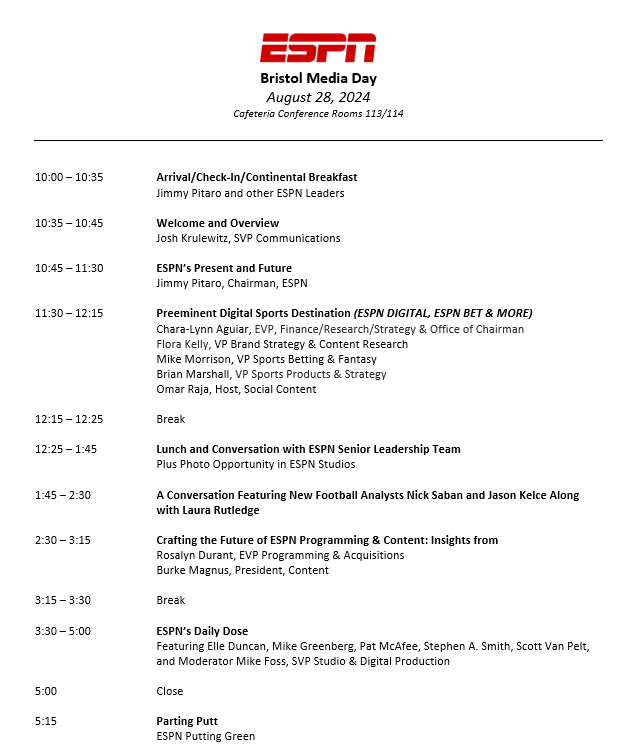
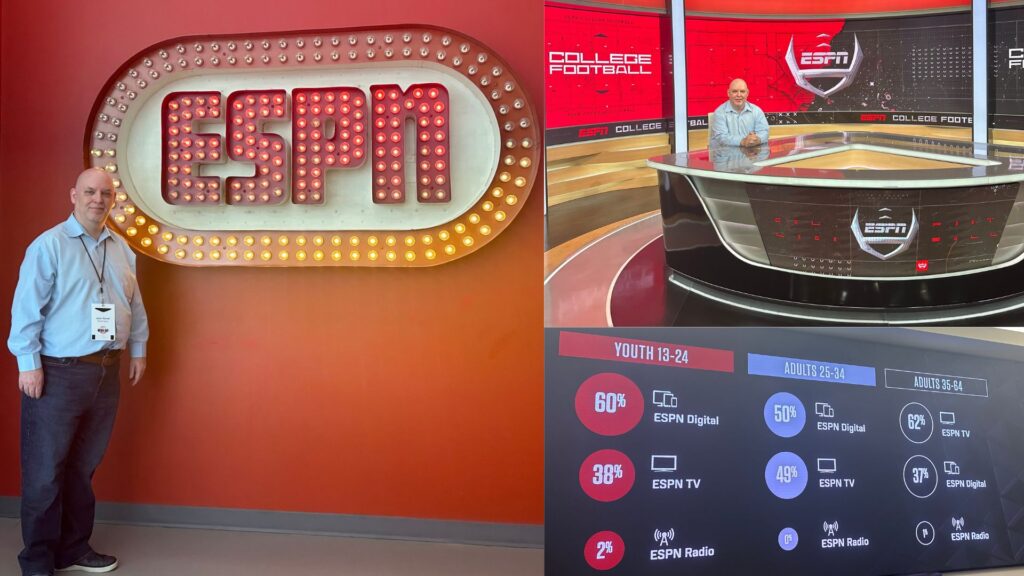
I attended ESPN Media Day last Wednesday in Bristol, CT. My thanks to Josh Krulewitz and the PR staff for the invite and hospitality. The event was well organized, informative, and offered access to key people. It was worth a day away from conference planning. I try to support brands and individuals who support us, and whether I’m offering praise or criticism, I try to be fair. Key people at the company understand that, which is why we’ve had a good professional relationship since 2015.
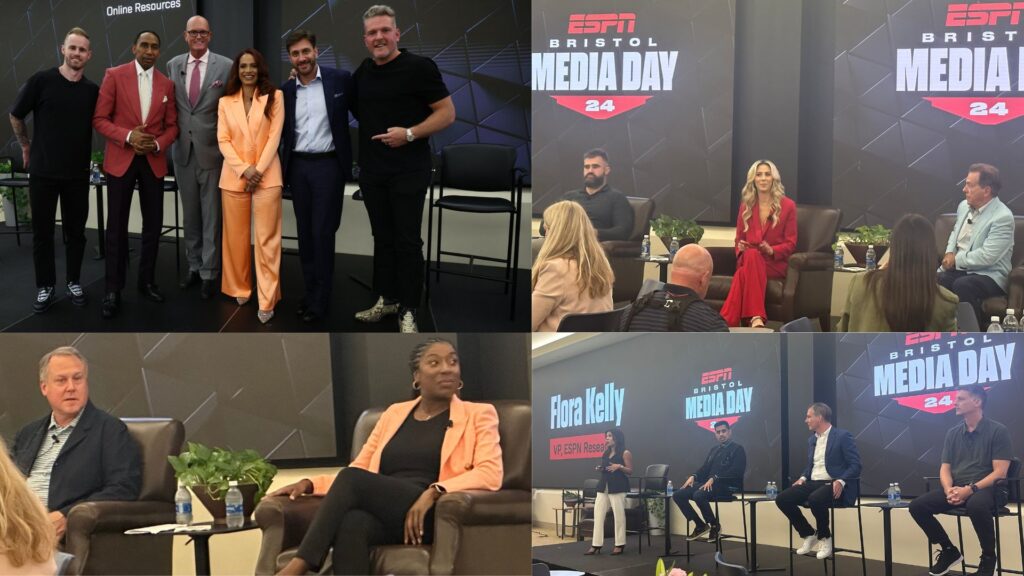
I’ll share shortly how brands can benefit from last week’s event but first I have to weigh in on Pat McAfee and Stephen A. Smith’s remarks. Their panel led by Mike Foss, which included Mike Greenberg, Scott Van Pelt, and Elle Duncan was outstanding.
Starting with Stephen A., he talked candidly about the separation between First Take and Undisputed. Smith said that the biggest misnomer ever made was that there was competition in the 10am hour. Over 1,600 shows aired, with Undisputed finishing within half of First Take’s ratings just twice. Yet media outlets covered the competition as if it was a close battle.
As Smith discussed the issue, Scott Van Pelt reminded the room that FS1 put up billboards in Bristol letting everyone know they were coming. Smith followed up with ‘they never arrived’. Elle Duncan then added ‘waiting’. Stephen A’s competitive spirit came out, as he discussed his drive to annihilate his competition. Whoever he goes up against, he intends to take them down. Pat McAfee then injected humor into the panel, thanking Mr. Annihilation for wiping everyone out so he has a good lead in at 12pm.
What Stephen A. said was accurate. The competition between First Take and Undisputed was not close. Skip Bayless and Stephen A. Smith’s prior relationship, and ESPN and FS1 wanting to own the daily sports conversation certainly warrants coverage. Shannon Sharpe later switching sides added another layer to it. That said, media outlets cared more about the potential story than the public did. The numbers don’t lie.
Pat McAfee’s comments about the media created the biggest buzz in the room. Andrew Marchand asked Pat about the media’s coverage of him and his show, and he took aim at Marchand, and then at Awful Announcing. He told Andrew how he feels, why he feels how he does, and explained how his reporting affected his show and staff. That doesn’t mean Andrew did anything wrong. He was doing his job covering a story. However, it showed that Pat is going to speak his mind, and tell you where he stands face to face. I had no problem with his remarks. In fact, I respect him for being open in the room.
Pat’s verbal lashing of Awful Announcing was even harsher. He ripped the outlet for trying to make him look bad, and stealing his work to drive clicks. Other hosts agreed. Pat did get defensive over Alex Sherman’s question about journalistic standards, but most people don’t mistake Pat for a journalist, they see him as an entertainer. Elle Duncan made that point in response to Sherman’s question.
I wrote previously how I felt Pat could’ve handled a prior situation with management better. I’ve criticized him before for being too thin skinned. I stand by what I wrote. However, I’m a fan of Pat’s work, and have said that he’s an asset for ESPN. It’s why I went over, said hello, shook his hand, and complimented his work. We can disagree over one issue. It won’t stop me from offering praise when it’s warranted.
Though Smith and McAfee’s remarks grabbed the headlines, I was most impressed by ESPN’s gameplan. I’ve written before how local outlets should be creating their own Upfronts to build stronger interest from advertisers. It works just as effectively if your goal is to increase coverage and improve media relationships. ESPN took one day, showcased their top talent and executives, created an informative agenda, provided transportation, food, access, a tour of their studios, and a parting gift, made a number of news announcements, and used time on site to strengthen ties between the company and media members, while increasing coverage of their work. That’s just really smart business.
Featuring the right people in the room matters, but offering the right topics, and details on key issues is also important. Think about what benefits your advertisers or local media outlets, and serve it to them. If you do, you’ll reap the rewards later.
Jimmy Pitaro for instance talked openly about the company’s interest in local sports rights, the growth of ESPN’s studio shows, and the company’s future direct-to-consumer product (billed as ‘flagship’ but to be renamed later). He also weighed in on succeeding Bob Iger, and the recent decision against Venu Sports. Though he couldn’t say much about it, he reiterated that ESPN disagrees with the court’s decision.
Pitaro was proud to share that ESPN+ is now profitable, and the brand has become #1 in the world on TikTok. Jimmy revealed that he underestimated how much attention ESPN got when he took the job. He also shared that he’s not a fan of the company being referred to as the network or worldwide leader.
Burke Magnus was open with the room too. Laura Rutledge, Jason Kelce, and Nick Saban’s session included a question for Kelce about his wardrobe plans for Monday Night’s. Magnus made it clear that he wants Kelce to be himself not somebody else. He later added ‘Jason Kelce in a suit would look like he’s going to a court appearance’.
ESPN’s President of Content was open about hating what ratings have become. Burke said that he values total audience much more than linear TV ratings. Magnus later admitted that the plan for Doc Rivers on ESPN’s NBA play-by-play team turned out to be fool’s gold. He also addressed Around The Horn ‘s future, noting that the show has another year left on its deal and there’s nothing imminent going on with it.
After learning that Bill Belichick would be a part of a new series called ‘Breakdown’ with Peyton Manning, I was curious if Belichick and Nick Saban would be creating content together given their history. Pat McAfee then chimed in from the back of the room, adding that the two would appear together a few times during the season on his show.
The best moment of the day came from Nick Saban, who was simply fantastic. Saban talked about his Ireland experience with McAfee, and explained how the excitement and interest from College Gameday helped improve Alabama’s image and recruiting.
When asked about his approach to leadership, he shared a great story from his time at Michigan State. Nick said he learned he was a Transactional leader, focused solely on results. A psychologist told him that he needed to become a transformational leader, someone who cares about helping people grow, improving a culture, showing that there’s more to it than just wins and losses. Once he made the switch, he never looked back. ESPN could’ve put Saban on stage for three hours, and nobody would’ve left the room. He was that good.
Though Smith, Pitaro, McAfee, and Magnus earned a lot of attention, one who may not have had the same billing but was excellent was Flora Kelly. Her presentation highlighted ESPN’s dominance across the digital landscape. One stat which especially stood out was that ESPN has reached over 100 million total users in a month across ESPN Digital 44x while its next closest competitor has done so just 4x. Powerful stuff.
ESPN announced a new 12-year deal with the United States Tennis Association, a new 30 for 30 called ‘The Sack Exchange’ on the famous New York Jets defense, Belichick’s new series and scheduled appearances on ESPN programming, and a new ‘Where to Watch’ feature on its app and website during the day. The mixture of news and insight from top talent and executive leadership made it valuable for those attending.
I’m sharing these details to show what a smart plan involves. Including the right people in your organization is one thing, but having valuable content for the right audience is another. For that reason, radio was not a discussion during the event. It appeared on one of Flora Kelly’s slides, and was verbally mentioned a few times when talent were introduced. Aside from that, it wasn’t a topic. Given where the state of industry revenue is, TV and digital should be the priority.
Any local radio, television or print brand could create this event if they identified the key stories and talent in their building, and designed a valuable agenda for advertisers or media outlets. The problem is, most don’t. For nine years I have preached the importance of marketing yourself, your people, your brand, and its story, and time after time, industry leaders do the same thing. If you don’t do anything different to elevate your business, you’re going to remain stuck in mud, and sinking.
ESPN dominates in many areas. Media attention is one of them. Relevance is easy to retain if you prioritize its importance. The more relevant you are, the higher your ratings/reach, which is usually followed by strong revenue. Maybe you can’t hire Stephen A., McAfee, SVP or Greeny, but you can create a full day event to serve fans, advertisers or local media. Taking the plunge and doing it right, could draw comparisons to the worldwide leader. Do it well, and Jimmy Pitaro may even let you keep that name.
This week, when the NFL kicks off its 2024 season, many eyes will be on Tom Brady. How will he fare in FOX’s top broadcast booth? What will the restrictions the NFL placed on him as minority owner of the Las Vegas Raiders mean for him as a game analyst? All of that is interesting but personally, I’m a little more interested in Bill Belichick.
Belichick has a deal with ESPN that will see him appear across multiple shows, including the ManningCast. If he nails it, ESPN could boast the biggest hires of 2024 in both college football and the pro ranks.
When a coach moves from the sideline to the studio, he has to make a decision. What does he want out of life? If Belichick can accept that at 72, and with his last two NFL seasons being something between aimless and hopeless, his coaching days are probably over, he could be an asset to any broadcast.
If he can’t accept that? Well, I’m a little less optimistic about what he will provide television audiences.
A lot of people praised Jon Gruden’s work in the Monday Night Football booth. I never liked him in that role. His quarterback interviews ahead of the draft were always interesting. His Monday morning visits with Mike & Mike were usually entertaining, but as a game analyst, I never thought he said anything of real value.
But in fairness, why would he? He was thinking about getting back to the sidelines someday.
That’s what I always worry about when a great coach signs on with a network. Are they dedicated to the craft enough to actually do the job they are paid to do?
I’m not demanding negativity from Belichick. I know he knows ball. All I demand is honesty. I don’t want to see one of the best to ever do the job pulling punches because being too good is against his best interest.
I would love to know what Bill Belichick wants out of this relationship with ESPN. A trio of the network’s journalists did an excellent job of cataloging just how badly he wanted to become the head coach of the Atlanta Falcons after exiting New England. It’s reasonable to assume that he views being on ESPN as the perfect way to advertise his services and knowledge and not the start of a new chapter. We won’t really know until Black Monday hits after Week 18.
I think at this point, it’s pretty well-documented that the standoffish, mono-syllabic version of Belichick that talked to Greg Hill on WEEI every week was sort of an act. Plenty of people that know him and have talked with him in a purely football-centric setting, have said that he has the kind of personality that can make him an asset to any network.
That’s the Belichick I want to see, and I’m not alone. ESPN joins Underdog Fantasy, Inside the NFL and SiriusXM in putting their faith in the guy too. Perhaps that should ease my mind. Enough people have seen and heard enough to believe that Bill the broadcaster is a bet worth making.
It’s just hard to believe. Even if he’s a revelation on television, there still must be some part of Bill Belichick that wants his coaching career to end on his terms. Cite the press release from the team, if you want, but it’s hard to believe there was anything mutual about Belichick’s exit from New England.
No coach has won more Super Bowls. No coach has ever been selected for two All-Decade teams. Yes, Belichick seemed less unimpeachable when Tom Brady left for Tampa, but it doesn’t diminish those “most ever” and “first ever” accomplishments. A guy like that doesn’t usually accept defeat.
As we enter the critical stage of the election, the candidates have already started to make the interview rounds. You might be called upon to do one of those candidate interviews. Here, with some nods to things I’ve seen in interviews thus far and in previous cycles, are some rules to live by if you find yourself in a studio with a candidate, whether presidential or down ballot:
1. Don’t ask the candidates what they’ll do on Day One of their administration. It’s a cliché. Besides, THEY really don’t know what they’re going to do on Day One yet.
2. Don’t state a talking point from the candidates’ opponents and ask for a reaction. It only lends credibility to those talking points, and that’s not your job.
3. Don’t ask about the candidates’ biographies. Anyone can get that online.
4. Don’t let the candidates evade a question. Follow up. Ask the question again. Don’t move on until you get an answer or make it clear that the question wasn’t answered.
5. Don’t ask compound questions. Asking two questions at once gives the subject the opening to ignore one of the questions, and it’s rare that an interviewer with one eye on the clock will go back and repeat the other question.
6. Do ask the candidates what they’ll do about things that actually matter to voters, and not just in general terms. “The economy” isn’t specific enough and means different things to different voters. Supermarket prices? There you go. And while we’re at it, nobody’s asking about health care costs, and the price of health care in America is one of the most universal topics. So is the cost of education. So is climate change, and infrastructure issues. Those should mean more to your audience than the stuff candidates raise as scare-tactic politics, and it’s something other news outlets aren’t doing, so you’ll stand out.
7. Do remember that the candidates aren’t gods walking among us. They are people just like everyone else. They deserve the same respect you’d give anyone else, but do not let them intimidate you.
8. Don’t fawn over a candidate even if you like and support them. Again, they’re just people. You’re allowed to like a candidate, you’re allowed to vote for them, you’re allowed to have an opinion, but kissing any interview subject’s butt is embarrassing and unnecessary. Save the idolatry for off the air.
9. Do remember that this interview may be forgotten in a matter of days or even hours, so if you screw it up, it’s not the end of the world. (If the candidate screws up, however, it could live forever.)
10. If you’re sick and tired of all the candidates and all of the election stuff and polling and rallies and controversies, remind yourself that in just a couple of months, it’ll be over. At least, this part of it will be over. Last time, things got even messier all the way through January. But you’ll have that to talk about.
The Labor Day Weekend. It’s the first reminder of summer’s closing days. It’s back to school for the traditionalists. More importantly, it’s the final season of emotional significance for Yacht Rock.
If you follow the genre of music identified by soft rock artists like Michael McDonald, Hall & Oates, Steely Dan, Ambrosia, Pablo Cruise, and Kenny Loggins, you know Yacht Rock has become more than a weekend feature for radio station critics.
The smooth sounds of the late ‘70s and early ‘80s occupy full-time status on the SiriusXM satellite dial, Pandora and iHeart Radio’s streaming channels, and a few FMs like Key 97.3, Key West, FL., and 106.3 Mac FM, Smooth Sailing, Cheboygan, MI. Cincinnati’s Q102 programs Yacht Rock music on the WKRQ-HD2 station as the brand Smoothinati.
However, the SiriusXM channel receives the most attention in radio’s social media circles. I learned the genre’s name in the late 2000s through the Yacht Rock mockumentary video series. The opening music is the intro to Michael McDonald’s Sweet Freedom. For those of us DJ-ing on pop radio in the mid-’80s, that song intro is a jock favorite to ramp-up.
For non-radio readers, ramp-up means talking over a song’s introduction. To take you even deeper into this non-scientific world, radio DJs often judged themselves on their ability to “walk up that ramp” to the point where the vocal begins or a noticeable music crescendo happens in the song intro.
During a review of the performance, called an aircheck session, you might see a radio DJ smile and virtually high-five their Program Director and proudly say, “I hit that post!” Years later, we discovered the audience wasn’t as impressed with this tactic as we had hoped, but we continued to perform this emotionally satisfying high-wire act.
It’s a rhythmic piece of audio art not shared by every radio talent. If you think it doesn’t make a difference, watch JoJo Cookin’ Kincaid’s Q-106 San Diego video aircheck and convince me the audience didn’t feel it.
Back to the Yacht Rock mockumentary series. The grainy, primitive video was hosted by one of the show’s creators, Hollywood Steve. He would introduce each of the twelve episodes, telling the stories behind the origins of the smooth, soft rock movement. The acting, by design, was campy and exaggerated. I laughed and shared the link with friends and radio colleagues who grew up being influenced by that era of music.
The video series would pop up in my algorithm periodically through the years, but I didn’t think about Yacht Rock until radio talent coach Steve Reynolds started posting his opinions about the SiriusXM channel in 2019. His first post critiqued a song being played on the Yacht Rock channel.
“Unfamiliar, stiff! Stop!” are the words used in Steve’s first Facebook post. It got the attention of his fellow radio comrades and became a fun way to engage and be sarcastic about a music genre many of us loved or disliked. Either way, the interaction and passion were created through music.
The radio industry Yacht Rockers community is opinionated, just like everyone listening to the radio. In our pending political election season, passion and opinion belong to the spoken-word formats. The News/Talk stations will benefit from increased audience listening and advertising spending through November 5th.
However, music stations must be aware of the gift of emotional relief their stations offer in this hostile and noisy political season. Our audiences are non-verbally asking for something to remove their brains and hearts from the tension of the season. But we can’t just play it. We have to engage the conversation with the audience.
According to radio industry veteran consultant and analyst Guy Zapoleon, Top 40 music is showing signs of emerging from one of the format’s longest doldrum cycles. Before reading his data, I would’ve agreed. I’m listening to Top 40 radio more often these days. Whenever I tune in, I hear Sabrina Carpenter, Chappell Roan, or Teddy Swims songs, and I happen to like those new songs. If Top 40 is experiencing a Rebirth, as Zapolean claims, it’s good for all formats because it brings people to the radio dial and the radio devices.
How do we create audience engagement through our music? We can thank Taylor Swift for giving us a Masterclass during the Eras Tour. Smart radio programmers and marketers took advantage of the passion her music and personality created, and those stations aggressively aligned their products with the moment.
Whether you’re playing Guns N’ Roses on your Classic Rock station or TobyMac on your Contemporary Christian Music station, the audience found you because of the music. Yes, they stay or leave for other reasons, but the passion for the music opened the door of opportunity.
Radio DJs/Hosts/Presenters can be different by engaging with the music you play. Spotify and Pandora playlists can’t perform that magic. Maybe the engagement branches into social media, video, and event content. But it starts with your primary product’s connection through Top 40, Adult Contemporary, Hip/Hop, Country, Gospel, Classic Rock, Jazz, or Yacht Rock music. Let the audience know or feel that you’re aware of the music you’re playing. The audience is aware.
Find your Yacht Rock and create the engagement. But don’t include Christopher Cross’s “Arthur’s Theme.” That doesn’t fit the format.
Last month, the attorney general of Texas, Ken Paxton, filed a suit against General Motors. Attorney General Paxton has had an interesting history in filing all kinds of lawsuits, but this one is relevant to the media business.
In the press release from his office, Paxton’s point was that GM collected information about owners’ driving habits and then sold the information to third parties apparently without informed consent on the part of the vehicle owners.
During my tenure at Arbitron, I spent time working on “connected cars” and privacy was always a concern. Early on, the automakers were split. When you buy a car, who owns the data the vehicle produces? Is it the owner or does the manufacturer have the right to use it? Purchasing a new or used vehicle involves a great deal of paperwork, all signed at the same time. Do you remember reading all the paperwork you were asked to sign prior to your last vehicle purchase?
This matters to media in two different areas. Collecting data from cars is the great hope of audio audience measurement. Mass data of actual usage would be huge. DTS AutoStage is doing that now, but with only 7.5 million vehicles, that’s a tiny percentage of the US fleet. GM has shown they can do it as well. I’ve attended presentations by GM showing audio usage data for Chicago and Detroit.
Meanwhile, video (television) viewing habits are measured in a similar way although the process is more mature. Data from either set top boxes or smart TVs is sent back to the cable companies and the manufacturers. In the former case, the user generally does not own the cable box, but with the decline in cable subscriptions, the number of boxes in use is declining rapidly. I’ll admit to still having a cable subscription, but our home has no boxes and we use the Charter Spectrum app through Roku instead.
Even Nielsen is finally getting into the big data game for television. With so many options for consumers to choose from, it’s almost a necessity. Nielsen people meter samples aren’t large enough, but those high-quality samples can be used to adjust the big data, accounting for biases.
There are issues. With auto data, how do you know who or how many are in the car? Ownership doesn’t mean the same person always drives the vehicle. And who is in the room watching TV? How many people are viewing? Who are they? Still, using advanced statistical techniques, this is a better system for today’s unlimited option world.
Here’s the problem: Attorney General Paxton has hit on something. His concern is that GM is selling data that may be detrimental to the vehicle owner, for example, that the driver regularly exceeds the speed limit, makes bad maneuvers, or is prone to hard braking, which, if known, can run up insurance premiums, all without the owner’s consent. But his basis is privacy.
When you bought your big screen HDTV, do you remember expressly allowing the manufacturer to either use your data or sell it to a third party, even if anonymized? Digging into menus in one of my LG OLED TVs, there is something there about Nielsen. For someone with my background, I understand it. If you weren’t an audience researcher, would you know what this is about? Can you give informed consent?
Further, if Nielsen or any other company (comScore, etc.) is using my data, how will I be compensated? If Nielsen asks me to wear a PPM watch, fill out a diary, have people meters installed in my home or whatever, they offer to pay me. It’s not a lot, but an acknowledgment that I’m doing something on their behalf. LG has never offered me anything. Have you received anything from Samsung, Sony, Vizio, or any other set manufacturer that is profiting from your data?
Personally, I’m not concerned that a measurement company may find out that I watch a fair amount of NHL hockey during the season, but other consumers may not be as sanguine. What is preventing Attorney General Paxton, another state attorney general, or the Federal Trade Commission from filing suit suggesting that this is an unfair deal for consumers? Perhaps some enterprising law firm, looking for a potentially big payday, will file a class action suit claiming that millions have been harmed.
We all want better ratings data, even if we don’t buy the data. However, businesses are always wary of having a “single point of failure”. Except for Nielsen Audio and Eastlan, the ratings system has a single point of failure, but so far, no one appears to have both discovered it and acted. The fate of Attorney General Paxton’s suit against GM will be worth watching.
Let’s meet again next week, but perhaps sooner if you’ll be attending the Barrett News Media Summit in DC. Hope to see you there!
The NBA recently announced its forthcoming media rights partnerships under new, 11-year contracts with The Walt Disney Company (ESPN/ABC), NBCUniversal (NBC/Peacock) and Amazon (Prime Video) that are reportedly worth a collective $77 billion. Among the media companies, Disney is the only incumbent within this deal, maintaining its relationship with the league that dates back to 2002.
As an existing rightsholder, Disney had the ability to discuss a new deal with the league under the auspices of an exclusive negotiating window, which began in early March. During that time, the discussions between both parties took place with regular discussion between Jimmy Pitaro, chairman of ESPN; Adam Silver, commissioner of the NBA; and Bill Koenig, president of global content and media distribution at the NBA.
During a recent episode of The Varsity podcast with John Ourand of Puck News, Pitaro outlined how the process unfolded between the media conglomerate and league itself. In fact, he shared that he is regularly at the table sitting with commissioners and attending meetings amid media rights negotiations. From his time working at Yahoo Sports as its head of media, he developed relationships with Silver and Koenig. Over the years, Disney and the NBA have built mutual trust that played a factor during these negotiations. Internal discussions at ESPN and The Walt Disney Company surrounding the deal picked up a few years ago, according to Pitaro, and both the company and league worked very hard within the exclusive negotiating window.
“There were meetings in Burbank with Bob Iger, and we made it a huge priority at The Walt Disney Company to get this thing done,” Pitaro said. “But you said it, you’re right that this didn’t exactly close within that exclusive negotiating window, but I think we reached a handshake agreement very, very soon thereafter, and so it was not easy. I don’t think anyone on the NBA side or on our side will tell you that it was easy.”
Pitaro explained that there were many moving pieces in the deals and that both sides had their respective priorities. One thing that never waned, however, was the factors of trust and respect. The discussions between the parties were always civil, he explained, and he affirmed with certainty that “it never got ugly.”
Under the terms of the new contract, Disney will distribute 80 regular-season NBA games per year, which includes more than 20 games on ABC and up to 60 games on ESPN. The company will continue serving as the exclusive home of the NBA Finals and will televise the Conference Finals for 10 of the 11 years under the deal. Additionally, the company has international rights for its games and rights for its Flagship direct-to-consumer platform set to launch next year.
“I don’t want to speak for the league, but we feel really, really good about the partnership,” Pitaro said. “If you look at the value of our deal, we made it very clear from the outset that the postseason was very important to us, especially the NBA Finals, and we told Adam and Bill that maintaining exclusivity for the full 11 years on NBA Finals was very, very important. To their credit, they got that, and they worked with us on that.”
In addition to the live game broadcasts, Disney secured the rights for a live whiparound-style program surrounding its games. Pitaro lauded NBCUniversal for its coverage of the Olympic Games Paris 2024 and specifically noticed what the company did with its Gold Zone whiparound show. ESPN has ventured in the space before, most recently with its Frozen Frenzy presentation during the NHL season that will make a return in the upcoming year. The company now has the ability to introduce a similar offering for NBA coverage; however, the exact parameters and alignment of such has yet to be determined.
“There seems to be significant appetite from a sports fan perspective for that type of experience,” Pitaro explained, “and so the fact that we were able to secure those rights as a part of this NBA deal makes me feel even more confident that that’s going to work for us.”
Internal discussions surrounding star players aging in the NBA took place, but Pitaro does not foresee LeBron James, Stephen Curry or Kevin Durant retiring any time soon. The company concluded that it has “a high degree of confidence” in the next generation of players within the league. Furthermore, Pitaro elucidated that Disney likes the parity within the league and the fact that several teams can win.
“Look, probably most important, we love the demos. We love the demos around the NBA,” Pitaro said. “If you look at the audience, it’s young. It may be out of NFL, NBA, MLB, NHL – the NBA may have the youngest audience. I believe the last I heard from our research department, they did have the youngest audience. I don’t know where that is exactly today, but we like that about this deal and this partnership, and like I said, we love the package that we got and the value that we got here.”
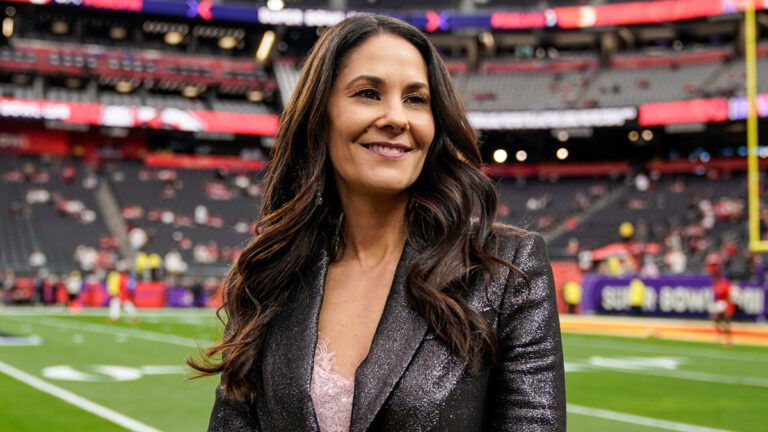
When Tracy Wolfson garnered her first Sports Emmy Award victory earlier in the year, it completed a whirlwind stretch of multiplatform broadcasts across different sports, along with the realization of what was ostensibly somewhat of an elusive accolade. Wolfson had been nominated six times previously but had yet to earn these plaudits in the category recognizing outstanding sideline reporters. Nonetheless, she was elated to win the award for reasons beyond the superficial recognition since it granted her a chance to exhibit her gratitude towards everyone that has helped her along the way.
As someone who took an untraditional path to her role by starting behind the camera and gradually assimilating to the other side of the lens, Wolfson has been able to achieve her goals through perseverance, fortitude and determination. Wolfson has worked for the company for more than two decades, and she maintains a mindset of a producer in contributing to insightful, enthralling broadcasts.
“When do you get to look back and say, ‘Thank you, because I wouldn’t be here without you’?,” Wolfson said. “So, it gave me that opportunity to do that, so it was definitely a tremendous honor and a really incredible moment.”
The awards ceremony occurred a few months after Paramount Global’s presentation of Super Bowl LVIII, which ended up winning three Sports Emmy awards. The game set a record for the most-watched U.S. television program in history with a total audience delivery of 123.7 million viewers across CBS, Paramount+ and various additional linear and digital platforms.
“We had the game that lived up to the hype,” Wolfson said, “and when you can go to overtime in a Super Bowl and have that many storylines surrounding it and then have the excitement of the celebs and being in Vegas for the first time, everyone who came out for that and that scene and wanting to see it, it just made for the perfect Super Bowl.”
As someone who did not have any mentors amid a dearth of women in the business, Wolfson chose to attend the University of Michigan because of its balance of academics and athletics. While interning at HBO Sports, Wolfson met professionals who freelanced for CBS, and she would volunteer as a runner every time there was a broadcast at Michigan. As more games progressed, she was invited on road trips and ended up traveling through her senior year.
“My friends were like, ‘Where are you?’” Wolfson recalled. “I had been gone for three straight weeks – I wound up in Tampa [and] I made, again, a lot of connections through CBS doing that. [I] worked March Madness and the Final Four… and this was all happening in my senior year, and they offered me a research job out of college working for CBS Sports.”
Discovering stories and accruing statistics for broadcasts helped Wolfson establish and refine her preparation process, an integral background that has paid dividends. Without tape to leave and start on-camera work, she sought a promotion internally but instead received an early indication of misogyny and caustic divisiveness that exists within the business. Wolfson was informed that despite her aptitude and passion for sports, it did not equate to that of the men with the company. Being subjected to this prejudiced speech, she affirms, is the best thing that happened, catalyzing her departure to become an agent under Steve Merz at IF Enterprises where she worked with clients and helped them find jobs.
“Seeing that side of the business – how to prepare, how to look on camera, how your voice should maybe sound, how to put together a tape – all of that also made me a better reporter,” Wolfson said. “So yeah, I think every stop along the way, while it took me four years to finally get in front of the camera, I learned so much that has made me a better reporter.”
After a stint producing at News 12 Long Island, Wolfson received an offer from WZBN-TV in Trenton, N.J. Her first live experience occurred with MSG Networks in New York, along with national work covering select sporting events for ESPN.
ESPN did not ask her back, but that coincided with an opening to report at CBS. As a result, she stepped into the job of lead sideline reporter for SEC football games with Verne Lundquist and Gary Danielson. Taking the air in the national spotlight, she learned more about storytelling and strived to excel.
“I realized very quickly, especially when people were saying we were rooting for one team and not the other, how seriously it is down [in] the SEC and how seriously they take college football, and I fell in love with it right away,” Wolfson said. “And it made you want to work even harder to expose those storylines and traditions and passions and bring them to life and be in the middle of every moment, and I was.”
After a decade in which NFL on CBS games stopped utilizing sideline reporters, the company decided to include them once again upon acquiring rights to Thursday Night Football in 2014. Despite feeling as if she betrayed her teammates at the SEC on CBS after a decade with the property, she surmised that the chance to arrive on the lead NFL broadcasting team may not be possible. Wolfson successfully made the transition in the fall and began working on marquee games throughout the calendar.
“You can turn to, let’s just say the Super Bowl situation with Tom Brady when he was telling me, ‘Just wait, just wait. I’ll give you the interview,’ and then everyone surrounded me and I was in that moment,” Wolfson said. “I was prepared for that moment. I did the Kick Six in Auburn, Ala. There was no bigger game than that when everyone stormed the field and you’re able to hold your own. You learn that in the SEC. In the NFL, that’s nothing, right?”
Beginning with the 2024 NFL season, both teams are required to make the head coach or either coordinator available for an in-game, on-camera interview at the end of quarter breaks or at halftime. This will expand access and the ability for viewers to hear directly from coaches amid the action, but it provides an additional challenge for Wolfson, whose job is predicated on strategically roaming the sidelines and extrapolating news.
“The home team gets to decide when they want to do it, and we still get those halftime interviews, going in, going out, off camera, so we get some stuff at halftime,” Wolfson said. “It’s going to be a feeling-out period, definitely, and you’re not going to get much from some of these coaches, but we’ll figure it out and we’ll adjust.”
There is no preset route Wolfson takes during the game, instead moving around based on the game flow. If Chiefs quarterback Patrick Mahomes throws an interception, she is watching him as he goes to the sidelines and who he is talking to. When tight end Travis Kelce and head coach Andy Reid had a heated exchange during Super Bowl LVIII, Wolfson was situated right near the incident and was able to report what happened, eliminating any speculation or conjecture.
“I feel like an investigative reporter down there, and I love that role – I really do,” Wolfson said. “Whether it is an injury or whether it’s a situation with the offensive line and there are some issues there or whether there was a mistake happening in the backfield – whatever it might be, I love finding out those stories.”
There is potential for the lead NFL on CBS broadcast team to cover eight Chiefs games this year, requiring Wolfson to find new angles and platforms on which to discover stories. The repetition helps her minimize fatigue and withstand the consistent travel, meetings and workload, facilitating her multifaceted obligations.
“I think it is that longevity and the relationships I’ve built with these coaches and players that [sets me apart],” Wolfson said. “You can see it in the interviews, and they’re going to give me more stuff because they trust me, and so I think there’s a lot of that when you’ve covered these teams over and over again.”
The current lead broadcast team featuring Wolfson, Jim Nantz and Tony Romo has been working together for the last seven seasons. There is clear synergy between everyone on the team evident through the repartee and interactions to bring viewers pertinent and salient developments.
“My favorite times in the broadcast is when we could do a whole segment on something,” Wolfson explained. “Maybe Jim starts it, I add to it and Tony wraps it up. That’s great television; that’s working as a team, and it takes time, and also it takes luck in the middle of a game that that can happen where an interception’s not thrown on the next play. But I think we’re at our best when we’re working as a team and everyone feeds off of each other and they support me in that role.”
Once the NFL season concludes, Wolfson transitions to serving as the lead sideline reporter for the NCAA Division I Men’s Basketball Tournament, a role she has held since 2008. She does not usually start following college basketball until December or January but nonetheless arrives prepared and embraces the sprint leading to the distinguished cutting of the nets.
“You’re learning eight teams in basically 24-48 hours, and half of those teams you’ve never heard of, and you don’t know one player on them,” Wolfson said. “…I love it – it’s a different set of producers and directors, and then of course Grant Hill and now Ian Eagle and now Bill Raftery. You can’t get a better crew than those three when it comes to college basketball.”
As the calendar moves through seasons of the NFL and college basketball, Wolfson also takes part in We Need to Talk, the first nationally televised all-female sports show. The award-winning program is embarking on its 10th year and will have a special broadcast featuring members of its panelist roster past and present.
“People think it’s a female sports show and we only talk women’s sports,” Wolfson averred. “We actually talk just as much about men’s sports and often lead with the NFL in a lot of our shows, but we do highlight women, which is also needed, and we do try and do what we can to further women in sports and to champion those women that are taking the next steps and doing incredible things.”
"She's really just provided so much confidence for young girls…" @TracyWolfson sheds some light on the impact Caitlin Clark is having on the world of women's sports. pic.twitter.com/rkSOgl7AiD
Over the years, Wolfson has learned to maintain a keen focus and refrains from searching her name on social media or reading comments after a game. It is essential to block out the outside noise and concentrate on the task at hand, and she is appreciative of the support of her colleagues.
“I think being a woman in the industry is tough when you want to have a family though as well,” Wolfson said. “How you might look on the air – look, I have a beauty mark on my face that I will never get taken off with the amount of comments that people will make about it [that] are often in my feed, but that’s why you have to put your blinders on. You have to just focus on yourself [and] not worry about that stuff.”
Wolfson and her teammates at CBS Sports are set to commence another NFL season, taking sports fans through the twists and turns of the 18-week schedule with credibility, integrity and a will to consistently innovate.
“I get really excited around this time of year,” Wolfson said. “Sure, summer is ending and you know you’re getting on the road for 20-somewhat weeks in a row, but I’m excited and I can’t wait, and I know that I’m in a business where I’m successful and I’m doing a good job, and I can’t wait to get back out there, and I’m lucky that I have the opportunity to do that again.”
The broadcast rights for Southeastern Conference football were granted to The Walt Disney Company under a 10-year deal reportedly worth a collective $3 billion starting in the 2024 season. On Saturday, the SEC on ABC broadcast property made its official debut within a tripleheader of games that averaged 7.6 million viewers, resulting in the second most-watched kickoff Saturday on record for the network. The matchup between Notre Dame and Texas A&M in prime time finished with 8.2 million viewers on the night, the most-watched Saturday Night Football game on ABC since 2022, according to viewership data from Nielsen Media Research and Adobe/Conviva Streaming.
In that year, the game between Notre Dame and Ohio State drew 10.53 million average viewers and finished with a thrilling come-from-behind victory for the Buckeyes. This season’s opening matchup in prime time drew more than double the game between North Carolina and South Carolina last year, according to Jon Lewis of Sports Media Watch. Chris Fowler, Kirk Herbstreit and Holly Rowe called the matchup on ABC that also streamed live on ESPN+.
Coverage on ABC began with Georgia defeating Clemson by a final score of 34-3, marking the most-watched 12 p.m. EST game on the opening Saturday. The game averaged 7.9 million viewers on the network, and it also secured a larger peak audience of 9.5 million than the aforementioned prime-time tilt (9.3 million) between Notre Dame and Texas A&M. The Aflac Kickoff on ABC took place from Atlanta, Ga. and featured Sean McDonough, Greg McElroy and Molly McGrath on the broadcast.
The late-afternoon window featured Miami visiting Florida on ABC and ESPN+ with a commentary team of Joe Tessitore, Jesse Palmer and Katie George. As the SEC on ABC made its official debut during this window, the network introduced revamped theme music, distinctive graphics and other presentation elements. The interstate matchup drew an average of 6.6 million viewers, making it the most-watched Week 1 game in this window since Michigan-Florida in 2017. Although the SEC on CBS season openers aired in Week 3 over the last two seasons, this game surpassed the average viewership for those matchups on that broadcast property.
Gary Berkowitz of Detroit-based Berkowitz Broadcast Consulting specializes in the AC format and growing 25-54 ratings. He works with all genres of AC, including mainstream, Soft AC, and Hot AC. Berkowitz describes his style as involved, active, and hands-on with every aspect of your programming product.
He is this week’s featured consultant.
Jeff Lynn: You specialize in one format AC and driving 25-54 ratings. Most formats are cyclical. What is the current state of AC?
Gary Berkowitz: It’s in a good place, which is a familiar place for AC. It’s probably the most consistent and resilient of all the legacy formats. Does it have its ups and downs? Yes, but it is consistent. I believe most of its ups and downs are measurement related. AC is a basic format. As long as you do it right, it works beautifully.
JL: I’ve often heard this over the years, as I’m sure you have as well. AC is a background format. It’s a dentist’s office format. You’ve heard it all. How can you address that stereotype with both potential listeners and advertisers?
GB: I love that it’s a background format. I love the Dentist part even more. Why? There are thousands of AQH in the background and in the dentist’s office! As for advertisers, they love being on in a dentist office. The listenership is not going anywhere so they hear the message while they are waiting as well as during the procedure.
JL: Correct me if I am wrong, but AC doesn’t seem to have a lot of current artists that the format can claim as theirs. How does that factor in the music mix, and what is the right amount of current product per hour?
GB: You are 100% correct. AC has lacked current product for a long time. Why? Our currents usually come from CHR, and that has been extremely weak in listener appeal for a while. As goes currents on CHR, also goes AC. We have the ability to lean on library, so when current appeal is low, nobody misses it. My stations, for the most part, have a very low profile with currents (right now). Maybe 1 per hour, and many of them are over 12-18 months old! That is always subject to change.
JL: Did AC, like oldies, do better in PPM where actual vs reported listening is measured?
GB: Now that PPM has been around for a while, I think the playing field has leveled some. With my group, I see similar results in both systems. All good (usually! Lol)
JL: What is the target M-F makeup for a healthy 25-54?
GB: For decades, it was 70/30 female, but that has changed some. Many of my markets are now closer to 60/40 female-male. It is still very much a female-driven format.
JL: How important is talent to the overall formula?
GB: Very important. To me, “companionship is more important than content,” and the only way to achieve that is thru personalities. I put a lot of weight on-air talent. I get some pushback on that statement (“companionship is more important than content”), but it’s true.
JL: Is All Christmas still a good tactic for stations that don’t have a heritage with it or are thinking about entering for the first time?
GB: Christmas ownership is perhaps the most important image a successful AC can have. It goes way beyond the rating period. Being the leading Christmas station is critical. It’s tough to be #2 or 3. I usually advise not getting into Christmas if there is already a dominant station (unless they are ok being #2, which some are).
JL: What do you consider the best cume-building tactics for stations now that there is such competition for everyone’s attention?
GB: It’s tough, mainly due to budgetary restrictions. Back in the day, everybody watched network TV and the big ACs were spending millions advertising on them. TV made superstars out of many ACs. Today, it’s tough. Less or no marketing budget. So many places to reach listeners that it’s hard to pinpoint the best ones. Potential listeners used to all be on TV, now they are spread out everywhere. I try to urge my clients to use a strategy of “concentration of forces.” Figure out the best place to find and grow new listeners and put some resources into it.
Connect with Gary at 248.737.3727. Email here. Or visit garyberk.com