A business trip to Nashville last week uncovered some industry news which gives radio operators another content consideration for improving their programming. It’s a move which Jonathan Hutton, Paul Kuharsky and Chad Withrow of OutKick 360 were very excited about, and it becomes official this morning
OutKick has tapped Skyview Networks to help them expand their radio presence, build market share, and maximize network advertising revenue opportunities for OutKick’s Sports talk network. The deal calls for OutKick to provide sports and pop culture commentary, headlines, interviews and entertainment, adding to Skyview Networks’ leading play-by-play sports and sports talk portfolio.
“We’re thrilled to work with Skyview to expand OutKick’s brand and reach,” said Clay Travis, founder of OutKick. “Beginning with the OutKick 360 show, we’re working with the best talent to bring authenticity, perspective and fun back to sports radio. Radio is at the core of OutKick, and we could not ask for better partners than Skyview to grow our network.”
Skyview Networks COO and President Steve Jones added, “We’re excited to be working with the OutKick team in launching a new sports network that provides radio stations dynamic and entertaining programming that will drive ratings and revenue. OutKick’s engaging and knowledgeable hosts with their fan-first sports perspective matched with sports wagering analysis to capture gaming revenue sponsorships fit perfectly with Skyview’s #1 local play-by-play sports position in network radio.”
The OutKick radio network launches with OutKick 360 featuring Jonathan Hutton, Chad Withrow and Paul Kuharsky. The trio spent years on 104.5 The Zone in Nashville delivering one of the highest-rated sports radio shows in the USA. OutKick 360 currently airs M-F 3p-6p ET and will be the first show offered by Skyview to potential radio affiliates. Stations looking to add the show to their airwaves can email affiliation@skyviewsat.com or visit www.skyviewnetworks.com/outkick for more information.
Additionally, OutKick recently hired Dan Dakich to host a new program for their network. The show is expected to debut today and air M-F 9a-11a ET. Dakich’s local show in Indianapolis has been one of the industry’s most recognized programs. Though Dan is just getting started on the network, this new deal with Skyview creates possibilities to expand the show’s reach in the future.
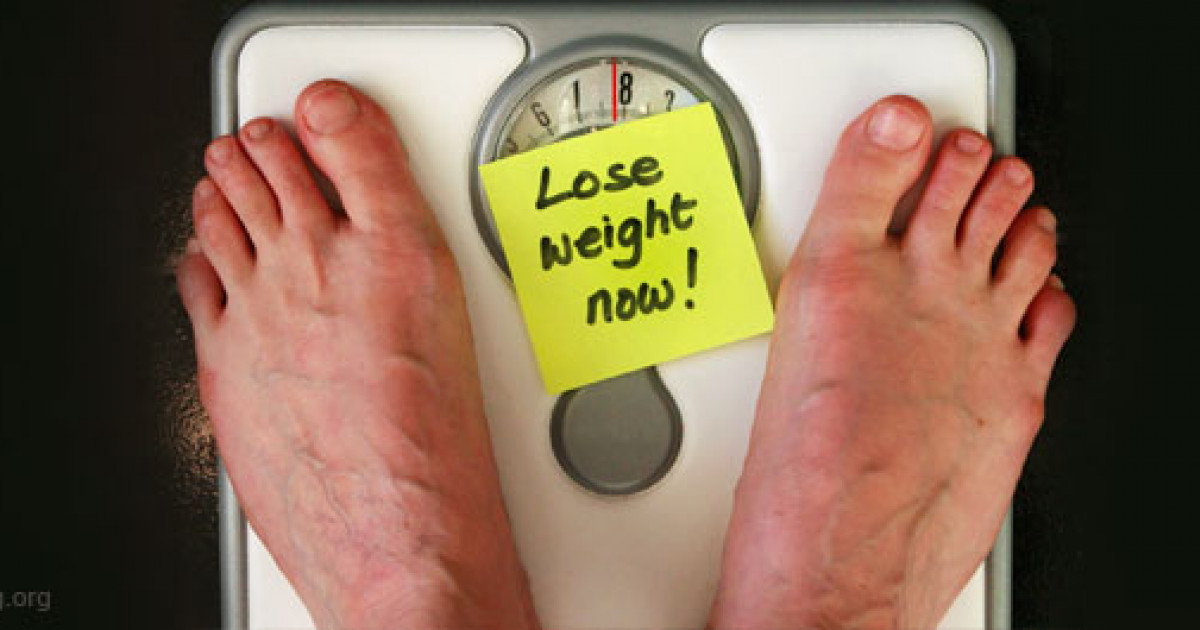
Now is the time to start selling the first quarter. And, the bigger the idea, the more lead time you need, so here is a whopper. Why not sell a weight loss challenge? After all, we all need to drop a few pounds, right?
Often, we get the inquiry from a weight loss product/supplement company soliciting on-air person people going on their diet to lose weight and then discuss it. Usually, one or two on-air people try it and lose weight, invite listeners to try it, and it is done by February.
Let’s try something different.
I feel it is best to go through the holidays knowing that come January 1, you are going on a diet. It also gives plenty of time for word of mouth to spread amongst your audience, and the promotion can build momentum. Go out now and find a weight loss company, clean meal service, supplement company, or medically supervised diet and pitch them. Why not get two sponsors and have them compete on air? Listeners can join in at a discounted price and interview each company to see if it’s what they want. I like the medically supervised vs. Jenny Craig or Nutri System battle or the Clean Food delivery service vs. folks who wish to follow a diet and prepare their own food fight. On-air people and station staff can also join in and pick a team. Talent fees should be paid to on-air people who do endorsements, and complementary or deep discounts should be offered to station personnel.
Commercials can invite listeners to sign up for the program starting on Monday, January 3, 2022. Then you can begin selling viewing parties for participants before then to get a before picture and create some group synergy. People want to be a part of a group and have support, and this is the perfect way to do it!
Have an official launch party complete with a Last Supper and unveil your incentive program. Get sponsors to provide prizes to the most weight loss, most weight loss by a couple, and most significant makeover. Clean eating certificates, clothing, photographers, and vacation spots are all good partners as incentives. I think this is best as a 12-week promotion, 1/3/22-3/27/22. You can have a Skinny Super Bowl party and get everybody together for clean eats and drinks during the diet. Get restaurants to offer Clean Eats Valentines Dinners or meal kits geared for those on a diet or anybody who wants a lighter Valentines meal. You can also invite listeners to a clean eats March Madness viewing party on Thursday, March 17, and Friday, March 18, during lunch or happy hour. Think veggie buffets, clean chicken, and steak all seasoned well. Skinny margaritas, Michelob Ultra, and vodka. Those who have been on this diet for ten weeks will love it!
Let your ideas go big and get behind this effort. Weight loss products and companies should be on the list of categories hotter to sell than gambling sites. This promo provides plenty of social media opportunities with food pictures. Before and after shots, blogs about turning down rice for veggies, and on-air testimony about a life lived lighter. This is a win-win idea and a moneymaker. On-air folks who don’t participate can run the other promos during the first quarter.
It’s a new era of television for the National Hockey League. Gone are the days of NBC, NBCSN, CNBC, USA and wherever else the games were airing. While I enjoyed the NBC telecasts, mainly because of Doc Emerick, it was time for something new. There was a need to freshen things up and get the NHL in front of different eyes and perhaps even a younger audience.
The league is now in business with both ESPN and TNT. The deals are each for 7 years. ESPN is paying around 400-million a year, while Turner is paying around 225-millon annually. ESPN has the ‘upper hand’ in the broadcast arrangement because ABC will air four of the next seven Stanley Cup Final series every other year starting in 2022. Turner will broadcast the three Stanley Cup Final in the years between.
Before the Cup Final, the two networks will split the first two rounds of the playoffs and the conference finals. Turner will have the broadcasts for the annual Winter Classic on New Year’s Day.
I realize at the beginning of this column I said there was a need to ‘freshen things up’. While the games are on new networks, there are some familiar faces and voices still bringing you the action. I still say it’s ‘fresh’ because the presentation is a lot different and some of these voices have been cast in new and better roles, showing off personality and deep knowledge of the NHL.
The broadcasts on TNT and ESPN are very different. That includes the pregame, intermission and postgame shows as well. Last week, I watched a game on both outlets and was a little surprised at what I saw. Keeping in mind, the studio shows featured some different cast members than the opening week of the season. Wayne Gretzky was absent from the TNT set and John Buccigross, who is sharing hosting duties with Steve Levy, was at the helm of the ESPN studio show. Also keep in mind that both shows were dealing with the serious subject of the Kyle Beach sexual assault case against the Chicago Blackhawks. Beach had just been interviewed by TSN and the subject matter was deep.
TNT STUDIO SHOW
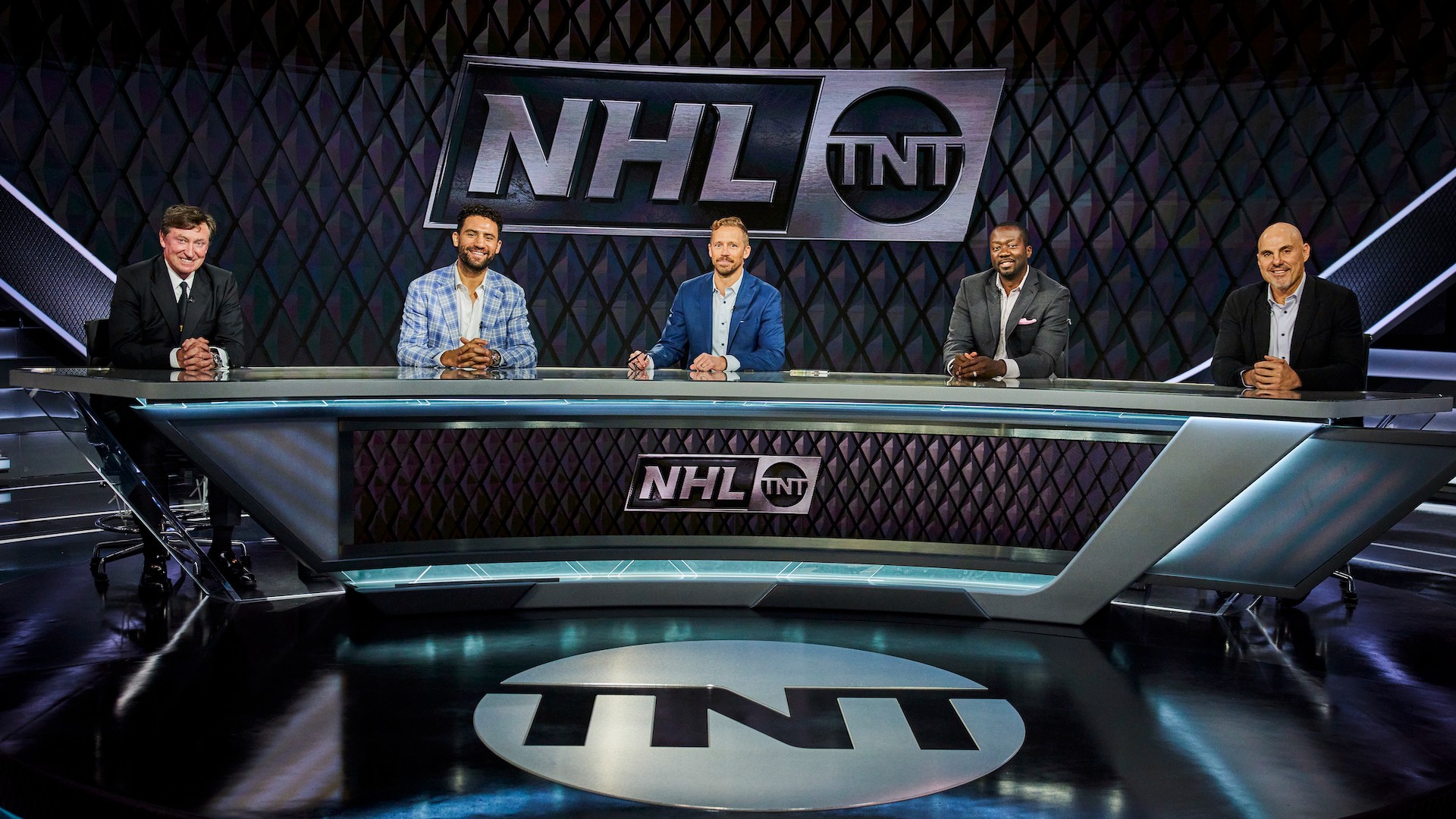
NHL on TNT Face Off is hosted by Liam McHugh, the former host on NBC’s intermission reports under the former contract. This night he was joined by Rick Tocchet, Anson Carter and Paul Bissonnette on the show.
McHugh is a seasoned pro, that actually gets to show off a little personality on this show. With NBC it seemed as though, McHugh was limited to a much more, straight forward approach, which allowed at times, a little humor. This TNT production allows him to really loosen up and run the show with fewer restrictions. His personality really comes out. He recently told the AP, basically the same thing.
“It felt like they wanted me to do what I do best, which is interact, and to keep a loose show,” McHugh said. “In the past, and it definitely occurred, I self-edited or I held back at times. In most cases, that’s gone. … And that was something that really appealed to me, it was more natural to me.”
Tocchet is an 18-year NHL veteran and coached for 6 seasons including the last four for the Coyotes. Tocchet can offer perspective as not only a high-level player, but as a coach just last season. He understands the mindset of today’s hockey player and that insight will be good as he gets more comfortable in the role. I like that he’s raw right now.
Bissonnette is the wildcard of the group. He’s probably the one most likely to drop a ‘bomb’, but that’s not an act, it’s all real. Hopefully he will be able to contain himself, but there’s no telling. During a Bleacher Report fans’ Q&A he told everyone what he’s most excited about, in joining the TNT crew.
“The advice I keep getting, especially from Wayne, is just be yourself. Turner tells us they want us to be ourselves. That was really refreshing. I’m excited to just get in there and let it fly with the guys. Whether it’s diving into a serious topic or breaking a video down, it’s just gonna be a very good time and a lighthearted feeling to the broadcast. Just having fun and just bringing my silly, goof personality.”
Carter is smooth on the set. No subject seems too much for him. He’s got a very calm demeanor about him, but that doesn’t mean he isn’t passionate. Watching him react to the Beach story and the Blackhawks, saying how it hits home to him with two daughters was powerful. Carter also made the comment that the hockey community is so close knit that the Hawks upper management failed to ‘take care of Kyle Beach’.
This production is terrific. It is very closely modeled after Inside the NBA on TNT. It’s irreverent at times, but mainly it’s fun. TNT showed us photoshopped pictures like the NBA show and also included instant reaction from fans and some famous folks on Twitter and social media. It’s almost like the folks at TNT are saying, ‘if you’re a fan of our NBA show, wait until you see what we can do for the NHL’. I loved the pacing of the show and everyone having a chance to take a ‘shot’ at the other.
This show featured a pregame interview with Oilers’ star Connor McDavid. Tocchet had the line of the interview when he prefaced his question by saying, “Hey Connor thanks for putting me on this panel, having to coach against you the last four years.” It was a fun interview that had its serious moments, but mainly showcased the personalities of the panel and of McDavid. The latter is so key for the development of the NHL on television. You have to let viewers get to know some of the big-time players and this was a mission accomplished.
Through all the fun, this show was able to turn into a very serious and informative program. With the seriousness of the Kyle Beach and Chicago Blackhawks situation, balance had to be struck. It was time to be serious and the balance was struck well. Carter was well spoken during the segment and spoke from the heart when he said, “this really hits home to me, I have two daughters,” he continued to call out the former Hawks executives, saying the hockey culture is all about looking out for each other and “they didn’t protect Kyle Beach”.
NHL ON TNT BROADCAST
Game broadcast has a familiar tone to the NBC telecasts of the past. That’s because this booth featured Kenny Albert, Eddie Olczyk and Keith Jones, guys that used to call games for NBC and NBCSN.
I think Albert is always solid. He has the ability to rise to the occasion when the moment calls for it and at the same time, he knows when to clear out to let Olczyk do his thing. Olczyk is hands down the best hockey analyst in the game, with a great feel for television and the game of hockey. He’s a great ambassador and a great teacher of the game for those that may have tuned in for the first time. Jones also moves from the NBC studio to the “inside the glass” position for the TNT broadcast. Unlike Pierre McGuire who made it more about himself than the game, Jones is now afforded the chance to analyze what he’s seeing at ice level and provides great insight.
The TNT scorebug is great as well. It’s just big enough not to be obtrusive. It’s clean and colorful and has excellent information. The thing most hockey fans truly appreciate about the TNT ‘bug’ is that the ‘Shots on Goal’ stay on it at all times.
ESPN STUDIO SHOW
In watching the first few minutes of this particular show, it kind of gave me the same feel as the old NBC telecast. It’s a little more “buttoned up” than the TNT show. Hockey lover Buccigross hosted this installment, he will split time with another hockey guy, Levy in hosting the show for the season. Both will also call games on ESPN’s coverage of the NHL. The ESPN studio show has two analysts. They are well known names to hard core and casual hockey fans. Mark Messier and Chris Chelios make up the panel. They are decorated players and big names in hockey circles.
Messier brings a wealth of experience and success to the ESPN show. He’s a six-time Stanley Cup champion and Hall of Fame center. His prior television experience includes work as an in-game analyst for the All-Star Game and making occasional guest commentator appearances for NHL on NBC. Messier is somewhat soft spoken on the ESPN set. But what he says packs a punch thanks to his credentials. You can tell he takes meticulous notes on each game he’s watching, now it’s just a matter of being able to speak without having to refer to them on air. Messier seems a bit fidgety in his chair at times, but that will change as he gets a little more experience. I was happy to see that he’s not so super serious all the time, playing well off his teammates on set.
Chelios is also a Hall of Fame player. He’s currently an ambassador for the Blackhawks. He previously worked for Fox Sports 1 back in 2013. He was part of the coverage of the 2014 Winter Olympics. Chelios is the ‘fun-loving’ side of the ESPN studio show. He smiles a lot and genuinely looks like he’s having a great time. He is dialed in on the current players in the game and is not afraid to express opinions. Chelios handled the Kyle Beach situation very well, when pressed during this particular show. While he still works for the Blackhawks, he didn’t mince words in stating how awful this situation was. Chelios looks very comfortable in the chair and is able to get Messier to smile and engage during the show.
NHL ON ESPN BROADCAST
There is a ‘newness’ to the telecast, just because it’s been so long since ESPN televised the NHL. Sean McDonough was named the lead play-by-play broadcaster and this night he was joined by a former NBC voice, Brian Boucher and reporter Emily Kaplan.
McDonough is a terrific broadcaster, versatile and solid. He’s called MLB, NCAA and NFL games. His foray back into hockey is taking a little time to get back on solid ground. It’s a different sport with different flow than the ones he’s more recently called. There were a few times that he was a little slow on the action. I’m sure as the season goes on, that will change, but right now it’s noticeable.
Boucher is solid as well. He was a rising star in the analyst world at NBC, so it makes sense that ESPN scooped him up. Boucher has a deep working knowledge of the NHL and has a clear and concise way of presenting information to the fans at home.
The ESPN scorebug is simple, maybe too simple. It doesn’t provide much other than the essentials, like the score and time left, etc. It’s larger than the one on TNT, but it features less. Shots on Goal are not regularly a part of it, once in a while the SOG is flashed up, but it’s not a fixture. The bug does expand to include penalty, power play time. I think it needs some work.
Overall, from the one watch of both networks, I’m kind of partial to the TNT telecast as a whole. From the studio show to the game broadcast, it just seemed more upbeat and cleaner. I think both broadcasts are a step up from the NBC broadcasts. Both are taking a few more chances visually. Whether it be penalty time actually displayed on the ice (TNT) or unique camera angles that capture more of the game from different perspectives (ESPN). Hockey is in good hands for the next seven years.
I don’t get the opportunity to write as often as I’d like to. Consulting projects make that harder these days but I do miss it. Fortunately I’ve been able to assemble a quality team to deliver news and industry opinions to your inbox and social media platforms each day. If you receive our emails, then you should notice one of those improvements today with our BSM 8@8 Newsletter. If you aren’t receiving our emails and would like to, click here to sign up.
The reason I chose to write today is because there’s one specific area of our industry that I’m concerned about and need to draw attention to. That’s the emergence of tomorrow’s sports radio program directors.
If you work in or follow this business, can you recall a year during the past decade where we saw more programming changes in sports radio than this one? I can’t. WFAN in New York, WEEI in Boston, KNBR in San Francisco, WIP in Philadelphia, Arizona Sports 98.7 in Phoenix, ESPN 97.5 in Houston, 93.7 The Fan in Pittsburgh, 750 The Game in Portland, ESPN 94.5 in Milwaukee, The Fan in Indianapolis, 107.5 The Game in Columbia, ESPN Las Vegas, 1620 The Zone in Omaha, and 98.1 The Sports Animal in Oklahoma City have or are soon to undergo PD changes. This follows a year where 101 ESPN in St. Louis, 104.5 The Zone in Nashville, WFNZ in Charlotte, and 680 The Fan and 92.9 The Game in Atlanta changed programming leaders. 98.5 The Sports Hub in Boston, ESPN 1000 in Chicago, 710 ESPN in Seattle, and ESPN LA 710 went thru changes too in the fall of 2019.
Twenty three brands undergoing change at the top of a station’s programming department in that short period of a time is an eye opener. But what really stands out are the lack of new faces to arrive on the PD scene let alone even come up during the interviewing process.
For every Rick Radzik, Amanda Brown, Kyle Brown and Qiant Myers who were elevated to PD positions over the past two years, there are proven leaders like Kevin Graham, Jeff Rickard, Tommy Mattern, and Terry Foxx who’ve landed in new situations. Those folks absolutely deserve those positions, so let me be clear, proven PD’s should always be valued. As I’ve told many decision makers before, a great PD is a difference maker. The film industry pays big money for Steven Spielberg, Martin Scorcese and Quintin Tarrantino because their track record highlights their abilities to deliver box office hits. Proven PD’s who can do the same for a radio station deserve similar respect.
But if you’re a younger person looking to advance your career into a programming role today, how do you take that next step let alone earn the nod when more experienced people want the same gig? Who’s advocating on your behalf? How would a corporate executive or market manager know that a producer, board op, promotions director or part-time host is capable of becoming the next great programmer?
Better yet, how does any corporate executive or market manager running a local brand know anything about your management style, vision, multi-platform skills, ability to lead people and work with multiple departments, and create exciting content, events and promotions if you’re working for another company in a different city? Here’s the answer, most times, they don’t. You apply for the job, your resume and email arrives in their inbox, which leads to them asking others about you. If someone you’ve crossed paths with says something good about you, you might get a call. If not, your materials go on file should the station have future needs.
Having led PD searches for a number of brands the past few years, I think the first step is finding out who’s interested in growing. Does anyone know of your desire to one day lead a brand besides the host you work with and the programmer you work for? Who have you sought out to gain knowledge and mentorship from outside of your building? Are you counting on an internal promotion to become a leader or assuming your PD will hype you up to potential employers? What are you doing to make sure the right people know you’re hungry to take the next step and you’re ready to go wherever an opportunity exists?
As someone who’s helped many aspiring programmers over the years, I’ve seen less new people seeking out advice the past few years than they did from 2011-2019. Maybe folks don’t think to come my way as much. Maybe they assume the company they’re working for will take care of them when the time comes. Maybe they don’t have the motivation to relocate or upset their current situation. Maybe the pandemic forced folks to press pause on pursuing advancement. Or maybe the role of a program director isn’t as appealing as it was to leaders from my era.
Some assume that because they’ve been successful at producing, and have done it for a long enough time, it means they’re ready for the next step. But programming is much more than managing a show. Not everyone is built to handle a verbal lashing from a market manager, balance a budget, negotiate deals, coach high profile talent, understand and examine PPM ratings, and unify departments. Let’s not forget interactions with corporate, being multi-platform skilled, knowing how to study and attack the competition, dealing with negative PR, and being the brand leader who keeps play by play partnerships in a healthy state.
If you’re behind the scenes in the sports radio industry, your path will most likely lead to becoming either a host, PD, moving into sales/marketing/imaging/digital/corporate or leaving the business. Top 10 markets and national networks are an exception as there are some very talented producers who’ve continued to work with top shows/stations for a long time. Both invest more in off-air positions. In many other cases, the financial upside for behind the scenes help is limited so eventually you reach a fork in the road when you have to decide the best path forward to make a decent living.
But those looking to take the next step don’t often think about positioning themselves to land the next big opportunity. They don’t take time to build relationships with key executives who they’ll one day interview with for a top job. Instead they think about that day’s show and the immediate tasks at hand. You can be the most creative, multiplatform savvy, best guest booker and strongest talent coach in America as a producer but if nobody else knows it outside your building, it’s going to be hard to take the next step. Which is why you have to make time to help yourself. You can start by emailing me. That can’t hurt.
Program directors have a responsibility here too. They should be making time to teach and push their behind the scenes people to want to advance their careers. They should also be telling anyone who will listen why one of their own is ready for the next step. Not enough do that. I can count on one hand the number of PD’s who’ve come to me championing one of their own for a top programming job over the past six years since I began helping stations find PD’s. Just going thru the interview process can be huge for an off-air professional who dreams one day of leading a brand. It helps them learn what to expect, how to present themselves, which areas they need to improve on in order to make the jump and most importantly, it shows them you care about them and their professional development.
I know that the job is busier today than ever for a PD and finding time is a pain in the ass. But coaching people is one of your biggest strengths. It’s why why you’ve been trusted to lead your brand. When twenty three positions open up and more than half require hiring elsewhere in the country and turning to folks inside different companies, that should raise eyebrows. Have you told others to consider someone on your staff? Did you push for them to be interviewed, even if they weren’t the right fit because you knew it’d serve them well later? Did you invest time in them to to make sure they were ready for the next step? And that doesn’t mean just giving them the crap you hate like filling out affidavits, building clocks, and corresponding with the traffic department.
Have you conducted 1 on 1’s with all of your off-air crew and learned who aspires to one day do what you do? Have you taught them how to analyze ratings and content? Sit in on show meetings? Critique talent? Recruit future staff? Participate in creative brainstorms or sales meetings? Have you told your GM or other high ranking executives or PD’s in your company about their passion to lead?
It should go without saying that if you’re in a position to lead and develop people, that it applies to more than just on-air talent. It should include grooming future programmers too. Any executive with oversight of your brand should be asking “who on your staff is ready to take a step?” If the answer is no one, they should be asking what your plan is to change that so the answer is different the next time they ask. If you’re skilled enough to lead a brand for years or even decades, those above you should want to protect the future by having you develop the next crop of programmers too. Your report card as a PD isn’t complete if all you can point to are good quarterly ratings. There are plenty of brands who’ve won in spite of their PD and others who have lost despite having an elite program director.
By the way, shouldn’t a PD want to see people inside their operations get called upon to take the next step? As hard as I pushed my crew to perform in St. Louis and San Francisco, when one got an opportunity to become a PD, APD or EP I was proud as hell. There’s nothing more fulfilling than seeing someone you have mentored, challenged and cared about take their career to a higher level. If you spend years in the position and have producers and assistant programmers not landing opportunities, let alone receiving calls to be interviewed for openings, you should be asking yourself ‘what haven’t I done to get them to that next level’ and ‘do I have the right people here who want to grow?’.
Lastly, I recognize everyone is under pressure to add good help. A station operating without a leader in the programming department creates a lot of problems, especially when it lingers for months. But you also need to find the right people or you end up with bigger problems later, most notably, others questioning your ability to hire the right people. If there’s one thing I’ve learned going thru these processes with different companies is that often times, decision makers want to move fast and find people who are referred by others they know and respect. If they hear a few good things said in conversation by a candidate that match what they value, they’re ready to move forward. Some get caught up in resumes or similar experiences/interests but not all ask the right questions and research people well. It’s amazing what you’ll learn if you investigate properly and ask questions that make folks uncomfortable. If you’re going to trust someone to lead your brand and staff, and set the tone for your operation, spending the extra time to be sure about those you hire is absolutely necessary.
Taking a chance on the APD or smaller market PD isn’t as safe as hiring a veteran leader. If you have a proven winner interested in your opening and feel confident that they fit your needs, I’m all for them being hired. But don’t make the mistake of assuming someone with less experience can’t make a greater difference. Imagine if we were back in 2004 and you passed on Jack Dorsey or Mark Zuckerberg in favor of a proven Newspaper editor to lead your brand’s digital strategy. How would you look today? That could be your radio station in five years if you overlook those with an ability to see the future better than the present when future openings arise.
To grow this format we need a mixture of new blood, new ideas, people who view the audio business differently from those in the present or past, and proven performers who’ve helped turn this format into a very successful one. We have to ask the right questions, fully research candidates, challenge our executives and programmers to take a greater interest in developing the next crop of sports radio executives, and consider new roads rather than the ones we’re most familiar with. We also need to hear from people who haven’t told us of their interest in taking the next step. We need to encourage them to want to grow and show them the path to do so. If we each do those things better, our format is going to spend a lot more time thriving and less time surviving in the years ahead.
Sports betting is becoming an omnipresent element of sports media, with many networks introducing new programming geared towards the flourishing sector of the industry. In fact, MSG Networks recently announced an expanded sports betting programming lineup featuring the premiere of two new shows, Odds With Ends and The Bettor Half *Hour, along with the expansion of The Betting Exchange.
While she was always a sports fan, Katie Mox did not initially look to work in the world of sports and entertainment. As a graduate of The Fashion Institute of Design and Merchandising and ardent fan of the NFL’s San Francisco 49ers, Mox originally sought to work in design and visual communications and found her career path in the field of public relations. Over fifteen years, Mox worked for various public relations firms, serving in managerial positions and communicating with clientele. It was not until recently that she began working in the world of digital content creation, which started through her Instagram account and helped land her a gig as co-host of The Betting Exchange on MSG Networks. She says the drastic career shift came as a result of her sports fandom and enthusiastic proclivity to make her insights and opinions known.
“I always wanted to be on-air and to do something hosting,” said Mox. “At first, it started as a passion project to talk about sports and gambling. In the pandemic, I saw… an opportunity to really go for it and make this transition for myself into sports broadcasting.”
Mox was laid off from her public relations job in the early stages of the COVID-19 pandemic because of a lack of work, an impetus that she avows hastened her subsequent transition into sports broadcasting. Yet she has a competitive advantage as a result of her background in public relations in that she knows how to effectively position herself as a brand among the assemblage of aspiring on-air personalities. In being able to work on a team, Mox is aware of the implications her actions have on others, and vice-versa, and possesses innate wherewithal to make informed, strategic decisions.
“I am so lucky to have worked in public relations for so long because I understand the other side of the business,” said Mox. “Being a content creator, I know what is expected from me from the marketing team; the public relations team, etc. Sometimes when you are working with influencers, they do not have the knowledge of the business side of it. I feel like it’s a benefit to me because I’ve been on the marketing side. I know how to make sure I’m doing everything I need to do to make the client happy.”
Following the nearly four-and-a-half-month pause on professional sports in the United States due to the COVID-19 pandemic, the popularity of sports betting began to significantly proliferate. With various new sportsbooks heavily advertising across radio and television, along with specialized programming created for bettors, it is a booming sector of the industry that shows no signs of slowing down. While the betting itself is centered on sporting events, Mox affirms that it is the entertainment it provides and camaraderie it cultivates that has made it wildly popular and profitable today, especially among younger audiences, something she and many others call “wagertainment.”
“There’s an entire community of people who love sports betting not just for getting skin in the game, but also for the community,” said Mox. “I do think sportsbooks are trying to figure out how to reach out to this millennial group of gamblers.”
One way to do that — through traveling. Mox serves as the host of the web series Ride with Katie Presented by Betfred Sports on the sports betting platform “The Gameday,” which combines the thrill of traveling to different sporting events around the country with sports betting. The content, which routinely has at least 10,000 views each week on YouTube, shows a different side of gambling that helps to eliminate the initial stigma surrounding it.
“It’s making [gambling] more accessible and demonstrating the camaraderie about it,” explained Mox, who began hosting the show in September 2021. “It’s also showing gambling in a different light and [that] it’s fun [and] doesn’t have to be scary. You certainly should be smart about it, but I think it reaches a new audience and makes it more fun and accessible to the young audience.”
Sports betting has adopted its own vernacular through use of terms such as “parlays,” “teasers” and “point spreads,” terminology that sports fans looking to immerse themselves in the world of sports betting may be unfamiliar with. Shows, such as Mox’s The Betting Exchange on MSG Networks, help to eliminate that boundary by explaining the nuances of sports betting through the context of current sports events. The show, which initially aired once a week, has broadened and is now live on MSG Networks Monday through Thursday at 5:30 p.m. E.S.T.
“I think MSG is bridging the gap between the younger generation of gamblers who want to be entertained with an easier access point that’s not as intimidating,” said Mox. “We explain parlays, teasers [and] how to use those [sic]. We give our best bets, we play games and provide some value with the picks as well.”
Along with Mox, The Betting Exchange is co-hosted by sports betting personality Jeff Johnson, and will feature former New York athletes, such as former Giants wide receiver David Tyree and former Jets safety Erik Coleman, to talk about sports betting.
Courtesy: MSG Networks
“I think MSG is the only network that is putting former athletes on and talking about sports betting, which I think is really interesting to a younger audience,” expressed Mox. “Who knows more about the game than they do?”
Expanding the demographic of sports betting is a mission every sportsbook has embarked upon, frequently advertising on sports networks in creative, captivating ways to try to appeal to new segments of the marketplace. With a background in public relations, Mox knows that understanding that audience should be the number one priority in bolstering their reach.
“It’s understanding that [the audience doesn’t] want experts barking at them telling them what they should be doing,” explained Mox. “They want real gamblers and people in front of them providing education and value, but not necessarily taking themselves too seriously. As long as sportsbooks are looking to media companies, and they are understanding this new audience that wants to be entertained more so than [have] experts [bark things] at them, they want to ride the wave with you.”
As an on-air host and content creator, Mox does not try to masquerade herself as a consistent, undisputed winner in her betting practice. Rather, she is realistic with the audience in that success in “having skin in the game” is not a guarantee and a practice that, while it is consumed as a form of entertainment, is best done responsibly.
“The reality is that you’re not winning all the time,” said Mox. “People pretending to win all the time lose the new audience. I think MSG Networks and The Gameday do a great job of showing the reality of it.”
Some sports broadcasts have implemented live odds and talk about sports betting into the game broadcast, including MSG Networks. The network regularly promotes its newly-introduced “MSG Pick ‘Em” app during its game programming, which allows fans to win or split a jackpot based on the amount of points they earn answering questions about that night’s game before it happens. Mox, though, believes persistently trying to discuss sports betting during the live game action is perhaps taking it a bit too far for now.
“There is a fine line with in-game broadcasts,” said Mox. “That might be a little bit too much because you want to make sure everything is still fair.”
With all 50 states moving to legalize sports betting, sports consumption habits are shifting across multiple platforms in a direction indicative of betting’s sizable expansion. There are ostensibly no signs of this exponential growth promptly coming to a halt, especially within the National Football League, as sportsbooks are partnering with broadcast networks and professional sports leagues to create focused content tailored to the relevant demographics.
“I think sports betting content is going to be synonymous with sports in the next five to 10 years,” said Mox. “Everyone wants a piece of this pie because it’s a huge market. I think you’re going to see it everywhere.”
VSiN (Vegas Stats and Information Network) and Kroenke Sports & Entertainment have joined forces to give Denver sports fans a new home for quality sports betting programming. Altitude Sports Radio 92.5 made the announcement this morning that starting on Monday November 1st, Altitude Sports 950AM will convert to a 24/7 sports betting information format, airing VSiN’s best in class sports betting news and analysis across every major sport 24/7, outside of live sporting events. The station previously aired FOX Sports Radio 24.7. FSR will remain in the KSE family, airing on weeknights and the weekends (when play-by-play commitments don’t conflict) on Altitude Sports Radio 92.5.
“With hundreds of millions of dollars bet on sports in Colorado, credible sports betting information and analysis is increasingly valuable to Denver sports fans,” said Dave Fleck, GM/SVP at Altitude Sports Radio. “Our listeners have repeatedly told us that they want informative, quality content focused on sports gaming. We’re responding to those listeners by bringing them some of the most knowledgeable sports betting talk in the business, as we become the home of VSiN in Denver.”
VSiN programming on Altitude 950 AM will be provided by leading media and industry experts including morning talk personalities Mitch Moss and Pauly Howard, former Denver Bronco and Denver radio host, Mike Pritchard, former pro football executive Michael Lombardi, sports betting analytics expert Gill Alexander, and sportscasting legend Brent Musburger.
“We couldn’t be more excited to team with Altitude Sports Radio and Kroenke Sports & Entertainment to offer Denver sports fans premium sports betting content around the clock,” said Brian Musburger, founder, and CEO of VSiN. “VSiN has assembled a quality roster of sports betting experts that will deliver an innovative brand of sports talk in a state that has been at the forefront of legalized sports betting.”
VSiN was acquired by DraftKings Inc. (NASDAQ: DKNG) in March and continues to deliver news, analysis, and insights that sports bettors need to make informed wagering decisions. The network operates out of Las Vegas at both Circa and the South Point Casino. Since arriving on the scene in February 2017, VSiN has established itself on both television and radio thru a series of partnerships with companies such as YouTube, iHeart Radio, MSG, NESN, Marquee Sports Network, AT&T Pittsburgh, Rogers Sportsnet, Fubo, and local radio stations across the country. Radio groups interested in carrying the network’s programming can explore that possibility by clicking here for more information.
Recently, Hubspot reported that six out of 10 of us consider generating leads our biggest challenge.
No shit. If you are new to radio sales, you probably spend almost 80% of your time (the other 20% in meetings about why you don’t have more appointments) looking for people to meet with about advertising.
With so many new sales reps quitting the business because of this activity, why hasn’t the radio industry embraced hiring an in-house expert at lead generation or outsourced the task? I am serious about saving radio sales jobs. We all go through countless hours of trial and error and waste most of our energy on the anxiety around finding clients interested in making an appointment about buying something.
George Leith was a PD, announcer, and AE for CJYM/CFYM radio in Canada for six years in the ’90s. He went on to publishing and sales consulting. He is now the Chief Customer Officer at Vendasta, a software company for digital solution channel partners to work with small- and medium-sized businesses. Vendasta, a private company, has over 500 employees listed on LinkedIn and serves over 5 million businesses. They specialize in Reputation Management, white-label software, mobile web development, social marketing, and digital advertising. Given Leith’s skill set, I asked him some questions about the radio industry and why sales development specialists for lead generation could work and let salespeople sell. I also commented along the way.
Jeff Caves: Are any radio groups outsourcing their lead generation?
George Lieth: We are starting to see radio groups beginning to outsource their lead generation and lower Annual Contract Value deals. I always suggest channel partners use modern demand generation tactics to drive new logo (client) acquisition.
Imagine the opportunity to sell a Christmas or back-to-school advertising package via the internet. And, the best part is, you can do it yourself even if corporate isn’t. Learn how to make offers online and create leads for yourself.
JC: What are some digital tactics to increase inbound leads for broadcast and digital radio salespeople?
GL: Use the “megaphone,” airing:30/:60 commercial inventory or infomercials, to address the problems your digital solutions solve. Educate the market that you are the trusted local expert to solve their challenges.
Push your production department to be creative in producing and running commercials for the sales department. These could be :10, :15, :30 or : 60 spots. Sit down as a staff and design an annual campaign with several themes. Produce a 30-minute infomercial that can air when you get another 30-minute program and run them adjacent to each other. This should be some of the best work we do not the last rip and read generic spot produced. I would even consider hiring an ad agency to write and produce these as a bartering project.
JC: What other industry that you consult uses outsourced business development that radio could pattern itself after?
GL: Independent software vendors, publishers, and large digital marketing agencies.
Get on google and search these companies out, or listen to the Conquer Local podcast with George to hear these companies’ stories.
JC: What are the general costs associated with hiring in-house or outsourcing lead gen?
GL: In-house is best if you can find the talent and your business model supports this cost structure. Outsourcing is usually less of an investment, but there are always communication and delivery challenges.
Which sales staff wouldn’t want a person, maybe even a former salesperson, who spent 40 hours a week creating leads? If large digital marketing agencies can afford it, so can radio.
Reggie Miller played his entire 18-year NBA career with the Indiana Pacers. In that time, he became one of the most prolific three-point shooters in history. While his teams never won a championship, Miller is considered one of the best players in Pacers history. His number 31 has been retired by the organization. He was recognized as one of the greatest to play the game when he was inducted into the Naismith Memorial Basketball Hall of Fame in September of 2012.
Courtesy: NBA.com
Miller grew up in California. He was one of five siblings and was born into a very athletic family. His brother Darrell is a former Major League Baseball player (catcher for the then California Angels); his sister Tammy played volleyball at Cal State Fullerton; and his older sister Cheryl is also a Hall of Fame basketball player. Cheryl was a member of the 1984 U.S. gold-medal-winning Olympic basketball team and is also an analyst for Turner Sports.
One of the family anecdotes Reggie likes to recall was when Cheryl used to beat him in games of 1-on-1 prior to his professional career. According to Reggie, they quit playing when he could finally block Cheryl’s shots. Miller says his unorthodox shooting style was developed to arc his shot over his sister’s constant shot-blocking. His brother, Saul, Jr., became a musician and followed in his father’s footsteps in military service.
ROAD TO TNT
In August of 2005, Miller announced his plans to join TNT as an NBA analyst and he’s been with the network, more or less, ever since. I say more or less because Miller was tempted at an NBA comeback with the Celtics in 2007.
On August 8, 2007, Celtics GM Danny Ainge and head coach Doc Rivers discussed joining their revamped roster, included Kevin Garnett, Ray Allen, and team legend Paul Pierce, in a reserve role. He seriously thought about it but a few weeks later, on his 42nd birthday, Miller decided not to attempt the return. He told the Indianapolis Star, “Physically, I know I could have done it. But mentally, when you do something like this, you’ve either got to be all in or all out. And I’ve decided I’m all out.”
At Turner, Miller has handled a variety of roles. Mainly he is a game analyst, working with some of the top play-by-play announcers in the game. He was regularly paired with Marv Albert before his retirement and also had many assignments working alongside Kevin Harlan.
Occasionally, Miller will pop up on the studio show Inside the NBA. His appearances there are not as numerous as they are courtside on the call of a game.
When Turner got involved in the NCAA Tournament broadcasting business, Miller was tabbed as an analyst. He called tournament games for the network from 2011-2019. He was scheduled to work the 2020 tournament, but it was canceled due to the COVID-19 pandemic. He did not work in 2021, thanks to the single-site situation, which resulted in streamlined broadcast crews.
FEUDS
Miller is a lightning rod for controversies, misspeaks, bad Tweets and feuds. He is no doubt an opinionated person and hey that’s fine when you’re an analyst that played the game at a high level. But along with those opinions come blowback and replies.
Take for example his Tweet during last year’s Eastern Conference Finals between the Nets and the Bucks after Brooklyn won Game 5. Kevin Durant had one of the greatest performances in NBA Playoff history scoring 49 points, grabbing 17 rebounds and dishing out 10 assists, in 48 minutes. The win gave the Nets a 3-2 lead in the series. For some reason, Miller decided to Tweet after the game. Proving the old adage, think before you hit send.
I’m just going to throw this out there to see what the responses will be.. If your Steve Nash and the Nets, would you sit James Harden AND Kevin Durant in Game 6 because of the heavy minutes tonight, and push all your chips to the center of table for Game 7??
Nets guard Landry Shamet was even asked about the tweet after the game. He told the New York Daily News, “That would be insane. I don’t know what universe you would even consider just giving a game away in the playoffs. That doesn’t make sense to me.”
If you didn’t know the game of basketball, you’d probably have a hard time believing that Miller actually played the game. His teams would never even think about ‘throwing’ a game to force a game 7. Do you really think the Pacers would lay down if they led the Bulls 3 games to 2 in a series under any circumstance? I don’t think so.
Miller has also had a running “feud” with Spike Lee, the director and Knicks superfan. It dates back to Game 5 of the 1994 Playoffs at Madison Square Garden. Miller willed his Pacers to a win by scoring 24 points in the 4th quarter. After every basket, he looked at Lee, who has courtside seats and trash-talked him. Miller gave Lee the choke sign several times as well.
It didn’t come as a surprise when the Hall of Famer took advantage of the opportunity to call Lee out again during a TNT telecast of the playoffs last season. In the dying minutes of Game 5 between the Knicks and the Atlanta Hawks, with the end result all but assured, Lee left his usual courtside seat and headed for the tunnel with just more than three minutes left. Miller, drew attention to Lee’s exit.
“That’s a fair-weather fan right there,” Miller said as cameras showed Lee walking out. “If he wants to be the No. 1 supporter of the Knicks, you’ve got to stay there and take it like the guys on the floor.”
AS AN ANALYST
Miller is not my cup of tea as an analyst. It’s hard to put my finger on exactly why, but I have a few thoughts. It probably doesn’t help his case in my mind that I grew up a major Bulls fan.
Putting that aside and the way he felt about my childhood team and the greatest to ever play the game, Michael Jordan, there is still something missing in his analysis. My feeling on that has nothing to do with his playing days.
I don’t always get the impression that Miller is fully prepared for a broadcast. I’m not exactly sure at times, where he’s going with what he’s saying. I can only imagine the stress this puts on his play-by-play partner. You never want to correct someone on the air or question the authenticity of the commentary, so it’s probably difficult to deal with.
Many fans react to hearing that Miller is going to be part of the coverage of their team in a less than favorable manner. Taking to Twitter to inject memes of Michael Scott from The Office putting his face into his hands, or Charles Barkley’s famous ‘Terrible’ complete with the shaking of the head.
Some former players, again some, feel like prep for these games isn’t as important as being the person that played the game. I’ve written about this many times, that just because you played the game, doesn’t necessarily mean you can make it translate to a broadcast.
Miller was a cocky player, that was able to back it up many times. He broadcasts almost like the way he played. It comes across sometimes as arrogant. As if to say, “I know more than you” without much substance to follow.
Courtesy: TNT
Yes, you are SUPPOSED to know more than me, you played the game, I didn’t. Instead of talking down to the audience, explain things, teach us something, and make us understand what comes so naturally to you. The smugness I perceive is unappealing.
CONCLUSION
I do appreciate the fact that Miller is willing to say things that others may not be able to get away with. I like how candid he is at times, but there needs to be some substance behind it. Don’t just tell me that you would be able to score 45 points a game under the new NBA rules, tell me why. Sometimes I get the impression a lot of what he’s saying is for effect, to kind of say ‘look at me, look what I can say’. It rings hollow with me and I really feel for the announcers he works with.
Ramona Shelburne is a versatile NBA reporter, writer, and on-air talent at ESPN. Here are five things she says she still has left to accomplish.
1 and 2. Maintain balance with health and rest.
We’ve all, over the last 1.5 years, learned how to do our jobs remotely. Some of us adapted better than others. I tended to really like being home and spending all this time with my son. I feel like I took care of myself much better than I normally do in my grind — flying, traveling, getting home late from games, getting up early for shows. It’s tough on your body and it’s tough on your life.
I felt like, during my time in quarantine, I was much better at eating, resting, and taking care of myself. I lost a bunch of weight, I ate healthy. I worked out every day. I still feel like I have enough connections and relationships that I can do my job well without always being on that intense grind on the road. I just want to keep that balance, as we return to games and seeing people. I realize I’m better as a person, a mom, a writer, a reporter — all those things — when I have that balance.
An example: the other night, I got home from the Lakers game around midnight, and I hadn’t done my daily swim. I was like I just gotta do it, and got in the pool for a half-hour. I just want to keep that up. We are all so much better when we’re healthier and balanced, and this job can kind of turn you off the path of health and wellness.
I tend to be a night owl. I do a lot of my writing at night. While it’s also the time when my son is sleeping, I’ve always been a night owl. Before my kid, I used to stay up all night and write. My editors laughed at the times I sent stories to them. I’d sent it at 4 am on the west coast, which meant they’d wake up to it at 7 am ET.
But now, it’s not super healthy to do that, because I have to get up in the morning, be a mom, and go do my job whether it’s in the radio or TV studio or wherever I’m going that day. I’ve been trying to scale back on my all-nighters; before my kid, I was even worse — I used to hole myself up in a hotel room, intensely focused for 2-3 days, and put together 6,000-word stories. I couldn’t do it at home. I’d get distracted. That was my way of literally locking myself in a room and doing it.
That’s something you can pull off in your 20s and 30s. When you’re in your 40s, and you’ve got a kid to take care of, it’s a little harder. I’m trying to be more balanced, and have more focus on my health and sleep. I’ve found out that you can do that and still do good work. I used to think as a writer that you needed to suffer and face mental and physical exhaustion to pull out greatness. I’ve had to be more strategic and focused. I actually don’t need all that pain.
3. Make stories that cut through and matter.
It’s harder to find these stories when we aren’t seeing each other in person, but they’re still out there. I just did one a week or two ago with Ben Simmons, where I told the much bigger, deeper story as opposed to the daily news. It’s valuable to take a longer, deeper look at a story. Nowadays, people read a headline and three paragraphs on their phones. I just believe that people also have an appetite for deeper dives like that.
I’m not saying everything needs to be 10,000 words, but if you do the work and you tell a good story and really get to the heart and humanity of the matter — people find them. They’re hard to do, especially without in-person access, but I want to keep challenging myself to do those. Those are where I can separate myself.
4. I’d really like to do another longform 30 for 30 podcast.
I think podcasts are a great medium for this day and age. People just love long-form narrative podcasts — almost more than long-form narrative written stories now. I love to read good writing, but I am always driving around and I listen to podcasts when I swim. If I find a good one, I can swim for an hour!
I did The Sterling Affairs. I’d really like to do another one of those. It’s hard to get off the ground, because I do have a day job, but I have a bunch of ideas that I want to take from stories that I’ve done that I think can be longer and better and lend themselves to the podcast format. I want to do another one of them, and I think I will relatively soon.
It’s a lot of work to do them. I had a great producer — Julia Lowrie Henderson, who is leaving ESPN for a great new opportunity, and I want to make sure she gets a shoutout. She was just incredible to work with. I can’t imagine a better podcast producer in the business. Creatively, I don’t know if I’ve sparked with anybody as much as with her when we worked on The Sterling Affairs.
5. Be optimistic.
It’s been a rough couple of years. I’ve had a lot of joy, but it’s been rough for a lot of people, whether they lost their jobs, got Covid, lost loved ones. People were separated from friends and family and got lonely — I just thought that my theme of 2021 and 2022 is to be optimistic. This is gonna pass. It’s gonna get better. It’s gonna get back to some version of normal — it might not be the version we left behind, but hopefully, it’ll be better.
Courtesy: ESPN Images
Whenever we get kind of bummed about what’s going on in our lives or work, I think we just need to be optimistic again. It’s been pretty heavy. But, sports have been great! The baseball playoffs, every night they’ve been awesome. We’ve been having amazing nights of sports.
We got away from a lot of the fun stuff we do in our jobs — actually going to games, experiencing live sports, being around people and not just talking about the pandemic all the time. It’s still going on — it’s heavy — so I just want to be optimistic about getting back to a version of our lives that is happy and we can enjoy each other’s company again. I don’t know when, but I’m optimistic that it’s coming.
The New York summer book results are finally in. Though they were released a month ago, a combination of other projects requiring my focus and information taking longer to track down made it tougher to tackle this sooner. Usually the NY newspapers report the results quickly but a ratings story wasn’t written up for the quarter for some reason, so we’ll dive into it now.
First, presenting NYC’s sports radio ratings can be very complicated. If you need a drink after reading this, I understand. 98.7 ESPN New York reports their numbers in one lump sum, Over The Air listening and Streaming combined. The preferred way to showcase measured listening. WFAN on the other hand, which is owned by Audacy, operates differently. They produce an Over The Air and Streaming number, which then needs to be combined to show a fair head to head comparison against their local competition.
Some will say only the OTA numbers should be counted. That’s been Nielsen’s message time and again. Others will say Streaming should be added since people are indeed listening on platforms other than radio and companies have different approaches to generating sales. We’ve consistently tried to present these stories showing a complete picture of what’s taking place in a market so that’s how we’re going to present information for the summer book. We’ll make it clear where OTA performance benefits one station over the other, but given that two quality brands are delivering listenership thru a combination of radio, phone, smart speaker and computer listening, we’re going to include the streaming numbers since it does represent actual listening. The day that each station and company presents one collective number to show how they stack up against local competition can’t come soon enough.
Now that we’ve got that out of the way, the summer book for New York City produced mixed results. For the full week (M-SU 6a-Mid) with Men 25-54, WFAN came in 6th with a combined 4.1 (3.5 OTA, 0.6 streaming) while 98.7 ESPN New York finished 12th with a 2.6. If you take away The Fan’s streaming number and go solely by OTA listening, WFAN holds a 3.5 to 2.6 advantage on ESPN NY.
During weekday prime, WFAN delivered a 4.5 (3.7 OTA and 0.8 Streaming) to finish 4th. 98.7 ESPN NY was 14th with a 3.3. share. The race gets tighter without streaming, with The Fan winning 3.7 to 3.3.
Due to both stations showcasing local shows during different hours, we’re going to concentrate on one brand at a time. Starting with WFAN, the station received a 4th place finish from ‘Boomer and Gio’ in morning drive. Boomer Esiason and Gregg Giannotti produced a 5.3 share which represents 4.6 OTA and 0.7 streaming. The show’s ranking obviously declines without streaming included. Boomer and Gio were down from the spring when they ranked 2nd.
In middays on WFAN, Marc Malusis and Maggie Gray recorded a 4th place finish for the quarter courtesy of a 4.5 share (3.2 OTA, 1.3 streaming). Moose and Maggie were 3rd in the spring therefore they lost one position this book. Once again, this takes into account the addition of streaming. Without it, the show ranks lower.
Moving to afternoons, Craig Carton and Evan Roberts finished 6th between the hours of 2p-6p if you go by the combined performance of a 3.6 OTA and 0.7 stream, which lifts them to a 4.3 share. The show drops further back if you only count their OTA performance. One issue with the 2p-6p numbers, they don’t take into account the afternoon show’s final hour. Yankees baseball programming does cut into that hour often but the station does promote the program airing weekdays from 2p-7p. Full data for 2p-7p wasn’t available, but I was able to gather data for 2p-6:30p when Carton and Roberts go head to head with ESPN NY’s Michael Kay Show. Craig and Evan recorded a 3.5 OTA and 0.7 stream for a 4.2, which put them in the mix for 6th if using combined numbers. If streaming is eliminated, the show slides way back to 13th.
Most in the industry who read this are going to focus on the Carton/Roberts-Michael Kay matchup since the afternoon drive battle is one that consistently produces a lot of interest. From The Fan’s perspective, not counting the 6p-7p hour as a Carton and Roberts hour when they’re barely on makes logical sense. The flip side is that the show also benefits a number of times during the summer months from Yankee games airing during the afternoon, something the Kay Show doesn’t receive, so discounting an hour that the station bills as part of its schedule isn’t perfect either.
Regardless of all of that, the bottom line, Carton and Roberts were down this book from the spring. The show was 3rd with a 5.7 (combined performance) in the spring book after scoring their first head to head afternoon win against Kay’s show in the winter book. Given the station and show’s expectations, whether using the combined performance (6th) or OTA ratings (13th), the program didn’t hit as expected. Rebounding in the fall book is going to be a top priority for Craig and Evan.
For 98.7 ESPN New York, the top story was two shows finishing in the Top 10 and one of them, The Michael Kay Show, beating the competition head to head. For the station as a whole in weekday prime, 98.7 ESPN NY finished the summer book in 14th place with a 3.3 share. That was down from the spring when the brand registered a 9th place finish with a 3.7 share.
Among the station’s weekday shows, The Michael Kay Show with Michael Kay, Don LaGreca and Peter Rosenberg turned in a 4.3 share to finish 6th between the hours of 2p-6:30p. That was one tenth of a point above Carton and Roberts (4.2) if you use the combined numbers, and eight tenths of a point (3.5) better if going by the OTA performance. The shows also run neck and neck for 6th if using combined performance, and 6th vs. 13th if going by the OTA numbers.
In the station’s other slots, Rick DiPietro, Chris Canty and Dave Rothenberg delivered a 9th place finish during the hours of 5a-8a. The morning trio popped a 4.0 share during the book, continuing to perform in the Top 10 as they did in the spring. The station’s second half of morning drive, ESPN Radio’s ‘Keyshawn, JWill and Max’ which airs locally from 8a-10a finished 18th with a 2.0 share.
Switching to middays, Mike Greenberg’s national show, which airs from 10a-12p registered a 14th place tie with a 2.4 share. The news was better during the Noon to 3p hours as Bart Scott and Alan Hahn scored a 3.0 share to finish the book tied for 10th. Bart and Hahn have now produced back to back Top 10 finishes after starting off the year with a 12th place finish in the winter book.
Looking ahead to the fall, WFAN and 98.7 ESPN NY should both improve. During the 2020 fall book, Boomer & Gio were 1st in mornings, Moose & Maggie were 3rd in middays, and afternoons, which featured two months of Benigno & Roberts and the first month of Carton & Roberts combined to finish 5th. For 98.7 ESPN NY, Michael Kay was 2nd last fall, mornings were 14th, and middays came in 9th.