Home Blog Page 2795

Product + Knowledge + Passion = Revenue

0

In the radio business, there’s this constant struggle between what matters more – generating revenue, or delivering great programming. Clearly you need both to make a difference, but not all brands experience success in both areas.

Given my background in programming, I’m sure you’re going to be stunned to learn that I lean first towards providing quality programming. However, I’m not one of those people who turns a blind eye to sales, or minimizes the importance of being profitable. Anyone who’s occupied a conference room with me knows that I’m going to defend the integrity of the programming at all costs, but if I reject an idea, I’m likely to counter with “but here’s what I will consider”.

We can play the chicken or the egg game, but in life, listeners have a choice of whether or not to invest their time in a brand. They didn’t turn on your radio station, listen to your podcast, or watch your personality’s video, because they were looking for an advertiser message.

The client didn’t place their ad budget on your radio station because they were concerned with helping your company turn a profit. They did it because you have something of value to offer – access to people!

With that access comes the opportunity to place effective messaging in front of an audience by aligning the advertiser with things that the user considers cool (talent, features, play by play, etc.). But how are you supposed to take advantage of the power you yield, if you don’t fully grasp the vision of the product, and the reasons why it connects?

I’ve been fortunate to work with some great Market Managers during my career. Since entering into business for myself last August, I’ve had the pleasure of meeting many more who truly understand the secret sauce of their radio stations. You can’t measure a brand’s success solely by ratings numbers, and you can’t make investments by only looking at expenses vs. revenue earned. If that were the case, this format wouldn’t have more than seven hundred stations operating in it.

One area today which is drawing larger industry concern is the product knowledge, and interest level, among market managers, and sales leaders. Some of that’s brought on by individual decisions, but most of it is the result of structure, pressure, and inexperience.

Selling sports isn’t easy. You have to use the emotion of a local team, the persona of an on-air talent, and the passion of the audience to create deeper interest. Ratings help, but for most sports radio brands, they’re not going to be the reason that local and national clients spend larger dollars on your station. If numbers are part of the decision making process, music stations will get more respect, because they perform better in the 6+ and Persons 25-54 demos, an area that only a handful of sports talkers do.

If you want to strike a chord with a buyer or client, you need evidence to make them look beyond the ratings sheet, especially if you have a competitor in your market.

Have you ever walked into a meeting with audio clips of your brand and your competitor, and let the client hear why it makes sense to invest more in your brand? If you want to draw an emotional response from the client or buyer, watch their reaction when they hear the way their business is presented. Few advertisers enjoy hearing their commercial run on your competitor’s station during an eight minute commercial break, let alone as the final unit.

You can point out the mistakes on your competitor, but when you do so, you better have your own house in order. The last thing you want to do is highlight how the brand you compete against treats a client, and then have the same issues occurring on your own radio station. If you can show a clear difference of the programming, and how a sponsorship works better on one brand than the other, they’ll give deeper thought to doing more business with you.

Here’s another idea. Have you ever taken a look on social media at the reaction of your audience when your on-air talent says something bold, or the station announces something big? The passion is off the charts, and the response can be overwhelming. I used to conduct quarterly Twitter chats when I programmed 95.7 The Game in San Francisco, and there was never a shortage of activity.

When you can take that emotion, and large sample-size, and put it visually in front of people, the evidence stands out. It tells them that people care, and gives them incentive to want to tap into your audience. It’s even more magnified if a radio station carries a team’s games, or has a weekly call-in arrangement with a popular local athlete.

For example, I negotiated a deal with Buster Posey, and Matt Cain of the San Francisco Giants years ago. Their call-in segments didn’t exactly set the content bar on fire, and their ratings were slightly higher than a few other quarter hours on the station. But, if you called a local advertiser in the Bay Area, and told them you were aligned with Posey and Cain during the Giants championship run, do you think there might have been interest? Of course there was.

When the two players met four contest winners prior to an A’s-Giants rivalry series, those listeners became fans of the radio station for life. If clients receive similar treatment, and are introduced to people that they view as heroes, and see as being a part of something that matters to them personally, they pony up to be connected to it.

Understanding what goes into selling sports radio is more important than ever, and the reality is that many markets feature staffs that have grown up in radio, and are trained on selling spots and dots. They don’t necessarily share an enthusiasm for the programming, and they look at digital and social media sales the way kids today view common core.

To be fair, it’s really difficult to sell all of these things, and be extraordinary at it. It’s even harder when stations have lean sales teams with big revenue expectations.

If sports is a local/direct sell, and your sports station is operating in a top 20 market with three or four sellers, and a group of other reps who are focused on selling other formats but lack an emotional attachment to the brand, you’re going to miss the mark. I don’t believe that every salesperson has to love sports to sell it, but, if they don’t know and love the radio station, the on-air talent, the way the brand connects with the audience, or understand why it’s special, good luck being profitable.

It’s also necessary to have a solid grasp on the assets you have at your disposal. Some programmers prefer to put it on a grid, some lack attention to detail which can make it tough for a seller to navigate thru, and others do neither because they’ll put anything on the air that sales asks of them (even if it weakens the brand) just to gain a client’s business.

In each scenario, success is possible, but I believe you help your own case by making it easier for everyone to follow. Here’s an example of how to lay things out for your sellers. It’s an edited version of an old features booklet I created in 2011 in San Francisco.

In it you’ll find the details of how each feature works, what day/time they occur, and what each sponsorship requirement is. This is helpful to sales teams who are trying to create Powerpoint presentations to place in front of potential clients, and it’s a great way for them to be reminded of how the brand operates, without having to constantly bang on the programmer’s door to get their questions answered.

The original booklet I created had other elements in it, including Raiders play by play, weekly call-ins during football, baseball, and basketball season, digital media opportunities, and something I refer to as “Beachfront Property”. Those assets are the biggest on the radio station. Everything from owning the name of the studio, to sponsoring the phone or text line, to being the featured sponsor of the station’s largest events and promotions.

If you’re charged with managing a sales team, and they have all of those assets to sell, in addition to commercials, web banners, Facebook mentions, and lord knows what else, is it realistic to expect them all to be monetized? I’ll help you answer this one, the answer is no.

Chances are, most of the sales team won’t remember half of the assets on the station because they’re under the gun already trying to sell out commercial inventory. If a station runs twelve to sixteen minutes of commercials each hour, and there are thirteen prime-time hours (M-F 6a-7p), and eighteen weekday hours (M-F 6a-Mid), that means they need to sell between 150-300 spots per day. That’s assuming they’re all :60 seconds in length, which they won’t be.

When you factor in :30 second spots, which are the usual length of most radio commercials, plus :10s and :15s, now that inventory number jumps even higher. And I haven’t even talked about digital, mobile, and social assets, promotions, local and national play by play, big station events, or advertiser demands to create specific opportunities.

The reality is that the radio station’s assets will likely never be fully monetized, and reducing them probably makes more sense. But, the second you tell a sales team that an opportunity is no longer available, all hell breaks loose.

Equally important is for the programming team to understand that just because a feature isn’t sold, doesn’t mean you shouldn’t do it. If it is sold, that also doesn’t mean you deserve an increase in pay. In many cases, the sponsor is given the feature sponsorship as a bonus, to close a bigger inventory deal on the radio station.

This all brings me back to my point about the lack of understanding and interest in sales leaders towards the product, its assets, and the unique qualities that make a radio station great. You can’t take advantage of opportunities if you don’t know how they work. If your focus is on making sure your sellers hit their revenue numbers, and move every unit of commercial inventory, that’s understandable. However, there’s likely going to be less focus placed on product integration, digital/social/mobile assets, and training people which means at some point you’re going to come up short somewhere.

We realize the business world is shifting to the digital space. Just last week ESPN went on offense to try and slow down providers like Netflix, Hulu, and Amazon. Why? Because they see their power reducing, and they know the money is heading in that direction.

Have you seen how Facebook, Google, Twitter, and Apple are performing? Google has grown 17% year to year in Q1, raking in over twenty billion dollars. Twitter is up 36% year to year while generating nearly six hundred million dollars. Facebook has climbed 52% year to year, while turning in more than five billion in the first quarter. Apple has grown by 2% year to year, en route to generating over seventy five billion dollars in the first quarter.

There’s a specific reason why I listed those companies. Three have been in existence for less than twenty years, and one experienced modest success in the 1980’s before falling on hard times. Its resurgence has taken place during the last two decades! Google entered the digital world in 1998, Facebook was born in 2004, and Twitter arrived in 2006. Apple was launched in 1976, but most view 1997-2016 as the time when it’s truly become one of the world’s most dominant companies.

How on earth is it possible that these companies which have enjoyed massive success for only two decades, could overtake the entire radio, print, and television industry for advertising revenue? The media business we grew up in has over a half of a century to put itself in position to be untouchable, yet here we are in 2016, and we’re all using these three platforms to help promote and grow our own businesses. Some would even say that without them we’d be in trouble at reaching our audiences.

Am I not the only one scratching my head, and wondering how that could be possible? Not only did they start their own companies, but they created an entire new media space too. We’ve had access to a megaphone, and a relationship with the auto industry which has given us great accessibility to people, but still couldn’t figure out how to grow revenue the way each of these groups have.

Here’s another scary fact that addresses one of radio’s bigger issues – each of those businesses have been built by someone who bled product first. That’s not always the case in radio.

Before Mark Zuckerberg started worrying about stock prices, and quarterly earnings reports, he was a programmer. He cared first about creating a product that mattered to people, before learning how to become a successful businessman. Here he stands now at 31 years old, listed as one of the top 100 wealthiest people on the planet. He figured out how to give a speech, excite investors, and cut deals with business leaders, but not before understanding every aspect of what made Facebook important.

Apple, was founded by Steve Jobs, who was an inventor with a large focus on product development. Before he spent his energies trying to sell a room full of people on the power of the iPhone, iPad, iPod, and iTunes, he concentrated on making great products that he thought people would use. Once he had a great product to offer, he learned how to market it, sell it, and become the face of the company.

At Twitter, Jack Dorsey led a group of four in bringing the social media network to life. He was a programmer, with a passion for innovation, and that enthusiasm for creating technology has earned him world wide praise. He sits currently in the CEO position, and is tasked with growing the business moving forward. Who better to explain why Twitter matters, and how it can be used to grow a business than the guy who helped create it?

For Google, Sergey Brin, and Larry Page were computer scientists who met at Stanford, and spent all their time in dorm rooms tearing thru computer equipment, and testing out different concepts in order to create the world’s most powerful search engine. By investing their time in developing an idea that they felt could change the world, they did, and in the process became two of the top 20 richest people in the United States.

Teaching someone how to create powerpoints, discuss ROI, lead a meeting, and operate a budget isn’t difficult. But, knowing a brand, creating a vision, selling its value, and producing the right strategy will take you further. Certain leadership skills can be taught, but if your laptop crashes, and it’s just you and the advertiser face to face, can you look them in the eye and make them believe in what you have to offer?

Natural born leaders are built to perform in front of anyone. They can sell their beliefs to any audience because it’s part of who they are. They live and breath their products, and don’t need a phony story, or fancy powerpoint presentation to convince people to invest with them.

I can’t explain why radio programmers don’t warrant deeper consideration to run companies or clusters. If you have the answer, please let me know. Dan Mason had a strong background in programming, and did very well operating CBS Radio. Bruce Gilbert had a great track record when he joined ESPN Radio, and his results at the network speak for themselves. I’m sure there are others out there who can make the same difference.

The point of this isn’t to lessen sales leaders, or suggest that programmers should run the world. It’s to explain the importance of connecting with your products, and understanding why they matter. We can’t operate in a silo, and expect one-trick ponies to be dynamic across multiple platforms. It’s just not realistic.

Today, we expect air talent to be skilled at hosting a radio show, writing a blog, interacting on social media, creating video, and being an advocate for advertisers, so it’s only fair that our revenue generators be proficient at maximizing on-air, online, and on-social sales. Before they can be successful in any of those areas though, they’ve got to familiarize themselves with the assets on their brands, and know why each is special to the audience.

Facebook, Google, Apple, and Twitter took over the media world, and changed the revenue game in less than twenty years. Others will do the same during the next two decades. If we want to avoid becoming the new age dinosaur, we’ve got to excel at creating unique and powerful content that connects with an audience, distributing it across multiple platforms, and having well rounded business leaders who understand how to maximize the assets. Without it, we might as well borrow ESPN’s ad campaign against streaming providers and pray that it works.

97.5 The Fanatic Leads The Way In April

0

The April ratings book is out, and for 97.5 The Fanatic it was an exceptional one. The Philadelphia sports radio station came in second in the market, beating their competitor WIP M-F 6a-7p, and M-SU 6a-Mid, according to Crossing Broad. WIP finished one spot behind in third place.

The most notable victory came in afternoons where Mike Missanelli dominated WIP’s Josh Innes Show. Missanelli finished 1st in the market, and four points higher than Innes who placed sixth. When streaming numbers enter the mix, Missanelli is up an impressive six points. The tide in afternoons has definitely turned in favor of Missanelli over the past few months.

The Fanatic also experienced success again in middays. In terms of sheer ratings numbers, Harry Mayes and Rob Ellis were tied with WIP’s Michael Barkann and Ike Reese, but when streaming performance enters the equation they were way out in front.

The Fanatic also held a steady advantage at night with Joe DeCamara comfortably ahead of WIP’s Brian “Sludge” Haddad.

The one bright spot for WIP was in mornings, where Angelo Cataldi continues to make an impact. Cataldi was ranked 2nd for the month, two places ahead of The Fanatic’s morning show featuring Anthony Gargano and Jon Marks.

Detroit Sports 105.1 Parts Ways with Dave Shore

0

A major shakeup has taken place at Detroit Sports 105.1. Program Director, and afternoon drive host Dave Shore has been let go. The decision was made this morning.

Shore, joined the radio station as PD in February 2015. He made a couple of moves to ramp up local programming on the radio station, but a series of changes in afternoon drive may have contributed to the radio station’s decision to move in a new direction. The website for the radio station no longer lists his afternoon show in the on-air section.

1051

Detroit Sports 105.1 now finds itself searching for new leadership for the third time in less than three years. Jason Dixon was originally hired to build the radio station in the summer of 2013, but was let go in February 2015. He’s since reemerged as a programmer at SiriusXM. According to sources the station remains committed to operating the sports format.

No word yet on who will replace Shore as Program Director, and/or afternoon drive host. Sources say that Rob Pascoe will sit in this week on the afternoon show opposite former Piston Lindsey Hunter. Jake Chapman is expected to join in and make it a three man show next week.

KNBR Adds Jeremiah Crowe To Programming Team

0

KNBR in San Francisco is stocking up on talented people. Last week, the radio station convinced John Lund to leave 95.7 The Game, and join Tom Tolbert in afternoon drive. Now, the sports leader has added a rising programmer to help contribute to the growth of its two AM brands.

Jeremiah Crowe has joined Cumulus San Francisco as Program Director of KNBR 1050, and Assistant Program Director of KNBR 680. He’ll work alongside KNBR 680 Program Director Lee Hammer.

Crowe, spent eight years at ESPN Radio in Bristol, CT working on every top show from Mike and Mike, to Colin Cowherd, to Doug Gottlieb, and GameNight. He left the network in June 2011 for the Bay Area where he played an integral role in helping build and develop KNBR’s rival 95.7 The Game.

“I couldn’t be more thrilled to be joining two heritage stations like KNBR & KTCT, who have both been a part of the fabric of the Bay Area sports scene for decades,” said Crowe. “There’s great potential to turn 1050AM into a major player within the market as we explore all options both here in the Bay Area and on a national scale. I’m looking forward to serving local fans and presenting them with a fresh perspective on the teams they love so much.”

During his four years at The Game, Crowe grew from Executive Producer to Assistant Program Director. He decided to leave the radio station and pursue a new opportunity working with Twitter when Program Director Jason Barrett departed in June 2015. Although his exit from the radio business provided its fair share of benefits, he couldn’t get rid of the radio bug.

When Cumulus SVP of Sports Bruce Gilbert (Crowe’s former ESPN Radio boss) reached out to get a read on where Crowe saw his future, it energized him. Soon thereafter, meetings and conversations took place with KNBR programming boss Lee Hammer, and Cumulus San Francisco Market Manager Justin Wittmayer. Once the vision was laid out for how he’d contribute to the programming team, it was only a matter of time before he was ready to join the party. 

Crowe’s first day on the job is expected to be May 16th. He’ll be tasked with developing original programming for 1050, and helping provide programming support to Hammer, and KNBR 680’s key weekday programs.

Why Great Brands Never Stop Making Adjustments

0

If you want to watch a group of people freak out, utter the one word that makes them uncomfortable – change! The minute they hear it, overreactions take center stage. If you can navigate your way through the threats, and insults, and avoid reversing course due to public pressure, you can stumble into success and enjoy a wonderful journey.

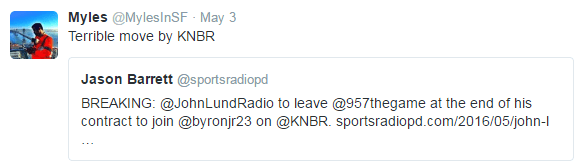
Take for example last week’s radio news in San Francisco. KNBR came to terms on an agreement with John Lund which will move him from middays with Greg Papa on 95.7 The Game, to afternoons with Tom Tolbert on KNBR once his contract expires in July. Lund is an incredibly talented host who will fit well with Tolbert, but KNBR was atop the ratings without him. One could make the case, “why mess with a good thing if it was already working”?

By adding John to their lineup, they not only put Tom in a stronger position, but they created long-term stability in afternoons with a host who knows how to get best out of his partners. They also added a fresh new voice to their lineup, and pulled someone away from their competitor, who was part of a show which was having ratings success against KNBR. That should give the brand confidence that Lund can be a solid ratings performer alongside Tolbert.

Although the majority of feedback was positive, not everyone was a fan of the move.

lima

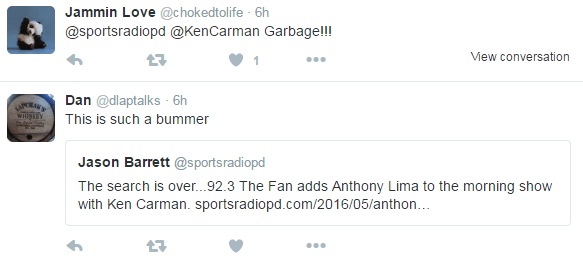
The same story took place on the east coast too, where 92.3 The Fan in Cleveland announced they were promoting Anthony Lima to the morning show to join Ken Carman. Having listened to the show a few times during its transition period, it was obvious that Ken and Anthony had good chemistry, a lot in common, and sounded invested in the local sports scene. Once again, most of the feedback was positive, but some still took exception to it.

lund

These type of responses happen in sports radio all the time, and it doesn’t make them right or wrong. If anything, it should serve as motivation to the talent to prove that the new program will be great. When a show can convert critics to fans, that makes the job a lot more fun.

As common as it is in radio to hear listeners complain about changes, it’s even more magnified when it involves television personalities.

Colin Cowherd and Jason Whitlock have yet to debut their new program “Speak For Yourself” on FS1, but that hasn’t stopped many from reading the show its last rites. Skip Bayless hasn’t even left ESPN yet to join FS1, but his show too has already been written off. It doesn’t matter that we don’t know when it will air or who will be involved, critics who dislike Skip can’t fathom the idea that the program could possibly work. If you think each of those moves have generated a response, just wait until ESPN names Bayless’ replacement. ”

Jamie Horowitz, Fox Sports’ National Networks President who put Colin-Whitlock together, and stole Bayless away from ESPN, has already been labeled incompetent, and the dumbest sports media executive on the planet for attempting to create a sports television formula similar to Fox News, one which he’s already proven to be successful for his former employer.

Does Horowitz’s past success mean that he can stick any two people together, and have them debate topics and enjoy a rapid rise in television ratings? Not at all. But if it’s what he knows and does best, and it’s produced results, and he’s adding people who understand how to execute the vision, why wouldn’t he attempt it again?

Ask yourself this question, if you were Jamie Horowitz, and Fox hired you based on your track record of creating opinion led programming, would you really try to build a network without using your best pitch? That’d be like telling Randy Johnson not to use his fastball just to prove he can win without it. That makes zero sense.

Every single move in the media is going to draw mixed reviews. That comes with the territory when you work in a public business. But what’s important to understand is why brands must freshen up their presentations, introduce new personalities and programming, and avoid overreacting to immediate feedback.

People dislike the unknown. Whether it’s changing schools, jobs, the homes they live in, or even throwing away that one pair of sneakers that they’ve worn for the past few years, saying goodbye to something we’re comfortable with is difficult.

But people also get bored. When they lose interest, it’s hard to reel them back in. You might be the show they’ve grown up with, but if they view you as a part of their past, and irrelevant to their present or future, is that really helping you?

As much as we prefer routine, we also get sick of it. The thought of something new terrifies us, and leaves a pit in our stomachs. It also peaks our curiosity. It’s that suspense that leads us to check out new things, even if our first instincts were to reject them.

Don’t believe me? Turn on CNN, MSNBC, or Fox News, and take a look at how many politicians have done a full reversal on Donald Trump.

To keep listeners/viewers interested, it’s important to disrupt patterns, and introduce new layers. For decades, people stuck with the same things because it was frowned upon if they attempted to satisfy their own individual tastes. They drove the same cars, kept the same jobs, ate at the same restaurants, and even stayed in the same marriages.

In professional sports, players used to report to the minors, and spend four to five years developing before being called up to perform at the major league level. Today, players like Bryce Harper, LeBron James, Kevin Garnett, and Kobe Bryant are rushed into action, and expected to dominate immediately. Although they may have experienced some growing pains along the way, most of them have proven that it’s a different era, and that they can handle the expectations.

On the other hand, one thing that’s drastically different is that there are no longer five to ten year plans in professional sports, let alone the sports media business. We perform in a win-now business, that exists in a “what have you done for me lately” world! You can put your vision on paper, and sell it to corporate bosses behind closed doors, but at some point in time, that strategy will require an adjustment. Everyone preaches patience, and the importance of understanding the big picture, but if progress isn’t experienced within two years, that’s when the finger pointing begins.

One brand which is always under fire is ESPN. When you’re the top dog in the sports media industry that’s to be expected. Critics quickly point out SportsCenter’s declining ratings, and the network’s loss of key talent. What they’re not as fast to point out is how the network still trumps every sports provider for audience size on-air and online, or how the company still employs the largest collection of on-air media talent in the entire sports business. That doesn’t mean they don’t face challenges, but few brands can sustain them the way the mothership has.

Speaking of moves, two big changes were made at the network yesterday. Mike Tirico’s departure to NBC was confirmed, but so were the exits of Ray Lewis, and Cris Carter. Stepping in to fill their voids are Sean McDonough, and Randy Moss. McDonough assumes Tirico’s spot in the MNF booth, and Moss is expected to take over for Carter, and/or Lewis.

If you’ve paid attention over the years, ESPN is known for giving its NFL programming a fresh coat of paint every few years. They do this to keep people interested in the programming.

We can debate which talents were great, and which ones weren’t, but shows like “NFL Countdown” have featured Steve Young, Michael Irvin, Jim Kelly, Bill Parcells, Rush Limbaugh, Keyshawn Johnson, Cris Carter, and Mike Ditka. Each of those men have had stellar careers and proven themselves worthy as analysts but that hasn’t stopped the network from changing the cast. They enter the 2016 season with a new cast of characters which is expected to include Charles Woodson, Matt Hasselbeck, and Randy Moss.

What that shows the viewer is that ESPN is committed to featuring compelling people, and providing a new reason to check out the show each season. The changes aren’t necessarily a reflection of the previous talent not doing something right, as much as they are about keeping things fresh, and offering players who are recently removed, but still connected to the game. I myself can appreciate what some of those former analysts brought to the table, but I’ll definitely tune in to see what Moss, Woodson, and Hasselbeck have to offer.

Think about your favorite television sitcoms or series. They usually run for three or four months, and include a variety of characters and different storylines, leading up to a season finale ends which ends with a twist, and leaves you in suspense wanting more. When the show returns a few months later, it has a new feel and approach. That’s done to help the program avoid becoming stale, and remain top of mind. If new elements aren’t introduced to draw people back in and keep them excited, ratings may decline, and the show could be cancelled.

In sports radio though, there is no off-season, so I’m going to use the WWE as a comparison since they deal with the same challenge.

This past April, the company’s signature event, WrestleMania 32, was held. It’s a major event which this year drew more than 100,000 fans to AT&T Stadium in Dallas, Texas. Another million plus people in the United States and internationally watched the program on pay per view and the WWE Network.

WrestleMania is supposed to be the show which brings closure to many of the company’s biggest storylines of the year. But after it’s over, a new season begins the following night on Monday Night Raw. In twenty four hours, the company has to close the door on multiple angles, and introduce new characters, storylines, and twists and turns. If they fail on Monday night, the previous night’s momentum loses value.

Now think about that as if it were your radio show. If on Friday you delivered your normal talk show, and on Monday you were due to receive a big boost in listening due to more sampling, what would you do to get people talking, and make them want to tune in again the next day?

From a week to week standpoint it might be difficult to introduce wholesale changes, but it absolutely can be and should be done on a seasonal or annual basis. All that requires is creativity and effective game planning.

Depending on what moves the needle most in your town, maybe it makes sense to introduce new regular guest appointments throughout one of those seasons. Or maybe you create a day where you pair two popular station personalities from two different shows together for an hour in-studio. You can also create roundtable debates, topical features, branded hours, themed road shows, and a number of other programming ideas. It all comes down to what suits your style and your audience’s interests.

Regardless of which path you choose, the goal is to keep people listening, talking, and wanting to come back. Whether it’s an annual makeover, a seasonal adjustment, or a monthly tweak, the more you keep the audience on their toes in suspense, and looking forward to new developments with your show, the better your chances of turning them into long-term fans.

And don’t think that this only applies when you’re trailing in the ratings. The best shows make adjustments when they’re on top. You don’t see professional sports teams standing pat at the trade deadline when they’re in first place and have an opportunity to add someone who can help them win a championship. That same mentality is necessary in keeping your program and/or station fresh.

If your personality, and presentation is strong, and new twists and turns are introduced to keep listeners excited, the audience will buy what you’re selling – even if their immediate reaction is to reject it. But, remember that people will change a car, job, and even a marriage, so if you treat them to a predictable brand of programming, don’t be surprised when they treat you to a sticker that reads “you’ve been replaced”.

Anthony Lima Named Morning Co-Host at 92.3 The Fan

0

In February, 92.3 The Fan and Kevin Kiley parted ways. Kiley had anchored the morning show with Chuck Booms on the Cleveland radio station from August 2011 to May 2015, before Booms was terminated and eventually replaced by Ken Carman in July 2015.

Kiley and Carman were in the midst of finding their groove as a show when things came to a screeching halt in February 2016. Kiley, who had previously spoken out about women not being allowed to vote for the NFL Hall of Fame, took the Buffalo Bills to task for hiring a female coach. The commentary drew local and national attention, leading to an eventual divorce between both parties.

With an opening available, Program Director Andy Roth wanted to make sure he found the right long-term fit. He used the next few months to evaluate a number of options, and after four months of research, and auditions, Roth has identified his man.

Anthony Lima has been named the permanent co-host of the morning show. The official announcement was made this morning on the radio station. Lima had been working as an anchor at the radio station, and has made previous stops during his career in Syracuse, NY and Parkersburg, WV.

“For someone who has been listening and calling sports radio stations for my entire life, it’s an incredible honor to be the guy on the other side of the microphone,” said Lima. “I feel like I have been doing a talk show with Ken behind the scenes since we started and now everyone gets to hear it.”

The pairing of Carman and Lima gives Roth what he had hoped to find, a local morning show led by two Ohio natives with a passion for Cleveland sports. The two men have worked together on an interim basis over the past few months, and have formed excellent chemistry while presenting a show that had a strong local flavor.

“Fans have e-mailed and called over the past two months about how much they have liked the pairing of Anthony and Ken,” said Roth. “The energy they have brought to the show during their short time together has really engaged our listeners.”

“Anthony has been a dear friend of mine since I met him when 92.3 The Fan launched in 2011, and I’m proud to have my chance to do my dream job with him,” added Carman.

790 The Ticket Teams Skolnick & Wittyngham In Afternoons

0

Ethan Skolnick and Chris Wittyngham have been officially named the new afternoon show on 790 The Ticket in Miami. The duo had been working together over the past few months on an interim basis, and produced solid ratings growth which earned them an opportunity to make the partnership permanent.

“Ethan brings credibility, humor, and a deep perspective of sports,” said Program Director Len Weiner. “Chris brings a youthful spirit to the program, but has the sports acumen of a veteran. The two have become a destination not only for Miami sports fans, but also those looking for an energetic, upbeat, and fun ride home in the afternoon.”

For over a decade, Dan Lebatard and Jon “Stugotz” Weiner anchored afternoons on The Ticket. Lebatard and Weiner moved to ESPN’s mid-morning spot in September, creating the opening for Skolnick and Wittyngham to team up.

The show airs Monday-Friday 4p-7p ET and more information about it can be found on their website by clicking here.

The 7 Myths of Sports Talk Radio

0

According to the dictionary, the word myth means an invented story, idea, or concept. No industry makes better use of that word than the radio industry.

We forget sometimes that our actions determine the way we’re judged. Presenting a great speech in a room full of industry colleagues may make you look smarter than you are, and smiling, shaking hands, and nodding in agreement with your corporate bosses may help you keep the peace, but when the smoke clears, and the truth rises to the surface, your results, and relationships can’t be disguised.

I’ve had the benefit of working inside nine different radio stations in seven different cities, and alongside many great people. I’ve also witnessed my fair share of gasbags who preach one thing, but then do another. Whether I’ve agreed with someone’s approach or not, I try to remind myself that there’s a lesson to be learned from every experience, even if we can’t always see it at first.

Since moving into business for myself, I’ve gained the trust of format people all across the country. I’ve gained knowledge of the way different companies, stations, and people operate, and I’ve developed a fondness for some, and a loss of respect for others. My desire to see people succeed is stronger than watching them fail, but when brands and people are mishandled, it’s difficult to standby and watch.

My inspiration to write this piece stems from having a personality that’s very direct, honest, and unapologetic. That approach has helped me gain respect from my peers during my career. It’s also caused a rift with critics, and employees who didn’t row the boat in the same direction.

Not every relationship is a good fit. Would Joe Montana have been the same player if he were on the NY Giants? Would Lawrence Taylor have had the same freedom on defense if he played for the San Francisco 49ers? We’ll never know, but because they landed in situations that took advantage of their talents, and played to their strengths, they turned out alright.

In the radio business, programmers, personalities, and behind the scenes people develop trust or disdain for one another based on the way they view and approach their jobs. Some prefer a hands-on approach. Others want to march to the beat of their own drum and be left alone. It’s for that very reason that the head coach of a radio station must be capable of managing multiple personalities, and having a different message and plan of attack for every situation.

Today, I’m going to focus on seven areas of our business which aren’t always what they’re cracked up to be. I could probably extend this list to ten or twenty but I’m not looking to take up eight hours of your time.

I’ve formed my opinions based on personal experience, and conversations with countless members of the industry. This doesn’t mean that certain people, and companies don’t set a good example, but more of us need to take charge to improve ourselves, and our situations. When that occurs, it’s amazing how much better we feel about the work we’re involved in.

Do As I Say Not As I Do

It’s one thing to talk about the importance of being active, creative, and well positioned for digital and social media success. It’s another thing to live it, breathe it, feel it, and be great at it.

How many times do you read one of the industry trades, and stumble upon a quote from a top market program director, or a well respected corporate executive touching on the growth in the digital space and how radio has to be a strong player in it? I see it every week.

When you read what’s offered in print, it looks really good. It makes you think that there’s a vision for the individual’s radio station or company in the digital, and social space. But then reality sets in. You go to find that person on social media to let them know you enjoyed their commentary, only to discover that they don’t have a Facebook, Twitter, Instagram, or Snapchat account.

You tell yourself “maybe they dislike interacting with the public”. But since they’re responsible for managing a business, you’re sure to find them on LinkedIn. After all, that’s where business people connect.

Once again you learn, that the only proof of their existence is through an email address.

Quickly you flashback to that speech they gave where they raved about having a digital, and social media strategy, and why talent must be accessible everywhere. You’ve heard all of the clever lines about the future of revenue generation, and how the industry will be in big trouble if it doesn’t perform strongly across multiple platforms, so then why are these leaders invisible in the locations they say are most important?

Believe it or not, there are a LOT of executives who can provide a good soundbyte or captivating quote to discuss digital, and social media growth and success, but just because they talk about it, doesn’t mean they are about it. I’m not going to provide names but take a look sometime and ask yourself how it’s possible that business leaders who oversee the digital efforts for some of the industry’s leading brands can be absent in the space.

In my opinion, there’s no excuse as a leader for not having a presence in at least one of these areas. If I’m working for you, and you’re going to sing me a song about the power of digital, and social media activity, and challenge me to provide more content, and interaction for the audience, then I’m going to look in your direction trusting that you’re going to lead by example. If I can’t find you on Facebook, Twitter, Linkedin, Instagram, or Snapchat, consider our conversation over until you understand the importance yourself.

We Value The Audience’s Time

People’s content choices are growing. Distractions are increasing rapidly. Developing great content, and being a unique personality matters, but it isn’t quite enough if the listening experience is consistently interrupted. Yet radio continues to turn a blind eye to the problem.

Whether you read it on an industry related website, or hear it in person at a radio conference, reducing inventory is necessary. Media groups recognize that digital listening is growing because it provides a strong listener benefit. Meanwhile, over the air broadcasts focus on pleasing the advertiser at the expense of the audience.

To combat these challenges, some TV (Saturday Night Live) and Radio (107.7 The End) brands have begun making adjustments. It’s clear that on-demand listening and viewing is rising, and the likelihood of it slowing down is minimal. The days of expecting people to sit through seven and eight minute commercial breaks are long gone.

But once again, radio does what it does best, and talks a big game without taking proper action.

I’d love for someone to explain how our business can talk about valuing the audience’s time, delivering a better content experience, and wanting to include people in the conversation, yet then jam twenty five minutes of commercials on to the airwaves during the course of a single hour. It’s like telling someone you care about their health, and then providing them with something that’s sure to make them ill.

On the day of the NFL Draft, one which you’d expect interest to increase on sports radio, five different stations in Top 30 markets rolled out twenty to twenty five minutes of commercials during a single hour. One actually took up thirty minutes when you include commercials, sales features (stock, traffic, weather), and sports updates. And it happened during drive time!

The eight stations I observed were owned by four different broadcast companies. CBS and Cumulus’ brands were the worst offenders. ESPN stations provided the best balance. iHeart was in the middle.

If we’re going to suck up oxygen by telling the industry that we value the time our audience spends with our brands, then we’ve got to eliminate the pitfalls that hurt our radio stations. Do you really think your ratings are going to continue to surge when you overload listeners with inventory? Ask yourself, “would I sit through an eight minute commercial break, just to hear a talk show host discuss a subject I like”? I don’t care how talented the host is, you’d be gone in an instant.

Don’t get me wrong, I know our radio stations need to make money. I want to see every brand in this format produce positive results. But I also know that cramming twenty to thirty minutes of commercials into a single hour is a recipe for disaster.

You may skate by for now if you have weak local competition. But, when your main competitor becomes every single company around the world that produces audio, not just another local radio station, then what are you going to do?

Don’t make the mistake that so many radio stations do – reacting after the storm hits, instead of before it. The longer you brush aside your audience, the more susceptible you are to being replaced. I bet you’ll adjust then. Unfortunately, your audience may not be around to notice.

We Must Bury The Competition

Let’s be honest for a minute, the sports radio format features some of the most egotistical and insecure people in the world. Don’t even shake your head, and bitch at me for pointing it out because you know it’s true.

How many times inside the hallways of your radio station do you hear two on-air talents shouting at one another because they have a difference of opinion over who should’ve taken the game winning shot in last night’s game? It’s not possible that each person could have a valid point because after all, each person has to be right. When you start bringing ratings performances, marketing campaigns, regular guest appearances, and employee contracts into the equation it becomes even worse.

While many in this line of work are ultra-competitive, and eager to be the best at what they do, there’s a misconception when it comes to measuring success.

If a host finishes 3rd in the ratings, and their competition comes in 1st, they see it as a failed month. It doesn’t matter that the company’s revenue increased by 10% because of their performance, or that they generated a quarterly ratings bonus, they simply see their show ranked behind another brand, and it lowers their morale.

This is one of the dumbest parts of our entire business.

Do you think Morton’s Steakhouse loses sleep over whether or not they outsell Ruth’s Chris? If they satisfy customers, make a profit, and enjoy cooking and serving great food, that’s success.

For some reason, sports radio stations can’t feel good unless they see their own name in lights. Is it really better for the industry if only one sports station existed in each town? If you put the competitor out of business, would that make you feel good? If you answered yes, how would you feel when your contract comes up, and there’s nobody else available to bid on your services? Now are you feeling good about your competitor closing its doors?

We should all be driven to want to be the best. If you don’t have that internal desire to kick ass, take names, and force everyone to take notice, then you might want to re-evaluate if this is the right business for you. But, we should also be wise enough to understand that success depends on more than just doing a good show.

If you design a good game plan, execute it well, connect with listeners, earn respect and admiration from your peers and partners, and help your employer turn a profit, that is the true reflection of success. It doesn’t mean you shouldn’t want more, but having your competitor’s blood on your hands shouldn’t be the only way you identify whether or not you’ve been effective.

Seeking An Opportunity

Waiting for developments to unfold before applying for a job is a mistake. The second I post a story on this website highlighting a change in a particular market, I’m hit with numerous emails asking “do you know anything about the opening?”

Here’s the secret, most of the time, that job has either been filled, or is in the process of being filled before the news trickles out. If you wait until a posting goes up to find your next opportunity, you’re going to be sitting on the beach for a while.

When a professional sports team signs a free agent on the day he becomes available, how do you think it happens? Conversations take place between the front office, agents, and former teammates, and the organization gathers its information to decide if they want to prepare an offer once they’re legally able to do so. Once the player “officially” becomes available, a deal is presented which usually meets the requirements that everyone has previously discussed. The only thing left to do is sign the contract and hold the press conference.

Can you imagine if the team waited until free agency started to begin doing their homework? They’d miss out on every single elite talent.

In radio it’s no different. As a former programmer, I was constantly evaluating talent, and having conversations. Do you think I’m going to put the future of my radio station in jeopardy by waiting until a problem occurs to address it? Not a chance.

Instead, I frequently listened to people all across the country, and asked around to get an idea of what I could expect if I brought someone on to my team. I also followed and interacted with the candidate on social media. I wasn’t going to standby and wait for a resume, demo, and programming philosophy to be sent over to my employer. I did my own research so when it was time to make a decision, I was fully prepared.

Are there times when a position opens up and a radio station makes a call based on the applicants it receives? Yes. In most cases those are behind the scenes positions, or lesser on-air roles. If an unexpected situation arises, that’s when a station may be forced to post a job and go through a lengthy process to fill an important vacancy. Usually though, the programmer has people on their radar before a problem pops up, and they’re deep into the process before the opening becomes public news.

This is why networking on a regular basis matters. Don’t wait until a situation arises to introduce yourself to someone. Do it every single day. The more ‘friends’ you have, and the more information you gain, the less likely you are to be on the outside looking in.

Don’t I Need An Agent?

I’m asked on a weekly basis to represent people or direct them to a group who can make a difference. If I enjoyed legal verbiage and arguing with attorneys I could probably make a great living doing it. But it’s one of my least favorite parts of the media business.

What’s important to understand is that an agent isn’t going to necessarily dive into your job search with the same relentless passion that you do. Most of the time they rely on the leads you send them or input they receive from business associates. Rarely are they burning up their phones or pounding the pavement to make sure you gain employment.

Many in the radio business assume that by having an agent it makes you sexier to a company. They believe that it’s going to put them in a position to find opportunities that others may not. As if there’s this secret paradise that exists and only media agents know about it. Simply put, that’s not accurate.

If you’re programming a radio station, you prefer to deal with as few people as possible. Especially when making a hiring decision. When an agent enters the equation it can complicate the process. If you’re able to deal directly with the employee or the person you’re looking to hire, that’s ideal. Once you tip your hand to others on the outside, it can spread like wildfire.

However, if you look at it from the other point of view, agents are valuable for the employee. The good ones have great relationships with various high ranking executives, and they’re there to serve their clients. They understand the challenges that face the radio station and work with the employer to strike a deal that’s fair for all parties.

The reason why companies prefer to negotiate directly with talent is because it gives them an advantage in cutting a deal which better serves their own interest. There’s nothing wrong with that. They are after all in the radio ‘business’. They’ll tug on your heartstrings, suggest they’re not doing well enough financially to afford more, and possibly even threaten to eliminate your position and hire someone else if you don’t accept their deal.

All that means is that they either don’t value you, or there’s more money available and they’d prefer not to spend it.

A lot of talent go into negotiations thinking they know the business. Assumptions are made about what a company will spend, and when the final deal is done they head home smiling and believing they’ve emerged victorious. What they don’t know is what level the company was willing to go to if pushed hard enough to present a better offer.

When representation is utilized, competition usually enters the equation. That’s because the agent’s job is to create demand for your services. Without demand, you can’t command a bigger increase. If you’re going to pay an agent to represent you, their performance has to be measured by what they deliver that you couldn’t have generated yourself.

More times than not, agents do deliver a better contract for the individual. They also shield the employee from negativity which helps keep the relationship between employee and employer on solid ground. If the individual were to sit in the room and endure what an agent does on their behalf, it would stain the relationship permanently.

Programming people assume that their past performances will be remembered when their contracts expire. They trust the company to ‘do the right thing’ to make sure the relationship continues. But business has a way of turning situations ugly.

If you’re an established talent with a good track record, performing in a top market, and you’re seeking to further your income or expand your brand, hiring an agent can be beneficial for your career. They have to believe that you’ve got the ability to ascend to a higher level because without it, they can’t maximize your earning potential.

But, if you’re at the early stages of your career, or trying to gain your first full-time opportunity, I’d suggest holding off. Yes there are some circumstances that may be beneficial. Especially if you know an agent in your city that has an established relationship with the company you wish to work for. But nobody will pursue a job more aggressively than you, and developing relationships is free. Put your time and focus into becoming great at your craft, and when you reach the next level, then you can explore adding someone to help you elevate your career.

Talent Is The Most Important Attribute

Sports talk radio stations that offer live and local programming sink and swim based on the talent they put on the air. If a great performer occupies the airwaves for 3-4 hours per day, the brand stands a good chance at developing an audience and generating ratings. But, no matter how talented a host might be, certain programmers place higher value in other areas.

For example, one PD may focus on adding people who are coachable, likeable, and a positive influence inside their building, rather than a more talented person who’s a larger pain in the ass. Another programmer may prefer a talent who’s deeply invested in working with the sales team, and views the existence of their show as a 3-4 hour platform to sell products. The next PD may seek a personality who can host a radio show, write a column, and produce video content, and reject another who’s special in one area, but unable to excel at all three.

It’s important to remember that no two programmers are alike, and each market, radio company, and situation is different. I know talents across this nation who have delivered big ratings and revenue for their radio stations, only to be disrespected, devalued, and ignored when it was time to discuss a new contract. Others have had to beg, plead, and threaten to leave for competitors to finally get their due. What may seem like a no-brainer decision to the on-air performer, isn’t always seen the same way by the PD or Market Manager.

You may believe that achieving ratings success and doing a quality show is what matters most, but everything ultimately comes down to internal relationships. You can produce big numbers and be at war with your boss, and as soon as they get their chance, they’re tossing you to the side of the road. Or you can struggle to deliver ratings, but click perfectly with management, and it soon leads to a contract extension. The continuation of a business relationship includes a number of factors, many of which have zero to do with your ability.

The Programmer Is Invested In Your Show

I’m not sure if it’s a matter of aging, or being removed from the daily rigors of running a radio station, but I find myself scratching my head often when I talk to people in the format about the way they’re supported by their Program Directors. There are a lot of really good ones out there, and they deserve respect, and praise for the great jobs they do. Unfortunately though, there are others who drift away from their brands, and care more about ‘being in charge’ than making a difference.

Maybe I missed the memo, but I thought the PD position required working with talent, scouting, creating content, studying programming trends, maximizing ratings, collaborating with teams, connecting with an audience, and setting a tone for how the radio station will operate. The vision is supposed to be supplied and enforced by the brand leader.

Now, I hear story after story about bosses who believe the job revolves around playing golf with clients, eating lunch with play by play partners, creating powerpoint presentations for sales teams, and spending time in ‘top of the food chain’ meetings. Those may be things you do from time to time to further local relationships, but they shouldn’t be placed ahead of working with your talent and talk shows.

If the way a programmer is measured is by the ratings performance of the radio station, and the connection they have with the programming team, how is it possible to have either one be effective long-term if there’s an obvious disconnect?

There are people working in this industry today who seek outside advice to improve, because they don’t get it from their superiors. That they value their development enough to pay for others to help them should tell you how much they love what they do. The only problem is that the one person they care to impress most, and gain a future opportunity from, is the one individual who’s the least invested in their career success. That’s what often puts two people on the fast track to divorce.

If a programmer has multiple responsibilities, and can’t listen to your entire program each day that has to be understood. I’ve always told talent, “I’m going to listen like a listener does”. That means that one day I’ll give you 30-60 minutes of my time, and share feedback based on what I heard. On other days I might consume the entire show, and drop by the office afterwards for an impromptu meeting. Then there are different days when another project requires my time, and prevents me from sampling any of the show.

If a host/show feels that you care, and pay attention to the product, they’ll understand when you can’t be available. They’ll go through a wall to make sure your vision for the brand comes to life because they know you want to help them be great.

But, if you rarely take the time to provide direction, ideas, criticisms, and praise, don’t be surprised when they stop asking, and start seeking it from someone else. Just hope that the party they reach out to isn’t the one which signs your paycheck.

John Lund Leaving 95.7 The Game For KNBR

0

Over the past five years, 95.7 The Game has emerged as a legitimate competitor in the Bay Area to KNBR. During that time, talent defections have only occurred on one side. Damon Bruce left KNBR 1050 (Cumulus’ second sports station) to join The Game in January 2013, and Dan Dibley, Mychael Urban, and a couple of contributors left KNBR to sign with 95.7 when the station launched in 2011. At no point did KNBR strike back.

Until now.

Barrett Sports Media has learned that 95.7 The Game midday host John Lund is leaving to join KNBR 680 where he’ll team with Tom Tolbert in afternoon drive. Terms of the deal were not disclosed.

Lund has been with The Game since its inception, teaming with Raiders play by play voice Greg Papa in middays. Together they’ve enjoyed consistent ratings success against KNBR’s midday program “Fitz and Brooks”.

The move helps KNBR in a few ways.

First, it provides Tolbert with a host who’s capable of running point, placing him in a position to be able to react, analyze, and utilize his personality more without having to worry about the usual radio formatics.

Secondly, it disrupts The Game’s most successful program. Sources say that consideration is being given to have Greg Papa host the program solo. Although adding a new partner still remains a possibility. A final decision has yet to been made.

The Game did express interest in retaining Lund, but according to sources, the KNBR offer was much stronger. Lund’s contract with The Game expires in July so he’s expected to remain on the radio station until it expires. It remains possible that the two sides could reach an agreement to terminate the partnership sooner.

With Lund coming on board to work with Tolbert, Ray Ratto will no longer be a regular fixture in afternoons on 680. The radio station is said to be interested in keeping him involved as a regular contributor and fill-in host.

What Is Happening To The Worldwide Leader In Sports?

0

It’s been a tumultuous time for the worldwide leader in sports. In 2015, ESPN lost a number of their best on-air talent, as Bill Simmons, Colin Cowherd, Jason Whitlock, and Keith Olbermann all vacated Bristol University. The company also shut down Grantland, and eliminated three hundred jobs, painting a gloomy picture for the largest sports media operator in the country.

But then 2016 arrived, and many assumed that the worst for ESPN was in the rear view mirror. Yet aside from the devastation of losing 300 positions, ESPN finds itself in similar territory, dealing with major talent departures once again.

In just four full months of the calendar year, the company has already lost or terminated Skip Bayless, Mike Tirico, Brad Nessler, Robert Smith, Keyshawn Johnson, Curt Schilling, Joe Schad, and Robert Flores. Another talented analyst Trent Dilfer is also expected to depart.

If there’s a media company capable of overcoming these types of losses it’s ESPN. But, when you lose high profile talent consistently, it has a way of coming back to bite you in the ass.

Keep in mind, we don’t know yet if Jeff Van Gundy or Mark Jackson will get scooped up by an NBA team looking for a new head coach. It’s too early to tell how a change in the Monday Night booth will affect Jon Gruden, and making the wrong hire on First Take could create a situation where the show has to be changed or possibly even cancelled down the road.

Even the network’s signature morning show “Mike and Mike“, which has been on the air for more than sixteen years, recently added Molly Qerim and it’s changed parts of its presentation. Depending on who you ask, the reviews are mixed.

Will the morning show continue to undergo future tweaks? Does the show finally move permanently to New York City? Or has the network reached a point where it’s decided it needs a fresh new program to kickstart a new era in mornings on ESPN Radio and Television?

ESPN Executive Vice President of Production and Programming, John Wildhack said “Understandably when there is a high-profile change, the picture might be viewed through a very small lens. Yet the facts are that more than 95 percent of our talent have remained at ESPN and there are a wide range of circumstances surrounding the few who don’t.”

He has a valid point. The company has indeed signed agreements with 200+ talent over the past twelve months. Given their ability to employ a large number of high profile positions, ESPN is well equipped to continue meeting the needs of sports fans across multiple platforms.

Remember that they’ve been stung by departures before. Great talents like Dan Patrick, Rich Eisen, Craig Kilborn, Charley Steiner, and Rick Reilly have all exited, and although they’ve gone on to successful careers, ESPN has remained dominant without them. To write off the most successful sports media company in America, and suggest that it’s on the verge of turning off the lights would be a bit presumptuous.

However, consumers and investors do have a reason to raise their eyebrows. With every talent defection comes larger questions about the company’s future, and its willingness to invest in keeping its best talent. A simple way to eliminate that noise is by locking up the company’s top people, introducing new media stars, and adding new programming that energizes viewers, and gives them confidence that ESPN is healthy and committed to being number one.

It’s rare to see ESPN getting outbid for quality personnel, but with Fox, CBS, and NBC chomping at the bit to take the next step, it’s the four letter network’s responsibility to make sure they protect their turf and retain their best assets. Failing to do so could open the door for others to make deeper inroads, and possibly lead to a larger competitive threat in the future.

Did ESPN Eliminate Curt Schilling’s Game 6 Heroics on Purpose?

Prior to ESPN’s Sunday Night Baseball matchup between the Red Sox and Yankees, the network chose to air the 30 For 30 documentary “Four Days in October“. The story covered the Red Sox miraculous upset of the New York Yankees during the 2004 ALCS, except it was missing one critical piece of the story – Curt Schilling’s Game 6 performance where he helped the Sox even up the series while pitching with a bloody sock.

ESPN said the program was edited because it needed to adjust its broadcast time to get back on track due to the Arizona-Oregon softball game running long. They supplied the following statement:

“When a live event runs long, it’s standard procedure to shorten a taped program that follows. In this case, we needed to edit out one of the film’s four segments to account for the extra length of the softball game.”

I recognize that there are times when edits need to be made to fit a schedule, but if you’re going to air a program, you cannot remove one of the most important parts of the story. Any baseball fan who watched that Yankees-Red Sox series will always remember Curt Schilling’s heroic performance in Game 6. It would be like removing the scene in Rocky 4 where Apollo Creed gets killed by Ivan Drago, and fast forwarding to Rocky’s fight at the end of the film. By removing the Game 6 drama, it showed a terrible lapse in editorial judgment, and denied fans the opportunity to understand the whole story.

To make matters worse, the issue occurred during the same week when Schilling went on the record blasting ESPN. It also involved a team which plays in a city (Boston) where ESPN’s image has been tarnished. If the company was looking to get back in the good graces of New England sports fans, they didn’t help their cause with this decision. Why they couldn’t edit out an earlier part of the story, or air a different program, I’m not sure.

Fox Sports Looks To Attack ESPN With Its Own Strategy!

Fox Sports National Networks President Jamie Horowitz has been unafraid to spend big for talent, while aggressively calling out his former employer. At The CAA World Congress of Sports in April, Horowitz touted ESPN’s decline of SportsCenter viewership, and proclaimed he would take a page out of the Fox News playbook and build FS1 around opinionated talk programming and polarizing personalities. He said that the approach would not only stand out more in today’s cluttered sports media environment, but it would cost less than sports programming built around news and documentaries.

That may seem hard to believe when Horowitz is opening the Fox checkbook to pay talents like Cowherd and Bayless. According to reports, Cowherd is making in the neighborhood of six million annually. Bayless is expected to receive more than five million per year. But featured presentations like 30 For 30 cost a pretty penny too.

The reason why Fox has aggressively pursued personalities is because they see their programming future driven by what Horowtiz likes to call ‘opinionists’. Cowherd, Bayless, Jason Whitlock, Katie Nolan, Clay Travis, Nick Wright, and Joy Taylor all fit that description.

But is replicating ESPN’s talk show programming a wise play? Or is it a subtle reminder that Fox is offering a replica, not the original?

Fox confirmed plans this week to launch a new television show with Cowherd and Whitlock titled “Speak For Yourself”. The show is expected to follow a PTI-style format.

Cowherd and Whitlock should make for a great pairing. They’ve forged a nice chemistry thanks in part to Whitlock frequently appearing on Cowherd’s radio show, and are both comfortable at offering hard hitting opinions, and in-depth commentaries. The duo will benefit from Colin’s radio/television simulcast serving as a promotional tool to help drive people to the new show.

Tony Kornheiser, and Michael Wilbon on the other hand are in the midst of their fifteenth year hosting PTI. Quality, consistency, and chemistry are three things they’ve supplied to audiences during their run on ESPN, and beating them at their own game won’t be easy.

Cowherd and Whitlock should be able to present a younger, edgier, and wittier presentation on camera, and the fact that they’re seen as the shiny new toy should help generate some early sampling. Whether or not they can produce an equal or better television show than PTI though remains a big mystery.

Fox is also said to be developing another opinion based program with Bayless. The show is expected to feature a second personality opposite Skip. No word yet on who that might be.

It’s hard to argue with the strategy since it involves well established talent, and a formula which has paid dividends for ESPN. The questions though are “can Fox do it better“, “will Skip’s exit from First Take bring new viewers to FS1” and “is the audience willing to abandon the brand they’ve spent a lifetime with in favor of something new“?

How the audience responds will tell us whether Horowitz has the right gameplan or not. Regardless of the result, you have to commend him for having the chutzpah to challenge one of the world’s most powerful media brands.

Saturday Night Live Eliminating 30% of Commercials

Media groups find themselves in an interesting predicament. On one hand, they’re fighting for every advertising dollar available, trying to hit this month’s budget, and ignoring the future. On the other hand, they find their products being consumed less, because listeners and viewers refuse to sit through long stretches of commercial breaks.

So what do they do?

In Saturday Night Live’s case, they’ve chosen to protect their programming by reducing their ads by 30%. SNL’s creator and executive producer Lorne Michaels said, “As the decades have gone by, commercial time has grown. This change will give time back to the show and make it easier to watch the show live.”

SNL’s skits have performed well when distributed on social media, but ratings for the program on both cable and broadcast television have suffered in recent years. One reason is because younger viewers have fled to on-demand services like Netflix, Hulu, and YouTube.

To offset the loss of inventory, NBC will bring in more original sponsored content from advertisers who will partner with the show for branded sketches, something the show is known for. Plans are also in place to add more pre-taped segments, and extend the length of some of the live sketches.

Over the past year, Viacom and Turner have reduced the commercial load on their networks, and Turner, TruTV and TNT have announced intentions to cut their ad inventory by 50%.

This resonated with me because the opposite is happening in sports radio. I see stations adding more inventory than subtracting it, and that’s a pattern that’s going to cause long-term damage to brands if they don’t take steps to address it.

For example, I listened to eight different radio stations last Thursday (the day of the NFL draft). Four of them treated their audiences to twenty minutes of commercials/sales benchmarks during drive time programming. If I include the sports updates that number increases to twenty four or twenty six minutes.

Three stations I observed ran between sixteen and eighteen minutes of spots, not including the updates. The worst sinner of them all aired twenty four minutes of commercials, and benchmarks, plus three updates that were between one and two minutes each. That means that half of their hour was spent running commercials.

If the key to building a connection with the audience includes treating them to entertaining personalities and topical content, how can you do that when you’re not available to be heard 33%-50% of the time each hour?

From a ratings perspective, if you’re required to generate at least five minutes of listening in a quarter hour to gain credit, is that realistic for your radio station when you’re providing only six to seven total minutes of programming? I didn’t even include the use of production opens, or liners which also takes away from your time.

If five major television companies can see where the world is headed, and why it’s critical to adapt before it’s too late, then why is radio consistently late to the party? I don’t care how storied your brand is, if you consistently feature twenty five minutes of interruptions, you’re begging your competitor to crush your business. Do you expect your audience to be loyal to you when you feed them twenty five minutes of spots, and another five to six minutes of generic sports updates each hour?

Once your numbers start to evaporate, don’t dare put that blame on your talent. The failure belongs to the programmer who wasn’t willing to stand up to protect the brand, and the sales manager and market manager who were naive enough to think that they could abuse the audience to enjoy a short-term benefit.

We have shifted towards a world where including advertising in content is normal. How we weave it in may be a work in progress, but it’s what we’ll need to provide to keep revenues high, and commercial time low. You should be thinking about the things you create on a daily basis, and how you can attach your clients to each of those assets. Listeners will endure hearing a sponsor’s name and ten second tag during a quality piece of content. What they won’t accept is a seven or eight minute barrage of commercials and equal or less content time.

If television can get creative, and sacrifice millions of dollars in ad time to help improve their programming, and ratings, then surely radio can figure out a way to do the same.

Under The Radar:

  • Congrats to John Cassio who has earned a promotion to Program Director of 1240/1270 The Fan in Fort Myers/Naples, Florida. He added the PD stripes in early April.
  • Mitch Nelles has gained additional air time on The Big 920 in Milwaukee. His program “The Mitch Nelles Show” added an extra hour, and is now broadcast weekdays from 1p-3p CT.
  • A tip of the cap to Jeff Parles who was named afternoon producer of “The Big Show” and host of the Saturday morning show “The Sports Wire” on KTGR in Columbia. Parles took over for Brandon Kiley who left to produce Kevin Wheeler’s show on 101 ESPN in St. Louis.
  • Paul Jarvis has left Greater Media’s 92.9 in Boston to return home to Burlington, Vermont where he’s taking over as Operations Manager of Vox AM/FM’s four station cluster. As part of his new job, he’ll be overseeing two sports radio brands, 101.3 ESPN, and 960 The Zone.