In society, we use terms like mainstream and underground to describe popular and unfamiliar trends. To those working in the terrestrial radio business, local AM and FM radio represents the norm. An audio platform like SiriusXM satellite radio is viewed as unfamiliar territory because it requires a cost, and leaving the traditional radio space to hear it.
But that doesn’t seem to be an issue for consumers who seek great content and minimal disruptions. The platform offers some of the most popular media personalities in the industry, and has over thirty million people subscribing to hear it.
So why then, especially in the sports audio space, does the platform not receive bigger accolades for the work they produce? This is one of many questions that linger in my mind when I think about SiriusXM. It’s even more magnified when I strip away all of the company’s individual audio brands and put the focus directly onto their sports channels.
 Without question, the Mad Dog Sports Radio channel features a number of exceptional high profile personalities. To the common sports fan, Stephen A. Smith is a household name. To sports radio fans, Chris “Mad Dog” Russo is one of the founding fathers of the format. To newer sports media consumers, Adam Schein is a rising star who’s grown his brand thru his work on Showtime, the CBS Sports Network, SNY and SiriusXM’s NFL Radio and Mad Dog Sports Radio.
When I look at the Monday-Friday 6a-7p lineup that Steve Torre and Steve Cohen have assembled for Mad Dog Sports Radio, it’s stacked. If their product was featured on a local New York radio station, it would pack a punch, and give WFAN some concern. It’d also likely receive a lot more fanfare and media buzz.
But it’s not a New York brand, even though the majority of its personalities possess New York roots.
In mornings, Evan Cohen and Mike Babchik are both from the big apple. The same holds true for Smith and Schein. Russo, although not originally from New York and currently residing in Connecticut, has built his entire brand and career by entertaining listeners in the concrete jungle. This is what makes it easy to label Mad Dog Sports Radio as an East Coast brand.
But is that a bad thing?
 Most of the world’s top national programs originate out of New York City or Los Angeles. Whether it’s Jimmy Fallon, Jimmy Kimmel, Stephen Colbert, The Today Show, Good Morning America, Saturday Night Live, Colin Cowherd, Dan Patrick or Jim Rome, they’re all reaching fans across the country while setting up shop in one of the top two media markets. Their location doesn’t take away from their abilities to connect with people and understand the issues that exist in every pocket of the nation.
I was granted access by the great folks at Mad Dog Sports Radio to get a stronger idea of the way they operate. With apologies to the hosts who work at night, I’m keeping the focus of this piece on the M-F 6a-7p lineup.
In addition to sitting down and talking radio with each of the channel’s key personalities, I also spent time with the braintrust (Torre and Cohen). I wanted to get a better idea of how they measure success at Mad Dog Sports Radio, what fuels their passions, and what they consider to be their biggest challenges.
The Beginning:
It was August 19, 2008, when Chris Russo signed a five-year contract with SiriusXM to headline a new sports talk channel titled “Mad Dog Radio” on SiriusXM. Russo, was leaving WFAN where for nearly two decades, he had been one half of “Mike and the Mad Dog”, the most popular local sports radio program in the history of the format. His departure from terrestrial to satellite radio would send shockwaves throughout the industry, and it became possible due to the vision of one man.
 “I give Mel Karmazin all the credit. He came up with the idea to get Chris and develop a channel around him,” said SiriusXM SVP of Programming Steve Cohen. “When he and Scott Greenstein came to me and asked ‘do you think this would be a good idea if we can get him here’, I said ‘absolutely, are you kidding me?’. Chris is the same guy I started working with in 1988. He has the same work ethic, the same mispronunciations, the same passion, and the same talent. Without him, I’m not the sports programmer that I am today.”
As part of the agreement, Russo would host five hours per day on the channel, and be involved in the hiring of the on-air staff. If a channel is going to built around an individual’s name, it only makes sense that they have a say in making sure the brand reflects what they stand for.
Sensing that he’d need additional help to run the channel properly, Russo brought in long time WINS anchor Steve Torre to serve as Program Director and afternoon show update anchor. Torre would later add hosting duties too.
“Mad Dog and I knew each other for 20 years, and were long time friends, but never had worked together,” said Torre. “When this started to develop, the transition was easy because of the familiarity, but I also had limited management experience, so there was a lot I had to learn.”
On September 15, 2008, less than a month after he had signed with the company, Russo debuted his new program “Mad Dog Unleashed”. By February 2009, the channel would be fully functional with live programming available twenty four hours per day. The original personalities to host programs on the channel (in addition to Russo) were Gary Williams, Bruce Murray, Bill Pidto, Andy Gresh and Larry Krueger.
It was nearly one year later (July 9, 2009), when Russo would learn a lesson about being involved in management. During a ten-minute rant, he proceeded to berate his entire staff on the air for his station being ranked outside the Top 100 stations on satellite radio. He concluded the rant by firing Torre.
 The segment created such a stir that even Howard Stern got involved, bringing Torre on the air as a guest to get an idea of what transpired. Torre was later rehired, and it’s unknown if the rant was legitimate or a radio bit.
“I’m never going to be able to manage him,” added Torre. “We’ve had battles where we’ve wanted to strangle each other, some of it has been well documented. Chris won’t ever be afraid to say ‘you’re out of your mind, I’m Christopher Russo’, but he’ll also give you respect, ask what you think, and allow for give and take. That’s all you can ask for.”
As the years progressed, Mad Dog Sports Radio got a taste of what it’s like to add and lose key talent. Williams would depart for the Golf Channel, Krueger to KNBR, and Gresh to 98.5 The Sports Hub. Pidto would return to television.
That allowed Russo, Torre and Cohen to introduce new voices, including former Mets General Manager and ESPN Baseball Analyst Steve Phillips, John Feinstein, Scott Ferrall, Dino Costa, and Jason Horowitz, just to name a few. They also shifted Schein over from NFL Radio, and partnered with ESPN to bring Stephen A. Smith to the channel after Russo again made headlines after stating that he couldn’t find a qualified black personality to host a national sports radio show.
However, Ferrall, and Feinstein would eventually leave to join the CBS Sports Radio Network, Costa would be terminated after numerous run-ins with station management, and Horowitz’s venture on the channel was short lived, leading to the addition of current morning man Evan Cohen. Phillips, would also be moved over to SiriusXM’s MLB channel, which opened the door for Mike Babchik to join Cohen in mornings.
 Russo acknowledges that building and developing the brand has required a lot of patience, fine tuning, and creativity.
“We did a lot of editing with this channel trying to find the right pieces,” he said. “We made a lot of mistakes but I think now we have a really good vibe. I probably shouldn’t have started with an overnight show. That wasn’t necessary. I also thought the updates were still significant and that didn’t matter because people don’t buy the channel for that. I learned through that process of what to do to find a connection. There’s a fine line because you want people to be nutty and creative and do what they want and not get in the way, but there’s a line that you shouldn’t cross, even here. We took some chances in the beginning and we have some issues still, maybe we’re a little New Yorkish, but I like how it’s come together”.
The Morning Men:
If there’s a secret ingredient inside the Mad Dog Sports Radio meal, it’s Mike Babchik. He doesn’t receive the fanfare of the other on-air talents, and he’s largely unknown to the majority of people in terrestrial radio, but I dare you to spend one morning listening to him perform with Evan Cohen. If you don’t come away from that listening experience laughing, cringing, nodding in agreement, and wanting to strangle him for something he said, then you may need to be checked for a pulse.
 Simply put, Babchik is an entertainer. His chemistry with Cohen is a huge reason why “The Morning Men” have been able to find their groove. During the course of one morning that I spent in studio observing the show, he weaved in a number of popular Jewish words to highlight each game result as part of a morning show “Dog Bites” update bit, accepted feedback from a caller who wanted him to undergo an exorcism, conducted an NCAA Tournament Memories draft which included telling a story about passing out drunk and getting his braces stuck in the carpet, and swapped opinions with Cohen about Carmelo Anthony.
“Mike is the single most talented person in radio because he will say what everyone is thinking, and not care if he looks bad because he knows there are people out there thinking the same thing,” said Cohen. “The goal of the show is to relate to as many people as possible, and to do that, you need an everyman, and that’s Mike.”
Prior to being named Cohen’s partner, Babchik produced the morning show. With former Mets GM, and ESPN Baseball Analyst Steve Phillips installed in mornings, Cohen was brought on to guide the program. Quickly the morning show created a strong vibe.
“The first time I met Evan I thought he was an intern” said Babchik. “I sent him to get coffee.”
With the show offering credibility, opinion, and entertainment, and all three members developing a friendship and chemistry on and off the air, the morning show was set up to have long term success.
But then something changed.
 Phillips’ agreement was coming up for renewal, and an internal decision was made to shift him over to the MLB Radio channel where his strengths and profile as a top tier baseball analyst and former GM would shine even brighter. The move though left a gaping hole opposite Cohen, and finding the right individual to counter his brash opinions, and lend some brevity to the conversation was important.
“Steve was huge for us, and gave us credibility,” said Torre. “He was relatable and had tremendous knowledge. When he moved on to the baseball channel, the obvious question was ‘who do we get for a co-host with Evan’? I said ‘we have someone (Babchik) right here under our noses, who’s already a big part of the show. Let’s give it a chance’.”
Although the feelings about adding Babchik internally were positive, the call didn’t belong to Evan. That gave him cause for concern. He also had to figure out whether or not he could forge a regular chemistry with Babchik as his main partner, something they hadn’t yet done.
 “I had no idea if we could do a great show together,” said Cohen. “Torre told me ‘Mike is not the norm, but he has the ability to be great’. I knew we we’re from the same area, and knew a lot of the same people. That certainly helped our off-air chemistry, and allowed us to become friends, which helps when you become on-air enemies at times.”
Taking the step from producer and third voice of a show to the main co-host chair isn’t always a smooth adjustment. It’s an even bigger gamble when your name isn’t familiar to the entire radio industry, and high profile talents across the country are ringing the phone lines of Steve Torre, and Steve Cohen, expressing interest in the position.
So what gave Torre the confidence that it would work?
“I always knew their chemistry was great,” said Torre. “There was always a positive reaction to Babchik, and you know why that is? Because he’s the loveable loser, the everyman. People relate to that. That’s why I felt we’d be ok giving him the shot.”
 When changes happen in radio, it’s common for personalities to wonder about the future direction of the show they’re involved in. Adding the wrong person to a successful show can send the train off the tracks very quickly. Despite the uncertainty, Cohen’s nerves were settled when Torre told him the company was going to roll the dice and take a chance on Babchik.
“Steve Torre deserves all the credit,” said Cohen. “He was smart enough to pair me with Mike, and saw that there was natural chemistry between us that can’t be taught. That decision has allowed my own personal career to grow, but more importantly it’s allowed the show to grow.”
Next, the show needed a name. SiriusXM SVP of Programming Steve Cohen shares the story of how they decided on branding the show “Morning Men”.
“When Phillips was leaving, Evan was mad at me because I agreed with the move, and he didn’t get a heads up about it,” said Cohen. “So we’re brainstorming the name of the show (Me, Torre, Evan and Babchik) and I’m explaining that it’s a guy talk morning show, it’s how dudes talk, it’s sports and entertainment, and Frank Raphael, a Hitchcock looking figure, opens the door and says ‘Morning Men’. I look at Evan, we just stare at each other, and I said ‘that’s it’. Torre’s like ‘what’s it’? I said ‘the name of the show’. He says ‘are you out of your mind’. I said ‘No, think about it. People call up, it’s how they greet you. It fits them too’.”
 With the pairing now solved, and a brand new show name in place, the rest was up to Evan and Mike. Developing a relationship as partners, furthering their chemistry, and identifying the roles each of them would play was important. Babchik recognized that the show had to be different and make an impression each day.
“In the morning, you don’t want to wake up to a hardcore debate,” said Babchik. “Our thought process is, if you’re out with your friends talking sports, we’re the guys who you relate to. Evan preaches don’t waste space, and he deserves a lot of credit for changing the mindset here, and making sure we all understand our roles. He’s the good guy, I’m the weird guy, and it works.”
In analyzing the show, and what makes it different from the rest of the channel’s programs, I came away with four key takeaways.
* They don’t take themselves too seriously – Russo, Schein and Smith may dive deep into topics, conduct lengthy conversations with guests, and offer piercing opinions on a variety of sports topics, but the morning show places its focus on having fun, interacting with their callers, and keeping the pace fast. They go into unplanned content areas often which plays to each of their strengths, and Babchik’s ability to think on his feet, and follow Cohen’s lead, leaves listeners wondering what the duo might say or do next.
 * The Sports Updates (Dog Bites) are fun and unique – Instead of providing the classic sports update that many stations are known for, the Morning Men utilize audio from Russo’s show, and weave in clever lines to have fun with the day’s news. For example, if it’s National Bagel day, Babchik will work in references to bagels in every story he reports. You’ll hear something like “The Spurs poppy seeded the Mavericks”, and as I alluded to earlier, on the day I was there, the references were Jewish, and game results included the terms Oy Vey, and Shalom.
* The guests they secure are people who are topical or interesting and fit their personalities, not necessarily the biggest names – as Evan told me, they’d rather pull two minutes of a guest appearance on Russo’s show or from another one of SiriusXM’s sports channels, than place a guest on the show for 10-12 minutes who’s ultra serious. As an example, the morning show has been trying to land former NBA player Cliff Robinson because he’s now a drug dealer. They look for people who fit their brand of content, not necessarily the biggest names.
* They brand the show by incorporating Mad Dog into it – Evan told me that one of the turning points for the show was when Steve Torre, Steve Cohen, and Scott Greenstein, approached them and said “we need more Dog on the channel”. That gave the show an opportunity to showcase their creativity. They began using Russo’s voice for all of the show’s intros, but acknowledged quickly that reading liners and delivering them in straightforward fashion didn’t fit their style. A change was made to start pulling cuts of things Chris said on his show that were funny, and provided an opportunity to respond.
By adopting that strategy it’s subconsciously connected the morning show to Russo. Their dedicated fans (FALS) are a result of that approach, as Russo mispronounced the word pal on his show, and the morning show grabbed the audio, and ran with it.
 When it comes to the show’s content creation process, Cohen and Babchik use multiple ways to develop their game plan. They’ll monitor social media to see what’s trending, and drawing reaction. They’ll look to see what’s popular on the satellite company’s other channels, and if a great rant is delivered by Mad Dog or Stephen A. it almost always finds its way onto the program. Ultimately though, it still comes down to what excites them individually and collectively.
The morning show meets daily with Torre to discuss the way the program is performing. They’ve developed an open door policy with their bosses which gives Torre and Steve Cohen an all access pass to enter the studio at any time, and call them out on something if they feel they’ve done something wrong. The only downside to that arrangement is that it’s led to Cohen earning the nickname “Larry Long Balls” (it’s a long story).
In a nutshell, the morning show has fun, and their energy is noticeable. It begins with the chemistry that exists between Cohen and Babchik, and thanks to the support of the men up above, they’re allowed to provide a different type of experience on Mad Dog Radio.
“When a listener calls in and says ‘when Howard’s not on, I listen to you guys’ I’ll take that every time,” says Evan. “We can control 3 things – the way we treat our fans, the way we treat our teammates, and the way we treat our advertising partners.”
So far, so good!
Adam Schein:
If the mornings are known for offering a blend of sports, pop culture, hilarity and chaos, middays are known for presenting a different tone. They’re informative, passionate, and provide a highly respectable presentation on the world of sports, and it begins with the ringleader Adam Schein.
 The Syracuse educated Schein attacks the microphone with enthusiasm segment after segment, and his advanced vocabulary, and genuine joy for discussing the ups and downs in sports makes him very relatable. Combine that with exceptional production value and topical high profile guests courtesy of his producers, and you have the makings of a great national program.
Every music bed leading into each segment brings with it high energy and a quick pace. The calls Schein takes, add to the conversation but never slow down the momentum. There’s this feeling you get when you listen, that the show is searching for the answers to help the everyday sports fan feel more informed.
Equally as impressive is the way Adam communicates with his audience. Every person who calls the show is referred to by their first name multiple times during the conversation. That shows Adam is listening and values the time they’ve taken to reach out and contribute to the program.
“What makes this channel great is the variety,” says Schein. “The Morning Men do a totally different show than mine. Mine is different than Stephen A’s. His is different than Mad Dog’s. There’s a method to the madness, and we try to keep it unique and interesting for the audience.”
Although Mad Dog Sports Radio has been in existence since 2008, Schein has actually been with SiriusXM longer. He signed on in 2004 to help launch NFL Radio, during a time when the company had only 200,000 subscribers. Why did he feel optimistic about the future of the company, when it was still foreign to everyone else?
 “The number one reason I wanted to come here was Steve Cohen,” Schein said. “He’s a radio guy, and he’s done it all. He understands what makes great sports talk radio. We met for a hamburger in May 2004, and just talked, and it confirmed what this place could be, and would be. It’s become a success because of his vision.”
Schein’s confidence in Cohen was certainly high, but those feelings were also mutual. Cohen saw something early on in Adam that convinced him he was destined to do big things.
“Adam was an intern at WFAN who I always had great respect for,” said Cohen. “His work ethic was tremendous. He was smart, entertaining and hard working. I could tell quickly he had great respect for this business, and I knew he was going to do well. He didn’t even ask me how much money the job would pay when we met. I told him you’re going to be my workhorse, and he looked and me and said ‘where do I sign’.”
 Despite not signing on upon the channel’s inception, when a second opportunity presented itself in 2013, Schein didn’t hesitate. With the product further developed, and a hunger to test himself as a well rounded all-sports talk show host growing, Adam came on board.
Soon the Mad Dog Sports Radio audience would learn what makes Schein stand out. Passion, opinion, knowledge, entertainment, and high energy, are all part of his repertoire. During the span of sixty minutes while sitting a few feet away from him, I observed as he delivered one strong opinion after another.
He started with “I’d rather play with 10 people on the field than employ Greg Hardy. He’s tone deaf, a distraction, and under no circumstance would I sign him”. From there, he moved on to the Oakland Raiders where he added “Raiders fans are not on Planet Delusional if they believe their team can win 10 games next season. This team has what it takes to be the best in the division next season.”
It’s easy to recognize how much pride Schein takes in his work. His respect, and intelligence, and appreciation for the audience are a big reason why his program is an enjoyable listen. It’s that same approach on-air that manifests off the air, and makes working with him attractive to behind the scenes people. Adam says that despite his name being in the lights, he understands that success is created by having good people around you.
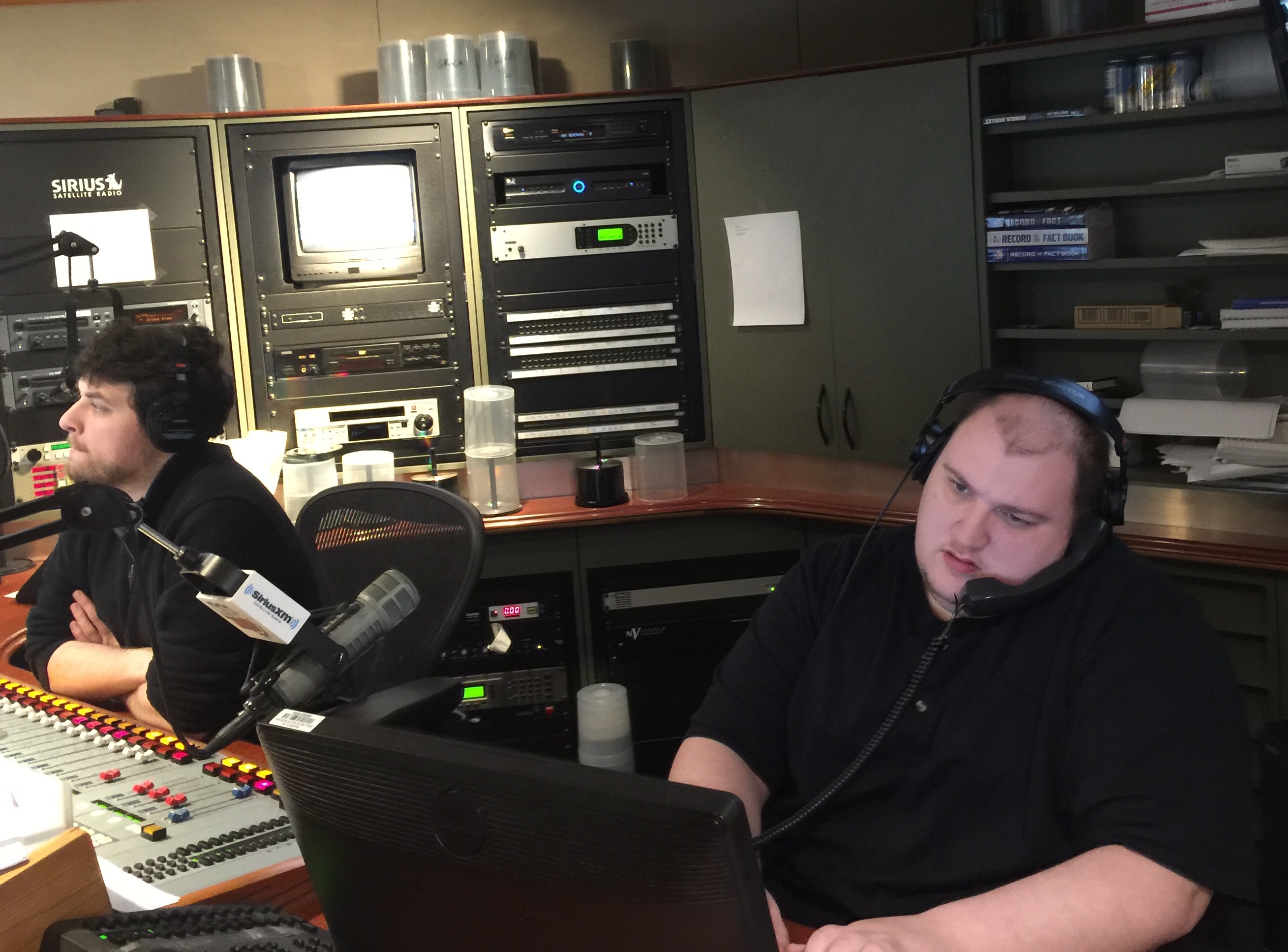 “The only request I’ve had from management is to make sure we have quality producers”, he added. “I think it’s very important. Yes it’s my name, my voice, my face, and my show but it’s OUR show. I like to surround myself with really smart producers because I want to be challenged. I value their opinions and ideas, and I thrive off of the collaboration process.”
In terms of crafting the daily game plan, Schein says he follows a similar model to the one he used while hosting programs on terrestrial radio. He’ll provide a hard hitting monologue, take phone calls, interview a couple of timely guests, and mix in a few other topics that have the largest appeal. He’ll also use Twitter on occasion as a trial balloon to gauge which topics generate the biggest interest.
So how does he know when it’s working?
“You feel it,” he said. “I never judge a show based on how many people are calling. Your management and your audience know if you had a good show. You have to have a Plan A, B, C and D and you never deviate from it based on the calls. You look for angles that appeal to a variety of people. People are going to love you and hate you. You’re supposed to create that reaction. That’s why you were hired. The main thing is, are they listening?”
 As much as he enjoys talking sports, and connecting with his production staff to develop each day’s show, there’s one thing that stands out when you talk to Adam – his love for his place of employment. As one of the originals of SiriusXM, he’s proud of where he performs, and believes much of the good fortune that has followed him in his career is a result of making the decision to join Steve Cohen.
“This is such a great place to work,” says Schein. “People are genuinely happy. It’s a destination for people. If you want to be in sports radio, it’s a place to target. That’s because of the quality and diversity of the programming. The original slogan of the company was ‘it’s the best radio on radio’, and I don’t listen to anything else. Where it is now is amazing, but where it’s going, is going to be even better. I’m signed long term here, and it’s a place I really love working at. I also believe that this channel, Mad Dog Sports Radio, has the #1 sports radio lineup ever.”
Stephen A. Smith
If you enjoy loud opinions, delivered with a purpose, by someone with a reputation for being unafraid to tackle controversial subjects, then you’ve come to the right place. Stephen A. has become a larger than life sports media personality, and with that honor, comes a lot of fame and disdain.

Much of the love and hate that Smith receives, stems from his over the top personality, and candid assessments that are provided on ESPN’s highly rated “First Take” where he lines up daily opposite Skip Bayless. But many industry experts who talk about Smith’s radio program, form their opinions based on what they see on TV, or what they previously heard while he was a host at 98.7 ESPN New York, not by what he’s producing through the speakers at Mad Dog Radio.
In this business we preach to create content worth stealing, deliver strong opinions that grab the audience’s attention, and be unwavering in your stance when you feel something, even if it’s not commonly accepted. Smith checks every one of those boxes, which is why he’s built an empire as one of America’s opinion leaders.
On the day of my visit, I had the pleasure of sitting back and watching Stephen A. entertain, and what I thoroughly enjoyed was how he could turn the volume up to ten during one segment, but bring it back down to five during the next. Unlike Schein who invites the audience in and treats them respectfully, Stephen A. has no problem verbally slapping a caller in the head if they contribute an opinion he believes is nonsensical.
 In the matter of minutes, Smith points out that the only time Bears Quarterback Jay Cutler has smiled is when he signed his contract, and after a caller named Hudson suggests the New York Jets should hold off on paying Ryan Fitzpatrick big dollars, and instead spend seven million dollars per year on Geno Smith, Stephen A. gets fired up and tells him “if you think Geno Smith is worth 7 million dollars per year you’ve lost your damn mind”. He gets even more annoyed when Hudson avoids answering his questions adding “Rule #1 Hudson. If you’re going to call this show, you answer my damn questions. I’m done with you.”
For a service that relies on subscriptions and keeping people satisfied, one could question if taking a caller to task is the right approach, but anyone who knows Stephen A. understands, that this is real, honest, and consistent with who he is.
“Of course I care about the subscribers and the people I work for” said Smith. “I don’t take lightly the responsibility I have to represent Steve Torre, Steve Cohen and Scott Greenstein well, but if a caller is getting on my nerves, I’m going to let them know. People know what I do and how I operate and I’m going to stay true to that.”
 There’s no manual in this business which tells you how to field phone calls, so the fact that Schein and Smith offer different styles which reflect each of their personalities is a real strength. It’s consistent with how they deliver their programs, and the more variety that Mad Dog Sports Radio listeners have throughout the day, the better.
The other interesting twist is that Stephen A.’s program is produced by ESPN Radio. The network and SiriusXM formed a partnership to make Smith’s venture into satellite radio a possibility. With it being commonly known that the rules can be different on the airwaves of Sirius, Smith explains how working with two organizations impacts the way he approaches his program.
“The only thing ESPN asks me not to do is curse, and I respect that,” he said. “I’d rather work for someone with standards than someone searching for them. Each of these companies allow me to be me. I’m a national figure, and this platform aligns with many of my interests. They’re supportive of what I do, and treat me well, and that makes it a great place to work at.”
During the course of my visit, Stephen was a featured guest during a SiriusXM Town Hall with Karen Hunter. It was on this show that the audience had an opportunity to see a very different side of the polarizing ESPN personality. That’s one of the real benefits of having so many talented people under one roof, and being able to concentrate on creating powerful content that excites the audience.
Over the course of his one hour appearance, Smith opened up about his issues with his father, not celebrating his birthday because it falls on the same day when he lost his brother, the challenge of being a black man in a predominantly white male industry, plus he tackled a variety of other topics that were equally as compelling. You can hear it by clicking here.

As I observed him, I was reminded of why he’s become the success that he has. The hour of conversation between Smith and Hunter, was one of the most honest and interesting hours of content that I’ve listened to in a long time. His ability to run point on his radio program, and deliver razor sharp opinions, and interviews that produce substance, in addition to entertaining exchanges with the audience, and a major league profile, benefits the channel. Because he’s in a workplace where he’s encouraged to operate the way he feels most comfortable, listeners are treated to some memorable material that not every personality has the skills to deliver.
But with a national TV platform, and a relationship with ESPN Radio that’s been established for the better part of the past decade, why make the move into the satellite radio space? Smith says it’s simple.
“Why’d I come here? Because it’s SiriusXM,” said Smith. “This is the gold standard in radio. The quality is incredible and there’s this feeling of not being restricted. No rules if you will. I’m wise enough to know not to put myself or the brand in a bad spot. But there’s no question, this is the pinnacle of the sports radio profession.”
Chris “Mad Dog” Russo:
When your face and name are on a brand, and you’ve walked away from the most recognized sports talk show and radio station in New York City, you’re sure to have pressure on your shoulders each day. But for Chris Russo, he doesn’t allow the complexity of the situation to impact his focus.
 “When you leave terrestrial to come here, it’s flattering. Who gets a station named after them?” says Russo. “At first it was a little overwhelming, but after a while you don’t think much about it. I do think having a name like ‘Mad Dog Radio’ probably helps because it’s not something like Sirius Sports Today. It’s not clumsy, it’s an easy name, and a good moniker to have. I try though not to get too wrapped up in it, and just focus on the show each day.”
At his core, Chris is a sports talk show host. He may have involvement in the creation of the channel and who represents it on the air, but the dirty work falls on Steve Cohen and Steve Torre’s shoulders. That allows Russo to concentrate on doing what he does best, informing, entertaining, and delivering opinions that pierce the brain of the audience.
But if you’ve listened to Chris over the years, you’ll notice one big difference in his content.
By offering a program on satellite radio that reaches people all across the country, a national focus is required. After talking about New York teams for nearly two decades, and continuing to live in Connecticut where the nightly television offerings are those same New York franchises, many would assume that a big adjustment would be required. But Mad Dog says that wasn’t exactly the case.
 “I’m not a New York fan so that’s helped me,” said Russo. “When I got here I didn’t have to worry about switching my allegiance. The content was easier. The biggest transition was dealing with no commercials. Five hours of radio here is like seven hours on terrestrial radio. At times I liked it, sometimes I didn’t. When you’re doing a good interview you love it, but other times it can be tougher. I’m now on three hours per day which isn’t enough. Five is too much, four is probably perfect.”
To the audience, more Mad Dog is a good thing. But to those on the inside, providing fifty great minutes of content per hour, with limited break times can be a daunting task, even for an industry icon. Program Director Steve Torre admits that it took Russo time to adjust.
“This is a lot harder to do than terrestrial radio,” said Torre. “Chris used to host 5+ hours with a partner, and it included twenty minutes of commercials, updates, benchmarks, and jingles. He comes here, and he’s doing 5 hours solo with limited break times. For the listener it’s great, but for the host it can be very challenging.”
Unlike many terrestrial stations which form partnerships with local teams to carry their games, on Mad Dog Radio there is no home team. Because the audience is spread out, and have different interests, it makes it harder to rally behind one organization, or spend large periods of a show on one team or topic. For a host like Chris who’s spent hours on WFAN battling with Mike Francesa over the Yankees and Mets lineups and rotations, that’s an area of his game that he’s not able to tap into as much.
 However, he does have the advantage of having been in the business long enough to form relationships with listeners who have New York roots, but now live elsewhere. Despite moving away, they still make listening and calling his show a priority. He represents a piece of their upbringing, and remains a connection to their home turf.
“I do have an advantage with New Yorkers who live in other towns and want to call up and talk sports with me,” said Russo. “But at the same time, you don’t want to turn it into a show for transplanted New Yorkers.”
So does that mean Chris feels he’s shed the New York label?
“I still feel like I’m a New York host in a lot of ways,” added Russo. “I’ve done a million of remotes to show that we can do other things besides New York sports. I’ve done the SEC Championship game, the College Football National Championship game, Spring Training, the NHL team store, and a few others. I’ve done a lot to get away from the New York thing but everyone knows my New York connection. I think though that it’s also helped me.”
As much as New York remains attached to his broadcasting career, that hasn’t led to any less interest or reaction from listeners who reside in other parts of the country. On the day of my visit, Chris’ lines were lit up by callers ranging from Philadelphia to St. Louis, Utah, South Carolina, and Florida. All of them interested in picking his brain on the NCAA Tournament, Carmelo Anthony, and NFL news.
 The one constant that remains when you listen to Russo is that he brings passion, and energy to everything he does. He also has a deep bucket of knowledge that he reaches into every so often, just to remind you that he knows his stuff. If you’ve enjoyed listening to Chris during his days on WFAN, you’re likely to enjoy him now. The only noticeable difference is the reduction on New York heavy content.
Another difference that exists off the air, is the change in focus towards judging success. For SiriusXM, the total number of subscriptions is what matters most. In local radio, many live and die by the monthly ratings. After spending two decades charged with the responsibility of finishing 1st with Men 25-54 in the nation’s #1 media market, how has Russo adjusted?
“We don’t have to worry about ratings which is a big advantage,” he said. “That said, I do think about phone calls, and what’s going to generate interest from the audience. We have 119 channels here. It’s like radio socialism. I make fun of it all the time. We’re all in this together. You’re not pressured from a subscription or ratings scenario on a day in and day out basis. Nobody overanalyzes you that way. In eight years I can count on one hand, if that, somebody coming up to me and saying ‘maybe we’re not doing enough of this or that’. They let you do what you want to do. They give you a channel, a show, and they trust you to do your job. ”
It’s clear that Russo has fun once the light goes on. He lives for the opportunity to inform and entertain, and when the lines start ringing, he feels good about the connection he’s making. He’s also a fascinating interviewer who digs for answers, and isn’t afraid to push his guests to tell him what he wants to know.
 Since signing on in 2008, Russo has solidified his status as a top performer on satellite radio. He re-signed with the company in 2013, and during that negotiation reduced his on-air schedule, while adding a television presence on the MLB Network. On occasion he’ll extend the show an additional hour when big events happen, or road shows are scheduled, but with his contract set to expire this September, and rumors swirling about a future reunion with Francesa, does he envision being back at the birthplace of his national sports radio career?
“I have young kids so I don’t see any reason why I’m going to quit,” said Russo. “As long as they’ll have me, I’d love to stay. I don’t think I’d go anywhere else. I took a little bit of the audience from WFAN and brought them here, so now I’m going to take them somewhere else? They may not go with me to the next place. They’re loyal but they’re not that loyal.”
Does that mean he’s shut the door on a return to terrestrial radio? No. But at this point, SiriusXM is in a good position because the options available for a Mike and the Mad Dog reunion in New York are few, and finding companies capable of writing big checks for sports talk programming are not easy. That doesn’t mean it can’t or won’t happen, but it’s still a long shot.
If there’s one thing that could sway him, it’s the opportunity to regain a higher profile. Although thirty million people subscribe to satellite radio, and the Mad Dog brand is established on a national stage across the nation, it has to be humbling for one of New York’s all-time great performers to not generate the same level of attention in his own backyard that he once did. While I can find the positives of flying under the radar, it’s easy for me to say when I haven’t produced nineteen years of fame as one of New York’s most popular media stars. Hosting the Mike and the Mad Dog reunion special, and seeing the buzz that the show created, certainly had to add to that curiosity.
 After listening to Francesa rib Russo for years about vanishing from the earth, I asked Chris how important relevance was to him.
“You get that knock of ‘who hears you, and did you go into the witness protection plan’?” he said. “Especially me, because New York is such a concentrated market with WFAN, and ESPN New York, and everyone knows me from my days on 660. Most New Yorkers, like most others fans, are going to be into their local market stations. So you have to understand that, and it bothers me at times. For nineteen years I’d go to a deli, and they heard the show that afternoon. Now, they don’t hear it. You don’t have a main fan base, and that takes time to get used to.”
The flipside to that conversation, is that Russo has now become a more familiar name beyond the New York market. That’s not something he’d have been able to do if he remained hosting a local radio program in New York. He’s also opened doors for himself on television, and given his baseball insight, local availability, and unique style, you’d assume he’d remain attractive to the MLB Network in the future.
All that being considered, here we are eight years later, and Mad Dog Radio is still going strong. Chris is entrenched in afternoons, and continuing to provide an exceptional sports radio program. He’ll have a lot to weigh as he considers his future, SiriusXM will too, but if you look at where the channel was, and where it is now, I think it’s safe to say great progress has been made.
The Conclusion:
 When you’re inside the headquarters of SiriusXM, you can’t help but chuckle when you find Mad Dog Sports Radio’s studios right next door to “The Catholic Channel”. I can only imagine the reactions next door when Cardinal Dolan is delivering a sermon, and the high octane opinions of Russo, Schein, and Stephen A. start penetrating the walls.
As I thought about my visit, and the past few years of consuming the Mad Dog Sports Radio product, I’m left with the belief that the channel has evolved nicely, and become one of the satellite company’s best. Steve Cohen, and Steve Torre deserve a lot of credit for that as does Russo.
Chris is clearly the face of the brand, and his talents speaks for themselves. The decision to shift Schein over from NFL Radio fit the personality of the channel perfectly, and the addition of Stephen A. not only added an ingredient that had been missing, but his profile, and style made for a perfect match.
 The one move that may not get the back page headlines, but also deserves acknowledgement, was the decision to pair Cohen and Babchik in mornings. The duo provide a nice spark, and a brand of entertainment that hadn’t existed previously in that timeslot.
I’m also impressed by the unique way the shows are imaged. In mornings, Cohen and Babchik feature Matt Damrow as their primary voice, while incorporating Russo into the mix to further brand the channel, and show. Schein, utilizes Roch Bordenave, who has a strong sound, similar to Paul Turner, the voice of WFAN. Jim Cutler provides the voice over for Stephen A.’s show due to the ESPN partnership, and Rena-Marie Villano rounds things out as the voice of Russo’s program. In addition to the personalities being different, the sound is too, and that keeps the programming fresh.
The one big challenge going forward will be retaining Russo. Without him, the channel would likely require a brand makeover. With him, they’re positioned well for the foreseeable future. Even Torre recognizes that despite the company’s growth, competitors will be lining up to pursue their talent.
 “We want to keep our high level talent here,” he said. “But trying to keep them can be challenging financially. In the past we’ve had to fight a perception of how established we were as a company. The competition never ends. Terrestrial has taken hits, but they’re still making money in a lot of markets. We’re also up against a monster in ESPN that’s carried under our own umbrella.”
I’ll give the channel credit for building its strategy around high profile personalities, and listener interaction. The lineup Mad Dog Sports Radio offers M-F 6a-7p is second to none, and they possess a strong ability to entertain, inform, and generate a response.
I also appreciate quality production, timely guests, and a commitment to topical content, and once again that’s an area where the personalities on Mad Dog Sports Radio deliver. Whether it’s the result of talent instincts, programmer feedback, effective producing, or a combination of all of the above, the bottom line is that it’s working.
The only area I wish I had a better read on, was how the channel performs in comparison to the other sports and talk offerings on SiriusXM. Most people agree that Howard Stern is the company’s biggest draw, and while I don’t expect Mad Dog Sports Radio to be in the same neighborhood with the audience he pulls in, I’d be curious to see how Russo’s channel is received compared to others such as NFL Radio, and MLB Radio.
Not receiving ratings measurement makes that problematic, but it’s also a big reason why the content is as good as it is. The focus internally is on satisfying the audience and every set of ears possible, not creating programming to appeal to a meter. If more brands in our industry worried about providing a programming benefit to the audience, and less on satisfying ratings and sales objectives, we’d all benefit from it.
Whether you love satellite radio or not, I think we can all agree that when a customer base grows from 200,000 to 30 million in twelve years, a company must be doing something right. Mad Dog Sports Radio is just one of SiriusXM’s great brands, and if they can continue offering high profile personalities, and excellent programming on a consistent basis, I’d expect their support to increase. All they have to do now is make sure they retain the man the brand is named after.