Home Blog Page 558

Adam Silver Praises Prime Video’s NBA Coverage Approach

0

NBA Commissioner Adam Silver hailed Prime Video’s coverage of the league this season as a standout example of how sports broadcasting can educate and engage fans. Speaking during the network’s pre-game show, Silver highlighted the platform’s ability to go beyond conventional commentary and offer deeper insights into the game.

“As a fan, I think you do a great job educating other fans about the game,” Silver said. “That, I would say, has frustrated me in the past about some coverage when it’s sort of reduced to ‘one side wanted it more’ or ‘this side played harder.’ When you guys are explaining, like, why can’t a guy get a shot off, why is a particular defense working, I think the studio you guys built is off the charts.”

While Silver didn’t expand on exactly what coverage he was speaking of, his comments singled out the integration of technology as a key differentiator for Prime Video. Silver went on to praise the network’s use of on-floor demonstrations and analytical tools, noting that these elements make the broadcast experience more engaging and informative.

“And I think the technology that you’re using—when you guys go out on the floor to demonstrate things—I can say as a fan I love that part of the coverage,” Silver added.

The commissioner’s endorsement is particularly notable given the crowded landscape of NBA media partners. The NBA signed its 11-year media rights deal with Disney, NBC and Amazon Prime Video in July of last year after saying it was not accepting Warner Bros. Discovery’s $1.8 billion per year offer to continue its longtime relationship with the league.

This is Amazon Prime’s first season of broadcasting the NBA under a rights deal reportedly worth $1.93 billion per year.

What stands out is Silver’s comments are a departure from traditional networks who often focus on narrative-driven commentary or highlight-driven recaps. The commissioner pointed to Prime Video’s different approach in interactive graphics, real-time breakdowns, and immersive pre-game programming.

According to Silver, this approach resonates with viewers who want a more nuanced understanding of strategy, player decisions, and game dynamics.

For Prime Video, Silver’s praise provides a timely validation of its NBA coverage strategy, which aims to differentiate itself from conventional broadcasts while appealing to both casual viewers and die-hard fans.

As the NBA season progresses, Silver’s remarks may encourage other networks to adopt similar approaches, blending technology, analysis, and storytelling in ways that enhance the fan experience.

Barrett Media produces daily content on the music, news, and sports media industries. To stay updated, sign up for our newsletters and get the latest information delivered straight to your inbox.

Salem Radio Network Tabs Scott Jennings, Alex Marlow to Replace Charlie Kirk

0

The Scott Jennings Show is seeing an expansion in the Salem Radio Network lineup, replacing The Charlie Kirk Show.

Jennings will now host from 1-3 PM ET in the lineup, growing his show from one hour to two. Previously, The Charlie Kirk Show was heard from 12-2 PM ET in the window. Salem Radio Network shifted affiliates of The Dennis Prager Show to Kirk’s program following Prager’s debilitating injury in November 2024.

The Charlie Kirk Show will remain in place as a podcast on the Salem Podcast Network. Producers Andrew Kolvet and Blake Neff will continue to helm the program in the wake of the host’s September assassination.

“This is an important moment for Salem,” said Salem Media Senior Vice President of Content Phil Boyce. “Salem has earned the trust of conservative audiences for decades, and we don’t take that lightly. Scott Jennings and Alex Marlow each bring a distinct voice, a rare ability to engage audiences, and real seriousness to the conversation. Together, they will carry the Salem legacy forward.”

“First, to my friend Andrew Kolvet and the Turning Point USA team, thank you for your stewardship of Charlie’s radio legacy over these last several months. It has been nothing short of brilliant,” said Jennings. “These are some of the most important hours in talk radio, shaped by voices who didn’t just fill time, but moved the national conversation. I’m grateful to Salem for the trust they’ve placed in me to step into that legacy. Expanding the show gives us the space and time to deliver serious analysis, honest debate, and thoughtful conversations for the audience. Looking forward to more great guests and more common sense for the American people!”

Meanwhile, Alex Marlow, who serves as the Editor-in-Chief of Breitbart News, will take over the 12-1 PM ET window on Salem Radio Network. Marlow is no stranger to Salem Media. He has hosted a podcast for the company’s podcast network since November 2024.

“Even before I became the first employee of Breitbart News and a mentee of web pioneer Andrew Breitbart, I was a talk radio junkie,” said Marlow. “It has been a constant part of my media diet since I was a teenager and has informed my news judgement as I lead Breitbart’s virtual newsroom. Many of the hosts that have captured my attention and imagination over the decades are or were on the Salem dial. Larry Elder was my first talk radio love, years went by where I didn’t miss a single moment of the Dennis Prager Show, and it was a rare pleasure to be a weekly guest on my friend Charlie Kirk’s show during the last year of his life. I have deep respect for the Salem audience as well as my on-air colleagues both as people and as broadcasters. I can’t wait to get started.”

In a statement, Kolvet shared that they’re honored to continue honoring Kirk’s legacy by the continuation of his show, they’re appreciative of how the network has been “so gracious throughout this process.”

“Salem has been so gracious through this process and even encouraged us to continue broadcasting the show on the Salem Radio Network,” said The Charlie Kirk Show Executive Producer Andrew Kolvet. “While The Charlie Kirk Show team is excited to continue the live show and podcast in other venues, ultimately we agreed that Alex and Scott were the perfect hosts to take over on the radio portion. Both are great friends and extremely talented broadcasters. We are also grateful that Salem Media Reps will continue to represent and sell the time inside the show. While some of the details around how we want to distribute the show will change, our friendship and trust in Salem does not.”

“I want to thank Erika Kirk, Andrew Kolvet, and the entire Turning Point USA team for the strength and dedication they’ve shown,” Boyce said. “Charlie was a once-in-a-generation leader, and the way his team has carried forward his mission speaks volumes.”

The expansion of The Scott Jennings Show will officially take place on Monday, January 2nd.

Barrett Media produces daily content on the music, news, and sports media industries. To stay updated, sign up for our newsletters and get the latest information delivered straight to your inbox.

CBS News Adding Several New Contributors, Including H.R. McMaster, Elliot Ackerman

0

CBS News is set to add a host of new contributors to the network under the direction of new Editor-in-Chief Bari Weiss.

According to a report from Puck’s Dylan Byers, the network is adding former National Security Advisor H.R. McMaster, ex-Marine Elliot Ackerman, emerging trends reporter Casey Lewis, and chef/food writer Clare de Boer to its roster of contributors.

McMaster is the most notable name on the list of new contributors. He served as the National Security Advisor during President Donald Trump’s first term in office. He exited the role in March 2018, before officially retiring from the military in May of that year.

H.R. McMaster is no stranger to the media world. Following his military exit, he began hosting a podcast called Today’s Battlegrounds, discussing the intersection of national security and economic prosperity.

The report from Byers indicates that most contributors to CBS News receive a $30,000 payment upfront before receiving $1,000 per appearance on the network.

CBS News has not yet confirmed any of those reports about potential new additions.

Barrett Media produces daily content on the music, news, and sports media industries. To stay updated, sign up for our newsletters and get the latest information delivered straight to your inbox.

Executive Producer Michael Samtur Announces Exit From Audacy, Infinity Sports Network

0

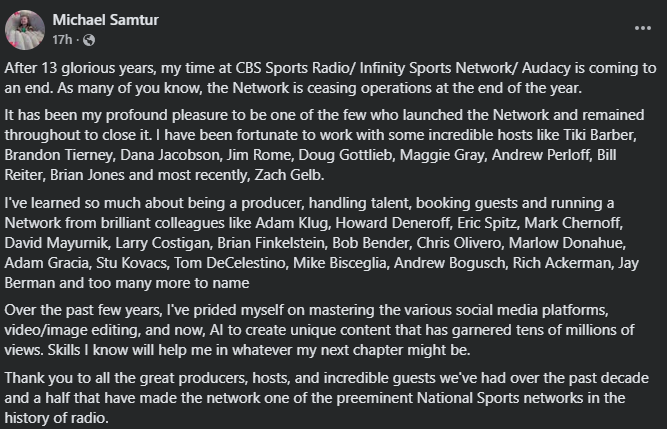
Michael Samtur, the executive producer of The Zach Gelb Show, announced he is leaving Audacy and the Infinity Sports Network after 13 years with the company, confirming his departure in a post shared on LinkedIn.

Samtur’s exit comes as the Infinity Sports Network prepares to cease operations at year’s end. The network is merging with the BetMGM Network. Together, they will form the new Westwood One Sports Network. The new network begins airing programming on December 29.

“After 13 glorious years, my time at CBS Sports Radio/Infinity Sports Network/Audacy is coming to an end,” Samtur wrote. “As many of you know, the Network is ceasing operations at the end of the year.”

Samtur was among the original staffers who helped launch the network. He remained through its final chapter. He highlighted that distinction in his message. “It has been my profound pleasure to be one of the few who launched the network and remained throughout to close it,” he added.

Over more than a decade, Samtur established himself as a trusted and versatile presence behind the scenes, working with a wide range of nationally recognized hosts. He also served as the Executive Producer at WFAN guiding Tiki Barber and Brandon Tierney for nine years.

Most recently, Samtur served as executive producer of The Zach Gelb Show. He played a central role in shaping the program’s sound. He also guided its editorial structure and booking strategy. Under his leadership, the show grew into a nationally distributed program. He also emphasized the evolution of his role as the sports media landscape changed. Highlighting his work in social media as a key area of growth. He also cited digital content and emerging technology. These areas have been central to recent developments.

“Over the past few years, I’ve prided myself on mastering the various social media platforms, video/image editing, and now, AI to create unique content that has garnered tens of millions of views,” he wrote.

With the change from the Infinity Sports Network to Westwood One Sports, Samtur is among many of the currently established hosts and staff that won’t be making the move. Earlier this week, Gelb revealed that The Zach Gelb Show will end on Friday afternoon, as he will not be included in the new Westwood One Sports network lineup.

In closing, Samtur expressed gratitude to the colleagues and contributors who helped define the network’s legacy.

“Thank you to all the great producers, hosts, and incredible guests we’ve had over the past decade and a half. You have helped make the network one of the preeminent national sports networks in radio history,” he said

Currently, Westwood One Sports has yet to announce who will host the 12-3 PM ET timeslot when the network launches in less than two weeks.

Currently, the lineup consists of:6-9 AM ET: Drake C. Toll
9 AM-12 PM ET: You Better You Bet with Nick Kostos
12-3 PM ET: TBD
3-6 PM ET: The Jim Rome Show
6-11 PM ET: Bet MGM Tonight with Brad Evans and Pat Boyle

Barrett Media produces daily content on the music, news, and sports media industries. To stay updated, sign up for our newsletters and get the latest information delivered straight to your inbox.

Warner Bros. Discovery Rejects Paramount’s Hostile Bid

0

The board of Warner Bros. Discovery has formally rejected a $30-per-share hostile tender offer led by David Ellison’s Paramount Skydance, reaffirming its support for the company’s previously announced merger agreement with Netflix and signaling little appetite to revisit negotiations with Paramount-backed bidders.

In a filing and statement to shareholders, WBD’s board said the Ellison-led proposal undervalues the company and introduces what it described as “numerous significant risks and costs,” calling the offer inferior to the Netflix transaction in both certainty and overall value.

“Following a careful evaluation of Paramount’s recently launched tender offer, the Board concluded that the offer’s value is inadequate, with significant risks and costs imposed on our shareholders,” board chair Samuel A. Di Piazza, Jr. said in a letter obtained by The Hollywood Reporter. “This offer once again fails to address key concerns that we have consistently communicated to Paramount throughout our extensive engagement and review of their six previous proposals.”

The rejection was widely anticipated. The tender offer mirrored a proposal Paramount submitted on December 4. That proposal came shortly before WBD agreed to merge with Netflix. At the time, WBD raised concerns about the financing structure. It also cited regulatory risk. The company questioned the durability of financial backstops tied to the offer.

Chief among those concerns was the role of Oracle founder Larry Ellison. His revocable trust was cited as a key financial backstop. WBD said the trust does not provide sufficient certainty. Its assets and liabilities are not publicly disclosed. The trust can also be altered at any time.

The board also pointed to risks tied to foreign sovereign wealth participation in the bid consortium, including $10 billion from Saudi Arabia’s Public Investment Fund, $7 billion from Abu Dhabi, and $7 billion from the Qatar Investment Authority.

Earlier versions of the Paramount-led bid included financing from Tencent. That $1 billion contribution was later removed. The decision followed regulatory and geopolitical concerns. Jared Kushner’s Affinity Partners had also pledged $200 million. The firm has since exited the consortium. Its departure further weakened the proposal in the eyes of WBD’s board.

From a regulatory standpoint, WBD said it does not believe there is a meaningful distinction between the Netflix transaction and the Paramount-led offer, countering claims that the latter would face fewer antitrust hurdles.

The board also took issue with Paramount’s legal posture.

In its filing, WBD referenced a December 3 letter from Paramount’s attorneys at Quinn Emanuel, describing it as adversarial and counterproductive. According to WBD, representatives from PSKY’s legal and financial advisors later indicated the letter “should not have been sent” and characterized it as “not helpful” and a “mistake.”

With the rejection now official, the burden shifts to Paramount and its partners. They must convince WBD shareholders to tender shares at the offered price. Alternatively, they must submit a materially improved bid. For now, WBD’s board remains firmly aligned behind the Netflix deal. The board frames it as the most compelling path forward. It also supports the company’s long-term strategic vision.

Barrett Media produces daily content on the music, news, and sports media industries. To stay updated, sign up for our newsletters and get the latest information delivered straight to your inbox.

’Twas the Night Before Christmas in Radio Land

0

’Twas the night before Christmas, and all through the dial,
The cluster was quiet, if only a while.
The studios were thinning, the margins were tight,
But the future of audio was already flickering with light.

Dereg was a rumor that danced in the air,
A whisper that ownership rules might repair.
For CEOs prayed to the FCC throne,
“Please let us buy more or unload what we own.”

On Cumulus, On Audacy, On Beasley, stay strong!
Shareholders asking, “How long… yes, how long?”
If caps start to change and limits unwind,
Whole markets could trade in a day if inclined.

The measurement wars left the industry worn,
With ratings contested and loyalties torn.
“Give us new metrics!” the programmers pled,
“Give us more data, we want that instead.”

And callout once ruled with a phone and a scale,
Hooks rated by panels that tired and grew stale.
Familiarity, passion, a web link in hand,
A moment in time few could truly command.
But fans now reveal what they love every day,
In skips and in saves, in what loops when they play.
They share it, they post it, they argue, they shout,
Leaving trails AI now reads better than any callout.

Meanwhile Super Hi-Fi kept rising in flight,
Its intelligent playlists sounding eerily right.
More stations signed on, looking under the hood—
“Wait… this sounds BETTER than humans? How is it so good?”

The smartest stations soon won’t just automate sound,
They’ll automate presence when no one’s around.
Each request line answered, each comment replied,
AI agents working both streams and the sides.
Not to fake connection, but scale what’s sincere,
To make every listener feel someone’s near.
Restoring the feeling of always being on the line,
Is how small teams grow without adding a dime.

And On The Sly, with sound that stirred every scene,
Turned audio to emotion in ways seldom seen.
From drone-lit skies for Blackpink, Coachella nights wide,
They scored moments so massive the silence replied.
Not chasing the spotlight, but shaping the air,
Where memories are formed the moment you’re there.
In a world chasing visuals, they proved this is why:
Sound moves us like nothing else — and that’s On The Sly.

Elsewhere stood Dave Bethel, a voice built to lead,
Turning jingling craft into brand-level need.
At TM Studios, sound carried weight,
Not just keys or notes, but how brands communicate.
From booth to the feed, his presence was clear:
He won’t just help brands, he’ll become one next year.

And Mix Group kept winning without much debate,
While others went quiet, still stuck in one state.
With market walls fading and borders all gone,
What Jason was building just kept marching on.
He works with the operators, big and the small,
Across every format that reaches them all.
When stations need sound that can travel and stick,
They know where to go. The answer is Mix.

And as budgets grew leaner in each radio zone,
More bosses announced, “You can voice-track from home.”
Studios went dark; the halls lost their sound,
As talent logged in with no need to be around—
No rent… no utilities… no parking rate,
Just send in your breaks, and please don’t be late.

And whispers grew louder in money-tight rooms,
Of barter expanding to stave off the gloom.
Not just prep or services stations once knew,
But systems and software and streaming costs too.
Automation, music, engineering on call,
Even freelancers paid not with cash, but with spots after all.
Electricity, offices, coffee on tap—
A short-term solution masking a long-term trap.
For more barter means more commercials to run,
And audiences scatter when the breaks still aren’t done.
When listeners leave, the inventory falls,
And barter collapses beneath its own walls.

Select stations were still selling for scraps in the snow,
As valuations continued their troubling low.
An FM in Tampa for less than your home,
AMs abandoned like forgotten chrome.

Some licenses were lingering, worth less than they cost,
A balance-sheet burden, a signal half-lost.
A dollar would do, or a handshake instead,
When silence made more sense than living in red.

Podcasting groaned with metrics askew,
“Downloads? Impressions? What counts as a view?”
Advertisers sighed, creators lost sleep—
One standard for all felt impossibly steep.

And podcasters began noticing what some in radio forgot:
Towers still matter, whether streamed or not.
So creators with followings started to buy,
Old signals reborn with a digital why.
Radio as amplifier, not center stage,
A megaphone married to a personal age.
The dial didn’t die, it just changed who was loud,
As podcasts walked in and claimed part of the crowd.

And whispers grew louder in meetings on high:
“How much more could EMF purchase… and why?”
Their checkbook still open, their appetite wide,
Snapping up signals to promote Jesus with pride.

And across the Atlantic came rumors that stirred—
“Will Global arrive here?”—a question inferred.
For if London’s big titan decided to try,
They’d buy up a company and make U.S. brands fly.
Their imaging, their promo, their world-building flair—
Some stations would soar just by having them there.

But nothing divided the halls of radio
Quite like the rise of the AI voice show.
Some stations embraced it for nights and for fills,
While others declared it the gravest of ills.
Some groups proclaimed with a chest-thumping grin:
“We promise you humans! No robots within!”
While others, less vocal and strapped for a shift,
Let synthetic announcers quietly drift.

And debt—oh the debt—kept circling the sleigh,
Restructures and swaps carried companies away.
Clusters went quiet, new owners stepped in,
Old logos came down with a hesitant grin.

Yet through all the chaos, one truth held its place:
Audio still thrives when it speaks with a face.

And talent kept shifting like snow in the breeze,
Bootleg Kev kept ascending with effortless ease.
From LA to worldwide, hip-hop took note,
A hungry new voice with a champion’s throat.

And Bru kept proving the mic wasn’t the end,
But the launchpad for worlds radio hadn’t yet planned.
On-air was the doorway, not all he could be,
With screens and spotlights waiting patiently.
Acting. Modeling. Game shows in view.
A face that connects before formats do.
The smart ones all see it, the rest will too late:
By 2026, there’s far more on Bru’s plate.

Greg Beharrell, once rock radio’s delight,
A master of pauses, of timing just right.
Steven Wright calm with a Hedberg-like bend,
A punchline that lands when you least can defend.
His humor ran quiet, then spread through the land,
From rock into formats no one had planned.
AC? Country? The labels all blur,
When the brand isn’t loud, but unmistakably pure.

And Woody kept proving, from LA to beyond,
That consistency builds what flash never bonds.
A show built on truth, not tricks or disguise,
That scaled without losing its soul in the rise.

Bobby Bones, ever busy, forever in flight,
Picked up more shows because the content is right.
From Nashville to network, his empire grew,
The BobbyCast landing on Netflix too.

And one reshuffle—oh, NYC beware—
Was happening quietly up in Times Square.
For HOT 97, stripped down to the bone,
Left legends realizing, “Let’s build what we own.”

For listeners seek stories, connection, insight—
A voice they can trust on a cold winter night.
So here’s to the dreamers, disruptors, and pros,
The stations, the streamers, the rivals, the flows.

May 2026 bring reinvention in sight—
Happy listening to all, and to all a good night.

Barrett Media produces daily content on the music, news, and sports media industries. Sign up for our newsletters to stay updated and get the latest information right in your inbox.

Howard Stern Has Signed His Last Contract with SiriusXM

1

Howard Stern signing another contract extension with SiriusXM feels familiar, comforting, and a little surreal.

Familiar because this cycle has repeated for nearly two decades.

Comforting because Stern’s presence still signals stability for the company.

Surreal because this one almost certainly feels like the last time we’ll write this headline.

That isn’t a knock on Stern’s legacy or relevance. It’s an acknowledgment of reality. Stern himself nearly retired earlier this year. When someone openly admits they were that close to walking away, it’s hard to imagine a sudden creative rebirth that leads to another extension three years from now.

Time has a way of clarifying these moments. Stern will be in his mid-70s when this deal expires. The grind of live radio, even in its modern form, does not get easier. It gets heavier, quieter, and less urgent.

Stern has always been fueled by doubt. Critics questioning his relevance pushed him during terrestrial radio’s peak. Naysayers doubting his SiriusXM move sharpened his edge in the early satellite years. Rumors of his demise have long served as rocket fuel.

That kind of motivation doesn’t appear on demand. You can’t manufacture existential pressure every few years and expect it to hit the same way. At some point, the noise fades. Comfort replaces conflict.

Howard Stern today is not chasing the industry. He is standing apart from it. That separation has value, but it also limits urgency. The hunger that once defined him doesn’t need to return for this deal to work. It would likely need to return for another one to make sense.

This extension feels more like closure than continuation. It rewards loyalty on both sides. It protects SiriusXM’s most iconic brand. It gives Stern the space to work on his own terms without committing to an open-ended future.

The media landscape has already changed dramatically since his last contract. Podcasts have professionalized. YouTube has matured. Streaming platforms are now fighting the same attention wars radio once owned outright. None of that slows down over the next three years.

By 2028, the ecosystem will look even more fractured. Distribution will matter less than community. Live appointment listening will be rarer. Personalities will still win, but the infrastructure around them will be leaner and less forgiving.

That reality complicates another deal. SiriusXM will be making different bets by then. Howard Stern will be weighing different priorities. Nostalgia alone won’t bridge that gap.

This isn’t about decline. It’s about timing. Every great run eventually reaches a point where continuing feels optional instead of necessary. Stern appears to be there now.

There’s also peace in that. Few broadcasters ever get to choose their ending. Fewer still do it while remaining highly compensated and culturally relevant. Stern has earned that privilege.

If this is indeed his final contract, it shouldn’t be viewed as a loss. It should be recognized as a rare, deliberate transition. Stern isn’t being pushed out. He’s easing off the accelerator.

That’s a powerful position to be in. It’s also one that doesn’t demand another extension. It simply asks for a strong finish.

How Adam Lefkoe’s Versatility Gives TNT Sports A College Football Playoff Edge

0

For one to be considered versatile, they must obtain skills through many different functions. In sports media, those experiences can range from on-air to off-air roles. With technology constantly evolving across every sector of the industry, it is key for anyone to be as versatile as possible for retention and longevity. When Adam Lefkoe pursued his career in sports media following his studies at Syracuse University, he was taught to embrace versatility in every aspect of his work.

“I think I’m the most versatile sports broadcaster right now. Just because of doing everything I’ve been asked to do,” said Lefkoe as he prepares for this weekend’s College Football Playoff first-round coverage on TNT Sports.

The 38-year-old host earned a multi-year contract extension earlier this year because of that versatility. He has hosted a wide range of sports coverage for the network since joining just over a decade ago. From college basketball to the network’s first coverage of Roland-Garros earlier this year, Lefkoe has crafted his own lane and led the network by never saying no to any opportunity.

“Working under timelines and doing what I’ve done makes you a better storyteller. It also makes you a better teammate,” explained Lefkoe. “It’s all very surreal, to be honest. I appreciate that they [TNT Sports] have let me grow, and I appreciate the fact that they have trusted me. The grass is usually greener. People look outside to find someone to handle all these duties. To let me build up to this, it’s a special relationship.”

Pressures of the Playoff

This is the second year TNT Sports is presenting opening-round games for the College Football Playoff. The broadcasts are part of a five-year sublicense agreement with ESPN. Next year, the network will add quarterfinal and semifinal matchups, in addition to first-round coverage. Lefkoe approaches this year’s coverage with a focus on execution. He is building on the experiences of last year’s debut while shaping expectations for the future.

“In terms of the studio shows that are housed in studios, I think ours was the most fun, most entertaining, and the best, if I’m being real with you,” noted Lefkoe of his work covering the Big 12 for TNT Sports with Takeo Spikes, Victor Cruz, and Champ Bailey.

While the foursome handled typical week-to-week coverage, including pregame, halftime, and postgame segments, the College Football Playoff coverage will differ. Lefkoe and his crew will host a one-hour postgame show following the conclusion of James Madison University taking on Oregon, with the broadcast originating live from Eugene, Oregon.

“It’s magic, man,” explained Lefkoe. “There’s a pulse. You get into television for the moments when you sit down and get a little nervous. A live audience takes it to that level. If all the Ducks’ fans are going crazy behind us, that will be a crazy atmosphere.”

The goal remains the same in approach, albeit just for a postgame program. Preparation is key, with solid production that leaps off the screen. The hope is to replicate the approach and viewing experience from the network’s highly praised Roland-Garros coverage earlier this year, which Lefkoe believes could set a new standard for College Football Playoff coverage.

“The tennis analysts at Roland-Garros had not experienced the TNT way of doing things. Which is Adam goes to the meeting, you don’t… I think they all had experiences elsewhere of rehearsals. We made it more of a natural conversation,” Lefkoe compared, reflecting on his experience at the French Open earlier this year and applying it to this weekend. “TNT was the first broadcaster for that sport [tennis] in over a decade, and people said that was refreshing. If we can do that with college football, I think we’re on the right track.”

Changes At TNT Sports

Lefkoe relies on his versatility and careful control of inputs. He applies strategy in preparing for every sport he is assigned to host. Earlier this year, through his experience at Roland-Garros, he learned that curiosity builds connections with the audience. Asking questions, rather than trying to prove yourself, allows the analyst to shine.

“The main thing was to enter with curiosity. Do not enter trying to prove yourself. Instead of having mindless conversations in the green room, I was asking questions non-stop,” said Lefkoe. “My goal is to keep being curious. Sometimes people get callous and have covered a sport for so long that they believe they are the arbiter of it. I feel as if I’m always the guest and make good dinner conversation.”

This year is different for TNT Sports, as the NBA is no longer part of the network for the first time in over two decades. With the league’s exit, Lefkoe lost the opportunity to continue hosting his Tuesday night NBA coverage.

He says he misses the NBA on TNT but still has affection for the sport. However, the departure of the league opened new possibilities for Lefkoe to break away from being known as “the NBA guy” on the network. More importantly, his focus shifted to the talented staff surrounding him.

“We were all worried about people behind the scenes if they’d lose their job. What TNT Sports has that I’ve seen through the eyes of other talent that have worked in other places is a vibe,” explained Lefkoe. “What happens behind the scenes completely impacts what you see on camera. We were just worried that we were losing people we really cared about.”

While not everyone behind the scenes was retained, Lefkoe was happy to see many colleagues he valued remain with the network in the same or different capacities. With Inside the NBA now airing on ESPN but still being produced in TNT Sports studios in Atlanta, Lefkoe remains ready in case his number is called.

“I believe I’ve been told that,” explained Lefkoe when asked if he would fill in for Ernie Johnson if he missed an airing of Inside the NBA. “If he [Ernie Johnson] had one of his grandchildren’s graduations or something like that where he needed to go, I’m going to get that call.”

A Try Anything Mindset to Success

Remaining versatile continues to be a key part of Lefkoe’s role at TNT Sports as he finds new ways to build relationships with sports fans. Even though he has become the face guiding the network’s sports coverage, he remains tied to his digital media roots through his partnership with Shaquille O’Neal.

For the past two years, Lefkoe and O’Neal have co-hosted the highly successful The Big Podcast with Shaq. They dive into any topic, expanding their reach and connection with the audience. When O’Neal asked Lefkoe to join the podcast, it was an opportunity he couldn’t pass up.

“Just don’t stop,” explained Lefkoe, emphasizing his commitment to growth. “When it comes to being versatile in doing different sports, why say no?”

Balancing opportunities is a daily challenge Lefkoe welcomes. Being passed up for multiple opportunities in his career taught him to persevere, take ownership of every request, ask thorough questions, and remain curious.

Building versatility into a sports media career is a goal many aspire to.

“Put yourself in those uncomfortable situations. Don’t be afraid of looking stupid, and stay curious,” said Lefkoe. “If you’re willing to listen and learn, then you can grow. If you think you know it all and feel the need to show people, they’re going to go, ‘this guy stinks.’ The journey and being open prepares you for anything.”

As the College Football Playoff approaches this weekend, Adam Lefkoe is set to once again demonstrate the value of his versatility.

Barrett Media produces daily content on the music, news, and sports media industries. To stay updated, sign up for our newsletters and get the latest information delivered straight to your inbox.

It’s Time for ESPN To Attempt an AI Alt Cast

1

Technology is always evolving. Artificial intelligence (AI) is becoming a regular part of our daily lives. We see ads marketing its benefits, Wall Street investing heavily, and people saying they don’t want it—but knowing they’ll eventually need it. In sports, innovation has always been at ESPN’s core.

From pioneering 24-hour coverage to introducing alternate commentary feeds (a.k.a. alt casts) like the beloved Manningcast, the network has consistently sought ways to give fans more personalized, immersive experiences.

As technology evolves and audiences grow more comfortable with AI, a new opportunity emerges that ESPN has yet to fully explore. After the success of alt-casts presenting live play in a digital realm, could it be time for an AI-powered alt-cast for play-by-play and analysis? The timing could not be better.

Hear me out before heading to the comments.

AI has moved from the fringes into the mainstream. Millions of Americans interact with it daily—through virtual assistants, recommendation algorithms, and generative tools that produce text, images, or music. Some of the top tracks you listen to are fully produced and arranged by AI. Don’t believe me, ask Alexa!

Your social feeds are filled with AI-generated ads geotargeted to your location, your diet, and even why you still love funny cat videos after all these years.

AI is no longer a novelty—it’s embedded in how people work, learn, and play. Sports fans, often early adopters of technology, present a prime audience for innovation. If ESPN wants to stay at the forefront of broadcasting, now is the time to experiment with AI-driven commentary.

The case is simple: fans want customizable, data-driven insights during live events. ESPN already taps into this with the new SC For You feature in its app—a personalized, daily version of SportsCenter delivering highlights, news, and must-see videos tailored to each fan’s favorite teams, leagues, and sports. ESPN has shown it can combine AI technology with its storytellers, expanding what SportsCenter can be in a new era.

Is play-by-play next?

Traditional broadcasts are entertaining, but human commentators have limits. They can only process stats, recall history, and deliver insights so fast while keeping up with live play. They are human, after all.

AI thrives where humans can’t keep pace. It can access vast databases, calculate probabilities instantly, and deliver nuanced insights that would be impossible in real time.

Picture a live NFL game. An AI alt-cast could provide immediate analysis after every snap. When a quarterback scrambles for a first down, AI could calculate the play’s success probability, compare it to past scrambles, and suggest alternative strategies—all in seconds. Think of it as Next Gen Stats on steroids.

If a wide receiver drops a pass, AI could provide context on historical drop rates, defensive adjustments, and projected impact on win probability.

All this data is available instantly—information human commentators would take much longer to compile.

Do all fans need this? Not necessarily. But alt-casts exist to give viewers options. Want stats? The stat-cast has you covered. Want sideline commentary? Enter Pat McAfee. Want to wager on the next sequence with ultimate probabilities on a single snap? AI delivers instantly, and data has enormous value.

With the College Football Playoff National Championship, why not experiment with the crown jewel of the college season? If that’s too soon, consider the NBA or the network’s college basketball slate. AI could calculate a shot’s expected value based on distance, defender position, and shooting history under similar conditions.

Even MLB, where moments are slower but highly data-driven, benefits. During a pitcher-batter matchup, AI could calculate pitch probabilities based on historical tendencies, weather, and sequencing. It could highlight a batter’s success against left-handed pitchers in the eighth inning or a pitcher’s ERA in high-leverage situations.

Sabermetrics will end up back, back, back, and gone with the birds.

The success of ESPN’s alt-casts shows there’s appetite for this innovation. The Manningcast draws high ratings and social buzz by offering something different—a more intimate, conversational experience.

Nothing AI can replicate… at least for now.

The timing is perfect. Over the past year, AI has shifted from curiosity to utility. Chatbots, AI image generators, and productivity tools have become mainstream. The public engages with them daily.

Sure, people say they want a human touch in entertainment. But how long will that remain true? It likely will be shorter than you think. Fans are experimenting with AI in their daily lives and learning to trust it as a tool for insight, creativity, and information. Sports fans, who crave instant analysis and dynamic storytelling, are particularly ready for AI integration.

So why not now?

Of course, challenges exist. AI commentary must be accurate, engaging, and culturally sensitive. Mistakes in analysis could erode credibility. These risks are manageable, especially if AI supplements rather than replaces human broadcasters.

It’s just another viewing option—not the only one.

Disney, ESPN’s parent, has a long history of embracing new technologies and creating integrated entertainment ecosystems. AI in sports broadcasting aligns perfectly with this philosophy. An AI alt-cast signals that ESPN is not just keeping pace—it’s leading the integration of technology into mainstream sports media.

The potential extends beyond fan engagement. Advertisers could see AI-driven broadcasts as a platform for targeted messaging and interactive experiences. AI could dynamically highlight sponsored content, adapt commentary to showcase brand partnerships, or create interactive features that traditional broadcasts cannot.

Adopting AI in broadcasting could open entirely new revenue streams while enhancing the fan experience. If it makes cents, it makes sense to try.

Are audiences ready? Is the technology mature enough? Would an AI alt-cast align with ESPN’s mission to serve sports fans anytime, anywhere? For a network that thrives on innovation and credibility, there may never be a better moment to leap.

With technology maturing and audiences increasingly comfortable with AI, the question isn’t whether ESPN can experiment—it’s whether it can afford not to. The future of sports broadcasting is arriving fast with a younger generation looking for more than is currently being presented. An AI-powered alt-casts could keep ESPN not just in the game, but ahead of it for generations to come.

Barrett Media produces daily content on the music, news, and sports media industries. To stay updated, sign up for our newsletters and get the latest information delivered straight to your inbox.

The Truth Behind Why Concert Ticket Prices Are So Expensive

1

Music fans of all genres can agree on one thing: Concert tickets are too expensive.

But besides going on social media and screaming into the desolate void alongside fellow frustrated Ticketmaster buyers, is there anything an individual can do to fight back against the out-of-control pricing within the ticketing market?

During a recent sit down with Randy Nichols, board member of NITO, the National Independent Talent Organization, the lifelong artist manager explained that although there are positive changes coming within the ticketing industry, it’s going to take a while. The path is not going to be easy, nor pretty.

StubHub vs. Ticketmaster

One of the biggest issues an average fan faces when trying to purchase a ticket to see their favorite artist perform is the lack of transparency.

Fans aren’t quite sure who they should be mad at for the outrageous prices. Is it the artist? Ticketmaster? Live Nation? The music venue?

“Fans need to understand that StubHub and Ticketmaster are two very different companies. StubHub is a secondary market platform, which is where scalpers are listing their tickets, while Ticketmaster or other sites such as AXS are the event holders selling the tickets.”

“Anytime you go to StubHub, you have a much higher likelihood of paying much more for the ticket… when a fan goes to resale marketplace such as [StubHub] or VividSeats, you know you’re overpaying.”

Fans are overpaying while competing against hundreds of thousands of bots run by scalpers, and fellow fans when tickets go on sale.

“It’s tough to get a shot at things like front row seats these days because these scalpers are using all kinds of bots to cut the lines.”

“There’s a whole set of scalpers that call themselves short sellers. They sell the tickets high, sometimes before the show is even on sale because StubHub will list tickets before the show is even out yet to the general public on Ticketmaster.”

“So they sell high, and as you get closer to the show date, some people’s plans change and they want to dump their tickets on the secondary market. However, scalpers are using bots to immediately pick up all those tickets that people list. The scalpers will buy [the recently released tickets] low, after already making enormous profit from their other sales… and it takes advantage of the fans.”

The Buck Stops Here

In the age of social media, it’s easy to point fingers and blame the powers-that-be and giant corporations.

In 2024 a disastrous pre-sale rollout of Taylor Swift’s Eras Tour occurred which led to Ticketmaster crashing. Fans were stuck in queue’s for 6+ hours before learning they wouldn’t be able to purchase tickets. Swifties were so furious that the hashtags “Ticketmaster Sucks,” “Ban Ticketmaster,” and other words that I can’t write here began trending worldwide. This continued for weeks!

However, Nichols says that it’s important for fans and artists to direct their frustration at the real culprits.

“You’ve got Ticketmaster and Live Nation and we all have our various issues with them, but they reinvest that money into producing events. Scalpers do not put a dime of the money they make into producing live events.”

“At the end of the day, the fan is not actually a customer of the ticketing company. So, the ticketing company is not even thinking about the fan in every part of the purchase relationship and the fan is hurt in that process because of it.”

“In my eyes, the big bad wolf is the multibillion dollar ticket scalping industry. These are people that are siphoning money out of local communities, as well as artist’s pockets and fan pockets  in order to buy yachts and private jets!”

“If I’ve got to pick the worst of the worst, it’s always going to be the person that is sucking our money out from everyone in the system and make no mistake about it, this stuff hurts everyone all the way down to the local restaurant owner in the neighborhood.”

“If an artist wants to sell tickets for $20, and scalpers bought them all and were selling them for $100 and fans bought them all, those fans may not be able to go out to dinner before the show because they spent so much money on the ticket. So, it really does effect everyone across the whole ecosystem,” said Nichols.

New Laws On The Way

Nichols has been one of the leading voices in the fight for ticketing reform. He recently addressed the issue with Gail Slater, the United States Assistant Attorney General for the Department of Justice’s Antitrust Division.

Politicians from both sides of the aisle recognize that inaction is no longer acceptable. Nichols, along with entities such as the Fix The Tix Coalition, have been actively working with and educating state legislators on what is really happening behind the scenes. The fight however, hasn’t been easy. The secondary ticket market is worth billions of dollars. It won’t simply go quietly into the night.

“The ticket scalper industry makes over $10 billion a year and is a private equity-backed business,” Nichols explained. “There’s a lot of legislation that protect scalpers and we need to roll the back.”

In March, President Trump signed an Executive Order directing the FTC and the DOJ to enforce the BOTS Act more vigorously. It not only reports bot attacks but can also shut them down.

“Both federally and statewide, there are countless legislators that want to take on this issue and we’re working on bills in states all across the country, so there is excitement and we feel good about it,” said Nichols.

Enough Is Enough

Fans can take comfort in knowing that their frustrations are being heard. The fact of the matter is, everyone has purchased tickets and understands how insane the marked up prices on the resale market have become.

“It’s tough because the artists aren’t as educated as you’d think on this problem,” Nichols explained. “The artists are busy trying to be artists. Now they have to run social media, they’re leading their marketing campaigns, there’s more and more put on the artist to do. And now we expect them to fix the ticketing problem.”

“The ticketing problem is incredibly difficult [for an artist to fight] because technically a ticketing contract for a concert is between the venue and the ticketing company, the artist is a use caught in the crossfire.”

“So, whether you’re Taylor Swift or The Mighty Mighty Bosstones, [artists] are all stuck in the same spot where the ticketing company isn’t our decision, and because of that, it’s not easy to force change easily.”

Artists Fight For Cheaper Tickets

Some artists however, are doing their part to fight back against ticket scalpers.

For example, Hayley Williams recently announced that her upcoming “Hayley Williams at a Bachelorette Party Tour” would be partnering with OpenStage, a verified ticketing platform that requires two-factor authorization to gain access to purchase tickets. The goal is to limit bots and scalpers.

“You shouldn’t have to jump through hoops to buy tickets to see the show, but unfortunately, it’s a broken and convoluted system,” Williams shared in an Instagram post. “My team and I are doing everything we can, and I am hopeful that the processes we’ve put into place will get as many tickets into the hands of my fans (at face value) as possible.”

“I want to get tickets into the hands of my fans, at a price that is as reasonable as I could get it,” Williams continued. “I’ve had countless conversations with my team, and they’ve spent countless hours trying to find the best solution for fans to be able to buy tickets. It’s been tough (to say the least), and unfortunately, there’s just no way to guarantee that zero tickets get scalped. But we’re doing our best.”

Fans across the globe expressed high praise for Williams’ move.

Just as companies such as Coca-Cola and McDonald’s face intense criticism and even boycotts from customers due to their use of Artificial Intelligence in advertisements, fans are not going to hold back their outrage over high ticket prices. Artists would be wise to follow what Hayley and other bands are doing. The battle against marked up ticket prices and scalpers isn’t going away anytime soon.

Looking Ahead

The good news is that change is on the way.

“2026 will be known as the year that changed the future of live event tickets,” Nichols excitedly told me.

“The UK is in the process of finalizing laws on capping resale prices from scalpers and we’re starting to see momentum globally and we are looking forward to bringing this to the United States.”

So are the fans… and their wallets!

How much have you paid for a concert ticket? Tweet me @TheGunzShow or email TheGunzShow@gmail.com.

Barrett Media produces daily content on the music, news, and sports media industries. Sign up for our newsletters to stay updated and get the latest information right in your inbox.