Most of my columns are radio and audio-related because, well, that’s what I know best. However, any idiot can tell you that the media world is changing rapidly and that means we need to look at how other segments are doing.
What triggered me was an article in AdExchanger by Justin Fromm, the Head of Insights and Thought Leadership at Samsung Ads. His piece, “Ghost Audiences Are Haunting CTV Measurement,” appropriately released on the day before Halloween, referred to subscribers who are not active users of services. Justin brought it down to a simple concept: “Just because a platform’s audience is large doesn’t mean it’s available.”
One example from Justin involves an app that viewers use to stream regular-season NFL games. Samsung Ads found that two of every three new viewers had “ghosted” the service once the season ended. These households are still part of the base, but once the season was over, advertisers couldn’t reach them. For SVODs (Subscription Video On Demand), he thinks the next streaming currency will be the one that has the “strongest combination of reach and availability,” in other words, a currency that doesn’t inflate the available audience.
Available Audiences vs. Actual Audiences
What stands out is that, just as radio doesn’t really know who is listening and depends on third-party measurement, digital services have similar problems. The SVOD services know how many subscribers they have on any given day, but don’t know that much about who is viewing. I’m sure many of you have subscriptions that you pay for and don’t use.
In my case, I have Spectrum for video, partly because some streaming services are included in the package. We use the ESPN app (well, I use the ESPN app), HBO Max, and some Paramount+. We haven’t used Disney+, Hulu, Peacock, or AMC+ in months. We haven’t even downloaded Discovery+ or the Tennis Channel. And if I want to watch ViX Premium, I’ll need to improve my Spanish.
Want to bet we’re an “available audience” for everything Spectrum offers?
Antenna Tracks the Churn
Justin’s commentary also had a link to some data you may not have seen before. Antenna is a research service that measures the “subscription economy,” and the company releases some fun pieces (go to www.antenna.live). Perhaps your definition of “fun” is different from mine, but let’s check an insight or two from them.
And yes, the name “Antenna” seems odd because the company measures video viewing that, well, doesn’t require an antenna.
Antenna releases a quarterly report of Premium SVOD subscription growth, except that not every quarter shows growth. The most recent report, released last week, reported a decline of 1.7 million subscriptions in Q3 2026. Summer is apparently the time to drop a subscription channel, as the same thing happened in Q3 2025 with a decline of one million subscriptions.
This may be a new trend, as Q3 in 2023 and 2024 showed net gains in the Antenna methodology. Here’s the chart:
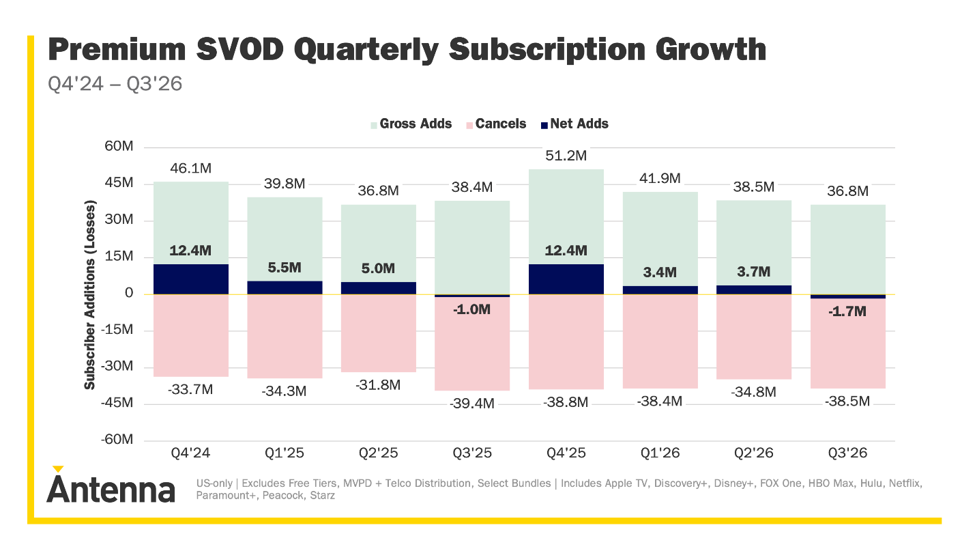
The net change is, of course, reflective of gains and losses. That 1.7 million decline was based on a gain of 36.8 million subscriptions against cancellations of 38.5 million subscriptions.
In addition, the losses occurred during July and August, while September showed gains.
The NFL Effect and What It Means for Advertisers
Antenna also showed which services (of those the company reports on) drove gains in subscriptions.
With all the negative focus on Netflix of late, the chart below seems to agree.
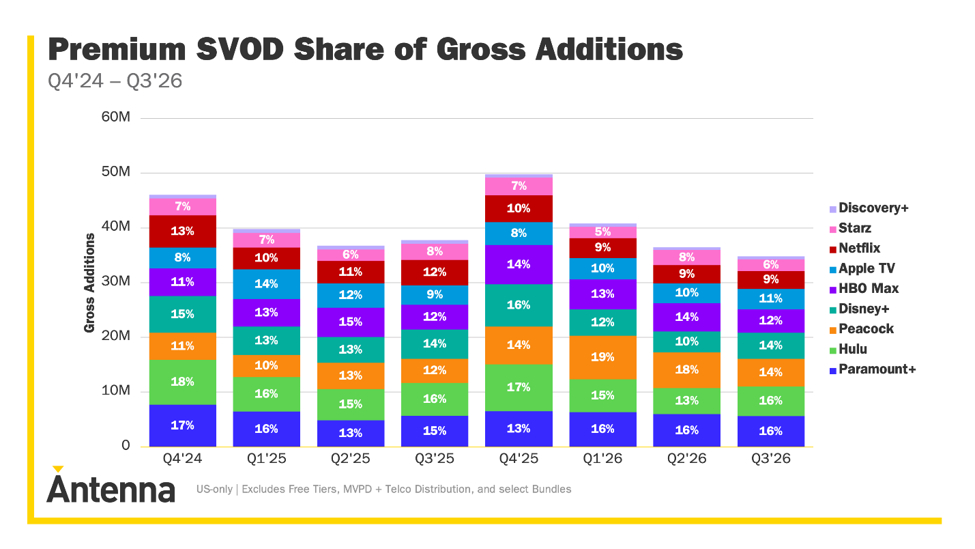
The two services that drove Premium SVOD growth were Paramount+ and Hulu, with Peacock and Disney+ close behind. Netflix, while the largest of the subscription services, was only seventh.
Finally, in case you were ever in doubt, the NFL matters. Look at the swing in signups for services that have NFL games.
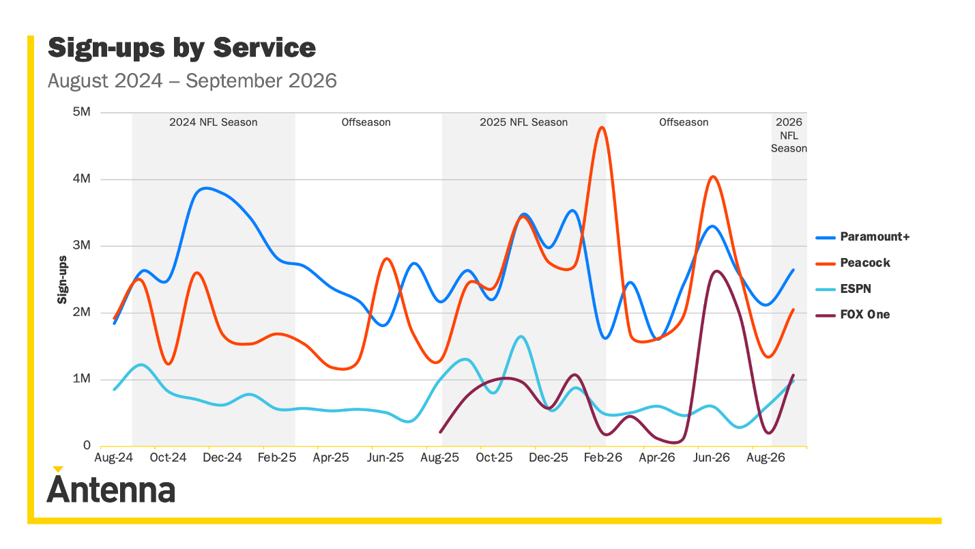
Notice that Peacock had a massive bump last February (the red line). Could it be that Super Bowl LX was available on Peacock? If you guessed that, you get a gold star from Captain Obvious.
What interests me is how the universe moves every day. Consumers add and cancel subscriptions to services, most of which now offer ads or at least an ad-supported tier. Advertisers can deal with logical changes, such as the NFL, but what about outside of sports? What audiences are they buying?
Certainly, the buy side has more data than ever before, but does all that new information yield results? As media has moved to on-demand and streaming, which should offer better understanding of audiences, I’m not sure that advertisers are any better off than in the analog days.
Let’s meet again next week.
Barrett Media produces daily content on the music, news, and sports media industries. Sign up for our newsletters to stay updated and get the latest information right in your inbox.