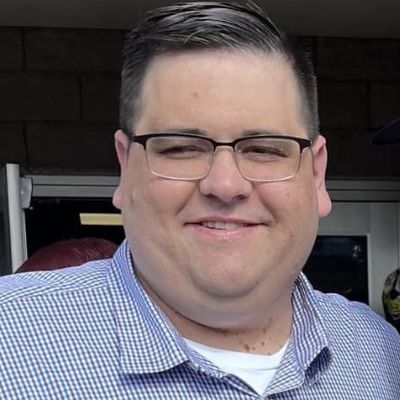
Meet The Leaders is a special 8-week series created in partnership with Point to Point Marketing. Today’s feature is on the Vice President of Ramsey Network, Hank Fuerst. Follow along with the series and revisit former conversations by checking out the entire category.
Hank Fuerst was elevated to Vice President of the Ramsey Network earlier this year. He took the role after Blake Thompson, the network’s Senior Vice President, retired following 30 years with the company. Fuerst now helps lead a network that distributes Dave Ramsey’s The Ramsey Show and other programming across radio, podcasting, and YouTube.
Fuerst has spent more than a decade at Ramsey, and he says that familiarity made the handoff smoother. Thompson also gave the team plenty of notice, so the network was already operating as if he’d left. Fuerst says the team knew exactly what to do when the first Monday after the Fourth of July arrived.
In this Q&A, Fuerst reflects on the transition and what he’s learned about leading. He also breaks down George Campbell’s YouTube success and the company’s approach to AI. Additionally, he explains how the Ramsey Network’s mission shapes its advertiser decisions. Finally, he previews 2027 priorities, including more YouTube testing and new ways to reach younger audiences.
Garrett Searight: Earlier this year, Blake Thompson — the Senior Vice President of the Ramsey Network — retired after 30 years with the company. How do you feel like everything has gone since you’ve taken the reins?
Hank Fuerst: Garrett, it’s been great. Not because we don’t desperately miss Blake, and miss his leadership, humor, and passion for our mission, but because Blake set us up so well. I think we will go back in time and study this transition because of how well it was executed by Blake. He gave us such notice that we were really able to act like he was gone for the last final quarter. That really set us up so well. While we woke up on the first Monday after the Fourth of July holiday and missed Blake, we didn’t not know what to do. That was all because of how well Blake set us up.
It was actually really funny. Blake is very active in a mission that goes over and frees slaves in Pakistan. He would go on these trips while he was still working here and be out for eight, nine, 10 days at a time. For those first eight or nine days, it just felt like Blake was on another trip. And then once we got into weeks two, three, and four, we were like, “Wait, he’s not coming back.” And then we really missed him. But there was one easy fix to that. We set up a lunch and got to see him, so we missed Blake, but he set us up so well.
GS: How much did that transition help? Especially with the fact that you had been at Ramsey already and were able to hit the ground running?
HF: It was huge. And you hit the nail on the head. We are an organization that revolves around people. We always say internally that we move at the speed of trust. And it’s why our building went to really great lengths to make sure we have this awesome cafe and cafeteria where team members can break bread with one another every day while we’re here at work. Knowing the people, the mission, and the brand helped out in a ton of ways.
The interesting point, though, is that I’m not Blake. So I was very intentional to not try to be a puppet of Blake. We might happen to both like baseball and really good music, but I can’t just be a mimic of Blake. And I had to learn that. I just have to be an extension of myself and try to be the best version of myself. That was another thing I focused on since he left. But being here for well over a decade — and next spring will be my 13th anniversary at Ramsey — I was able to just pick up right where I needed to.
GS: What have been the things that you’ve had to learn on the fly on the job? How much have you learned about yourself in the process since you’ve taken over?
HF: Blake was always really big on surrounding himself with really smart, intelligent people who got the job done every day, every week. That team is largely still intact. So it’s really just making sure that they have the right expectations from me. Then I’m letting out the right amount of rope to find that balance where I’m not completely over-delegating to them, but I’m also not micromanaging them. That’s been an interesting balance to find. But because we were set up so well by Blake, we’ve already been acting this way for so many quarters.
One of the core tenets of succession and promotion at Ramsey — and Blake helped champion this — is that he would always say, “Promotions should never come as a surprise. You should already be acting — whether it’s by influence or by title, or we’re just going to go ahead and start leaning into this — like that next role that you’re about to get promoted into.” That helps alleviate some of that “Oh my gosh, here we are, and we don’t know what to do or where to go.” We were already in that mindset, in that mode, and so we just picked up where we left off.
GS: When you take a 10,000-foot view and look at 2026, what have been the successes and the things that have stood out that you feel like you’ve accomplished?
HF: Wow. It’s been a great year. The number one thing that comes to mind for our network has been the success of George Kamel. George has had an unbelievable year on YouTube. He is really taking that creator mindset and taking our network to another level. What we’ve been able to do with George is find different types of content that work well on YouTube and double down on those. One of the things that has really taken off this year for George’s channel is what we call “man on the street” or “George on the street.” If you go to his channel, they’re some of his highest-performing videos.
Probably the culmination of that — and my favorite and proudest moment of the network this year — was a last-minute trip where we got George up to the World Cup Final at MetLife. We talked to all the people up there tailgating and asked, “How much did you pay for this ticket?” You can imagine the stories. These tickets were going for $15,000, $20,000, $25,000, and people were maxing out credit cards and all sorts of ways to make sure they could get into that game.
What we do in those situations is, yes, it’s kind of crazy to hear some of those stories and scenarios, but we’re not making fun of those people. We’re not being nice to them on camera and then blasting them off camera. George is actively teaching those people how that money’s going to have to be paid for at some point, and he’s not shaming them or anything like that. We’re using it as a teaching moment for our audience.
What we were able to do is strike on a really trending hot topic. The World Cup was such an unbelievable success for our country this summer. It was cool to have the entire world look at us. It was just a fun little way for the Ramsey Network to get involved on a trending topic. George’s channel was our avenue for that.
Outside of George, John DeLony continues to do really, really well. And his show helps a lot of hurting people who aren’t sure what’s the best next step to take with their mental health. But probably the proudest we’ve been with DeLony’s brand is how many marriages he’s helping heal and how many people who feel lost. He’s helping bring connection back into their marriages. He’s got a book coming out in January all about that topic, and we’re really excited to continue to help people in that space.
Very intentionally, I’ve mentioned a couple of non-Ramsey Show shows that are part of our network and are doing well this year.
Another thing we’re proud of this year is the amount of work we’ve done on succession for our media content: George’s show, DeLoney’s show, Smart Money Happy Hour. Even on The Ramsey Show, the co-hosts have really stepped up this year and have done a really awesome job. I love hearing from our fans and from radio program directors around the country about how much they like these new, younger, diverse voices that we’re bringing to The Ramsey Show each day.
GS: Speaking of George on the YouTube front, there are brands today that are sitting down and going, “Oh, we should do more on YouTube,” or “We should even launch a YouTube channel,” let alone do more on it. How much did being ahead of the curve on the YouTube front set you up for success today?
HF: Well, YouTube continues to change. They’ve always changed, and that change feels like it’s coming a lot faster and more frequently. One thing we’ve noticed this year is that the playing field has leveled out a little bit. I wouldn’t say that we have this tremendous leg up because of getting on the platform well over a decade ago. YouTube just celebrated two decades as a website, and we were on it probably closer to 15 years ago. That does give us a lot of reach, a lot of discovery, and a lot of longevity on the platform.
YouTube is leveling the playing field for newer creators and newer channels, so I would encourage anybody that now would be a great time to start trying it out, but be ready to test, be ready to fail, and iterate off of those failures and tests. That’s really how you build out a channel.
If you look at most of the successful creators on YouTube, especially if they’re new, they try out a bunch of different content in long form and Shorts. They see what works, and then they just double down on that. But it takes a tremendous amount of patience. It takes resources, and you really have to find the right audience and engage them in a way where they want to keep coming back to your channel. We know all this because we’ve been on the platform for well over a decade, but now is a great time for anybody to get in.
GS: I know Dave on the air one time had said, “Hey, we’ve made the decision. We’re not going to use AI in a content aspect on the air, but absolutely behind the scenes, we’re going to use it and harness the power to make us more efficient, better at our jobs.” What are the biggest and best ways Ramsey is using AI behind the scenes?
HF: I said it earlier when I was talking about some of the Blake succession stuff, but we are a people-first and relationships-first company. We’re not going to use AI to replace human connection, which I know sounds obvious, and I know that has societal impacts, but what that means in the workforce is that we have policies around when and where we can use AI, and it needs to be disclosed if we’re ever using it. We’re not trying to pretend that I got a lot smarter because I’m interacting with an LLM. We are open about it when we do use it, and we never let it replace that human connection that we value so much.
On top of all that, it’s definitely making us faster. It’s speeding us up. It’s creating efficiencies for us. That’s mainly what we use it for: that speed and that efficiency. Because of the mission of our company, we’re not getting more efficient or gaining speed because we want to make more money or become more profitable. We do all that so we can help more people. It’s a great use of AI: something that used to take someone 20 hours now takes them 20 minutes, and that person can then focus those other 19 hours and 40 minutes on helping more people.
Those are the wins around AI that we’re seeing, and we’ll continue to use it in that way to help more people.
GS: When you speak of the mission of the company, how does that affect the advertiser and sponsor space for Ramsey Solutions? Does it limit the sponsors and advertisers you can work with? Does it make it more difficult to go out and gobble up as many folks as you can? Because some nationally syndicated shows or digital shows will take any dollar they can get. Well, obviously that’s probably not going to be the case for you guys at Ramsey Solutions. How do you go about finding the right sponsors and advertisers that work with the show and the network overall?
HF: Because we help people, and we consider our brand to be a trust brand, we are never going to bring on an advertiser that does not allow us to continue to do both of those things. If there’s an advertiser that goes against something we might say in our content, then we’re not going to bring that advertiser on, because it would be very disingenuous for us to talk about one principle.
I don’t know if you know, Garrett, but financial topics are kind of a hot-button topic for certain people. We’re very principled in the way that we teach about people’s money. So whenever we are talking about it on the air, we’re never going to bring on an advertiser that does a complete 180 in the commercial break. So step one, the advertiser has to be aligned with our content and the mission. We work with a wide variety of advertisers, and we’re continuing to grow our advertising opportunities and the brands that we love working with. But they’ve got to be on mission and on board with our content in order for it to be a fit. That does sometimes cause us to limit the number of available advertisers.
We’re not opening up the floodgates. We are constantly looking at who we’re prospecting and who can potentially come on board. I’ve been in the media department my entire career at Ramsey, and I’m very proud to look back over my 10-plus years here and see consistency around the mission and around our advertising, who advertises and who we work with. It’s been consistent that entire time. We just want to help more people.
GS: There are a lot of media figures who are concerned about declining rates when it comes to Google referral traffic, etc. You guys have been at the forefront of making sure that your content is available on an app in a direct way, should people want to consume it that way, while also straddling the line of, “We can do well on Google” and “We can do well on YouTube.” With folks in the industry being concerned about those referral rates and search results being more focused on AI results, how important has it been for you guys to have that destination with the Ramsey Network app to make sure that you stay at the forefront, at the fingertips, when people are searching for advice both financially and relationally?
HF: It’s been very important for us. Again, we just want to help people. Traditionally, it was on radio and in books and in live events. That morphed into podcasting, YouTube, webinars and that kind of thing. If the next frontier is AI overviews or performance in a large language model, we’re going to lean into that frontier and try to get our content there. And we have successfully gotten our content there.
We look at any new frontier as an opportunity to continue to help people. We’re able to stay nimble that way. Dave, as you know from all the times you’ve talked to anybody at Ramsey, has always been independently syndicated on the radio. We’re in charge of all of our media distribution. We’re really independent all the way across the board at our company. That allows us to lean into those new opportunities and learn how to get our content surfaced in those new frontiers.
GS: When you look at things that are on the to-do list for 2027, what do you hope to accomplish? What are the biggest priorities going into next year?
HF: Obviously, when I was talking about YouTube earlier, continuing to test and test and test some more is definitely something we’re going to continue to do next year. We’ll lean into YouTube, test a lot on that platform, and then start to double down on the stuff that works. Whether we’re on radio, podcast, or YouTube — I hinted at this earlier — but we love all of our distribution platforms and continue to pour resources, effort, and work into those areas. We’re going to continue to give quality content through those various distribution outlets to our fans.
In the case of radio, we love hearing from our stations where they say, “You know what, when I have The Ramsey Show on, I know that content is helping my listeners on the other side of that radio signal. I know that I’m helping people and providing value to them.” We’re just going to continue to provide awesome content across all those different outlets.
One cool stat I heard the other day is that the youngest millennial will hit their 30s next year. With Gen Z fully owning the 20s demographic, we’re looking for new ways to talk to that audience. A lot of that audience consumes media in different ways, so we’re looking for new ways to talk to them and give them the same financial wisdom that we started out with back in 1992.
Barrett Media produces daily content on the music, news, and sports media industries. Sign up for our newsletters to stay updated and get the latest information right in your inbox.