Home Blog Page 1393

ESPN Digital Posts Best Weekend Ever

0

This past weekend, which saw the opening weekend of the NFL, college football, US Open Tennis, the start of Fantasy Football and more, led to ESPN Digital having its best weekend ever with a reported 82.2 million unique fans across both days.

On Saturday, September 7, the ESPN App set an all-time single-day mark with 15.7 million unique users, which was up 12% year over year. The ESPN Fantasy APP drew 7.1 million unique visitors, which is up 29% year over year. The day was also ESPN Digital’s third best day ever with 40.5 million unique visitors.

Sunday was ESPN Digital’s best day ever with 41.7 million unique visitors, a 5% increase year over year. The ESPN Fantasy App also set a new record that day, with 11 million unique visitors, an increase of 7% year over year.

The weekend follows ESPN Digital’s 29th consecutive month as No. 1 in the U.S. Sports category in July with 102.3 million unique visitors. 

News/Talk Radio Remembers 9/11

0

Tuesday, September 11th, 2001 will forever be remembered as a pivotal day in American history, as the United States suffered a terrorist attack in New York City, Washington D.C., and in Shanksville, Pennsylvania. Many news/talk radio professionals on the air today were also hosting shows or leading brands around the country on that fateful day.

On the 23rd anniversary of the 9/11 terrorist attacks, we asked several news/talk radio hosts and programmers to share their memories from that fateful day.

These are their stories.

Former WCBS Newsradio 880 Brand Manager Tim Scheld

“I was a network correspondent at ABC. So I was the New York-based network guy, and it was Election Day, primary day in New York City. So there was a mayoral election. So I was starting late so that I could work late, and so that I could wrap up and be the reporter who could put those stories together at night. I was still in my driveway when the first plane hit, and I was it was pretty clear to me that I better get into the city as quickly as I could.

“Then I spent the next many hours trying to get into New York, while a lot of people were trying to get out. My story is such that I tried to drive a couple of different ways that I was blocked. The George Washington Bridge was closed. I live in New Jersey, so the George Washington Bridge was closed. I came back and went up to Westchester and tried to go to Tappan Zee Bridge. And that became an issue, and ultimately, I came back home.

“I don’t remember how I communicated with my wife. Somehow, I had a phone call to her, and she met me at a local shopping mall in Rockland County with a bike, I put the bike in the back of my car, and I drove as far as I could to the Bronx, parked the car and get on the bike, and rode into New York City. Then I was reporting there for the next several days at or around Ground Zero for ABC. So I wasn’t down there when it happened. I wasn’t down there when the buildings collapsed. But that was my beat for the next many months at the World Trade Center.”

Former News/Talk Radio — Including at KDKA and WABC — Program Director Dave LaBrozzi

“I was in Pittsburgh, and we were on the air broadcasting live. It was one of those mornings that Krispy Kreme had just opened up and it was a big deal back then. We had the show live and we have a band and the mayor, all kind of TV people. I remember driving back to the station in the 9 AM hour and hearing the news. I thought ‘Wow, this is gonna be a very, very sad day.’ From that point on, we went wall-to-wall coverage that day for the remainder of the day.

“What really sticks in my mind is a year later. I had to go to Shanksville because I oversaw Johnstown (Pennsylvania) when I was one of the regional guys for Clear Channel. Standing in that field at 4 AM on the one year anniversary of that event is a day I’ll never forget, either. The wind was howling and it was a very eerie feeling. The President was going to be there that day, so we were feeding audio to the rest of the country that day. Being in that field that early in the morning was something I’ll never forget, along with the sadness that I felt on the day itself as I drove back to the radio station. You don’t forget those kind of days.”

OutKick Host Tomi Lahren

“I was in the fourth grade. So, probably the only person that you’re talking to that was in the fourth grade at that time. For me, I’ve always loved my country. It’s always meant a lot to me. I was raised that way, to love my country. Even when you’re a fourth grader, this stuff meant more to me than your average fourth grader. I grew up in South Dakota, so New York seemed so far away when you’re South Dakota in the fourth grade. Watching it, and feeling proud to be an American is something that is a Midwestern value that I had … When I looked around in the fourth grade, I saw a bunch of people who loved our country.”

Good Day Host Doug Stephan

“I was on the air when it took place. I was looking at a television screen. My co-host at the time was Roberta Facinelli, who lived in New York City. She watched both planes crash into the World Trade Centers. We were about to go into a break, and she said, ‘I just saw something.’ She lived down on 29th, so she could see over the World Trade Center. And she saw the first plane going and she thought it was a small private plane, but she talked about it almost immediately as it was happening, so she stayed on with me.

“And then when the next plane hit, I stayed on the air for a long time that day because the kid who followed me was driving to the studio. The studios were in Washington. I wasn’t in Washington, but he did the show that he did from Washington, and he was driving by the Pentagon as the American (Airlines) plane crashed into the side of the Pentagon. So I had him on the air telling us what it looked like, what was going on. And then I had Roberta, she couldn’t move. She’d go outside and she could look at what was going on.

“So then I started nosing around American 11, which had taken off from Logan at 8:10 AM, I believe, was the first plane to be hijacked, and I knew the pilot. The pilot was a guy named John Ogonowski, who was a farmer in addition to being an airline pilot. And I knew him because he and I were both very involved in the agronomy of the state of Massachusetts. He was a very Polish, crew-cut guy, strong as an ox, and I can’t imagine that anybody got into the cockpit and didn’t get a ‘What for,’ before they got in.

“But he was the pilot on American 11. So I remember talking about him when I found out who it was, because it didn’t take long before the news media was full of ‘This was the pilot, this was the co-pilot.’ I knew he was an American pilot, and he’d had enough seniority and the Boston-LA route was something that the guys who had more seniority would take. And he did Boston to LA usually about seven or eight times a month. So the fact that he was in that plane made it very personal. And then Roberta being there made it very personal as well.

“So each year you kind of go back. You can’t help but talk about it, those remembrances and all the other stuff that played into it, what went on that day. We talk about it still because I have such vivid memories of being on the air that day.”

Joe Pags, Host of The Joe Pags Show

“I was a television news anchor in Lansing, Michigan. I was asleep. I had a tendency to stay up very late, and get up late. My wife woke me up at nine o’clock in the morning. We just recently, a few years earlier, been to Manhattan and stood beneath the World Trade Center and went, ‘Wow. This is nuts. This is crazy.’ She got me up. We turned on the TV, and were hearing about how a plane went into it. I thought somebody was drunk, maybe the pilot had a heart attack. You don’t think somebody’s attacking us.

“And then we watched the second plane hit, and I sat there stunned for about five minutes. I threw my suit on and went to work and stood outside the capitol in Lansing all day doing interviews. And I mean, that day we were hearing Osama bin Laden’s name and al-Qaeda’s name. But the experience was one that I became a drone and was just the guy doing the job, bringing the information. I didn’t allow myself to have the emotion that I would have as a guy from New York originally, and a guy who loves America seeing that we were under attack, I didn’t let that get to me.

“I mean, probably a week or two later, I cried — a lot — but my job was to do what I did, and my job was to get to the bottom of what was the biggest news story my life that was unfolding in front of us. So that’s what it was. I was at work probably 15 hours that day, just trying to get all the information we could. We were an ABC affiliate in Lansing. We were also a CNN affiliate, so we all the information from them. And it was just, it was a day that I still don’t believe, even to this day, really unfolded the way that we saw it unfolding. But it did. I covered it.

“Subsequently, I won an award from the State of Michigan for excellence in reporting on the events. The House of Representatives, I got a flag from them about my excellence in reporting and so on. But interestingly, none of that mattered. What mattered was, am I getting the people the information that I’m getting as soon as I’m getting it back to my job that day? It really solidified what my job was as a communicator. But looking back at it, emotionally, I was a non-emotional information source for weeks, and then eventually — like I think most Americans who love this country — I cried, and really hit me hard that oh my god what happened to us here.”


James Earl Jones Contributed Much More to Sports Media Than Just ‘Field of Dreams’

0

It’s so hard to unhitch James Earl Jones from the seminal scene in the movie ‘Field of Dreams.’ First, it involves a dramatic rendering of a speech. If James Earl Jones were reading the menu at Waffle House, you’d sit through it in pure rapture until he decided he was finished. The man could deliver a line.

Second, though, that scene, the “people will come” scene — that’s the whole ballgame. That is almost everything that the movie, based on the brilliant novel by W.P. Kinsella, was pointing toward in all of the moments that preceded it. And Jones’ performance elevates all of it and negates the mawkishness that seeps into other scenes in the film. He even nails the low-key great lines, like, “For it is money they have, and peace they lack.”

So yes, no one will separate Jones, who died Monday at age 93, from the heart of one of the most famous sports movies ever made. But if you can believe it, that actually shorts James Earl Jones’ contributions to sports media during his rich, varied career.

Jones is certainly Terence Mann, who first torments and then assists Kevin Costner’s Ray Kinsella character. But more than a decade before that film, Jones played the slugging catcher Leon Carter, one of the featured roles in the all-time underrated “The Bingo Long Traveling All-Stars & Motor Kings.”

And well before any of that, Jones played the lead in “The Great White Hope,” a 1970 film centered around a boxer named Jack Jefferson, a character based on the champion prize fighter Jack Johnson. Jones previously starred in the Broadway play that begat that movie; he won a Tony for the play and was nominated for an Oscar for the film.

He was, of course, Mr. Mertle in “The Sandlot,” and he famously recited the national anthem while accompanied by a choir at the 1993 MLB All-Star Game. If you visit the Negro Leagues Baseball Museum in Kansas City, you will hear Jones’ thundering intonations as he narrates the history of those leagues over vintage film footage. A University of Michigan alum, he lent his pipes to the football team’s hype video, which is played before every home game.

Jones, that is to say, was immersed in sports media in ways that go beyond any one movie, no matter how well known. But it’s the thread that runs through his theatrical assignments that makes his career choices so fascinating.

Jones once said that he felt his contribution to the civil rights movement lay in the roles he played that dealt with racial issues. He had many such roles, and it’s noteworthy how often they were in movies about sports, at least nominally.

“The Great White Hope” was the fictionalized study of Jack Johnson’s successful but self-destructive career as a Black boxer in a white industry. “Bingo Long” was about a barnstorming baseball team filled with ex-Negro leagues players, but the movie’s real underpinning was the segregation of the sport and the struggle for equal pay.

Mr. Mertle, the (mostly unseen) junkyard owner the kids all feared in “The Sandlot,” was revealed to be not only kindly, but a former player and friendly rival to Babe Ruth back in the 1920s — but of course he could not play in the same league as Ruth.

Even one of Jones’ most dramatic acting roles, in August Wilson’s Pulitzer Prize-winning Broadway play “Fences,” saw him playing a sanitation worker whose dreams of a baseball career had been thwarted by racial segregation.

Time and again, Jones was honored for his work, and eventually that voice – so unmistakable – carried him to a place beyond ordinary theatrical fame. But in his own way, Jones was also building a legacy of telling important stories, not just entertaining ones.

He was Darth Vader, sure. But he was more. And Jones understood sports, both on stage and in film, as one way to process his own American experience – but also as a way to share that experience with people who might not otherwise be interested in hearing the story.

That isn’t a novel idea; it’s been done by innumerable artists through American history. But few have executed it so well. The fact that it worked so often is an ultimate testament to Jones’ excellence at his chosen profession. We’ll be hearing the voice for a long time to come.

Grading Performance of David Muir and Linsey Davis During ABC News Presidential Debate

3

With great responsibility comes great expectations. And, surprisingly, after the CNN Presidential Debate in June, expectations for ABC News anchors David Muir and Linsey Davis were high coming into Tuesday’s debate.

Pretending as if moderating a debate featuring Donald Trump is “easy,” isn’t a fair litmus test for any debate moderator. The Republican nominee almost always answers the question — eventually — no matter how many detours he might make along the way. Now in his third time in the race, there is plenty of tape on Trump for moderators to prepare for.

But Vice President Kamala Harris is different. There isn’t as much material to work with, and was, when it all boils down, the wild card in the debate. David Muir and Linsey Davis couldn’t prepare as easily for her as they could for Trump.

And it showed.

The best debate moderators are like NFL referees: you only know their names when things have gone poorly. Unfortunately, I think many will know the names of David Muir and Linsey Davis.

The debate did not get off to a smashing start, with Muir saying that Vice President Harris was elected alongside President Trump four years ago. Slip of the tongue, yes, but to begin a television special with millions watching was an unfortunate slip of the tongue.

But early on in the debate, Muir — and Muir alone — set the precedent that multiple rebuttals would not only be allowable but encouraged. On the debate’s first question, he offered three chances for each candidate to respond to what the previous had just said. Rather than advance the conversation and control the debate, he allowed predictable mudslinging to take place right from the get-go, which continued throughout the event.

Muir controlled the first 15 minutes of the debate by himself before Davis asked a question. To be frank, I don’t know who to assign blame there. Was that a conscious effort by ABC News to showcase it’s star anchorman in the first portion of the debate? If so, it seems like a curious choice given that ABC World News Tonight has an already commanding lead in the ratings war with its network news counterparts. But, it did feel as if it took too long for Davis to be showcased.

In her first appearance, Davis asked an incredibly wordy and lengthy question.

“I want to turn to the issue of abortion. President Trump, you’ve often touted that you were able to kill Roe V. Wade. Last year, you said that you were proud to be the most pro-life president in American history. Then last month you said that your administration would be great for women and their reproductive rights. In your home state of Florida, you surprised many with regard to your six-week abortion ban because you initially had said that it was too short and you said, ‘I’m going to be voting that we need more than six weeks.’ But then the very next day, you reversed course and said you would vote to support the six-week ban. Vice President Harris says that women shouldn’t trust you on the issue of abortion because you’ve changed your position so many times. Therefore, why should they trust you?”

That was the first question asked by Davis, according to the ABC News transcript. It is entirely too long of a leadup into a simple question: “Why should American women trust you on the issue of abortion when your stance has been so unclear?” It’s that easy.

There was a redeeming quality from Davis in the response to President Trump’s answer, and this is where I will differ from many — especially in conservative media — watching the event. The former President ended his answer with a demonstrably false talking point that there are states that allow post-birth abortions. That is unequivocally not true. And at the time he said it, I thought “You have to immediately push back on that as a moderator.” And I was wrong. You don’t have to push back on it immediately. You have to push back on it eventually. And Davis did a good job handling that in the moment.

But that is where many believe the ABC News event turned into a three versus one debate with Muir, Davis, and Harris taking on Trump. I disagree. Because the two or three times Trump was fact-checked, he deserved to be real-time fact-checked. If you’re going to say that Haitian immigrants are “eating the pets of people” that live in Springfield, Ohio — when there is no evidence that it has happened — a debate moderator wouldn’t be doing their job by failing to call out the false statement.

Reactions to the real-time fact-checks were swift. Conservatives were not shy about their beliefs that it showed an inherent bias by the moderators. Mostly because those same fact-checks weren’t extended to Kamala Harris. Call me a hippie, commie, liberal, or whatever name you’d like to levy, but from my standpoint, Harris didn’t share an opinion as blatantly false as “They’re eating cats and dogs” or “In some states, you can kill the baby after it’s born.” Those statements are so demonstrably lacking in any semblance of reality that they need to be called out. It was the political equivalent of “Call it both ways, ref!” cries from the stands, but when only one team was committing technical and flagrant fouls while the other was guilty of administrative fouls.

What also needed to be called out was the extreme lack of actually answering the question by Harris. While I don’t think she shared as blatant disregard for the truth as the Republican nominee, she continually failed to actually answer the questions asked of her. In my opinion, David Muir and Linsey Davis should have pressed her for more concrete answers on a bevy of topics throughout the night. For instance, Muir point blank asked the Vice President if she had ever met Russian President Vladimir Putin. She never even approached the simple yes or no nature of the question, and Muir let it slide.

At one point, there was a question about Trump’s reversal on the outcome of the 2020 election. I thought it was a fair question and one that should have been asked. When Harris was asked a follow-up question about whether or not she viewed that response from the former President as voter suppression, she just flatly did not answer the question that was asked of her, instead using the opportunity to claim that military leaders have called Trump a disgrace. And instead of pressing her for an answer, Muir allowed a one-minute response to Trump about an answer that had nothing to do with the question being asked.

That might be where my biggest point of contention with the debate moderators lies. Linsey Davis refused to put her foot down and say “We’re moving on.” In the first hour of the debate, Muir had to step in as the quasi “muscle” to stop Trump from responding out of order. It almost appeared as if Davis was too afraid to take control of the event. But that’s your job as a moderator. Instead of continually saying “We have a lot of issues to get to,” sometimes you just have to grab the bull by the horns and say “Mr. President/Madam Vice President, we’re moving on.”

And that continually did not happen Tuesday. Several times, the candidate took control of the opportunity to return serve at their opponent, oftentimes with the beginning of their remarks failing to be heard because of the muted microphones. The moderators had the chance to move the debate forward. Instead, the wheels continued to spin in the mud that was being slung from one side to the other.

Ultimately, not as much ground was covered as I would have hoped. Were there good questions overall? Yes, absolutely. Was more than 6 minutes of a 90-minute debate wasted on a January 6th question in which each side gave an answer you could have seen on virtually any other televised conversation over the past three-and-a-half years? One-hundred percent.

But from a broadcasting perspective, I don’t believe it was the best performance by either David Muir or Linsey Davis.

For Muir, I’m giving him a C-. I believe he allowed too many responses from each side after neither had adequately answered the question in the first place. His failure to press Harris for answers was glaring.

For Linsey Davis, I’m giving her a D-. Her reluctance to take control of the event, coupled with an even bigger reluctance to press Kamala Harris for more concrete answers earns her a D-. I fully understand that a presidential debate during a hotly contested race with millions of viewers is a hell of a spot to be thrust into, but I just don’t believe Davis met the challenge. Muir, who is more experienced in the role, didn’t fare much better.

Unfortunately for the pair, I believe they might be the biggest story coming out of the event. Which is never what any debate moderator wants to hear the morning after one of their biggest assignments.

Advertising Sales And Creating ‘Deep Footprints in the Sand’

0

Selling Advertising vs Marketing Partnerships

The world of media continues to change exponentially each year, choosing the best approach for promoting businesses becomes even more challenging. How our industry sells our own services has also gone through great change. For generations, many radio AEs have been able to sell advertising by being armed with data and a plethora of packages available from which to choose. Every salesperson has two tactics they can use to try and engage with clients. They can focus on selling advertising, which has worked for generations, or they can offer a strategic marketing partnership. These approaches cater to different needs of both the client and the seller.

Marketing Partner: A Collaborative Approach

Being a marketing partner requires a somewhat deeper relationship between you and the customer. When I worked for AMFM, Inc. I remember meeting with CEO Jimmy de Castro, who talked about creating “Deep Footprints in the Sand.” This was obviously a metaphor for deepening relationships that are resistant to being washed away. The concept of a marketing partnership is built less around a traditional advertising transaction, using a collaborative effort targeting the customer’s own long-term goals. Transactional selling is more about an arsenal of advertising that a salesperson has available which may include a variety of packages that are made available.

Selling today leverages experience and understanding through conducting a Customer Needs Analysis (CNA). It requires tapping into the customer’s goals. The art of the CNA can transform a more traditional approach into a marketing specialist and partner. It moves a seller from simple transactional relationships to solution and consultative sales. Most importantly, marketing partnerships foster trust and long-term relationships. They are built on collaborative efforts, which lead to the most effective and authentic marketing.

Chris Forgy, President/CEO at Saga Communications built a wonderful strategy on Solution Marketing when he was previously Saga’s Market Manager in Columbus, OH. He referred to his Columbus Operation as “The Solution Store.”  His clients came to him and his marketing specialists for marketing solutions that helped the clients grow.

Selling Advertising: A Transactional Model

Selling advertising, on the other hand, is a more transactional approach. In this model, a company sells inventory to those looking to advertise. The focus here is on delivering a product—time and/or space—rather than building a partnership.

Some find advantages to simply selling advertising –it is certainly simplistic in nature. That is not to say that it’s easy, but it is a straightforward process: advertisers simply pay for whatever is provided. There is no real need for collaboration, and it works well for those looking to generate immediate revenue from available inventory. It also takes less time to build a long-term, relationship and a partnership requires minimal engagement between a salesperson and advertiser. They simply have a budget and base their buy on ratings or goals predetermined by the client.

Comparing the Two Approaches

While both models work, they do cater to different needs and goals. Marketing partnerships are ideal for those people looking for collaborative opportunities. Companies working on building brand equity, expanding their market reach, and engaging in opportunities that offer more than just advertising space experience the best results from a specialist willing to build a partnership.

In reality, there is a time for both methods of selling, and knowing when to use each is key. I am not suggesting that building relationships is not important in any type of sales, including transactional sales.

Imagine you have car trouble while you’re taking a trip, and you end up going to a mechanic you don’t know in the area to have your problem repaired. He treats you well and lets you know the problem and what it will cost, and ends up doing a good job. You still have your preferred auto mechanic, who you have taken your vehicles to for years because you trust him, and he’s always been fair and honest. The former did a good job, but you haven’t built a long-lasting relationship with him, so you continue to go to your trusted mechanic. Why? Because he simply set deeper footprints in the sand.   

I have learned over the years that selling advertising often forces a sale based on price over value. Deep relationship marketing enables you to sell on trust and value.

Seller to Seller: Why Salespeople Should Attend the Next Barrett Media Summit

0

Last week I was in Washington, D.C. for the Barrett News Media Summit, which was two days of the news media industry coming together to talk about what is happening now and what might happen in the future that we need to be prepared for. This was the second summit I have attended. I was also in New York for the Barrett Sports Media Summit in March. I came away with the same couple of thoughts from both as it relates to sales, even though from the outside looking in, you might see the summits as more for programmers, managers and executives. So, let’s talk seller to seller about why we should see more salespeople at these events.

I want to let the Account Executives, or whatever it is your company calls you, in on a little secret. However, I don’t want to tell everyone, I just want to tell the sellers who really understand what it means to prospect and to come up with ideas and solutions for clients.

I want to talk to the sellers who are in early and leave late, who make the extra calls, who put in the work to make sure they are working towards the goals of their clients. Those sellers are really the only ones who will understand this – you are missing out on some great opportunities to brainstorm and get ideas from some of the brightest minds in the industry if you are not investing what it would take to attend a summit.

If you do it right and take advantage of all of the discounts offered, you should be able to do it relatively inexpensively for what you will get out of it. Do the math and see what it might mean to come away with even just one great idea that you might be able to sell over and over again. What if it is the idea that finally sways that big client you have been chasing, would it be worth it then?

My sales brain never stops after selling in media for nearly two decades and I am constantly listening for ideas that would be great to turn into something I could take to a client. And here is the real secret to attending events like these – if you play your cards right, you will come away with several different ideas, which could lead to several sales opportunities for you.

Now, don’t get me wrong, you aren’t going to see a session listed as ‘Sales Ideas for Radio Sellers’ so you are going to have to put some work in. You need to ‘play the room’ and learn who are the really bright stars you might want to talk with and gain some knowledge from. You will hear some of it come out on stage, but the real magic happens when you can spend one on one time talking to people and picking their brain.

I had several different memorable conversations at the news summit that gave me ideas. I spent the entire plane ride home going through my notes where I marked certain things to look back on or think about more. And the one overall thought I kept thinking to myself is why more of you don’t attend.

I recall seeing a saying or a meme once that talked about if you want to be better, put yourself in rooms with people who will make you better, with the smart people, with the ones who are just as into what you are doing as you are. This is where you will find those people.

This is where you can ask questions from people that are not ones you talk to daily, are not in your market, people who might be with a different company. At these events, everyone is willing to share ideas. It is an industry event and the one thing we all have in common when we attend is everyone wants what is best for the industry.

Great sellers have to be great listeners and if you are a great listener when you are surrounded by the types of people who attend the summits, you will pick up on ideas and strategies you may have never thought about before.

Here is an example of just one thing that was talked about at the summit. A Market Manager answered a question about finding new talent in news/talk radio by talking about a program they do with a local college where they have younger hosts who hosted an overnight show to gain experience. He said as it turns out, this turned into permanent jobs for a couple of the students.

What a brilliant idea! Guess what, if I were managing a radio station right now, we would be in a meeting TODAY talking not only about how we could execute that, but how we could find advertisers to support it. What a great pitch: working with students, developing talent, creating jobs and a company being able to brand themselves with that type of opportunity. What is that Seinfeld line, ‘That’s gold, Jerry! Gold!’

So, as you can see, this was an idea that came from a panel discussion which included the topic of recruiting the next generation of talk show hosts. My point being, the topic of this great idea wasn’t going to be listed in the program. It just happened. Where lots of ideas happen, where lots of people are wanting to share their successes.

If you are in or around the Chicago area, the next summit happens Thursday May 8th and Friday May 9th at the MCA’s Edlis Neeson Theater.

Schedule the time now, if you are interested in new revenue-generating ideas that is.

Glenn Schuck Recalls Covering 9/11 for 1010 WINS

23 years later, America continues to keep their promise and ‘Never Forget.’ This includes 1010 WINS reporter Glenn Schuck who witnessed the second plane hit one of the twin towers and later watched them fall. The radio veteran was set to cover the mayoral primary on the evening of September 11, 2001, but everything quickly changed.

“I was sitting [in Edgewater, New Jersey] just having a cup of coffee and saw something happen at the World Trade Center. Literally could see it right across the Hudson River. Then I saw the second plane hit and I knew obviously at that point, I need to get to work.”

Schuck was able to drive about two miles before he was unable to get through traffic at the Lincoln Tunnel. “They’d already shut down everything.” He along with several other colleagues stuck in the Garden State hired a boat to get to the other side of the river and into Manhattan Harbor.

“At this point, both of the towers are smoking terribly, all the media were walking south down the West Side Highway and as I’m walking down you can already smell the broken gas lines. When I finally walked those 30 blocks down there, the first tower came down and fortunately I was far enough away. I wasn’t in any immediate danger, but obviously, at that point we knew this is something we had never experienced before.”

By chance, Schuck saw then-Mayor Rudy Giuliani and then-Police Commissioner Bernie Kerik outside of a fire house. “I never left his side for about 70 hours. If he went to ground zero, I followed. He went to talk to first responders, I followed.” Never leaving the mayor’s side, Schuck stayed overnight at the police academy in the days after 9/11.

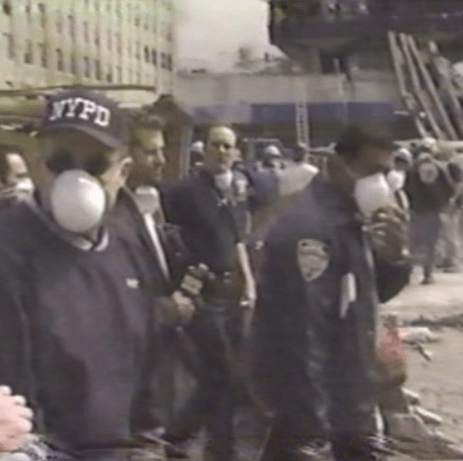
On Wednesday, September 12, Schuck became a part of a reporter pool and toured Ground Zero with ‘Americas Mayor.’ “I was basically the first radio reporter there to get a tour of it,” he said. He expected to see bodies in the debris, instead he saw something much more frighting, “Going that first time, I was afraid I was going to see people dead or see bodies on the ground and I saw nothing. There was nothing left of anything. You could hear the scratching of the first responders going through the debris. It was actually very frightening.”

Unbeknownst to many, there was an unknown fright lingering in the air. “I have a picture of me standing there with the mayor. I’m not wearing a mask, and the mayor is telling me to put a mask on, and people are walking up to us at Ground Zero saying, we need masks, we need masks.”

Photo Courtesy: Glenn Schuck

Years later, many first responders and reporters are now affected by 9/11 related illnesses, including Schuck. “I had some minor illness,” he said. “I have a skin pigmentation that has started on me. I have a little spot on my lung. I’m in the 9/11 health registry because I’m concerned about my health going forward. I highly encourage anybody who was down there in that time, reporters or those who lived there to get registered, because it’s an amazing program.”

The New Jersey native later wrote two books, including a part in the book Covering Catastrophe, about the attack, and he was involved with the HBO documentary, In Memoriam. “HBO did an amazing job on it,” Schuck said. “Very, very difficult to watch, but I thought it was a really good job they did in making sure that they showed what actually happened that day.”

Schuck’s involvement in the HBO documentary got him involved with the New Jersey Hall of Fame. While he has not been inducted (yet) he is the host of their annual induction ceremony.

Schuck always knew he wanted to do radio and used to tell his school guidance counselor of his dream whenever asked about his future. His passion for news and current events has only grown with his time in the industry. “I love my job, and I’ve always considered that it’s not really even a job,” he said. “I mean, some days are more stressful than others but there’s very, very few days that I feel like, oh, I don’t want to do this anymore. I love it.”

Named after astronaut John Glenn, Schuck was always told to reach for the stars. Little did his parents know he would one day become one of New York radio’s biggest stars (a title which the humble Schuck will likely say is over blown… but it’s true!). He was inducted into the Seton Hall WSOU Hall of Fame in 2013.

Today, the reporter and fill-in anchor is heavily involved with mentoring today’s up-and-coming journalists. Not just at his alma-mater, Seton Hall, where he is a professional in residence, but other journalism focused schools including Muskingum University in Ohio.

“I always tell those journalists you can make three or four connections in your career, and it’ll change your life. I can name those three people probably in my life that if they didn’t help me in some way, my career would have taken a different turn or maybe even ended. Starting with [my high school] guidance counselor.”

The biggest advice the 40+ year veteran of the industry gives to those he mentors is to focus on your writing. “At 1010 WINS we’ve had people who come in who are very good writers in many ways but when it comes to writing conversationally or writing for radio or TV, they’re not really up for it,” he said. “Even the college students that I mentor, I say, ‘Listen, if you don’t get into radio or TV, if you can write and write really well, you’re going to have a step ahead of everybody else.”

Lastly, he noted, “If there’s something that you really want to do, don’t let anybody talk you out of it, because it’s easy to kind of pack it in and go do something else. But I would never have been as happy doing a job than I am doing this.”

On a personal note, Glenn and I met working in the field nearly 10 years ago when I was an intern at a local TV station. His kindness and wisdom have no limits. He is vivacious with a contagious laugh and very thoughtful.

As a child living in suburban New York on 9/11, I distinctly remember his voice and that of his anchor, Lee Harris, being the calm in the middle of chaos. It’s an honor to call him a colleague, even more so to now call him a friend.

One lesson Schuck taught me early in my news career was reiterated in our conversation earlier this week. “We have a job to do and a responsibility [to cover tragic and/or historical events] like these. The people really need us.”

News Media Reacts to ABC News Presidential Debate Between Donald Trump and Kamala Harris

The much anticipated ABC News Presidential Debate between Donald Trump and Kamala Harris took place Tuesday evening. Dozens share their observations on the event, with ABC News moderators David Muir and Linsey Davis failing to draw rave reviews for their performances.

Before the debate began, some news media members showcased behind-the-scenes photos of their preparations, including anchors at CNN.

The debate began with Vice President Kamala Harris making a concerted effort to cross the stage to shake the hand of former President Donald Trump. Some were impressed by the gesture while others argued it was a tacky move.

As the event continued, opinions began to fly about the performance of ABC News moderators David Muir and Linsey Davis. Conservative media pundits were quick to pounce on the fact-checks levied against the Republican Trump, while noting that Harris rarely received similar treatment.

On the other side of the political aisle, however, the responses by Muir and Davis to falsehoods made by Trump were welcomed.

However, as the event continued, many conservative media members shared their anger at the performance of the ABC News moderators. Reactions ranged from surprised, to shocked, to outraged at what transpired Tuesday evening.

‘B-Dub Radio’ Returns To WIL St. Louis

0

Skyview Network’s “B-Dub Radio” and host Bryan “B-Dub” Washington is returning to Hubbard’s Country WIL/St. Louis.

It marks a return to the station for “B-Dub Radio,” which previously aired weekdays from 2020 to 2022.

Tommy Mattern, Hubbard St. Louis, Operations Manager/Program Director, said,
“B-Dub is an incredible talent, and we are extremely excited to have him back on 92.3 WIL.”

B-Dub added, “WIL is one of the best country stations in America, and I’m thrilled to be back on in St. Louis. Thanks to Tommy Mattern, Marty Brooks, and Greg Strassell for being believers!”

Matt Walsh Explains Why He Paid For Guests to Appear in Upcoming ‘Am I Racist?’ Film

0

The Daily Wire’s Matt Walsh is preparing to release a film entitled Am I Racist? later this week. He freely admitted that some of the people in the film were paid to appear, and shared why he published those figures.

While promoting the movie in an interview with 1210 WPHT afternoon host Rich Zeoli, Walsh shared that in the movie, the dollar figure some experts were paid to appear is prominently displayed on screen as a way to highlight his argument that the guests are opining on topics for nefarious reasons.

“They do it because of money and power, and we don’t hide that in the film. One thing we do in the film is we put up on the screen in the movie how much money we paid these people to appear in our film,” Walsh admitted. “Because, to us, that’s part of the story. The fact that they’re in it for the money, and sometimes they’re getting paid exorbitant amounts. We paid it. And we would pay the fee because that’s part of the story. We wanted to put that in the film and we did.”

Matt Walsh continued by noting that filmmaking is simply another avenue — similar to his daily radio show and podcast — to get his beliefs to the masses.

“There’s a lot of power in using entertainment and using narrative to get a message across,” he said. “I’m hoping to keep doing it for as long as I’m around.”