Longtime Buffalo TV and radio reporter George Richert retired Friday following a 30-year career in journalism.
“My heart is breaking…but I am so happy for @GeorgeRichert4, who retires today and 30 years in radio and TV journalism,” tweeted WIVB anchor Jacquie Walker. “It was my privilege to tell his final ‘story’ on @news4buffalo.”
Buffalo Mayor Byron Brown declared Jan. 21, 2022, “George Richert Day” for the difference Richert’s reporting made in the community spanning three decades.
Richert resigned as the spokesperson for the Buffalo Diocese to return to WIVB in 2018.
According to the Buffalo News, Richert spent 17 years at Channel 4 and five years before that as a reporter at Newsradio 930 WBEN.
Whether it be baseball, basketball, football, or hockey, one voice is a consistent presence behind the microphone, bringing fans all the action locally in the New York-Metropolitan area, domestically across the United States, and internationally all around the world.
Versatility is a coveted asset across many lines of work in today’s media job marketplace and in the realm of play-by-play announcing, Kenny Albert seems to have set the standard.
Calling all four major sports on a near-regular basis for both regional and national sports television networks — including NBC Sports, Turner Sports, MSG Networks, and Fox Sports — Albert has seen firsthand the shift in the industry from the perspective of a broadcaster. But that’s not all. He calls games on the radio as well, working in various capacities for the New York Rangers, the team with which he got his start in professional broadcasting alongside his father.
Albert was exposed to sports broadcasting from a young age by virtue of growing up in a family of sportscasters, with his father Marv and uncles Steve and Al building careers in the profession. Upon being gifted a toy tape recorder for his fifth or sixth birthday, Albert began to prepare for what quickly became his primary career aspiration; that is, to be a professional play-by-play announcer.
He remembers bringing his toy tape recorder to sports venues including Madison Square Garden and Shea Stadium once of age, and prepared for each game by looking over the rosters and keeping up-to-date with the latest statistics. His big break as a broadcaster later came as a sophomore at Paul D. Schreiber High School in Port Washington, New York by means of volunteering to fill an unaddressed vacancy.
“Cox Cable of Great Neck came to my school to film a girls basketball game,” said Albert. “They had two cameras [and] a small production van, but no announcers. I volunteered and they clipped a microphone onto my shirt [and] I did the game.”
By the end of high school, Albert had turned his volunteering into a job, working 75 to 100 games all over Long Island in sports such as lacrosse, hockey, basketball, baseball, football, and soccer, with his friends serving as color analysts. In college, Albert was a member of WNYU Radio at New York University and continued to call games on the radio. Yet he believes the experience he had in high school positioned him to be ahead of the pack in a profession with substantial levels of competition.
“I felt like I really had a three-year head start on anybody else at that time who wanted to do play-by-play,” said Albert. “There weren’t really any opportunities until college back then in the ‘80s. The three years at Cox Cable were just such an unbelievable experience to get three years of practice and reps under my belt.”
After graduating college with a bachelor’s degree in broadcast journalism, Albert became the radio voice of the Baltimore Skipjacks in the American Hockey League and quickly made his jump to the pros beginning in 1992 as the television play-by-play broadcaster for the National Hockey League’s Washington Capitals.
From there, Albert continued to find and add new opportunities to call professional games in football, baseball, and basketball, both on the radio and on television – and he continues to call games in both mediums today. Being conscious of the audience and how it is consuming the game is central to understanding the differences in calling a sporting event for one medium as opposed to the other.
“On radio, obviously you have to be more descriptive [because] the listener can’t see what’s going on. The description is the key. Location on the ice, on the court, on the field, etc.,” Albert explained. “You have to give the time and the score a lot more often on radio. On TV, it’s up on the upper lefthand corner of the screen, which wasn’t the case before I started working professionally. [Also,] you definitely don’t have to talk as much [on TV]; you can leave more time for the color analyst to come in.”
In broadcasting events across many professional sports, Albert has worked with over 225 color analysts, a figure he surmises might just be the record for a play-by-play announcer.
No. 20 Rondé Barber gets his due today w/induction into the @Buccaneers Ring of Honor at halftime of Giants/Bucs game on FOX.@KennyAlbert has a special message for his broadcast partner ???? pic.twitter.com/mv2KPqZEdX
Whether it be Walt “Clyde” Frazier, Eddie Olczyk, Tim McCarver, or Jonathan Vilma, getting their perspectives on the game at hand is essential in creating and maintaining a seamless broadcast. Since the play-by-play announcer does not need to describe as much of the action occurring on visual broadcast mediums, he is able to afford his partner in the booth, whoever it may be, more time to talk in those instances.
Albert, in his opinion, says hockey is the least difficult sport for him to call, partly because he has been doing it for 32 years, but also due to its rhythmic style of play – especially on the radio.
“You’re just into the flow really for the entire 60 minutes,” he said. “People always ask me about the names and the pronunciations and the fact that the players change on the fly, but to me, it’s almost like riding a bike because I’ve been doing it for so long.”
Conversely, Albert believes baseball is the most difficult sport for him to call since the style of the broadcast is more conversational in nature and because he does not call baseball games on a regular basis. “If it’s a game every week, or 10 [to] 15 games over the course of the season – which is what I’ve usually done – because there is so much downtime, [hopefully] you have a great color analyst that can fill in a lot of that time,” he explained.
While Albert calls baseball the least out of the four major U.S. sports, one of his most memorable moments as a broadcaster was being behind the mic for José Bautista’s iconic bat flip in Game 5 of the 2015 American League Division Series at Rogers Centre in Toronto with the background noise of 49,742 impassioned fans.
He also recently called the 2022 NHL Winter Classic from Target Field in Minneapolis – home of Major League Baseball’s Minnesota Twins – at a game-time temperature of -5.7 degrees Celsius. Despite the frigid temperature, Albert’s experience calling the game was “magical,” especially since it was played at night with natural, aesthetic touches in a setting seemingly made for television, including eight frozen ponds formed in the outfield.
“We had [the window] open at the start because we wanted to feel the elements and experience what it was like for the fans and for the players,” said Albert. “We did keep the window closed in the broadcast booth for a good portion of the game… We were still able to see the ice and see all the monitors in the booth the same as if the window were open. It was a fantastic experience.”
Albert has called other big events as well, including the Stanley Cup Finals, the Winter Olympics, and NFL divisional playoff games. From the days practicing with his toy tape recorder and growing up around family members in the profession, he understood the importance of preparation and professionalism in trying to establish a career for himself in the booth.
“That’s the goal for any play-by-play broadcaster is to continue to work big events, playoff games, [and] championships,” said Albert. “There is a lot of travel and a lot of preparation involved, but it’s just so much fun.”
As the landscape of sports media continues to shift, in spite of its apparent acceleration due to the COVID-19 pandemic, the introduction of emerging technologies, new platforms for content dissemination, and modification of best practices to maximize cost-efficiency have resulted in a paradigmatic deviation from the norms that had been associated with travel and preparation.
Pertaining to travel, Albert and nearly every other play-by-play announcer in the country has experienced the process of calling games remotely to ensure the health and safety of themselves and network crew members. While the decision, which had been in consideration among sports networks prior to the pandemic to cut travel expenses, impacts the range of vision and subsequent understanding of action away from gameplay, Albert sees its implementation as a “new normal” towards which the industry will have to lessen its intransigence.
“To me, I feel like no matter the sport, I [can] probably see about 85 percent on the monitor of what I would [see] if I were at the arena,” said Albert. “You don’t get the emotions or the feel of being there, but it’s probably not as bad as I expected when we started… It does save the wear and tear on the body a little bit for those of us who have been traveling for a long time. That’s probably one positive that’s come out of it.”
Information overload is an offshoot of the development and expansion of the internet, directly affecting the preparation process for play-by-play broadcasters. When Albert started working for the NFL on Fox in 1994, he would receive a shipment of VHS tapes every Wednesday with the games of the teams they would be covering that week, and any news clippings or supplementary materials were received through fax. Following the advent of the internet, Albert received articles through email, began to tape games on television, and see action from all across the country with DirecTV NFL Sunday Ticket.
“It really wasn’t that long ago, but thanks to technology, it’s made the preparation on one hand a lot easier, [but] on the other hand there’s so much information available [that] you could basically 24/7 try to find various nuggets and read that extra article in order to get ready for that week’s or that night’s game,” said Albert.
The role of the traditional play-by-play announcer is also changing with the introduction of concurrent presentations during national games, such as the Monday Night Football “ManningCast,” Statcast Edition of the MLB Home Run Derby, and the forthcoming Sunday Night Baseball with Kay-Rod. Though he hopes the role in which he has been employed for over three decades staves off extinction, Albert is cognizant of the ongoing evolution of the industry geared to satisfy consumer demand while minimizing the opportunity cost associated with such evolution in the process.
“I think with a telecast such as the ManningCast, it’s a unique perspective hearing from two guys who were among the top quarterbacks of all time,” said Albert. “Hopefully, the role of a play-by-play announcer on the traditional broadcast doesn’t go away and is around for a long, long time. But I think with so many channels out there with people watching things on their phones and on computers and on [tablets], and all of the technology available now that wasn’t [around] 10, 20, 30 years ago [that] there’s definitely a place for the alternate broadcasts, for sure.”
Whether they want to be a play-by-play announcer, analyst, sideline reporter, or talk show host, Albert’s advice is the same for prospective broadcasters: Come prepared, be versatile in whatever you do, and find opportunities in places where they may seem sparse.
“When I was growing up, we had seven channels; there was no cable [and] no satellite,” said Albert. “There are just so many opportunities out there these days. [While] I was at college at NYU, we had to fight for air time to broadcast the men’s and women’s basketball games because the radio station was the only outlet. These days if you’re at school, you can go broadcast a lacrosse game or a soccer game and put it out there on the internet. It’s just another way to get reps and get practice even if it’s not through the traditional means of a campus radio station.”
Albert has never genuinely “worked” a day in his life and he certainly hopes to keep it that way. Whether it has been on the radio or on television, rinkside or perched behind home plate, at the venue or in a studio, his ability to broadcast different types of sporting events professionally on multiple broadcast platforms both locally and nationally has afforded him various opportunities in sports media. He hopes he can continue to be the voice behind more memorable moments as his career progresses within a dynamic, growing industry.
“I never feel like I’m going to work,” said Albert. “I hope I never lose that feeling.”
Jeff Rickard’s tenure in Boston did not last long. Chad Finn of the Boston Globe tweeted yesterday that the WEEI brand manager has left Audacy and intends to return to Indianapolis.
Rickard was announced as the new brand manager of the legendary Boston sports talker in August. He left his role as morning show host and PD at The Fan in Indianapolis at that time.
In the memo, new Audacy Boston market manager Mike Thomas says that the station will be naming a new brand manager in the future.
Jeff Rickard’s time as WEEI program director didn’t last long. Per Audacy memo, he’s headed back to Indy. pic.twitter.com/brjvDPE6Xv
In the meantime, Ken Laird has been promoted to operations manager for the station. Laird announced yesterday that this means he is leaving the Greg Hill Show, which will be on the lookout for a new producer.
On Monday, Jeff Rickard took to Twitter to update fans and followers on his situation. He did not have anything negative to say about WEEI, Audacy, or anyone involved with him coming to Boston. He even noted that this move is likely what is best for him and his family.
During my short time at the station, our team went from 7th place in Men to a solid 3rd for the past three months and I’m exceedingly proud of the entire staff and the way they’ve all come together as a true unit during this time.
I will always be appreciative of @timclarke for taking a chance on me, and to everyone at WEEI who jumped right in with both feet and started an epic mountain climb. Know that I’ve enjoyed working with all of you and I know you’ll continue to build on the foundation we’ve set.
One of Atlanta’s legendary conservative voices is returning to the airwaves. Neal Boortz will be heard daily on XTRA 106.3 as part of the station’s morning show.
The “Boortz Report” will air every weekday during The Morning XTRA with Tug Cowart and Scott Rhino. Boortz will also make weekly appearances with Cowart and Rhino.
“The opportunity to be stridently un-WOKE and to stir things up during a crucial election year just couldn’t be passed up,” Boortz said in a press release. “Let’s have some fun.”
In addition to his radio career, Neal Boortz has had success as an author and attorney. He began his radio career in Atlanta in 1969 at WNRG radio. He was inducted into the National Radio Hall of Fame in 2009.
“We are excited to announce the return of Neal Boortz to the Atlanta market on XTRA 106.3FM,” David Dickey, Dickey Broadcasting Company President, said in a press release. “His voice has entertained and informed generations of Atlantans, and will now continue to do so on XTRA 106.3FM and streaming on the XTRA app. Neal is an accomplished broadcaster who will bring a unique and important perspective to XTRA 106.3FM’s line-up and to our loyal listeners. And Neal’s addition to the XTRA line-up further fuels the fast growth of this incredible radio station.”
The founder of conservative TV network One America News (OAN) is pleading with its viewers to call their cable companies as the network faces an uncertain future following a decision by DirecTV to drop the channel from its lineup.
“It was a major surprise to me when I read it in the news last Friday night, as I’m sure it was to you,” Herring said during a segment Thursday.
Robert Herring Sr. appeared on OAN last week and said the cable provider’s decision came as a surprise to him. In the past, Herring said that AT&T advised him to create the network which is reportedly being bankrolled by the phone carrier.
“Whether it’s Spectrum, Dish, or any of the other great providers … let them know that you would like for them to carry One America News,” he said in a 2 1/2-minute segment.
DirecTV plans to remove OAN later this year, a move that would cripple the network which reportedly is struggling to retain viewers.
“We only charge 10 cents per household per month,” Herring said. “That is a great deal by any standard, giving all of the amazing content our team puts out.”
A former Newsmax TV White House correspondent is speaking out about her new job with Mike Lindell’s new platform called “Frank.”
Emerald Robinson, who was fired from the network after a controversial tweet last year, joined ``Eat the Press” host Steve Malzberg on RT America last week.
“This is going to be a 9 a.m. morning show with hard-hitting news,” Robinson explained, adding that she didn’t have an exact launch date. “If you follow me on Substack, it’s really going to be an extension of that.”
Robinson was fired from Newsmax last year following a controversial tweet about the COVID vaccines which subsequently led Twitter to ban her.
“Dear Christians: the vaccines contain a bioluminescent marker called LUCIFERASE so that you can be tracked,” she tweeted. “Read the last book of the New Testament to see how this ends,” Robinson wrote in a post earlier this week. Twitter removed the tweet as a violation of safety rules.”
Robinson also criticized Big Tech for banning conservative journalists from platforms such as Twitter and Facebook.
“We are going to hit those subjects, we are going to look at the real numbers,” said Robinson. “We are going to see more and more censorship ahead of these midterm elections.”
Last May, Robinson departed One America News Network (OAN) for Newsmax TV. Last week, DirecTV announced plans to drop OAN, a move that could spell the end of the network.
The most iconic network on sports radio just turned 30 years old. It was January 1, 1992 when ESPN Radio first debuted. Since then, the network has been the home of legendary voices and games that live in the annals of history.
ESPN television was already an institution and destination for sports fans in the early 90s when the worldwide leader decided to enter the world of sports radio. The move made logical sense as it provided the company with an opportunity to expand its reach and presence. WFAN in New York had proven that the format could find an audience and stations were starting to pop up everywhere across the country. Even brands that didn’t have a need for 24 hours of sports talk were interested. After all, many news/talk stations aired sports radio programming at night and on weekends back then.
When the network launched, ESPN offered weekend shows and boasted 147 affiliates. Since then, the network has grown into a 24/7/365 operation with over 400 local stations partnering full time with the country’s largest sports brand, and many others picking it evenings, weekends and other select shows.
“That’s a credit to the power of the brand,” says Traug Keller, the former Vice President of ESPN Audio. “The biggest challenge local radio has is ad sales revenue right? It’s how they eat. And if you’re a salesperson in Quad Cities, Iowa or New Orleans or whatever market, it doesn’t matter. You’re coming into a business to sell radio ad time, which is invisible to begin with. You’ve got to get people over the visual part of the value. But as soon as you say those four letters, ‘I represent ESPN radio,’ it takes half the battle off the table.”
Norby Williamson, ESPN’s Executive Vice President of Production, has been with the radio network since the beginning. He said its launch was very different from how ESPN rolled out another one of its iconic brands a little over a decade before.
“We grew SportsCenter and there was always a demarcation point,” he told me. “Whether it was Berman or Dan and Keith or Robin Roberts, the product was always there and it was about the content. The brand SportsCenter kind of became front and center.
“I think with radio it was first and foremost, certainly about sports, but when you think of the great radio voices of the past, there was this sense of credibility and connectivity between the talent and the audience, which then gave the talent the opportunity to go in different directions about different topics.”
The lineup has gone through its share of changes over the years. For many, there was a distinct “golden era” of the network’s prime lineup. It was the middle of the first decade of the 21st century. The mornings featured Mike & Mike followed by The Herd with Colin Cowherd, who joined the network in 2004. Cowherd was then followed by one of ESPN’s biggest names on any platform, Dan Patrick.
Patrick’s star was well-established. The next step for the network was establishing its morning show as a force in the national syndication space.
“The truth is that was just the timing of the situation, it wasn’t necessarily a strategic decision,” Bruce Gilbert told me. He served as the network’s GM until 2007. “Dan Patrick was hugely successful, and really didn’t need any more focus. Meanwhile the network was uncertain about whether Mike & Mike would work together or if they would be better off on separate shows.”
Clearly, Greenberg and Golic belonged together. Gilbert credits not just the hosts, but the entire behind the scenes crew with building what he calls “the show of record for sports fans centered on the newsmakers.”
Calling it “the show of record” implies that Mike & Mike was a stuffy affair, the kind of thing that you respect and learn from more than you actually enjoy. Nothing could be further from the truth.
Mike & Mike were funny. They had great on-air chemistry. They took the games and the outcomes seriously without losing sight of the fact that their audience, for the most part, will never be invested like the people they interviewed each morning.
“My thought process in the morning because people are driving to work, was maybe I can take you where you can’t go,” Golic told BSM’s Brian Noe last year. “I can take you into a pro athletes’ head, I can take you into their locker room. I can take you onto the field of any sport because as pro athletes you have that mentality, and can I make you laugh a little bit? If I can make you smile and chuckle a little bit on your way to work, I feel like I did my job. So to me the best part of radio is when you went off course and that turned out to be the most fun.”
That is a very particular needle to thread, but the duo and their crew did it. That is why the show became more than just a sports show. It became a huge part of the national sports conversation.
What was the exact moment that happened? Well, that depends on who you ask.
Maybe it started with the show going to television as well as radio. That wasn’t a landmark moment though in Williamson’s eyes. He told me putting Mike & Mike on TV was almost a necessity for ESPN to meet the needs of its audience.
“You’ve got to realize that not that long ago SportsCenter wasn’t even alive in the morning. You know, at one point I said, ‘Wait a minute, we’re doing the show at 1am on the West Coast that re-airs until one o’clock in the afternoon? We’re giving away the entire morning!’”.
For others, it was specific events that proved Mike & Mike was something more than just a sports radio show.
“When we were first invited on Letterman,” Greenberg insisted when I asked about it. “He was someone both Mike and I admired a great deal. That first appearance was among the most exciting nights of my life.”
That appearance on The Late Show with David Letterman happened in October of 2006.
For Williamson, it wasn’t so much about the invitations. He liked the physical proof that Mike & Mike had become a big deal.
“I remember going to a remote, I think in Philadelphia. I can’t remember exactly where. At four o’clock in the morning, people were lined up around the block to get in to see the show. And that’s kind of when it registered for me that these guys had broken through. They’re resonating, and we’ve got something special.”
ESPN Radio wasn’t just a collection of strong talent behind the microphones at that time. Plenty of people in behind the scenes roles went on to successful programming careers in markets of all sizes.
Bruce Gilbert isn’t surprised when he looks back at the members of his former staff that went on to spread their wings and leave their stamp on the sports radio industry. He says that the network was in something of a luxury position: every sports fan wanted to be there, and that meant the talent was stacked from floor to ceiling.
You couldn’t even get in the door without a degree and high scores on one of the hardest sports trivia exams ever developed. This created a competitive environment and a workforce of people that were hungry, passionate and driven to succeed and grow. The other great thing about ESPN were the different paths it offered to professionals. The company was always evaluating talent and working to help them find the right growth trajectory. At ESPN you could grow in audio, move into television, the magazine or digital/web. The opportunities were endless and equally rewarding.”
One of the people that passed that test and earned an opportunity is Freddie Coleman. The longtime host joined the network as part of Game Night in 2005. Coleman is still heard nightly on Freddie and Fitzsimmons.
The network doesn’t currently have a lot of people with Coleman’s kind of hosting tenure. Greenberg would be the other. ESPN Radio went through two major lineup overhauls as recently as last year. That position, a sort of “dean of hosts,” is one Coleman takes a lot of pride in.
“I know how blessed I am to have been a part of the Worldwide Leader for 17 plus years. It’s hard to be ANYWHERE now for 17 minutes. With that pride comes accountability and I never take that for granted,” he told me.”
Some of the most successful talent in the radio industry have come and gone over the years. Each has left his or her mark on a network which has been a key part of millions of listener’s lives. Though change is a part of every business, there’s no doubt that some departures have created larger voids than others.
Tony Kornheiser’s exit from the network’s weekday lineup in March of 2004 fits in that conversation. Replacing a host with his stature was not easy. In fact, Bruce Gilbert says he recoiled a bit at the idea of having to find “the next Tony Kornheiser.”
“My boss and I really wanted a TRUE radio person,” shared Gilbert. “Most of the people on the radio network at that time had come up through SportsCenter or ESPNews. We made a pact to find someone that really understood the intricacies and subtleties of audio and how to connect emotionally and passionately with the ESPN radio audience.”
Remember, this was before radio stations across the country were focused on streaming. Gilbert’s search wasn’t easy. He was calling affiliates and asking how he could listen to their best talents over the phone.
There was one name that Gilbert heard from two trusted advisors. Scott Mastellar and Rick Scott told him to check out this guy in the Pacific Northwest named Colin Cowherd.
“I was a local radio guy, and Tony Kornheiser was amazing,” Cowherd said, reminiscing about the process during a show in 2015. “He’s a brilliant man, brilliant writer, media icon, and he was leaving. And they could have picked a million guys out of New York, or L.A. Chicago, Dallas, many applied, it was a good job.”
“After hearing his show we flew him to Bristol and when Colin came into my office, he never even gave me a chance to ask a question, he basically started doing a show,” Remembers Gilbert of his first meeting with Colin Cowherd. “For 45 minutes straight he entertained the hell out of me and I don’t believe he ever took a breath. I remember telling my bosses he was the guy and they couldn’t understand how I was so sure and I said I just wish you could have been in my office the day he was here and you wouldn’t even ask me that question. There was one executive who said to me, and I quote, ‘What the hell is a Colin Cowherd, and is that even a real name?’”.
Plenty of sports radio fans across the country are happy Gilbert got his way on that one.
A few years later, the network had to replace another icon. Traug Keller remembers Dan Patrick’s decision to leave ESPN as “bittersweet.” He jokes that it worked out just fine for the recently inducted Radio Hall of Famer and ESPN Radio “kept on trucking”.
“We had this collection of 300-plus affiliates that were trusting us. As big of a name as Dan was and him going probably made some of them nervous, they were confident we would figure it out.”
The initial plan was Mike Tirico. Keller says that just as that show was finding its rhythm, the host was tapped for another assignment by the network. He describes the call for Tirico to take over as the voice of Monday Night Football coming just as “you could see the ratings start to pop.”
From there, Scott Van Pelt was given a shot. He and Ryen Russillo established a strong presence in the noon to 3 pm time slot. Van Pelt was well-known thanks to SportsCenter. Russillo wasn’t a national name quite yet, but had established some credibility for himself in Boston, working on 1510 The Zone and WBCN.
The move to ESPN Radio wasn’t exactly easy for Rusillo. Last year, he told Bryan Curtis, his colleague at The Ringer, that his prep process and scope had to change in order to be successful on the national level.
“I always had to know a little about a lot of things, where in local I had to know everything, but only about one thing,” he said in October on The Press Box podcast. “The math is easier on the local side of things.”
Cowherd would leave the network in 2015, but not before calling his time there “the best ten years of my life.” In 2017, it was Greenberg who said goodbye to radio.
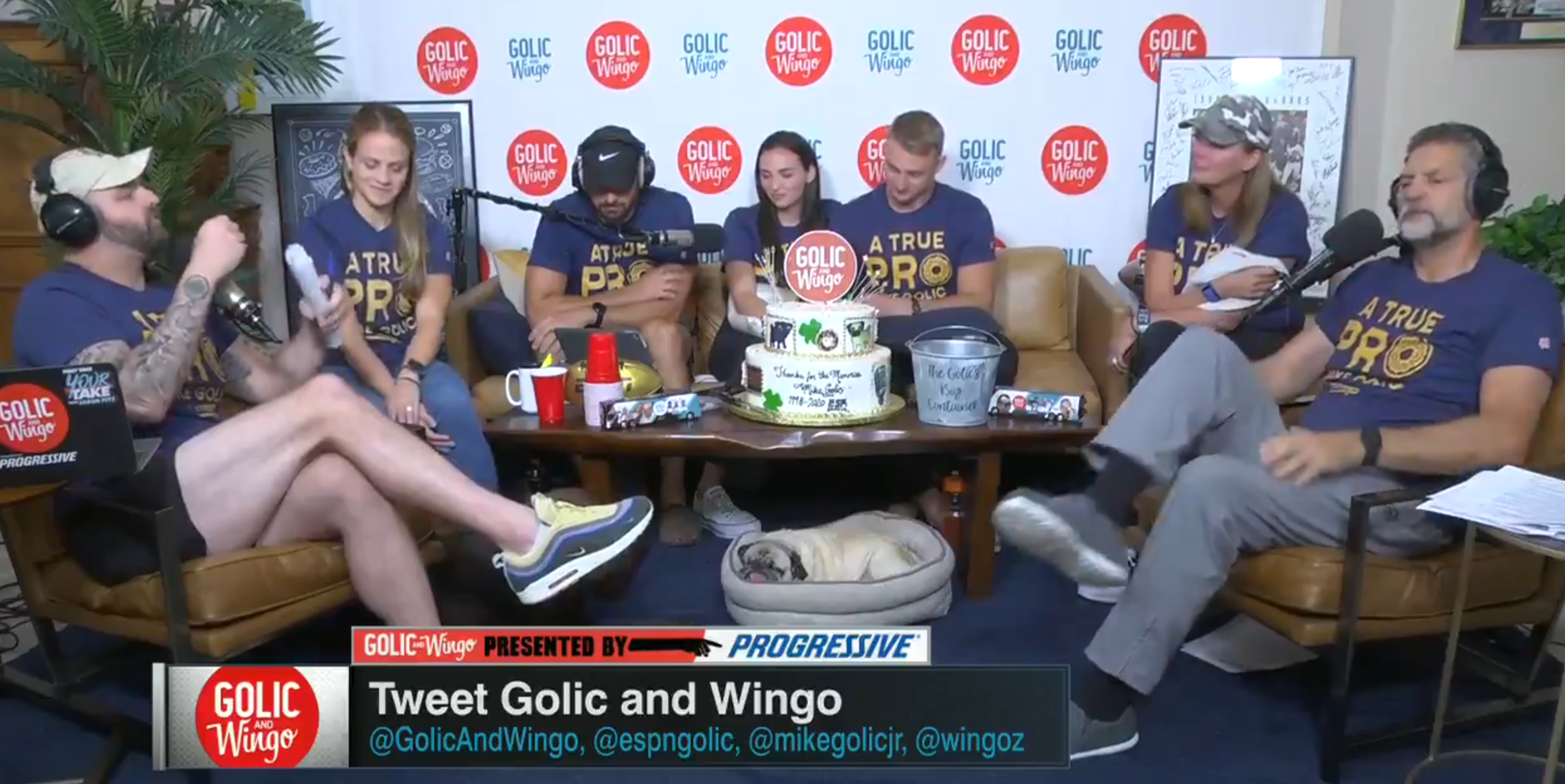
That gave ESPN Radio the chance to give its morning show the first overhaul it would receive in nearly two decades. Mike Golic was given two new co-hosts, NFL Live’s Trey Wingo and his son, Mike Golic Jr, who had been working overnights on the network.
The younger Golic told me that he knew from growing up around broadcasting that it was the career he wanted. That didn’t mean he was ready for the spotlight on day 1.
“That’s kind of like being in shape vs being in football shape,” he told me via email. “Growing up around it certainly made me familiar with the names and the environment, but I was still so green when it came to doing the actual job. Everyone gives you the same advice coming in: reps reps reps. And they’re all right. It worked a lot like my football career though, where Dad was able to help me by being an extra set of eyes and ears. I got to watch my high school football tape with a guy who played 9 years in the NFL, and now I was getting feedback from a hall of fame radio host.”
Golic and Wingo lasted for four years on the network. Then it was Mike Golic Sr.’s turn to say goodbye.
His final show has become one of the truly iconic moments in ESPN Radio history. Originating from his home, with his entire family around him, Golic shared stories and insight about how the job had changed his life.
It was Golic Jr. that stole the spotlight though. His farewell to his father was raw. Everyone on the set, and presumably most people on the other side of the screen or speaker, were in tears
“To get to do this with you for the last three years will be the highlight of my professional life and my personal life,” Junior said. “To get to do the thing you always wanted to do with the person you always wanted to be is just surreal.”
I asked Junior about that moment and if he recognized immediately the weight that it had.
“Oh yeah,” he said. “I think as long as I live and am with ESPN that and dipping Oreos in mayonnaise will be my legacy.”
Mike Golic Sr. looks back on his ESPN Radio years mostly with fondness. He did tell Brian Noe that there is one thing he would never miss though.
“Getting up sucked, but once you start going and getting to the studio and everybody is there, I loved it. There wasn’t much I haven’t missed outside of that 4:15 alarm, which I swore at every single morning. Every time 4:15 hit, I had a bad word come out of my mouth.”
Changes don’t happen without grumbling at ESPN Radio. Norby Williamson says he is used to that. “Radio and audio is a very personal connectivity,” he says. Sometimes, there isn’t much you can do to change people’s minds. The public will just have to wait and form their own opinions.
Affiliates though are a different story. Williamson says that they tend to offer the people making the decisions a certain level of trust. That is what comes with long relationships and a history of performance.
“I think the ESPN brand stands for something, you know? For a lot of years we’ve worked hard to create this brand affinity with our customers to serve sports fans and to gain some credibility with them,” he says. “So I think when you put the ESPN logo on certain things, whether it’s audio, ESPN Plus, etc., there is a very particular expectation by the customer. There’s also a sense of ‘Alright, I trust this group. So maybe I may not like it initially and boy, I really like that old show better, but I understand I’m going to give it a chance and hope.’ We do a great job. I think a lot of our partners approach any new product we offer thinking ‘I’m going to learn it, accept it, and possibly like it maybe more than the old offering.”
“There isn’t a day that goes by that we aren’t looking to super serve our partners,” says Justin Craig, ESPN’s Senior Director of Network Audio Content. “From paying attention to storylines in key markets to doing our best to have a two way conversation to understand what matters to them, it’s a non-stop focus. We try to be as representative of the largest set of the audience as possible.”
Keeping affiliates happy means giving them help when they want it and giving them an audience when they want that instead.
The network has held regular calls with its affiliates over the years to discuss key issues and ideas that could benefit both sides. Local program directors and executives often join network managers on those calls, which keeps the relationship between both parties in a healthy state. The network has also welcomed representatives from local stations to Bristol to explore ways to work better together, providing tours of ESPN’s studios and making introductions to ESPN Radio talent during those visits to further remind partners of their appreciation for the partnership.
“We work very hard at making sure our talent is accessible to supplement what’s being done with our partners, whether it’s regular appearances, liners or anything else that might be of interest,” Craig adds. “We also operate the other way. If there is a story that matters in one of our markets, we aim to have a host or talent from that market on the network to enhance our coverage. We also continue to provide production elements to everyone through a web based system, so what you hear on the network is easier to duplicate locally. The most important thing is the open flow of communication.”
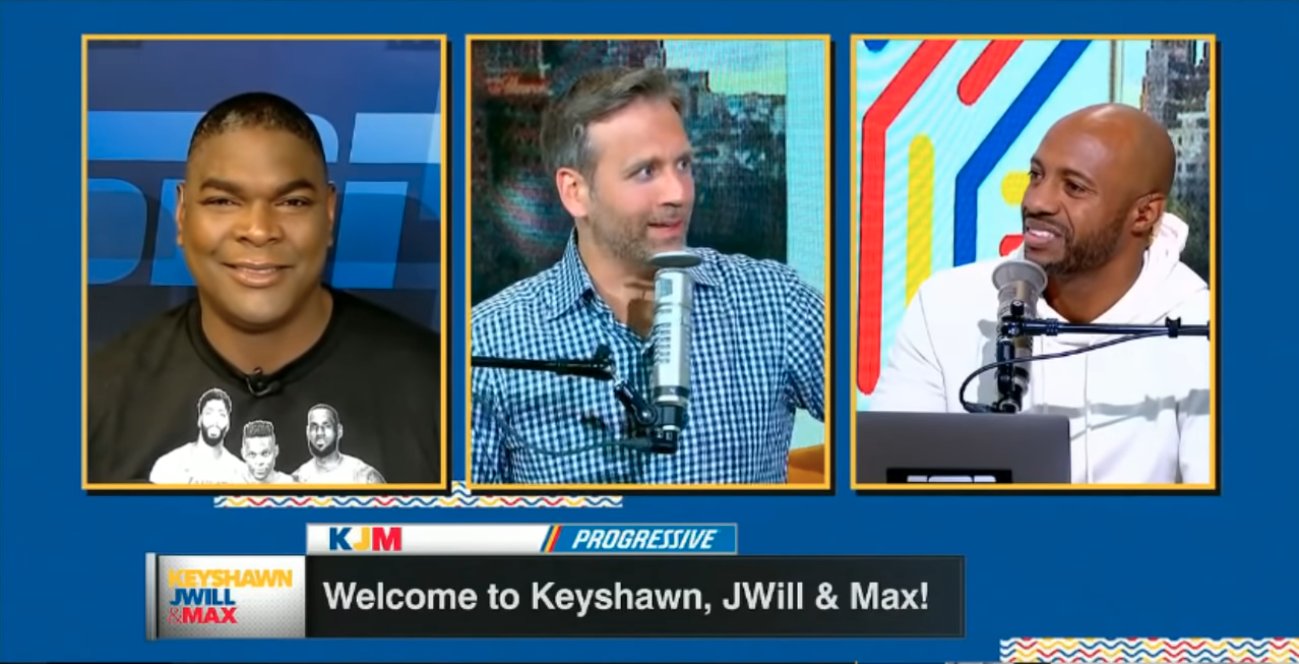
The older Golic’s exit was the first step towards ESPN Radio’s current lineup, one that features a plethora of voices that weren’t on the radio in Bristol just a few years ago. Keyshawn Johnson and Jay Williams are not new faces by any stretch. ESPN had already created major profiles for each in the past to go along with what they had established in their playing days.
Tapping them for morning drive radio on a national network though? That was going to be a new venue for both of them.
In August of 2020, I had the chance to speak with Williams and he told me that a big part of the reason he felt up to the challenge was that he had the chance to watch, learn from, and get to know Mike Golic.
“I’ve been with ESPN for a long time. Mike Golic was the first person I saw on there for an extended period of time doing that show. I remember sitting there thinking to myself ‘Wow, that is really cool. Mike Golic Sr. is Mike Golic Sr.’ He’s very comfortable with who he is and he is very comfortable being that person on camera.
“It was the first time in my career that I ever thought ‘I’ve gotta figure out who I am, so I can be who I want to be on air.’ I never thought about who I was. I was too busy running. I was too busy giving my opinions about other things to ever have an opinion about myself.”
Johnson told BSM in 2020 that he was ready for the challenge of establishing a new identity for the network in morning drive, because he was not worried about the old identity. The audience was going to have preconceived notions and set feelings no matter what he said on the first show, so he was just going to focus on Keyshawn, JWill and Zubin instead of worrying about how he compared to Mike Golic.
“There’s nobody else out there that’s me, there’s nobody that’s any of my co-hosts. Everybody has their own opinion on how to do something, how to host a show. You’ll hear people say, ‘they’re not that good,’ and you’ll also hear people say ‘they’re really good.’ Everyone has a different opinion, so I don’t get caught up in the hype.”
When the radio lineup received its first post-Golic overhaul, Zubin Mehenti was part of morning drive. Eventually, health concerns forced him to step away from the grind of morning radio. Max Kellerman, who had been added to the radio lineup in early afternoons would move into Mehenti’s seat in mornings.
Good things that go away have a way of not staying gone forever in the media business. That’s why it shouldn’t be a surprise that another part of ESPN Radio’s new identity was Mike Greenberg.
He was no longer in morning drive and he wasn’t grinding away for four hours everyday anymore, but Greeny was back on the radio three years after leaving to launch Get Up on television.
His new show #Greeny is heard for two hours every weekday. Now it is on from 10 am until noon, but it started out from noon until 2 pm.
Greenberg told me that he didn’t sit around pining for the chance to be back on the radio during the time he was solely focused on TV, but it is a medium he loves. So when the opportunity to sit behind a microphone again presented itself, he was interested.
“I didn’t actively think about it much because my time was fully consumed with launching Get Up, but I always knew I’d eventually go back in some form,” he said. “There is an intimacy in the relationship you develop with your audience in radio that is unlike anything I’ve found in any other medium.”
Say the words “ESPN Radio” too many times or to the wrong person these days and you are bound to be corrected. It’s ESPN Audio now. The network is creating shows and content with different identities across different platforms.
“Nobody makes decisions in a vacuum,” says David Roberts, ESPN’s Senior Vice President for NBA and Studio Production. “It’s a matter of understanding the markets, analyzing the research, reviewing the ratings, and placing a focus on the importance of cross platform content creators. The days of being just a radio focused brand are long gone. You have to be focused on audio, video, digital. Those are the parameters you have to operate in.”
Roberts played a major role in the overhaul of ESPN Radio’s talent lineup and overall philosophy. Two years ago, he spoke with Jason Barrett and explained that he has faith that diverse voices and diverse technology would be a key to ESPN’s long term success in the audio space.
“I have the utmost respect for our competition. There are some very talented personalities and brands out there. But I’m not focused on what they’re doing. I’m looking at how we can improve ESPN Radio. A key part of our strategy is making sure our platforms are connecting with one another. It’s why you see many of the people on our product today. That underscores the commitment we have to maximizing the strength of the ESPN brand to the depth of talent. That’s integral to our strategy and growth. Any decisions we make are going to be made with that being a key focus.”
Like every other radio venture, ESPN functioned for so long following the rules of what entertainment on the platform was supposed to be. Norby Williamson says that isn’t good enough in 2022. Audiences want options when it comes to entertainment. If you want to stay on their radar, you have to play by the new rules.
“Ultimately the consumer wins,” he says. “I think sometimes, whatever product that you’re making, whether it’s in the media or other things, sometimes we think we know more than we actually know. The consumer will always win.”
Every ESPN Radio show is also a podcast. It has a video feed on ESPN+. Keyshawn, JWill and Max, is on ESPN2 in the morning. On top of that, clips from everyone’s content make their way to ESPN’s and ESPN Radio’s various social media channels.
A multi-platform approach is nothing new really. Remember, going back to the days of Mike & Mike, ESPN Radio was sharing shows with television. Traug Keller says he feels lucky to have been in the business during a time when the options for audio entertainment were blowing up.
When ESPN Radio launched in 1992, there were no podcasts. There was no satellite radio. There was no streaming audio or smart speakers.
It wasn’t just executives. Talent had to earn to work and succeed in the new media environment too. Not every old school radio guy is cut out to start playing “anywhere there’s ears” as Keller puts it. That is why he gives credit to Dan Le Batard.
“Dan was incredibly creative with how he did both the radio show and a TV show. The show works so well as a podcast too without even without a lot of tinkering, just kind of the way Le Batard and his crew down there in South Beach presented it. So, you know, a lot of ESPN’s strategies depended on the different personalities and different shows. But as a general theme we wanted to be what we called ‘Uber Audio,’ right? We just wanted to be everywhere that there was the opportunity for more listening.”
The other piece of the puzzle that makes ESPN Radio what it is are play-by-play rights. Sure, the four letters are valuable to sellers in local markets, but what makes those letters valuable? It is that ESPN is synonymous with the biggest events in sports.
A local ESPN Radio affiliate instantly gets play-by-play rights to Major League Baseball’s Sunday night showcase game and its entire postseason, the biggest college football games each week including the College Football Playoff, and the NBA Finals.
To look at that collection today, one would be forgiven for thinking that ESPN Radio put a premium on accumulating those rights from day one. Bruce Gilbert says that isn’t true and he credits one man for helping change that.
“ESPN Radio was actually behind the curve when it came to the number of live events. We had John Martin – “The Chief” – who was an experienced and extremely talented producer of live audio play-by-play and John was always looking to do more and add more to the ESPN Radio offerings.”
Even if others in Bristol didn’t think it was imperative that the radio network carry actual games, Gilbert says “Chief” kept it at the front of everyone’s mind. This was sports radio after all! Games have been airing on the radio long before they were on TV and even longer before the word “talk” became synonymous with “sports radio.”
Besides, this is ESPN! It’s the biggest name in sports. How could the radio network live up to that standard without the biggest games?
“John understood the drama of live events and the storytelling that brought those events to an even higher level,” Gilbert said. “Like many successful business ventures, the addition of play-by-play was a natural and organic process that elevated ESPN Radio.”
Thirty years is a long time. Plenty of radio networks have come and gone since January 1, 1992 when Tony Bruno, Keith Olbermann, Chuck Wilson appeared on the network’s airwaves, soon to be followed by a trailblazing female host, ‘The Fabulous Sports Babe’ Nanci Donnellan. Plenty of media formats have come and gone too. Remember mini discs?
ESPN’s audio offerings keep expanding and adapting. The executives get the importance of that. David Roberts says the key to continued success is finding and investing in talent that gets that too.
When ESPN Radio launched in 1992, it found success by leveraging the ESPN brand in a new space. Success in 2022 in beyond is about getting both listeners and affiliates to view audio offerings as part of the entire ESPN portfolio.
“If you think otherwise you’re not being realistic,” Roberts told Barrett. “Today, you have to connect in multiple ways. That’s how you build a bigger brand.”
Success in the future will certainly depend on understanding new trends and appealing to the modern listener. But the foundation for success was laid long ago.
“I think there are a few reasons for the sustainability,” says Amanda Gifford, the Senior Coordinating Producer/VP, ESPN Audio and Content Strategy. “One – the ESPN Brand. Nothing says sports like “ESPN,” so when people tune in to ESPN Radio, they know they’ll get high-quality sports talk to keep them informed and entertained about everything going on in the sports landscape. Two – the people. We’ve had such talented people both in front of and behind the microphone over the past 30 years, and because of the aptitude of hundreds of folks who have made an impact on ESPN Radio, we’ve been able to uphold the standards of the World Wide Leader.”
ESPN is the biggest name in sports media. The company has access to some of the biggest events and most unique voices. As long as that is true, no one will worry about whether or not the radio network can survive another 30 years. It absolutely will. The questions are more along the lines of what will it sound like and how will we hear it.
After thirty years of success, it is probably fair to trust that ESPN will figure all of it out.
CNN began their 2022 slate of original series back on Jan. 16 with the two-episode premiere of the four-part “Reframed: Marilyn Monroe.”
Narrated by award-winning actress Jessica Chastain, the documentary series retraced Monroe’s story from budding starlet to Hollywood power-broker. Amidst the treacherous casting couch culture of Hollywood, she bravely spoke out about abuse at a time when silence was the norm.
The first episode of “Reframed: Marilyn Monroe” at 9 p.m. Eastern delivered 650,000 viewers that included 84,000 of the key 25-54 demographic, according to Nielsen Media Research. The second episode at 10 p.m. rose to 720,000 viewers and 95,000 adults 25-54. Based on total viewers, Fox News Channel ruled the cable news roost during the two-hour 9-11 p.m. period on Jan. 16 with the pair of “The Next Revolution” (1.147 million viewers/120,000 adults 25-54) and a rerun of “Sunday Night in America” (747,000 viewers/78,000 adults 25-54).
Compared to the first 2-hour installment of the documentary series “Diana” from Oct. 10, the first two hours of “Reframed: Marilyn Monroe” were down 13 percent in total viewers and down 17 percent among adults 25-54. The declines might initially appear alarming, but it’s also important to note its other notable viewing competition. NFL football on NBC aired directly opposite both CNN documentaries but for “Diana”, it faced Bills-Chiefs which drew an audience of 17.5 million; as for “Monroe”, a playoff matchup of Steelers-Chiefs averaged a more potent 28.9 million viewers — a 65-percent, +11.4 million jump from the aforementioned Sunday night telecast.
Also of note, these figures are only based on live plus same day data. Programming of this nature also exhibits value in delayed viewings and multiple repeat airings. A rerun of “Monroe” from midnight to 2 a.m. Eastern averaged 312,000 viewers, roughly the same ratio of percentage declines from the first rerun at midnight of “Diana” from Oct. 10 (349,000 viewers)
Live plus seven day data had not yet been released for “Monroe” at publish time; for “Diana”, its initial Oct. 10 telecast grew 226,000 viewers to a 7-day total of 1.014 million viewers — an increase of 29 percent.
CNN’s top regularly-scheduled Sunday show of 2021, the travel series “Stanley Tucci: Searching for Italy” returns on March 13. Its series premiere from Feb. 14, 2021 drew 1.57 million viewers according to live plus same day.
Cable news averages for January 10-16, 2022:
Total Day (January 10-16 @ 6 a.m.-5:59 a.m.)
Fox News Channel: 1.452 million viewers; 232,000 adults 25-54
MSNBC: 0.690 million viewers; 75$,000 adults 25-54
CNN: 0.482 million viewers; 99,000 adults 25-54
HLN: 0.195 million viewers; 57,000 adults 25-54
The Weather Channel: 0.194 million viewers; 34,000 adults 25-54
CNBC: 0.153 million viewers; 35,000 adults 25-54
Newsmax: 0.145 million viewers; 24,000 adults 25-54
Fox Business Network: 0.103 million viewers; 11,000 adults 25-54
Prime Time (January 10-15 @ 8-11 p.m.; January 16 @ 7-11 p.m.)
Fox News Channel: 2.291 million viewers; 346,000 adults 25-54
MSNBC: 1.248 million viewers; 142,000 adults 25-54
CNN: 0.597 million viewers; 132,000 adults 25-54
Newsmax: 0.294 million viewers; 58,000 adults 25-54
CNBC: 0.219 million viewers; 65,000 adults 25-54
HLN: 0.211 million viewers; 65,000 adults 25-54
The Weather Channel: 0.202 million viewers; 40,000 adults 25-54
Fox Business Network: 0.058 million viewers; 11,000 adults 25-54
Top 10 most-watched cable news programs (and the top MSNBC, CNN and Weather Channel programs with their respective associated ranks) in total viewers:
1. The Five (FOXNC, Mon. 1/10/2022 5:00 PM, 60 min.) 3.621 million viewers
2. The Five (FOXNC, Thu. 1/13/2022 5:00 PM, 60 min.) 3.598 million viewers
Tucker Carlson took aim at a mega media star on Thursday night. The highly opinionated FOX News host made it clear, he views SiriusXM radio host Howard Stern as a coward.
During Carlson’s show, he focused on comments Stern made on the air on September 7th of 2021 and January 3rd and 19th of 2022 and followed up by labeling the king of all media as a coward. That was further supported on social media where Carlson tweeted out the clip of the segment where he blasted Stern.
Howard Stern used to be incredibly brave and courageous. But now, he's become a coward. pic.twitter.com/HL3E0wMx9S
“Howard Stern, by any measure, is one of the great radio hosts of all time,” Carlson said as he began his commentary. “He has made a huge amount of money for doing what he does but there is a reason for it. He was incredibly brave, vulgar yes, but truly talented, above all courageous.”
That was followed by Carlson mentioning a number of Stern’s accomplishments and crediting him for his prior fights against free speech and the government.
But then, Carlson described Stern as he sees him now.
“Maybe it was coronavirus that broke him, maybe it was hormonal changes from middle age, he is now a coward. His broadcast is now about cowardice. Amplifying his fears about corona over the air, and attacking, more precisely, attacking anybody else who has decided to live life as a free person.”
Carlson then aired the September clip from Stern’s show where he talked about wanting it mandated that everyone had to be vaccinated. That was then followed by a clip from Stern’s show in early January where he criticized Oprah Winfrey for holding large gatherings at her home.
From there, Tucker mocked Stern and moved into his next soundbyte from Stern’s January 19th program where he said that those who weren’t vaccinated wouldn’t be able to seek treatment at a hospital if he was in power and had his way.
The segment ended with Carlson stating ‘there is something sad about this’ before welcoming Jimmy Dore to the show, who proceeded to ridicule Stern and explain how the satellite radio host has lost his way and turned into a modern day version of Don Imus.
We are learning more about the events that led to the firing of former CNN anchor Chris Cuomo.
The New York Attorney General’s office released six hours of video testimony Thursday showing Cuomo discussing his involvement in advising his brother, former New York Gov. Andrew Cuomo, in his defense against sexual harassment allegations.
Chris Cuomo was deposed on July 15, 2021. Cuomo was fired in December over ethical concerns that he used his position at the network to influence the investigations into his brother’s alleged actions.
Cuomo admitted during his testimony that his brother asked him to stay “in the loop.”
“Chris Cuomo was suspended earlier this week pending further evaluation of new information that came to light about his involvement with his brother’s defense,” CNN said in a Dec. 5 statement.