

Thank you for checking out The Industry According To. Every Wednesday we speak with a different expert or leader from somewhere in the vast music industry — label executives, artist managers, programmers, talent, artists, consultants, and beyond. To be considered as a future guest, email me at keithblackboxgroup@gmail.com.
Today we sit down with Sam Milkman, Executive Vice President and Senior Consultant at Coleman Insights, whose career has given him an unusually complete view of radio, music, branding and consumer research.
Before becoming one of the industry’s leading researchers and strategists, Sam held programming and operational roles at some of America’s most influential radio stations, including WXRK and WHTZ in New York and WMMR in Philadelphia. He also began his professional career as a litigation, intellectual property and entertainment attorney.
Sam later founded mediaEKG, whose innovative content-testing work led to its acquisition by Coleman Insights in 2009. Today, he helps radio stations, podcasts, streaming platforms, music companies and other media brands understand what consumers use, what they believe and expect, and what they may choose next.
Few people have spent as much time sitting on both sides of the research, so let’s dive in.
*Editor’s Note: Answers have been edited for clarity and length.*
Is Ignorance Bliss?
Keith: What’s the single most important finding you repeatedly see clients rationalize away or choose to ignore — and what will continuing to ignore it eventually cost them?
Sam: A continued downward trend in station Awareness and Cume. We know that most of us don’t market our brands. Some not at all, many at a small fraction of what we did years ago. A framed sign in Abbey Konowitch’s office at Hollywood Records read: “Without promotion, a terrible thing happens… Nothing!” (P.T. Barnum gave us that wisdom originally, but I’m a bigger fan of Abbey’s). I understand the economics of 2026, but it’s unfair to expect audiences to grow organically.
Community
Keith: Radio has long claimed companionship and community as two of its defining strengths. Yet a recent Coleman study found podcast listening is more strongly linked to both than most other media. How much ground has radio lost on one of its greatest advantages — and what will it take for brands to win it back?
Sam: The Power of Community podcasting study is a great read. You can find it here.
And I understand that there is a strong correlation between podcast listening and a sense of companionship and community. But that’s obviously not an exclusive quality of podcasting. I believe the same holds true for great radio and always did. My takeaway is that we need to continue to build and nurture these connections in radio. Celebrate radio’s place in this ecosystem rather than look over our shoulders at podcasting.
Radio’s Purpose
Keith: You’ve argued that sounding somewhat better than the other stations in town may no longer be enough to save the day. Based on the consumer behavior you see, what key purpose can radio still serve that Spotify, podcasts, TikTok and other media can’t?
Sam: Connection and community as you mentioned above. More, radio should focus on being culturally relevant — in the center of the story — as it always has been historically. When Madonna does whatever she did in the bathroom set at the VMAs, we should be hosting dance parties in bathrooms the next morning. Okay, that idea may need some refinement, but you get my point. Radio needs to be in the middle of the story, not just reporting on it the next day. Steve Kingston used to say: “I want Z100 to be the story — not just another station talking about it.” Aren’t you sick of hearing that somebody on TikTok did this or that outrageous thing — stuff that we used to do all the time?
Radio can tell stories in its own short-form way. Listening to podcasts requires a time commitment. Spotify is a utility. Radio can add so much more to content in a quick, snackable fashion. I’m not talking about spending money here, I’m talking about getting creative.
The Image Pyramid
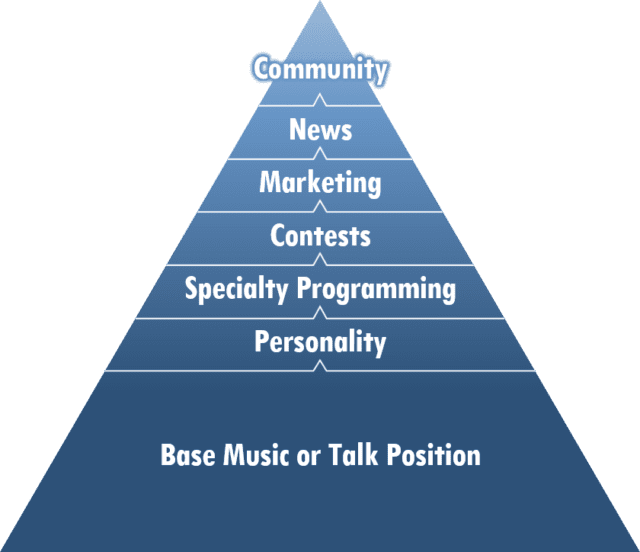
Keith: Coleman is famous for its Image Pyramid, putting Base Music or Talk Position at the foundation, with personality, promotions and other images built above it. If you were launching a station for 2027, would its layers and order remain exactly the same, or do digital access, distribution and discovery now deserve a place of their own in the pyramid?
Sam: I wouldn’t change the Image Pyramid at all. The pyramid is meant to express the basic concept of how brands are built. Any brand from Apple to Jeep. More than anything, a brand must stand for one thing and own it. Whether that’s your music position or a talk position. Everything else is designed to support that idea — the upper bricks of the pyramid add complementary, memorable elements that elevate the big idea.
Digital and distribution are tools, just the delivery system. We didn’t promote the tower in the 90s. No harm in explaining how to hear your station, but that’s not the purpose of the pyramid. It’s all about brand building. Discovery could be used to build the brand, and I think that’s covered in the Image Pyramid as it stands today.
A Hit Song or a Career Maker
Keith: Consumption data can show that a song is working, but it doesn’t necessarily tell you whether listeners care about the artist behind it. How can research help a label determine whether it has just a hit record or an artist capable of building a lasting career?
Sam: By deploying the same brand research we do for radio stations, podcasts, and other products. And we have done a lot of this work for labels. A song may just be a good song, but mate that to a compelling brand and you have an artist with career. An artist has an Image Pyramid just like a radio station. A consumer can describe what Ella Langley stands for, what her persona means, what attributes they perceive she has. Couple that image with songs that match, and you have bottled lightning.
Needles in the Haystack
Keith: A Coleman Plan Developer perceptual study may ultimately produce 200 slides. Which finding or data point makes your stomach drop because it signals a brand has a real problem — and which tells you there may be enormous upside the client hasn’t recognized?
Sam: Please don’t exaggerate the length of our studies, 199 slides at most! Perceptual studies do not uncover a tiny needle in a haystack. They reveal big structural elements with potential for enormous upside. You have morning show with tremendous potential — but not enough people know about it. You aren’t owning your position. You don’t have enough Cume. Music tastes are evolving and you need to adjust. That’s what a perceptual study will tell you.
Music Testing
Keith: Many cite “mood” as a key driver in their music selection. Traditional music research asks how much someone likes a song but rarely asks when, where, or in what mood they want to hear it. A ballad may be perfect at one time of day and poison at 8 a.m. Is music testing too context-free — and should mood and listening occasion become part of the measurement?
Sam: Music testing has its limitations. When we understand a brand from all of our studies, particularly the music that a station has an image and expectation for, we get closer to understanding the when, where, and mood. Some of that requires a programmer who really knows their brand.
We sometimes ask how often the listener wants to hear a sound, even if they love it. Now could we add these additional dimensions to our studies? Sure, let’s try it with one of the stations you work with!
Listeners & AI
Keith: AI continues to be a hot-button issue, but what does the consumer research you’ve seen tell us about how listeners feel about two things: radio personalities powered by AI and music created entirely by AI? Do consumers care — and does knowing something is AI change their reaction?
Sam: Knowing something is AI definitely changes listeners’ perceptions. You don’t really want to interact with something you think is AI-generated. But more and more, the audience doesn’t realize the content is AI. And in that case, great content is great content. Unless the curtain comes down when AI pronounces Conshohocken like an out of towner.
He Said, She Said
Keith: A client’s Nielsen performance says the brand is healthy, but your research shows serious weakness, or vice versa. How do you handle that, and how do you prevent a client from simply believing whichever data flatters them most?
Sam: We have really smart clients. They understand that a station could have good ratings but the brand is in trouble as our study might reveal. The competitive environment might allow success despite brand weakness. A foreboding report would prompt them to shore up their brand despite Nielsen success. Going the other way, our work might tell them their brand is strong and the ratings haven’t captured that just yet. Because we work with much larger sample sizes of the station’s Cume, we are more likely to see performance in a more consistent manner. As one of our biggest clients always says: I’d trust Coleman!
Research on a Budget
Keith: Radio companies are cutting research budgets while describing themselves as more data-driven than ever. Is the industry actually better informed — or is it just surrounded by more available data? And what gets lost when custom research is reduced or eliminated?
Sam: Stations have a lot more behavioral data available, but not perceptual information. Here’s what people are doing online, for example, but we don’t know why. What’s lost is what people in your local market are thinking and feeling. And that’s the key to generating more listening on a consistent basis.
Are Demos Outdated?
Keith: Radio still builds and sells brands around demos such as Adults 25–54 — a 30-year age span whose members may have very little else in common. In a media world where consumers can choose from an endless menu of niches, are broad age-and-gender demos now too blurry to guide product strategy? Should stations target a mindset first and let the ages fall where they may — or would that collide with radio’s advertising model?
Sam: You have to deliver what the sales department can sell. But no format falls neatly into “Adults 25-54” and so we wouldn’t advise programmers to focus broadly on that demo. Still, there is a correlation between age and mindset and format and mindset. So, find a way to grab a big piece of a sellable demo. But start with the proposition that a large number of people within that target must love this idea.
Which Risk Is Riskier?
Keith: Research is great at identifying things listeners don’t like, but many of the biggest brands and personalities became successful by making people either love them or hate them. Can following research too closely make radio so safe that nobody has a reason to tune in? And how do you tell the difference between a real warning sign and a strong reaction that means you’re onto something?
Sam: I would agree that following research too literally could cause someone to shave off all the edges and stick to a plan that is too safe. Often, research can tell you whether it is worth the risk. Add this style of music and you will bring in a lot of people, but you will lose some too. And that’s okay if it is done intentionally and responsibly.
Reading the Wrong Room
Keith: Research is only as valuable as the way it’s interpreted. The same pie chart can lead two people to different conclusions, but only one may actually be supported by the data. Without naming names, what’s the funniest or most painful example you’ve seen of someone completely misreading research — and what happened then?
Sam: The examples that come to mind are from our song-testing for labels, specifically, pre-testing songs before release. When a song is a cover or contains samples of a popular song it may test very well, but you can’t be sure that listeners are excited about the original or what you are putting in front of them. Or, the song may be great but the artist has no image or worse the wrong image. It’s easy to get confused in both cases, but experience and an understanding of these sorts of issues can steer you in the right direction.
The Blank Slate
Keith: Last question — blank slate. Say anything you want to any sector of the industry. What do you want them to hear?
Sam: As an industry we have a blank slate. We don’t have to stick to any pre-existing formats or designs. We can try things and put them on the air tomorrow. Somebody is going to try something crazy and build a new audience. Let’s do that together!
Barrett Media produces daily content on the music, news, and sports media industries. Sign up for our newsletters to stay updated and get the latest information right in your inbox.
