

Home Blog Page 256

Dan Le Batard Explains Why He’s Avoided Discussing Dianna Russini, Mike Vrabel Topic

0

Dan Le Batard didn’t just address the conversation surrounding Dianna Russini and Mike Vrabel — he explained why he avoided it altogether. During Thursday’s episode of The Dan Le Batard Show with Stugotz, Dan Le Batard broke his silence and offered a candid and, at times, emotional explanation for his reluctance to engage with the viral story.

The photos, which circulated widely online, prompted statements from both Russini and Vrabel, each describing the interaction as innocent and lacking context. Even so, the topic quickly became fuel for debate across sports media. Le Batard chose a different approach.

“I’m really uncomfortable with all of this and sort of the dirtiness of what my profession has become,” Le Batard said. “Where every time I’m talking about that [Adam] Schefter and Shams [Charania] are compromised, nobody cares. Then they do this thing that’s in public that I don’t want to give it air because I haven’t talked to my friend… I’d like to see how she’s doing, because this seems deeply unpleasant, no matter true or not true.”

Le Batard confirmed he has yet to speak with Russini following the photos being leaked by the New York Post. Russini has been a long time regular guest on Le Batard’s program. That personal connection shaped his editorial decision.

Le Batard emphasized that he did not want to contribute to what he described as gossip-driven coverage, especially without knowing the full context.

“I don’t know anything, and I don’t want to gossip,” he said. “I just like to know how she’s doing, because this seems awful. It was so hard for her to come by her credibility, and now we’re going to do this s**t. So I don’t want to give it oxygen, but everybody wants to talk about it.”

Le Batard repeatedly pointed to Russini’s standing within the industry. He described her as a journalist who built her reputation through reporting, not opinion, and through years of cultivating sources across the NFL.

“This woman is at the height of sports journalism,” Le Batard said. “She got there the right and the hardest way. Fighting the other information people to get to the top of information that is credible. That like is rock solid, reported stronger than the opinion maker. She’s not an opinion maker. She’s a journalist.”

At the same time, he acknowledged the difficulty of balancing personal relationships with professional expectations. Le Batard admitted he struggled with how to address the situation publicly while remaining fair.

“I sound here like I’m simply blindly and emotionally defending and riding for a friend. I don’t know what the hell happened here, but this is a journalist who came by her credibility honestly. The hardest way and harder than all the other people that have to do this stuff. Getting and fighting for the information who don’t have to deal with this s**t,” said Le Batard.

Le Batard also raised concerns about how situations like this are covered differently depending on who is involved. He suggested that Russini’s experience reflects a broader issue within the industry.

“This would not happen to Shams,” he said, referencing Shams Charania, nor would it happen to Adrian Wojnarowski. “She doesn’t want to be at the center of this. This is not why she got into this business.”

Beyond the immediate story, Le Batard connected the moment to a larger critique of modern sports media. He argued that the line between journalism and personality-driven content continues to blur, often at the expense of substance.

“I don’t want to give oxygen to it,” he said, adding that similar dynamics play out in other high-profile media disputes, including the ongoing tensions between Stephen A. Smith and Jason Whitlock. Le Batard suggested that the industry increasingly prioritizes attention over accuracy. As a result, he said, personalities risk becoming the story rather than covering it.

“I [also] don’t want to go give oxygen to that bulls**t going on between [Jason] Whitlock and Stephen A. [Smith]. I could drive it for clicks all day,” said Le Batard. “All day I could sit here and talk about all the s**t that happened between those two friends of mine. They were trying to do something journalistically objective once upon a time. Then the distance distorted all of us, and turned us into f***ing preening peacocks. We are the news. We are the newsmakers. We opine on the news,. When you don’t talk about your friend, you’re a fraud.”

Ultimately, Le Batard framed his decision as a matter of principle. While acknowledging the audience’s appetite for discussion, he maintained that not every trending topic warrants amplification. In this case, he chose restraint — prioritizing respect for a colleague over the demands of the content cycle.

Barrett Media produces daily content on the music, news, and sports media industries. Sign up for our newsletters to stay updated and get the latest information right in your inbox.

Wright Media Group Adds Four to Growing Team

0

Wright Media Group has announced the addition of four new members to its team as it continues its expansion.

Brian Wright has announced the launch of new members to what he is calling the “street-level alliance team.” The Wright Media Group founder added that he believes radio is entering a fantastic new era.

“We all believe local radio has its greatest opportunity ever, starting right now,” he shared. “While others debate the challenges, WMG is conquering them. We build custom plans that help stations reach their highest levels of ratings and revenue.

Scott Meier joins the company with 50 years of broadcasting experience. Similarly, Kevin Walker joins with more than 30 years of senior leadership experience.

Wes Bleed will work as a specialist in the podcasting, video, marketing, and communications realms for Wright Media Group. He has more than 30 years of experience in the industry, including time at WGN Radio.

Rebecca Wildeboer is joining the group as Client Relations Director. She’ll handle integrated marketing strategy, community positioning, and engagement growth.

Wright said that the new group has the same mindset as they get started.

“Our industry does not need more commentary,” Wright concluded. “It needs leadership, precision, and belief. Local radio wins when it decides to win.”

“For the last few years, I have been looking for the right timing and the right people,” Wright said. “All of this came together within the last few months.”

Barrett Media produces daily content on the music, news, and sports media industries. Sign up for our newsletters to stay updated and get the latest information right in your inbox.

Otis Day Out at 95.9 KISS FM Following Restraining Order Filed By 101.1 WIXX Talent

0

Northeast Wisconsin radio personality Otis Day is no longer part of the lineup at 95.9 KISS-FM following legal issues tied to an alleged online harassment case involving a competing host.

The station confirmed Day’s exit on Thursday but did not disclose a reason for the move.

The development comes as Day, whose legal name is Richard Dey, faces a temporary restraining order filed by Natalie Jansen, a morning host at 101.1 WIXX. The order stems from allegations connected to online activity that authorities have been reviewing for several weeks.

According to a report from FOX 11, Day declined to comment after being contacted earlier this week about the situation. The outlet had been preparing a story regarding the restraining order, which was filed on March 23. Court documents indicate the Brown County Sheriff’s Office referred a potential felony stalking charge against Day. However, the Brown County District Attorney’s Office chose not to pursue charges.

The same decision was made in a related case involving Emily Chagnon, a Marion resident. She is also facing a restraining order request from Jansen. Authorities had referred a stalking charge in that case as well, but prosecutors declined to move forward.

Investigators allege Chagnon used Facebook to post critical remarks about Jansen, both personally and professionally. Documents further claim that Day communicated with Chagnon through Facebook Messenger and shared information that was later posted publicly.

In her filing, Jansen stated that the situation has caused significant emotional distress. She said the alleged actions left her fearful for her safety and impacted her mental well-being.

Meanwhile, 95.9 KISS-FM has moved quickly to adjust its morning lineup. The station announced that Eddie will serve as interim host alongside Katie Schurk and Nick Vitrano.

Day had been leading the station’s morning show since December 2023. He stepped into the role after the abrupt cancellation of The Jake and Tanner Show, which had been on the air for six years. Schurk and Vitrano joined the program in June 2024, forming the current iteration of the show.

Prior to his time at KISS-FM, Day spent more than two decades at WIXX. He departed that station in March 2022 after a 24-year run.

The restraining order case remains ongoing as it moves through the court process.

Barrett Media produces daily content on the music, news, and sports media industries. Sign up for our newsletters to stay updated and get the latest information right in your inbox.

The NFL’s Media Blitz: Renegotiating the Future While ESPN Absorbs the NFL Network

The NFL is the most watched show on American television. Each year, millions of viewers watch professional football and the networks are always fighting among themselves to win the rights of airing games and NFL-related shows, like the Draft or the NFL Honors, because they know they work like glue. The League decided to sell the vast majority of its media rights and could choose to do so with the totality of its media assets in the near future: NFL Films and the entire department is quite expensive to run, and the NFL could gain a lot by selling them.

Commissioner Roger Goodell, who is quite the navigated money-grabber, wants to anticipate the renegotiation of tv rights, scheduled for 2029, to this year, exploiting the new shape of Paramount-Skydance and last year’s acquisition of NFL Network by Disney/ESPN. That very agreement opens up scenarios that are still difficult to evaluate. What is certain is that the NFL will remain intact, with the 2026 season starting on September 10th and culminating in Super Bowl LXI on February 14th, 2027. 

Even though the championship has yet to begin, bookmakers are already hard at work compiling odds and predictions; therefore, if you’re interested in betting on the next Super Bowl winner, you can take advantage from BetMGM bonuses or promos and exploit welcome offers to minimize losses and focus only on your slips and potential wins.

What Happens to NFL Network Workers After Disney’s Acquisition of the Channel?

NFL Network’s acquisition became official last August, when the league announced that it was about to discontinue the service after reaching an agreement with ESPN to air the channel under its management. A lot of supporters were mad about this decision, because it meant that a beloved show like NFL Redzone, who was the place to see all the touchdowns scored during the Sunday slate of NFL games without any commercial interrupting the flow of the game, was about to lose its ad-free etiquette by showing hated commercials to football enthusiasts only interested in the action on the gridiron.

From next April onward, NFL Network workers won’t have a contract with the league anymore and will become ESPN employees. This is a piece of news that worries some professionals. They are uncertain about their future worklife and whether the new company will fire someone once it integrates the network in its well-oiled broadcasting system. 

The professionals hope things will be smooth and the transition won’t mean pay cuts or job losses. For the moment, it seems as if ESPN won’t limit any NFL Network activity (the channel will air its usual NFL Draft broadcast at the end of April) but who knows what the future holds?

CBS versus FOX: The Clash For NFL Rights

The NFL is the cream of the crop in American television. The league’s schedule generates roughly $10 billion per year, on its current media rights deal. Goodell wants more, because he knows its product is always more popular, year after year, and is likely to renegotiate the actual deal by the end of 2026 or preferably before that deadline, ideally before the kickoff in September. 

CBS is moving towards an agreement with the league. The NFL wants around 1 billion more from the network, for the Sunday afternoon package, and the broadcaster is prepared to pay that sum. Football matches are one of their most popular airing and there’s no way they will risk losing them, together with a huge portion of their audience. 

The league is also talking with FOX, in order to restructure their deal. We don’t know the sum we are talking about here but, again, it is difficult to imagine the broadcaster opting out: FOX’s airing of the NFL is going very well, especially after they signed Tom Brady as an announcer, because he’s funny and talented. The long offseason may be the ideal timeframe to close both the new deals.

BIA Advisory Services Ups 2026 Local Advertising Forecast to $185 Billion

0

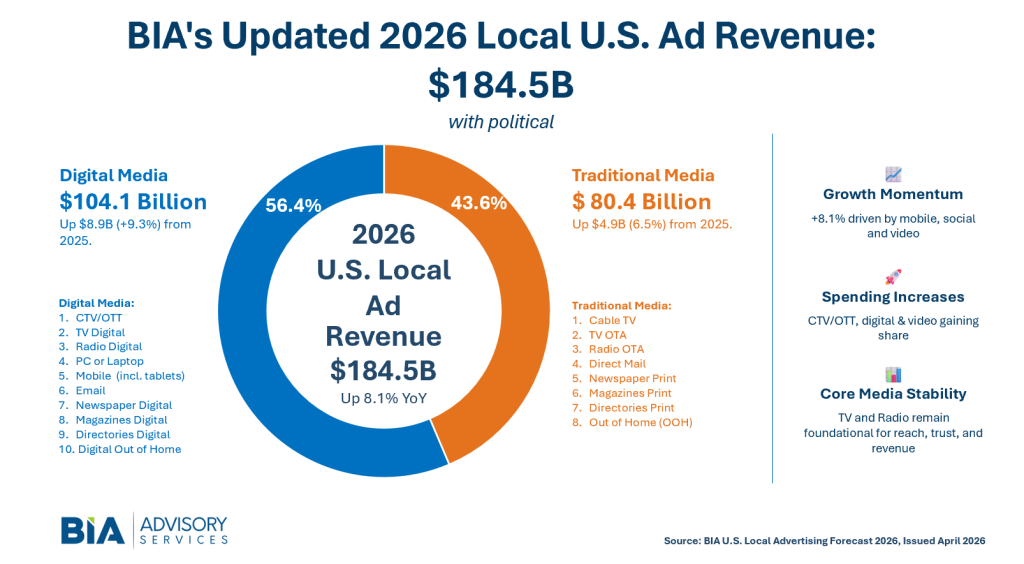
BIA Advisory Services has revised its local advertising projections to reflect an 8.1% year-over-year uptick.

The company now forecasts that $184.5 billion will be spent on local advertising in 2026. Previously, the number was projected as $181.7 billion. However, stronger-than-expected growth in mobile, video, streaming, and political advertising has led to the increased forecast.

When political advertising is excluded, the company’s forecast is at $176.1 billion. That’s an increase from its previous projection of $172.7 billion.

“Our updated forecast reflects continued momentum in social and connected and over-the-top television, which are capturing a growing share of local advertising budgets,” said BIA Advisory Services Vice President of Forecasting and Data Analysis Senan Mele. “At the same time, traditional media such as broadcast television, cable and radio remain essential, providing the scale, credibility, and local connection that advertisers rely on to drive awareness and demand.”

Political advertising is projected to reach $8.4 billion, according to BIA Advisory Services. That will be split across broadcast television, linear cable, CTV/OTT, radio, and direct mail.

The company’s Managing Director, Rick Ducey, says the forecasted increase comes from higher-than-expected spending by the average American.

“The local advertising marketplace continues to reflect a K-shaped consumer economy,” said Ducey. “Stronger spending from higher-income households is supporting discretionary categories like travel, leisure, and automotive, while value-oriented spending is shaping demand in retail, restaurants, and essential services.”

Barrett Media produces daily content on the music, news, and sports media industries. Sign up for our newsletters to stay updated and get the latest information right in your inbox.

Craig Carton: Dianna Russini Has Done “Damage” to Women in Broadcasting

0

The fallout from photos involving Dianna Russini and Mike Vrabel continues to generate discussion across sports media. Now, the conversation is shifting toward credibility and long-term perception. During a recent segment on The Craig Carton Show, Craig Carton offered a blunt assessment of how the situation could impact Russini’s career and others in the industry.

While both Russini and Vrabel have strongly denied any wrongdoing, Carton argued the public reaction may already be set. Carton suggested the biggest issue is how future reporting from Russini could be received.

“The next time Dianna Russini reports a story, I know what I’m thinking,” Carton said. “I know what you’re thinking. I know what everybody’s thinking. Wonder how she got that story.”

Russini, a senior NFL insider for The Athletic, has built her reputation on breaking news and cultivating sources. However, Carton believes the optics of the situation could create lingering doubt among audiences, regardless of her track record. He went further, saying the impact extends beyond one individual.

“She’s done herself great damage,” Carton said. “She’s done a lot of damage to other women in broadcasting, no fault of their own.”

Carton added that the perception may follow Russini indefinitely.

“I think sadly, for the rest of her life, I think now that becomes a kind of tattoo that’s on her,” he said .”Even if she’s very good at what she does. By all accounts, she is.”

The comments reflect a broader concern about how women in sports media are judged. Carton argued that situations involving optics can reinforce skepticism that female reporters already face, even if unfairly.

Meanwhile, Vrabel, who leads the New England Patriots, dismissed the photos as “completely innocent.” Russini also pushed back, stating the images lacked context and were taken during a group outing. Steven Ginsberg of The Athletic also publicly supported Russini, calling her a premier journalist.

Still, Carton questioned the decision to deny any deeper implication.

“I would prefer you just come out and go, look, I’m estranged from my husband, Mike’s estranged from his wife,” Carton said. “We’re consenting adults, and if I want to do this, that’s nobody’s business. Because here’s the problem. When you deny it, there’s more to come,” Carton said. “You don’t think there’s more to come?”

Barrett Media produces daily content on the music, news, and sports media industries. Sign up for our newsletters to stay updated and get the latest information right in your inbox.

TNT Sports Draws Best NCAA Men’s Basketball Championship Audience in Seven Years

1

Michigan’s national championship win over UConn Huskies men’s basketball delivered a strong audience for TNT Sports, continuing the upward trend for men’s college basketball on television.

Monday night’s title game averaged 18.3 million viewers across TNT, TBS and truTV. That figure ranks as the most-watched NCAA men’s championship game since 2019, when Virginia Cavaliers men’s basketball defeated Texas Tech Red Raiders men’s basketball in a game that drew 19.6 million viewers.

The audience also represents a modest increase from last year’s championship matchup between Florida Gators men’s basketball and Houston Cougars men’s basketball. That game aired on CBS and averaged slightly fewer viewers.

For TNT Sports, the performance sets a new benchmark. The 18.3 million average surpasses the company’s previous high of 17.8 million viewers for its first men’s title game broadcast in 2016, when Villanova Wildcats men’s basketball edged North Carolina Tar Heels men’s basketball on a buzzer-beater.

Viewership peaked late in Monday night’s contest. The broadcast reached 20.4 million viewers between 11:00 and 11:15 p.m. ET as Michigan closed out the victory.

The strong title game audience capped an impressive tournament run across multiple platforms. The 2026 NCAA Men’s Basketball Tournament, which aired across CBS, TBS, TNT and truTV, finished up 7% compared to 2025. It now ranks as the second most-watched tournament since 1994.

Barrett Media produces daily content on the music, news, and sports media industries. Sign up for our newsletters to stay updated and get the latest information right in your inbox.
How News/Talk Radio PDs Would Handle President Donald Trump Calling Out Their Talent

1

President Donald Trump is never shy when taking on his critics. That was evident when he shared a post on Truth Social telling Fox News executives they needed to remove Jessica Tarlov from the network.

“For Fox executives only, take Jessica Tarlov off the air,” wrote Trump. “She is, from her voice, to her lies, and everything else about her, one of the worst ‘personalities’ on television, a real loser! People cannot stand watching her. Thank you for your attention to this matter!”

It does not appear as if Fox News officials addressed the statement from Trump.

Which got me wondering: how would news/talk radio program directors handle if Donald Trump called out one of their hosts in a similar fashion?

I spoke with three different news/talk radio program directors around the country to ask that very question. They were granted anonymity to speak more freely on the topic.

A program director in a Midwestern market initially answered sarcastically.

“I’ve had consultants tell me to fire people. I’ve had ratings books tell me to fire people. My own mother has even told me to fire people,” they said, with a laugh. “And now I’ve got the leader of the free world weighing in? Terrific.”

They continued by noting that it would likely do wonders for their station if the President did take such an interest in a specific host.

“It’d add a spike to our streaming numbers, I’m sure of it,” they said.

When prodded for a more realistic answer, they said they’d have a conversation with the host.

“I’d tell him, ‘Don’t let this get to you. Continue to be yourself. I’ve got your back.’ Sometimes, that’s all that needs to be said. Trust is an important condition of any relationship. If your host doesn’t feel like you trust them, they’re not going to produce their best work. That’s the goal, right? To do your best work? That’s all I’d say.”

Another program director in the Pacific Time Zone said they’d worry about blowback from listeners.

“If we’re on the radar of the President, it means we’re doing something right, usually,” the PD shared. “But I wouldn’t want to be on the bad side. When you’ve built a brand as a conservative talk station, having the person all conservatives look to, saying negative things about your hosts, isn’t good.”

Obviously, the hypothetical situation between President Donald Trump and a local news/talk radio host has plenty of variables. But the Pacific Time Zone PD said they would be unlikely to sever ties with a host if the President said he wanted them off the air.

“This isn’t really something a local PD would have to worry about,” they said. “It’s something a syndicator would have to think about. But really, unless one of our hosts did something unethical or said something that was just way out of line, I wouldn’t feel much pressure to fire them if they just said things that the President disagreed with.”

Finally, we spoke with a news/talk radio leader in the southeast who said they’d welcome the opportunity to have Donald Trump criticize one of their hosts to the point that he’d call for their firing.

“I would die to have audio of him calling out one of my hosts,” they said with a chuckle. “I’d be so disappointed if he did it in a Truth Social post. Could you imagine what you could do with (audio)?”

They added that creating such a reaction from Trump would be what they’ve instructed their hosts to do.

“We talk all the time about creating impact. Make listeners feel something. Whether they love you or hate you, the only bad emotion you can create is apathy. People will listen to a host they love. They’ll also listen to someone they hate. But they’ll turn away when they’re indifferent. So, if one of our guys elicited a response that was so strong that the President wants them fired? They’re doing exactly what we’re asking for them. And that’s what I’d tell my boss, too.”

Barrett Media produces daily content on the music, news, and sports media industries. Sign up for our newsletters to stay updated and get the latest information right in your inbox.

How J.A. Adande Explores Legacy Through Journalism and Evolution With “Dynastic”

0

In sports, success is the pinnacle of how legacy is established. There are many steps organizations take to achieve even the smallest victories. However, few franchises develop into dynasties where a team becomes an influential case study. Those franchises are the subject of a new podcast recently launched featuring J.A. Adande and Chuck Todd.

The podcast is called Dynastic, a longform historical series that explores how franchises build toward championships and how those championships shape legacy. Each episode examines how a team impacted its sport and the broader cultural significance of that success. The concept was developed by Todd and his business partner Steve Hull, who pitched the idea to Adande to gauge his interest.

“I just kind of trusted that it [Dynastic] would work,” said Adande. “I didn’t know Chuck [Todd] prior to this. Obviously, I knew who Chuck was, but I didn’t have a personal relationship with him… It’s great working with someone as professional and accomplished as Chuck Todd.”

Adande is no stranger to the sports media space. For nearly 25 years, he served in multiple roles at ESPN and as a columnist at the Los Angeles Times, in addition to positions with The Washington Post and the Chicago Sun-Times. Adande is also a member of the Basketball Hall of Fame, earning the Curt Gowdy Print Media Award in 2024.

Why Dynastic Works

However, Dynastic marks his return to podcasting after several years away. He said that previous podcast opportunities often found him, but he was drawn to Dynastic because of its flexible schedule.

“I’m more interested in doing [a podcast] now that I’m not doing Around the Horn anymore,” explained Adande. “It’s a better time for me to do a regular podcast, and I like the pacing of Dynastic. It’s still not overly time consuming.”

The content approach is straightforward. Each episode focuses on a single franchise, with new installments recorded twice per month. The teams featured are selected two to three episodes in advance. From there, extensive research follows, ranging from online sources to trips Adande makes to the Chicago Public Library.

This process unfolds alongside Adande’s role as Associate Professor and Director of Sports Journalism at Northwestern’s Medill School of Journalism. Even in the podcast’s early stages, he has been encouraged by the response.

“I’ve had so many people contact me that don’t necessarily follow what I do professionally, and they all seemed really interested. The overall feedback has been positive,” says Adande. “Dynastic fills a niche to look back and understand. I want to promote a historical understanding.”

One advantage of the format is its evergreen nature. While history continues to evolve, the depth of research and context gives each episode a longer shelf life.

“It’s not like it’s expensive to do what we’re doing, but it’s time consuming,” said Adande. “I think there are people who want a fuller meal than just the fast-food drive thru experience… There’s a value to evergreen content too. A podcast that we pattern ourselves after is The Rewatchables. The genius of that podcast is that it is evergreen… Two to three months later, the episode still holds up.”

Teaching By Example

Adande acknowledged he is still adjusting his writing style for podcasting. As an instructor, he uses his own scripts to show students how he is adapting to a different medium. While he writes less for Dynastic than in past roles, his experience reflects an ongoing evolution in his approach to storytelling.

For the past decade, Adande has taught full time at Northwestern Medill. Over a career spanning more than two decades, he has witnessed significant changes in the sports journalism industry. Despite the decline of some traditional outlets, his students remain optimistic about their future.

“Their perspective hasn’t changed as much, but the industry has. There is still a lot of people who would like to do longform writing, and the avenues to do that just aren’t there the way they were before,” explained Adande.

He said he has always enjoyed teaching, even while balancing roles at the Los Angeles Times and ESPN earlier in his career. Despite industry shifts, he continues to value the academic environment.

“It’s great to be in an environment where everyone is trying to get better. It hasn’t changed as much as the industry has changed. Teaching at school is great. It’s the real world that’s changed not so great,” says Adande. “I still believe in what we do, and still enjoy it especially when someone gets it.”

One of the most rewarding aspects of teaching, he said, is sharing real-world experiences with both graduate and undergraduate students. This year, Adande accompanied a group of graduate students to the Super Bowl in San Francisco. More recently, he joined undergraduate students at the NCAA men’s basketball regionals in Chicago.

He enjoys seeing major events through the eyes of students experiencing them for the first time. While job opportunities may be evolving, he remains optimistic that journalism will continue to adapt.

Journalism Concerns

However, he does have concerns about the future of investigative journalism, particularly as leagues gain ownership stakes in networks that cover them. A recent example is the NFL’s 10% acquisition of ESPN, which included control of NFL Network, NFL Fantasy, and distribution rights for the RedZone channel.

“There has to be concern, but there still will be great reporting. That won’t go away, but will there be great journalism? My working definition of journalism is telling true stories that would otherwise not be told,” says Adande. “If there’s more outlets that aren’t allowed to talk about these things, and they’re the biggest outlets. Yes, that’s concerning.”

Adande believes strong journalism will endure, even if the business model continues to shift.

“It used to be that all the best journalists work at the best places and be paid the most because they’ve earned it. Now, not even all the best can afford to be paid by these same institutions,” explains Adande. “Is there going to be funding to do the deep investigative stories? That I’m worried about. However, just because the great entities aren’t investing in great journalism doesn’t mean great journalism won’t be around any more.”

The End of Around the Horn

Adande may be best known for his regular appearances on ESPN’s Around the Horn, which ended in May 2025 after more than 4,900 episodes. He made nearly 1,300 appearances on the program, beginning in November 2002.

He said he is not surprised ESPN has yet to name a permanent replacement for Around the Horn as the lead-in to Pardon The Interruption. In fact, he views the show’s conclusion as part of a broader shift.

“This wasn’t about ending Around the Horn. It was about ending studio shows in general,” said Adande. “The daytime programming was just something to fill the airtime in-between games. Now in the streaming world, you don’t fill airtime. So, there won’t be this need for studio shows and that’s why you haven’t seen a replacement. Because it wasn’t about replacing Around the Horn. It was about phasing out those type of shows.”

He pointed to ESPN placing another episode of SportsCenter in the former time slot as evidence of that trend.

“The big names that can draw big audience and eat up a lot of time. The Stephen A. Smith’s and Pat McAfee’s. Those will continue, for now. But I don’t think you’ll see anyone replacing them when it’s time for them to move on,” said Adande. “ESPN doesn’t want to invest and develop anymore.”

Adande has long believed Around the Horn was ahead of its time. He referenced host Tony Reali describing the show as “Zoom before Zoom.” Even now, he still hears calls for a similar format on platforms like YouTube.

However, he said replicating the production quality of Around the Horn in today’s environment would be difficult.

“One of the great crises in America is the acceptance of lesser caliber products,” explains Adande. “The thought today is it’s easy and everyone can do it now, but the audience standards aren’t that high. But if you try to aim higher, maybe you can have something that lasts. I don’t see anything that you’re seeing now are going to last 22 years like Around the Horn did. I’m really proud to be on a show that lasted over two decades. I’m not sure how many things will have that kind of staying power.”

Now, with Dynastic, Adande is doing what he has always done best—slowing the game down and adding context where others rush past it. In an era driven by immediacy and volume, his latest project is a reminder that depth still matters, that history still teaches, and that the stories worth telling are often the ones that take time to fully understand.

If the industry continues to shift toward speed, Dynastic stands as a deliberate counter—proof that there is still an audience for substance and still a place for storytellers committed to getting it right.

Barrett Media produces daily content on the music, news, and sports media industries. Sign up for our newsletters to stay updated and get the latest information right in your inbox.

The Dianna Russini-Mike Vrabel Controversy Is a Media Ethics Lesson To Learn From

2

When you enter the world of media, you are automatically under a microscope. Whether you know it or not, everything you say, do, write, and experience is being watched. When the photos of Dianna Russini of The Athletic and Mike Vrabel, head coach of the New England Patriots, surfaced, I wondered if they both understood the responsibility that comes with being a public figure.

Being a public figure doesn’t mean you can’t have a personal life. Of course you can. Judging from her Instagram profile, Russini is a world traveler, a mom, a wife, and a hard-working NFL insider who enjoys the beat she’s been assigned. The same applies to Vrabel. The demands of being an NFL head coach are something most of us will never understand. It requires a constant balance between work and home life that few people can sustain long-term.

However, both are public figures, and one covers the other professionally. The photos are what they are, and the responses from Russini, Vrabel, and The Athletic are what they are as well. Still, this moment should spark a larger debate about where the line of professionalism exists for those in media. That is especially true in an age when everyone is always being watched.

Taking the photos at face value, along with the setting in which they were taken, what additional context does the public need?

“The photos don’t represent the group of six people who were hanging out during the day,” Russini said. She’s right. The photos only showed two people—Vrabel and Russini.

“These photos show a completely innocent interaction, and any suggestion otherwise is laughable,” Vrabel said. “This doesn’t deserve any further response.”

Regardless of the conclusions you draw from the interaction or the imagery of shared moments—whether hand in hand or poolside—one thing is clear: Russini, especially, lost sight of the optics tied to her role as a journalist. She covers the league, including Vrabel.

She has broken stories involving teams he has coached. If you connect the dots, this situation creates the appearance of a direct pipeline between source and reporter. One could point to Russini breaking news about Ryan Tannehill joining the Tennessee Titans, or A. J. Brown potentially heading to the Patriots, as examples that now invite added scrutiny.

The journalism is strong. However, Russini’s latest actions are not.

To The Athletic’s credit, the company released a statement supporting Russini, calling her a “premier journalist” and saying it is “proud” to have her on its team. That response is not surprising. Companies almost always stand by their talent publicly at first, especially when that talent consistently delivers results.

Russini has built a reputation as a well-sourced insider, and in today’s NFL media landscape, that kind of access is currency. But that’s exactly where the conversation needs to shift. Because access is currency, and perception is everything.

When those two collide, perception usually wins.

The issue isn’t whether Vrabel and Russini did anything inappropriate on a personal level. That’s not for the public to decide, nor is it the central point. The issue is that once those images become public, the audience begins connecting dots—fair or not—and those connections can impact credibility.

That’s the part of this business that younger talent, and even some established voices, often underestimate or choose to ignore. You don’t control how people interpret what they see. You only control what you put out there.

When you work in media, especially covering a league like the NFL where information is tightly guarded, relationships matter. Scoops are built on trust. Even the appearance of being too close to a source can raise legitimate questions.

That doesn’t mean Russini’s reporting is compromised, nor does it mean her past work should be discredited. However, it does mean that a segment of the audience will question it moving forward—and that is the consequence of perception.

Fair or unfair, that’s the reality. This is where media ethics move from theory to real life.

In school, you learn about objectivity, independence, and avoiding conflicts of interest. In practice—especially in sports media—those lines can blur. Reporters travel with teams, speak with players daily, and build relationships with coaches, executives, and agents. That’s part of the job.

However, there is a difference between professional access and visible personal familiarity. Visibility is the key. If no one sees it, it doesn’t shape perception. The moment it becomes public, it becomes part of your professional identity—whether you like it or not.

That’s the trade-off.

If you want to be an insider, break news, and operate within those circles, you must be even more aware of how those relationships appear from the outside. Even if you think no one is watching, why put yourself in situations where you could allow speculation?

The audience doesn’t see nuance or context. They see a moment, freeze it, and draw conclusions. In today’s digital world, those conclusions spread instantly. Social media doesn’t wait for context. It doesn’t care about full stories. It reacts to visuals, headlines, and moments. Once something is public, it takes on a life of its own.

That’s why this situation matters beyond just Russini and Vrabel. It applies to every young reporter trying to climb the ladder, every on-air personality building credibility, and every insider working to maintain access.

This is a reminder that personal decisions don’t exist in a vacuum. They become part of your brand—and when you work in media, your brand is everything.

You can be the most connected reporter in the world, but if the audience begins to question whether you are too close to the people you cover, that connection becomes a liability instead of an asset.

That’s the tightrope.

You need relationships to do the job well, but you also need enough distance to maintain credibility. Lean too far in either direction, and something gives. In this case, what gives is perception.

Perception doesn’t come with a reset button.

Russini will likely continue to break stories. She will remain well-connected. The Athletic will continue to support her. However, this moment will follow her—at least in the minds of some fans—because it introduced doubt where none existed before. That’s the cost. Not cancellation, or career-ending damage. Something more subtle and, in many ways, more lasting: skepticism.

Skepticism is harder to shake than criticism. Once people start questioning how you obtained information instead of simply consuming it, the dynamic changes.

That’s why this isn’t about judgment. It’s about awareness. If you work in any form of media, especially when covering people you interact with regularly, you must think one step ahead. Consider not only what you’re doing, but how it looks. Think beyond the moment and focus on the aftermath.

Because the audience is always watching. That’s what you signed up for. And once they see something, they don’t unsee it.

Barrett Media produces daily content on the music, news, and sports media industries. Sign up for our newsletters to stay updated and get the latest information right in your inbox.