Although the nation’s capital may be known for its political climate, the appetite for sports radio is very healthy. With 106.7 The Fan and ESPN 980 providing original content and high profile personalities each day, the market is responding by investing time in both radio stations.
In the latest November ratings, 106.7 The Fan benefitted the most, winning the market among Men 25-54. The radio station finished in the top 8 M-SU 6a-Mid with a 4.3. They advanced into the top 7 during prime time programming (M-F 6a-7p) with a 5.1.
When you dig deeper into the local show performances, it’s another strong story for The Fan. The “Sports Junkies” finished 7th in mornings with a 4.8 and “Chad Dukes vs. The World” was 7th in afternoon drive with a 4.5.
Where The Fan really popped was during middays. “Grant and Danny” produced a 6.8 to finish 2nd overall. During the show’s first 2-hours, they’re actually tied for 1st with a 7.0. That’s extremely impressive.
For ESPN 980 there are some good signs as well. The station’s “Inside The Locker Room” program which features Scott Jackson, Brian Mitchell and Doc Walker finished in the Top 10 with a 2.9. The afternoon show which consists of Steve Czaban, Chris Cooley and Al Galdi and airs during a different time (4p-7p) than The Fan (2p-6p), is only separated by a few tenths of a point during the 3 hours they’re on the air. Czaban’s show generates a 2.7 versus The Fan’s 3.1.
One other item that stood out in afternoons and is worth noting, SportsTalk 570 which is owned and operated by Red Zebra Broadcasting (the owner of ESPN 980) and operates ESPN Radio and Yahoo Sports Radio network programming, saw some lift in afternoon drive. Bomani Jones’ show delivered a 1.5 and was the only network program to appear on the first page of the ratings report.
Where ESPN 980 experienced their lowest weekday prime performance was in morning drive. The radio station has since eliminated the “Man Cave” which was anchoring that slot. The next monthly will provide a better indication of how that helps or hurts the station going forward.
For the sake of this conversation though, The Fan has taken control of the ratings in DC for the November book. But as we often see in many cities, there are usually two or three great brands providing sports radio content, and in Washington DC that story is no different.
Few markets in the country produce the interest in sports talk radio that Boston does.
Led by WEEI and 98.5 The Sports Hub, it’s become a common theme to see the two stations finish among the top 2 stations in the market and deliver more than 20% of all male listening, especially during drive times.
And the November book was no exception.
The Sports Hub finished the month in 1st place with Men 25-54. WEEI came in second.
However, there was one big change worth celebrating for WEEI. The station’s morning show “Dennis & Callahan” which features John Dennis, Gerry Callahan and Kirk Minihane, recorded an impressive 14.4 rating to win the month against the Sports Hub’s “Toucher and Rich”. It was the second month in a row that Dennis and Callahan turned in a 14 share.
In middays, afternoons and evenings, the Hub was strong and finished 1st. WEEI came in 3rd during middays and 2nd in afternoons and evenings.
What’s become clear is that while bragging rights are important to both stations and their personalities, the performances by each brand are very impressive and the audience has access to two great local sports talkers.
The sports radio format often promotes the success achieved by stations in New York, Boston, Philadelphia and Detroit. But brands that deliver strong results in the Midwest, the South, and on the West Coast often receive less recognition.
But the noise that KFAN in Minneapolis is making is impossible to ignore and deserves to be highlighted.
The radio station which is made up of “The Power Trip” in mornings, “Paul Allen” from 9a-12p, “The Common Man” from 12p-3p and “Bumper To Bumper with Dan Barreiro” in afternoons, completed its November book by finishing 1st overall with Men 25-54. That marks 15 straight months in 1st place with Men 25-54.
Two thirds of the way through the Fall Book, and the station’s Monday-Friday shows are all in 1st place in their respective dayparts. “The Power Trip” have now finished ahead of long time Twin Cities morning leader KQRS for four months straight.
If that wasn’t impressive enough, the station also sits 1st overall Monday-Sunday 6a-Mid with Adults 25-54.
With the Vikings looking like a playoff contender, and the weekday show’s delivering double digit ratings, KFAN should finish 2015 as one of the best performing sports station’s in America.
On Thursday, Talker’s released its 4th annual Heavy Hundred of Sports Talk Radio, and as you’d expect it’s creating a lot of noise. Lists are very effective in terms of generating debate and discussion. When the focus becomes sports radio personalities and radio stations, that stirs even more emotion. Having created a few pieces like this myself, I know how subjective these things can be. So I recognize how difficult this project can be for the Talkers crew.
To assemble a piece like this and generate buzz is very easy. It’s the evidence though that supports each decision that determines if the list carries any weight. The outlet behind the piece also is important. There’s no question that Talkers has been a reputable source for talk radio for a long time. That’s why the “Heavy Hundred” creates interest throughout our industry. People in radio want to feel like their work is being recognized and measured by those who understand the challenges of doing it. Not by those who are uninformed or wearing rose colored glasses.
When I clicked on the link yesterday to review the list, I hoped to be pleased with the final result. I wanted to believe that quality research was done to showcase the industry’s best but once again I was left with more questions than answers. There also seems to be a bias directed towards certain shows, stations, and cities.
On Wednesday, Talkers posted on their website what some of their criteria was for the “Heavy Hundred”. They stressed that the final results are admittedly subjective and a number of factors determine who makes the cut. Which qualities mattered most though was not clear.
I thought it was worth researching to find out which criteria was most important and if the decision making was done in collaboration with different radio companies and programmers or if it was done independently. Many stations and industry professionals have been led to believe that there is a group of industry executives determining these results.
I started my investigation by reaching out to more than 50 Program Directors and Corporate Executives. I asked them how involved they were in sharing feedback with Talkers for their process. Only one Program Director said they had shared their input with the company. Whether Talkers asked for it or even considered it is unknown.
Next, I reached out to Talkers to get an idea of how they handle the process. The three questions I posed were:
Who takes part in the selection committee for deciding the Top 100? (Are they strictly folks from the magazine/website or are managers from different radio groups included)
Which factors matter the most in determining where you slot a show? (Ex: Ratings, Revenue, Market size, Longevity, etc.)
If ratings are taken into account, are you looking at 6+, 12+ or the format’s key demo Men 25-54?
Michael Harrison, the company’s Editor and Publisher, didn’t address the questions directly but he did offer the publication’s perspective. He said “putting this list together is based on as much art and subjectivity as it is objective and empirical. In other words, this is not an “official” PPM-style ratings project based on a hard methodology – but rather, an impression based on a combination of information and opinions and that’s the way we want it to stay. Lists like this are thought-stimulators and not to be taken TOO seriously.”
What Michael said in his last line is very important to be aware of. The list is meant to be a fun, thought provoking piece, that highlights the best in the format through the eyes and ears of the editors at Talkers Magazine. It’s not industry involved by design and whether a show finishes 1st or 100th, simply earning recognition from an industry resource like Talkers should make a talent and radio station feel good.
But therein lies the issue. Talkers has done a great job at building a brand that the radio industry values. They have a larger responsibility to showcase the industry properly. A fun subjective list that’s not to be taken seriously is something we should expect from our friends on Facebook. Not from one of the radio industry’s leading publications.
Yesterday after the list was released, I received five different press releases from radio stations pumping up their people who were on the “Heavy Hundred”. That tells me that the industry takes this list very seriously. One particular quote stood out. David Dickey with 680 The Fan in Atlanta said “We are thrilled that experts in the sports industry recognize The Fan as the most credible and most consumed sports station in Atlanta, airing some of the best sports-talk shows in the country”.
There’s one problem with that quote. Experts in the sports industry did NOT participate in this project. It was done independently by the editors at Talkers.
Being a former Program Director who studies this format as intently as I do, there are a couple of issues I believe need to be addressed. Most of the Talkers group are based on the East Coast. Call me cynical but I don’t believe they are listening to sports stations in the South, Midwest, or West Coast on a regular basis. Nor do I believe they are in tune with how impactful, successful or not successful, some of those brands and personalities are.
I also know that gaining access to a station’s ratings and revenue is very difficult. Especially when you take into account that the key demo for the format (Men 25-54) isn’t made available to the public. You can dissect 6+ and 12+ numbers but those are not what accurately reflect a sports station’s performance. You can also see total revenue for a brand but that doesn’t tell you which personalities bring in the dough and which ones don’t.
As I analyzed the list, my initial impression is that many of the shows selected were chosen based on reputation of brand and longevity of show. I don’t believe ratings and revenue factored heavily into the equation as previously suggested. It feels more to me like “The Reputation 100” than a review of the best of 2015.
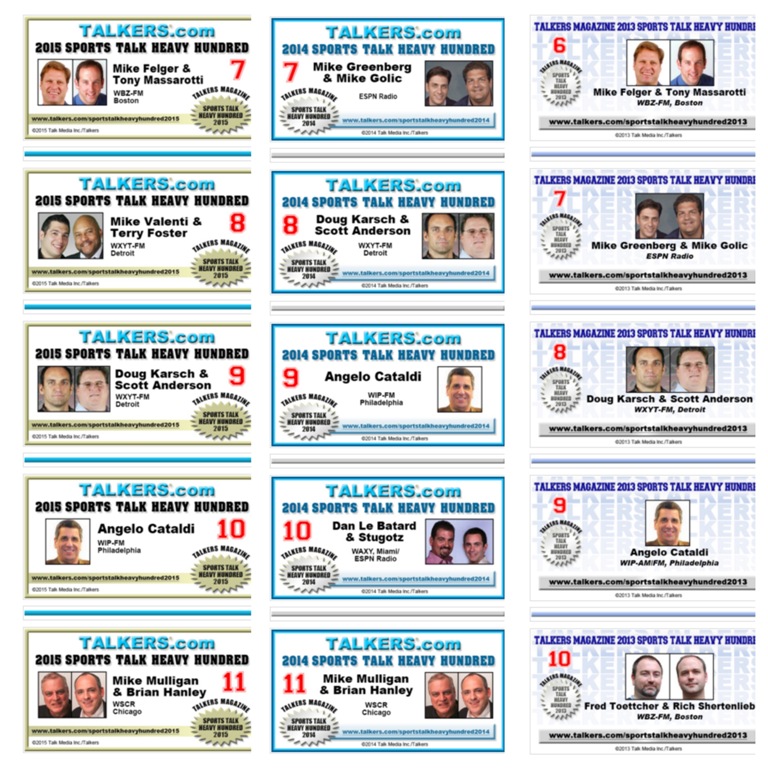
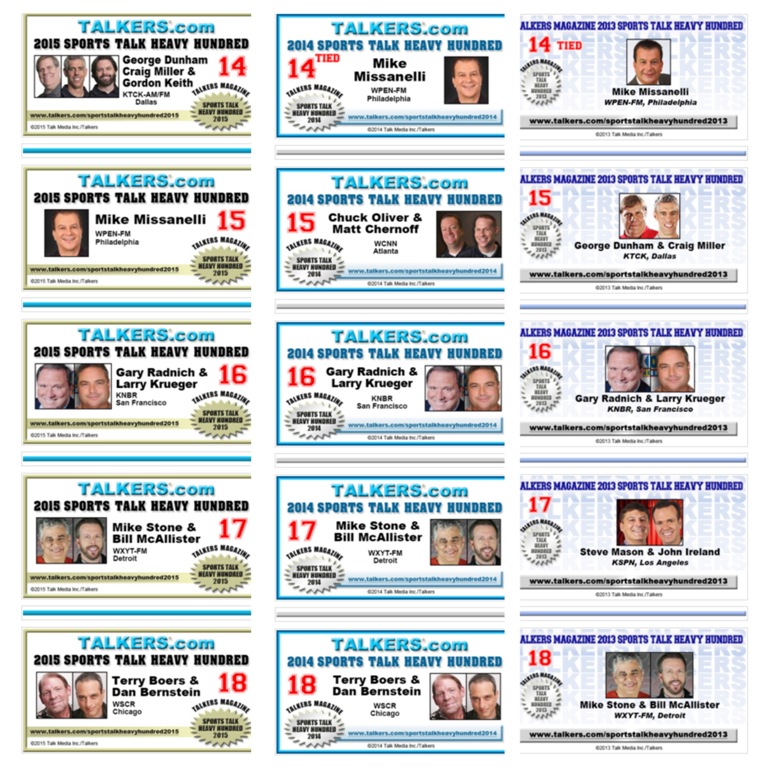
One other thing that I noticed that is very troublesome is that this list rarely changes. There’s no way in the world of radio ratings and revenue (where things change constantly) that you’re going to convince me that these shows have produced the same for the past 3 years. The only time you’ll see major changes are when shows no longer exist or guys who recently started with a station are lower one year and higher the next. Take some time and look at the lists for 2012, 2013, 2014, 2015. You’ll see a lot of the same results. Here is some photo evidence.
A few years ago one of my shows made this list and at that time the program had been on the air less than six months and was rated 17th in the market. Another show on my station which didn’t make the list, had spent 2-3 years together and was consistently rated in the Top 5. They were also our highest generating revenue program. I wasn’t asked nor was my General Manager for any information about our station or personalities ratings or revenue.
While that was then, let’s take a look at now.
In San Francisco, Damon Bruce not only generates revenue for 95.7 The Game, but he’s been a Top 5 rated program throughout the past year. If you’re a Top 5 performer in the 4th largest market in America, how can you not be included as one of the industry’s Top 100?
Talkers also said that in addition to ratings and revenue, a few other criteria were important. They included “effort, courage, uniqueness, recognition, impact and doing a show at the time of the list’s release”. Once again, Damon checks all of those boxes. So does Greg Papa and John Lund who work at the same station and have been in the Top 5 for the past 3 years and just finished #1 in October.
But that’s my former radio station so clearly I’m biased right? Well let’s switch coasts then.
Mark Madden does afternoons on 105.9 The X in Pittsburgh. He’s not on a full-time sports station, but he hosts a sports talk show for 4 hours a day in afternoon drive and delivers HUGE double digit ratings and revenue. He also possesses many of the attributes that Talkers said were important. He too though is not on the list. Three of the market’s shows on 93.7 The Fan made the list (deservingly so) so that eliminates any argument about the market being smaller.
Staying in Pennsylvania, Josh Innes hosts afternoon drive on WIP in Philadelphia. He started in that slot in February with Tony Bruno and quickly the show was leading the afternoon ratings battle against Mike Missanelli who’s ranked 15th on the Talkers list. Bruno left the show in July which many thought would hurt the show. But WIP never lost momentum. Innes continued to win afternoons with a new crew.
If I were to ask Andy Bloom who runs WIP, I’m sure he’d tell me their station is making a lot of money by finishing in the top spot in Philadelphia. If Innes is winning in afternoons, and doing so with two different versions of his program during the past calendar year, that should only further help his standing right? Nope. He’s rated 49th.
Missanelli is an exceptional talent and deserves to be in the Top 15. That’s not the issue. A host who’s on a heritage brand and in the same conversation for afternoon ratings and providing many of the qualities that the publication said were necessary shouldn’t be 34 spots away.
That same issue exists in Chicago where Waddle & Silvy (58th) on ESPN 1000 have won multiple months against Boers and Bernstein (18th) on The Score and in Kansas City where “The Drive” with Danny Parkins and Carrington “CDot” Harrison aren’t even on the list, despite doing a great show and leading the ratings against Kevin Keitzman (42nd) from WHB. How Michael Kay of 98.7 ESPN New York is relegated to 56th (third year in a row 55th or 56th) is another head scratcher.
Moving south to Dallas, G-Bag Nation airs on 105.3 The Fan and is an incredible program. It beats The Ticket and ESPN 103.3 in middays and is often The Fan’s highest rated show. But once again, the show isn’t on the list. Their competitors who they beat consistently each month are. Norm Hitzges and Donovan Lewis from The Ticket are 79th and Steve Dennis and Mark Friedman are 83rd.
Ben & Skin (who are a really good show) work on the same station as G-Bag Nation and they finished 43rd despite delivering the same or lower numbers than the midday show. If G-Bag Nation produces the top ratings on their station, and beats the two shows (Hitzges & Lewis and Dennis & Friedo) that they line up against, then how are they left out?
Finally, I don’t need ratings evidence, only a good set of ears to know that Bomani Jones, Adam Schein and Dan Dakich are three of America’s best on-air talents. There’s no defense for them not being included. They are way too good to be left off.
In the grand scheme of things, this is only a list. We’re not dealing with a life threatening illness. But shouldn’t we expect some transparency when it involves voting on our entire industry? Is that too much to expect?
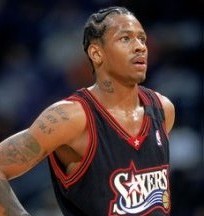
I remember when sports media people voted for MVP awards and made terrible decisions but couldn’t be held accountable because we didn’t know how they voted. Then two specific situations occurred and it’s been very different since. Fred Hickman voted for Allen Iverson as MVP over Shaq in 2000 and Keith Law placed Javier Vasquez above Adam Wainwright and Chris Carpenter in the 2009 NL Cy Young voting. Both men received a ton of backlash for their selections and with social media a major part of people’s lives now and accountability being important to the general public, it’s much harder to place a vote and hide.
What frustrates me most is that people in our format really do care about this. They want to be measured fairly and some checks and balances would go a long way towards getting it right. Furthermore, there are stations using this information in local marketplaces to create confusion and present a false narrative for their brands and personalities. It’s similar to when a radio station runs a promo touting itself as America’s #1 sports station, when the truth is that they’re not even rated #1 in their own market. Just because you say something is factual doesn’t mean that it actually is.
The last part I want to draw attention to is SiriusXM. I recognize that the focus of this type of list is going to be on ‘terrestrial’ radio but if we’re identifying the Top 100 sports hosts in America, then shouldn’t they be included? Stephen A. Smith, Evan Cohen and Mark Packer aren’t good enough to make the Top 100? Chris Russo, despite having an entire channel named after him is only the 35th most important? Really?
In talking to a number of Program Directors, they’re disappointed because they’re not asked about their shows and stations and they feel that Talkers aren’t privy to key information. I’ve often wondered why Program Directors weren’t interviewed as part of this process. Why consultants like Rick Scott, Tom Bigby and myself who follow the format nationwide and interact with stations and personalities aren’t asked to share a perspective. Why executives like Bruce Gilbert and Scott Masteller weren’t asked for feedback when they operated ESPN Radio and Fox Sports Radio and had regular communication with local stations across the country.
I’d think that Program Directors, Consultants, and Executives like Bruce, Mark Chernoff and Mike Thomas at CBS, Steve Cohen with SiriusXM, and Don Martin with Premiere/Fox Sports could lend some extra insight and information that would be beneficial. Some will say that by talking to them they’ll be biased towards their own people and while that’s probably true, they still have information that’s important. I’m not suggesting they be part of the final decision making process. That should absolutely belong to Talkers. But without knowing key details about many of these stations, it leaves a lot of industry people feeling like the list is very skewed and not well researched.
If you’re an On-Air talent and you made the list, be appreciative towards the folks at Talkers who have highlighted your show and clearly value your work. However, just because you made the list, doesn’t mean you deserve a raise or that you should start bombarding other Program Director’s for bigger jobs because you’ve clearly established yourself.
I had one talent reach out to me two years ago and explain why I needed to hire them. They told me that based on their ranking on the Talkers Top 100, it was clear that the entire industry knew they were a difference maker. This individual didn’t finish in the Top 30 so when I responded by asking them “why should I hire you over all of the other shows that finished ahead of you” they didn’t take too kindly to my sarcasm. Now knowing that the survey is done independently by Talkers and without the involvement of the top radio minds in America, that same person may want to craft their wording a little differently.
I’m glad Talkers does this piece each year to give our format and our people some exposure. I know it’s a very hard list to assemble and everyone involved at the publication has to view this project as a love/hate assignment. No matter what they put out, there’s going to be some disagreement with it. By not providing transparency though with their process it leaves them open to additional criticisms.
From where I sit, I don’t think you can find much room to argue with the Top 15-20. Personalities like Mike Francesa, Boomer & Carton, Jim Rome, Colin Cowherd and Dan Patrick deserve to be high on the list. In many ways this list reminds me of the NFL Draft. You can identify who the top prospects are but after Round 1 it’s a crapshoot and the great organizations do their homework and strike gold, while others miss the mark and ultimately pay the price for it.
To those that made the list, congratulations. Whether you take it seriously or with a grain of salt, it’s a nice honor. The last thing I wanted to do was rain on Talkers parade but the process and research that goes into this should matter and industry people deserve to know who determines the results and what criteria matters most. Many assumed that top executives and programmers were involved in this process. But they’re not. They’ve also not been spoken to. If some additional conversation takes place, this list could become excellent and one that all groups look forward to being a part of.
For now though, the Talkers Heavy Hundred has become our Santa Claus. It started as a good idea that made us feel good inside, but the more we choose to believe in it, the more disappointed we become.
Alpha Media and John Canzano have agreed to extend the successful run of Canzano’s Bald Faced Truth sports radio show (weekdays 12-3 p.m.) on 750-AM and 102.9-FM The Game.
Alpha signed Canzano to a four-year contract extension this week that will keep The Game’s longest running sports talk show on the company’s flagship Portland-based station.
Alpha Media Executive VP of Programming, Scott Mahalick commented on the announcement, “Renewing a seasoned professional varsity multimedia broadcast talent like John Canzano is the perfect centerpiece to The Game’s talent roster.”
Canzano has been with The Game since its launch in 2008 and also serves as a sports commentator at KGW-TV, Portland’s NBC affiliate. Canzano’s social media following includes more than 65,000 followers. His radio show guests have ranged from national figures such as President Obama to Mike Tyson and regular spirited exchanges with the local sports athletes and coaches.
“John Canzano is a multi-media Portland sports brand that Alpha Media is thrilled to extend to 750/102.9 The Game for many years to come,” remarked Alpha Media Senior Vice President/Market Manager, Milt McConnell. “John’s ability to get big name sports personalities and unique insights on our local sports franchises provide some of the most compelling content on local radio.”
“Today’s sports talk listener wants great local talk; unbiased and truthful,” added Canzano. “It’s why my show and The Game connect so deeply with listeners. I’m proud to sign a long-term contract to be part of a sports station that is surging forward.”
Read more at The Oregonian which is where this article was originally published
To make things better in life and business, we often have to tackle difficult subjects and be willing to engage in conversations that make us flinch. As a former programmer, I was taught to avoid three subjects which can divide an audience – race, religion, and politics. While I agree that those topics can be divisive in everyday sports talk conversation, I don’t think those subjects should be avoided when they apply to the progress or lack thereof in our format.
For some in the media industry, this column will serve as a breath of fresh air and make them feel inspired to have deeper dialogue on ways to evolve our people and brands. For others, this trip into the land of the uncomfortable is going to make them uneasy and maybe even angry or dismissive. But it’s necessary.
Sharing our views on a subject such as race is often perceived as dangerous. Why? Because it’s a topic that gets people’s emotions stirred and when information is lacking or revealed, it can make us look uninformed, irresponsible or agenda driven.
While it may be complex and make the hairs on our necks stand up, it’s a conversation that shouldn’t be ignored when it comes to sports radio. We’re all adults and it’s 2015 not 1865. Anyone who works in this format should understand that we benefit more by reaching the entire audience, not just select demographics. You can’t do that though by only providing one side of the conversation.
Since the sports talk format was created thirty years ago, it’s been heavily targeted to white males between the ages of 25-54. Part of that stems from white audiences being more interested in the content. Some is a result of on-air lineups and station management being heavily caucasian and refusing to step outside of their comfort zones.
ESPN Audio’s Vice President of Network Content David Roberts says those realities extend beyond the media business: “In many industries there’s still this comfort level to pick people who we identify most with. Diversity means being willing to listen to ideas and surround yourself with people who look, think, and act different than you do. If someone can bring a different perspective and help a company improve, then it only makes sense to explore hiring them.”
Although the format has grown, there are many sports stations today that don’t deliver big ratings. In some cases, brands finish between 10th and 20th place, and reach only 2-3% of the Male 25-54 audience. Yet, that is considered a success. To play devil’s advocate, one could argue that 97-98% of Men 25-54 DIDNOT listen to those stations/personalities. It’s really hard to use the word ‘success’ when you look at it that way.
So why do sports stations struggle to generate bigger numbers? Is it because the programming is predictable? Is it due to a steady presence on AM radio which younger people listen less to? Is it because of poor measurement? Or is something else happening that prevents the format from reaching the largest pool of people?
That ‘something’ I’m referring to is a lack of diversity on the air. And let’s be clear, that doesn’t mean black personalities – it means Black, Asian, Hispanic, Indian, every ethnic background that is non-white.
I’ve programmed in San Francisco, Philadelphia, and St. Louis – three different pockets of the country, and in each case, the percentages of white males to non-white males who listened were between 70-90% white, and 10-30% non-white. There are a few markets where the percentages are different, but overall, this is a regular trend.
What that tells us is that the content appeals to a select group of people (white males 25-54). Attracting interest from minority audiences remains a bigger challenge.
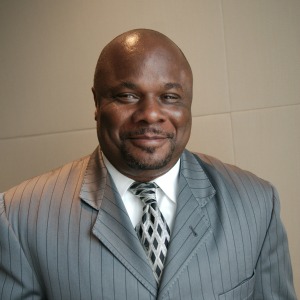
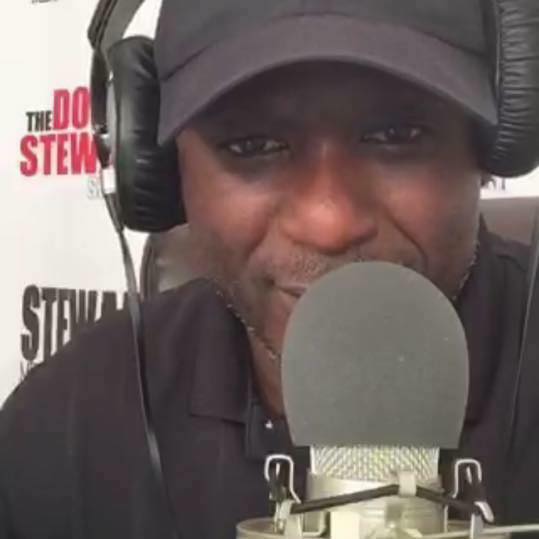
One of the first diverse shows to expand the audience in a local market were the “2 Live Stews” who broadcasted on the now defunct 790 The Zone in Atlanta. Doug and Ryan Stewart were the hosts, and they debuted in 2001 and grew from late evenings, to mid-days, to afternoon drive, and became The Zone’s highest rated show. That led to appearances on ESPN, a show on ESPN2, a syndication deal with Radio One, and a national slot on Sporting News Radio.
Despite all of that success, the pair have had a tough time gaining another opportunity in Atlanta, or anywhere else for that matter. They currently host a 1-hour program on Saturday morning on WGST in Atlanta.
Doug said “The diversity in Sports Radio almost 15 years after the debut of the “2 Live Stews” is very disappointing. We were lauded for being the first (all) black show in sports radio history and you’d think it would open up doors right? Not. We don’t have a job (or real interest for that matter) and not many other black hosts have been given opportunities either. Factor in that just about all of our station contemporaries are working in the industry, and add to the equation the “verifiable” success that we had concerning numbers and national success, and it’s disheartening to say the least.”
It’s common to gravitate to those who think and sound like us and share a similar upbringing. When we hear someone speak differently and approach topics from an unfamiliar place, we usually reject it. What makes that problematic is that for someone like myself, who’s 41 and a white male, I can still put on a sports radio station and hear 80-90% of people who I stand a chance to connect with. For a minority listener though, they’re treated to 15% of people who share a similar background. That means that if they want to listen to sports talk, they have to listen to hosts who they may identify with less. The only other option is to not listen at all.
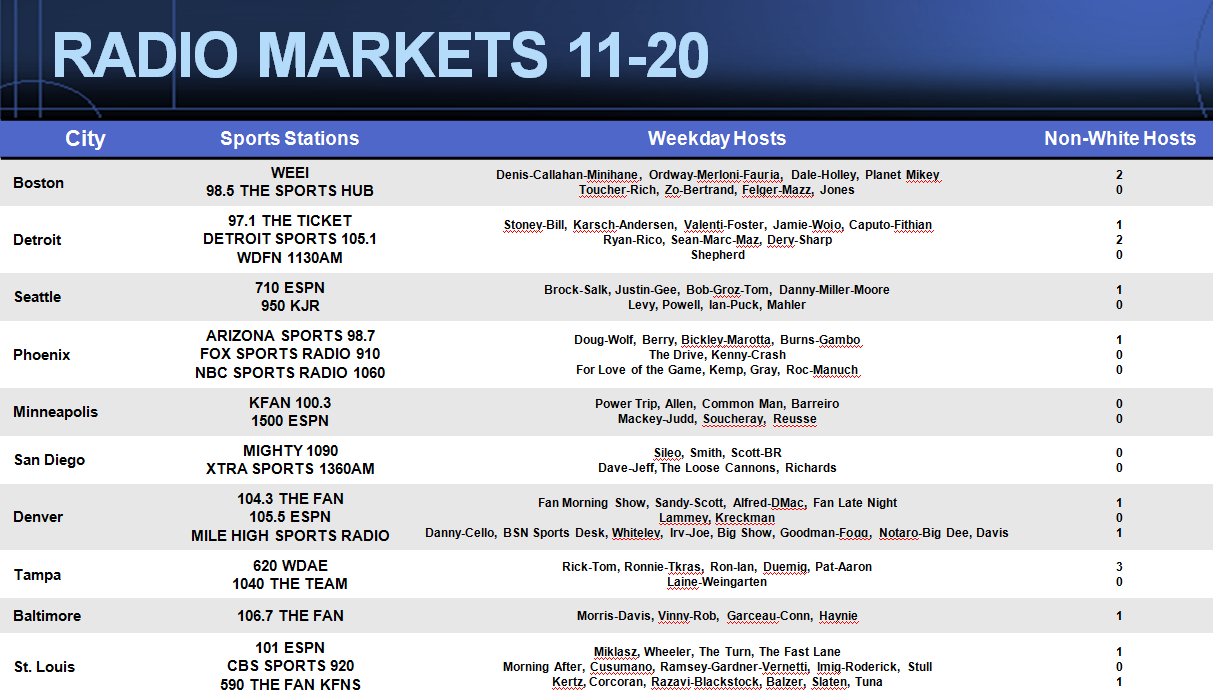
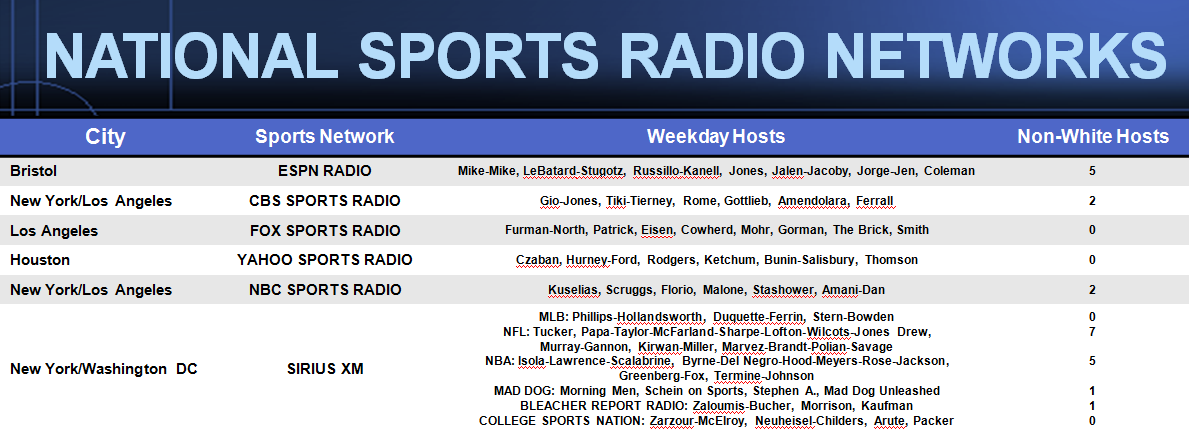
I went through the top 20 markets and the stations in each of those cities that operate this format. I also analyzed 5 national sports networks and SiriusXM’s key sports channels to look at the total amount of regular weekday on-air personalities who are white vs. non-white. I’m not including update anchors, fill-in hosts or reporters – just the people who occupy positions M-F between 6a-Midnight.
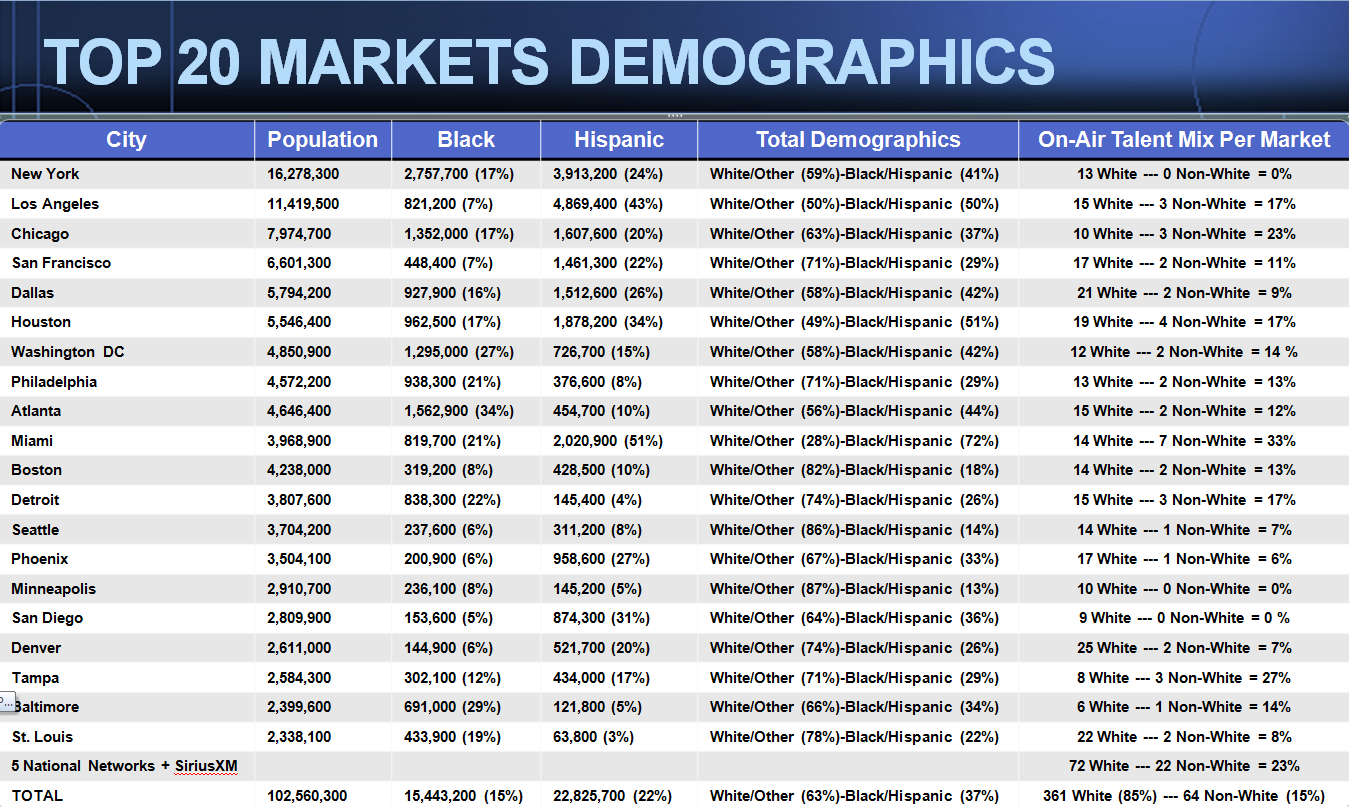
Now take a look below at each market’s demographics and how they compare to the talent mix in each city.
For additional observations on the information I presented above, click the following link.
If you were to create a headline from the data above, it would say “sports radio stations over deliver on white personalities and under deliver on non-white personalities“. 85% of the on-air people in this study were white. That’s 22% higher than the percentage of people in these cities who fit the same description. The only demographic in line with its statistics are African Americans. They make up 15% of the population among the Top 20 cities, and are represented by 14% of Black on-air personalities.
What’s more alarming is the shortage of Hispanics who are hosting sports talk shows. I counted five in top 20 markets and across all national platforms. That means only 1% of our key on-air talent are Hispanic, yet they make up 22% of the population in these markets. Hispanics love sports as much as everyone else, and they are a larger group of people than even African Americans. Still, they are the most underrepresented group in our entire format.
Altogether, minorities (Black and Hispanic) represent 37% of the population in these cities but only 15% of the format’s On-Air personalities come from minority backgrounds. This is a major issue that needs to be corrected, but it’s one that I’m not sure we’re prepared right now to fix. Here’s why. Did you know that of the entire list of stations above in top 20 markets, only 1 has a Program Director who isn’t a white male (Terry Foxx at 92.9 The Game in Atlanta)? If you look at the 5 national sports networks, only ESPN Radio employs a minority Programmer (David Roberts). They also employ two female programmers (Amanda Gifford and Louise Cornetta). No other network does that.
If we expect to expand our thinking, and reach more people, it has to start up top. I’m not privy to the braintrust of each group and why they make the decisions that they do, but the disparity I see on the air is not in line with the makeup of the audience. If you look deeper, the same challenges exist with market manager positions, corporate executive jobs, and ownership. In the NFL, the Rooney Rule was introduced to encourage organizations to consider candidates who weren’t white. I’m not sure if that type of approach is necessary or if it would even work, but clearly something has to be done.
As true as it may be that we have work to do in hiring minority managers and on-air talent, there is also a problem with getting them interested in our business, especially Hispanics. That doesn’t mean there aren’t great non-white candidates out there who are worth investing in, but the options to choose from are definitely less.
In May 2014, Chris “Mad Dog” Russo addressed this subject on his national radio program when a caller asked him why his channel didn’t feature any minority personalities. He said “What would you like us to do? There are not a million candidates. Would you like us to put on a black host for the sake of putting a person on? If there is any person of any ethnicity who wants to get a job at ‘Mad Dog Radio’ and we feel he or she is capable of doing a national talk show at the highest level, I’d put them on in a second. Let’s just say we are not being overwhelmed by resumes.”
Although Russo’s comments were originally criticized, I appreciated his honesty. My only issue was that while he was absolutely right about a lack of interest, the solution is to go out and find people, not wait for them to find us. Most personalities don’t know the challenges that exist inside each radio company, and it’s the Program Director’s job to find talent, bring them in, coach them up, and give them the platform to display their skills.
To their credit, Mad Dog Radio solved the issue by partnering with ESPN Radio. That relationship resulted in Stephen A. Smith joining the channel and becoming the host of weekdays 1p-3p EST. As part of the agreement, ESPN Radio produces the program.
When Smith was initially named host of the program he said “I’m not just able to help myself but various African Americans within the radio industry that are looking for opportunities. I’ve got to be a trendsetter and make it happen because if I drop the ball, I not only drop the ball for me but I drop the ball for all of us.”
He’s probably right, and that in itself saddens me. No person should have to go to work feeling like they have the weight of an entire race on their shoulders. Can you imagine if a white on-air personality was faced with that responsibility and their success or failure determined whether or not other companies would employ future white hosts?
We can talk about these problems until we’re blue in the face but what our industry needs now are solutions. For starters, there should be a stronger emphasis on training and recruiting. It’s easy to tell a manager “go hire great people and get us ratings” but most radio stations don’t talk to their managers about the importance of being diverse, nor do they show them why it matters or how to find candidates from different backgrounds. If nobody else inside an operation thinks it’s critical, and the programmer is judged on their ability to deliver ratings, they’re not going to care as much about the makeup of a lineup, as they are its ability to produce results. They’re also more likely to surround themselves with people they relate to.
I asked a Program Director (who wished to remain anonymous) about this issue and he confirmed that it’s a problem. “I’d love to say that I’ve done a good job at promoting diversity but the truth is that I can do better and probably need to focus on this more than I have in the past. We can place blame on a lack of training but that’s a cop out. The bigger issue I believe is simply having a discussion about it. Very few people want to talk about race. I think it’s only natural for people in my position to hire talent who they connect with most. Our audience comes from a similar place. But to your point, we’re not going to grow the audience if we don’t make hiring minority talent a bigger priority and it all starts with increasing dialogue”.
Early in my career when I first started programming, building a diverse radio station wasn’t on my radar. I went to work, listened for great talent, reviewed the candidates that applied for an opening, and made decisions based on what I felt was good. However, when I built 101 ESPN in St. Louis, I took a different approach. I made a real conscious effort to make sure we had a unique mix of people to reach the entire community. I wanted younger personalities, and veterans. Male and Female. White and Non-White.
During that time I hired D’Marco Farr and the late Bryan Burwell in weekday positions. I also hired Alvin Reid and Rene Knott as weekend hosts, Tony Softli as a Reporter, Rick Venturi as an Analyst/Host, Sara Dayley as an Anchor, and Michelle Smallmon as a Producer. The brand was unique and full of talented people from multiple backgrounds and together we enjoyed a lot of success.
In San Francisco I took a similar approach. NFL Network personality Eric Davis was part of our initial afternoon show with Brandon Tierney. As we grew I added others to the roster from different backgrounds including Henry Wofford, Daryle “The Guru” Johnson, Gianna Franco, Anna Kagarakis, Lorenzo Neal, and a program called “The Three Amigos” which featured Victor Zaragoza who was Mexican, and Rudy Ortiz and Brandon Santiago who were Hispanic.
While my previous two stations took diversity into account, and did a good job of making it important to the programming mix, one could still argue that we didn’t do enough. I can’t disagree but I can say that we did try and put a lot of thought into every decision we made.
One group which I believe did a masterful job at making their programming more diverse recently is ESPN Radio. Dan Le Batard, Jorge Sedano, Bomani Jones, and Freddie Coleman are all non-white and talented, and they’ve been given the same chance to succeed on the network as Mike Greenberg, Mike Golic, Jon Weiner, Ryen Russillo, Danny Kanell and Jen Lada. Traug Keller, Mo Davenport, David Roberts, Amanda Gifford, Pete Gianesini, Ray Necci, Louise Cornetta and every other ESPN Radio manager who was involved in the talent process deserves to be applauded for taking steps to create change.
I asked Roberts how the hiring process worked and he said “We never select numbers for how many people will be given a position based on their background. As long as you operate by making sure that the best talent available is selected, then the principles and impact of diversity will take care of itself. The wider you make the net, the better chance you have at success. The more narrow the pool, the less likely you are to succeed.”
Let’s understand one really important thing on this subject. Just because a white personality hosts a show, doesn’t mean they can’t relate or connect with an African American or Hispanic listener. The same holds true for any minority host trying to connect with a white audience. If the content is great, and the topic, information, and opinion is intriguing, people will listen to it. But that doesn’t mean we shouldn’t strive to provide a better mix of on-air talent so we can appeal to all demographics.
To get a better read on the challenges our industry faces with regards to diversity, I thought it’d be helpful to talk to some non-white personalities who I respect a great deal. I think you’ll find this conversation to be very enlightening. Change can only happen when we recognize a problem and care enough to fix it. If a few people in our format in positions of influence read this and are moved to re-evaluate their approach and commitment to diversity, then that’ll be a step in the right direction. From where I sit, we could all benefit a great deal from it.
Jorge Sedano – Host of “Jorge & Jen” on ESPN Radio
Carl Dukes – Host of “Dukes & Bell” on 92.9 The Game in Atlanta
Newy Scruggs – Host of “Voices of The Game” on NBC Sports Radio
Freddie Coleman – Host of “The Freddie Coleman Show” on ESPN Radio
Sean Adams – Co-Host of “The Bottom Line” on AM 1300 The Zone in Austin
How do you feel about the balance in sports radio today as it applies to presenting diverse on-air personalities and programming?
Adams: I don’t think it is diverse at all. People might look at the raw numbers and say things are better but many members of the mainstream media who also write and do television, are still pulled from a very homogeneous group of white men that lack the the most important part of diversity, experience.
Sedano: I think a market or a network should reflect its communities. At ESPN Radio, we have done a great job with diversity. Look at our weekday lineup. Mike & Mike, Dan Le Batard, Ryen Russillo & Danny Kanell, Bomani Jones, Jalen Rose & Dave Jacoby, Freddie Coleman, Jen Lada and myself. It’s a reflection of our society. That’s a testament to our leadership at ESPN, Traug Keller, Mo Davenport and Dave Roberts. They look for the most talented group of hosts who can provide different perspectives. It’s what the medium was built on – different perspectives.
Dukes: I don’t think there is a balance. When you look around at the major market radio companies and stations and the major dayparts on those brands, how many African American are hosting shows? The balance is still very inadequate when you talk about sports radio today and how it applies to presenting diverse on-air personalities and programming.
Harrison: There is no racial balance in sports radio today. Look at the Talkers Top 100 list from any year, and count the number of non white people on that list. An even better exercise, count the number of non-white non athletes on the list. Sports talk radio is a middle aged white male platform so the hosts reflect that and largely speak from that relatable point of view and connect with the intended audience.
Is it better, the same, or worse than it was 10 years ago?
Sedano: I came from Miami where 50% of the radio listening audience is Hispanic. When I worked in Miami there were only 3 Hispanic hosts in the weekday lineups. LeBatard, Orlando Alzugaray and myself. Now my ESPN colleague and long time friend Israel Gutierrez is doing drive time in Miami. 25% of Miami is African American. There are only three African American hosts on weekdays in Miami. Joy Taylor is a morning host on the Ticket, Leroy Hoard does middays there and Channing Crowder does afternoons on WQAM. There are 4 sports stations in Miami. The number of ethnic hosts don’t reflect the community there enough. I can say the same for most markets in America. For that matter, I can say the same for some radio networks as well.
Dukes: It is certainly better. Some doors have been opened for minorities but it’s still not as good as it should be. I think it has a lot more to do with guys like myself, the 2 Live Stews, Terry Foster in Detroit, and others having success when they do receive an opportunity. I’m a big believer that you have to see it to believe it. Once people can see us doing well, it will give more of them the courage to pursue their dreams too.
Scruggs: It’s better because you get to hear shows with hosts like Bomani Jones, Steve Kim, the 2 Live Stews or Mike Hill. You can actually give points and opinions from a minority perspective and not be afraid you’ll be pulled off the air. Some PD’s don’t want you to sound too “urban”, the code word.
Coleman: Definitely better because there are more minorities who are a part of sports talk radio. For the longest time, there weren’t any to listen to nationally or locally.
In sports radio, many of the on-air talent who aren’t white, have a background in professional sports. Why do you believe that stations will take a chance on a former athlete but not as much on an individual from a different background who is simply well educated or a good broadcaster?
Adams: Historically those from non-white backgrounds have had to have more credibility than their white counterparts. In some ways it worked almost like television where one was the play by play (radio guy) and one was the color. Non-whites filled the second role and their credibility came from former players.
Sedano: I’m not in those other guys heads so I can only speak for myself. I was the PD/Host at WQAM for one year (Sept 2012-Aug 2013). In that time, I put on Channing Crowder who played in the NFL, and on the weekends I hired Ed Freeman & Jeff Fox who were broadcasters. I tried to hire Bomani Jones. I texted him once to gauge his interest, but he had bigger things on the horizon. Obviously, we see what that was.
It’s easier to hire a former jock because they have name value. It takes more of an investment to give a broadcaster that same opportunity. Most PD’s are under pressure to produce ratings and help sales staffs to meet numbers. So they don’t want to invest the time and effort it takes to coach a good, young broadcaster.
Dukes: The reason why is because the formula has always been that you needed a former professional athlete on the station to attract an audience. I don’t believe that formula is true anymore. My partner (Mike Bell) and I here in Atlanta didn’t play professional sports and we’re doing well. Toucher & Rich in Boston and Ben & Skin in Dallas are doing excellent and they didn’t play the game. I’ve worked with numerous former athletes, including Kordell Stewart here at The Game, and as knowledgeable as they are about the game, sometimes they can be limited in what they’re willing to say or do.
Scruggs: PD’s like names and get fooled all the time when athletes want to get into radio. The person hiring thinks they hit a 2-run homer: a former local player AND he’s black/Latino. Most players don’t want to put in the work that it takes to do sports radio at a high level. That is not a shot but it’s something I have seen.
Why is it important for sports stations to feature personalities who come from different backgrounds?
Dukes: That’s what life is all about. We should all strive to see what’s out there. When you include different cultures and ethnicities, then you can respect things more when certain stories come up. For example, when the Adrian Peterson story blew up last year, two white guys from Iowa discussing that topic versus an African-American with the same cultural experience, is a different deal. That viewpoint is going to be different and I think that’s beneficial and important to sports radio. As society continues to change, and we are truly one big melting pot, I think it’s important that listeners and fans get to hear as many perspectives as possible.
Scruggs: Just look at the world we live in. It’s important to bring viewpoints from women, gays, minorities and people of different faith. The world has changed.
Harrison: Talk radio is such a different type of medium because so much of your personality, upbringing, culture, background, and religious beliefs come out in how you portray your opinions. Since when is having different voices (not just black males) but a woman’s perspective too a bad thing? Can’t they provide a view that I don’t have? Isn’t that the point of open discussion?
If all the personalities are largely the same and essentially at the same point in life (married, two kids, house, etc.), how is the conversation ever truly unique? That’s not representative of the entire audience. I’m a 27 single black male, and on some levels it is impossible for me to relate to the middle aged white male, but doesn’t my story and the story of people like me also deserve to be heard?
Coleman: Because everybody isn’t the same and I’ve always believed that you don’t have to like people from different backgrounds, but you should be able to understand the differences. To me if you don’t, then you have a completely narrow view. Not every white person thinks the same, but a host has to understand, no matter their color or background, that understanding has to play a part.
If the majority of listening is done by white males between 25-54, and they relate strongly to white hosts in the same demographic, why should a company executive alter their approach?
Adams: Those same white males enjoy watching sports that are largely minority and the value of the diversity in former players (of any level) lends credibility to said host.
Sedano: Why wouldn’t you want to grow your audience beyond white males between 25-54? Are executives afraid that the white male audience will not be retained if there is a minority host? I think that’s a bit presumptuous. Good content is good content. People want good content.
Dukes: A lot of guys are afraid to alter their approach because they’re afraid that people won’t listen. My approach has always been that I need everyone to listen to win. I am not solely dedicated to having just African Americans listen. I want the husband, the wife, the sports fan, the fringe fan, no matter what they look like, or where they come from, I need all of those people to win.
I never try to delegate my style or my delivery to one type of individual. I hope the audience likes who I am and what I do but I’m not trying to do something to attract a certain type of individual. How does it sound? Is it smart? Is it intelligent? Is it entertaining? If it checks those boxes, then it shouldn’t matter what you look like because people will listen, and that should be the reason why an executive should be receptive to altering their approach.
Scruggs: So it’s OK to bring in the ex minority ballplayer for pre and postgame coverage of the station’s games but keep the host white so you don’t offend the white audience? That is hooey and 1990’s type of thinking. We live in a country where the voting public is overwhelming white and a black man was elected President of the United States twice. There are many talented non white male broadcasters that can bring compelling sports talk to the airwaves.
What is the #1 reason in your opinion of why stations struggle to employ more non-white on-air talent? (is it a lack of interest from minority candidates, programmers afraid to leave their comfort zone, listening audiences won’t listen as much, etc.)
Adams: Not only are programmers afraid to leave their comfort zones but they are also uncomfortable with communication styles and patterns that might work against non-traditional forms of diction and odd usage. Stuart Scott was popular and hated for a reason. He was different. That scares people.
Dukes: This is traditionally a white male dominated field. It’s slowly changing though. When we can stop saying there’s one minority candidate on a sports station in an entire market occupying a major daypart as a lead host, that’s when we can say we’ve made real progress. Most stations are afraid that the listening audience won’t connect if they feature more non-white personalities, and I disagree with that. I think you connect through your experiences and your likes about sports and real life. I have children, I’m a homeowner, I own a car, I enjoy restaurants, those things apply no matter what you look like or where you come from.
We need to get past what a person looks like, and think about what they offer to the radio station and the listening audience. Here in Atlanta it’s very unique. Terry Foxx is the Program Director and Sean Thompson is the Assistant Program Director and both are African American. That dynamic isn’t anywhere else in the country, but it should be. But those doors haven’t opened as much. None the less, because there are not enough minorities
Scruggs: Sports radio PD’s are on par with baseball. I saw it two years ago when there was pushback from executives on a black talk show host who had strong opinions. The GM identified him as an up and coming young talent. The GM also had a young white writer with strong sports opinions who he felt was also an up and coming young radio talent. He wanted to hire both but he listened to his staff’s opinion instead of his gut.
The white male ended up getting a show and they passed on the black candidate. The black candidate now has a successful national show and has blown up with a different network. The white male has been very good and performed well, just like the GM predicted. The station could have had both.
Harrison: Lack of effort. Lack of development. Lack of trying. Everyone wants a job like this. You get to talk sports for a living. Sure like any job it comes with a certain set of challenges but it’s an incredible line of work. It’s what I always wanted to do. It requires someone taking a chance and believing that you can do it. More PDs have to believe that someone like me is capable of connecting with a large audience. It takes time and patience.
How do you feel non-white personalities are measured in sports radio?
Adams: It’s no different than what we see with non-white coaches being hired. While it is getting better in all parts of society, a smaller margin for error is usually in place.
Sedano: I can only speak to my own experience. Once you’re in the business, it’s the same. You have to make it on your own talent and some good fortune. Don’t get it twisted. We all need a few bounces to go our way in any walk of life. Especially, in this business. The issue for minorities is getting in the business.
Coleman: I would say under the microscope more, but not as much as before. I think there are plenty of programmers that look at ratings and that’s enough. I could be wrong though.
Scruggs: You don’t see any minorities getting manager jobs without experience. Ain’t no Latino, Asian or Black Brad Ausmus’ or Scott Servais’. I’ll always remember this one guy told me in an email I was simply hired because I was black. Little did he know I had a longer resume and worked in a larger market than all of the white hosts who were at the station that he felt were more qualified than I was.
What do you attribute the lack of non-white station managers and programmers to?
Adams: Many folks in executive positions in radio stations studied radio, broadcast and television in college and planned on being in the industry on one way or another. Many non-whites join the industry trying to figure out a way to leverage their expertise and playing or coaching history. That leaves the technical side of the job wanting in most cases.
Sedano: Most people hire people like them. We see it in all walks of life. I’ve had all different people manage me. White, African American, Hispanic, and women. Though, I don’t think I’m the norm in that regard.
Harrison: It’s a cycle and there’s a lack of talent. There aren’t many hosts as it is, let alone minorities who are training and developing to become PD’s. If they’re not around the radio business to see how it runs and works then they can’t be given opportunities to manage.
Coleman: It goes back to comfort level and how much of a chance they have to succeed as well as the resources invested. I think it’s as if they’d rather interview, but not hire someone from a non-white background so they won’t get in trouble for being discriminatory.
What can sports radio do to become a more appealing career destination for people from non-white backgrounds?
Sedano: Invest in young talent and people of all backgrounds. There are a lot of good young talented people out there and they need to be given opportunities. Not all of them are conventional broadcasters. Look for the local blogger who covers your local sports landscape. See what they’re made of. Stuff like that takes effort. I think a lot of managers in radio are on cruise control and take the path of least resistance.
Dukes: I think we need to get into schools especially middle-schools and high-schools. We need to create programs, especially for under privileged children, and kids of color. They need to see that this is something they can do. The business has changed so much thanks to technology. You don’t have to work at a radio station to start practicing but those things have to be shown to people. I don’t think we’re doing enough in this business to create those opportunities for people who are going to come after us.
Harrison: I don’t think it’s non appealing to non white backgrounds. I think it’s a matter of seeing more minorities hired. It’s discouraging to some to look at the media and not see many people like them in places of power. That shouldn’t be a deterrent. You have a dream, chase it, and put the work in.
Coleman: It IS an appealing destination. I get letters all the time from young black broadcasters who want to do what I’m blessed to do. I don’t think the format needs to do anything to attract more interest.
What advice do you want to pass along to aspiring broadcasters who aren’t white and are looking to receive consideration for a future opportunity?
Sedano: This will sound totally cliche, but there is a reason it becomes a cliche. Knock on every door and don’t be afraid of rejection. It’s going to happen. Get over it quickly and move on. Don’t let that stuff linger. It’s a useless exercise. Also, network your behind off, but be respectful of people’s time. No one likes anyone who is overbearing or worse… annoying. And, if you get in the business… Be nice to EVERYONE. You never know who your next boss will be.
Dukes: Be yourself. You don’t have to change or do anything different than what you’re doing. I was told by my mentor “don’t do it for the money, if you’re good enough, the money will come”. He was right.
The other thing, if you aspire to be, you can achieve it. Just because there may be no one who looks like you doing it in your town, doesn’t mean you can’t be the first to do it. Be a pioneer, be a trendsetter, and make it happen. Don’t let anyone stop you. I’ve been told many times “you don’t sound like the radio station, I’m not sure this is going to work, we might have a spot for you in a lesser daypart”. Those things didn’t stop me, so don’t let anyone try to steal your dreams.
Scruggs: Work hard and continue to pursue your dreams. The big thing is to build your contacts and be in touch with decision makers. Go to conventions and conferences and get in front of people. I landed three radio jobs by going to the people who did the hiring and said give me a look. I made it happen. Now, it is easier for me because I’m a local TV sportscaster but you have to be willing to go grind and hustle to find work.
Also, be willing to move and work in a smaller market to get daily reps to become a good host. Never allow anyone to say you are not prepared. Too many guys in this business do ZERO prep work. Do the darn work. Build your contacts. Show up to events and games.
Coleman: Never give up or give in. There will be a person that will be advanced enough in their thinking to give you an equal chance. Once you’re in there, to use the old black adage, “be twice as good and never be afraid to be yourself”. That’s what got you in the door in the first place.
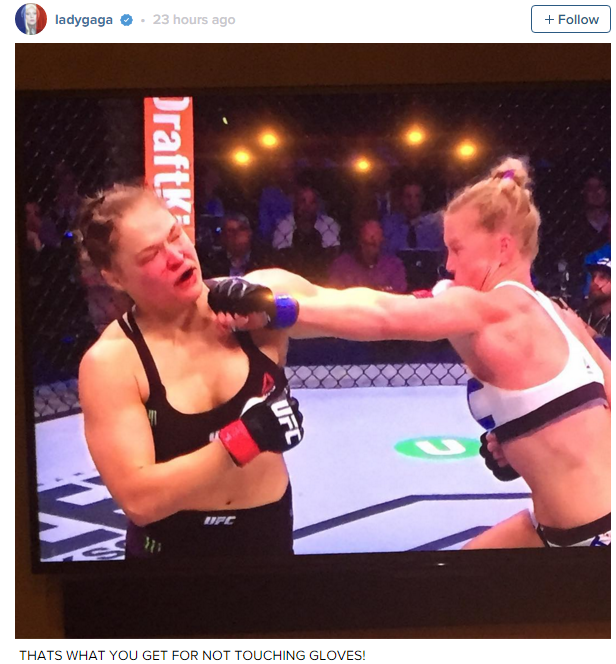
On Sunday morning I awoke to a flurry of messages on my phone and social media. They were all related to Holly Holm knocking out Ronda Rousey and pulling off the biggest upset in UFC history on Saturday night.
I don’t care if you love Ronda, or wish harm to her inside the Octagon, the reality is that unless you’re related to Holly Holm, you watched that fight on Saturday (and every other fight she’s been involved in) because you were attracted to her era of invincibility.
The public is drawn to greatness. Perfection in sports gives us fuel for bigger conversations. Whether it was the undefeated New England Patriots in 2007, Mike Tyson, the Michael Jordan led Bulls teams of the 90’s, or Floyd “Money” Mayweather, when the best are on display, we become attached to the story and compare it to the historical performances of others.
After the fight, athletes, media people, and celebrities weighed in on what had just taken place. Two responses in particular drew even larger attention – a post from Lady Gaga on Instagram, and a tweet by Donald Trump on Twitter.
For the next 24 hours I watched as people continued to celebrate Ronda’s loss and vent their displeasure with her style. As they did so it hit me – Ronda may have lost the physical battle in that cage on Saturday night, but the power of her brand actually grew from this defeat.
Until she steps in that cage again, everything is going to revolve around “how could this happen to the unstoppable Ronda Rousey”. Only she can answer that lingering question, and when she finally does, it’s going to result in a record payday for her, and more pay per view buys and media coverage than any fight in UFC history.
As a personality, you’re tasked each day with finding a way to connect with the audience. How you do it isn’t as important as getting them interested. There are numerous entertainment options available to people, and it takes tremendous skill and intelligence to launch, develop, and preserve a powerful brand. Each decision you make becomes part of your identity, and your audience forms many of their opinions based on your choices.
In Ronda’s case, she created a mystique that divided the audience. Her fans see her as a ruthless badass with an “I don’t give a damn” attitude (which they love). Her critics meanwhile see her as a bully and a trash talker, and someone who doesn’t display class towards her opponents. In both instances, the audience is emotionally invested in her character.
If you work in sports media as an on-air personality, the goal should be to be relevant, interesting, and important to the audience. Being liked or disliked isn’t as imperative. The strongest personalities in this industry are prepared, highly opinionated, inquisitive, unique, and unflappable, and they carry this larger than life presence with them that results in attracting legions of fans and haters.
When you create a brand that matters, the audience will eat out of the palm of your hand whether they want to or not. To stir human emotion and make a person to think requires great skill, and those who possess it, often generate big ratings, and laugh all the way to the bank.
Remember, the same people who made plans to stay up late on a Saturday night to watch Ronda fight, are the same people driving to and from work Monday through Friday. They’ll also be the same people buying the rematch between Ronda and Holly and reliving every single emotion they just experienced this past weekend.
People are drawn in by greatness, confidence, drama, unpredictability, competition, and mystique. Whether it’s sports, radio, movies, concerts, or any other form of entertainment, people are drawn to these characteristics. Does your show provide them on a consistent basis? If it doesn’t, how do you plan to change it?
In terms of wins and losses, Ronda Rousey was a loser on Saturday night. But any individual who has the power to generate that type of connection to an audience, is a huge winner in my book. In fact, they’re the gift that keeps on giving. I’m sure Dana White agrees.
Crunching The Numbers:
101 ESPN in St. Louis turned in an impressive October book, the station’s first with Bernie Miklasz in morning drive. The station produced a 7.9 with Men 25-54 which was 2 points higher than its September book, and good enough for 3rd place. Even more impressive was the station finishing ahead of the market’s dominant News/Talk brand KMOX, which carried St. Louis Cardinals games during the month.
Under The Radar:
Damon Bruce had his contract renewed for another two years at 95.7 The Game in San Francisco. The afternoon talk show host will be with the radio station into the early part of 2018. Congrats to Damon and the radio station.
Chris Hoffman has been hired by Cumulus Salt Lake City to program AC station B98.7. Additionally he’s been named Operations Manager inside the cluster and one of his responsibilities will be overseeing Salt Lake sports station 1320 The Fan.
ESPN’s 30 For 30 “Chasing Tyson” was the #1 rated sports program last Tuesday night. The show delivered a 0.6 and 1.203 million viewers among the 18-49 demographic, beating the World Series of Poker Final which produced a 0.4 and drew 1.147 million, and the College Football Rankings Show which turned in a 0.4 and 1.097 million.
For two years, while 790 The Ticket was pounding WQAM-560 in the ratings (except morning drive, which was very close), one question remained unanswered:
To what extent was The Ticket benefiting from having two signals (790 AM and 104.3 FM), compared to one for WQAM? Because Nielsen Media Research combined the 790 and 104.3 ratings, it was impossible to know for sure.
Now that 104.3 has changed formats (to alternative rock), the playing field between The Ticket and WQAM has leveled in the past two months. And WQAM has capitalized.
In the October ratings book, WQAM had a 1.3 share compared with a 0.8 for The Ticket and 0.4 for WINZ, which owns radio rights to the Dolphins and Marlins. It marked the first time that WQAM beat The Ticket at least two consecutive months since September through November 2012.
In the key male 25 to 54 demographic group, WQAM’s Joe Rose; Orlando Alzugaray; and Marc Hochman, ChanningCrowder and Zach Krantz all beat The Ticket in their respective day parts.
The Ticket beat WQAM, and handily, from 6 to 10 p.m., which included an hour of The Ticket’s Ethan Skolnick and Israel Gutierrez, often three hours of Josh Friedman and ChrisWittyngham, plus Heat preseason games and postseason baseball.
“I’m skeptical of the numbers,” Ticket general manager Doug Abernathy said of the October ratings overall. “We had a lot of disruptions at one time [the format change, Dan Le Batard moving hours, etc.]. It will take a few months to get a true sense” of audience size.
WQAM management declined to comment.
Abernathy said he is “really impressed” with The Herald’s Skolnick and ESPN’s Gutierrez and anticipates them becoming the permanent afternoon drive hosts, while stopping short of saying it’s definite.
Read more at the Miami Herald where this story was originally published
In August, FX Networks CEO John Landgrafspoke at the Television Critics Association summer tour about the state of the television industry. Landgraf said “I long ago lost the ability to keep track of every scripted TV series, but this year, I finally lost the ability to keep track of every programmer who is in the scripted programming business. This is simply too much television, and my sense is that 2015 or 2016 will represent peak TV in America, and then we’ll begin to see declines coming the year after and beyond.”
On the other hand, Netflix CEO Reed Hastings shares a different point of view. Speaking last week at The New York Times DealBook Conference he said “John’s wrong. There’s not nearly enough. There’s a lot more food than ever before, there’s a lot more choice, but I think when you do great content you’re going to find viewers. It comes back to entertainment spending, and entertainment spending has been increasing faster than disposable income for decades. I think as we come up with new experiences, when you look at virtual reality and how that’s going to improve video gaming, you’re seeing continued investment in entertainment.”
Both men raise interesting points and a case can be made for each but I’m not here to analyze whether television has too much programming. I want to spin it towards the sports radio industry because the same question deserves to be asked – are there too many stations operating the format, and does that hurt the format’s ability to generate higher ratings and larger revenues?
When you look at the sports radio landscape today, there are 5 national networks offering the product full time. If you want to include Sports Byline that makes 6.
Then you have SiriusXM which provides national content through Mad Dog Radio and Bleacher Report, and delivers targeted content on channels such as NBA Radio, MLB Home Plate, the NFL channel, NHL Radio and College Sports Nation.
That’s just the national talk part of the conversation. Now let’s add play-by-play into the mix.
Westwood One, Sports Radio USA, Compass Media Networks, IMG, Learfield Communications, and the Touchdown Radio Network all play in this space, and I may be missing one or two but you get the picture.
Now let’s take a look at the local markets. For the sake of this conversation, I’m going to focus on the Top 25 markets. If we went beyond that, you’d find many smaller markets featuring the same amount of choice which is even more alarming considering there are less people and advertisers in many of these places.
MARKET
STATIONS
NEW YORK CITY
WFAN, 98.7 ESPN NY
LOS ANGELES
ESPN LA 710, 570 KLAC, 980 THE BEAST, AM 830 KLAA
CHICAGO
670 THE SCORE, ESPN 1000
SAN FRANCISCO
KNBR 680, 95.7 THE GAME, 1050 KNBR
DALLAS
105.3 THE FAN, 1310 THE TICKET, ESPN 103.3
HOUSTON
610 KILT, ESPN 97.5, SPORTS TALK 790, 1560 KGOW
WASHINGTON DC
106.7 THE FAN, ESPN 980, CBS SPORTS RADIO 1580
PHILADELPHIA
97.5 THE FANATIC, 94 WIP, 610 SPORTS
ATLANTA
92.9 THE GAME, 680 THE FAN, ESPN 1230, FOX SPORTS 1340
BOSTON
93.7 WEEI, 98.5 THE SPORTS HUB, ESPN WEEI 850
MIAMI
790 THE TICKET, 560 WQAM, 640 SPORTS, 940 WINZ
DETROIT
97.1 THE TICKET, DETROIT SPORTS 105.1, WDFN 1130AM
SEATTLE
710 ESPN, 950 KJR, 1090 THE FAN
PHOENIX
ARIZONA SPORTS 98.7, FOX SPORTS 910, NBC SPORTS 1060
MINNEAPOLIS
KFAN 100.3, 1500 ESPN
SAN DIEGO
MIGHTY 1090, XTRA SPORTS 1360
DENVER
104.3 THE FAN, 105.5 ESPN, MILE HIGH SPORTS 1340AM
TAMPA
620 WDAE, 1040 THE TEAM
BALTIMORE
105.7 THE FAN, WNST AM 1570, CBS SPORTS RADIO 1300
ST. LOUIS
101 ESPN, CBS SPORTS 920, 590 THE FAN, 1490 THE CHAMP
PORTLAND
1080 THE FAN, RIP CITY RADIO 620, 750 THE GAME, 910 ESPN
CHARLOTTE
610 THE FAN, ESPN 730, FOX SPORTS 98.7
PITTSBURGH
93.7 THE FAN, 970 ESPN
SAN ANTONIO
ESPN 1250, THE TICKET 760, CBS SPORTS RADIO 860
SACRAMENTO
KHTK 1140, ESPN 1320
As crowded as the list above might be, I’m not even close to being done.
In Pittsburgh and Boston for example, The Boston Herald and the Pittsburgh Tribune have their own full service sports radio stations online through their websites. Those count as programming options which pull away sports radio listeners.
In most of these markets, you’ll find News/Talk brands that also dabble in sports. To shed light on a few, KMOX and KTRS in St. Louis, have produced sports talk at night and on the weekends along with carrying play by play. KOA in Denver, WGN in Chicago, WOR in New York, and WCCO in Minneapolis have all followed a similar strategy.
Then you have music brands which also get involved. In Pittsburgh, 105.9 The X offers music throughout the day, and Mark Madden’s afternoon sports show and Pittsburgh Penguins hockey. 102.5 WDVE which is also in Pittsburgh and a classic rock brand, is the home for Pittsburgh Steelers football.
I haven’t even touched on the stations that offer sports programming in Spanish. When you add them into this conversation, it becomes even more congested.
As of January 2015, the sports format was the 4th largest at 794 stations in the United States. Only Country, News/Talk and Spanish formats received more clearance. Growth has been consistent for nearly a decade, and to put it in perspective, in 2005 there were 500 sports stations, which means that there’s been nearly 60% growth during the past 10 years.
But is that a good thing?
In many of these markets, stations are clearing the programming and using the clearance to justify larger dollars from national advertisers, but the performance is minimal. While the industry loves to tout the number 794 to illustrate massive interest in the programming, it’s a case of smoke and mirrors. Yes there are brands doing a phenomenal job to captivate audiences, but there are also hundreds who are filling air time with national content, and not generating ratings or revenue.
What becomes more puzzling is when you look at the total percentage of audience who consume sports radio. The format’s success is largely dependent on Men 25-54, and even if you stretched the demographic to Men 18-64, an entire market might produce 15-25% of listening. Certain cities like Boston and Detroit may outperform that number, but as a whole this is where we are.
If that’s the percentage of listening that’s available, then how can 4-5 brands operate the format in one local city and expect to run a successful business?
Some folks will point to stations that only offer national content on a smaller brand and say that they shouldn’t count, but the way I see it, if a station can be heard in a local market, and sports programming exists on it, then it counts. If that station pulls in a half a point of listening, that’s a half a point that didn’t go to one of the other sports radio brands in the market.
You can make a case that a city like New York which has close to 15 million people and 9 professional sports teams, can support three sports stations. Dallas and Houston have already demonstrated that three can work, but Los Angeles, Chicago and San Francisco haven’t had the same luck. However, I can’t see three to four sports brands being successful in a market like St. Louis, Portland, Pittsburgh, or Baltimore.
Seattle and Minneapolis (which have a larger population than each of those four cities) tried to introduce a third sports talker over the past few years only to fail. Another similar sized city, Tampa, saw its only FM sports brand (98.7 The Fan) get flipped when the station was sold by CBS to Beasley. The feeling was that the pie wasn’t large enough, even though The Fan had started to make inroads.
It may sound good when we tell people the format is nearly 800 stations strong, but the performance can’t match the distribution. Many in the industry today believe there are too many networks offering national programming. The same can be said of play-by-play providers, and local markets with too many choices and not enough people to listen to them.
With digital listening growing, it’s only a matter of time until the options for consuming content become even smaller. Television is on the verge of an ala carte viewing world, and radio will experience the same fate. The listener today has less time, more distractions, and they want more control, and once the inside of their vehicle matches their cell phone or computer, it’s going to be a game changer. It won’t matter if you have distribution, it’ll matter if your brand and personalities are important enough to be consumed.
To put it in simpler terms, a personality like Bill Simmons will be more valuable than an entire radio station. Users won’t care if the content is distributed through radio or a podcast. If it’s digital or terrestrial radio. If the show is on a station with a big signal or a digital channel that can be picked up by having a wifi connection. You can offer them ten different local outlets to enjoy sports programming and they’re going to go to the one that supplies them consistently with the best content experience.
This discussion started with two CEO’s disagreeing over whether or not there is too much programming on television. I connect more with FX Networks CEO John Landgraf who says there are too many choices, and I believe the same holds true for sports radio.
Being available as an option on the dial is one thing, but standing out on it is another. It’s not about quantity, it’s about quality. That’s what sports radio groups need to focus on because without high quality programming it’s only a matter of time before a brand is obsolete.
I can’t help but think about how much better our format would be in local markets if the best content and people weren’t so divided between so many stations. They say there’s strength in numbers, but I’m not so sure that’s accurate in this case.
Crunching The Numbers:
WDAE in Tampa enjoyed a good October book. The station finished 7th with a 4.9 in the desired Men 25-54 demographic. That was up from 3.8 in September, and a 4.3 during the same time last year.
KNBR in San Francisco turned in a great October, finishing 1st with a 6.3 with Men 25-54. Year to year the station was down nearly three points (9.2) but but that’s largely due to the San Francisco Giants winning the World Series last year.
95.7 The Game in San Francisco had a strong month finishing 6th with a 4.1 with Men 25-54. The station was up from 3.9 in September, and beat KNBR in the 12p-3p timeslot. The Game’s “Papa and Lund” finished in that slot in 3rd with a 5.2. KNBR’s “Fitz & Brooks” were 4th with a 4.7.
Two weeks ago I read a column by Jason Whitlock and it got my wheels spinning. The outspoken columnist who recently left ESPN and returned to Fox Sports stated that we were witnessing the decay of journalism in sports media, and numerous media companies were guilty of allowing it to happen.
Much like any written piece, there were areas that could be disputed, but in general, I felt he raised a number of valid points. There’s no question that the public has a big appetite for sports information. Social media outlets like Twitter and Facebook have increased the interest, speed, and accountability for quality reporting, and most of the content produced on sports radio, television, and websites, is built from it.
But for every major network who commits large resources to employing skilled reporters, the local end of the business does face a different reality. The commitment to developing young people has become a much bigger challenge for many media companies.
Today, people are often thrust into roles they’re not ready for or they’re asked to perform multiple jobs inside of an organization because of limited budgets. That makes it harder to gain deeper penetration on a local beat, and become your very best.
Newspaper readership and advertising dollars have declined, and the radio and television industries have experienced similar difficulties. Those issues unfortunately have caused groups to reduce or eliminate these positions and limit the amount invested in them. For someone who is young, hungry, and looking to create a career as a reporter, it can be disheartening.
Over the years I’ve conducted numerous research projects, and I’ve learned that audiences prefer truth over entertainment. There is a need for both presentations but without experienced reporters investing time in developing sources, and working tirelessly to investigate stories so our demand for accurate information is satisfied, the need for sports content becomes less important.
The sports media business benefits greatly from having highly trained reporters in the field who can cut through white noise to provide a detailed account for what’s taking place. The access to information, and ability to provide it fairly, and in a timely fashion, makes our sports experience more fulfilling. It can be argued that a top notch reporter at a high profile sports network is its most valuable asset next to live play-by-play. With social media playing a dominant role in each individual’s daily routine, the demand for a reporter’s content exists 24/7.
There will always be a fraction of the audience who just want to be entertained, and don’t care to know the truth and will accept certain issues being swept under the rug (MLB Steroids scandal). Most though who watch, listen, and read about sports, want to believe that the results being achieved are honest, and we put our trust in reporters to make sure they are. Nobody has more to gain or lose, than the reporter who’s right in the middle of each story.
If there’s another growing concern, it’s that in many cases, professional sports leagues, agents, and teams have made a reporter’s job even more difficult. For example, the Redskins are notorious for trying to cover up information and present details which can only be viewed through rose-colored glasses. The Packers also recently tried to intimidate a reporter who had published an article about a player with a checkered past.
And those aren’t the only two. There are many others who operate the same way. That unfortunately makes it even tougher to trust those who do conduct themselves properly.
Despite those challenges, reporting is a necessity for our business. Digital and social media audiences are soaring, and sports consumers are investing large chunks of their time to learn everything they can about their teams and the individuals who are a part of them.
While a reporter may not have their name on the marquee of the show you tune into, many times it’s their information and content that dominates the majority of the programming.
The real question facing media groups is “how can the increased demand for breaking sports news across multiple platforms be utilized to generate even larger profits, pageviews and ratings“? Measuring the impact is becoming much more difficult for media operators, but there’s certainly no shortage of interest in the information.
I was curious about the benefits and challenges of reporting, and what it takes to succeed in the field, and figured that if I’m going to write a piece on one of the most important roles in our industry, I might as well ask the best.
In addition to each of these gentlemen being great at what they do, they’re also quality people, who love their profession, and have no issues sharing feedback that will help others inside the industry. If reporting is an area of interest to you, I encourage you to follow each of them on social media, and heed their advice.
Ken Rosenthal – Fox MLB Reporter/Senior Baseball Writer; MLB Network Insider
Q: What do you enjoy the most and least about reporting?
Rosenthal: Being the first to tell fans something they want to know is what I enjoy most. NOT being the first is the thing I enjoy least!
Schefter: There’s nothing like the adrenaline of a big, breaking news story. I love big stories, and would think all journalists do. It’s the equivalent of a big game. Do athletes feel the adrenaline and anxiety of a playoff matchup or championship game? Absolutely. It’s the same thing in journalism. There’s nothing like a big story. As for the least appealing part of the job, you never want to get beat on one of those big stories.
Bucher: What I enjoy most is discovering what inspired a person to become who they are, or what inspired a certain move or decision. Basically, unearthing the back story to an event or entity that everyone may know on the surface. What I enjoy least are people who don’t respond to my queries. Saying no or refusing to be interviewed isn’t ideal, but at least I know where I stand. Not knowing if the message ever reached them is the most aggravating aspect.
Clayton: The challenge of getting the information and getting the information correctly reported. Social media has made the pace of information increase, which is good. The more information the better. What this is leading to is being able to analyze the information and put it in perspective quickly.
Q: How difficult is it to establish yourself on a local level, and how did you build your brand and earn trust locally when you didn’t have a national outlet behind you?
Schefter: That’s not really how I thought about it then, or now. I just tried to do my job as well as I could ever day, treat people as fairly as I could every day, work as hard as I could every day, and wherever that went, it went. If you do those things — act professionally, report responsibly, treat people fairly — that’s how you earn trust and build your brand. They are simple things, but they are harder to follow through and carry out.
Clayton: It just takes time. You have to be patient. You can’t rush stories when they aren’t ready. You earn trust with the way you handle the tougher stories. Not every story is going to be positive. If you handle the negative stories correct, the team or the players involved learn to respect your professionalism. That is how you gain sources. You have to build trust.
Rosenthal: I had a different job at the local level for many years – I was a general sports columnist for the Baltimore Sun. I did a lot of baseball, though, and my initial contacts when I went to the national level were mostly people who had worked for the Orioles.
Bucher: I don’t think it matters who you’re attached to. It depends on the strength of your relationships. Are you fair? Are you thorough? Do you do your homework? And, finally, do you have knowledge or insight that might be useful to the people from whom you’re seeking knowledge or insight? Working for a big enterprise might get your calls returned, or returned faster, but what they’re willing to tell you, and whether or not they’re simply using you because of your platform — and perhaps not giving you the most accurate assessment of what’s going on — still depends on how much they trust and respect you and your work.
Q: When your sport is at its peak level of activity, what does a day’s work include? How many hours are put in, and how do you balance sleep and family commitments with the job?
Bucher: I never can be sure when my sport is going to peak, because I never know when I might stumble upon something that then requires my complete focus. Or perhaps I have a project to complete and therefore need to shut out everything else; that happens, too. But let’s say we’re talking about the traditional peak activity, which is at the trade deadline, the week before the draft and the start of free agency. Generally, everything gets put on the back burner or has the potential to be put on hold for several days during those periods. The key, though, is doing your work early — knowing what potentially could be brewing weeks or months in advance and staying on top of those situations as the witching hour approaches.
When I was in full-reporter mode, everything came second. I am fortunate that I now get to spend a good part of my energy creating unique content or seeking certain stories to report out, as opposed to being subject to chasing down whatever may be going on in the league at any given moment. When that was the case, I was either making calls or thinking about who I needed to reach, and when the ideal time to contact them would be.
Rosenthal: My job never stops – and that’s year-round. Sleep is an issue, especially during the postseason, and during the off-season when I wake up at 6 a.m. to do the MLB Network morning show. As for family commitments, I’m fortunate my kids are older (two out of college, one in). I could not have done this job when they were younger. I’m also lucky that my wife is extremely patient – and I mean extremely.
Clayton: The job is pretty much a 12-to-15 hour marathon. You start by making a to-do list at around 5 or 6 in the morning. You work until dinner if not later. The longer you work, the better it is. Because of that, it is difficult on family commitments and sleep. I am lucky because I have an understanding wife. That is important.
Schefter: Every day is different in this job. The regular season — September through January — has a certain rhythm to it, predictability. I can tell you what any Sunday, Monday, Tuesday, Wednesday, Thursday, Friday or Saturday will be like, and the things I have to get done. It’s the other parts of the year that are more unpredictable and challenging, because you never know when news will be coming. It could happen any time, any day, with any team or player.
There are certain times of the year that truly are peak news periods, where the work never really stops. The few weeks after the regular season ends, when teams are firing and hiring coaches while the NFL playoffs are kicking off; that’s really busy. The week leading up to and then the first couple of weeks of free agency also are non-stop, with calls coming in and going out, and news constantly happening. The two weeks leading up to the draft and the week of the draft also are heavy phone call times, with lots of speculation and questions.
Q: How hard is it to decipher between a real piece of information that has legs, and when an individual or organization are trying to utilize you and your platform to further their own agenda?
Clayton: You enter every interview knowing you’re being used. No one would be talking to you if that person wasn’t trying to present a story from their perspective. There is nothing wrong with that. You just have to recognize what angle that person is coming from.
Schefter: I don’t really think about that often. If you do this job long enough, you create long-standing relationships. People you trust and who trust you are not going to do that to you; it’s unethical and wrong. People think this sort of thing goes on all the time, but if there is enough trust built up, it doesn’t happen nearly as often as you think. And it’s also the reporter’s responsibility to decipher what is real and what is not, what sounds plausible and what is not.
Bucher: I’m not the first to say it, but I wholeheartedly believe it: any reporter worth their salt has a hair-trigger bullshit detector and is a bit of a cynic when it comes to sources and news. That said, sometimes you can’t tell right away if something is on the level or not. Sometimes you can go pretty far down the road and discover that the hot item you had really isn’t that hot. What is disturbing in today’s world of reporting is that finding out an item isn’t as solid as it initially appeared to be doesn’t seem to be a deterrent to putting it out there anyway as “news.” Or maybe it’s that the vetting process, the digging further to see if this juicy item truly is both juicy and an item, just isn’t a de facto part of the process anymore.
Rosenthal: It’s not always easy, but part of our job is to figure out when we’re being used.
Q: What was the one story you got burned on that still stings? What did you learn from it?
Clayton: There isn’t one that comes directly to mind. You learn from every story you do.
Rosenthal: There are too many to mention! And I’m not kidding. I remember the failures more than the successes. Just my nature, I guess.
Bucher: There are two stories that I mishandled that probably will always haunt me. The first concerns Kobe Bryant and his desire to be traded to the Bulls in 2007. I was careful to report only what I knew to be undeniably true, which was that he wanted Jerry West or another addition to Lakers management or he intended to force a trade.
On SportsCenter shortly before training camp opened, I reported what I knew and at the end was asked by Neil Everett, if I thought Kobe would show up for camp. I had been told by an unimpeachable source that he did not intend to show up. So I said, “I don’t think he’s showing up“. Now, that was my opinion, not something I considered on the level of reporting because even if I had been told that, there was no way I could certifiably KNOW that. But that’s how I viewed it, not necessarily how viewers heard it. So, of course, he shows up and I get killed for reporting that he wouldn’t. If I had it to do over again, I would’ve told Neil, “I don’t know what he’s going to do.”
The other one involves a colossal game of catfish, in which someone got the phone of an NBA executive and texted me from it about a trade that could be going down between the Raptors and the Heat involving Kyle Lowry and Chris Bosh. My bullshit detector was buzzing, but I spent three days texting back and forth with the alleged executive, asking questions, trying to poke holes in what they were telling me. Finally, my secret texter said the deal was about to pop and I should be good to go with it. I can’t recall ever reporting a story having talked to only one source, but this executive surely would’ve had a direct line to the information and we had spent three days going back and forth. I didn’t want to expose my source by calling someone else in the organization to ask about the deal — or so I told myself — and finally sent the story.
As soon as I did, the thought hit me — our conversation had only been by text. We’d never spoken. What if? It only took minutes before I received a call from one of the GMs involved who I knew well and who promptly told me the deal was bogus. I felt as if someone had shotgunned my guts. The same evil being then texted me again offering me the Jason-Kidd-forcing-out-John-Hammond story to “make it up to me.” That’s one sick individual.
What would I have done different? What I do now — I never report anything strictly off one source. It’s how I long operated but I’m once more committed to it fully.
Schefter: Sometimes you’re awaiting one final confirmation from a source when a story breaks. That’s never enjoyable. But it’s one of the issues of today. You need to be as fast as possible, yet you better make sure your reporting is right first. That’s the most important thing. But that’s the pressure that every reporter deals with on his or her beat. Be fast. But more important, be right.
Q: What advice would you pass along to someone who is pursuing the path of a reporter, or has just started on the local level and is trying to make inroads?
Rosenthal: Work hard, read a lot, be respectful – and be patient.
Schefter: Be consistent. Be reliable. Be steady. Be productive. Be honest. Be fair. Be professional. Be diligent. Be open-minded. Be curious. Be brave. Be bold. Be patient. Be considerate. Be compassionate. And then you can be whatever you want.
Clayton: Start as young as you can. I was credentialed to cover the Steelers when I was 17. The jobs of the future aren’t yet created. You have to create the jobs, but there are plenty of opportunities. You have newspapers, magazines, radio, television, internet and blogs. If you work hard and are accurate, you should be fine.
Bucher: Be honest. Do your homework. Cover a subject or beat as you would want to be covered. If you want your subjects to confide in you, then you have to let them get to know who you are and how you work. Don’t worry about how big the beat is or the size of the stories you’re assigned; you never know when a small story is going to become a big one. In the meantime, you get to practice on reporting out small stories so when a big one does come along you’re more apt to handle it correctly.
Spend as much time talking with the notebook closed and the tape recorder off as you do with them open and on. I still believe most people will accept the truth being told. They may not like it, they may prefer it be kept quiet, but if it does come to light and it is presented fairly they ultimately will come to understand that it needed to be told.