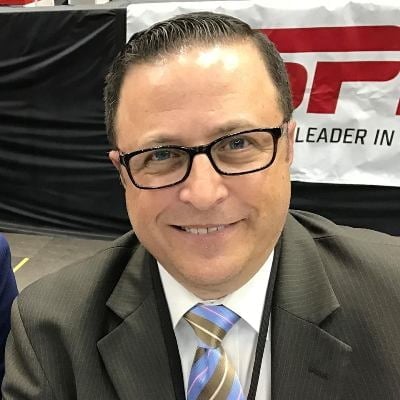
For the first time in his broadcasting career, Richard Jefferson will be on the call for the NBA Finals. Jefferson was named to the top crew in February and will join Hall of Famers Mike Breen and Doris Burke when the series between the Pacers and Thunder gets going tonight. He’s come a long way in a pretty short period of time on ESPN. Now he gets the call on the sport’s biggest stage.
Jefferson was born in Los Angeles and grew up in Phoenix. His mom was very involved in their church, and when the family left LA, it moved with 8 or 9 different families who were also with the church and trying to get away from their rough neighborhood.
The 17-year NBA veteran insists he was late to playing basketball. “I was actually … a late bloomer. I didn’t start getting recruited until my junior year because I didn’t really play organized basketball. I just played in the park and hung out with my boys,” Jefferson told NBA.com in 2015. “My parents would go to work at 8 a.m., I’d wake up, nobody’d be in the house. I’d call my boys up: ‘Wanna go play some basketball?’ And we’d go play, all day every day – and just hoop, joke around, talk trash.”
Things turned out all right for Jefferson in Arizona. He attended Moon Valley High School in West Phoenix, where he was part of the varsity basketball team that won the 4A State Championship in 1998.
College & NBA Career
Jefferson played college basketball at the University of Arizona under Hall of Fame coach Lute Olson from 1998 to 2001. During his 84-game career, Jefferson averaged 11.2 points, 5.0 rebounds, and 2.8 assists per game. He was part of the Wildcats team that advanced to the 2001 national championship game, where Arizona fell to Duke. Along the way, Jefferson was an All-Midwest Regional and All-Final Four selection. He was inducted into the Pac-12 Basketball Hall of Honor during the 2012 Pac-12 Conference men’s basketball tournament.
From Arizona, Jefferson was drafted in the first round of the 2001 NBA Draft as the 13th overall selection by the New Jersey Nets. He played seven seasons in New Jersey, reaching the NBA Finals in each of his first two seasons. After the Nets, he went on to play for the Bucks, Spurs, Warriors, Jazz, Mavericks, Cavaliers, and Nuggets. Jefferson won an NBA Championship with Cleveland in 2016. His résumé also includes a bronze medal as a member of the U.S. Men’s National Team in the 2004 Summer Olympics.
Jefferson was a fixture in the NBA Playoffs from 2001–2017, playing in 140 postseason games. He averaged just under 11 points and nearly 4.5 rebounds per game.
The Road To ESPN/ABC
Jefferson started his media career while still playing. He was a hit on social media and had a Snapchat account that earned him awards. He received For The Win’s “Best Sports Snapchatter of the Year” in 2016.
During the 2017 season, Jefferson began co-hosting the podcast Road Trippin’ alongside former Cavaliers sideline reporter and Lakers host Allie Clifton and teammate and friend Channing Frye. The podcast was known for giving fans a humorous, behind-the-scenes look at life on the road in the NBA.
His first real gig came just months after retiring from the NBA. On October 16, 2018, he joined the YES Network as the Nets’ game and studio analyst, working with Ian Eagle. He also appeared as an analyst on FS1 and the Pac-12 Network.
Jefferson then joined ESPN in 2019 as an NBA analyst. He worked on NBA Today, editions of NBA Countdown, and began calling games consistently in the 2023 season.
What Makes Him So Good?
Jefferson hasn’t been broadcasting for a long time, but he’s made his mark at ESPN and has climbed the ranks quickly. He certainly has the credentials to make a great game analyst.
During his long NBA career, he played in 140 NBA Playoff games, averaging just under 11 points. Jefferson played with many players and learned under countless coaches, which has contributed to his high basketball I.Q. Having been in so many of the situations he’s analyzing, he’s able to break things down easily. As a result, he can put the viewer right there in that spot and make things understandable.
Jefferson has worked with a lot of personalities, whether in the studio or courtside at a game. No matter who he’s with, he holds his own. He’s not a loud “hey, I’m here, listen to me” type, but he makes his points within the flow of a show or a game and isn’t lost in the shuffle.
Jefferson brings some comedic value with him, but it doesn’t get in the way of his basketball knowledge. He has personality and knows when to use it. During a game, it can’t all be “X’s and O’s,” because that can be a little tedious. Proper use of humor and sarcasm can loosen you up, along with the folks you’re broadcasting with.
Case in point: this interaction between Jefferson, play-by-play man Ryan Ruocco, and former colleague, now Lakers head coach, JJ Redick at halftime of a game last November.
Ruocco: And we get to chat right now with our old partner, the head coach of the Lakers, JJ Redick. There was a lot of pressure on him to have the lead at the half, so he could have this conversation with us.
Reddick: I just want to be clear on this, guys. There’s nothing I’d rather be doing less than talking to the two of you. I want everybody to know. I want to be very clear on this. I do not like these two gentlemen. I couldn’t even drop my ATO coming out of the half because I had to do this.
After a couple of questions from Ruocco and Jefferson, Reddick then thanked the broadcasters and took off the headphones.
Jefferson: I’m glad the feeling’s mutual because I’ve truly never liked him as a professional. Yes, we work together, but you know.
Ruocco: When you say this, there’s a subset of the audience that thinks you’re being serious.
Jefferson: And there’s a subset of the audience that knows I’m telling the truth.
Ruocco: And now everyone’s confused. They love each other. Don’t worry.
Jefferson told GQ a few years ago that he has a love for comedy. The interviewer followed up by asking if that love made him want to get into broadcasting and be on TV.
“Yes and no,” Jefferson told GQ. “I think my love for comedy is probably what keeps me here. And I say that because I love the game of basketball. I love it. But for me, I can only talk so much about this stuff,” he said.
“So, I’m finding ways to add entertainment or humor or a shtick or just something. When you listen to comedians and they say a joke and it bombs, they’re like, ‘Hey, guys, sorry, I don’t care.’ You learn that comedy is about failure. It’s about trying things out. It’s about getting out of your comfort zone. And that’s why I love it.”
Often, when someone is new to the game and replacing well-liked analysts, the response is mixed. There have been some fans who haven’t exactly fallen in love with his commentary. Many accuse him of “shilling” for the team theirs is playing. Some don’t appreciate his “hot takes” on things. He’s had high-profile feuds with Bill Simmons and Ben Stiller regarding some of his calls. He’s also called out everyone from Charles Barkley to his own co-host, Kendrick Perkins.
Still, others just say, “he’s bad,” and offer nothing else. All of this means Jefferson has made it as a game analyst. If you’re stoking this much reaction for each game, he’s doing something right. The vitriol isn’t an indictment on his abilities — it’s more that fans are still getting adjusted to a new style, voice, and view.
Every time I’ve heard him call a game, the information seems fair and accurate, even when talking about former teammates. Eventually, I think Jefferson will find a good comfort zone and grow on people because he has the potential to be really good.
Did You Know?
Growing up, Richard Jefferson’s favorite player was David Robinson of the San Antonio Spurs.
“When I first really started watching basketball, it was him and Sean Elliott,” he told CavsNation.com in 2015. “I can remember my second year in the league, when we were down by 10 and they were about to win the championship. On the free throw line, I looked over to him (Robinson) and sort of said, ‘Now that this is all over, I can tell you, you were my favorite player growing up.’”
Barrett Media produces daily content on the music, news, and sports media industries. To stay updated, sign up for our newsletters and get the latest information delivered straight to your inbox.