I spent Friday in New York City attending The Newsletter Conference. Given how important newsletters are to Barrett Media, and watching how they’ve grown in importance, I was excited to make the trip. We’ve had challenges recently with our newsletters so gaining relationships and additional knowledge was needed. Over 220 brands were represented at the show. Noticeably missing were radio and television digital leaders. More on that later. Congrats to Ryan Sager and all involved on a successful show.
I’ve attended different events over the years because they keep me sharp, which helps Barrett Media’s business grow. That also benefits my clients. As the host of an annual Summit, I gain ideas too, which is a great reminder that tickets are available to the Barrett Media Audio Summit, June 30-July 2, 2026 in NYC. Our speakers and sponsors are strong, but it only works if media industry pros are in the room. When things change professionally, and they will at some point, you’ll be better positioned if you’re informed and connected. You can do that by joining us this summer in the big apple.
Ok enough about that. Let’s talk about The Newsletter Conference.
What Stood Out Most
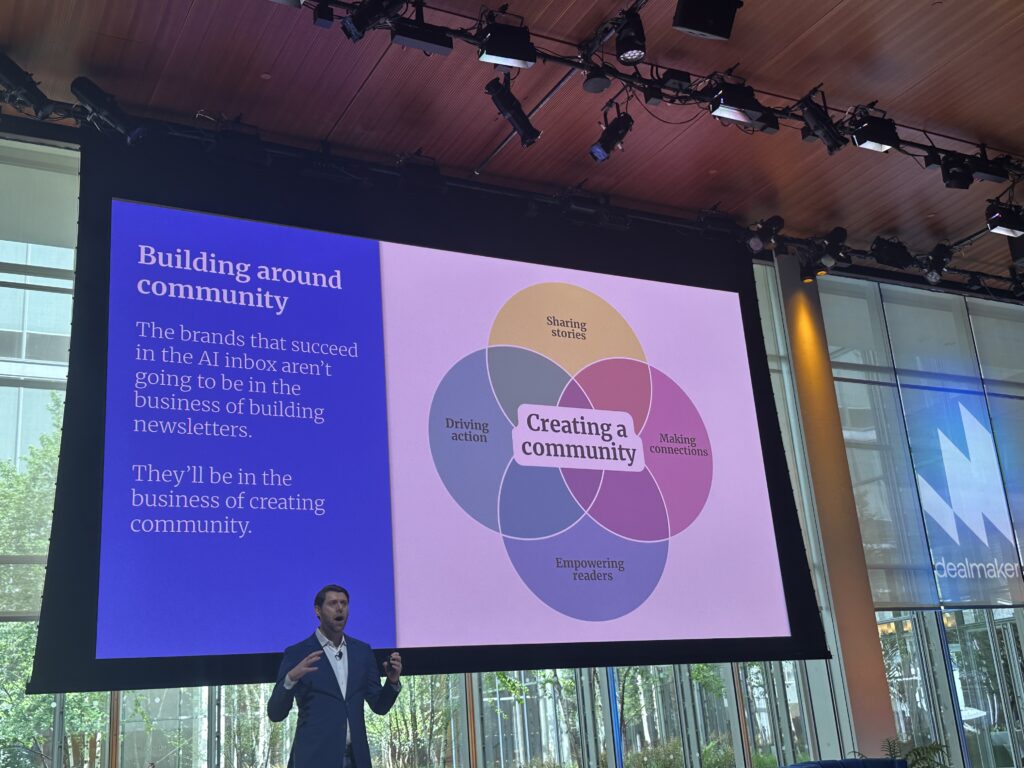
Surviving the AI Inbox by Finding Your Unfair Advantage: Dan Oshinsky, founder of Inbox Collective was outstanding. He examined AI’s disruption of the inbox and shared how brands can help themselves survive future changes. Oshinsky provided examples of international and American brands that generate high open and click through rates and explained why. He reminded attendees of how much disruption has occurred across the media business over the past few decades while email went relatively unscathed. With the inbox undergoing rampant change, Oshinsky addressed critical issues publishers and brands are facing. One of the top two presentations.
How to Grow a $5M Media Business Using The SCALE System: Andy Mackensen, Co-Founder & Chief Growth Officer of The Assist also knocked it out of the park. His session focused on his SCALE system (Subscribers, Conversion, Activations, Lifetime Value, and Enrichment), which included showing ad campaign tests that reached different levels. Mackensen went into detail showing how one campaign had a 46% success rate but grew to 70% with small adjustments. Media pros could learn a lot from this. He also shared why quizzes after signups build brand-subscriber connection, explained why quality audience matters more than large audience (this has been Barrett Media’s strategy from Day 1), and covered the six parts of a funnel that are vital to revenue growth. His best lines, “Rate cards are where sponsorships deals go to die” and “don’t sell ads, sell activations.” One of the top two presentations.
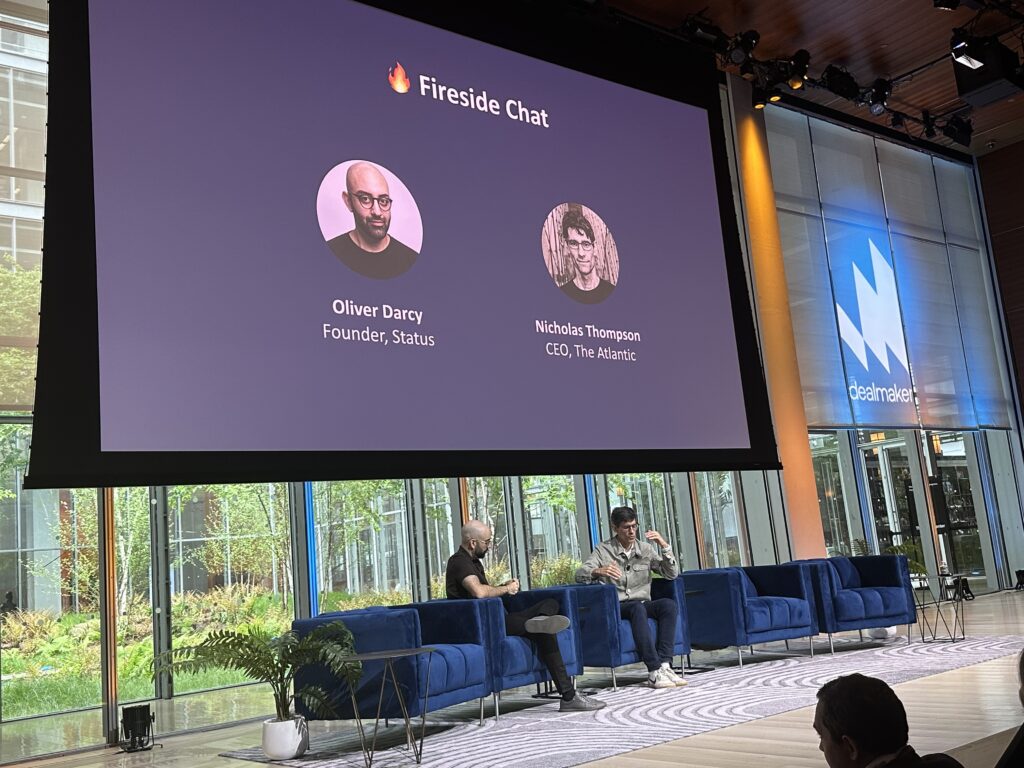
Oliver Darcy with Nicholas Thompson: This conversation showcased how exceptional of an interviewer Oliver Darcy is. After leaving CNN to launch Status, you could tell he was passionate and invested in the subject matter. He listened, followed up, and kept a serious business conversation feeling like a chat between two friends. Additionally, I learned fast why The Atlantic succeeds. Nicholas Thompson is sharp, curious, open minded, and invested in newsletters. He understands how they drive The Atlantic’s business and why one-to-one relationships beyond algorithmic connections matter. Thompson also detailed how he uses platforms to test content and impact, plus both men covered how AI will change the inbox over the next 10 years, and if major brands will need to offer greater incentives to retain top talent. Overall, a smart conversation.
Building Beyond the Inbox: Events are a big focus for Anna Palmer of Punchbowl News, Jacquelyn Cameron of Axios, and Eric Newcomer of Newcomer. All detailed why a big and small events strategy matters. With AI becoming more dominant, the belief is that events will be even more crucial for brands and independent operators. Hearing how Axios identifies their five target audiences and where each brand swung and missed was also interesting. They all agree that influence means more to business than reach and scale. At Barrett Media, we host a successful Summit, but to do 5-6 of them is impossible. Hearing their ideas and feedback though has me rethinking our events strategy for 2027.
Meeting the Audience Where They Are: I wasn’t familiar with Informa TechTarget, The Local Girl Media Group or Entreprenista before this session but I was well aware of Morning Brew. Robin Re, Jennifer Tripucka, Courtney Spritzer and Eleni DuBois came across as four talented, well spoken women. Conversation focused on identifying niche business opportunities, using newsletters and social channels to grow audience and community, and creating events strategy to build relationships and grow revenue. Tripucka’s business strategy for The Local Girl Media Group, and Spritzer’s energy and delivery especially stood out. Just a smart, insightful discussion on how to grow an independent business.
The Art and Science of Getting Readers to Pay: Lachlan Cartwright, Max Tcheyan, and Jacob Cohen Donnelly joined Nathan May to discuss their subscription strategies. Tcheyan’s past experiences at The Athletic, Puck, and Bleacher Report shined bright while Cartwright detailed the value of scoops in driving subs, explaining how it has driven Breaker Media’s business. Cohen Donnelly explained he wasn’t bullish on subs, but has worked with May on a test, which has produced small results, though it’s too early to tell its effectiveness. On a lighter note, Cartwright shared how he was recruited by Tcheyan to join Puck, explaining that they wouldn’t tell him who else would be involved. He camped out at the hotel, saw who interviewed, and then told the hiring team during his chat who they were targeting. The session could’ve easily gone 30-minutes more. May’s questions and directing were a bright spot.
What Could Have Been Better
Sponsorships and Advice: As a conference host myself, I know events are never perfect. Sponsors need time, and a mix has to be offered to satisfy different people. But folks at this event value strategy and information. I’d have liked more insight on how to grow sponsorships, build larger audiences, and correct issues when your emails don’t reach your subscribers. Given the AI rise and economy issues, those issues matter.
If you follow Tyler Denk (beehiv CEO), Austin Reif (Morning Brew co-founder), Matt McGarry, Kendall Baker, Ryan Sager, Adam Ryan, Dan Oshinsky, etc. these leaders really know the space. Their opinions and insights matter. Some were involved in panels but there’s a difference when given time to explore deeper like Oshinsky. Being inside the Times building, Jodi Rudoren of the New York Times would have been great too or Adam White of Front Office Sports. Both use newsletters to drive their businesses. But whether it’s them or anyone else, more focus on how the information on stage can help attendees grow business.
Charging Your Phone: The Times Center is a beautiful building with an exceptional theater but I was surprised by the lack of outlets to recharge. When you’re attending an important business conference, you’re going to use your phone a lot to take photos, write notes, check email, etc.. The good news for the event hosts is that by not having access to charge, it keeps people in the theater. The bad news, if someone’s phone dies they’re not going to be happy. Also, if they stay in the theater, they connect less with vendors. Fortunately, a staffer helped me find a private spot to charge up. Maybe that’s a business opportunity for the next conference – a sponsorable charging station works.
After Party Location: 5th and Mad was a great venue but getting there wasn’t simple. I asked a few people where it was and those walking to the event seemed unsure. Knowing NYC as I do, a 10-minute cab ride at 5pm on a Friday is usually 20-30 minutes, so I chose to walk. It was further away than expected. That may explain why some people who spoke weren’t there between 530-630. That part aside, the venue, food and mix of people were good.
Radio’s Missed Opportunity
The radio business was missing in action at this event. Why? The industry proclaims to be digital, but what that really means is radio, podcasting, apps, video, and social media. Newsletters and websites are digital too but the strategies used by most radio groups are poor. Presentations often look similar to what existed 10-20-30 years ago.
I receive newsletters from many radio brands. To be blunt, they are not worth opening. I looked at recent emails sent by WFAN, 98.5 The Sports Hub, 97.1 The Ticket, Arizona Sports, SKOR North, 680 The Fan, 101 ESPN and WWJ Newsradio 950. Most were promotional/advertising filled or directing people to audio links to listen. Little content value is offered inside the newsletter. Most don’t prioritize growing open/click rates, subs or generating larger advertising.
Some of those newsletters don’t even display content in the inbox. Graphics are used and blocked by Gmail and Outlook. In addition, most of the newsletters land in Gmail’s promo folder or Outlook’s Junk folder. That means people have to make an effort to move them into their inbox. When your newsletter headline reads “we open the big ole tub of pretzels” it provides little reason to open let alone click. That might be a great on-air radio bit, but inside the inbox, you need a stronger hook.
Additionally, how many brand leaders actually look at the newsletter content created and distributed by their station? Would any of it be good enough to lead your opening segment? As a member of the radio station, do you even open your own newsletter? I know many people at stations who don’t. Guess why? They know it’s fluff. But it doesn’t have to be. It can be an asset with the right strategy and focus, and it can make you money.
Here’s why this matters. Total U.S. digital ad revenue in 2020 was $139.8 billion. By 20205 that number soared to $294.6 billion. Of that $294 billion, 81 billion went to websites and 37 billion went to newsletters. That’s about 40%. The IAB cited newsletters as the fastest-growing sector of the digital media market, jumping up 26% year-over-year. Axios, Puck, Punchbowl News, The Free Press, Morning Brew, and Front Office Sports all launched between 2015 and 2022. They are each valued between $50-$500 million dollars. How much is your radio station worth today compared to a decade ago? That should get your attention.
Each year radio folks mention radio advertising declining, social media producing peanuts, subscriptions, events and merchandise strategies not being important, and sellers seeing less value selling podcasts. Meanwhile, spaces like newsletters and websites grow despite little focus from the radio industry. Execs will not increase their brand valuations or annual revenues without adjusting. There’s tons of opportunity out there but sometimes you have to enter new rooms to find out. I did on Friday. Maybe it’s time you did too.
Barrett Media produces daily content on the music, news, and sports media industries. Sign up for our newsletters to stay updated and get the latest information right in your inbox.