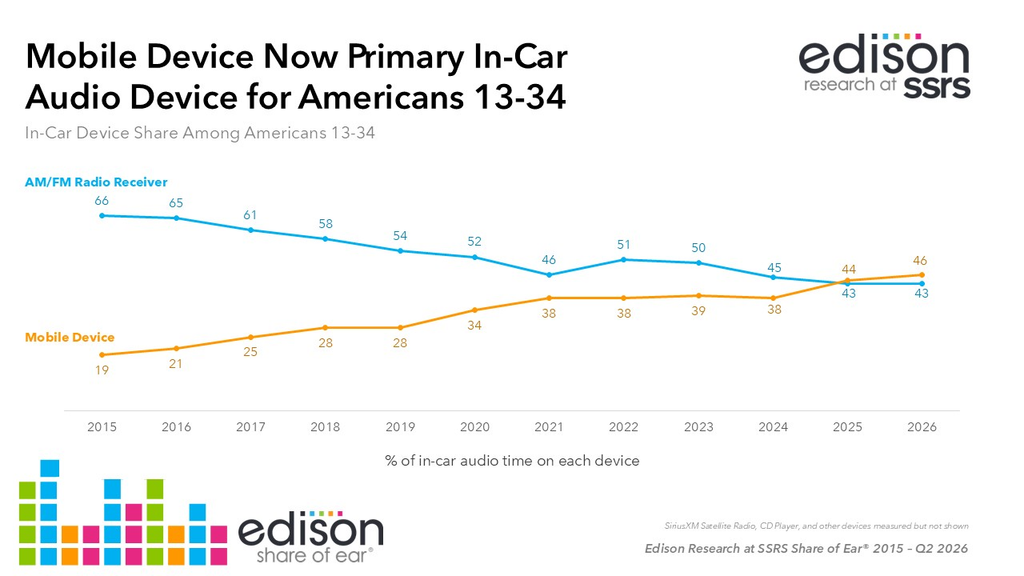
The latest data from Edison Research should make every programmer, general manager, and sales leader stop and think. Among the 13-34 demographic, the phone is now the primary audio device in the car. AM/FM radio has slipped to second place.
The numbers tell the story. In 2015, 66% of that demographic called AM/FM radio their primary in-car device. By 2026, that figure had dwindled to 43%. Meanwhile, the share calling their phone their primary device jumped from 19% to 46%. That’s a 23-point drop for AM/FM and a 27-point jump for mobile in 11 years. The lines have crossed, and they aren’t crossing back.
So, what does that mean for AM/FM radio today? On one hand, it means nothing. Many stations aren’t targeting the 13-34 demographic anyway. But that thinking is shortsighted. You should always be prospecting for new clients, right? That rule isn’t just for the sales department.
Focus on the 34, Not the 13
It’s abundantly clear we’ve reached a crossover point. However, don’t focus on the “13” portion of that demographic. Focus on the “34.”
For many stations, those listeners are on the cusp of landing in your target demo. Think of it as a pipeline. The habits they’re forming now will follow them into the audience you sell today. If they’ve already handed the dashboard to their phones, you’re already behind the 8-ball. That isn’t going to magically change anytime soon. You need to have a plan to attract those listeners to your content, whether it’s terrestrial or digital.
So, what can you do to attract them?
Two Schools of Thought on the App
I think there are two approaches, and both work. The first is simple: have a bomb-ass app. People in the industry love to rag on iHeartMedia, and sometimes that’s justified. However, the iHeartRadio app is awesome. From a design, functionality, user interface, and ease-of-use perspective, it’s a fantastic product.
The opposite end of the spectrum works, too. If you can’t build a bomb-ass app, make it as simple as possible. I never like to slip into “back in my day” mode. Still, the first mobile app at one station I worked for was amazingly simple. The screen showed the logo, a gigantic play button, and individual stop and mute buttons in the bottom left corner. That was it. There was no talkback button, no podcast tab, and no nonsense. Download the app, click play, and boom, you have the station.
Either way, the goal stays the same: remove friction between a listener and your content. You can market either product. You can make the case for why both work. But you can also go a step further.
The Case for an App-First Station
The first time I heard about 95.7 That Station in Raleigh, I thought the idea was genius. Launched in 2018, the station makes no bones about being an “app-based station.”
Its terrestrial signal stinks. When you’re in that situation, you have to do something different to compete. So they did. They put all of the focus on the app rather than the radio signal, and the accolades followed. Instead of treating the app as a side project, they treated it as the product. That mindset shift matters more than any single feature.
I’m not saying that approach works for every company, brand, signal size, or market. I am saying that chasing the content listeners want on an app is never a bad idea.
Think Like a 13-34-Year-Old
Finally, put yourself in the shoes of that demographic. They haven’t grown up the way you likely did. What do they value? What do they want?
Trust me, remembering a frequency number is far harder for that group than knowing which app handles which task. Keep that in mind when you’re branding your station and building your digital distribution. Kids today call over-the-air TV with plenty of ad breaks “vacation TV”, because that’s the only time they experience it. As wild as that sounds, it’s true.
Ultimately, the crossover has arrived. And the Edison Research data proves what we already knew. Younger audiences put much more emphasis on their phones. You can argue that the industry misplayed that push that’s been steadily growing for years. But there’s also time to rectify that, too.
Radio has always won by meeting listeners where they are. Right now, more of them are on their phones. You need to be, too.
Barrett Media produces daily content on the music, news, and sports media industries. Sign up for our newsletters to stay updated and get the latest information right in your inbox.