600 KOGO is experiencing another change. Mark Larson has departed the outlet.
What We Know: Larson departed the iHeartMedia San Diego news/talk station last week. At the time of his departure, he was hosting a one-hour show from 7-8 PM. He had previously been paired with Leland Conway for the early evening timeslot. Conway is also departing 600 KOGO. He is now hosting middays at 840 WHAS, the iHeartMedia Louisville news/talk station.
What They Said: “I’m sure glad that my book is not completed yet. Turns out I need to write another chapter or two about unexpected events this week. I’ll explain soon.” -Mark Larson
What Remains Unclear: If Larson’s departure is tied to the iHeartMedia layoffs. While hundreds have been cut around the country, Larson has not stated the reason for his exit.
What It Means: Larson’s exit is the latest in a string of moves for 600 KOGO. Mike Slater, alongside Leland Conway and Mark Larson, also departed the brand earlier this year. Larson has been a longtime figure in San Diego radio. Last month, he celebrated 50 years on the air in the market.
Barrett Media produces daily content on the music, news, and sports media industries.Sign upfor our newsletters to stay updated and get the latest information right in your inbox.
Stephen A. Smith isn’t threatened by Pat McAfee’s reported potential payday with ESPN. He’s framing it as a market-setting moment for black talent in sports media.
What We Know: ESPN and McAfee’s team are reportedly discussing an extension worth $60-65 million annually. According to The Athletic, McAfee currently earns roughly $30 million per year under his existing deal, which runs through 2028. Smith, meanwhile, signed a five-year, $100 million ESPN contract in 2025. When asked at the Barrett Media Audio Summit on Tuesday about McAfee’s reported extension price, Smith applauded McAfee for the number he reportedly could earn from ESPN.
What They Said: Stephen A. Smith (via Barrett Media Audio Summit): “First of all, I’m happy for him. He’s earned it, and I truly mean that. I do believe, even though it makes people uncomfortable, as a black man that I don’t believe that’s an opportunity that would ever come to us first. In our society, we can say that’s fortunate or unfortunate. But the reality is that there usually has to be a precedent set before somebody is in a position to capitalize off of that. I’m certainly positioned to capitalize off of that. Make no mistake. I will be. But I definitely think along those lines, business is business. He’s earned it with a multitude of things that he has done. I’ve been incredibly successful in linear. He’s incredibly successful in streaming. The future is there, and I think that’s incredibly important.”
What Remains Unclear: McAfee’s extension is not official with ESPN. It’s also unclear if McAfee could be in discussions with any other networks or streaming platforms. ESPN has not commented on the matter.
What It Means: Smith’s comments frame McAfee’s reported extension discussions as bigger than a salary story. He’s positioning it as a precedent that could reshape opportunity for talent who look like him. If ESPN pays McAfee $60-65 million, the network sets a new financial and cultural benchmark. That benchmark could shape Smith’s next negotiation and the industry’s broader pay structure. Instead of animus, Smith is showing grace and celebrating the moment for not just McAfee, but also ESPN.
Barrett Media produces daily content on the music, news, and sports media industries.Sign upfor our newsletters to stay updated and get the latest information right in your inbox.
Day 1 of the 2026 Barrett Media Audio Summit Presented by Point to Point Marketing is taking place inside the SVA Theater in New York City. Barrett Media News Editor Garrett Searight is passing along key takeaways from this year’s sessions and speakers.
Check back throughout the day to find out what you’ve missed.
Barrett Media President Jason Barrett opened the show by welcoming attendees to the SVA Theater in New York City. He noted that Nielsen ratings have grown 3.8% across PPM markets since a change in measurement. He then shared concerns about what is or isn’t acceptable coverage in a story, pointing to the widespread video of Charlie Kirk’s assassination last September. That led to questions about what does and doesn’t constitute as “television” in 2026. It’s the same challenge radio is facing in 2026. The rise of AI only exacerbates the questions.
9:10-9:50 AM: A Few Good Brands
Drew Anderssen (Audacy/1080 KRLD)
Mary Sandberg Boyle (WGN Radio)
Ben Mevorach (1010 WINS)
Ken Charles (95.5 WSB)
Moderator: Chris Berry (iHeartMedia)
Berry opened by noting that the panel assembled represents some of the biggest brands in the format. He asked Mevorach about moving 1010 WINS to the FM dial on 92.3 FM.
“Certainly, we’ve seen interference on the AM band. That interference was growing and growing and growing,” Mevorach said. “So our move to FM changed everything. It was our rebirth, really. It was our blow up. We don’t look at WINS as competing as the all-news vertical. We’re competing with everyone on the FM dial.”
Mevorach added that the business model no longer supported 1010 WINS and WCBS 880 both, which led to 1010 WINS being the main news brand for the company.
Berry then asked Anderssen about competing in the spoken word space in a competitive market like Dallas. He noted that many of his competitors are, like KRLD 1080, strictly on the AM band. It also changed to a more spoken word format compared to an all-news brand. He added that it’s led to longer time spent listening than the previous format.
95.5 WSB’s Ken Charles said that it’s important for the station’s programming to be where every listener is. He said that the changing demographics of the city mean they can’t rest on their laurels.
“2 million more people are moving to Atlanta in the next five years. We can’t rely on three letters to carry us,” Charles said.
Like others, WGN Radio isn’t available on FM. Knowing those challenges shapes how the station operates.
“We find that we have to do our consistent programming so that the audience knows they can return to us, but that they can also return to us because they know what they can get when they listen,” Sandberg Boyle shared.
Mevorach noted that the station’s cume has nearly doubled to 2 million since it moved to the FM dial. However, he added that the station made conscious decisions to be an “FM-sounding station” before it made the move.
Charles said that programmers have to know what makes their brand. He shared that Atlanta listeners expect a strong news presentation, even if they’re a talk-first listener. “When we look at the strategy for the radio station, it’s a news-first strategy,” Charles said. “On radio, on social media, on Facebook. The things we do first on those social brands is news.”
KRLD 1080 moved from all-news to adding more talk programming during the day. But Anderssen said it’s still a news-focused brand.
“We are talking about the news all day long, in one capacity or another,” said Anderssen. However, he said that hosts still need to be able to cut through, because there are so many options to consume news today.
Berry noted that sports has always been a way to build cume. WGN Radio is home to the Chicago Blackhawks, and Northwestern Wildcats. It also broadcasts primetime NFL games. So that adds to the cume of the station. However, she noted that knowing what your lane is is important.
“We are not news first,” Boyle shared. “We have a competitor in the market that does that better than us. But we provide context. And WGN Radio has excelled at that for 100 years.”
Weather coverage can also be a strong cume driver.
“You can’t do enough of it,” Anderssen said. “It’s something you need to do all year long. That branding has to not just happen in severe weather season. It has to be all year long.”
“A lot of our anchors are failed meteorology students,” Boyle said with a laugh. “Dipping our toe in weather coverage is really fun for the station. It’s something important that we can provide.”
“When it happens in your car, you can’t turn on a TV,” added Charles. “If your power is out, you can’t go to the TV. So you need to own that. They can listen on their phones. They can still consume you.”
Mevorach noted that traffic coverage can also help in that space.
“I look at everything we do minute by minute. We’re very blessed in New York to do research. And we can see traffic is still really important. You can have a philosophical conversation about whether or not traffic is still relevant. In the past 15 years, traffic importance hasn’t dropped. We have a system in place and conversations about how to do alternate routes. It is an integral part of our radio station.”
Partnerships with TV stations has remained a critical relationship for large brands.
“Aligning with a television station just makes us bigger and stronger,” said Boyle.
“I want to be partnered with as many organizations that provide reliable, trusted information to the audience as possible,” Anderssen shared. “When I scroll on social media, I’m gonna see the same story 100 different times. I wanna see it through a different lens. I want to see it in a different way.”
“Can 95.5 WSB survive without a radio partner? Yes. Do I want to to survive without a TV partner? No,” said Charles. “They can do things I can’t do. It doesn’t hinder the brand, it enhances. Partnerships are key to get you out of your universe and into a much bigger universe.”
“It also helps in exposure. If I create a partnership with a local TV station, I’m going to get promotion on that station,” Anderssen added.
Verifiable and credible news is becoming a bigger challenge.
“Our philosophy is human-in, human-out,” said Mevorach.
“AI is a great way to be more proficient and efficient. But you still have to have someone making sure that a newscast is still correct,” added Anderssen. “AI is getting better every day, but for right now, humans are still a large part of the process.”
9:50-10:30 AM: Evolution of Influence
Phil Boyce (Salem Radio Network)
Hank Fuerst (Ramsey Network)
John Sylvester (Fox News Audio)
Moderator: Pete Mundo (KCMO Talk Radio)
Hank Fuerst is newly promoted as the Vice President of Ramsey Solutions. He began by noting that one of the company’s priorities is serving its existing partners while also seeking new relationships. Digitally, however, it’s completely different.
“The first thing I think about every morning is ‘What is the algorithm going to do today?'” Fuerst said. “That’s embarrasing to admit but it’s true. Those algorithms decide everything.”
Salem Media began as a Christian broadcasting company. Boyce noted that the company evolved because research showed listeners moved from their Christian stations to news/talk brands. So they began buying signals to launch the Salem Radio Network.
“Every day we wake up with a show screaming to get off our chest,” Boyce said. “It provides a constant stream of talk topics. You can’t get out of the way. We have to be relevant and cognizant of things going so we can tell our listeners what we think about it, and help them figure out what they think about it.”
“For us, we started in ’03 with 40 affiliates, to now having 3100 different affiliiations,” Sylvester added. “It’s every platform now. I’m thinking about our syndicated partners. I’m thinking about every platform out there and making sure our content is credible and trustworthy. It’s a constant mind meld of all of the stuff we’re doing. I think we’ve really pivoted and created multiple platforms and aren’t cannibalizing our partners on terrestrial radio. We’re constantly thinking about multiple platforms and multiple partners.”
Mundo noted that no one owns the algorithm. So, how do leaders help build a network when you’re at the mercy of something you can’t understand?
“We’ll diversify. For us, the algorithms play a big factor for us, but we’re driving people back to our home. It’s hard to operate a platform on rented land,” Sylvester said.
“The truth is I don’t think there’s any less desire to listen to what we do than there ever was,” Boyce shared. “There’s just so many different ways to do it. We made our own OTT television platform to just reach listeners and viewers where they are. Video is where the action is. YouTube is such a behemoth now. We have to be in that space, too. Every one of our shows has the look of a TV studio behind it. Multiple cameras, multiple people working behind the scenes that never had to worry about what it looked like when we were just radio. Everybody has to do it now to go forward and succeed.”
“It’s a similar strategy for us at Ramsey Network,” Fuerst said. “It’s easy to get caught up and forget that it is rented land. Ultimately, we want to drive people to our destination. If you look at the metrics to each individual platform, you’ll see that they want platform-specific content. I think the thing that we don’t see in the data but remind ourselves is to remain consistent. We have had the same show, but I think it’s been a benefit that our show has been consistent since 1992. That show has been able to transcend radio into podcasting and now into social media. As long as we’re helping someone on the other end, we don’t care what the data says. We’re going to stay consistent.”
AI is impacting everything. Phil Boyce noted that the company has an AI news service operating in Chicago to see how listeners respond. It’s something Salem is still in its infancy.
Fox News Audio, however, is using it extensively.
“Between talk, syndication, podcast business, and streaming audio, we are going to leverage the tools. We use it for metadata, research, and other ways. But we’re never going to take it right to air. I think it’s a great tool,” Sylvester said. “It’s making our team more efficient. It’s going to save you a ton of time. At the end of the day, it’s about the content. If you can create really great content, and save time by using AI, it’s an efficiency multiplier.”
Terrestrial radio still matters, despite many other platforms and options.
“Radio built the brand, so we’re not gonna turn our back on a medium that helped build the brand,” said Fuerst. “There’s a magic that transcends into digital. We’re capturing the magic that happens. We’re still live every day. There’s a magic in live, and there’s a magic in radio.”
“Most of us still love radio and always will,” Boyce added. “We’ve been lucky to find guys who love the medium. It’s just a different way of reaching your audience now. But radio will, in my mind, always be with us.”
“For us, why would you not put your content on radio?” Sylvester asked. “Radio still has a tremendous reach. We may live in New York or LA, but the middle of America is still listening to radio. It’s got reach and habit. And it’s local. People still need that. We’re up 10% and added 300 new affiliations. We’re not turning away from radio. That impact alone, the marketing value alone, is so important. We look at it that way.”
Talent is always changing. So where are leaders looking for new talent?
“I look everywhere,” Boyce said. He explained how Salem Media worked with Cumulus Media to add Larry O’Connor to morning drive. He added that 10 years ago, it would have likely been impossible. But the partnerships has worked tremendously now.
“A lot of them are fans of the brand first,” Fuerst said of where Ramsey Solutions finds talent. “That’s been the strategy to this point. The game has changed, though. To be a Ramsey Network personality, you need to physically move to Nashville. You’re going to come work for us, and we’ll help you build the brand. But a lot of creators can leverage the platforms to build their own brands. We’re going to need to take the Ramsey Network far and wide.”
John Sylvester shared that he’s looking digitally. “It’s TikTok, Substack, or YouTube. We don’t look at it from just a pure follower count. We do video for everything. I think that we look at that talent and say ‘Ok, how can we cultivate this and build together?’ We’re gonna take that talent, know their authentic, and know they understand the space, and if they come in and understand that? We’ll cultivate that.”
10:30-11:10 AM: Are You Not Entertained?
Adam Carolla (PodcastOne)
Jimmy Failla (Fox News)
Buck Sexton (Premiere Networks)
Moderator: Jason Barrett
Barrett asked about how each panelist got to where they are today and what they envisioned.
“I was a carpenter and a boxing coach before I got into radio,” Carolla said. “I always wanted to do radio. It was my first love. I did radio for quite a long time all through my TV career. I didn’t set the bar too high. Frankly, I just wanted to get off the construction site.”
“I’m accidental media,” Sexton said. “I had resigned from the CIA and was going to Columbia Business School. Glenn Beck convinced me to bail on business school and go work for him in one meeting. Three years later, I was filling in for Rush Limbaugh.”
“I was driving a cab 12 hours a day,” said Failla. “I was doing standup at night. A Fox booker saw me at a comedy club. My first hit on Fox was during a taxi shift. It was in the middle of a hit. That turned me onto Fox’s radar. I then began writing for Kennedy, and that was really my break.”
Buck Sexton and Clay Travis replaced Rush Limbaugh after his death. It was an interesting process to make that transition.
“We had a very honest, from the get go, conversation both off air and on air with the audience about what the mission was. There was no replacing Rush,” Sexton said. “The decision to go with two hosts was essentially an admission that there’s no replacing Rush. The joke that we make with some frequency is no one could fill Rush’s shoes, so Julie (Talbott) put Clay in one and me in one, and we move it forward. We complement each other well. But we were honest. We’re not Rush. But we’re here to do the best we can for the audience. We love the audience and want to do our best for them every day.”
Failla pointed to the success of Greg Gutfeld as for why Fox News would take a risk on a taxi cab driver and comedian.
“Gutfeld’s success absolutely created my opportunity,” Failla said. “But I bring a different perspective. Greg may know one lane, but as a former New York City cab driver, I know a guy named Jesus who sells stolen flat screen TVs. I just try to come into it at my level.”
There are copious amounts of data available for everything today. But do these hosts pay attention to it?
“I honestly just try to focus on the quality of the work,” Sexton shared. “If I think the work is solid, I think the audience will, too. The people writing checks and renewing contracts will let you know if things aren’t working. There’s a lot of gaming of the data that works online. That’s something people in the business are much more aware of than the general public. I don’t want to be paralyzed by the data. Obsession with data isn’t always a good thing. Some things go viral that aren’t good for your brand. Some things are going to reach people you don’t want to reach.”
Failla said he once overheard a conversation between Jay Z and Julius Erving about his process in create music. The artist said ‘You can’t make art with business in mind.’ And Failla has kept that in mind.
Carolla says he takes a different approach.
“I’ve done a lot of TV shows and other projects. If you’re on a show that’s working, you’ll get stopped at the airport,” he said. “I was at a Father’s Day thing last weekend in LA, and people kept stopping me and saying ‘Keep doing what you’re doing, keep up the good work.’ So I knew it was getting out there. I didn’t need to look at a graph or crunch numbers. If you’re doing a podcast, you’ll know if it’s working. All the metrics and meters in the world can’t fix it. But you can analyze what the audience likes based on some data. There is a lot of data that can be gleaned from YouTube.”
The panel also discussed how they handle serious and humorous topics.
“If there is anything of remote seriousness in the world, Fox wants me away from TV,” Failla said. “There’s no way they’re putting me on TV. I’m like a cable news palate cleanser. There’s bad news, and then I come on and make balloon animals. On the radio side, it’s more conversational. You have more time on the topics. You can eventually drive the subject away from the serious topic.”
“You have to be authentic. The audience doesn’t want fake tears and sincerity,” Carolla said. “It’s also nice — and our job — to try to find the humor in whatever the tragedy is. Some of the hardest times people will laugh is at a funeral. There can be a lot of humor in tragedy and I think it’s about doing it in a way that’s on brand and authentic.”
“Something that is sometimes an advantage for me and the show is the expectation that we’re going to cover the news,” Sexton said. “But then, out of nowhere, I can do an Anthony Fauci voice and start to work in something that the audience does not necessarily expect. I’m not a comedian, and Clay isn’t a comedian. Some of the best advice I’ve been given is just be yourself. They expect you to be ‘this guy’, so be ‘this guy.’ Our show is a conversation between two guys. We try to balance the humor and the seriousness. You’ve gotta strike that balance.”
11:20 AM-12:00 PM: News/Talk’s Front Seat Advantage
Juan Galdamez (Xperi)
Galdamez began the session by discussing the capabilities of Xperi’s DTS AutoStage, and the data that is provided. More than 6 million vehicles are now equipped with the ability to report data on what drivers are listening to.
“It’s all AM/FM, HD, translators,” Galdamez shared. “We launched our metrics two-and-a-half or three years ago. We launched our new portal and added more data going into the NAB Show. And we added this ranker that shows any station’s share, cume, average time spent listening, and total time spent listening.”
For instance, in a market like Cincinnati, there was data provided by more than 22,000 individual cars. That allows next-day data of those metrics.
“Having access to data like that before has never been possible,” Galdamez noted. “How we deliver data in New York is how we deliver data in Kenosha, Wisconsin.”
The figures can also be broken out by daypart activity in addition to the entire day, and four-week trends. A heatmap, showing the point of consumption for each listener, is also made available.
Specifically for the news/talk realm, stations can see where they’re overperforming and underperforming the past month’s trends. The broken out data can also highlight how important stations are during breaking news events.
The data also shows some news/talk stations are earning more than two hours of time spent listening, according to the DTS AutoStage data. That is up from a half-hour that was originally seen when the service was first unveiled.
1:00-1:40 PM: The Keynote Conversation
Audacy CEO Kelli Turner
Jason Barrett began the conversation by asking Turner about risk-taking. Many point to her position as a relative radio newcomer as a point of contention. But she believes that’s the best way to operate.
“It’s been a really interesting almost 18 months now,” Turner said. “I’ve learned a tremendous amount and feel like I’ve joined a fantastic company. Entering Audacy, I knew several of the brands. I’m from Detroit and we have great brands there. But I didn’t really understand some of the passion and connection radio brings to people’s lives. We’re taking risks we believe in. But it’s not just me. There’s a team of 10 of us that are in the decision-making process.”
During her time on the job, Turner has tried to better align the business and its future strategy.
“I wanted to help, and it was a company that was emerging from bankruptcy in an interesting position. But once I joined the board, and then once I came in as interim CEO, I got really excited about what we could do. In terms of what we needed to change, I think we really just needed to stabilize. I think we needed to sort of have the right financial discipline, the right operational discipline. So that we could move from sort of stabilization to eventually growth and really invest in our brands and our people, and what we’re building. There wasn’t sort of one thing that I came in and said ‘We need to fix.’ It was a little bit more, ‘How do we just get sort of a great team with great assets all on the same page, all working together for the same outcome? We’ve done a good job of aligning around a strategy and where we’re going as a team.”
Yesterday, Audacy announced plans to sell its St. Louis cluster to Hoffmann Media Group. That was a decision that the company couldn’t ignore.
“It just makes too much business sense to not do. Look, we’re going to be opportunistic. If people come to us with a compelling offer, we need to consider everything. We were not looking to sell St. Louis. We have great stations in St. Louis, we have great people in St. Louis and great brands,” said Turner. “This was the right buyer coming to us at the right value. It was something we had to take seriously. We think it’s really good for our people in St. Louis. And we think it’s good for us as a company. We have very positive thoughts about St. Louis, our brands, and the people there. But I think this is going to be great for them and great for us.”
Audacy went through the process to eliminate the Market Manager position. Turner explained the strategy behind the move.
“Throughout my career, I’ve always tried to sort of get things done quickly and be in a position where we can help move things along fast. These situations where you have to go through this person, and then that person, and then that person, and then that person? It’s a lot, and it slows people down. You can’t get decisions made. In this new structure, we know exactly where to go for everything. More importantly — and people that work at Audacy are sick of hearing this — but sharing best practices is really important,” said Turner.
Audacy is a major player in the sports radio space. Kelli Turner says one you do something well, you do it often.
“One of my very early moves was Chris (Oliviero) in his expanded role, and Bob Phillips as Chief Revenue Officer. The minute I walked in, all I heard from Bob was ‘sports, sports, sports,'” Turner said. “Obviously, I think everyone in this room knows that Chris is an expert in sports. They kind of had me at hello. There are people who say that the radio companies aren’t investing in their brand. They’re not investing in content. They’re just cutting costs. Financial engineering, et cetera. This isn’t about financial engineering. This is about doubling down in something that we do very well, that we’re passionate about. It’s not that hard to tell the sports story to advertisers. It is the easiest story that podcasts are probably the easiest stories that we tell. If we can’t launch a great FM sports station in LA, then maybe nobody can.”
As it comes to the future of Audacy, the company believes in brands and the spoken word format.
“I think it’s sports, sports, sports, to quote Bob Phillips. Spoken word is very important to us in general. Brands are very important to us. When I look at the company, that’s how I look at it. And I think we’re going to be more focused over time. I think we’re going to double down in the areas where we think we can lead and grow and succeed. We feel really good about our position in the industry, about what we can be in the future. I think we have laid a lot of groundwork in the last 18 months as a team, and I think we are well-positioned to have a successful future and excel in the things that we’re doing.”
1:40-2:20 PM: Playing the Trump Card
Larry O’Connor (105.9 WMAL/Salem Radio Network)
Sid Rosenberg (77 WABC)
Mark Simone (710 WOR)
Moderator: Erick Erickson (Compass Media Networks)
Erickson opened the panel by asking, with all the data that shows people don’t want to hear about President Donald Trump, how they handle the news when it’s constantly surrounding Trump.
“How do you express your opinion without alienating all the people who don’t want to talk about Trump? But he brings out passion in people, and we’re in the passion business,” O’Connor said. “It’s not that you do it, it’s how you do it.”
“What would we have done if he hadn’t come down the escalator 11 years ago?” Simone asked. “He’s the best thing that’s happened to talk radio. The same thing happened when Howard Stern got into talk radio. It’s one of the reasons Stern has grown to hate Trump. He’s not a politician.”
“I don’t worry about what people think because they know when they tune in, Trump and I are buddies,” Rosenberg said. “I’m not afraid to be critical if he’s doing something I disagree with. I’m not a Fox News personality. I don’t think we’re winning the Iran war. I think he’s got thicker skin than most people think. But my show isn’t just about Trump. He’s one of 90 things I could talk about in a given day.”
When asked about how they research for their shows, Simone said it’s easy.
“You just wade out the mainstream news,” Simone said. “You can go through this every day, just correcting the lies. I don’t know what we’re gonna do when he leaves. We’re gonna go back to a regular politician and it’ll be a problem. Trump Exhaustion Syndrome exists.”
“I’ve been blessed by being in Washington, D.C. that we have so many local issues that become national issues,” O’Connor added. “Our listeners are parents. They’re just people trying to pay their taxes, follow the laws, and keep the government out of their lives. The story continues. But if you keep putting yourself in the position of your listener, and if you have a lot in common with your listeners, you’ll have no problems talking with your audience.”
“I don’t have to spend that much time talking about President Trump, because there are so many things going on in New York,” Rosenberg shared.
Beyond talking about the President, the panelists were asked about what they look for on social media for show prep.
“Show prep?” Simone said with a laugh. “It’s nothing specific. It’s 24/7. I’m just watching everything and trying to turn it into something. Mamdani is just like Trump. He’s constantly in the news. And people keep coming back for more. There will be whole shows that I don’t talk about Trump just to see if anyone notices. They don’t.”
“You can’t avoid talking about President Trump, and nor should you,” O’Connor said. “We’re in the business of talking about what everyone is talking about. So many of my colleagues got wrapped up in their own influence, because their listeners disagreed with them. We can learn from our listeners. We all have our egos and our loyalties, but if we can make better sense of the news for our listeners than cable news, that’s the kind of synergy we’re looking for.”
“Your listeners do get bored. I’m telling you they do,” Rosenberg said. “So you can’t just insert Trump to insert Trump. You can talk about other things.”
Erickson said he does receive criticism from Trump supporters on some issues, but not others. And that he’s shared that information with the White House, noting that Trump will have 100% support on some issues while supporters are quiet about other criticisms.
He then asked, after talking about what the audience is no longer interested in, what the audience does want to hear about.
“Management can be important in telling you about what you’re spending too much time on, or if you’re not moving fast enough,” said Simone. “I don’t do a whole topic, I just move on to the next topic. I might come back to it five or six times, but I don’t finish the whole topic. It’s really important to keep it moving. We’re in a TikTok world. You need to be going fast.”
“You want to lead with the punchline,” said O’Connor. “But I think what we do separates us from TikTok or Instagram Reels. I get very frustrated with the executives who say our audience has a short attention span. And I think we have a smart audience who can listen for 15 minutes.”
“I am just completely uncoachable,” Rosenberg admitted. “I break my boss’s balls all the time. And I tell them, ‘If you knew so much, you’d be hosting this show.’ But confidence is all about ratings. If you have ratings, you get left alone.”
2:20-3:00 PM: Dollars on the Dashboard
Jacobs Media President Fred Jacobs
Fred Jacobs spoke about the importance of dashboard messaging for in-vehicle branding on the dashboard. He also shared some best practices for how stations can brand themselves in cars and also create additional revenue.
For many listeners, the car is the only place where they listen to AM/FM Radio. That is especially true of younger listeners. 21% only listen in the car, while 29% said most of their radio listening happens in-car. That is just under 50% in total. However, for news/talk stations, that number is 43%.
Radio remains “king of the car”, but that advantage is diminishing. For news/talk radio listeners, 52% happens with terrestrial radio, while 22% happens on SiriusXM. While 52% sounds like a strong advantage, it was 64% in 2018. “I expect this is going to continue to erode over time,” Jacobs said. “That’s due to connected cars.”
There are now more connected cars on the road, and that is going to continue to grow. In-car infotainment systems now represent 40% of the overall vehicles on the road. While 52% of news/talk listeners listen on terrestrial radio, that number drops to 44% of those listeners with an infotainment system. Auto manufacturers are no longer giving preferential placement for AM/FM Radio in new models.
More respondents said they’d prefer their car come equipped with Bluetooth (81%) than FM radio (79%). Only 40% of respondents said they viewed AM radio as an important feature for their new vehicles. Of news/talk radio listeners, Bluetooth and FM radio were each at 77%, while AM Radio rested at 67%.
Car infotainment systems have become increasingly visual in recent years. Additionally, pillar-to-pillar systems are becoming more common. Those systems have also become confusing due to a lack of standardization. Quu data shows that manufacturers are making it more difficult to find AM/FM Radio on the in-vehicle dashboard. There are fewer and fewer dedicated “radio” buttons in cars. In 2024, 36% of new models had a dedicated “Radio” button. It fell to 26% in 2025.
RDS messaging has become more prevalent, however. 82% of listeners said their radio can display song title/artist on their dashboard. That falls to 78% for news/talk radio. 30% pay “above average attention” to those messages, with 24% paying “close attention” to that information. That’s a five percent increase compared to the prior year.
3:10-3:50 PM: Managing the Magic
Ryan Gorman (WFLA/WIOD)
Chris Krok (Radio Fill-In Host)
Ann Thomas (WJR 760)
Dave Tepper (KOA 850)
Moderator: Garrett Searight (Barrett Media)
Searight opened up asking both Ryan Gorman and Chris Krok about how they’re searching out feedback from their programming team on the approach of their programs. Gorman opened his comments by crediting his station management team of supporting the direction of the program to bring in a broader audience with his style of programming.
As for Krok, he says he doesn’t hear much from programmers on his affiliates much around the country. He believes in relationships lead to trust. If the relationship is there, the trust is there. However, he believes one of the attributes that’s missing from programmers today is protection from the outside. There’s a balance between keeping talent accountable and supporting talent when they need that support.
Ann Thomas discussed her approach to coaching talent to open her commentary. She says the best tip is to be kind. When you’re working with your talent, you need to understand what makes them tick. When you navigate ways to work with the talent, you get better results from the coaching approach.
Dave Tepper spoke of his experience both in programming in sports and news, and the benefits of playing in both formats. He spoke about a personal situation he encountered as a talent where he didn’t receive feedback and was in turn released before receiving any feedback. That moment allowed him a moment to lean on when he elevated to a programming role to provide the feedback.
When Searight asked about the balance with Tepper and Thomas and the stations they represent with both sports and news represented on the brand, Tepper considered that a challenge. Why? Because it forces all talent on his brand to be great with both sports and news because the audience demands it in his market. Thomas agreed that the challenge is also present in WJR in Detroit. The station carries a number of college and professional play-by-play because of that challenge.
Gorman spoke also of the intersection sports and news on a local level, using the current example of the ongoing Tampa Bay Rays stadium issue. His approach is more about talking about what are people interested in the morning instead of playing to one topic selection of another. Krok followed Gorman’s comments with perspective from a syndication perspective. He says it’s more about educating yourself and ensuring you’re planting yourself into the community for every opportunity you have.
Building on the conversation, Thomas referenced that sports and the culture of Detroit are easy angles of topics that can apply to the WJR audience. Tepper, who is not a Denver native, talked about the importance of making sure programmers understand the history of the radio station and the aspects that make any market you work in tick.
When asked about how to get a team on the same page if you’re not from the market, Tepper said it’s more about identifying with a younger listener while also honoring the consumption of the older generation.
“We changed our morning show. Colorado’s Morning Show was around for roughly 50 years… I’m more of a talk person, they’re the experts. But I won’t lie to you, it was hard,” said Tepper. “iHeart trusted me to put in a news/talk show in the morning, and I appreciate the opportunity to do something like that.”
Ryan Gorman then leapt into the conversation talking about how he no longer gives out the signal of the two stations he hosts programming on. Instead, it’s about WFLA and WIOD and the iHeartRadio app. He discussed how he was looking for entertaining over what news/talk radio typically provides. What also has worked is generating audience using social media, where the younger listeners are.
“We’re not trying to beat the algorithm. It’s about putting the content everywhere, something will hit. And it has,” said Gorman.
When asked how he’s adapted to the Miami market following his years in Tampa Bay, Gorman talked about the support he’s received in Miami. Finding stories that matter to both communities, mixed in more entertaining stories, then going to the big national stories. It’s about local, state, national, trending in a twenty minute timeframe because of the attention spans of the public shrinking.
When talking about the balance of local content with local voices, Thomas talked about the conversations she’s having with talent to ensure that content matches what matters to not just listeners locally, but also playing in the digital world. Krok talked about his home studio which he just built, and how it impacts his social media success. His approach is taking flashpoint issues and says he ‘owns it.” It doesn’t matter if the content is shot in his car, studio, or out and about.
“Let’s people see you,” said Krok. “Being present on social media and being active is key to success.”
Talking about video strategy with social media, Tepper said the focus wasn’t there prior to his arrival at KOA.
“Social media is marketing. It’s where it’s at, and it’s free,” said Tepper. “But you have to ensure the experience on social media fits everything else on your station.”
Searight then asked Gorman to talk about the conversion rate of bringing in listeners from social media. Doing all the little things right is key, including teases that hammer home and keep people hanging.
“The social media aspect allows us to reach people we may not have been able to reach before,” explained Gorman. “The WFLA items on social media is local based content for Tampa. Same goes for WIOD in Miami. The Ryan Gorman Show content is more items that play to a different audiences.”
When asked about finding a younger audience for WJR, Thomas talked about how sports is bringing in a younger cume to the radio station. But also with social media, how audiences want to see the behind the scenes of what makes radio go. Also, how the app presents itself to a younger audience is key to meeting a younger demographic.
Tepper then talked about how younger audiences comes down to imaging, social, and also trying to make every element you can make “cool” for the listening and viewing audience. “Always entertain people. It’s an ageless thing,” said Tepper.
3:50-4:30 PM: Getting Serious
Stephen A. Smith (ESPN/SiriusXM)
Moderator: Jason Barrett
Barrett opened the conversation by asking Stephen A. Smith how he handles pushback from those who don’t appreciate him sharing opinions on both sports and news topics today.
“I don’t,” he said. “I’m me at the end of the day. What you’re able to sustain is being true and authentic. I don’t care whether it’s television, it’s radio, it’s streaming and digital. They’re asking for authenticity. If you’re living a lie, if you’re disingenuous, if you’re phony, you’re not going to be able to sustain that. Because, ultimately, you will get caught. Because somewhere along the way, you’re not going to remember some of the lies and the fakeness that you disseminated. I don’t concern myself with that. Because I know I speak my truth. As a result, whatever you ask me in the moment, I’m going to let you know where I stand.”
Smith added that he’s earned his position in the industry due to his work ethic and working his way up through the ranks.
“There are two reasons why you get paid: for either what you’ve done or you’ve proven you’re trustworthy,” Smith shared. “It’s one thing if you’re sitting there and you’re saying, in the moment, ‘Here. You produce. You’ve gotten these ratings, so we’re going to give you this money for the next 12 months. It’s another thing when it’s for the next 60 months. There’s a projection that comes along with that. Where they’re saying to you, ‘We believe in you. And we believe the same level of production that you’ve given us, you’re going to give us that, if not even more so. We’re trusting you.’ And along the way, they’re not only trusting that you’re going to produce, but they’re trusting that you’re not going to compromise them in a way that will veer away from your ability to produce, thereby delegitimizing the investments that they’ve made in you. I’m mindful and cognizant of that at all times.”
Smith shared what is often missed in the background is how much he believes in the teamwork that comes with producing fantastic content and being successful.
“I don’t think people emphasize that enough as talent,” Smith said. “Talent is not just about you. You’re the face of it. You’re the one that has to go in front of that microphone and that camera and execute it. But I see my guy Dave Gorab here for Sirius XM. I’m doing a political show for him. I know my man Scott Greenstein for SiriusXM. I know the bosses at ESPN are watching. And I always like them to see me and to know just by shaking my hand, just by conversing with me, I always like them to look at me with a smile on their face. Because I know what that means is they know that I’m doing it for them just as well as I’m doing it for myself. Of course, I matter. Of course I want what I want. But it’s never at their expense. I think that when you do that, that is what contributes to you getting paid. When you show that you’re not just in it for just you. They gotta benefit, too.”
Recently, President Donald Trump said he didn’t believe Smith had the aptitude to run for the office. Smith said he laughed about the statement.
“Look, I’m in good company. He’s called quite a few people low IQ,” said Smith. “What I will say to you is that we live in times of extreme polarization. He has not helped one bit. I’ve been utterly disgusted with how he behaves. But I emphasize his behavior because I believe the presidency is a statesmanship position, and that you should be about galvanizing, not polarizing. And I don’t think he’s that way.”
Gold Standard in Business Award: Chad Lopez, Red Apple Media/77 WABC
Gold Standard in Programming Award: Phil Boyce, Salem Radio Network
Gold Standard in Broadcasting Award: Mark Simone, 710 WOR
Chad Lopez thanked John and Margo Catsimatidis for their stewardship of 77 WABC and Red Apple Media since purchasing the station. He added that theater of the mind remains an important aspect of the medium.
“We still get the chance to create the theater of the mind,” Lopez said. “They put the talent into whatever suit they want, even if they’re in shorts and a t-shirt. Talent has the power to help people make powerful decisions. We’re fortunate to go out and try new things. The corporate bureaucracy of waiting a year-and-a-half? That doesn’t happen when you’re working with someone who is passionate and cares about immediate response. Work with someone that is just as passionate as you are.”
Salem Radio Network host Mike Gallagher introduced Phil Boyce. The two have known each other for 30 years. “In a boss, you want someone who has integrity, clarity, and knows his stuff. Phil is a talk show host whisperer,” said Gallagher. “He has cemented his role as one of the great programmers in our industry. Most of all, Phil always has his host’s back.”
Boyce said that while he was earning the Gold Standard in Programming award, he’s still a believer in the future of the format.
“This format is not done yet,” Boyce shared. “I do think there’s going to come a time that we’re going to have to fight for what we do someday … I just ask you all to be ready for that day, whenever that day comes. And be prepared to fight for what we do. Becuase it will take a fight. But I think we’re all in it to win it.”
710 WOR Program Director Tom Cuddy introduced Mark Simone. The two have worked together at 710 WOR for the past 13 years.
“Mark has done unbelievable numbers for us in those years,” Cuddy shared. “And he never stops working at it. He’s the most sought-after MC in the city. Mark is only on the air for two hours a day. But if you only saw what he put into it. I’m so pleased to acknowledge what he does for us at iHeartMedia New York.”
“I’m not going to talk very long, because I’m the only thing standing between you and the cocktail party,” Simone joked to attendees.
“When I told my parents I wanted to be in radio, they were disappointed. They wanted me to be a doctor or a lawyer. Now, doctors and lawyers have overpriced fake radio shows. They wanted to be us!” Simone joked. “Thank you for this award. I accept it for all of us in this great business.”
Barrett Media produces daily content on the music, news, and sports media industries. Sign up for our newsletters to stay updated and get the latest information right in your inbox.
The live music business just posted back-to-back near-record years — and somehow, that’s the complicated part.
According to a new report from Luminate Intelligence, the top 100 global tours grossed $9.1 billion in both 2024 and 2025. Attendance held flat as well, at roughly 69.5 million tickets in 2025 versus 69.7 million the year prior. Pollstar’s numbers told a similar story — gross down 6.1% year-over-year, ticket sales off 3.7%. Still massive. Just not growing.
The post-pandemic surge that carried the industry through Taylor Swift’s Eras Tour, Beyoncé’s Renaissance Tour, and a string of other blockbuster runs appears to have plateaued. Live music hasn’t crashed. It’s just caught its breath.
Concert Ticket Prices Are More Nuanced Than the Headlines Suggest
Average concert ticket prices across the top 100 global tours actually dipped slightly in 2025 — $127.17 versus $130.36 in 2024. That’s still the second-highest yearly average Billboard Boxscore has ever recorded. But the modest pullback may signal that the industry heard the complaints.
Here’s the part worth watching for anyone in music programming: price sensitivity is declining — particularly among younger fans — even as concert ticket prices remain historically high. In Q1 2024, 75% of Gen Z live event attendees cited ticket cost as a barrier to attending shows. By Q1 2026, that number had dropped to 57%. Among the U.S. general population, the figure fell from 59% to 53% over the same period.
Perceived value moved in the opposite direction. The percentage of U.S. music listeners who rated concerts as a good or great value climbed from 73% in Q2 2024 to 78% in Q1 2026. Festival favorability jumped from 74% to 82%.
That’s a meaningful shift. Fans are paying more, complaining less, and increasingly feeling like they got their money’s worth. That’s not a given in any entertainment category right now.
Gen Z Is Going to More Shows — and Traveling to Do It
Overall concert attendance in the U.S. has held steady since its 2023 peak, but the frequency of attendance is rising. The percentage of concertgoers who attended three to four shows in a 12-month period has grown since 2024, driven largely by Gen Z. Zoomers attending two concerts per year grew from 29% in Q1 2024 to 37% in Q1 2026.
Gen Z women are leading that surge. They consistently outpace Gen Z men in both past and planned concert attendance — a divergence that tracks with the era’s biggest touring artists, many of whom command predominantly female fanbases. Gen Z men, by contrast, are redirecting discretionary dollars toward video games, spending double on gaming versus live events in Q1 2026.
Music tourism is also accelerating. Gen Z attendees are increasingly willing to travel to see artists in other markets, and the data suggests cost of travel is less of a deterrent than it used to be. Bad Bunny’s San Juan residency helped Puerto Rico attract a record 7.5 million visitors in 2025, according to Condé Nast Traveler — a concrete example of what happens when a tour stop becomes a destination.
What This Means for Radio
The core audience for live music — Millennial males with household incomes above the national average — still drives the most spending. Concert and festival attendees spend twice as much on music activities per month as the general population and consume significantly more music overall: 60 hours per month for concertgoers, 66 for festival fans.
Those are your heaviest listeners. They are engaged, spending, and deeply invested in music as an identity. The challenge for radio isn’t whether this audience still exists. It’s whether stations are giving them a reason to stay.
Barrett Media produces daily content on the music, news, and sports media industries. Sign up for our newsletters to stay updated and get the latest information right in your inbox.
There is an unfortunate corporate coincidence in holding an event titled “The Human Advantage” at the same time so many humans are being pushed back into the job market.
Dozens of talented people got Canned, with their company citing “structural changes,” “new tech capabilities,” and “greater precision.”
Layoffs are complicated, and I do not pretend every decision is easy. But the optics are tough when those cuts sit alongside logoed lattes, live Kelly Taylor podcasts, fun runs, and the always-popular go-to phrases about trust and human connection.
To anyone who woke up this week wondering, “So now what?” first, I am sorry. I have been there myself, on both sides of the table: hearing the difficult conversations and having to deliver them. Both are painful in different ways. If you ever need advice or someone to simply listen, please reach out.
Take the day. Be mad. Be sad. Call your people.
Then get tactical, because AI can help you move faster than the company that decided “faster is better.”
Over the next two weeks in this column, I am going to share practical AI steps and exact prompts to help you find your next opportunity if you still heart this business. Today starts with Phil’s first five.
1. Build Your Full Career File
Create one master document that tells the full story of your career. Not just where you worked, but what changed because you were there. Include the stations, markets, formats, ratings wins, revenue wins, talent you coached, events you built, digital growth, podcast work, social wins, client success stories, audio links, awards, press mentions, and yes, even the weird skills only radio people understand, like turning a client’s 47 required talking points into a 30-second live read or making an empty car lot sound like a party.
Prompt: Full Career File
Act as a career strategist for an experienced media, audio, radio, podcasting, content, programming, or sales professional. I am uploading my full career history, not a polished resume. Organize it into a master career file with these sections:
1. Best measurable wins 2. Best content and creative examples 3. Strongest leadership examples 4. Best revenue and sales-support examples 5. Best digital, social, podcasting, video, or AI examples 6. Resume bullets worth using later 7. Potential job titles I should target 8. Industries where my experience would be valuable 9. Missing information I should add before applying
2. Create Three Versions of Yourself
The biggest mistake displaced media people make is applying with one resume for every job. That resume screams “radio lifer.” Like Billy Milligan, you need multiple versions of yourself.
One resume should target radio/audio leadership. One should target podcasting, digital content, video, creator strategy, or audience development. One should target marketing, brand, partnerships, events, sales enablement, and communications.
Prompt: Three Resume Versions
Using my full career file, create three resume positioning options:
Any radio-specific language that should be translated for non-radio hiring managers
3. Audit Before You Apply
Treat job postings like dating profiles. Do not just look at the post, pictures, and video before you swipe. Read what is actually written.
Paste the job description into AI and make it tell you whether you are a real match, a stretch, or wasting your time because the company is really looking for “a man in finance, trust fund, 6’5”, blue eyes.”
Prompt: Job Match Audit
Act as a senior recruiter for this exact role. Compare my resume to this job description and tell me:
My score from 1 to 100
The strongest reasons I should be considered
The missing keywords that may matter to ATS software
The biggest concerns a hiring manager may have
The experience I should move higher on the resume
The experience I should reduce or remove
The best version of my resume to use for this job
Whether I should apply, pass, or have you go through my network to find a way in
4. Reload Your Bullets
A lot of media resumes read like job descriptions. “Hosted afternoon drive.” “Managed promotions.” “Oversaw programming.” “Worked with sales.”
Wonderful. That tells me you had a job. Your resume has to say what changed because you were there.
And it shouldn’t be the locks.
Prompt: Resume Bullet Rewrite
Rewrite my resume bullets so they show results, not responsibilities. Use this structure when possible: achieved [result], measured by [metric], by doing [specific action].
Rules:
Start each bullet with a strong verb
Use plain language
Add real metrics when available
If a number is missing, use [ADD METRIC] instead of inventing one
Keep bullets short enough for a hiring manager to scan
Translate radio language when the target job is outside radio
Put the strongest accomplishments first
5. Your Network Is Your Net Worth
Fix your LinkedIn so recruiters can find you.
Your LinkedIn profile should not just be a digital version of your resume with a headshot and one endorsement from a guy who also needs to update his LinkedIn. It is your search engine result.
Prompt: LinkedIn Rebuild
Rewrite my LinkedIn profile for the roles I am targeting next. Give me:
Five headline options under 220 characters
A first-person About section with a strong opening line
A version that works for [type] roles
A version that works for broader media, marketing, or digital roles
A list of keywords recruiters may search for and the best place to put those in my profile
Three Featured section ideas using my work, articles, audio, video, awards, or campaigns
A short post announcing I am open to new opportunities without sounding desperate
The tone should be confident, grateful, forward-looking, and human.
On the Hunt
As you begin your search, for the first time in your career you can use AI to move faster than the shock you are going through. Use it to clean up your resume, translate your radio experience for people who think a “clock” is used to tell time, find jobs you did not know existed, prep for interviews, write better follow-ups, and keep your search organized while you process what just happened.
Remember, your advantage is not what was listed on your business card. It is who you are, not what you do. It is your knowledge, creative instinct, audience understanding, coaching, problem-solving, and the strange resilience that comes from working in radio.
To everyone impacted last week, this week, or any week before: your company may have decided your role was no longer part of its future. But prompts like the ones above can help you find what comes next.
Next week, we’ll go over another round of RIFs: Real Internet Fixes designed to help you find your next creative home.
Barrett Media produces daily content on the music, news, and sports media industries. Sign up for our newsletters to stay updated and get the latest information right in your inbox.
Normally, my weekly column takes a dive inside the rock community with artist interview clips, covering all rock formats. This week, however, I’m taking a turn. I guess I’ll call it a hard turn, because it was a horrible week for radio. “Hard” is actually an understatement.
While I’m constantly hearing about the “positive data about personalities” or the “appeal of localism,” the industry does not follow through. In fact, it continues to inflict harm. We saw iHeart fire more folks than we can keep up with. Some “were their radio brands.” I was in the same position ten months ago, so I get it. With that said, I’ll fast forward, because it’s all connected.
The Pretty Reckless Return with Dear God
The Pretty Reckless have returned with a dazzling fifth record, Dear God, released Friday, 6/26. It’s their first since 2021’s Death by Rock and Roll, so this is exciting news for rock fans like me. Frontwoman and band founder Taylor Momsen called the release their “most personal and reflective” record to date.
Said Taylor: “DEAR GOD is the most honest record we’ve ever made. Every song came from a real place, whether I wanted to admit it or not. There was no hiding behind characters or concepts this time. It’s all there…the doubt, the anger, the hope, the questions. We made the record we needed to make, and I’m incredibly proud of it.”
Meanwhile, “When I Wake Up” recently became The Pretty Reckless’ ninth No. 1 on Billboard’s Mainstream Rock chart, solidifying their hold on the record for most chart toppers by a female-fronted band. The record features 14 tracks written by Taylor and her longtime collaborator and bandmate, guitarist Ben Phillips. This is a vibrant and exciting band for the format. I’ve seen them live, I’ve done radio shows with them as a station program director, and I’ve interviewed them. They are a perfect rock band.
A Record Release Party Like the Old Days
A few weeks ago, an invite dropped in my inbox for a “Dear God” record release party at a church in Brooklyn, NY, celebrating the new release. The party was amazing. Huge thanks to Fearless Records’ senior VP of marketing, the goddess Marisa Kurtz, and the always-awesome Elias Chios, for the experience.
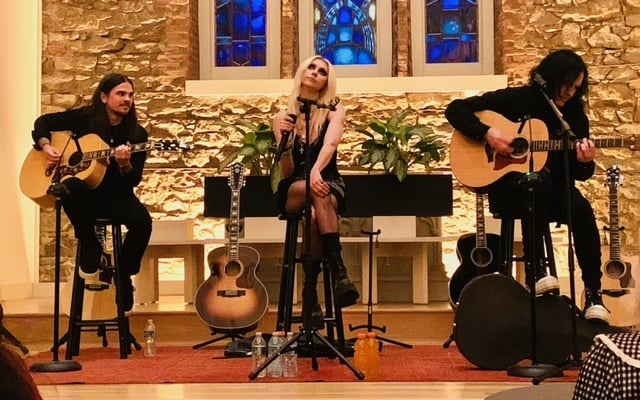
Everything had a band theme, from the “Dear God” photo area to the napkins and pizza boxes. There was even a confessional, which was so cool. As the new album streamed through the sound system beneath the gorgeous stained glass windows of the church, and we got ready for the band to grace us with an hour-long acoustic performance live from the altar, the thing that struck me wasn’t the free booze, food, or cool atmosphere. Instead, it was the sense of community that has been missing in our business.
Why These Moments Still Matter
A record release party. How long has it been? I attended them for Van Halen, Lenny Kravitz, and tons of other artists during my career over the years. It was great to hang with friends, celebrate a killer new release, and feel that sense of rock music community once again. The band hung out, too, and the atmosphere was pure rock and roll. While the programming and on-air attendee crowd may have been thinner than it was years ago, it still mattered.
When you’re a music brand, these events matter. Artists matter. Passion for the medium matters. Huge thanks to Taylor Momsen, Ben Phillips, Jamie Perkins, and Mark Damon.
Sitting at a table in a church while The Pretty Reckless “took it to church” in performance at the altar was the perfect way to spend a Thursday night. With the constant doom-scrolling of terrible news, these are the experiences that still make the music industry a community, not just a cost-cutting enterprise. For a few hours, everything felt right.
Looking for a killer new release to rock out to? The rock record of the summer has arrived. Download or grab Dear God.
Photos and a performance of “For I Am Death” from the event are below: For I Am Death
Barrett Media produces daily content on the music, news, and sports media industries. Sign up for our newsletters to stay updated and get the latest information right in your inbox.
The last two weeks at KXnO have been simply devastating. The Des Moines sports radio outlet was virtually wiped out as every local show and nearly every talent who comprised the station fell victim to the latest round of layoffs by iHeartMedia. All but one.
Like many smaller markets, KXnO featured talent who bought airtime. Trent Condon fit that model, hosting Miller & Condon in the midday slot from noon to 2 p.m. alongside Ken Miller, the longtime pioneer of sports talk radio in Des Moines.
The afternoon following the layoffs at KXnO, Condon remained. As an independent contractor, his agreement with iHeartMedia Des Moines was centered more on sales than employment. As news of the cuts spread across the Iowa capital, Condon faced a choice. One many talents around the country have unfortunately confronted in the hours, days, and now weeks following another round of layoffs. It’s a choice that occurs far too often in the industry.
To comment or not to comment.
A Difficult Decision
Condon chose to open his program by addressing the massive number of people who were no longer part of the station. Morning drive was gone. Afternoon drive was no longer local. The program director, who had just been promoted last June, was also out. Once again, listeners were left searching for the local voices they connected with each day to discuss their favorite teams.
While Condon wasn’t an official iHeartMedia employee, he considered everyone cut by the company a teammate. He had been part of the station for seven years and had seen reductions in force affect the brand before. He also watched several employees return after public pressure from listeners and clients alike.
This time, lightning wasn’t striking twice. This time, KXnO was cut, and likely for good.
So instead of ignoring the moment or briefly acknowledging the layoffs before moving on, Condon leaned into it. He shared his emotions openly. Honest. Authentic. And yes, somewhat willing to hold the company he worked with accountable.
He spoke about how his heart ached for his friends, teammates, and colleagues. For the listeners, he honored those who lost their jobs by recognizing the work they had done for the audience. No matter your team allegiances, Condon celebrated the people who gave a voice to sports fans throughout the Des Moines community.
It was an amazing, honest, heartfelt tribute to everyone who served the KXnO audience. Days later, Condon also found himself out at KXnO after iHeartMedia reportedly considered his commentary “controversial.”
Over The Line Authenticity?
It’s not an easy line to walk for any talent facing the circumstances Condon encountered. Everyone around him was gone. People who dedicated their time, and cared deeply about the product. I’d be willing to be they also likely took on additional responsibilities without additional compensation. I’ve worked alongside those types of people, and they are by far the absolute best of the industry. Compensation isn’t always the most important thing when your passion is radio. Radio, of any kind, is a public service that entertains, informs, and occasionally provides a laugh along the way.
Now, was there likely language in Condon’s agreement that he violated with his commentary? Probably. However, was the situation Condon found himself in any fault of his own? Did he bear the responsibility of once again being the good soldier, a role he had likely played several times throughout his career?
Condon made his choice and has now paid the ultimate price.
Sports radio is built on the connection between the talent and the listener. That trust is earned through the authenticity of the host. Every survey says it. Every programmer stresses it. Executives across the country sell it. Podcasting built an entire business model around it. Meanwhile, audiences continue to lose trust in media because they believe there isn’t enough authenticity.
Sometimes talent have to be the voice of the listening audience. Sometimes circumstances demand it more than others. And sometimes taking a shot to the chin is warranted. While Condon’s commentary was deemed “controversial” and ultimately cost him his job, how can you not view his comments as doing the job to the highest standard?
The Warning Sign For Talent
Condon’s story serves as a reminder that authenticity in sports radio now comes with a price tag many hosts never had to consider before. The industry has spent decades telling talent to be genuine, build trust, and create authentic relationships with listeners. Yet when those same qualities extend beyond sports and into the realities of the business itself, they can suddenly be viewed as liabilities instead of strengths.
Thank you for listening and showing that local sports talk matters. You can still hear me daily on @LockedOnIowa & have already had conversations with many outlets.
I'm here to listen to any and all ideas. As media evolves, I will evolve with it.
That doesn’t mean authenticity should disappear. It’s the very thing that separates great local hosts from replaceable voices.
But it also means talent today must recognize that every personal opinion, every emotional moment, and every decision to speak candidly about the companies they work for carries more professional risk than ever before.
Condon chose to stand with his colleagues and his audience, and he’ll live with the consequences of that decision. Whether you agree with what he said or not, his experience is another reminder that in today’s sports radio business, authenticity may still be part of the job, but understanding where that authenticity can lead has become just as important.
Barrett Media produces daily content on the music, news, and sports media industries.Sign upfor our newsletters to stay updated and get the latest information right in your inbox.
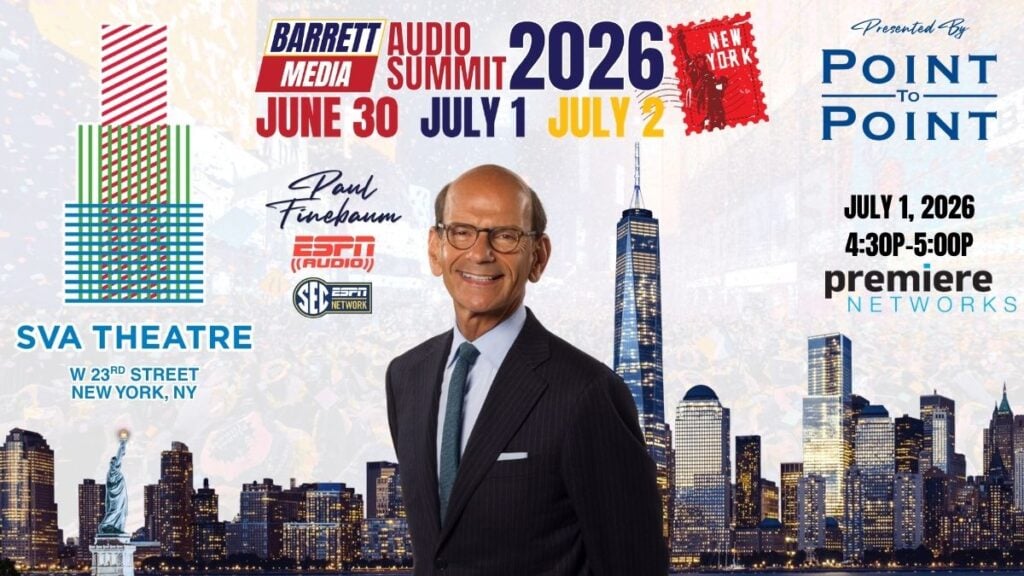
Few in sports media have achieved the arc of a career that ESPN’s Paul Finebaum has enjoyed. What began with award-winning work as a columnist and investigative reporter evolved into a career that, nearly 50 years later, continues to define him as “The Voice of the SEC.” Over that time, Finebaum has earned accolades in print, radio, and television. Because of his sustained success throughout his career, Barrett Media will recognize his impact later today at the Barrett Media Audio Summit when he becomes the fifth recipient of the Sports Media Lifetime Achievement Award.
“I was pretty overwhelmed and shocked when I heard I would be receiving this award,” said Finebaum, reflecting on when he learned the news. “You just don’t think about stuff like this. I was really touched by Jason [Barrett]’s appreciation of someone who has mostly been in a small market for the majority of my career.”
For more than 30 years, Finebaum has hosted The Paul Finebaum Show. From its humble beginnings on WAPI, the program’s popularity grew so much that it helped launch the Paul Finebaum Radio Network in 2001. In 2004, Sports Illustrated named the show one of the top 12 sports radio programs in the United States.
However, for Finebaum, radio and television were never the career destination he envisioned.
“This was not what I started out doing. I was a newspaper writer, that’s all I ever wanted to do. All I wanted to do was be a writer and a sports columnist. I never once thought at some point I’ll do a talk show,” explained Finebaum. “I, somehow, have been able to survive and adapt. My career is full of different chapters. Every one of those chapters, I never really knew if I’d make it out of it.”
Unexpected Success At ESPN
Finebaum’s success eventually led him to ESPN when he signed with the network in 2013. He instantly became the featured attraction for the launch of the SEC Network a year later. His profile and radio program continued to grow during his time with ESPN. He is the longest-serving talent on the flagship Saturday morning program SEC Nation, all while continuing to serve his devoted radio audience.
Finebaum is a believer in the power of radio. He believes the uniqueness of the medium is something no television show can match, even as the industry continues to evolve and change with each passing day.
“It’s amazing to me how many people tell me they listen to me. It’s not that they watch me. That’s really special,” says Finebaum. “Radio is always a personal one-on-one relationship with someone. Television is completely different. I’m convinced most people that watch me on television have never heard me speak. Whereas with radio, you need to listen to me speak.”
When Finebaum arrived at ESPN in 2013, he admitted there were lingering doubts about how he would fit in. A brash, bold, and direct voice who had dominated attention throughout the south was now joining a national network with its own expectations and identity. Finebaum admits producers were skeptical that executives would give his radio program a chance with television viewers.
However, Finebaum believed in the people who gave him the opportunity in the first place and in the loyal audience with whom he had built a rapport over many years in Alabama.
“There was a great concern that the show wouldn’t make it [at ESPN]. The reason why there was concern was I didn’t understand television,” noted Finebaum. “But Scott Van Pelt pulled me aside one day and told me, ‘Don’t let them change you.’ He was a radio guy at the time. A lot of people told me to do my thing, and don’t worry about the cameras. Then after about a week, they [management] were telling me the complete opposite of what I had been told at first.”
Believing In The Audience
Over time, things fell into place for Finebaum. Despite concerns from some ESPN executives, his focus remained on serving the audience that had made the program successful. He admits the show he hosts today is not exactly the same as it once was, but it remains remarkably close to the product that first earned his audience’s loyalty.
“It’s still a close facsimile of what it used to be. That’s always been the tug of war. Fortunately, the bosses at ESPN have mostly stayed out of my way. They’ve let us do our thing,” said Finebaum. “At this point, whether they thought it would work or not. They’ve allowed it to work, and have been supportive of it.”
Finebaum considers himself “counter-industry” by nature. He has been critical of those he labels as “suits,” but he also admits he has received plenty of support from many of those same executives. When he entered sports radio, it wasn’t about driving revenue or understanding the business side of the industry.
He is also self-aware enough to know he doesn’t fit many of the stereotypes associated with sports radio. He never yells or screams at callers. Instead, Finebaum’s approach centers on the message and how it is communicated. He welcomes the audience and gives callers the opportunity to participate and become part of the show as often as they like.
“I care about the audience. Some people say I have a bunch of crazy people that call my show. They don’t represent the masses. Well, I don’t know about that. All I know is for as long as we’ve done the show, the people I run into are interested in those people because they are represented,” explains Finebaum. “In some ways what we’ve done, we represent fans.”
A Political Decision
Over the past year, Finebaum found himself questioning that same representation, but in a different context. In August of last year, Finebaum was approached about an opportunity to serve the people of Alabama as a United States senator. With Sen. Tommy Tuberville, a former college football head coach, deciding to run for governor, the seat would become vacant.
Over the next three months, Finebaum weighed his options: continue his award-winning work with ESPN and The Paul Finebaum Show or leave it behind to pursue a career in politics.
“That was a tug of war. I’ve lived a long time, but it was the biggest challenge I’ve ever had professionally. I didn’t go looking for it, it came to me,” said Finebaum. “They told me they thought I could win. Then they told me not only do they think I could win, they know I could win. It’s tempting when someone tells you they have the money and the support to put behind you to be a United States Senator. It’s very tempting.”
However, the timing was difficult. As the college football season unfolded, Finebaum balanced the weekly grind of sports media with exploring a possible political future. During that process, he said many fans encouraged him not to run. He sought advice from his wife, who shared her thoughts about the risks that accompany a campaign for public office.
“Ultimately, the reason I couldn’t do it is because that’s not me. I can’t get up there and mimic a talking point that I don’t believe and I believe to be patiently false. That’s exactly what you have to do. I spent enough time around the political advisors telling me what I have to say. What I can’t say and how many times I have to say this and that. Win or lose, and I do believe we would have won. I would have sold my soul and given up something I worked hard to ascertain for what,” explained Finebaum about the decision to not run for the Senate.
Because of everything he experienced during that three-month process, Finebaum has closed the door on a future political career.
“There was a time in this country when it really would have been enjoyable. You could be collegial and work with others across the aisle. But today, the stuff that is said every single day is insane. That’s not right or left, it’s both,” notes Finebaum. “After you go through this, you realize how bad it is. I still feel I could add something to society, but it won’t be as an elected official.”
An Honor Well Deserved
Now 70 years old, Finebaum remains at the top of his profession. With another college football season approaching, he looks forward to reflecting on his achievements as he accepts the award later today. He admits that weighing a potential career in politics has also helped him think about retirement. While he feels as energized as ever by the work he continues to produce, Finebaum is also realistic about the challenges that come with age.
For someone who has spent decades asking questions, challenging conventional wisdom, and giving college football fans a place to be heard, the Sports Media Lifetime Achievement Award represents more than a celebration of longevity. It recognizes a career built on authenticity.
Photo Credit: Canva, ESPN Press Room
Finebaum never set out to become one of the most recognizable voices in sports media. He wanted to write. Radio happened almost by accident. Television followed. Along the way, he transformed a regional call-in show into a national institution without abandoning the qualities that made it successful in the first place.
Politics would have required him to become someone else. Sports media never has.
As another college football season approaches, the voice that has become synonymous with the SEC isn’t ready to leave the conversation. And for the countless fans who have spent decades listening on their radios, watching on television, or waiting to hear his next opinion, that may be the greatest reward of all.
Barrett Media produces daily content on the music, news, and sports media industries. Sign up for our newsletters to stay updated and get the latest information right in your inbox.
News/talk radio has always prided itself on being the format that moves fast. Breaking news, hot takes, callers lighting up the phone lines within minutes of a big story — speed is supposed to be the format’s calling card. So it’s more than a little ironic that when it comes to digital, this format has been one of the slowest to catch up.
Walk through the rosters of major news/talk brands across the country and you’ll find a startling number that still don’t have a real YouTube strategy. Plenty of shows don’t post on-demand audio in any meaningful way, leaving listeners who miss a segment with nowhere to go. And clipping content for YouTube Shorts, Instagram Reels, or TikTok? For too many stations, that’s still treated as a nice-to-have rather than a necessity.
Those days need to be in the past. Like, two years ago. Not today, and certainly not next quarter. The audience has already moved, and the format needs to catch up before it’s left talking to an empty room.
What Fred Jacobs Showed Us
During his session at the 2026 Barrett Media Audio Summit on Tuesday, Jacobs Media’s Fred Jacobs delivered an outstanding presentation, and he shared a data point that should open the eyes of every news/talk program director and brand manager in America.
Among those surveyed by Jacobs Media, 81% said Bluetooth was an important feature for any new car purchase. Meanwhile, 79% said the same about FM radio, and only 40% felt that way about AM radio.
Sit with that for a second. People care more about Bluetooth than they do about FM radio. And they care about Bluetooth more than twice as much as they do about AM.
If you want to live in denial, you could argue consumers just want Bluetooth to take phone calls in the car. But do you honestly believe those same people aren’t streaming their own music, firing up Apple Podcasts, or running apps through their car speakers instead?
If so, I’ve got a bridge to sell you.
The Boat Already Left the Dock
The shift to digital isn’t some looming threat anymore — it already happened, and a lot of the format missed the boat. Now stations need to swim to catch up. Getting in the water late still beats standing on the dock, watching the boat sail off, and muttering, “Man, that sure sucks.”
So what does catching up actually look like? Start with your app. Whether it’s a standalone station app or a company-wide platform through Audacy or iHeart, it needs to be fast, intuitive, and genuinely useful, not an afterthought bolted onto a website. Next, get cameras in the studio. Video doesn’t need to be fancy, but it needs to exist, and it needs to be clipped consistently for social platforms where younger and more casual listeners actually spend their time.
From there, prioritize getting full shows, interviews, and bonus content onto Apple Podcasts and Spotify immediately, not whenever someone gets around to it. On-demand audio shouldn’t be an afterthought; it should be as automatic as flipping on the mic. Additionally, every host and program director should treat their digital footprint with the same urgency they’d give a ratings book.
None of this means abandoning AM/FM. Terrestrial radio still reaches massive audiences, and it remains the format’s backbone. However, it can no longer be the entire strategy. Listeners expect to find their favorite hosts wherever they happen to be scrolling, streaming, or driving, and stations that ignore that reality are quietly ceding ground to competitors who don’t.
The format has the talent, the storytelling, and the built-in trust to thrive across every platform. What it hasn’t always had is the urgency to match. That urgency needs to start now, because the digital realm isn’t a side project anymore. You can’t survive on AM/FM radio alone, and if you’re not adapting, you’re losing. Losers don’t prosper.
Barrett Media produces daily content on the music, news, and sports media industries.Sign upfor our newsletters to stay updated and get the latest information right in your inbox.
Coleman Insights and Greater Public are teaming up on a new research study. It focuses on the state of underwriting in public radio.
What We Know: The two organizations will debut The State of Public Radio Underwriting at the Public Media Growth Conference in Chicago, July 8-10. Coleman Insights will recruit participants at Booth 22. After the event, researchers will conduct one-on-one online interviews with underwriting and sponsorship professionals nationwide. Findings will be released exclusively through a fall webinar.
What’s at Stake: Public radio underwriting revenue faces mounting pressure from shifting advertiser expectations and growing competition. Digital sponsorship opportunities are expanding, but stations aren’t always equipped to capitalize. Team structure, training gaps, and measurement challenges compound the problem. Without better data, stations risk leaving significant revenue on the table.
What Remains Unclear: The study hasn’t launched yet, so specific findings aren’t available. It’s also unclear how many stations will participate or how broadly the results will apply. Whether smaller markets will be proportionally represented remains an open question.
What It Means: This research arrives at a critical moment for public media sustainability. Coleman Insights President Warren Kurtzman says the underwriting environment is evolving quickly. Stations need practical, research-backed strategies to strengthen revenue performance. This study could provide exactly that kind of roadmap.
Barrett Media produces daily content on the music, news, and sports media industries.Sign upfor our newsletters to stay updated and get the latest information right in your inbox.